
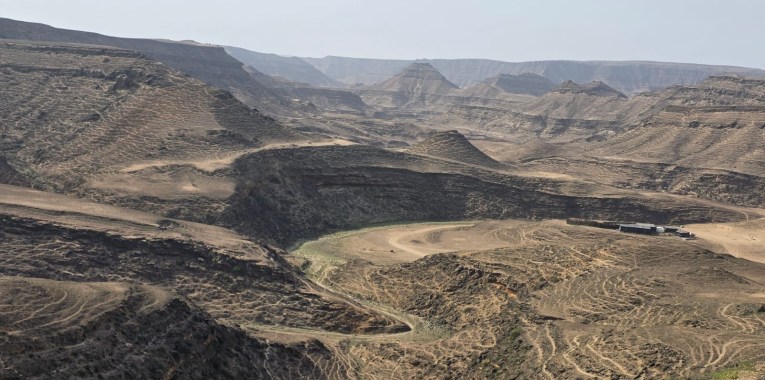
(photo by M. A. Al Awaid)
Even after two years in the States, I have a lot of ‘muscle memory’ from living in Oman. I still dislike shaking hands and I can’t seem to stop offering people bottles of water. If you show up at my office, I am going to ask if you would like some water. And I feel it keenly that the hot water situation is not figured out sufficiently for me to ask if you would like tea.
One of the many, many wonderful aspects of living in Oman was the constant offering of tea. Many people know this as a kind of joke or marketing ploy but I loved it. When going rug shopping, of course a cup of hot sweet tea makes the bargaining more fun, more like a social interaction. I had lovely conversations drinking tea with the men who worked at my favorite rug shop next to Muttrah Souq.
However, now when I ask people if they want water, I usually get a ‘deer in headlights’ look and a quick refusal. Americans don’t have time, but also I sometimes feel that there is a layer of ‘I don’t want to be indebted.’ If you give me something, what might I have to do in the future?
The people who usually accept are my favorite Americans: blue collar workers. If I am struggling with an armful of papers, it is most often the person in work boots who will open the door, make a joke, hold the elevator or give me a quick smile of understanding. Even before I moved to Oman, I felt an affinity for these people who move, in a fashion, through tribal patterns.
To me “tribal patterns” means an understanding that none of us have everything we need to make it through the day, so what you have at hand to offer other people, you offer. And what you need, you ask for (implicitly or explicitly). Between neighbors in Oman, there is no counting, e.g., “I received this so I must give that is return.” In some cases I know, the neighbors with less financial security received food almost every day and never reciprocated. Some men never brought food to picnic dinners and this was never mentioned – everyone was glad they came, showing up with or without some snacks made no difference.
Often I have found that blue-collar workers in the Boston area live within the same framework. I feel like there are invisible webs of connections with me handing out bottles of water to carpenters, construction workers, movers and delivery people and me getting repaid by different sets of carpenters, construction workers, movers and delivery people holding doors open for me.
I recently attended a lecture by a scholar who, in the midst of a larger discussion, pointed out the problems inherent in “tribalism,” which they defined loosely as groups who unthinkingly follow a particular creed. After the talk, I wrote an e-mail to the scholar, saying:
I am sure you have debated this endlessly, but I do want to make a pointed objection to the use of “tribes” as negative given that I have studied tribes on the Arabian Peninsula for over 15 years.
The answer was rather like the Grinch patting Cindy-Lou Who on the head. The scholar stated that while tribalism “is a problem, but there is nothing wrong with being a member of a tribe.”
Further, they wrote, “in the broader sense of the word, as I use it, we are all members of tribes. In any case, I hope it was clear that I do not use the term pejoratively.”
You can’t claim “this is what I want the word to mean” while ignoring how it is used in everyday life. As an academic in a position of power, you should define your terms carefully and be sure to acknowledge the background, main-stream usage, other points of view and mis-use of your terms.
“Tribe” has been used for centuries to not only describe but dismiss/ disrespect groups of non-Western peoples as being part of “non-evolved” cultures. Tribalism/ tribal/ tribe are used almost exclusively as negative terms within the USA/ EU/ UK. If someone has a “tribe-mentality” the connotation is that they cannot think objectively or rationally. It is not a word that can be pulled out from its cluster of negative connotations when referring to human behavior.
[And it is worth thinking about how the negative connotation of tribal = sheep-like behavior is transmuted to positive when it is used as an adjective for a purchasable item, e.g. tribal jewelry.]
A further part of the scholar’s answer was: “I would say that tribalism is a human universal, present to varying degrees in all cultures and built into the way humans think and feel, but not insurmountable.”
“Not insurmountable”? Insurmounting tribes is an objective only if you are thinking of “tribal” as negative, e.g. backwards, hide-bound and incapable of independent thought.
Obviously, that’s not how I think of tribes, either in the established sense (e.g., tribes in Dhofare) or the more casual sense (e.g., construction workers in Cambridge). I think of tribes as groups of people who support each other and, to come back to the point about offering bottles of water, do not shy away from interdependency.
Predator Anthropologists, Anthropologist Predators: Anthropological Metaphors in Popular Movies
Reflections on Ethnographic Research: (Not) Asking Questions


You must be logged in to post a comment.