
“The Arabic Alphabet” website (written by Michael Beard, illustrated by Houman Mortazavi) – http://alifbatourguide.com/
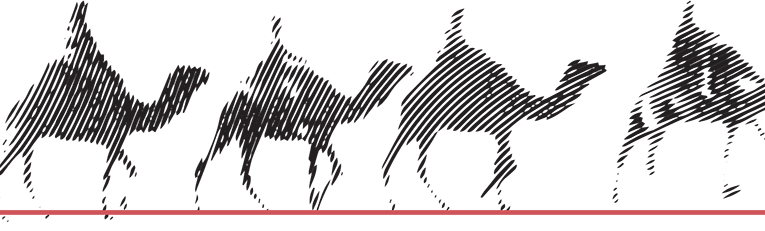
Kâf is for Karavan – https://alifbatourguide.com/the-arabic-alphabet/kaf/
excerpt
âf’s Phoenician predecessor, also a K sound, was Kaph, one of the letters whose name has a meaning: the hollow of the hand, the palm. The word (kaff) survived in Arabic and the usual companion languages. In Persian poetry a glass of wine is traditionally held in the kaff. The constellation we know as Andromeda was once called in Arabic The Hand decorated with Henna, Al-Kaff al-khad͎îb, الکفّ الخضیب. (Khad͎ab is one of two words for henna, the other being the more recognizable h͎innâ’.) A kaffa is the pan of a scale or balance. The dual form of the word, kiffatân, is our constellation Libra.
A kalb is a dog; Al-kalb al-asghar is Canis Minor. (Canis major is Al-Kalb al-akbar.) The constellation we call (misleadingly) Crater (Latin for bowl or cup) is Al-Ka’s, the bowl or goblet. The etymological origin of Kochab, the second brightest star in the Little Dipper (Ursa Minor), is contested, but if it’s an unimaginative origin (always a possibility), it may come from kawkab. (A kawkab is a star.)
Kâf is pronounced like our K, and it has a shape which seems to show a distant family relation to it. The straight line of ک , rising slightly rightward from the top of the upright, called in Arabic the ra’s (head), in Persian the sarkesh (the line “pulled” – keshideh – upward), looks familiar to us. (It gives us two thirds of our three-stroke letter K.) Looking at the various shapes it takes in Nabataean, I’m puzzled how it gets there.
That nearly horizontal extension, the line that gives it its personality, rising at various possible angles, is present when ک appears at the beginning of a word, or the middle. One is taught to draw the upright, its mast, as a simple, erect vertical line, but in practice the upright is more frequently folded down to the left, or even bent over horizontal, parallel to the base line, as if it were the first step in making a paper clip. If it’s followed by an upright (Alif or Lam), it may be a complete circle.
At the end of a word, Arabic Kâf loses the horizontal, the sa’r, and becomes ك , something like backwards L, simply an upright rising from a slightly curved extension with a long foot running along the base line. Then you add a little mark like a miniature 2 (which resembles a Hamza), floating above the base. Persian script is different. Its terminal Kâf loses the little Hamza shape and retains the spar. The Persian adaptation is said to have a practical use—to distinguish Kâf (ك ) from Lam (ل) when writing rapidly. In both cases terminal Kâf sits solidly on the line.
Arabic Kâf (like Fâ) can have a meaning on its own: as a one-letter word in Arabic, attached to its neighbor like a prefix, it means “like” or “as.” It’s also popular as a suffix. At the end of an Arabic word it marks the second person possessive: –k is “your” (-kum in the plural). Thus Salâm ‘alayk or Salâm ‘alaykum. Kâfplays an even more nearly ubiquitous role in Turkish in the infinitive suffix (ending in –mek or –mak). In Persian, –ak is a diminutive suffix, as in cheshmak, چشمک, a wink (from cheshm, “eye) or bâdbâdak, بادبادک, a kite (from bâd, “wind”).
Kâf words in Persian often suggest the tiny and cute: kudak, کودک an infant, kuchek, کوچک, small, and kuchelu, کوچولو, smaller still. Kam, کم, is “a little,” or “not enough.” But Kâf is also for kabîr, “great,” which we are likely to know from the comparative form, akbar (as in Al-kalb al-Akbar). The comparative also has a feminine form, kubrâ’, which to English ears seems a little startling when we hear it as a woman’s name.




You must be logged in to post a comment.