Even after two years in the States, I have a lot of ‘muscle memory’ from living in Oman. I still dislike shaking hands and I can’t seem to stop offering people bottles of water. If you show up at my office, I am going to ask if you would like some water. And I feel it keenly that the hot water situation is not figured out sufficiently for me to ask if you would like tea.
One of the many, many wonderful aspects of living in Oman was the constant offering of tea. Many people know this as a kind of joke or marketing ploy but I loved it. When going rug shopping, of course a cup of hot sweet tea makes the bargaining more fun, more like a social interaction. I had lovely conversations drinking tea with the men who worked at my favorite rug shop next to Muttrah Souq.
However, now when I ask people if they want water, I usually get a ‘deer in headlights’ look and a quick refusal. Americans don’t have time, but also I sometimes feel that there is a layer of ‘I don’t want to be indebted.’ If you give me something, what might I have to do in the future?
The people who usually accept are my favorite Americans: blue collar workers. If I am struggling with an armful of papers, it is most often the person in work boots who will open the door, make a joke, hold the elevator or give me a quick smile of understanding. Even before I moved to Oman, I felt an affinity for these people who move, in a fashion, through tribal patterns.
To me “tribal patterns” means an understanding that none of us have everything we need to make it through the day, so what you have at hand to offer other people, you offer. And what you need, you ask for (implicitly or explicitly). Between neighbors in Oman, there is no counting, e.g., “I received this so I must give that is return.” In some cases I know, the neighbors with less financial security received food almost every day and never reciprocated. Some men never brought food to picnic dinners and this was never mentioned – everyone was glad they came, showing up with or without some snacks made no difference.
Often I have found that blue-collar workers in the Boston area live within the same framework. I feel like there are invisible webs of connections with me handing out bottles of water to carpenters, construction workers, movers and delivery people and me getting repaid by different sets of carpenters, construction workers, movers and delivery people holding doors open for me.
I recently attended a lecture by a scholar who, in the midst of a larger discussion, pointed out the problems inherent in “tribalism,” which they defined loosely as groups who unthinkingly follow a particular creed. After the talk, I wrote an e-mail to the scholar, saying:
I am sure you have debated this endlessly, but I do want to make a pointed objection to the use of “tribes” as negative given that I have studied tribes on the Arabian Peninsula for over 15 years.
The answer was rather like the Grinch patting Cindy-Lou Who on the head. The scholar stated that while tribalism “is a problem, but there is nothing wrong with being a member of a tribe.”
Further, they wrote, “in the broader sense of the word, as I use it, we are all members of tribes. In any case, I hope it was clear that I do not use the term pejoratively.”
You can’t claim “this is what I want the word to mean” while ignoring how it is used in everyday life. As an academic in a position of power, you should define your terms carefully and be sure to acknowledge the background, main-stream usage, other points of view and mis-use of your terms.
“Tribe” has been used for centuries to not only describe but dismiss/ disrespect groups of non-Western peoples as being part of “non-evolved” cultures. Tribalism/ tribal/ tribe are used almost exclusively as negative terms within the USA/ EU/ UK. If someone has a “tribe-mentality” the connotation is that they cannot think objectively or rationally. It is not a word that can be pulled out from its cluster of negative connotations when referring to human behavior.
[And it is worth thinking about how the negative connotation of tribal = sheep-like behavior is transmuted to positive when it is used as an adjective for a purchasable item, e.g. tribal jewelry.]
A further part of the scholar’s answer was: “I would say that tribalism is a human universal, present to varying degrees in all cultures and built into the way humans think and feel, but not insurmountable.”
“Not insurmountable”? Insurmounting tribes is an objective only if you are thinking of “tribal” as negative, e.g. backwards, hide-bound and incapable of independent thought.
Obviously, that’s not how I think of tribes, either in the established sense (e.g., tribes in Dhofare) or the more casual sense (e.g., construction workers in Cambridge). I think of tribes as groups of people who support each other and, to come back to the point about offering bottles of water, do not shy away from interdependency.
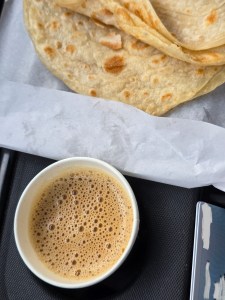
A friend sent me the photo above and I got teary-eyed. I drank so many cups of that kind of tea, ate so many of that kind of parathas, sitting in a car in the parking lot of some small road-side cafe or driving along, looking at the beautiful scenery.
That kind of snack meant I was in the middle of a marvelous adventure – driving across the barren desert plain, going through the mountains or along a winding road next to the sea.
Even a luke-warm, uninspiring, tiny cup of tea in a plastic cup is magical in the right circumstances and there are few things more delicious than a freshly-made, hot-off-the-stove paratha.
There is another wonderful aspect of having a meal in Dhofar: the omnipresent generosity. Whatever food anyone had, it is shared. All meals are eaten communally and there is no policing of who ate what.
I miss Oman every day and I hope for peace for every Omani.
I am happy to announce that I will be talking about ‘Omani Rituals, Feast and Fasts’ on July 14th for the ‘World on a Plate’ class at University of Mary Washington.
When the publisher of my forthcoming book about marriage in Dhofar, Oman asked for a short article about my book to put on their webpage, I didn’t know what to write [ blog.anthempress.com/2026/04/17/marriage-and-peace/ ]. In literature, marriage is the ending for comedies, but the Arabian Peninsula and Arabian/ Persian Gulf are now enveloped in tragedies. It feels wrong to be writing about joy in the midst of such grief. But perhaps that is the point: hoping for the return of joy by remembering and explaining that joy when everything is bleak, like Samwise talking about the Shire when he and Frodo are on Mount Doom.
As I was writing the book, I focused on trying to accurately describe the information I knew connected to marriages of Dhofari Omanis and the stories I heard. It was only later I realized that, in focusing on being exact, I didn’t talk about how wonderful it is to attend women’s wedding parties.
An ethnographer is supposed to participate, understand, record, interpret and, if need be, replicate. Maybe there is fun along the way, but I don’t remember reading in any of the anthropology texts about the Arabian Peninsula: I had such a blast at the party, I want to go one every week!*
But I told the research guys that, for me, a perfect month meant two weekends camping, one weekend at home and one weekend with a woman’s wedding party. They rolled their eyes. The research guys are always glad when a brother, cousin, friend or colleague is getting married, but their wedding parties are not very relaxing. First of all, men usually need to give money, which means budgeting finds to make sure there is enough to give (see Risse 2015). Women only give gifts to very close female friends and relatives. If a woman does not work, other women will pay her share.
Second, Dhofari men have wider circles of acquaintances whose wedding they need to attend. Men are usually expected to appear at the wedding of all cousins (which can be mean 50 or more people), aunts and uncles (who might be younger than him), neighbors and friends. Both brothers and sisters gather to figure out who will go to which wedding parties on any given weekend but men often end up with 5 to 15 parties on one weekend, while women will attend one. For example, if a set of brothers and sisters have 6 close relatives who will marry in one weekend, all brothers usually go to all 6 male wedding parties and each sister would go to one of the brides’ parties. The brothers figure out the order in which they will visit the parties; the sisters will divide the parties between them.
If a man works in an office with ten men, he will often go to the party if any of the men, or their sons, marry. If a Dhofari woman works with ten other women, they will often be a party in the office (sometimes subsidized by the company or each women bringing one item), but not the expectation that all women will attend each other’s weddings.
Men only need to stay at the party for 15-30 minutes, but given that the events might be in 4 different towns, they can spend from 9am until 2pm on a Saturday driving and visiting. Plus the ‘system’ of every party is the same so there is almost no variation. Every man is in a clean dishdash; there is tea and coffee to drink, rice and meat to eat.
Also men need to make sure they comport themselves carefully when they are in public: recognizing and greeting each other, appearing serious, speaking well and listening to elders. A wedding party can be a chance to catch-up and chat, but there are so many people around, it’s not wise to have private conversations. I always think of men at gatherings as being at ‘parade rest’ in that men are never really relaxed. A good man in public is always looking about him, noticing who is there, who is talking to who, etc. Only with their own group, men he has known for years if not decades, can men let down their guard.
But Dhofari female wedding parties are fun. If it is at the bride’s house, there are plenty of women to share the work. I have gone to several in which I was invited by a sister of the bride, who was busy ten minutes an hour or so; the rest of the time she chatted with me or greeted other guests.
All women walk around and greet all the other women when they arrive, so you know who is there and it’s fine to ask someone as you shake their hand, “who are you?” or introduce yourself. Everyone is happy, chatting and (oh so important!) wearing what they want. Some women go all out with the make-up, jewelry, fabulous up-do and a dress that reflects hours of work getting the right fabric, the right design and the right trim. Or you can show up in a cotton dhobe (loose housedress) and a bare face. Sisters of the bride and groom and a woman who was recently married often need to be in fancy clothes, but there is lee-way for a woman who doesn’t want to have an elaborate presentation.
So you show up in a long, loose dress; get warmly greeted; choose what to drink from trays of coffee, tea and juice that are offered; and sit surrounded by girls and women in colorful dresses. There’s lots of perfumes, lots of finger-food, dancing and plenty of time to chat, but you can also pull out your phone and tune out for awhile. What’s not to love? (Well maybe if you are allergic to perfumes…)
The first one wedding I attended was a little awkward. I didn’t know the bride that well and I was with several other ex-pats; none of us knew what to do. And I left one wedding party early because the person who invited me wasn’t there and women were unfriendly. But the other 17 parties were wonderful.
I have many happy memories of chatting with good friends and laughing with new acquaintances. I was always asked if I was married and sometimes when I said no, women would offer to marry me to their husband. So we would run with that joke for a hour, me asking how much money I would get as dowery, if I would get my own house, etc. or we would talk about where I worked, or they would explain who all the other women were. It was all relaxed and, as one friend said, “no protocols.” If you needed to leave early, you left. If you didn’t want to eat, as long as you had a token amount of food on a plate in front on you, you could avoid pressure from your hostess.
Sitting in a bright pink velvet dress festooned with rhinestones, which had been sprayed with glitter perfume, an armful of colored bangles and bare feet, I was as happy as a clam. I don’t think I will ever have an occasion in the States to wear that many sparkles.
At picnics with the research guys, I was in drab-colored loose pants and long tunic, no make-up and no perfume but the feeling was similar. For the people in the hakli (also referred to as qara) groups of tribes I do research with, communal events means people working to create a positive atmosphere. The goal is always no drama. If you have a bad day or are in the middle of a personal tragedy, you do your best not to show it.
I have written about how this emphasis on staying positive is sometimes not seen as work by non-Omanis, but if you have ever had to attend a celebration in the midst of a personal struggle, you know how difficult it is. I joke that there is no TMI or over-share in Dhofar as the people I know keep their emotions in check. My male and female friends are in their 30s, 40s and 50s so self-control is of paramount importance.
Risse, M. “Generosity, Gift-giving and Gift-avoiding in Southern Oman,” Proceedings of the Seminar for Arabian Studies 45 (Oxford: Archeopress) 2015: 289-296.
* Some of the accounts about Yemen had a little of that attitude, especially about qat chews but there was always a need for justification. Qat fields take up water that could be used for growing food and fodder and explaining that sitting around and chatting for many hours every day is a necessary part of life can mean sidestepping the issue of what structures and supports are in place that allow for certain groups to spend every afternoon and evening relaxing.
The monsoon season (finally) started yesterday so, in celebration, I went for the first time to a small, cute shop which sells food made by a local woman. I had driven by and seen it but never gone in. With the drizzle coming down at a steady pace, I decided to have a small party, support women who are selling food, and, of course, continue my food research!
As I viewed the sandwiches, cooked food and cakes on display, I discussed the food in a mixture of Arabic and English with the expat man who was working. “Is this strawberry cake?” I asked, pointing to a cake with a pink layer of what looked like jam. He said yes. I repeated the question in Arabic to make sure, then moved on, “Is this cake with coffee flavor? Is this chicken? Is the chicken spicy or normal?” etc. I bought a selection of things, went home and produced them for my guests: this is non-spicy chicken, this is strawberry cake, this is coffee cake.
Wrong. All of it wrong. The chicken was fiery hot, it wasn’t strawberry and the brown cake was ‘Lotus’ flavored, not coffee. Sigh. Last week it was at KFC, I ordered 4 chicken strips and Dew with ice; I got someone else’s order and was told that the Dew, which had no ice, has “ice inside.” Sigh. In these kinds of example, it’s a mixture of linguistics and culture. I would not think of a ‘biscuit-flavored cake’; a white cake with medium brown frosting looks like ‘coffee’ to me. ‘Ice’ to me is cubes the size of cherry tomatoes, not that the soda is cold.
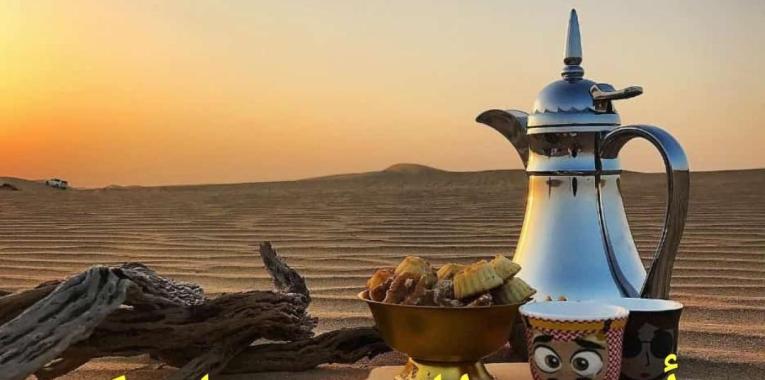
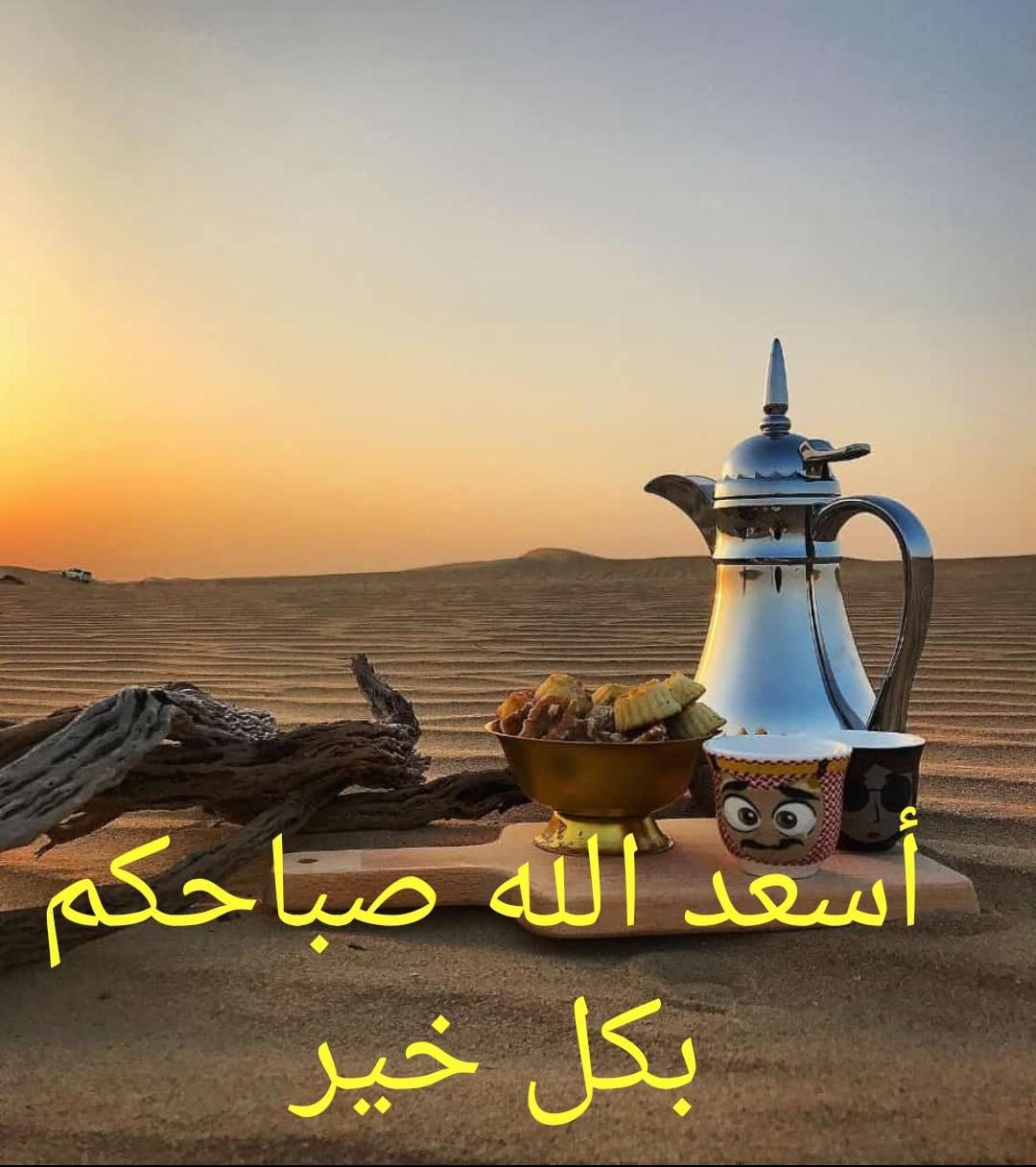
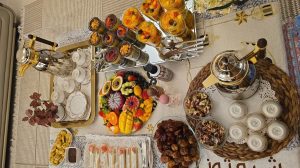
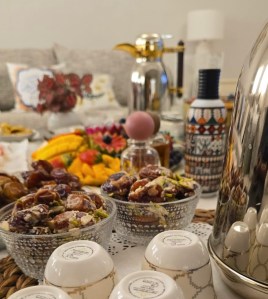
Sometimes it is an issue of what you ask for is not what you get but sometimes it’s a visual and cultural problem, as in the photo above – I enlarged that photo several times, tilting my head, thinking “WHAT is that in the little bowl?” Finally I decided it was walnuts and date maamoul (dates with spices cooked into a paste, surrounded by a heavy sugar cookie dough and baked). I don’t think of walnuts as breakfast food so I had to wait until my eyes could “see” them. Several times I have seen shallow bowls of dates and assumed it was pieces of meat and vice versa. One trick I learned is that if there is a coffee dallah (traditional Arabian coffee pot) it is dates; if there are cups of tea, it is probably meat. [Or in the above photo, the piece of wood doesn’t look like what I expect ‘camp fire wood’ to look like: it’s dark, full of holes, almost insubstantial looking. But from camping in the desert, I know this is typical of wood you can find or buy and it serves as a marker, “we are very far from town.”]
There is another level of difficulties: seeing various food items and not understanding how they fit together. A friend remembers being in a grocery store with me when we were in grad school. As we came around the corner of an aisle and the end cap had: cans of tuna, cans of peas, cans of sliced mushrooms, egg noodles, salt and canned cream of mushroom soup. I looked at her and said how this combination of food was a culturally-bound signifier of middle-class American in middle America, an implied recipe without stated recipe. Everyone who saw that display would know that all these items should be bought and cooked together to create a tuna casserole. But someone from outside that culture would see a collection of disparate items. Such as the photo below: chips, processed cheese and bread. This might be read as “put cheese on bread and eat with chips.” But Omanis know, you open the bag a little then crush the chips. Put cheese on bread, sprinkle on chip fragments and then roll up into a tube.
Eating begins with the eyes and everyone sees food through their cultures, upbringing and experiences. Learning to see again, see new, and re-see is a long process that I am still in the middle of.
I will be leading a book discussion at the Boston Athenaeum: Two Views of Corfu, April 25 at 10 am
Join us for a discussion of two very different books which feature the same landscape and main characters. Most people know only one of the Durrell brothers, but each one has his own brilliance. Lawrence writes about the historical and literary landscape in an artistic and serious manner, while Gerald focuses on the local wildlife, a group which includes his older siblings. The juxtapositions between what each one thinks is important and noteworthy makes reading the books in tandem a delight. Gerald doesn’t deign to mention his brother’s wife; Lawrence ignores the fauna. Gerald has nothing to say about Greek myths; Lawrence pretends he is not with his family. Read one book or both and join a short visit to the gorgeous Greek island of Corfu. If the conversation leads to a wider discussion of Lawrence’s fiction (The Alexandria Quartet), Gerald’s impressive improvements in how zoos are designed and the Boston area’s best Greek restaurants, all the better.
Lawrence Durrell – known for fiction: Alexandria Quartet (Justine, Balthazar, Mountolive, Clea) and The Avignon Quintet(Monsieur, Livia, Constance, Sebastian, Quinx)
light humor: The Best of Antrobus, Esprit de Corps
travel writing: Prospero’s Cell (Corfu), Reflections on a Marine Venus (Rhodes), Bitter Lemons (Cyprus), Spirit of Place (collection of travel writing)
children’s fiction: White Eagles Over Serbia
biography: Larry: A New Biography of Lawrence Durrell, 1912-1945; Lawrence Durrell: A Biography by Ian S. MacNiven
if you like his fiction, maybe try: The English Patient
if you like his light humor, maybe try: Hotel Splendide, La Bonne Table, Bemelmans
if you like his travel writing, maybe try: Provence, F. M. Ford; The Station, Robert Bryon
Gerald Durrell – known for autobiographical books set on Corfu in his childhood: My Family and Other Animals, Birds, Beasts and Relatives; The Garden of the Gods
animal collecting/ creating a zoo: Three Singles to Adventure.A Zoo in my Luggage, The Bafut Beagles, The Whispering Land, The Aye-Aye and I, Menagerie Manor
animal/ nature conservation: The Ark’s Anniversary, Amateur Naturalist
children’s fiction: Rosy Is My Relative
autobiography: Myself and Other Animals
biography: Gerald Durrell: The Authorized Biography by Douglas Botting
Several people have asked me, “Aren’t you glad you aren’t in Oman right now?” Actually, no. I wish I was there, but I have aged out of work visas and can’t afford one of the housing units that comes with a residence visa. I do not support this war and I think America should stop bombing Iran. It must be terrifying for the people who are staying and all the photos of expats leaving the Arabian Peninsula make me reflect on how difficult it was to leave Oman, even with plenty of notice and in peacetime.
In remembrance of happier times, this is an essay I wrote in 2017. May peace come soon to all troubled lands.
“I’ve never such a beautiful ocean” – tourist
“Holy sweet Jesus he’s got no clue” – local
“Public Relations” lyrics from the musical Don’t Stop the Carnival
Tourists burble. Tourists gush. If I hear a woman is raving about how “the food is so natural and healthy!” you can be sure that she’s got a plane ticket back to the Land of Whole Foods and Mexican restaurants within a week or two. It’s amusing to watch a man coo about how relaxing life is here, all the while checking his Blackberry and reading e-mail on his laptop at one of the two cafes in town with wi-fi.
Expats don’t coo. Expats don’t prattle. The people who live here, we send SMSs: “Flaxseed oil in at the pharmacy,” “Sandstorm coming – batten down hatches,” “Did you hear X is in the hospital?” and “Do you know a good carpenter?”
I call an expat friend and ask, “What’s the name of the place you hang your clothes?”
He starts throwing off fancy French furniture terms: armoire…
“No, no,” I say, “What’s the simple word. I forgot it.”
Pause.
“You mean ‘closet’?”
“Yes!” We say goodbye and hang up the phone.
A woman who came to town for an extended visit mentioned to me that she had a rental car. I told her to be careful; any problem that happened to the car while she had it was her responsibility.
She said, “I didn’t sign a contract.”
I said, “It doesn’t matter, the understanding here is, unless you go to Budget which is twice as expensive as normal rentals and has insurance, that any problem is your fault and you pay for the repair, as well as the regular daily charge.”
She said, “But I didn’t agree to that and I didn’t sign a contract.”
Expats do not say “I didn’t sign a contract.” They would laugh and tell you about the rental car in Uruguay, which would segue into a story about Nepal, and then into that fabulous B& B in Dorset. Expats know that this is not a theme park full of natural and healthy food, beautiful scenery and exotic folkways. It is a working community. You either stay cut-off by cycling between your job, the two expat grocery stores and the big hotels or you become part of it – whether you agree or not. Expats are normal people who have evolved and devolved into a new species.
Expat – Definition
The first part of my definition of living expat is that it’s voluntary: moving to another country by choice to study, work, retire, create art etc. I am talking about a narrow band of middle-class experiences – not forced immigration or those ‘on the wind’ fleeing war, disease and/ or poverty. I made the decision to live on the Arabian Peninsula.
The second part is that I live middle-class. I live alone (not in a camp or apartment with co-workers), I can move about when and how I choose (not being driven in a bus), I have two days off every week (not only an afternoon or no free-time at all). On the other hand, I know nothing of upper class life beyond what I read in Town and Country. My car is 8 years old and has over 300,000 km; I worry about retirement. I don’t think I am ever going to have a set of Ghurka luggage or diamond stud earrings, much less one of those really gorgeous Persian rugs.
My third point is that it’s living expat. I have traveled to 38 countries but have lived overseas only 4 times. “Living” I define as having an address where mail is delivered, having a bank account in a local bank, and having a set of places to go to – your café, your beach, your tailors, your schwarma stand.
The fourth part of “living expat” is what does “expat” convey? Mawuna Remarque Koutonin’s article [https://www.theguardian.com/global-development-professionals-network/2015/mar/13/white-people-expats-immigrants-migration%5D discusses how “expat” is a racially charged term. I can’t speak for other areas of the world, but I’ve lived in the Middle East for 14 years and on the Arabian Peninsula, “expat” it is an indicator of economic status not country of origin. Here, “expat” means people who have a position which allows them to sponsor bringing over a spouse and/or kids and people who are free to move about as they please outside of work hours. To talk about one group, people put qualifiers in front, such as Arab expats, Indian expats, Western expats. “Expats” is used as opposed to “workers,” almost always men, who live in single-sex compounds whose movements are more closely controlled.
I have never heard of anyone referred to as a “guest” and “guest-worker” is not a configuration used here. I have only heard “foreigner” used by Gulf Arabs referring to non-Muslims. My personal pet peeve is people who call themselves “nomads;” just as bad are businesses which cater to this nonsense: “tools for nomads” with $600 backpacks. Do you carry all your worldly possessions yourself or with a pack animal? Are you without bank account and/ or property? Do you sleep in structures you erected yourself? Do you roam around a wide geographical area without changing continents? No? Then you aren’t a nomad.
Expat Talking
There are many positives of living expat. When British Airways lost my luggage, I had to make a list of the items lost: handmade slippers from Muscat; shoes from Edinburgh; shoes from Leiden; dress from Victoria, BC; skirt from my tailors; shirts from Boston and San Francisco; jean jacket from Denver; Swiss cosmetics; earrings from Maine. Reassembling that small suitcase would take thousands of dollars’ worth of airplane tickets as I pick up clothes as I travel to see family and friends and for conferences.
This is normal for people who live middle-class expat but can be really annoying for those who don’t. We are used to have objects and experiences from a myriad of places and with other expats, ordinary conversations can quickly turn insufferable for normal people: the waterfalls in Vancouver airport vs. the mini-tropical forest in Bali’s airport, Taba in Egypt vs. Aqaba in Jordan, foot massages in Phuket vs. head massages in Delhi, Rhodes vs. Crete, water-taxis from the airport in the Maldives vs. water-taxis in Dubai, island hopping in the Seychelles vs. island-hopping in the Caribbean, Malta vs. Corsica, the Khan el Khalili in Cairo vs. the Blue Souq in Sharjah, Stockholm vs. Amsterdam, Doha airport vs. Chicago airport, throwbacks to crossing into Turkish Cyprus vs. crossing into East Germany. As I said, it gets old fast for people who have built their lives in one or only a few communities.
Every expat has had the experience of being asked “What’s it like” as if one can sum up living in a country for a year in two sentences. And then there are people at home who never even ask that, who avoid any mention of the life overseas.
Expats learn to keep quiet about their lives and open up only with other expats with whom they can trade experiences and opinions freely: making fun of Jumeirah Janes, debating the best college to stay at during the summer in Cambridge, complaining about being woken up by the sound of kookaburras in Brisbane and loons on a Wisconsin lake, comparing Swiss Christmas markets vs. southern German Christmas markets. Expats who have lived in the toughest conditions are usually the nicest. People who lived in Cairo and Dubai are never as friendly or helpful as those who lived in Afghanistan and Papua New Guinea where cooperation meant survival.
Expat Travel
Baltimore, Lisbon, Mousehole, Heidelberg, Petra, Charlotte Amalie, Santa Fe, Al Mukulla: expats get to used to the chance for travel during vacations and the perks of travel seem so obvious, it’s useless to complain about the times I have walked off a plane after a 10+ hour flight trying to remember what country I was in, looking at the signs at passport control trying to remember which line to stand in, all the methods of coping with jet-lags, the stupid mistakes done under the blight of jet lag, and most importantly, the sense that you can never have all the things you like together.
It is useless to grumble but inside most expats’ hearts there is a wish for impossible meals and events: Dutch pancakes with American coffee, an English pub lunch with waiters who come to the table, Bangkok with the air quality of Edinburgh, Winnipeg’s summers with Puerto Rico’s winters, Dubai shopping but with taxi drivers who speak English; bookstores in Oxford that stay open later than 6pm; Tartine pastries at the Hong Kong airport.
An expat’s life is always a mosaic, never a unified whole. My favorite way to travel is the 8-seater plane from Logan to visit my mom, the train from Sydney to Melbourne, a sailboat in the Strait of Juan de Fuca, and the DC metro. My favorite stores are Ragamuffin on the Isle of Sky, the main Jim Thompson store in Bangkok, gold stores on the Ponte Vecchio, and M & S. My favorite hotels are the Charles Hotel in Cambridge, MA and the Peninsula in Bangkok but my favorite places to eat are the Palm Court at the Balmoral Hotel in Edinburgh, the Windmill café in Kingston, Ontario, pretty much any restaurant in Rome and the Lime Tree Café in Jumeriah. I want to walk off my favorite beach in the BVI, have a ‘rice table’ in the Netherlands for dinner then fall asleep to the blinking of Grand Forks, ND fireflies.
Expat Decor
I always think that a person’s home should be like a 3D collection of Girl Scout badges; it should reflect who you are and where you have been. Living middle-class expat means that it’s easy to collect pieces from all over. In my living room I have a sofa I bought in Bali, a chair from India that I got in the Emirates, and an Egyptian rosewood chest. The three pieces are nice, but don’t really coordinate with each other or my dark wood IKEA desk or my dark wood book cabinet which had a glass front section resting on top of a (non-coordinating) set of cupboards. That’s one of drawbacks: you pick up pieces as you go along, and you simply have to tell your furniture to get along with each other because it’s almost impossible to get things to match.
Another characteristic of expat living is that pieces usually develop narratives. I have a dish a friend brought me from her trip to Iran; one rug is from the store run by two Iranian brothers at Mutrah souq. There are very few things that I have bought anonymously, so to speak, at a store which I can’t remember. When I go to a friend’s house and admire something its: “I picked that up in a little village in Cambodia when I worked there” or “Got that in Siberia.”
Every piece has a story. The rug I bargained for with a friend standing by amazed at my ability to spin tales about the poverty of teachers to lower the price. The coffee table was bought at X store on Y street with my friend Pat pretending to be my husband and saying I was spending too much money in an effort to get the price down (that trick worked). Even my computer has a story of the how I got it and what happened when it broke down (four hours of sitting in the store reading a novel because I was not leaving until it worked).
Even as a single woman, there’s not much shopping I do on my own – there is often an Omani or western friend to give advice, and I willingly go on shopping expeditions in turn. When I walk thought my apartment I see the pieces connected to my friends Marlene, Tom, Rosemary, Samantha, Barbara, Sophie, Margie, Sanda, and Helen, all of whom have since left town but whose memories remain.
Another effect of living expat is that decorating is usually very personal – you often incorporate other people’s lives and they incorporate yours. In my sitting room, my sofas are from a dear friend who was selling them when she left Salalah. Given how much turnover there is, if you see something you like that a friend has, if they leave you have a chance to get it in a way that would seem predatory in the States. Several times I have had the unsettling experience of walking through a good friend’s house and deciding which of their pieces to buy.
On the other hand, when I want to get rid of something, it doesn’t go out anonymously on the street to be picked up or to someplace like Salvation Army. I give it to the woman who cleans my house. In the Middle East, almost all middle-class households have maids, who either live-in or have keys and come to clean a few times a week. Mine has worked for me for almost ten years and, like most expats, I give her her salary, bonus twice a year and whatever I no longer need.
My old sofa, coffee table, pillows, even shoes and purses are set in a pile for her and she takes everything. I wonder if they are all in her house or if they are handed on to her friends. That angst of “I can’t get rid of it because it still has some use in it” doesn’t exist here – if I don’t need something, don’t like it anymore or have bought a replacement, I can pass it on knowing it will be used. I see it as a ladder: an Omani friend gave me a gorgeous wooden bookshelf; I give the woman who cleans for me my old fridge.
Expat Fitting In
As you live expat, and start to understand the culture, the prevailing wisdom is that you should try to fit in. I agree with this most of the time, but there are also times when I think deliberate dissonance is helpful. Sometimes speaking, dressing and acting in ways that mark you as a foreigner can create a more positive interaction, especially in dealing with Arabian cultures in which people usually dislike being surprised.
I learned this point when I went to two social events with a non-Omani Muslim woman (I’ll call her Muna). We were both wearing the right kind of clothes for the event but Muna greeted each Omani guest in the correct way but I said, “salam aleikum” – the wrong thing to say. This greeting should be said by a person who comes into the room, but I was sitting down. It is such a blatant mistake, each woman who was greeting me paused for a moment, looked at me carefully, then carried on with greeting the other attendees, often gesturing towards me and asking other women, “Who is she?”
My incorrect greeting immediately signaled that I was foreign and the women could immediately adjust their expectations and assumptions about me. Older women did not wonder why I don’t stand up and kiss them on the head, etc. There was a momentary flutter, but I was quickly forgotten.
On the other hand, several women tried to speak to Muna after she gave the correct greeting. Then Muna would explain she didn’t understand Arabic, which would cause surprise and begin a several minutes conversation about how the woman THOUGHT Muna was Arabic-speaking, but she wasn’t and where was Muna from and why was she at the event and wasn’t it a surprise! Several Omani would say they thought Muna was from X country, Muna would explain she was from Y country, the women would say “Oh you look like you are from X,” Muna would affirm that she was from Y, the women would ask “Is your mother from X?” Muna would answer no; her mother was also from Y. This happened several times and after her country of origin was cleared up, there was no more conversation.
What happened with me was opposite. The women sitting near me would usually ignore me for an hour or so, then ask me a question or two (how long had I lived in town, was I married, did I have children, was I Muslim etc.) which would slowly grow into a longer conversation. After two or so hours, all the women around me would have talked to me. As I was sitting quietly, smiling at the children, accepting tea, looking as benign as possible, the women would socialize with each other, occasionally glancing at me, then slowly one or two would start the process of figuring out who I was and passing that information around.
I had given them space and time to adjust to me and I happily answered all their questions with answers that made sense: I am a teacher, I have learned Arabic from my students, I am a friend of the groom’s sister, etc. There was always a sense of wonder – this American Christian sitting amongst us! – but I made no sudden moves, gave ready and plain answers, smiled at children and (with honesty) professed myself delighted with the house, food, tea, party and the company. Slow, easy and steady but always marked as different and foreign.
This insight was found by chance (the first time I did this, I really didn’t know the right thing to say) but I realized that, on the Arabian Peninsula, the more you speak and act correctly, the more it is believed you know all the culture’s rules. In my experience it is far better to start off with an obvious stumble and rehabilitate yourself later than to start strong only to fall off. Set the bar low, make it clear you don’t have all the necessary cultural knowledge and mistakes are forgiven or at least not coded as deliberate rudeness.
Expat Friends
Expats friends can sometimes turn to gold. When I met The Divine Ms. S., I felt like I was reunited with my birth sister. Just as my idea of ‘plot’ is add another shark attack, my idea of decorating is throw a few more rhinestones on. She had a living room with floor to ceiling red velvet curtains on all the walls and a four-foot mirrored snarling jaguar statue. Truly a woman after my own taste.
Living overseas in a small community everyone knows each other – most people live next to or near people they work with; you see all the same people at the same (few) restaurants and shops. You can’t move unobserved. You and your car are known entities and, maliciously or not, information is passed around. If you go to Lulu’s you either see someone you know or someone was driving by and saw your car, or someone saw you take the Lulu’s bags out of your car.
You learn not to lie, but to preserve some sense of privacy, to be circumspect. You seldom use names in conversation or discuss your specific plans. Everyone says, “Oh I am busy that night” or “Yes, I know that restaurant. I went there with a friend once.”
Once you become part of a circle, you have to take care of those people; you have to help. Like it or not you are in for giving rides to the airport, rides if their car went in for service, borrowing books, handing out whatever medicine you have, sharing the names of good dentists and plumbers. Unlike a small town in America, it is impossible to find basic information here. There is no Yellow Pages, much less store web-sites. The opening times change, stores close or move locations. You have to tell the newcomers the name of the good tailor and about the Japanese dollar store. The gardeners have to tell each other when a certain plant (mint, yellow hibiscus, almond trees, olive trees) is available at the nursery and when there is a delivery of clay pots. The person you told about the good new shawarma stand is the person who, tomorrow, will tell you about a good place to have curtains made. You have to walk people into stores and hand them over to your ‘cushion guy,’ your ‘frame guy,’ your ‘copy guy’ and your ‘coconut guy.’
You get to know what everyone in your groups likes to eat and drink. As I walk around the grocery store, I send off messages: “Hey, they have tortilla chips!” and “Hey, they have dried cherries.” I get calls now and then, “Hey, they have cranberry juice!” and “Candy canes are in.” When I leave town, I ask for requests. When my friends return from trips, I get goodies: Halloween candy, vitamins, clothes dye, doughnuts, curtain fabric.
Expats almost always develop a veneer; whoever you meet you can manage a pleasant conversation about something. You go to a party, end up sitting next to someone you didn’t know – you two look at each other and there is an almost palpable assessment, “Ok, let’s get on with it” and you make a go at figuring out something in common: How long have you been in town, where do you live, where do you work? You smile and wave when you see acquaintances, “How are you?!”
Nothing serious, no soul-baring, no sharing, no real talk, just simple chat, do you know where to get a good hair cut? Have you heard anything about the new Al Jazeera flights? A bit of complaining about the weather, a little discussion about what’s available at the grocery store, “Strawberries are in at Isteqrar!” and “I saw real Hershey’s chips at Al Haq.”
Expats know: you do what you can with what you have where you are.
Risse, M. “Living Expat.” Emanations: Chorus Pleiades. Carter Kaplan, ed. Brookline, MA: International Authors, 2018: 308-318.
I meant to publish this several days ago, but recent events have overtaken the usual quiet, home-based focus of Ramadan on the Arabian Peninsula. I know that many expats are currently trying to leave but I want to put this up as a reminder that, whatever else is happening, it is still Ramadan.
the section on how to behave respectfully during Ramadan from ‘Researching and Working on the Arabian Peninsula’ (2025)
Ask questions about Islam, but frame those questions respectfully. During Ramadan, one male student at the Arabic school where I studied ridiculed a female, Muslim student who was fasting, “She said she was fasting but then I saw her drinking water – she’s a liar!” The woman had her period, so she couldn’t fast but there was no way a woman would tell that to a new, male acquaintance. She was acting appropriately; women act in public as if they are fasting but eat/drink out of sight, then ‘make up’ those days at some point before the advent of the next Ramadan.
Before you leave, look up when Ramadan will fall; Freya Stark (1940) famously made the mistake of not checking before her difficult trip with Gertrude Caton-Thomas. Unless you are Muslim, male, and specifically doing research related to Ramadan/Islam, doing research during Ramadan will probably be difficult. Muslims will be concentrating on prayers and family. You might be invited for iftars (the meal to break the day’s fast) but there probably won’t be time/opportunity to have private conversations/ask questions.
In addition, it’s a good idea to pay more attention to your appearance and behavior. Ramadan is not just about fasting from food from sunrise to sunset; Muslims should also refrain from anything that pulls them away from spiritual reflection, for example being angry, lying, cheating, or listening to non-religious music. You should live in a way that allows everyone else to also concentrate on spiritual matters.
There might be specific laws in your location, but in general I suggest trying to blend in with your surroundings, be it a university, archive, or business. This often means dressing more modestly than usual, e.g., switching from short-sleeved to long-sleeved shirts with rolled up cuffs if you want, tea-length instead of knee-length skirts, less or no jewelry, make-up perfume, etc. Before the month starts, ask if there are changes people often make.
If you are not fasting, keep food and drink out of sight. Don’t leave your bottle of water clipped to the outside of a backpack, put it inside. Various people don’t fast for various reasons (such as being pregnant or ill), so it’s understood and accepted that people are going to eat, just do it behind a closed door or in a hidden corner. Some businesses will set aside a room for non-Muslim to eat meals in or employees will informally co-opt a room, so ask around. If you are in a new space or are the only person not-fasting, try stairwells. Usually there is an empty area at the top of the last flight of stairs.
Behavior in Ramadan relates to two concepts I will discuss further in the sections about tribes and clothes in Chapter 5. First, many cultures on the Arabian Peninsula are tribe-based, meaning it is expected that you will try to fit in to prevailing mores in the same way that people fit into tribal expectations. During the day in Ramadan I cover my hair and the most frequent comment I hear is, “Good, you are with the people.” The fact that I am attempting to blend is seen as positive; yet at the same time there is no expectation that I will adopt every behavior of a Muslim women.
During Ramadan I drink coffee, eat, and play music in my office but my door is always closed. When someone knocks, I drape my scarf over my head, cover my coffee cup with a Kleenex, turn off the music, then call out “Come in.” Everyone knows I am hiding my coffee while they wait outside my door, but in 19 years, no one has complained because I am making an effort to respect the rules and that is sufficient.
The second concept is that people who alter what they wear, what they say, how they act can be viewed with suspicion. Hence, decide if you are going to change anything and what you are going to change, then stick with it throughout the whole month. Dressing modestly one day and not modestly the next is often viewed as worse than dressing non-conservatively because the person is viewed as playing with/making fun of cultural norms. Several years ago, when I decided to wear a head-scarf during daylight hours in Ramadan, I knew that was an irrevocable decision and I have stuck with it. Ramadan creates a framework for my changes and gives a clear explanation of why I am behaving differently.
My last point is that modifying your clothing and behavior (not playing music during the day where people can hear it, not showing anger, not reacting to anger, etc.) helps you navigate smoothly. Yes, sometimes it’s hot to wear a headscarf and sometimes it’s awkward to get it correctly arranged. I hate walking out of the house without lipstick and perfume. On the other hand, these adjustments mean a month without women shooting me angry glances, men acting as if I don’t exist (cutting in front of me in line), clerks pretending that they don’t see me and government officials refusing to help me. When I tell a male student to stop yelling in the hallways, he is not going to backtalk me.
Sometimes other expats show frustration with me and ask “Why are you making your life difficult?” I see my actions in terms of helping to create a peaceful atmosphere. I know it’s silly that I carry my coffee cup at my side or behind my back when I walk to rinse it out in a sink. I know the sight of my coffee cup will not ruin someone’s day, but why should I flaunt the fact that I am drinking? It doesn’t hurt me to be discreet.
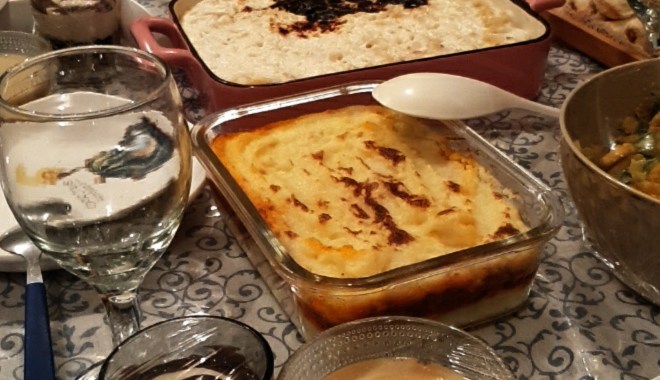
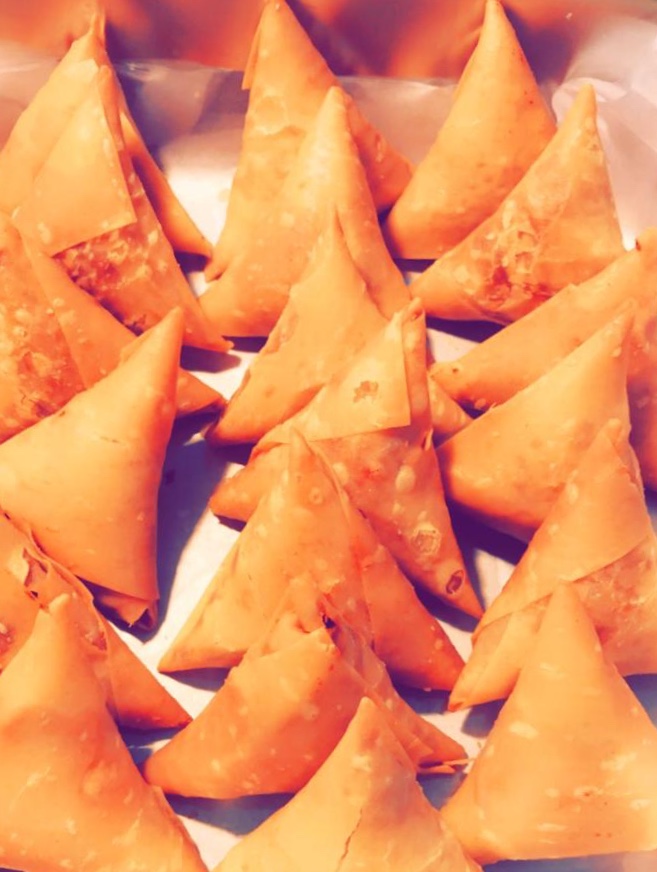
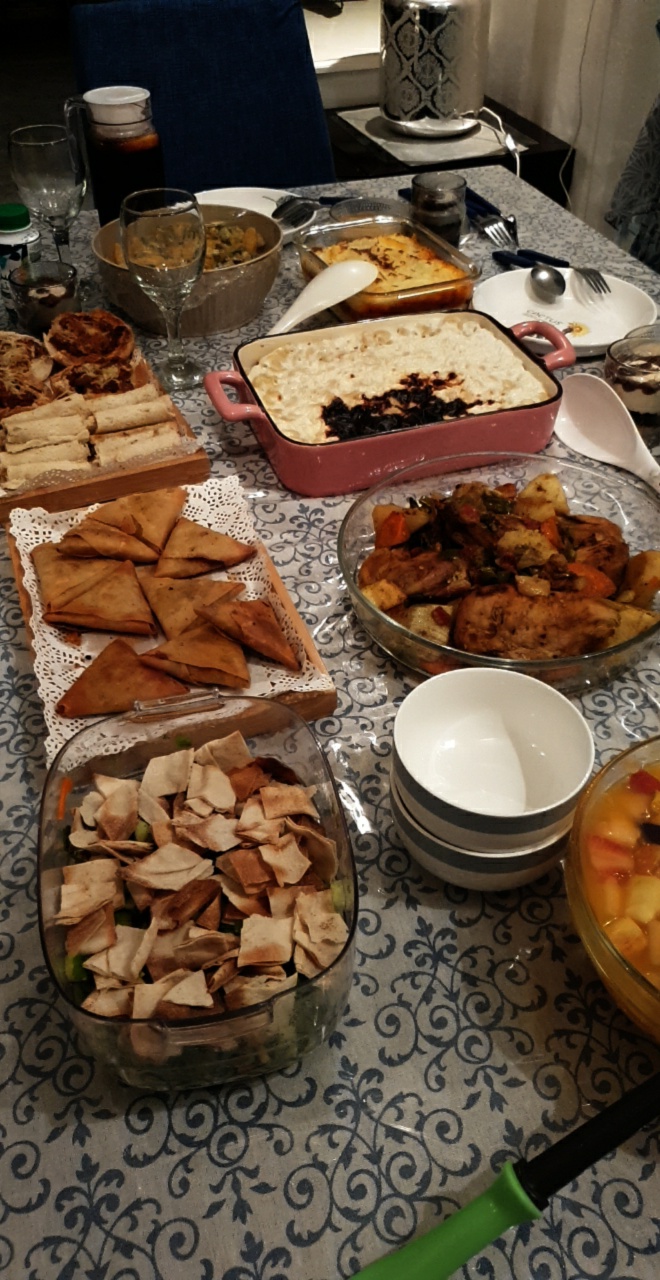
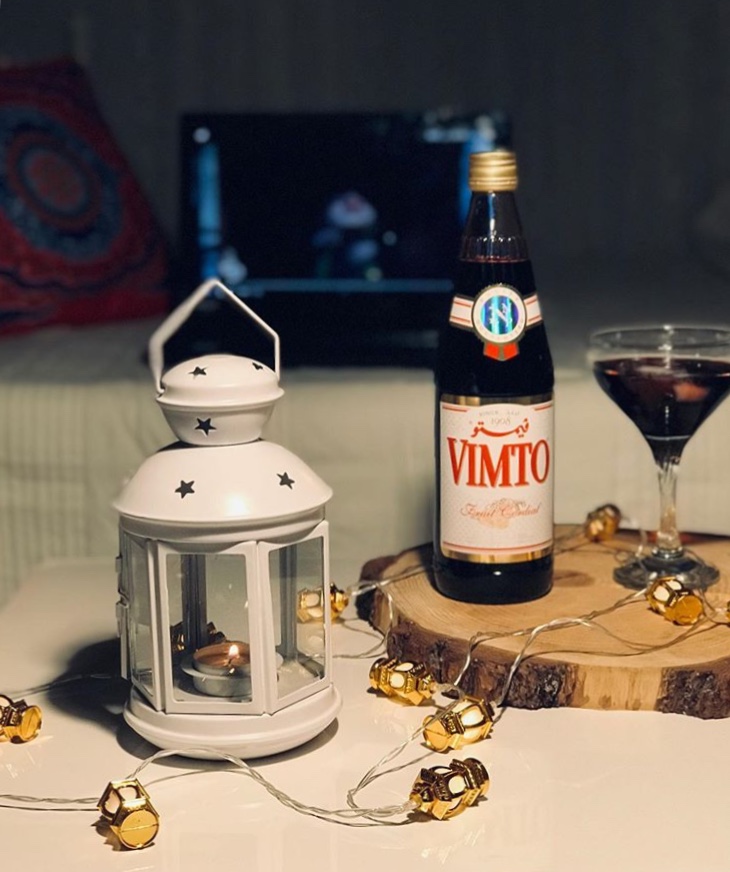
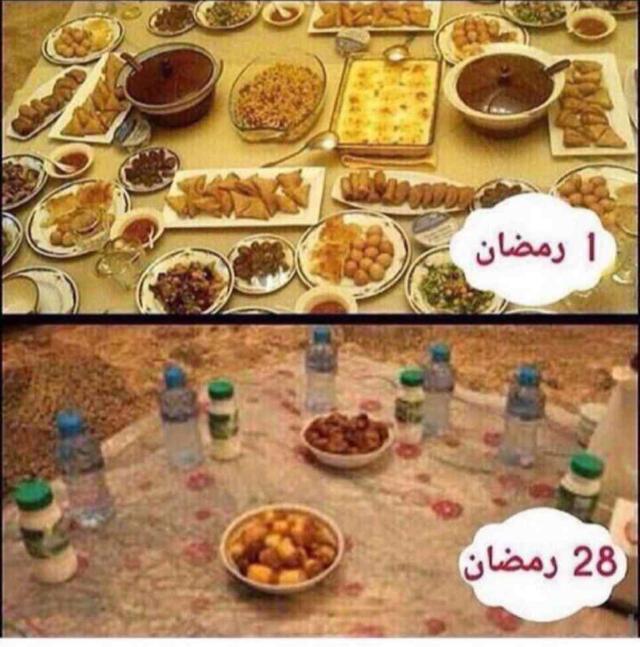
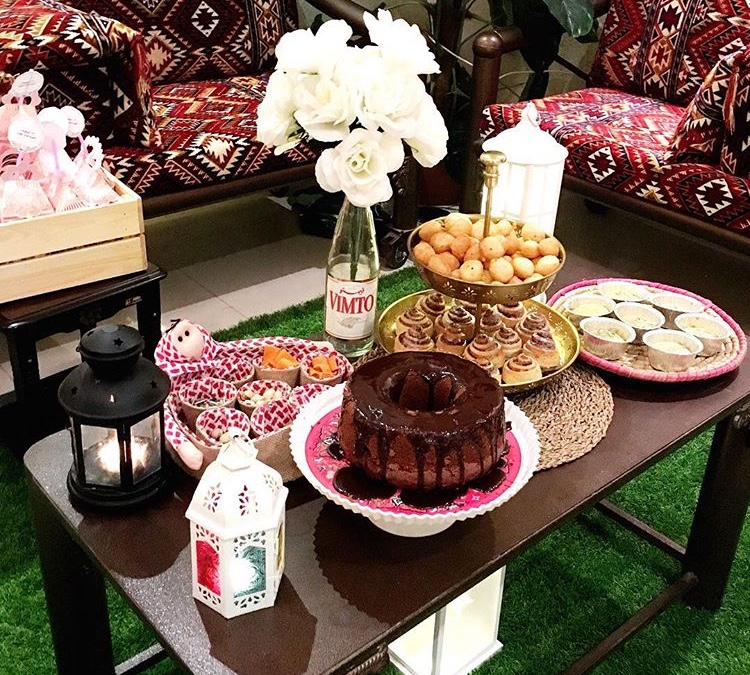
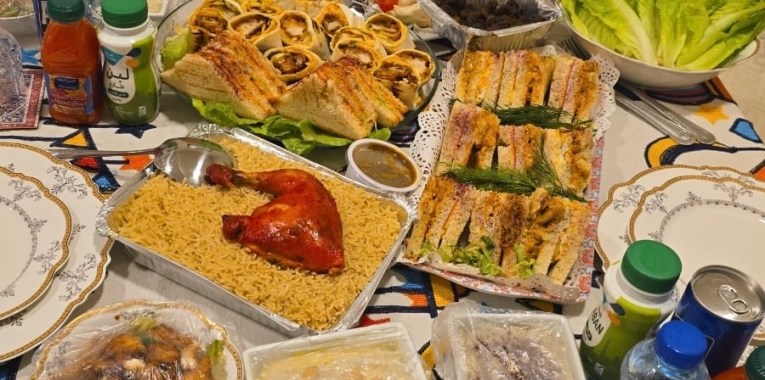
I love the Dhfoari tradition of “killing the snake” (hunger) by inviting close friends to a pre-Ramadan gathering with a beautiful and delicious array of food.



















You must be logged in to post a comment.