New essay: “Ṣâd is for Zero” on the Arabic alphabet website

The Arabic Alphabet: A Guided Tour – http://alifbatourguide.com/

by Michael Beard, illustrated by Houman Mortazavi

“Ṣâd is for Zero” – http://alifbatourguide.com/the-arabic-alphabet/sad/

excerpt:

The shape of Ṣâd shares something with the letters of the Roman alphabet: the appearance of weight, the feeling that it stands, or reclines, rather than floats. Granted, that cushion shape doesn’t look particularly heavy or solid. In fact it looks a little squishy, rounded on the right, flattened down to a point on the left, but it’s wide and substantive enough to have some substance, to function as a base or stand.

The sound in Arabic is not quite that of Sîn. The term for the sound of Ṣâd is S “velarized.” It has to do with the position of the tongue. It feels more emphatic. Non-native speakers of Arabic who don’t always hear the distinction may try focusing instead on the vowel sound which follows it, particularly if the vowel is an A. After Ṣâd, that A is lengthened a little. In other words, ص is pronounced something more like the S in English “sod” than the S in “sad.”) A cunning student might learn to approximate it by lengthening that A before learning how to pronounce the consonant. Textbooks may not say this, but non-native speakers of Arabic who don’t differentiate Sîn from Ṣâd will still be understood. They’ll have a speech impediment, but there are worse obstacles.

In fact your listener may prefer you to have the accent. There is a funny and profound essay by Abdelfattah Kilito in which he confesses to discovering an anxiety in himself: “One day I realized that I dislike having foreigners speak my language…” and adds that the anxiety increases with the fluency of the non-native speaker. “What if this stranger speaks exactly, and expresses himself as clearly as we do?… This person who came from a faraway place causes confusion, not only because he undermines our sense of superiority but also because he suddenly robs us of our language, the principle of our existence, what we consider to be our identity, our refuge, ourselves.” He gives the example of a meeting with an American woman who spoke Moroccan Arabic like a native. He is surprised at his own reaction: “for the first time I felt that my language is slipping away from me, or rather that the American woman had robbed me of it” (Kilito, Thou Shalt not Speak my Language, 87, 91). Perhaps it’s a little like the paradox of animation technology: we admire the skill that makes the image on the screen look real, as it imitates the world outside more and more accurately, but there’s a point beyond which, if the images become too realistic, they start to look a little creepy. I’m not saying you shouldn’t try.

New essay: “Shin is for Saracen” on the Arabic alphabet website

New essay: “Sîn is for Zenith” on the Arabic alphabet website

New essay: ‘Zhe is for Bijan’ on the Arabic alphabet website
New essay: “Za” on the Arabic Alphabet website

New essay: “Ra” on The Arabic Alphabet website

Teaching Literature and Staying au courantThe Man from Nowhere and the Ancient Greeks

There is a profound joy in introducing students to classic texts. I am very grateful that I have spent so much of my working life among the splendors of ancient Greek plays, Romantic Era poets, Jane Austen and Oscar Wilde.

And I am happy that as I teach I have gotten better at choosing classics which speak to my students, from 20th century writers such as Tawfiq al-Hakim to more modern writers such as Mohammed Al Murr and Badriyah al Bashar. And it’s fun help them get over the newness of Moushegh Ishkhan, Oriah Mountain Dreamer, Ryszard Krynicki, T’ao Yuan Ming, Tomas Tranströmer and Wisława Szymborska.

When I start the poetry class, I know that there is at least one student will be blown away by the Cold Mountain poems, Basho, Mary Oliver, Naomi Shihab Nye or Fowziyah Abu-Khalid. Someone will fall in love with  “Embroidered Memory” by Lorene Zarou-Zouzounis; someone else will champion “About Mount Uludag” by Nazim Hikmet.

It’s a delight to read familiar lines and see how students relate to familiar characters. Who is going to defend Ismene this semester? Who will argue on Creon’s behalf? Who is going to laugh when Patty in Quality Street talks about her hopefulness?  If we read Rebecca West’s The Return of the Soldier, who will my students pick as the one who deserves Chris – Kitty, Margaret or Jenny?

At the same time, it is good for me to be in the position of not knowing, to remember how it feels to be confused by a text. I became a better teacher after I spent two summers studying Arabic in Muscat. Sitting in a classroom as a student, panicking when a teacher asked me a question I did not understand, studying for a test and waiting anxiously for my grade made me more understanding of my own students.

So I try to seek out new texts to read and, perhaps, use for teaching. I scan shelves in bookstores and ask friends for suggestions. Since I don’t know Spanish writers, I asked a friend who has expertise and, following her suggestions, found “Marta Alvarado, History Professor” by Marjorie Agosín and “New Clothes” by Julia Alvarez, as well as “Tula” and “Turtle Came to See Me” by Margarita Engle.

Over the past few years, I have realized that I few students are into K-pop (BTS! Blackpink! Twice! NCT!) and so I decided to dip a toe into that cultural tradition.

The easiest way to start was movies so I duly looked at “top 10 Korean movie” lists and rented The Man from Nowhere (2010). One review mentioned that it was similar to Léon: The Professional (1994) in that it involved a young girl who is taken in and protected by a hired assassin. I thought knowing the plot would help me but there were a lot of differences, making the movie both interesting and confusing. For example, the ending surprised me. At the end of Léon, the girl is re-enrolled at her boarding school and she finally plants the small tree that she has been carrying around with her, symbolizing that she is now rooted.

At the end of The Man from Nowhere, the anti-hero asks the police for one favor and he brings the young girl he has been trying to protect back to her old neighborhood, goes into a small convenience store and buys her some composition books, writing supplies and a back-pack. Then he asks her if she will be ok. She nods, they hug and then he turns to go back into the police car.

I stared at the screen in astonishment. “That’s the end?!?” I wondered. Her father left long ago, her mother died at the start of the film, the girl was kidnapped and brutally treated for weeks, and now, with a few stationary supplies, the girl is now alone and supposed to take care of herself?

Over the next few weeks, I watched a few more and was astounded by whole new levels of plotting. It often feels like I am watching several movies at one: Assassination (2015) has freedoms fighters betrayed by team members (shades of Guns of Navarone), funny but doomed killers (shades of Butch Cassidy and the Sundance Kid) and twin sisters on opposite sides of an immense cultural, educational and temperamental divide (a grown-up, super spy equivalent of the Parent Trap).

I am often bewildered as I try out comedies, historical fiction and modern thrillers such as The Good, the Bad, the Weird (2008), Masquerade (2012), The Villainess (2017) and War of the Arrows (2011).

It takes a lot of concentration to understand each movie, not because of the sub-titles but the  work of trying to create new templates and figure out new tropes. How can I visually tell the difference between good guys and bad guys? Is the behavior of this woman showing that she is good or bad? Does this style of house indicate that the owners are rich, poor, old-fashioned or trend-setters? Is the meal the characters being served haute cuisine or everyday fare? Is this behavior normal or odd?

Sometimes it is good to be lost.

I am happy to announce that I will be presenting “Bringing Language Teaching into Literature Classrooms”

l will be presenting “Bringing Language Teaching into Literature Classrooms” at the English Scholars Beyond Borders – Dhofar University International Conference. Dec. 4-5, 2021.

My presentation will argue that in non-Anglospheric institutions such as Dhofar University, literature teachers will always need to be language and culture teachers. Given that many students on the Arabian Peninsula will use English when traveling or teaching primary or secondary students, texts must be chosen for their linguistic and cultural, as well as literary, qualities. I will use examples from teaching literature, cultural studies and education on the Arabian Peninsula for over 15 years to discuss how to create syllabi which reflect both the literary canon and students’ needs, with an emphasis on teaching multi-level classes and explicating cultural narration differences, as well as sneaking in language lessons. For example, folding language teaching into literature classes means both silent editing (such as not calling attention to spoken mistakes but repeating the student’s words with the correct pronunciation and/ or grammar) and short, explicit lessons. Lastly, it is vital to foreground cultural differences in plot, characters, settings and themes, in addition to narrative structures as an analysis of a literary text in English is expected to have the author’s opinion clearly stated with proof in the form of quotes and specific details, a format that Arabian Gulf students sometimes have not learned.

New essay: ‘Zhe is for Bijan’ on the Arabic alphabet website

New essay: ‘Zhe is for Bijan’ on the Arabic alphabet website

by Michael Beard, illustrated by Houman Mortazavi

http://alifbatourguide.com/the-arabic-alphabet/zhe/

http://alifbatourguide.com/

excerpt of ‘Zhe is for Bijan’

Zhe is the third of the four Persian letters that have been added to deal with sounds you won’t hear in Arabic. The sound of Zhe is the S of “measure,” the J of French (jupe, jour, bijou, jus), or the common mispronunciation of the hard J in “Beijing.” It is for indigenous Persian words still in use after the arrival of the Arabic alphabet, a glimpse of an earlier language. Today it also allows for proper transcriptions of words borrowed from European languages. Zhânvieh (through French) for January, Zhâpon for Japan. Dehkhoda’s massive Loghat-nâmeh, the OED of Persian, includes Zhen for Genoa, Zhâmâ’îk for Jamaica, Zhakobît for Jacobite. The last example may be a key to his political affinities.

The letter J is used for Zhe words in contemporary Turkish, though there aren’t many of them. There is less than a page of J words in Redhouse’s 1,292-page dictionary, most of them loans from French. Nine of them are on loan from Persian.

Household Words

Before Zhe was devised, you would just use Ze (Arabic Za’) and assume the reader would recognize the word from context, spoken but not visible on the page. And then sometimes pronunciation of Zh words would adjust to what the Arabic alphabet was able to express. Zhang, “rust,” became zang. Zhang still exists, with the same meaning, but you won’t see it often. If you look up zhang in a Persian/Persian dictionary the definition is likely to be zang.

Sometimes a Zhe word will evoke the substantial, resonant or sublime, as with the word zharf, “deep, profound.”  It’s a respected Zhe word, the only Zhe entry in A.K.S. Lambton’s shorter Persian Vocabulary. And sometimes a Zhe word will send us back to the heroic world of pre-Islamic chivalry, as in Ferdowsi, like zhubin, a spear.’ More frequently, though, the Zhe words which persisted over the evolution of New Persian, the ones that slipped through the 28-letter Arabic mesh, are the words closest to home, the intimate ones: household words, words for the ordinary, humble and non-heroic. Often you have to dig through those dictionaries which include the obscure and forgotten to find them. Zhakfar means patient, meek, mild. Zhakâreh is quarrelsome, squabbling. Zhan means deformed. (A cultured Iranian friend has never heard of the last three. It’s a good thing we have dictionaries.) Zhulideh, definitely still in use, is to be disheveled, tousled, scattered in the wind. Zhendeh, also a linguistic survivor, means old, worn out, frayed, or a patched garment. Imperfect things can be a source of praise too. Hair which is zhulideh is a source of fascination. Patches or patched clothes can be the clothes of someone who has taken a vow of poverty, a mystic. Zhendeh is a positive image, as you can see in a couplet of Hafez:

Chandân bemân ke kharqeh-ye azraq konad qabûl
bakht-e javân-at az falak-e pir-e zhendeh-push

[Stay as you are (or perhaps “be patient . . .”) until the sky’s patched blue (azraq) coat grants to you, though you are young, a spiritual elder’s patched robe (zhendeh).]

New essay: “Ra” on The Arabic Alphabet website

The Arabic Alphabet: A Guided Tour 

by Michael Beard, illustrated by Houman Mortazav

Ra is for Rigel (first section)

http://alifbatourguide.com/the-arabic-alphabet/ra/

Ra is proverbial for smallness (as iota is proverbial for the slight and diminutive in Greek): a simple swoop from the baseline downward. No connection on the left. It just descends, comes to a point and stops. Drawn with a reed pen it thickens half-way down and narrows again as the angle of the reed shifts. Add a dot overhead and you have the letter pronounced Z. (Add three dots and you have the sound added by Persian speakers in the 15th century, Zha.)

In their early forms the Ra and Dâl shapes look, to my eye at least, identical. Evidently early users felt the same way. Writers of Syriac distinguished them by a dot: Ra had a dot added above, Dâl had one added below. In later forms Ra (now dotless) came to descend below the base line and distinguish itself from Dâl by position. (Dâl was higher.) Dâl is often thicker at the top. Most Ra s seem aerodynamic, immersed in a right-left current which blows the thinner edges leftward. The lower point can curl up. In thulûth script Ra can extend until it almost connects on the left, because the lower point may curl up and seem to connect, as if to make the point tickle the underside of the letter which follows. In handwriting today Dal and Ra can still look very much the same.

The sound is a trilled R; when it is doubled (unlike doubled R in English, as in “current” or “barracks”), you hear the prolongation. This is the case of the two (or four) R sounds which occur in the basmala (Bism Allâh al-raḥmân al-raḥîm), where the Ra is doubled because “L-R” is pronounced as RR. (Long story. It requires knowing more about Lam.) Ra is one of those letters whose sound takes on a lot of disguises. In Sorani Kurdish it takes two identities: the familiar trilled R is written with a little V shape close underneath. The naked, stand-alone R shape is pronounced something like a glottal stop.

New Essay: “Dha” on the ‘The Arabic Alphabet’ website

The Arabic Alphabet: A Guided Tour

by Michael Beard, illustrated by Houman Mortazavi

http://alifbatourguide.com/the-arabic-alphabet/dha/

Opening of Dha is for Zildjian

فی ذکری
PBW
(1945-2021)

It is unseemly, says a friend of the Persian poet Sa‘dî, and contrary to the judgment of the wise, for two things to happen:

ذو الفقار علی در نیام و زبان سعدی در کام
Dhû al-fiqâr-e ‘Ali dar niyâm va zabân-e Sa‘dî dar kâm
…for `Ali’s sword to remain in its scabbard and for Sa`dî’s tongue to remain in his mouth

Sa‘dî’s friend is revving him up to write his masterpiece, the Golestân. It was clearly a convincing argument.There are readers who may say that eloquence is more powerful when the tongue operates inside  the mouth rather than outside, but it’s not as if we didn’t know what Sa‘di’s friend means. It’s a powerful argument, cunningly located, since it makes the creation of the Golestân a kind of heroism, heroism without the sword.

Islamic tradition has tales of heroism and chivalry which will be understandable to western readers. As with us, a hero’s sword may have a name, in the manner of Excalibur in the Arthur stories and Roland’s Durendal. Ali, the Prophet’s nephew, was a historical figure, but he became a legendary hero with enough cachet to deserve a legendary sword. Dhû al-fiqâr (usually transliterated as Zulfiqâr) is etymologically that which possesses a backbone (from fiqâr, spine, from a stem meaning to pierce or perforate). Sa‘dî’s friend makes a clearer case: if you have a tongue with the power of Ali’s sword, out with it. En garde, miscreants.

Dhû means possessor, owner, holder or master of… You can be master of an object or a concept. Dhû al-Qa‘da and Dhû al-Ḥijja are names of months in the lunar calendar. During Dhû al-Qa‘da, military conflict was suspended (since it’s a month characterized by qa‘da, “sitting,” thus “sitting out the action”). Dhû al-Ḥijja is the month of pilgrimage (Ḥijja, the pilgrimage). Dhû ‘aql, possessing reason, understanding, is a term for an intelligent person. Dhû al-Ḥiyyâtayn, the possessor of two lives, is an amphibian. Dhû al-Qarnayn is “the one who possesses two horns” (from qarn, “horn”). In European tradition the hero with horns would be Moses (which we know from Michelangelo’s statue of a horned Moses with the ten commandments); in Islam Dhû al-Qarnayn is Alexander the Great, well known in the Islamic world as Iskandar, who is portrayed in Sura 18 of the Qur’ân, building a wall to keep out Yâ’jûj and Mâ’jûj , our Gog and Magog (Q 18.93-97). Dhû al-Nûn is an epithet of Jonah (Nûn can mean a Ḥût, “whale”): it demonstrates that dhû doesn’t always mean “possessor,” unless we think of Noah as owning the whale. “He of the whale.”

New essay: “Dâl” on “The Arabic Alphabet” website

Dâl is for Dinar

http://alifbatourguide.com/the-arabic-alphabet/dal/

Dâl is the fourth basic shape. We started with the shape of Alif (population one). Ba, with that simple plate shape, plus dots, gave us the second and least interesting of the shapes. Jîm was the mold for three or four additional letters. The Dâl shape marks the end of a series (with one companion letter to follow). The four shapes in sequence spell abjad. ابجد. ) .د .ج .ب .ا)

Dâl in its simplest form is just two lines which splay out leftward from a point usually at the base line. In calligraphy the upper line can be thick or thin, drawn with the full width of the reed’s edge, but it is almost always nearly upright, leaning at perhaps the 11:00 position. The lower line ramps down to the left, usually at a slight angle, perhaps 8:00.  From the Nabataean predecessor, an inverted L, Dâl has rotated not quite 180 degrees clockwise. More schematically, we can imagine it as simply two thirds of an equilateral triangle with the left side missing. Its Greek counterpart, Delta, adds the third side, to form the complete triangle.

Perhaps because it is a simple letter, in calligraphy there is room for considerable variation. It may curl up as it tapers. You may see the lower mandible almost join the upper one. There are lengthened versions which allow them to stretch out left in long, straight parallel lines.

The Arabic Alphabet: A Guided Tour

by Michael Beard

illustrated by Houman Mortazavi

Foodways – other avenues of research

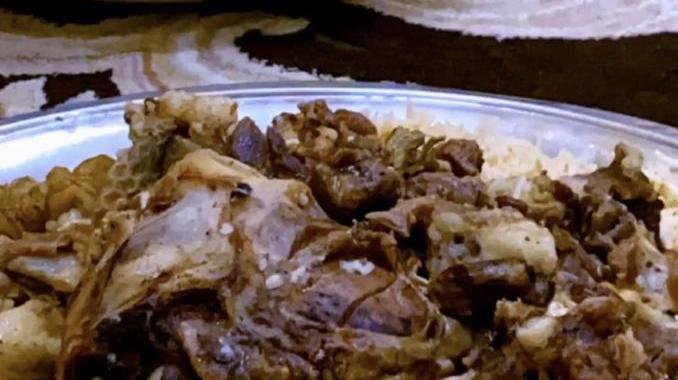
(photo by Salwa Hubais)

The good news is my book, Foodways in Southern Oman (Routledge), is now officially published. The bad news is, as every author knows, I keep finding topics I should have mentioned. Just today I happened upon: Of Dishes and Discourse: Classical Arabic Literary Representations of Food by Geert Jan van Gelder – what a great-sounding book! I will try to find a copy and read it.

I know there is a whole sub-genre in Arabic literature of personified ‘fights’ between different type of foods (munazara) for example “The Delectable War between Mutton and the Refreshments of the Market Place” featuring King Mutton and King Honey (or Clive Holes’ work “The Dispute of Coffee and Tea: A Debate Poem from the Gulf,” in Tradition and Modernity in Arabic Language and Literature, ed. J.R. Smart, 1996, 302-315). But I did not include a discussion of these as they seemed a little too far from my topic, as did poems about being a host/ guest such as Abu al Hakam Al Maghribi’s “A Domestic Disaster” which is too ribald to teach but is a good match with Ben Jonson’s “Inviting a Friend to Supper.” Perhaps at some point I can look more closely at this type of writing.

I have also realized that I was never able to find government documents about the number of animals (cows, camels, goats) in Dhofar – that was on my to-do list, but got lost in the shuffle of work and dealing with corona. I also wanted to go to a fish market and meat market and write a lot more about cuts of meat/ types of seafood in terms of prices, how they are prepared and sold but the markets didn’t re-open until after the books was sent to press.

Another topic I want to reflect about more is cultural issues relating to TIME and PLACE of eating, i.e. [pre-corona] my surprise that many of my students do not eat or drink anything before coming to class while they are surprised to see me eating lunch at my desk (“Why don’t you have lunch at home? How can you eat in your office?” they wonder.) Or the surprise of me drinking or eating while walking, something that is not done here. Another difference is my habit of making a cup of coffee last over an hour, while most Dhofaris will finish their drink quickly. A small cup of tea is usually gone in three sips, while I nurse mine until it is cold.

Lastly, I wanted to do interviews with Dhofaris who made/ sold food on Instagram, at festivals and small stores. I have heard of one Dhofari man who opened his own restaurant where he not only supervised, but cooked. However, between the public and private mourning for Sultan Qaboos and the on-set of corona, spring 2020 was not the time to ask strangers to help with my research. I hope 2021 affords more chances to write, research, think and discuss about foodways!

y - meat rice and fruit

Foodways and Literature – Animal Poems

As I was looking for food poems last week, I realized how many animal poems I have taught and have written out a partial list below.

One starting place is the Mu’allaqa, most of which have many vivid descriptions of desert animals, for example in Imru al-Qays “Halt, friends” and Labid’s “The campsites at Mina.” Another group of early poems which feature animals are by the sa’alik poets; no one who has read Shanfara’s Lamiyyat (“Sons of my mother”) can forget the wolf metaphors.

“Aunt Jennifer’s Tigers,” Adrienne Rich

“Bear,” Valerie Worth

“Butterflies,” Fawziyya Abu Khalid

“Cat, Valerie Harper

“The Crocodile,” Lewis Carroll

“The Darkling Thrush,” Thomas Hardy

“Darwin’s Finches,” Deborah Digges

“December Snow,” May Sarton

“The Dromedary,” Archibald Young Campbell

“The Eagle,” Alfred, Lord Tennyson

“The Face of the Horse,” Nikolai Alekseevich Zabolotsky

“The Gazelle Calf,” D. H. Lawrence

“The Goat Paths,” James Stephens

“The Horses of the Sea,” Christina Rossetti

“How To See Deer,” Philip Booth

“The Last Wolf,” Mary Tall Mountain

“Minnows,” Valerie Worth

“A Night with a Wolf,” Bayard Taylor

“Not Swans,” Susan Ludvigson

“The Nymph Complaining for the Death of her Fawn,” Andrew Marvell

“Pangur Ban,” unknown, Irish

“The Plaint of the Camel,” Charles Edward Carryl

“The Poet and the Moth,” Ahmad Qandeel

“The Raven,”  E.A.  Poe

“The Seal’s Lullaby,” Rudyard Kipling

“Sister Cat,” Frances Mayes

“Snake,” Emily Dickinson

“Snake,” Valerie Worth

“The Terrapin,” Wendell Berry

“To a Skylark,” Percy Bysshe Shelley

“Turtle Came to See Me,” Margarita Engle

“Upon a Snail,” John Bunyan

“The Vixan,” John Clare

“The War God’s Horse,” unknown, from the Navajo

“The White Stallion,” Abu I-Salt Umayyah

and many poems by Mary Oliver including “Ravens,” “Swans of the River Ayr,” “Turtle” and “White Heron”

More of her poems can be found at: https://www.poetryfoundation.org/poets/mary-oliver

Short stories: “Pepsi” by Mohammad Al Murr, “A White Heron” and “A Dunnet Shepherdess” by Sarah Orne Jewett and all the Jungle Book stories by Rudyard Kipling