

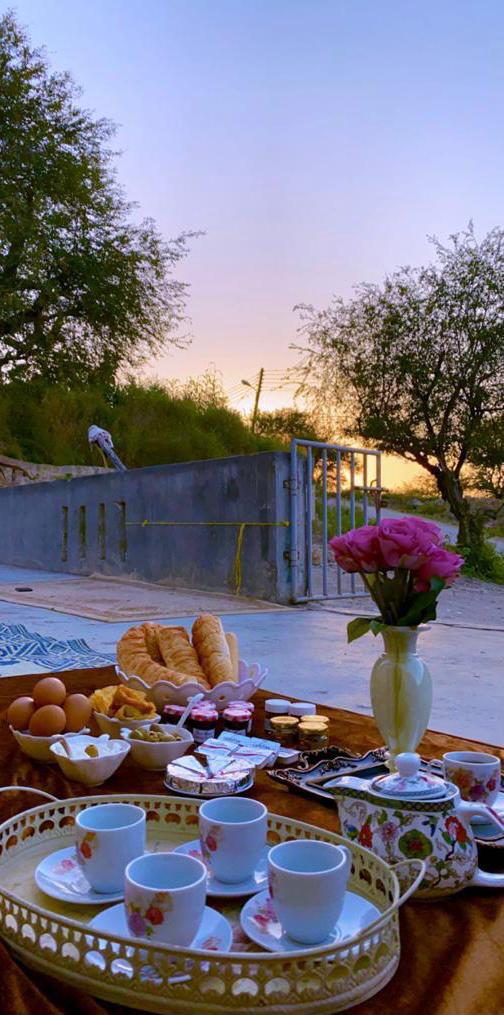
(photo by Salwa Hubais)
I teach literature classes but my most recent book is on foodways, which might seem like two dissimilar topics but food is omnipresent in poems, stories and dramas so my students and I often have conversations that include foodways, literature and cultural differences. Explaining a reference to Persephone in a poem led to my telling the story of Demeter/ Ceres, which led to a conversation about cereals.
Sometimes I focus simply to the vocabulary aspect: explicating “civil as an orange/ and something of that jealous complexion” in Much Ado about Nothing or “cucumber sandwiches” and “sugar tongs” in The Importance of Being Earnest. But occasionally food takes center stage as with the fishing with a sword scene in Tawfiq Al Hakim’s Princess Sunshine when the question of ‘who makes dinner’ helps carry the theme of the play. Another food-centered example is the dual breakfast scene in Thornton Wilder’s Our Town. On our first run-through, it’s simply a confusing jumble of random statements. But when we have read it a few times and then ‘perform’ it with one student per character, the beauty (and sadness) of that section shine through. Students often remark, “it’s like that at my home.”
Some stories show cultural similarities, such as Laura bringing food to the widow in Mansfield’s “Garden Party,” but they can also show differences. Unlike in Oman, only Laura visits the house (not with her mother and older sister) and she only stays a brief time.
Another Mansfield story “The Doll’s House” uses food to give insights into the social standing of the schoolgirls – having a sandwich with meat shows wealth while a jam sandwich wrapped in newspaper points to poverty. Similarly, the social niceties observed in the dining room at the beginning of Room with a View preview the theme of the novel. Who sits at which table reveals the hierarchies which Lucy will eventually break.
Food issues can even be the comic element of a story as with Elizabeth Gaskell’s magnificent Cranford with its details of manage your cook, take care of your cow and why you should eat your orange in your room (so you can roll it under your bed to check if anyone is hiding there and then slurp the orange sections in private).
Food essays are also wonderful for sparking good student writing. “Jam” and “A Thing Shared” from The Gastronomical Me by M. F. K. Fisher, “Girl” by Jamaica Kincaid and “In Search of Our Mother’s Gardens” by Alice Walker are great example texts to help students see how to write about their own food experiences.
As for poems about food, we have to start with
“Talk,” Gökhan Tok
You never hear it
but at breakfast the sweetest talk
is between the jam and the honey.
and Naomi Shihab Nye’s wonderful “Arabic Coffee,” “My Father and the Fig Tree,” “Sifter,” “The Traveling Onion” and “The Tray.” For more, please see https://www.poetryfoundation.org/poets/naomi-shihab-nye and https://poets.org/poet/naomi-shihab-nye
Other poems include:
- “After Apple-Picking,” Robert Frost
- “The Angler,” Thomas Buchanan Read
- “The Bean-Stalk,” Edna St. Vincent Millay
- “Blackberry-Picking,” Seamus Heaney
- “Coolness of the Melons,” Matsuo Basho
- “Cynddylan on a Tractor,” R.S. Thomas
- “The [Date] Palm Tree,” Adnan Mohsin
- “The Fisherman,” Goethe
- “From Blossoms,” Li-Young Lee
- “I Return to the Place I was Born,” T’ao Yuan Ming
- “Love Poem With Toast,” Miller Williams
- “Mending Wall,” Robert Frost
- “The Solitary Reaper,” William Wordsworth
- “Sorry I Spilled It,” Shel Silverstein
- “What’s That Smell in the Kitchen?” Marge Piercy
A few food-oriented short stories include: “A Dash of Light” by Ibrahim Aslan, “I Saw the Date Palms” by Radwa Ashour, “A Cup of Tea” by Katherine Mansfield and “Lamb to the Slaughter” by Roald Dahl, as well as several by Mohammed al Murr including “A Late Dinner,” “The Night’s Catch,” “Look After Yourself” and my favorite: “Dinner by Candlelight.”


You must be logged in to post a comment.