

The Cranfordians had that kindly esprit de corps which made them overlook all deficiencies in success when some among them tried to conceal their poverty. When Mrs. Forrester, for instance, gave a party in her baby-house of a dwelling, and the little maiden disturbed the ladies on the sofa by a request that she might get the tea-tray out from underneath, everyone took this novel proceeding as the most natural thing in the world, and talked on about household forms and ceremonies as if we all believed that our hostess had a regular servants’ hall, second table, with housekeeper and steward, instead of the one little charity-school maiden, [and]… who now sat in state, pretending not to know what cakes were sent up, though she knew, and we knew, and she knew that we knew, and we knew that she knew that we knew, she had been busy all the morning making tea-bread and sponge-cakes.
Pragmatics of When and What to Eat
Breakfast is usually a light meal. The timing varies from after the dawn (fajr) prayer to 11am on weekends and holidays. Almost everyone drinks tea, either plain, with a lot of sugar, with milk and/ or spices. In houses, thermoses are made by or under the direction of senior women and set out throughout the day. Some Gibalis simply have tea or tea with toast (sliced bread from a loaf); pita bread (called khbus lebnani) with butter, jam, honey and/ or processed cheese; round, thick traditional bread (called variously tanoor or kak in Arabic or godom or thakin in Gibali); store bought biscuits; a parata (plain or with dal or eggs inside) bought from a small, road-side restaurant or brought to the office by the “tea-assistant.” Eggs (scrambled, fried or boiled) are often set out and children often eat cereal and sometimes pancakes.
Lunch is the main meal of the day and eaten around 1:30 or 2pm after kids return from school and adults return from work. In almost every Gibali household rice must be served.[i] The rice might be plain white and served with dates and fried or grilled fish; biryani with fish, meat or chicken placed on top; a “curry”; a salona; or one of the dishes seen as traditional including qabooli, kebsa, maqboos, and mandi.[ii] The main dish is served with one or more condiments called “chutney” and a chopped salad, often made with fresh vegetables such as onions, cucumbers, tomatoes, carrots, green peppers and, sometimes, lettuce; this is served without a dressing.[iii] Quartered limes and small plates of chili peppers are often set out; some families use bottled hot sauces such as Tabasco.
When the Gibali men I know say “lunch” they mean “rice with meat or fish.” There is no other definition. Although they will sometimes eat chicken, older Gibali men will usually not. More than one male Gibali friend told me that his father had never tasted chicken in his life; this is mentioned in Thomas (1929 103).
Dinner is more varied. It is eaten between 7pm and 11pm, or even later while camping or at large formal parties. There might be rice and meat, chicken or fish again, but also dishes such as potatoes and eggplants sliced thin and baked in tomato sauce; macaroni or spaghetti mixed with tomatoes and fish (usually tuna), meat, or chicken; macaroni or spaghetti with a béchamel sauce. There is usually a chopped salad, chutney, hot sauce and sometimes yogurt.
****************
[i] As Al-Hamad (2016) states, “The Arabic for rice is riz/ruz, but in the Gulf it is ‘aish,” the Arabic word for living or life. In other countries such as Egypt, bread is called ‘aish but in Oman, rice is the most important staple.
[ii] “Curry” is used locally to mean a stew or vegetables and meat, chicken or fish, not necessarily made with curry powder, which is poured onto a platter to be eaten by being scooped up with bread. Salona is usually locally to mean a thin soup with chicken, meat or fish, usually with purred tomatoes as a base which makes it dark red. It is served in bowls or tin-foil containers. People either simply dip bread in the soup or position bread between thumb and two forefingers and, using a pincher action, tear off a piece of meat. Qabooli, kebsa, maqboos, and mandi are considered traditional, local rice dishes in several Middle Eastern countries. It is beyond the scope of this paper to adjudicate origin, ingredients or recipes.
[iii] “Chutney” is not the same as chutney from India which is usually cooked with fruit. It is a condiment whose exact composition varies from family to family but usually made from blended spices with uncooked vegetables. A common one is made from pureed tomatoes, onions and spices and is similar to salsa. A more traditional one is made from pureed garlic and ginger with vinegar. When I showed several Gibali men a small dish of Indian-style mango chutney and asked “Is this chutney?” all of them said no.
This moment – like all moments – has food tastes and choices changing with some people (not necessarily from the older generation) lamenting that the change is too fast and others (not necessarily from the younger generations) lamenting that the change is too slow.[i] In “Notes on the Omani Kitchen: Eating with Tradition” (2018) Popp notes that “Until recently, dates, lemons, a few vegetables, rice, wheat, water and bread formed the basis of the Omani diet in the impenetrable interior of the country” with a goat on feast days, sometimes dried fish and on the coast “fresh fish, fruit, and goods imported by sea.” There are now far more choices than in the 1970s.[ii]
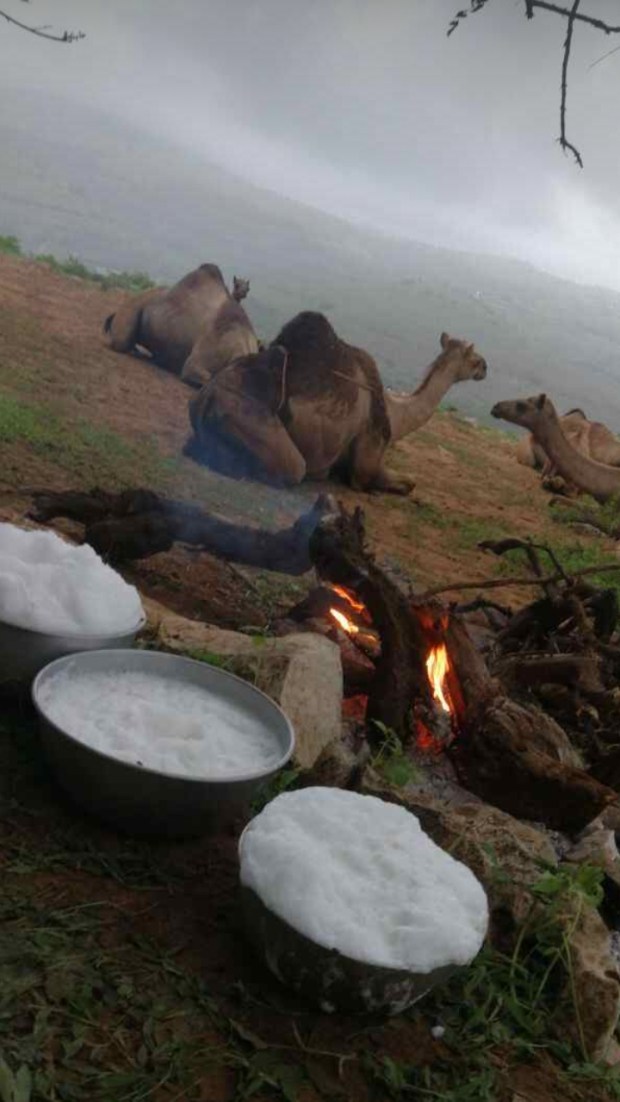
Gibali-speaking informants in my research group are aware of and often discuss culinary changes. Some food, such as locusts, are no longer eaten because the nutrition they provided can be easily obtained from other sources; others, such as wild game like gazelle and bustards, are now forbidden to be killed by the government. Some kinds of bread cooked over the fire are not made because of it is simpler to buy bread; while other kinds, such as qalb, made by pressing dough to the wall of a round, sunken oven, are still eaten frequently. Sometimes there are watershed moments when a significant food change occurs such as the opening of the McDonalds or the Carrefour grocery store which brought certain kinds of Western foods into Dhofar for the first time.[iii]
Another major difference from the 1970s is that almost all families in Dhofar have help with the cooking; with a live-in full time cook, a maid who cleans and cooks some of the meals, a person who comes every day for several hours to cook and clean, or a person who comes in to cook only one meal. Some maids/ cooks will stay with a Dhofari family for over ten years, going home for a month each year; others will work for a few months or a year and then return home or move to a different family. Since the 1980s, having outside help in the kitchen means that while most women know how, cooking is not seen as required skill. Another reason that women spend less time cooking is that now females have equal access to primary, secondary and tertiary education so that some women are able to forego household responsibilities to concentrate on their studies.
There are several other noticeable changes in food use, choice and preparation in the last ten years. One is an awareness of dieting. Several businesses such as “Smart Diet” have opened advertising “scientific” weight loss. There are storefronts which sell supplements and offer counseling, diet plans and weekly ‘weigh-ins’ to help research or maintain a healthy weight. Weight gain, and the often-accompanying diabetes, was never a problem in Dhofar until the advent of selling cheap sweets that occurred from the late 1970s onward.[iv]
A second change is food and medicine. In the past, the most common medical treatments were cauterizing and honey. Medicinal branding is used much less frequently now, but I know several men who have had it done and believe it is efficacious. Honey, especially wild honey from Yemen, was used for many aliments (see Rodionov 2012). Although bottles of honey (usually in used Vimto glass bottles) are still given as gifts, easy access to modern medicine means that honey is now used for lesser aliments such as a sore throat and as a preventative measure.
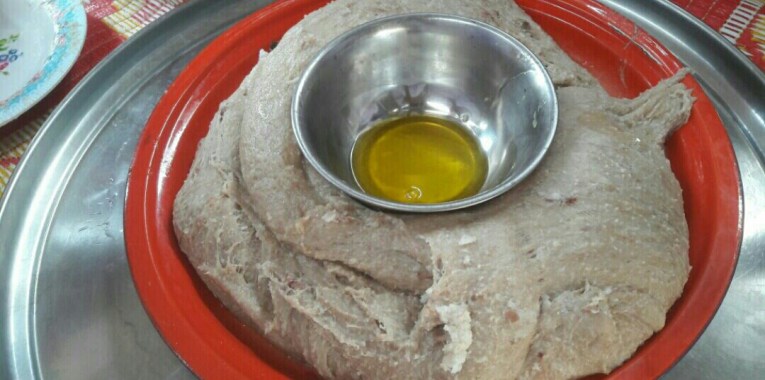
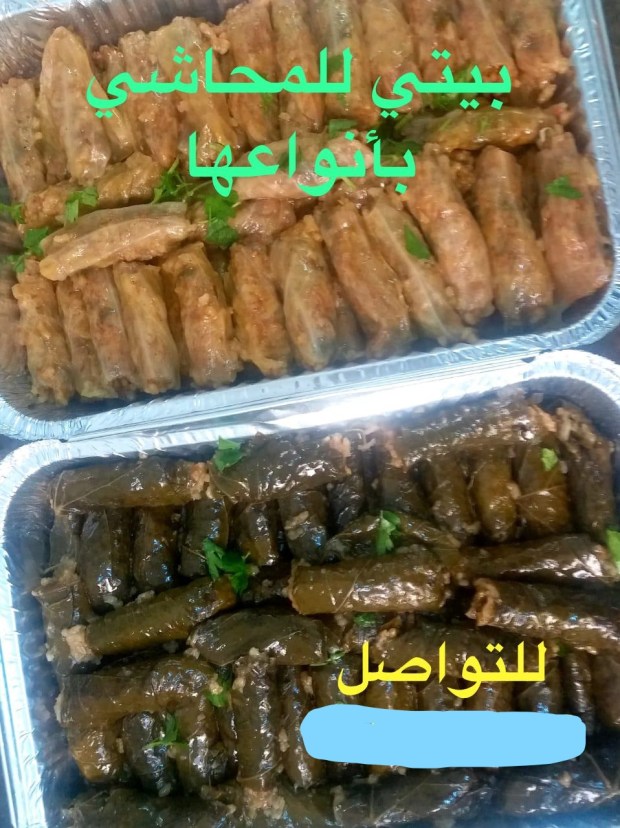
Another noticeable change is women monetizing food. Women often give away food stuffs and prepared dishes to relatives, neighbors and friends, but there are now also chances for women to sell their handiwork [see examples below]. Some women create personal bakery/ catering companies and advertise on Instagram. The local government has set up a series of women-only shopping fairs where women can rent small booths for a nominal fee and sell food meant to be eaten immediately or taken home, in a milieu of small booths selling women’s clothes, beauty products, and oud/ bukhoor. There is also an annual city festival where women can rent booths selling packaged or homemade food, in addition to traditional hearth-cooked breads.
During the khareef (monsoon) tourist season and Ramadan, women often sit under small tents next to main roads. Under the tent there is usually a table covered with food the women have made such as bread, rice and meat dishes, cooked vegetables and/ or sweets such as basboosa (coconut cake) or carrot sweet. Sometimes the women themselves sell what they have made; sometimes the women sit behind the table and male relatives walk to the cars, take orders and accept payments.[v] In addition, some women own and run small store-front businesses which sell, almost exclusively, sweets such as mini-cheesecakes, brownies, cupcakes and chocolates, often with cakes for sale by special order.
Lastly, methods of cooking are changing. In the past, heated rocks were often used to cook meat or fish. Although I have been at picnics where this has been done and most picnic cooking is still done over a fire, most men now use various accouterments such as tinfoil and tongs. Men will still cook in a traditional way, for example burying potatoes in sand and covering them with heated rocks, but they are clear that they are doing something old-fashioned for the ‘taste’ of it.
One aspect of food culture that is not changing (yet, perhaps it will in the future) is that of eating locally and in season. Given the continuing close connections between relatives who live in the mountains and those who live in the coastal villages or Salalah, seasonal delicacies such as wild roots, mushrooms, a local kind of tuber, and seed pods are brought down from the mountain and given to relatives and friends. On the coast, changes in the ocean temperature bring various fish closer to or farther from shore so that people are used to have certain fish at certain times of the year. Further, the government enforces seasons on various seafood, so that abalone and lobster, for example, can only be bought at certain times of year.
Example of photos sent through social media to advertise home-made food:

******************
[i] I was struck by Roseberry’s (1996) comment that some aspects of food culture “could be seen to represent an attempt to re-create, through consumption, a time before mass society and mass consumption” (774). I think of Dhofar as being in a state of pre-food nostalgia in that Dhofaris often talk about how society, people, family relationships etc. were “better” in the past, I have never heard anyone say that the food was better.
[ii] Writing about Oman, Boxhall (1966) states that “Rice, ghee, dates, and goats’ meat provide the Bedouin’s only sustenance, except (and very rarely) for gazelle meat” (217) and on coast there was, “tunny, king-fish, bonito, and shark…turtle, oysters, clams, sea urchins and limpets” (217, 218). Turtles are forbidden to be eaten by the government, but informants tell me that neither turtles nor sharks were eaten in the past.
[iii] The opening of McDonalds led to a certain amount of what Elie (2006) terms “‘let’s save them from modernity’ syndrome” (158) from some Dhofaris and expats. There were huge lines for a few days, then it became of the choices alongside KFC, Subway, ChicKing, etc.
[iv] In response, the government has created a series of well-maintained, well-lit walking paths next to main roads so that Dhofaris have easy access to safe places to exercise.
[v] By main roads, women sell prepared food, bread, processed food such as chips, and sometimes small bundles of wood used for campfires. Only men work in the road-side stands selling fruit (such as melons), vegetables (usually potatoes and onions) and grilled meat.

(photo by M.A. Al Awaid)
Abstract from “Issues of Autonomy in Southern Oman” by Dr. Marielle Risse
Gibali (also known as Jibbali, Śḥeret, Shari and Eḥkili) is a non-written, Modern South Arabian language spoken by several groups of tribes in the Dhofar region of Southern Oman. While teaching in Salalah for more than ten years, I have been working with several Gibali-speaking men researching the culture and life-ways of one particular group of tribes, the Qara. Gibalis, both in interviews and from my long-term observations, see their culture as giving both men and women opportunities to craft their own lives and, specifically, to gain a positive reputation for wisdom.
This paper will explore how the Gibalis create and maintain an atmosphere in which both men and women are seen as having access to positive virtues and some control over their own lives. In addition to my observations and interviews, I will include examples from the fields of political science and anthropology, as well as stories from the first set of written texts in the Gibali language.

Excerpt from the essay “The Culinary Triangle: What can Claude Lévi-Strauss teach us about food fads today?” by Sara Davis
Lévi-Strauss placed the three phases of food at the points of a triangle to emphasize both the opposition between different stages and the degrees between them. If you look at the diagram from the point of view of raw food, you might see the other two points as the outcomes of two different transformations: Cooked food is the product of cultural processes, such as the application of heat or tools; rotten food is the product of natural processes, time and decomposition. Truly raw food, for Lévi-Strauss, is unmarked by human intervention or decay; even the uncooked foods we eat have been washed, peeled, sliced, and prepared for human consumption. But though a chopped salad and a roast chicken might both appear on the dinner table, they occupy fundamentally different places in our cultural imagination.
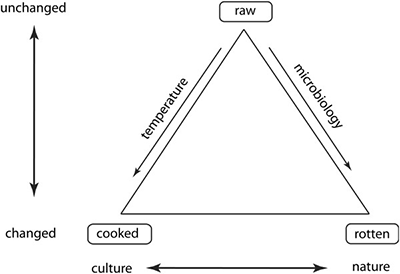
Alternatively, if you tip the triangle onto its side to position “cooked” at the top of the pyramid, then the other two points indicate food that falls outside the category of edibility — what we might decide not to eat because it is underprepared or tainted. This visual tool permits a more nuanced framework for cultural comparison than an us/them contrast: We can perceive the French and Italian methods of preparing uncooked vegetables as points along a scale of cultural mediation, different in degree rather than kind; we can explain that the American soldiers had a wider conceptualization of the rotten than the French fromagers.
Of course, mapping foodways with this tool is just the tip of the triangle for Lévi-Strauss. Because the categories of “raw,” “rotten,” and “cooked” are culturally constructed, thinking about food in this way leads us into the realm of metaphors and ideas: The oppositions between points on the culinary triangle frequently point to other clusters of oppositional concepts in a particular society’s beliefs and practices. “Cooking is a language,” writes Lévi-Strauss, “through which society unconsciously reveals its structure.” Cultural values and fears might manifest through actual cooking and eating practices, as when we bake our most elaborate pastries for milestones such as birthdays or weddings, or when we refuse to eat food that has fallen on the floor because it has strayed into the zone of the rotten. At times, the allusions of the culinary triangle are mapped out in language itself, as when the life cycle of food is invoked to describe the life cycle of human beings, who might be said to be “green” or “raw” if they are not yet fully inculcated into the manners of civilization, or “crunchy” if they deliberately refuse certain trappings of society in favor of those closer to nature.


My current research focuses on the practices and perceptions of buying, making, eating and disposing of food among Dhofaris in the southern region of Oman. I am examining details of food preparation (who makes what kind of food in which location), as well as when, where and how food is eaten. I will also compare Dhofari food traditions with anthropological accounts from Yemen and recent changes in food culture including expanding selection of foods, hiring people to help with cooking, dieting, monetizing food and cooking methods.


You must be logged in to post a comment.