
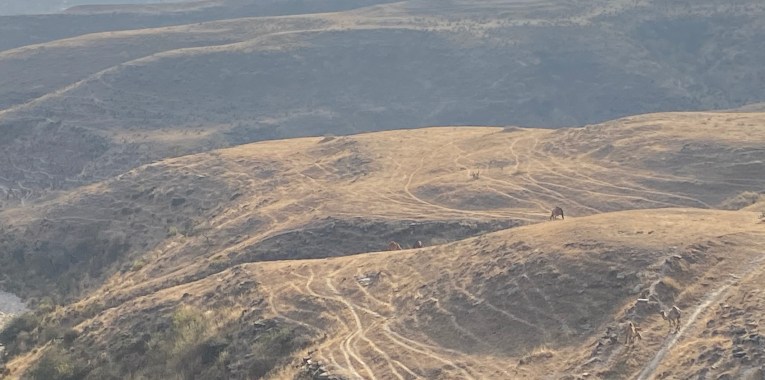
In Arabian Sands (1959) Thesiger recounts his travels on the Arabian Peninsula between 1945 and 1950, including two crossings of the Empty Quarter. In 1997 taught sections from the book in a non-fiction writing class at American University of Sharjah. I did so again when I lived in Salalah and also presented a lecture at the university where I worked: “Thesiger and the Persistence of Cultural Memory: How Arabian Sands Can Help Improve Teaching in Oman.”
Thinking about how the lifeways Thesiger describes are still extant in Dhofar, I then wrote an essay about his book: “Verstehen/ Einfühlen in Arabian Sands: Wilfred Thesiger as Traveler and Anthropologist” (2013).
Hence, I have been on team Thesiger for 30 years. The only travel book I would put as an equal is Apsley Cherry-Garrard’s magnificent The Worst Journey in the World (1922) about the South Pole Terra Nova expedition (1910–1913) led by Robert Scott.
So when my bookclub choose to read Into Thin Air: A Personal Account of the Mt. Everest Disaster (1997) by Jon Krakauer I was the only person not enamored of that book. After reading of Oates’ self-sacrifice and Cherry-Garrard’s warning:
There is no chance of a ‘cushy’ wound: if you break your leg on the Beardmore you must consider the most expedient way of committing suicide, both for your own sake and that of your companions.
It is jarring to read Krakauer describe himself and other stepping over dying people. It is also jarring that he published the book the year after the disaster. I can understand Krakauer wanting to explain his version of the events, but there was no time for reflection
Then we read The Abominable Snowman (1955) by Ralph Izzard, one of those travel books by men who had their own WWII experiences (or someone else’s) in front of them and went to foreign countries as a way to continue (or start) to test themselves. Blind White Fish in Persia Hardcover (1953) by Anthony Smith is a classic of that genre.
Our next book was The Snow Leopard (1980) by Peter Matthiessen. I have read several positive reviews of it, but I was afraid it would be too much of an internal-focused travel book. Like Thesiger (and Cherry-Garrard) there was a space of more than seven years between when he traveled and the publication, but the result is an emphasis on reflection: 1 page of walking to 3 pages of thinking.
The reflections about Buddhism, with digressions to explain the history of the religion, are interesting, but the personal reflections are unsettling. He and George Schaller are both clear that they are glad to be away from civilization, but they are traveling with 14 porters and 4 guides, porters who are carrying all the supplies so the two western men have only “rucksacks.”
Then there is a brief mention of Matthiessen’s wife death, followed a few pages later by a copy of letter from his youngest son and a description of his leave-taking from this boy, leading me to wonder why he was walking around the Himalayas when his son was grieving.
Thesiger and Cherry-Garrard had it easy, no sentimental attachments to pull their thinking back to home. Cherry-Garrard was also working in one of the few landscapes on earth that had no people who he was displacing, nor was he asking (or forcing) anyone to work for him. Thesiger paid the men he walked with, but he also lived by their standards, wearing their clothes, speaking their language and eating what they ate. If they starved, he starved.
Matthiessen has interesting information about Buddhism but after so many comments about how his porters were “childish” and eating the wrong time of day, I started to hope that he would not see a snow leopard. It was petty of me but the whiplash between his mediations and omening with the mountains vs. his scolding the men he was traveling with was jarring. And his creating a mystic “otherness” about one of the men was creepy: his smile meant this and his was thinking that and we are somehow connected and he is my teacher… about a man Matthiessen can’t communicate with but the letters from about his son go unread so as not to spoil the precious mountain atmosphere.
It’s a good book, I can see why it is acclaimed, but I ended my essay “Verstehen/ Einfühlen in Arabian Sands” with:
Thesiger is one of the few writers about southern Oman who has managed to manifest an appreciation of and respect for the local population, as well as convey their beliefs and habits accurately.
Twelve years on, after reading dozens more travel books, I would change that to say
Thesiger is one of very few travel writers who respects and appreciates the local population, as well as conveying their beliefs and habits accurately.
Below is a section from my Thesiger essay and as a side note, books about the Himalayas follow the familiar arc of travel books in English:
1) the Western “first” books
- High Adventure: The True Story of the First Ascent of Everest, Edmund Hillary, 1955
- The Crystal Horizon: Everest-The First Solo Ascent, Reinhold Messner, 1989
- Seven Years in Tibet, Heinrich Harrer, 1952/ 1954
2) place as setting for the creating a persona after WWII
- The Abominable Snowman, Ralph Izzard, 1955 (adventurer)
- A Short Walk in the Hindu Kush, Eric Newby, 1958 (humor)
3) place as setting for personal growth/ discovery
- The Snow Leopard, Peter Matthiessen, 1980 (traveled 1973)
- To a Mountain in Tibet: A Haunting and Intimate Memoir of Pilgrimage, Loss, and the Journey to Mount Kailas, Colin Thubron, 2011
- A Glimpse of Eternal Snows: A Family’s Journey of Love and Loss in Nepal, Jane Wilson-Howarth, 2012
4) women
- Annapurna: A Woman’s Place, Arlene Blum, 1980 (traveled 1978)
5) disaster, place as setting of personal survival
- Into Thin Air: A Personal Account of the Mt. Everest Disaster, Jon Krakauer, 1997
- The Climb: Tragic Ambitions on Everest, Anatoli Boukreev and G. Weston DeWalt, 1999
5) fiction, place as background
- Thin Air, Michelle Paver, 2016, set in 1935; her Dark Matter (2010, set in the Arctic in 1937 is also excellent)
- The Snow Line, Tessa McWatt, 2021
- With or Without You, Carole Matthews, 2005
6) the locals speak
- Beyond Everest: One Sherpa’s Summit and Hope for Nepal, Corinne Richardson and Pem Dorjee Sherpa, 2024
section from “Verstehen/ Einfühlen in Arabian Sands: Wilfred Thesiger as Traveler and Anthropologist” in Journeys: The International Journal of Travel & Travel Writing (2013)
Tabook, as a member to the community he describes, can be expected to demonstrate Verstehen and Einfühlen; it is harder to understand how Thesiger, as an outsider, also managed to display both understanding and empathy. Thesiger also had an ability to reflect on the why he traveled and what the possible effect of his travels would be. Before the first crossing of the Empty Quarter, an old man comes to his encampment “to see the Christian” (82). His eyes are “bleary” and Thesiger’s companions mock him, but he
wondered fancifully if he had seen more clearly than they did, had sensed the threat which my presence implied–the approaching disintegration of his society and the destruction of his beliefs. Here especially it seemed that the evil that comes with sudden change would far outweigh the good. While I was with the Arabs I wished only to live as they lived and, now that I have left them, I would gladly think that nothing in their lives was altered by my coming. Regretfully, however, I realize that the maps I made helped others, with more material aims, to visit and corrupt a people whose sprit once lit the desert like a flame. (82)
It is clear that Thesiger’s most important attribute is his appreciation of and attempts to comprehend the people he was traveling with. “Above all however his life there is [sic] a measure of the love that he bears to the people among whom he traveled, without which he never would have been able to do what he has done” (Rennell 1948: 21). In his obituary, Maitland (2004) quotes Thesiger as saying “Ever since then [serving in the Sudan Political Service] it has been people that have mattered to me, rather than places” (93). In the Guardian Weekly’s obituary, Asher (2003) writes that “Few other explorers in the last century have tried so genuinely to see the world through the eyes of foreign people” (22).
That Thesiger thought the local people were the essential part of a journey is clear from his (1951) obituary for Bertram Thomas. Thesiger praises Thomas by highlighting the people, not the place: “the measure of his achievement is that he won the confidence of these proud and difficult tribesmen, and with no authority behind him, persuaded them by patience and fair dealing to take him across the Empty Quarter” (199). Of his own travels, he says “My achievement was to win their [his tribal companions’] confidence” (Glancey 2002).
But beyond the personal connection and mutual respect, i.e. Einfühlen, his books are also praised as “invaluable as anthropology” (Woodward 2007). It is his Verstehen, the ability to explain the different cultural features he encountered in a way that makes sense to readers, few of whom have ever been to this part of the world, which makes his book both a classic and valuable. Of course, the main caveat often mentioned is that he has no information on women or settled habitations, but if one takes the book strictly within the terms of ‘male Bedu traveling through the mountains surrounding Salalah, Yemen and in the desert’ Thesiger illuminates life on an almost epic-scale including food, clothing, religion, sickness, death, war, animals, plants, weather, and the importance of family and tribe connections. As someone who has lived in Salalah for seven years, what is most impressive is that after fifty-three years, Thesiger’s book is still an accurate guide to the culture I see every day.
A good anthropologist explains not just the surface appearance of the culture, but the bedrock structure which changes slowly if at all. Southern Omanis I know from my academic life, friends and the men in my research group are fluent in modern technology; they have university degrees, work in the mechanical and computer engineering fields, and travel widely. Yet, time and again, an example of Thesiger’s Verstehen presents itself when I am with them.
When greeting people, the news is always “good” and one has to ask several times, or simply wait awhile, to learn what is actually going on (102). His description of how to eat (86) is a letter-perfect description of how many Dhofaris eat dinner. It is still true that “Bedu have no desire for variety in their meals” (113). While camping it is often mentioned that someone should not relieve himself under a tree (where someone might sit for shade) or on a path (62). I have heard people swear on the divorce oath (169).
Often, when driving with the men in my research group, they will point towards a road or animal that is “right there, so close” that I cannot see and I think of Thesiger not seeing camels or oryx (164, 233). Several times while driving through a wadi at night, a colleague would say to me “go that way.” When I informed him that I couldn’t see his hand to know which way he was pointing, I was answered in lines similar to Thesiger’s companions who told him that “you would have sat there, without seeing them until they came to cut your throat” (233).
Even the remarks I found hard to believe or disliked have come true. At one point, Thesiger asks the Rashid men about crossing the Empty Quarter and Mohammed answers, “We are your men. We will go where you go. It is for you to decide” (219). When I first read this, it seemed a fantastic, wildly romantic over-statement. Then one day I asked the men in my research group where they wanted to drive to on the weekend, and one said, straight-faced and without irony, “You decide and we follow you.” Another time, in trying to decide where to go, one informant said to me, “I am a box,” i.e. a package to be picked up and carried. These were older, married, educated Gibali men and they certainly didn’t mean that I had any control of their lives, but in the specific point of traveling on a certain day – they were happy to leave the choice of destination up to me.
I thought also Thesiger was too tetchy about progress: “I resented modern inventions; they made the road too easy” (278). Then I went camping with a group of Westerners. As usual, I pulled out a sleeping pad, pillow, blanket, knapsack with clothes, small bag of food and a small cooler and set up in about ten minutes. One of the man took over an hour to erect a mini-Waldorf-Astoria complete with three mats, dining table, chairs, food prep table, stove, two mattresses, sheets, blanket and bed cover. When he pulled out a small box full of condiments, three kinds of ketchup, three kinds of mustard, brown sauce, soy sauce, etc., I had to stifle a groan.
Interconnectedness
To take an extended example of the depth of Thesiger’s understanding of the men he traveled with I would like to explore the concept of interconnectedness. Thomas (1932) understands the “corporate consciousness on the part of the tribesmen by which the acts done by or to any member of his tribe are virtually acts done by or to himself, with all the consequences that involves” (67). But the reality is that the interlocked/ interdependent tribal system goes farther than ‘acts’ to include, for example, possessions. Nanda and Warms (2002) explain that “The idea of scarcity is a fundamental assumption of Western microeconomic theory. Economists assume that human wants are unlimited but the means of achieving them are not” (170). This is not the underlying assumption among Bedu and Gibalis. The actuality of scarcity is not perceived as long as someone in one’s social circle has X object. If a brother/ cousin/ close friend has X, then access to X is assumed.
This can be a little heart-stopping from a Western point of view. I once offered a flashlight to a man in my research group and he took it saying, “I know that everything you have is mine.” The male and female informants I worked with would relate waking up to find that their sisters/ brothers or visiting cousins has “borrowed” shoes and/ or clothes. Cash flew from hand to hand; whoever had it was duty-bound to share with those who needed it, even sums as large as several thousand dollars. Cars could be borrowed for weeks or months. The only two items I found that did need to be returned quickly were a khanjar (traditional dagger) and guns which were borrowed to attend wedding parties.
Again and again, Thesiger explains this point from the simple, “no one ever smoked without sharing his pipe with the others” to “Bedu will never take advantage over a companion by feeding while he was absent” (60, 65). He writes “I have never heard a man grumble that he has received less than his share” (86) and how his companions praised a man who had ruined himself by excessive generosity (71).
What is refreshing about Thesiger is he makes it clear that this cultural necessity was grating: “In my more bitter moments I thought that Bedu life was one long round of cadging and being cadged from” (64). Twice Thesiger complains about bin Kabina giving away his clothes because someone has asked for them (137, 315). It is possible, therefore, to see both how the culture is organized and Thesiger’s reaction to that organization.
When, at the end of the book, Thesiger describes the men he traveled with as men “who possessed, in so much greater measure than I, generosity and courage, endurance, patience, and light-hearted gallantry,” it is clear this is not meaningless praise or hyperbole (329). He saw, recorded and reacted to their generosity. The Bedu insistence on sharing comes through as one of the key components of the culture but this is not described in a simplistic, formulaic cliché.
Thesiger shows the unrelenting requests he was subjected to and the inability of the Bedu to refuse a request even if they did not want to agree. He shows himself as the one who gives and the one who takes advantage of the laws of hospitality, i.e. Verstehen and Einfühlen. During his first crossing, he accepts milk from camel herders in the desert: “I drank again, knowing even as I did so that they would go hungry and thirsty that night, for they had nothing else, no other food and no water” (136).
Thesiger from the Omani Point of View
Although most academics would agree with the need to describe the culture with respect, there is a debate within the field about the necessity of communicating the locals’ point of view by using terms that make sense to both the reader and the people described. Thesiger was clearly on the side of living and describing events from the local point of view: “whoever lives with the Bedu must accept Bedu conventions, and conform to Bedu standards” (52). His method agrees with Geertz’s as explained by Abu-Lughod (1989) “[Geertz’s] ethnography consists in interpreting people’s actions in terms of the interpretations with which they themselves work” (272).
Agreeing with him are, for example, Michrina and Richards (1996) who write in their standard anthropology textbook, “it becomes the anthropologist’s task to give sense to the reader of what it feels like for a native live in his or her culture” (130). Further, Marcus and Cushman (1982) assert that it is imperative that the “ethnographer’s conceptual and descriptive language make (common) sense to his readers within their own cultural framework, but it must communicate meanings to these same readers which they are persuaded would make (again, common) sense to the ethnographer’s subjects” (46). The simplest way to check if this “common sense” has been applied is to give the finished work to members of the culture and ask them to comment.
In the interest of gathering this insight, I asked a group of informants (working with me on a different project) who had read Thesiger’s book in Arabic to discuss their opinions, The three men are Gibali while Thesiger’s Dhofari travel companions were from the Bait Kathir (Gibali and Bedu) and Rashid (Bedu) tribes. Gibali and Bedu cultures are seen as quite similar by outsiders; both communities place a great deal of emphasis on courtesy to guests, self-control, and self-reliance. For example, after researching Southern Omani culture for several years, it is easy for me as a teacher to differentiate students as being from Salalah, from other parts of Oman or Gibali/ Bedu, but I can’t immediately tell the difference between Gibali and Bedu students. Thus, although my informants were not from the tribes which are described by Thesiger, they are culturally close enough to the culture to tell if his descriptions are correct.
Their first reaction was straight-forward and positive: “what he describes is accurate” and Thesiger “was understanding the culture.” When I asked for more details, I was told “I like his hunger,” i.e. my informant respected Thesiger’s willingness to live the same life as the men he was traveling with. Another informant told me that he is “wide” like Bedu and Gibalis, in the sense of being patient, able to accept difficult situations. On the other hand, one informant’s reaction to reading Thomas’ book was “I didn’t hate it.”
The two negative reactions were perceptions that Thesiger was a government spy and that he was homosexual. No one I have talked to believes he was traveling because of locusts. Neither was my argument that “some people like to travel, he just wanted to see something new” believed. I was told, “His real job was not looking for locusts, sure, [he was traveling] to know the people and lands and the strengths of the tribes to make maps to make the way for oil.”
There was also uneasiness about his sexuality. Thesiger, like T.E. Lawrence, addresses the issue directly, but says that is was not part of the Bedu’s life: “during all the time I was with them I saw no sign of it” (125). The men I spoke to about the book were ready to believe that was true of the Bedu, but not of Thesiger himself. I was asked directly several times if he was gay, based on his careful descriptions of the men, the close-up photos of the men and caring for bin Kabina when he was sick, an extreme example of Einfühlen:
The others crowded round and discussed the chances of his dying until I could scarcely stand it; and then someone asked where we were going tomorrow and I said that there would be no tomorrow if bin Kabina died (189).
Conclusion
Thesiger’s praise of the Bedu seems at times a desire to keep their lifeways intact for his benefit. He could return to British settlements when his “mind was taut with the strain of living too long among Arabs,” but for the Bedu to similarly cross cultures would mean their ruin (266). This is his most important Verstehen, not simply Einfühlen, for this contradiction is experienced by all of the Omanis I have met – not simply nostalgia for the past or childhood, but a sense that modernization has brought both benefits and drawbacks. To most Westerners, especially Westerners I have talked to in Salalah, modernization is only positive. In discussing the changes in Oman over the last 40 years, informants have told me that while life is much better, yet they are also reconstructing a more traditional way of life. One man with a technical job decided to start sleeping outside for months at a time. He would camp, wash himself in one of the open showering rooms [for men only, a shoulder-high, 15-foot square cement square with spigots for men to wash off for prayers and after fishing/ swimming] and then go to his work which involved communicating with satellites. Another man whose father practices transhumance taking care of camels, has an older brother who, after a successful career, now assists the father.
Travel writers roughly divide into Verstehen, with the focus on accurate reportage of language, distances, flora, fauna and closely observed behaviors, and Einfühlen, in which the author’s emotional connections to the place are foregrounded. Peter Mayne’s (1953) The Alleys of Marrakesh, has and is expected to have, a quite different description of a Moroccan suq than Clifford Geertz’s (1979) “Suq: The Bazaar Economy in Sefrou.” Thesiger is one of the few writers about southern Oman who has managed to manifest an appreciation of and respect for the local population, as well as convey their beliefs and habits accurately.
Reflections on Ethnographic Work: The Grasshopper
Predator Anthropologists, Anthropologist Predators: Anthropological Metaphors in Popular Movies
Ethnography – Finding the Middle Ground, part 1 of Discussing Photographs
‘Reflections on Marriage in Dhofar, Oman’ is accepted for publication
 Come From Away
You must be logged in to post a comment.