When Should You Arrive at Your Ithaca? Thinking about Cavafy, Gerald Durrell, Lawrence Durrell and Corfu (Boston Athenaeum, April 25, 10am)

I will be leading a discussion about Gerald Durrell’s My Family and Other Animals and Lawrence Durrell’s Prospero’s Cell at the Boston Athenaeum on April 25th. It’s interesting to come to the books by the two brothers again so many years after first reading them. I went through all Gerald’s books in middle school and Lawrence’s when I was in college.

On rereading them, Gerald’s book stands up: it’s charming and erudite. Lawrence’s is still excellent, but now the sexism is clear and, in a way, debilitating because you can now see what he missed. He wrote best in and about Greece. Although Caesar’s Vast Ghost is wonderful, nothing he wrote in France is as good as what was sparked by the more difficult landscapes of North Africa and Greece.

Rereading them makes me wonder, when is the best time to find your Ithaca? Both autobiographies recount their days on Corfu. But as Gerald is 12 years younger, he experienced Corfu as the background of a magical childhood. Lawrence, newly married, had the magic of first love in a perfect little beach house, complete with sailboat, good friends, excellent food, splendid weather and the time to write.

So is it better to have an enchanted childhood, and have those memories to fall back on, or perhaps lead you on, for all your life? Or better to have your glorious golden years in your early twenties? Cavafy famously urges you to arrive late in life:

When you set out for Ithaka

ask that your way be long,

full of adventure, full of instruction.

The Laistrygonians and the Cyclops,

angry Poseidon – do not fear them:

such as these you will never find

as long as your thought is lofty, as long as a rare

emotion touch your spirit and your body.

The Laistrygonians and the Cyclops,

angry Poseidon – you will not meet them

unless you carry them in your soul,

unless your soul raise them up before you.


Ask that your way be long.

At many a Summer dawn to enter

with what gratitude, what joy –

ports seen for the first time;

to stop at Phoenician trading centres,

and to buy good merchandise,

mother of pearl and coral, amber and ebony,

and sensuous perfumes of every kind,

sensuous perfumes as lavishly as you can;

to visit many Egyptian cities,

to gather stores of knowledge from the learned.

Have Ithaka always in your mind.

Your arrival there is what you are destined for.

But don’t in the least hurry the journey.

Better it last for years,

so that when you reach the island you are old,

rich with all you have gained on the way,

not expecting Ithaka to give you wealth.


Ithaka gave you a splendid journey.

Without her you would not have set out.

She hasn’t anything else to give you.


And if you find her poor, Ithaka hasn’t deceived you.

Wise as you have become, with so much experience,
you must already have understood what Ithacas mean.

When I read My Family I wished I lived on a Greek island, although I had a shorter, but similar, experience: as a child, I spents three weeks every year in the ruins of a sugar mill in the Caribbean. Reading Lawrence’s books in my late teens and early 20s helped pull me out into the world. I wanted to go to the places he described so I managed to get myself to Cairo, Alexandria, Athens, Corfu, Cyprus, Rhodes and other Greek islands, as well as his house in Sommières. But I didn’t find my Ithaca, the Dhofar region, until I was 39. Then I had to move away so I now agree with Cavafy. Arrive at your Ithaca late, so you never have to leave it.


Boston Athenaeum – April 25, 10amhttps://bostonathenaeum.org/whats-on/discussion-groups/

Join us for a discussion of two very different books which feature the same landscape and main characters. Most people know only one of the Durrell brothers, but each one has his own brilliance. Lawrence writes about the historical and literary landscape in an artistic and serious manner, while Gerald focuses on the local wildlife, a group which includes his older siblings. The juxtapositions between what each one thinks is important and noteworthy makes reading the books in tandem a delight. Gerald doesn’t deign to mention his brother’s wife; Lawrence ignores the fauna. Gerald has nothing to say about Greek myths; Lawrence pretends he is not with his family. Read one book or both and join a short visit to the gorgeous Greek island of Corfu. If the conversation leads to a wider discussion of Lawrence’s fiction (The Alexandria Quartet), Gerald’s impressive improvements in how zoos are designed and the Boston area’s best Greek restaurants, all the better.

Back from Ubar or What to Read if You Insist on Staying Home

Research on Travelers and Tourists in Dhofar

Marriage and Peace – essay published

The Beauty of Beau Geste


Marriage and Peace – essay published

I am happy to announce that my essay on ‘Marriage and Peace’ has just been published. The photographs were taken by Onazia Shaikh. 

It is difficult to write about my book, Ethnographic Reflections on Marriage in Dhofar, Oman, given the current war in the Middle East. The anthropological study of people’s lives seems unimportant in the face of such terrors and tragedy. Also it’s hard to understand why such a peaceful country as Oman has been pulled into the war, given that for over 50 years its unofficial motto has been ‘Friend to All, Enemy to None’. Salalah, the city in southern Oman where I lived for 19 years, has been bombed twice.

Anthropology in war is a fraught undertaking; the Human Terrain project, the American government’s attempt to merge military logic with ethnography, did not work.

Anthropology is more along the lines of ballroom dancing. You need peace now, peace in the recent past and the expectation of peace in the future to get started; you also need a group of people who are willing to learn a new way of movement. I like the analogy because people who haven’t done ballroom dancing can dismiss it as frivolous but learning when to turn, when to cross, how to follow the music and how to move in clothes and shoes that are unfamiliar while making the right kind of small talk is excellent training to become an ethnographer.

And marriage is a peace-time activity; you need peace and food security to think of adding someone to the family and for people and goods to travel to the celebration. So my book is a peace-time book. It reflects my thinking about how Omanis in the southernmost region go about finding someone to spend their life with and how to create a peaceful life together. I cover how men and women decide to start looking for a partner and all the following steps, including the dissolution of a marriage and old age. I did most of my work with people from the hakli, or qara, group of tribes whose first language is a Modern South Arabian language called Gibali (Jebbali/Shahri /Shehret).

The full essay is here.

I am happy to announce that my new book is now available for pre-order: Ethnographic Reflections on Marriage in Dhofar, Oman

Living Expat, A Remembrance of Happier Times on the Arabian Peninsula

Reflections on Ethnographic Research: (Not) Asking Questions

Team Thesiger: ‘Arabian Sands’, ‘The Worst Journey in the World’, ‘The Snow Leopard’ and ‘Into Thin Air’


Book Discussion at the Boston Athenaeum: Two Views of Corfu, Gerald Durrell and Lawrence Durrell

I will be leading a book discussion at the Boston Athenaeum: Two Views of Corfu, April 25 at 10 am

Join us for a discussion of two very different books which feature the same landscape and main characters. Most people know only one of the Durrell brothers, but each one has his own brilliance. Lawrence writes about the historical and literary landscape in an artistic and serious manner, while Gerald focuses on the local wildlife, a group which includes his older siblings. The juxtapositions between what each one thinks is important and noteworthy makes reading the books in tandem a delight. Gerald doesn’t deign to mention his brother’s wife; Lawrence ignores the fauna. Gerald has nothing to say about Greek myths; Lawrence pretends he is not with his family. Read one book or both and join a short visit to the gorgeous Greek island of Corfu. If the conversation leads to a wider discussion of Lawrence’s fiction (The Alexandria Quartet), Gerald’s impressive improvements in how zoos are designed and the Boston area’s best Greek restaurants, all the better.

Lawrence Durrell – known for fiction: Alexandria Quartet (Justine, Balthazar, Mountolive, Clea) and The Avignon Quintet (Monsieur, Livia, Constance, Sebastian, Quinx)

  • light humor: The Best of Antrobus, Esprit de Corps
  • travel writing: Prospero’s Cell (Corfu), Reflections on a Marine Venus (Rhodes), Bitter Lemons (Cyprus), Spirit of Place (collection of travel writing)
  • children’s fiction: White Eagles Over Serbia
  • biography: Larry: A New Biography of Lawrence Durrell, 1912-1945; Lawrence Durrell: A Biography by Ian S. MacNiven
  • if you like his fiction, maybe try: The English Patient
  • if you like his light humor, maybe try: Hotel Splendide, La Bonne Table, Bemelmans
  • if you like his travel writing, maybe try: Provence, F. M. Ford; The Station, Robert Bryon

Gerald Durrell – known for autobiographical books set on Corfu in his childhood: My Family and Other Animals, Birds, Beasts and Relatives; The Garden of the Gods

  • animal collecting/ creating a zoo: Three Singles to Adventure. A Zoo in my Luggage, The Bafut Beagles, The Whispering Land, The Aye-Aye and I, Menagerie Manor
  • animal/ nature conservation: The Ark’s Anniversary, Amateur Naturalist
  • children’s fiction: Rosy Is My Relative
  • autobiography: Myself and Other Animals
  • biography: Gerald Durrell: The Authorized Biography by Douglas Botting
  • visit: Jersey Zoo, https://www.durrell.org/visit-jersey-zoo/
  • if you like amusing adventures, maybe try: Whatever You Do, Don’t Run: True Tales of a Botswana Safari Guide and A Short Walk in the Hindu Kush

Other texts

  • Whatever Happened to Margo? Margo tells HER side of the story!
  • Dining with the Durrells: Stories and Recipes from the Cookery Archive of Mrs Louisa Durrell – mom’s recipes!
  • The Durrell-Miller Letters: 1935-1980

Back from Ubar or What to Read if You Insist on Staying Home

Cultural Refraction: Using Travel Writing, Anthropology and Fiction to Understand the Culture of Southern Arabia – 2009

Travel Writing

“Yemen with Yul,” travel essay published

Team Thesiger: ‘Arabian Sands’, ‘The Worst Journey in the World’, ‘The Snow Leopard’ and ‘Into Thin Air’

In Arabian Sands (1959) Thesiger recounts his travels on the Arabian Peninsula between 1945 and 1950, including two crossings of the Empty Quarter. In 1997 taught sections from the book in a non-fiction writing class at American University of Sharjah. I did so again when I lived in Salalah and also presented a lecture at the university where I worked: “Thesiger and the Persistence of Cultural Memory: How Arabian Sands Can Help Improve Teaching in Oman.”

Thinking about how the lifeways Thesiger describes are still extant in Dhofar, I then wrote an essay about his book: “Verstehen/ Einfühlen in Arabian Sands: Wilfred Thesiger as Traveler and Anthropologist” (2013).

Hence, I have been on team Thesiger for 30 years. The only travel book I would put as an equal is Apsley Cherry-Garrard’s magnificent The Worst Journey in the World (1922) about the South Pole Terra Nova expedition (1910–1913) led by Robert Scott.

So when my bookclub choose to read Into Thin Air: A Personal Account of the Mt. Everest Disaster (1997) by Jon Krakauer I was the only person not enamored of that book. After reading of Oates’ self-sacrifice and Cherry-Garrard’s warning:

There is no chance of a ‘cushy’ wound: if you break your leg on the Beardmore you must consider the most expedient way of committing suicide, both for your own sake and that of your companions.

It is jarring to read Krakauer describe himself and other stepping over dying people. It is also jarring that he published the book the year after the disaster. I can understand Krakauer wanting to explain his version of the events, but there was no time for reflection

Then we read The Abominable Snowman (1955) by Ralph Izzard, one of those travel books by men who had their own WWII experiences (or someone else’s) in front of them and went to foreign countries as a way to continue (or start) to test themselves. Blind White Fish in Persia Hardcover (1953) by Anthony Smith is a classic of that genre.

Our next book was The Snow Leopard (1980) by Peter Matthiessen. I have read several positive reviews of it, but I was afraid it would be too much of an internal-focused travel book. Like Thesiger (and Cherry-Garrard) there was a space of more than seven years between when he traveled and the publication, but the result is an emphasis on reflection: 1 page of walking to 3 pages of thinking.

The reflections about Buddhism, with digressions to explain the history of the religion, are interesting, but the personal reflections are unsettling. He and George Schaller are both clear that they are glad to be away from civilization, but they are traveling with 14 porters and 4 guides, porters who are carrying all the supplies so the two western men have only “rucksacks.”

Then there is a brief mention of Matthiessen’s wife death, followed a few pages later by a copy of letter from his youngest son and a description of his leave-taking from this boy, leading me to wonder why he was walking around the Himalayas when his son was grieving.

Thesiger and Cherry-Garrard had it easy, no sentimental attachments to pull their thinking back to home. Cherry-Garrard was also working in one of the few landscapes on earth that had no people who he was displacing, nor was he asking (or forcing) anyone to work for him. Thesiger paid the men he walked with, but he also lived by their standards, wearing their clothes, speaking their language and eating what they ate. If they starved, he starved.

Matthiessen has interesting information about Buddhism but after so many comments about how his porters were “childish” and eating the wrong time of day, I started to hope that he would not see a snow leopard. It was petty of me but the whiplash between his mediations and omening with the mountains vs. his scolding the men he was traveling with was jarring. And his creating a mystic “otherness” about one of the men was creepy: his smile meant this and his was thinking that and we are somehow connected and he is my teacher… about a man Matthiessen can’t communicate with but the letters from about his son go unread so as not to spoil the precious mountain atmosphere.

It’s a good book, I can see why it is acclaimed, but I ended my essay “Verstehen/ Einfühlen in Arabian Sands” with:

Thesiger is one of the few writers about southern Oman who has managed to manifest an appreciation of and respect for the local population, as well as convey their beliefs and habits accurately.

Twelve years on, after reading dozens more travel books, I would change that to say

Thesiger is one of very few travel writers who respects and appreciates the local population, as well as conveying their beliefs and habits accurately.

Below is a section from my Thesiger essay and as a side note, books about the Himalayas follow the familiar arc of travel books in English:

1) the Western “first” books

  • High Adventure: The True Story of the First Ascent of Everest, Edmund Hillary, 1955
  • The Crystal Horizon: Everest-The First Solo Ascent, Reinhold Messner, 1989
  • Seven Years in Tibet, Heinrich Harrer, 1952/ 1954

2) place as setting for the creating a persona after WWII

  • The Abominable Snowman, Ralph Izzard, 1955 (adventurer)
  • A Short Walk in the Hindu Kush, Eric Newby, 1958 (humor)

3) place as setting for personal growth/ discovery

  • The Snow Leopard, Peter Matthiessen, 1980 (traveled 1973)
  • To a Mountain in Tibet: A Haunting and Intimate Memoir of Pilgrimage, Loss, and the Journey to Mount Kailas, Colin Thubron, 2011
  • A Glimpse of Eternal Snows: A Family’s Journey of Love and Loss in Nepal, Jane Wilson-Howarth, 2012

4) women

  • Annapurna: A Woman’s Place, Arlene Blum, 1980 (traveled 1978)

5) disaster, place as setting of personal survival

  • Into Thin Air: A Personal Account of the Mt. Everest Disaster, Jon Krakauer, 1997
  • The Climb: Tragic Ambitions on Everest, Anatoli Boukreev and G. Weston DeWalt, 1999

5) fiction, place as background

  • Thin Air, Michelle Paver, 2016, set in 1935; her Dark Matter (2010, set in the Arctic in 1937 is also excellent)
  • The Snow Line, Tessa McWatt, 2021
  • With or Without You, Carole Matthews, 2005

6) the locals speak

  • Beyond Everest: One Sherpa’s Summit and Hope for Nepal, Corinne Richardson and Pem Dorjee Sherpa, 2024

section from “Verstehen/ Einfühlen in Arabian Sands: Wilfred Thesiger as Traveler and Anthropologist” in  Journeys: The International Journal of Travel & Travel Writing (2013)

Tabook, as a member to the community he describes, can be expected to demonstrate Verstehen and Einfühlen; it is harder to understand how Thesiger, as an outsider, also managed to display both understanding and empathy. Thesiger also had an ability to reflect on the why he traveled and what the possible effect of his travels would be. Before the first crossing of the Empty Quarter, an old man comes to his encampment “to see the Christian” (82). His eyes are “bleary” and Thesiger’s companions mock him, but he

wondered fancifully if he had seen more clearly than they did, had sensed the threat which my presence implied–the approaching disintegration of his society and the destruction of his beliefs. Here especially it seemed that the evil that comes with sudden change would far outweigh the good. While I was with the Arabs I wished only to live as they lived and, now that I have left them, I would gladly think that nothing in their lives was altered by my coming. Regretfully, however, I realize that the maps I made helped others, with more material aims, to visit and corrupt a people whose sprit once lit the desert like a flame. (82)

It is clear that Thesiger’s most important attribute is his appreciation of and attempts to comprehend the people he was traveling with. “Above all however his life there is [sic] a measure of the love that he bears to the people among whom he traveled, without which he never would have been able to do what he has done” (Rennell 1948: 21). In his obituary, Maitland (2004) quotes Thesiger as saying “Ever since then [serving in the Sudan Political Service] it has been people that have mattered to me, rather than places” (93). In the Guardian Weekly’s obituary, Asher (2003) writes that “Few other explorers in the last century have tried so genuinely to see the world through the eyes of foreign people” (22).

That Thesiger thought the local people were the essential part of a journey is clear from his (1951) obituary for Bertram Thomas. Thesiger praises Thomas by highlighting the people, not the place: “the measure of his achievement is that he won the confidence of these proud and difficult tribesmen, and with no authority behind him, persuaded them by patience and fair dealing to take him across the Empty Quarter” (199). Of his own travels, he says “My achievement was to win their [his tribal companions’] confidence” (Glancey 2002).

But beyond the personal connection and mutual respect, i.e. Einfühlen, his books are also praised as “invaluable as anthropology” (Woodward 2007). It is his Verstehen, the ability to explain the different cultural features he encountered in a way that makes sense to readers, few of whom have ever been to this part of the world, which makes his book both a classic and valuable. Of course, the main caveat often mentioned is that he has no information on women or settled habitations, but if one takes the book strictly within the terms of ‘male Bedu traveling through the mountains surrounding Salalah, Yemen and in the desert’ Thesiger illuminates life on an almost epic-scale including food, clothing, religion, sickness, death, war, animals, plants, weather, and the importance of family and tribe connections. As someone who has lived in Salalah for seven years, what is most impressive is that after fifty-three years, Thesiger’s book is still an accurate guide to the culture I see every day.

A good anthropologist explains not just the surface appearance of the culture, but the bedrock structure which changes slowly if at all. Southern Omanis I know from my academic life, friends and the men in my research group are fluent in modern technology; they have university degrees, work in the mechanical and computer engineering fields, and travel widely. Yet, time and again, an example of Thesiger’s Verstehen presents itself when I am with them.

When greeting people, the news is always “good” and one has to ask several times, or simply wait awhile, to learn what is actually going on (102). His description of how to eat (86) is a letter-perfect description of how many Dhofaris eat dinner. It is still true that “Bedu have no desire for variety in their meals” (113). While camping it is often mentioned that someone should not relieve himself under a tree (where someone might sit for shade) or on a path (62). I have heard people swear on the divorce oath (169).

Often, when driving with the men in my research group, they will point towards a road or animal that is “right there, so close” that I cannot see and I think of Thesiger not seeing camels or oryx (164, 233). Several times while driving through a wadi at night, a colleague would say to me “go that way.” When I informed him that I couldn’t see his hand to know which way he was pointing, I was answered in lines similar to Thesiger’s companions who told him that “you would have sat there, without seeing them until they came to cut your throat” (233).

Even the remarks I found hard to believe or disliked have come true. At one point, Thesiger asks the Rashid men about crossing the Empty Quarter and Mohammed answers, “We are your men. We will go where you go. It is for you to decide” (219). When I first read this, it seemed a fantastic, wildly romantic over-statement. Then one day I asked the men in my research group where they wanted to drive to on the weekend, and one said, straight-faced and without irony, “You decide and we follow you.” Another time, in trying to decide where to go, one informant said to me, “I am a box,” i.e. a package to be picked up and carried. These were older, married, educated Gibali men and they certainly didn’t mean that I had any control of their lives, but in the specific point of traveling on a certain day – they were happy to leave the choice of destination up to me.

I thought also Thesiger was too tetchy about progress: “I resented modern inventions; they made the road too easy” (278). Then I went camping with a group of Westerners. As usual, I pulled out a sleeping pad, pillow, blanket, knapsack with clothes, small bag of food and a small cooler and set up in about ten minutes. One of the man took over an hour to erect a mini-Waldorf-Astoria complete with three mats, dining table, chairs, food prep table, stove, two mattresses, sheets, blanket and bed cover. When he pulled out a small box full of condiments, three kinds of ketchup, three kinds of mustard, brown sauce, soy sauce, etc., I had to stifle a groan.

Interconnectedness

To take an extended example of the depth of Thesiger’s understanding of the men he traveled with I would like to explore the concept of interconnectedness. Thomas (1932) understands the “corporate consciousness on the part of the tribesmen by which the acts done by or to any member of his tribe are virtually acts done by or to himself, with all the consequences that involves” (67). But the reality is that the interlocked/ interdependent tribal system goes farther than ‘acts’ to include, for example, possessions. Nanda and Warms (2002) explain that “The idea of scarcity is a fundamental assumption of Western microeconomic theory. Economists assume that human wants are unlimited but the means of achieving them are not” (170). This is not the underlying assumption among Bedu and Gibalis. The actuality of scarcity is not perceived as long as someone in one’s social circle has X object. If a brother/ cousin/ close friend has X, then access to X is assumed.

This can be a little heart-stopping from a Western point of view. I once offered a flashlight to a man in my research group and he took it saying, “I know that everything you have is mine.” The male and female informants I worked with would relate waking up to find that their sisters/ brothers or visiting cousins has “borrowed” shoes and/ or clothes. Cash flew from hand to hand; whoever had it was duty-bound to share with those who needed it, even sums as large as several thousand dollars. Cars could be borrowed for weeks or months. The only two items I found that did need to be returned quickly were a khanjar (traditional dagger) and guns which were borrowed to attend wedding parties.

Again and again, Thesiger explains this point from the simple, “no one ever smoked without sharing his pipe with the others” to “Bedu will never take advantage over a companion by feeding while he was absent” (60, 65). He writes “I have never heard a man grumble that he has received less than his share” (86) and how his companions praised a man who had ruined himself by excessive generosity (71).

What is refreshing about Thesiger is he makes it clear that this cultural necessity was grating: “In my more bitter moments I thought that Bedu life was one long round of cadging and being cadged from” (64). Twice Thesiger complains about bin Kabina giving away his clothes because someone has asked for them (137, 315). It is possible, therefore, to see both how the culture is organized and Thesiger’s reaction to that organization.

When, at the end of the book, Thesiger describes the men he traveled with as men “who possessed, in so much greater measure than I, generosity and courage, endurance, patience, and light-hearted gallantry,” it is clear this is not meaningless praise or hyperbole (329). He saw, recorded and reacted to their generosity. The Bedu insistence on sharing comes through as one of the key components of the culture but this is not described in a simplistic, formulaic cliché.

Thesiger shows the unrelenting requests he was subjected to and the inability of the Bedu to refuse a request even if they did not want to agree. He shows himself as the one who gives and the one who takes advantage of the laws of hospitality, i.e. Verstehen and Einfühlen. During his first crossing, he accepts milk from camel herders in the desert: “I drank again, knowing even as I did so that they would go hungry and thirsty that night, for they had nothing else, no other food and no water” (136).

Thesiger from the Omani Point of View

Although most academics would agree with the need to describe the culture with respect, there is a debate within the field about the necessity of communicating the locals’ point of view by using terms that make sense to both the reader and the people described. Thesiger was clearly on the side of living and describing events from the local point of view:  “whoever lives with the Bedu must accept Bedu conventions, and conform to Bedu standards” (52). His method agrees with Geertz’s as explained by Abu-Lughod (1989) “[Geertz’s] ethnography consists in interpreting people’s actions in terms of the interpretations with which they themselves work” (272).

Agreeing with him are, for example, Michrina and Richards (1996) who write in their standard anthropology textbook, “it becomes the anthropologist’s task to give sense to the reader of what it feels like for a native live in his or her culture” (130). Further, Marcus and Cushman (1982) assert that it is imperative that the “ethnographer’s conceptual and descriptive language make (common) sense to his readers within their own cultural framework, but it must communicate meanings to these same readers which they are persuaded would make (again, common) sense to the ethnographer’s subjects” (46). The simplest way to check if this “common sense” has been applied is to give the finished work to members of the culture and ask them to comment.

In the interest of gathering this insight, I asked a group of informants (working with me on a different project) who had read Thesiger’s book in Arabic to discuss their opinions, The three men are Gibali while Thesiger’s Dhofari travel companions were from the Bait Kathir (Gibali and Bedu) and Rashid (Bedu) tribes. Gibali and Bedu cultures are seen as quite similar by outsiders; both communities place a great deal of emphasis on courtesy to guests, self-control, and self-reliance. For example, after researching Southern Omani culture for several years, it is easy for me as a teacher to differentiate students as being from Salalah, from other parts of Oman or Gibali/ Bedu, but I can’t immediately tell the difference between Gibali and Bedu students. Thus, although my informants were not from the tribes which are described by Thesiger, they are culturally close enough to the culture to tell if his descriptions are correct.

Their first reaction was straight-forward and positive: “what he describes is accurate” and Thesiger “was understanding the culture.” When I asked for more details, I was told “I like his hunger,” i.e. my informant respected Thesiger’s willingness to live the same life as the men he was traveling with. Another informant told me that he is “wide” like Bedu and Gibalis, in the sense of being patient, able to accept difficult situations.  On the other hand, one informant’s reaction to reading Thomas’ book was “I didn’t hate it.”

The two negative reactions were perceptions that Thesiger was a government spy and that he was homosexual. No one I have talked to believes he was traveling because of locusts. Neither was my argument that “some people like to travel, he just wanted to see something new” believed. I was told, “His real job was not looking for locusts, sure, [he was traveling] to know the people and lands and the strengths of the tribes to make maps to make the way for oil.”

There was also uneasiness about his sexuality. Thesiger, like T.E. Lawrence, addresses the issue directly, but says that is was not part of the Bedu’s life: “during all the time I was with them I saw no sign of it” (125). The men I spoke to about the book were ready to believe that was true of the Bedu, but not of Thesiger himself. I was asked directly several times if he was gay, based on his careful descriptions of the men, the close-up photos of the men and caring for bin Kabina when he was sick, an extreme example of Einfühlen:

The others crowded round and discussed the chances of his dying until I could scarcely stand it; and then someone asked where we were going tomorrow and I said that there would be no tomorrow if bin Kabina died (189).

Conclusion

Thesiger’s praise of the Bedu seems at times a desire to keep their lifeways intact for his benefit. He could return to British settlements when his “mind was taut with the strain of living too long among Arabs,” but for the Bedu to similarly cross cultures would mean their ruin (266). This is his most important Verstehen, not simply Einfühlen, for this contradiction is experienced by all of the Omanis I have met – not simply nostalgia for the past or childhood, but a sense that modernization has brought both benefits and drawbacks. To most Westerners, especially Westerners I have talked to in Salalah, modernization is only positive. In discussing the changes in Oman over the last 40 years, informants have told me that while life is much better, yet they are also reconstructing a more traditional way of life. One man with a technical job decided to start sleeping outside for months at a time. He would camp, wash himself in one of the open showering rooms [for men only, a shoulder-high, 15-foot square cement square with spigots for men to wash off for prayers and after fishing/ swimming] and then go to his work which involved communicating with satellites. Another man whose father practices transhumance taking care of camels, has an older brother who, after a successful career, now assists the father.

Travel writers roughly divide into Verstehen, with the focus on accurate reportage of language, distances, flora, fauna and closely observed behaviors, and Einfühlen, in which the author’s emotional connections to the place are foregrounded. Peter Mayne’s (1953) The Alleys of Marrakesh, has and is expected to have, a quite different description of a Moroccan suq than Clifford Geertz’s (1979) “Suq: The Bazaar Economy in Sefrou.” Thesiger is one of the few writers about southern Oman who has managed to manifest an appreciation of and respect for the local population, as well as convey their beliefs and habits accurately.

Reflections on Ethnographic Work: The Grasshopper

Predator Anthropologists, Anthropologist Predators: Anthropological Metaphors in Popular Movies

Ethnography – Finding the Middle Ground, part 1 of Discussing Photographs

‘Reflections on Marriage in Dhofar, Oman’ is accepted for publication


Back from Ubar or What to Read if You Insist on Staying Home

I am re-reading Apsley Cherry-Garrard’s The Worst Journey in the World (1922), one of my favorite travel books as it is an excellent description of people clinging to ‘civilization’ in difficult circumstances. This is an essay I wrote in 2004 about travel books. 

[O]ur passions are never accidental. We do not by chance…decide to specialize in epaulets  (Evan Connell, A Long Desire)

Friends of mine have a little house on a two-acre island in a small lake in quiet Ontario. I woke up one morning there and realized that from that point on, I would be going back – back in the boat to shore, back in my friend’s van across the border to the bus station, back on a bus to the train station, back in a train to the city where I lived, back on the metro to the station near my house, back in a taxi to my house. It amused me, that from that point I was merely retracing steps. As I was about to walk down to the dock, I realized I was on the very outer limit of the web.

In Women’s Ways of Knowing, the authors posit that women feel more comfortable being in the middle of connections (webs) while men prefer the edge. Perhaps one of the reasons I like traveling and reading about traveling, is that I get to go all the way out to edge and peer over. I rather enjoy edges, that moment you realize the limitations. I like ‘you can’t get there from here’ and all those Italian strikes that keep you stranded for days. I love the moment when the subway car goes underground and the annoying guy yelling into his cell phone suddenly pulls it away from his ear with disgust and shoves it into his bag. You get to the farthest point and there you are, stuck; you now have to wait, turn around, finagle, throw a hissy fit.

If I was going to be perfectly honest about it – I’d say close your computer and go buy Road to Oxiana, West with the Night, Three Men in a Boat, Caesar’s Vast Ghost and The Decline and Fall of the Roman Empire, but I am so seldom able to make people do what they ought to, even when, perhaps especially when, I know what is best. Those are all real travel books, this is a semi-travel essay. But although I’m not promising enjoyment (go read Mark Salzman), you will get a little edification, like it or don’t.

The question is not now, not ever, “why travel?” The solar system travels, Earth travels, you travel. The question is why travel outside of those tiny, minuscule patches of territory you know. “Ahem,” says a voice in the back, “I have lived in Boston all my life, hardly minuscule.”

But do you know where the Tufts college students party, the best Bollywood theater, the real Italian place in Little Italy, where to get your eyebrows threaded, where the cops drink? Do you know Jamaica Plain and Watertown? A person could live in Back Bay their whole life and never know Quincy. Face it, you don’t really know your hometown. You probably don’t even know your neighbors and, if you haven’t been paying attention, you might not even know yourself.

Yet, traveling is not the way to find yourself in any grand scheme: you go along with yourself and your main insights are ‘I hate grey carpeting’ and ‘McDonald’s has better pancakes than Burger King.’ People are always squawking “Paul Theroux” at me, well read his books – what are his insights? He hates it here. It is dirty and the people aren’t nice. And he also hates it over here. It’s dirty. And, quelle surprise, he hates this other place as well. In addition, he hates it over there, too depressing. And, by coincidence, he is unhappy here as well. The people who are impressed with this are mistaking indigestion for insight.

You will get those (very infrequent) moments of revelation, almost all of which will be exasperatingly saccharine. Like me waking up my first morning in Italy and seeing, through a thick fog, a stone wall which enclosed a grove of olive trees (olive trees!) with sheep grazing underneath.

I went to Corfu, Rhodes, Cyprus, and Provence because I was going to write my dissertation on Gerald Durrell and Lawrence Durrell. Then, I spent the night in a sort of bed and breakfast place in Pathos and realized that after six months, I knew pretty much nothing about the Durrells and I would have to expand my focus to all travel writers. If you can’t fail little – fail big.

Most scholarly books on travel writing take some small selection and examine it closely, such as Janice Bailey-Goldschmidt’s and Martin Kalfatovic’s article, “Sex, Lies and European Hegemony: Travel Literature and Ideology,” which sounds like it covers everything a person would need to know. But is it only about European descriptions of travel in India until 1761.

When I was doing my dissertation on travel writing, I read all over the place: Pausanias’ Description of Greece, 2nd century B.C.; Egeria’s Travels, a European abbess’ account of her travels to the Holy Land c. 385 A.D.; Gustave Flaubert, Isabella Bird, James Fenton, Anthony Smith.

I ran through ’Abdallah ibn Battuta’s Travels in Asia and Africa: 1325-1354; Bernal Diaz’s The Conquest of New Spain, a Spanish soldiers’ account of his part in the defeat of the Aztec empire under Hernán Cortés in 1521; Matsuo Basho’s The Narrow Road to the Deep North, and Other Travel Sketches and Back Roads to Far Towns, a Japanese Buddhist monk’s walking tours from the mid to late 1680s.

I adore the English canonicals: Mary Kingsley’s Travels in West Africa, 1897; Apsley Cherry-Garrard’s The Worst Journey in the World, 1922; Laurie Lee’s As I Walked Out One Midsummer Morning, 1969; Eric Newby’s A Short Walk in the Hindu Kush, 1958.

I read the ones you have to: John Steinbeck’s Travels with Charley, 1962; Bruce Chatwin’s In Patagonia, 1977; Jonathan Raban, Mary Morris, Redmond O’Hanlon, Bill Bryson, and Pico Iyer. And the ones I wanted to: Mark Twain, Mark Salzman, Eric Hansen, Tim Cahill, Calvin Trillin, and Robin Magowan.

It’s a measure of my temperament that I deliberately avoided Meriwether Lewis and William Clark’s History of the Expedition under the Command of Lewis and Clark, 1814 and Alexis de Tocqueville’s Democracy in America, 1841. But I devoured J. R. Ackerley’s Hindoo Holiday: An Indian Journal, 1932; Vikram Seth’s From Heaven Lake: Travels Through Sinkiang and Tibet, 1987; and Anthony Smith’s Blind White Fish in Persia, 1953. What heaven to find No News From Throat Lake by Lawrence Donegan, 2001, Getting Stoned with Savages by J. Maarten Troost, 2006 and Driving Over Lemons by Chris Stewart, 1999.

And then there are the immortals: Gerald Durrell and Lawrence Durrell, Wilfred Thesiger, Dervla Murphy (would someone please knight her? She would probably turn it down but, honestly, the gesture ought to be made); and dear, cranky Amelia Edwards, A Thousand Miles up the Nile, 1877.

I got my Ph.D. and moved to the Middle East to teach. While there, one of the places I wanted to visit was Ubar, a stop on an ancient Arabian trading route whose “refinding” is recounted in breathless, “Entertainment Tonight!” prose in Nicholas Clapp’s The Road to Ubar, 1998. I had thought at one point I was close enough to get to it, but it turned out to be much farther away (slavish attention to maps is the hobgoblin of little minds), but I promised myself that I would figure out how to get to Ubar before I moved back to the States.

This involved finding someone to watch the cat, deciphering out airline schedules, securing hotel reservations, faxing the tour company, getting the right visa: pedestrian, unromantic toils. I woke up on the momentous day and hit the first disappointment, I did not have a “real” tour guide; he was a perfectly pleasant guy, but he wasn’t local and had no good stories. Second disappointment – we weren’t going in a Land Rover. As far as I’m concerned, for land travel it is Land Rover or Land Cruiser pick-up or just stay home.

We drove for hours up through the mountains (I think Eden must have looked like this) and then along through the flat, desiccated landscape until the desert started.

The museum at Ubar was closed, so my guide decided to “show me” the Empty Quarter, the Rub al-Khali, an area of 250,000 squares miles of sand dunes. It is the size of France, Belgium and Holland with sand dunes as high as 925 feet. We continued on the road for a few miles, passed a small collection of derelict buildings, then onto drifting sand where the road disappeared. For about 50 yards. Then the car (did I mention it was NOT a Land Rover?) got stuck. It took us about twenty minutes to get unstuck, then the driver turned right around and we were back on the road, headed back to the hotel.

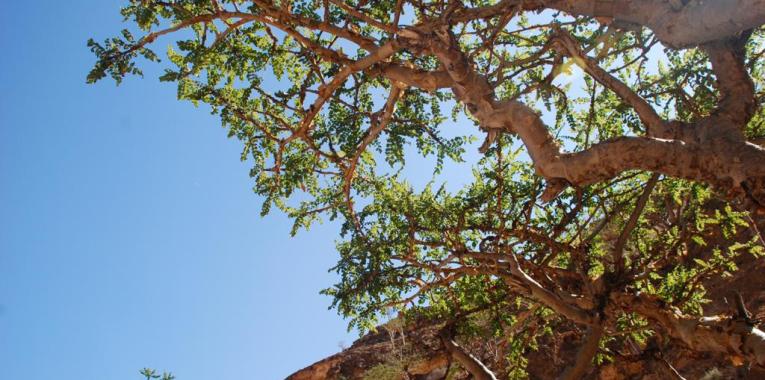
Perhaps aware that the day was not quite the happy culmination of a year’s hope and expectation, after an hour or so, he pulled off the road, navigating between rock outcroppings until he stopped in front of a small group of stubby, scraggily trees with peeling bark.

“Frankincense!” he exclaimed proudly.

Now this indeed was something. Unexpected and marvelous – to actually see the trees close up, especially since the lore is that they are rigorously guarded. Perhaps the driver took every single tourist to this stand of trees. But it was hidden from the road, without other tire tracks, desolate. A quest fulfilled and an extra, unexpected adventure: it was time to go home. Then I was home and what is there to do at home, except plan the next travel?

Verstehen/ Einfühlen in Arabian Sands (1959): Wilfred Thesiger as Traveler and Anthropologist – 2013

Cultural Refraction: Using Travel Writing, Anthropology and Fiction to Understand the Culture of Southern Arabia – 2009

Research on Travelers and Tourists in Dhofar

“Yemen with Yul,” travel essay published

Research: Article on Theodore and Mabel Bent Has Been Published

I am happy to announce that my article on Theodore and Mabel Bent has been published at: http://tambent.com/2025/08/07/ya-mabel-and-the-duchess-by-marielle-risse/

Abstract: What are the conditions in which ‘imagination and humility necessary to climb into the head of people who live by a very different set of assumptions’ is created? Later travellers to southern Oman have seen and reported only what was most unusual, most foreign and more recent books about the Dhofar region show less understanding of the culture than articles and books written in the 1800s. We will discuss two specific examples of this odd juxtaposition: a Victorian, female traveller who is more accurate about Dhofaris than a modern, female traveller.

Keywords: Dhofar, Mabel Bent, Oman, Qara Mountains, Theodore Bent, travel writing; Jan Morris, Suzanna St. Albans, Wilfred Thesiger

The homepage of the Bent Archive : http://tambent.com/

How NOT to Describe People Who Are Foreign to You: Exoticizing Omanis

Annotated Bibliography of Texts Pertaining to the Dhofar Region of Oman

Cultural Refraction: Using Travel Writing, Anthropology and Fiction to Understand the Culture of Southern Arabia – 2009

Verstehen/ Einfühlen in Arabian Sands (1959): Wilfred Thesiger as Traveler and Anthropologist – 2013

Adjusting to Oman: My Dangerous Taxi

I left Oman exactly one year ago and I miss Salalah every day. This is one of the first essays I wrote about Dhofar, sent to friends in October 2005

When I said I was moving to the Middle East and people asked me, “Isn’t that dangerous?” I replied “Not really.” What I meant to say was “What is ‘dangerous’ is not what you would understand nor what I would I be able to foretell.” Witness my taxi driver.

In many place in the Middle East, taxis don’t have meters and there is an accepted ‘in-town’ fare for ‘just go’ and one for ‘go and come back’ which, considering how long it takes to get a check cashed, find the right form, mail the letter, etc. basically means the driver will wait 10 minutes or so for free. And since usually you are running around trying to get your errands done Thursday morning (ME equivalent of Saturday morning) from 9 to 12, if you have a driver who doesn’t smoke, spit, leer or drive like a maniac, you will often just keep him all morning, giving him one lump sum when he takes you home.

If you find a really good driver (knows some English but doesn’t ask if you are married), you can work out a weekly rate for taking you to and from work every day and Thursday morning errands. As you can’t lease or buy a car without your official visa, which can take up to a month once you are in-country, getting a good driver quickly is essential. This is usually a process of having a lot of bad taxi rides (blaring music; passing on the wrong side; getting lost) until you find a guy you like. The paradox is that drivers who offer to be a regular driver are usually exactly the wrong kind of guy (a “any club who would have me as a member…” issue – you want a taxi driver who does not particularly want to talk to a Western woman, who treats you as one more anonymous fare).

My second night I was in town, I stopped by a schwarma stand (a few tables inside, clean, well-lit) and sat for a few minutes to have my chicken wrapped in pita bread and fresh fruit juice in peace. My colleague, X, walked in by chance so I started to ask him what some of the items on the menu were. X didn’t know what “Maryam” meant in this country and as we were discussing, a middle-aged local sitting at another table, explained the meaning (mixture of orange and mango juice) to X in Arabic. I asked about another term; X asked the local guy, who explained with a few smiles and gestures, fruit juice and frozen ice cream. I tried a third item; X, not interested in my linguistics endeavors, left. As I was paying, the local man introduced himself as N and asked if I wanted a taxi.

I said no, but, impressed that he had kept talking to X, not trying to talk directly to me until X had left, I asked for his mobile number. After he gave it to me, a man walked up to me and asked “You want a taxi,” I laughed, then glanced at N, who met my eye and laughed too. Ah, a sense of humor!

The next day I asked one of the secretaries to call N to pick me up from work. We went to the telephone company – I wanted a mobile, the ne plus ultra necessity of ME life. I had various forms, all of which were rejected by the clerk. N, who had wandered over to see what the problem was, jumped right in. Fifteen minutes of heated discussion later, the clerk agreed I could have a cell phone. Then it was two hours of paperwork and waiting. Once I had the phone chip in hand, back in the taxi. “Could you please take me somewhere to buy a phone?”

This was a request, but also a test – were we going to end up in his cousin’s overpriced House of Cell Phones? Nope, straight to a real store (i.e. you would get a warranty). But the man at the cell phone counter hadn’t shown up for work yet. I told N I would go to the grocery section for 15 minutes. When I returned 20 minutes later, he tapped his watch and said “I have been waiting five minutes!” Part of me thought “give me a break, I have been in-country 48 hours, I don’t even own a coffee cup”; part of me thought “Getting scolded by your taxi guy is a good sign. The more he sees you as a regular person, the better.”

Cell phone man arrives; I pick out a phone; N takes over. He installs the chip, sets the date and time, adjusts all my settings, programs a password, calls my phone and puts his name on my contact list, then calls himself on my phone so he has my number. We are now joined.

I put my groceries in the truck and collapse into the back seat; “Time to go home” I say. N drives off in the opposite direction. I am going to get a tour of the town and there will be a quiz: “This is Water Roundabout. What is the name of this roundabout?”

“Water.”

“Very good.” Then he heads out of town – as in away from all buildings and up a mountain road. Hmmmm, then he turns off the main road and onto a small side road. I contemplate whether I should ask him to turn around, attempt to jump out of the car or scream. I wonder how one calls the police, given that I have a brand-new cell phone in my purse, which for all he I know he has sabotaged. I wonder if this qualifies as “dangerous.”

I don’t do anything – trust? stupidity? jetlag and culture shock and general weariness? Ten minutes later he pulls up at beautiful scenic overlook. “Too much beautiful” he proclaims. Well yes, not that I wanted to go a scenic overlook, but then I hadn’t seen anything of the town yet except the inside of offices, so it was rather nice.

After sufficiently impressing upon me how nice his town was, he pulls into an open air restaurant and disappears for 5 minutes. When he comes back he hands me over a carefully wrapped plate of something. “Fish,” he says with a smile. “Special fish.”

 Then he drives me home. Where I discover it is a plate of grilled beef cubes. Ok.

Two days later we are out for more errands. We go to find me two small lamps, which he insists on plugging in to make sure they work; fuse boxes, which he inspects carefully; plastic bath mats, which he allows me to choose in peace; cleaning supplies, he picks up and looks at, but doesn’t comment on. I’m starving.

He pulls up to a mini-cafeteria, toots the horn and asks me “chicken or egg?” Well that is a Mobius strip sort of question. The guy comes out of his shop and looks at N. N looks at me. OK. “Egg.”

After a few minutes, the restaurant comes back and hands me a wrapped sandwich which is a bun shaped like a hotdog roll, but sweeter, with a chopped up boiled egg, cucumbers, tomatoes, ketchup, mystery sauce and cold French fries – which pretty much covers whatever one could possibly want or need.

 “Nice?” N asks.

Nice indeed.

He has a real job besides taxi driving so he can’t take me to and from work every day, but I call him for errands and for longer missions. When I was stuck at a hotel far from town with 2 obnoxious Brits and a bunch of local taxi drivers who wanted 5 times the going rate, I called N.

“Let’s take one of these taxis and just pay what we want to pay when we get there, not what we have agreed to pay,” said one of the obnoxious guys.

“You can’t do that. And N said he would come, he’ll come.”

“Why would he come all the way here?”

 You can’t explain the intricacies of the taxi relationship to Middle Eastern newbies, so I keep quiet. N comes; the guys start to ask him why the hotel taxi drivers were ‘so stupid’ as to charge so high a price that I ended up calling him instead. N doesn’t understand the question, thank goodness, and I try to steer the conversation to other issues. But both men spend the taxi ride complaining about Middle Eastern taxis and the Middle East in general.

When we drop off the second guy, N gets out a piece of paper to write his mobile number. “No, no, no,” I say softly in Arabic. N looks at me – why am I depriving him of a customer? – but puts the paper away.

As we head to my home, he says accusingly, “I give my number; you say no.”

“Those men too much bad, argue with you, not pay you fair price. My friend, I give your number. Not bad men.”

“Bad men?” He looks at me in the rearview mirror, not quite believing but sometimes you just have to trust across that cultural divide.

“Too much bad men,” I say.

“Ok.” He drives me home then refuses to let me pay him. “I was sitting, no work, you call, I am happy.” I tell him to look over there, he looks, I drop the cash in the front passenger seat. He laughs.

He goes to his village for a week and brings me back a large plate of fresh dates and an indescribably ugly black plastic bath mat.

I call him to ‘go round.’ He picks me up and we drive out of town. I don’t say where I want to go, just that I need to be back home at 6pm. “7pm,” he says. He switches on the English language radio station and, carefully avoiding the herds of camels in the road, drives for two hours – beautiful scenery flashes by. I drink the water and eat the ‘pizza’ flavored potato chips he insisted on buying for me.

I trust N with my life on steep, winding roads with camel obstacles; I trust him as he drives lonely roads hours outside town to places I couldn’t find on a map. I get in his taxi, say “Bookcase” and he takes me to the, by his carefully reasoned standards, the best place for bookcases in town.

When I said I was moving to the Middle East and people asked, “Isn’t that dangerous?”, I replied “Not really.” What I meant to say was “I have a lot of fresh dates in my kitchen I am trying to give away and a very ugly black plastic mat I am trying to discreetly throw away.” What I meant to say is, “May I introduce you to N?”

Practicalities of Moving to the Arabian Peninsula: How to Sit, Not Wear Shoes and Use Your Hands

Practicalities of Moving to the Arabian Peninsula: Dealing with Loss

Ethnography – Staying Calm

Ethnography – Navigating Shaking Hands on the Arabian Peninsula


Reflections on Ethnographic Work: Ending and Beginning

Now that my time in Oman is ending, I am thinking about when I first came here. My friendships began in the usual ways: meeting colleagues, accepting an invitation to dinner, deciding to take an evening class, accepting a lunch invitation, deciding to teach a summer class and deciding to take language lessons. These small decisions had many consequences, but not life-changing consequences. If I had not accepted that dinner invitation, there would have been another one, or if I had not met that person, I would have met someone else.

Starting my unexpected foray into ethnography was quite different; my academic work hinged on two insignificant, random acts: reading a footnote and cutting vegetables. Thanks to those two actions, I published three books and several articles, gave many presentations and tried to help newcomers with orientation sessions. I also have a whole set of life skills I will probably never use again from making a fire with damp wood to driving up steep inclines to sitting patiently for hours to speaking colloquial Arabic.

The story of the footnote starts on the first day of khareef (the monsoon season) in June 2006. A few Omani men (who were part of a larger group of Omanis and expats that I was part of) sent me a message saying they were in town and wanted to meet. I invited them to my house, sad that the heavy mist would mean that we would have to sit indoors instead of enjoying my nice garden.

But when they arrived, they picked up the trays of water, soda, chips and cookies and brought everything outside. “Khareef!” they proclaimed joyfully as we sat amidst the mosquitos and drizzle. “This is not fun” I thought, but their enjoyment of the humidity and light rain made me realize that there was a lot about them I did not understand. And what field of study helps people comprehend foreign behavior? Anthropology.

So I asked my dissertation professor, Michael Beard, if he had any recommendations for basic anthropology texts to help understand the cultures I was now living amongst. By chance he had a friend and colleague who taught anthropology and was retiring; Gretchen Lang kindly boxed up 20 texts and sent them to me.

I read the books throughout the fall. They were interesting but so few of the texts’ examples dealt with the Arabian Peninsula, I felt that they didn’t pertain to my life. Then I read a footnote that referenced Wikan’s work in Oman as an example of a particular phenomenon. And it was off to the races.

I read all of Wikan, then started reading the works in her bibliographies, leaving my home provinces of literature, pedagogy and travel writing for archeology, architecture, cultural studies, folklore, history, Islamic studies, political science and tourism, then farther afield to animal husbandry, city planning, house construction, fishing, ornithology, use of public spaces and zoology. I ended up writing about Dhofar/ Oman in terms architecture, comparative literature, cultural acquisition, ethnography, fairytales, foodways, gift/ gift theory, houseways and urban studies.

The second act happened in August, 2013. By this time I was part of two research groups with Dhofai men, which were centered around A and B (see note). B’s group included C and some of his friends. In August, C invited me for a picnic dinner with only his friends. We all had a good time and one week later, C invited me again. As we settled down on the mat, he handed me a plate of vegetables and said, “cut these.” I took the metal plate and knife and got to work. From that night until covid hit and we stopped meeting, cutting vegetables was my job. After the covid restrictions waned, the guys started to bring prepared food from home and my job changed to bringing the soda and water.

Years later, when we were talking about how we all met and how long we had all known each other, I mentioned those first beach picnics and C said that his asking me to cut vegetables was a test as he wanted to understand my personality. If I had refused, then he never would have invited me again.

His words were not surprising because by then I knew how the men always teased and tested friends, but it struck me that so much had rested on one small act.

All the men in A’s group spoke at least some English and had traveled; most of the men in B’s group spoke some English and had met other Western people. Also, when I hung out with A’s and B’s groups, we usually met in spaces where they would not see anyone they knew.

But in his group, C was the only one who spoke English so I generally spoke only Arabic. In over 300 picnics with C’s groups I had the chance to improve my Arabic, meet dozens of men, go camping and ask endless research questions. We celebrated weddings and births, mourned deaths, ate a lot of (too spicy!) meals and discussed all sorts of geo-political upheavals.

And, since none of the men had ever socialized/ eaten a meal with a Western, female Christian we went through a lot of steep learning curves together. This June I handed a package of cookies to one man and he replied by saying “Duck?” in Arabic. I thought that was odd, so I repeated “Duck?” then thought, he is making a joke by asking if I am giving him duck food! So I said, “Duck” again and began to quack.

C, who was scrolling through his phone, said, “Open” in English. Oops! I misunderstood; the man said “Open?” in the local slang of Hindi, not “Duck?” in Arabic – two words which sound somewhat similar. And by “Open?” he meant: should I open the cookies now or save them for my children? So I said, “for your children” in Arabic. No one commented on the fact that I had enthusiastically quacked for 10 seconds. This is what you have to put up with when you have friends from different cultures.

Reflecting on over eleven years of meetings, I brought up the subject of how we started to work together with C a few weeks ago. I asked him if he remembered the first time he invited me to a picnic, then the second invitation and “did you ask me to cut vegetables?”

He said, “yes,” then asked me why I was thinking of that subject.

The conversation in Arabic went something like this:

me: Now that I am going, I am thinking of the beginning, and I remember you told me once that when you asked me to cut vegetables it was a test. And I am thinking that it was a chance, an important chance, and if I had said no, then we would not be friends.

C: It is important to test people you don’t know. If they will just sit and never work, there will be trouble later. So it is better to see how a person is at the beginning.

me: I understand, but I am thinking if I was in a bad mood or sick and said “no,” maybe I would have missed knowing you and these men. It was just that one chance. You said you would have not invited me again.

C: I would have invited you once or twice more. You have to give space for a person, maybe they are tired or maybe they are saying “no” because they don’t know what to do. If you had said, “no” I would have given you another chance, because maybe you would have said, “I don’t know how.”

I nodded and we changed the subject. The next day I decided to check my recollections by looking at my excel spreadsheet where I have information (date, place, names, what we ate, what we talked about etc.) on all picnics and camping. For August 11, 2013 I have an entry about meeting at ‘the place’ with C and four of his (now my) friends. For August 17, there is another entry about meeting at the same place with the same people and after the summary for what we had for dinner is the note “me cutting vegetables.”

It’s nice to see my research life validates two of my constant talking points with other researchers: document everything and you may never know the good thing you do that will open doors for you.

Note: For the research guys, their friend groups are never conceived of as being “centered” on one person. I use this terminology as it reflects my reality. In each group there was one man I met first, who introduced me to the other men and ran interference in terms of me asking questions (what should I wear?) and other men asking questions about me.

Antigone and Ismene – Making Difficult Choices

Conference presentation about conducting research on the Arabian Peninsula

Reflections on Ethnographic Work: The Grasshopper

Reflections on Ethnographic Research: Claiming Knowledge and Shifting Perceptions

Reflections on Ethnographic Research: What is Missing and What Changes

Reflections on Ethnographic Research: Getting it Wrong

I have been looking at collections of ethnographic essays and several essays show in up most or all texts: Bohannan’s “Shakespeare in the Bush” (1966), Lee’s “Eating Christmas in the Kalahari” (1969) and Miner’s “Body Ritual Among the Nacirema” (1956). There is another essay that is often included, Geertz’s “Deep Play: Notes on the Balinese Cockfight” (1972). In looking over these 4 essays, I wondered, why are these the most widely anthologized?

What they have in common is that in Bohannan’s, Lee’s and Geertz’s essays, the first-person authors are revealed to be completely wrong in an amusing and memorable fashion. In Miner’s essay it is the reader who learns that they were wrong as the essay is set up to de-familiarize American culture (Nacirema = American).

In Bohannan’s, Lee’s and Geertz’s texts, the first-person narrator starts out facing a common field-work task and ends up being the one out of control. Bohannan wants to explain Hamlet to a group of interlocutors she has been gathering stories from, but she is taught the true meaning of the play. Lee wants to get a fat bull to give his interlocutors a feast but, although he gets the largest animal he can find, he is accused of being stingy. Geertz and his wife are trying to integrate into their new research environment, a small village in Bali. They succeed not by their academic reasonings but because they run away when police raid a cock fight. Fleeing in terror and ending up in a stranger’s courtyard pretending to drink tea is what gets them included in village life.

Bohannan, Lee and Geertz confidently set out on their paths, get linguistically/ culturally/ physically lost but end up with valuable insights that help them understand the cultures they are studying. To me, they are popular for the same reason The Wizard of Oz, Alice’s Adventure in Wonderland and the new Super Mario Brother’s Movie are popular. It’s fun to watch someone else live through a tornado/ drop down a rabbit hole/ fall into a tunnel, arrive in a foreign county and slowly learn the ropes.

And I think there is something hopeful and reassuring in hundreds of anthropology professors assigning these essays over the last 50-odd years. Reading them is a reminder that things can go very wrong in fieldwork and still turn out ok. They are anthropological equivalent of the Tolkien quote:

It’s like in the great stories, Mr. Frodo. The ones that really mattered. Full of darkness and danger they were. And sometimes you didn’t want to know the end. Because how could the end be happy? How could the world go back to the way it was when so much bad had happened? But in the end, it’s only a passing thing, this shadow. Even darkness must pass. A new day will come. And when the sun shines it will shine out the clearer. Those were the stories that stayed with you. That meant something, even if you were too small to understand why. But I think, Mr. Frodo, I do understand. I know now. Folk in those stories had lots of chances of turning back, only they didn’t. They kept going, because they were holding on to something.

Brief, non-life-threatening panic is useful, like the concept that nightmares aren’t telling you something terrible will happen, but simply trying to get your attention. And it’s helpful that all three essays highlight the randomness of the panic in that the three narrators felt confident in what they were doing until, suddenly, they were lost. That’s exactly how ethnographic research goes; the panic can come at any time.

A few months ago, I brought food for a meeting with the research guys. I usually bring the firewood and drinks as I don’t cook, but there is one restaurant in town that is trusted so I try to bring dinner now and then.

Like Lee, I was happy to know that I had managed to bring good food for people who have been helping me with my research for years. I unpacked the hummus, salads, bread and plates of grilled meats with pride. One of the men motioned me to put one of the plates of meat back into a cooler, saying “there is enough.” I knew this was in keeping with their normal practice of not setting all the food out as untouched food could be given to other people if not needed. It’s better to have everyone eat from one or two plates which are picked clean than have three or four half-eaten plates with the leftovers thrown out for animals.

We started to eat and, after a while I noticed that the plates were emptying faster than I had anticipated. Soon, there were only scraps left on table. I looked at the man I know best (X) and he glared at me. I felt horrible. I had failed. I had not provided enough food. I was miserly. What a stupid mistake to not bring enough! I glanced again at X and he glared at me again. I was a huge disappointment! I wanted to sink into the sand.

Then I reflected – wait, these guys do not care about food! I wrote an entire book about these men do not care about food. They can handle being hungry for hours; they take pride in their self-control. And they had all eaten at least some meat; no one was starving. So why was X glaring at me?

I looked at X for a third time and he glanced over at the cooler. Suddenly I remembered, I had put an extra plate in the cooler to save for a late comer. So I reached over, opened the cooler, pulled out the plate, took off the tin-foil and set it in the middle of the mat. Everyone dived in.

Ah-ha! The issue was NOT that I had not brought enough dinner but that I had not offered all that I had. Given the importance of self-control in their cultures, they were not going to ask me to give them more food. I brought the meal, so I needed to be the one to offer it. Since I was not offering the last plate, perhaps I wanted to keep that food for myself. And they were not going to lose their dignity by asking for it.

X wasn’t glaring because I had underestimated how much to buy but because I was acting like a miser. Not buying enough is ok; selfishness and stupidity are not ok. I should have remembered the last plate and immediately set it out.

A few weeks later, I checked my insight with X and he agreed with my understanding. He thought maybe I had forgotten the extra plate, but he wasn’t sure, and he had to leave the decision up to me. Then I ran this whole story by another research guy who was not there that night and got the same reaction: no one would care if I didn’t provide as much as everyone wanted to eat, but to have food in the cooler and not share it – that was bad behavior.

The event made me think of Lee’s essay and Alice playing croquet with flamingos. It’s fun to read about other people’s moments of confusion and frustration, and so difficult to live through those moments yourself.

(photo by S. B.)

Reflections on Ethnographic Research: Claiming Knowledge and Shifting Perceptions

Reflections on Ethnographic Research: What is Missing and What Changes

Reflections on Ethnographic Research: (Not) Asking Questions

Reflections on Ethnographic Work: Behaving Badly and Defending Grandpa

Reflections on Ethnographic Work: Shopping, Safety and Maneval’s New Islamic Urbanism (2019)