
I started to write an essay about the problem of dealing with American handshakes, then realized I needed to back track and explain what handshakes mean in Oman.
In the Middle East, the basic premise is that women shake hands or kiss cheeks with women and men shake hands, kiss cheeks or bump noses with men. The exceptions usually are usually between men and women in business situations with non-Arabs and between family members.
It took me a little time after moving to Oman to realize that I should never put my hand out – if the man wanted to shake hands, he needed to put his out first. As I became friends with Omanis, I gradually adopted the local pattern of putting my right hand on my heart rather than shaking hands with a man. The change was partly because of the Dhofari culture understanding that if there is no need to do something, don’t do it.
Also, men who I didn’t know would come up to shake my hand and that felt odd. Several times an unknown man would walk into my office, stick out his hand, then get angry that I would not shake with him. I didn’t who they were (they never gave their name) or why they were doing it.
Their actions led to several conversations with my Omanis students in which I explained that in American culture – handshakes come with names. Either there is someone there to make the introduction or the person extending their hand says their name and their relationship (e.g., I live next door, I am here to fix your printer, I am the manager, I am your daughter’s teacher).
My stopping handshakes was also partially due to interactions with the research guys. A few of the guys shook hands with me the first few times we met, but that gradually ended. Shaking hands with a woman was not something they were comfortable with; they did it at first as a way of respecting my cultures, but as I got used to them and tried to fit in with their cultures, we stuck to verbal greetings.
This was in keeping with the general understanding that men should never touch a woman who was not proscribed from marriage (mother, sister, child, aunt, etc.). If a man did touch a woman before prayer-time, he would have to do the ritual washing before he prayed.
This comes across to some people as “women are pollution.” That’s not how I see it. First, a lot of actions can put a person out of the state of “ready to pray,” it’s not just a touch of a woman. In Islam, a person should make their body, mind and surroundings ready for prayer by creating a temporary sacred space (see below). I was once having a discussion with one of the guys about praying and I said that as a Methodist, I pray a lot, doing small prayers throughout the day in the midst of everyday actions such as brushing my teeth.
“Not in the bathroom!” he snapped.
“God is everywhere,” I answered. For him, God is everywhere but when you pray, you should be solely focused on prayer.
When I first started having picnics with the research guys, their saying “Don’t touch me!” was sometimes annoying as it did not seem a big deal if I bumped someone by accident as we were trying to fit 6 of us around a platter of food, passing lemons, knives, bottles of water and Kleenex. I felt that they were being unfriendly.
I gradually understood that they felt I was being uncoordinated and unhelpful. I wasn’t pollution; I was inept for grabbing a spoon at the same time they did. And the result was that they had to spend the time and water to get ready for prayers. So, I got less clumsy and learned how to notice my surroundings more carefully.
The “Don’t touch me” was part of a much larger lesson about understanding how to move myself and objects through space. For example, if someone needed the floss I would put it in my right hand, pull my hand back to my right shoulder and then throw it at their center mass as hard as I could. This is not the way to move objects! They told me to put the object in my right hand, bring my right hand down to my right hip and loft it up, so that the trajectory was not a straight line but an arc which would end with the object in the lap of the person I was throwing to.
That took a while to learn, but I got it. And I learned how to pass Kleenex boxes by holding on to one end, with the far end towards another person. I learned to hold a cough drop in my gathered fingers, wait until a guy held his palm open underneath, then let it fall.
The lesson that made the biggest impression on me was passing teacups. Tea was served very hot in small cups and, from their culture, you should make sure everyone else has a cup before you drink; this meant I was constantly passing hot cups. I would grab the bottom and be told “Take the top!” To me, that was rude because it meant putting my fingers on the place they would be drinking from. I finally asked, “WHY do I have to take the top?”
They told me, “The bottom is too hot, you will hurt yourself.” Which was absolutely true, grabbing the bottom of a thin carboard cup full of water just off the boil was painful. And for months they had individually and collectively organized cup-passing so that I had the easy part (holding the rim of the cup) and they would take the hard part (holding the bottom).
So, when people try to explain to me that Omani men see women as pollution, the image that comes to mind is a group of men shaking their hands because their fingers are scorched.
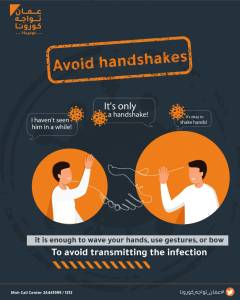
Then came Covid and I was enormously grateful for the Omani convention of keeping 4- or 5-feet away from strangers and acquaintances. I always had a healthy buffer zone between me and everyone else. There was no need for those stickers on the floor telling people where to stand in lines. If you were with family, stickers were not going to keep you apart; if you were with strangers, no one was going to stand close to you whether there were instructions or not.
The result of hundreds of picnics with the research guys and an epidemic is that one of the hardest aspects of returning to America is how often people want to shake hands, something I no longer want to do.
Researching and Working on the Arabian Peninsula: Creating Effective Interactions
Returning to USA – Culture Shock essays
Religion and spaces in houses (from Houseways in Southern Oman, 2023)
A few months after I met one of the research guys he said to me, “I want to see you pray.” The men always did their prayers if we happened to be together at a prayer time, so he knew I had seen what they did and, as he had never seen a Methodist pray before, I recognized the same “how do you do that” type of question that I always asked them. I was sitting cross-legged, so I clasped my hands and rested them on my shins, took a deep breath, closed my eyes and said the Lord’s Prayer and St. Francis’ prayer (“Lord, make me an instrument of your peace”). This elicited a lot of conversations over several weeks about what “doing prayers” means.
One awareness that came out of these conversations is that I myself understand two types of prayers: prayers which a person does at anytime and anyplace with no preparation and prayers that are in a sacred space, i.e., when I walk into a church, I feel I am in an area set-apart from all aspects of daily life as everything in the building makes me focus on my relationship with God.
In my opinion, when the research guys pray there is always some external support in that they will always make physical adjustments, such as doing the ritual washing, adjusting their clothing, facing Mecca and, if possible, laying down a prayer mat. If we are on a boat, lines are pulled out of the water, one man does the call to prayer, hands and mouths are cleaned and the man who will lead the prayers moves closest to the direction of Mecca as the boat temporarily becomes a sacred space. As I don’t want to interfere with the moments of preparation or prayer, I huddle close to the side of the boat and look at the water.
Praying in a mosque is the best way to pray; as one informant told me, “better in the mosque, all other places are the same.” Thus, if they are not in a mosque, the research guys create the sacred wherever they are. In asking about the sacred in houses, informants answered the same way: the majlis, salle or bedroom were equally good, as was any “clean” space. Praying is not acceptable in the bathroom and not advised in a kitchen.
In Dhofar, Omani women do not usually go to the mosque to pray except in Ramadan, thus spaces in their homes become their sacred spaces, a change that is created by their intentions and actions. They usually pray in their bedroom, but none of my informants told me that they had a specific place for prayers. When the call to prayer is heard from the nearest mosque or a cell-phone reminder, the person will wash, adjust clothing (for example a woman will make sure her sheila is tightly wound around her head), lay down the prayer mat and make the gesture to start the prayers. In the same way, if someone wants to read the Holy Qur’an, they will make sure they and their clothes are clean, set up the wooden stand to hold the book in a clean area and begin reading.
 Come From Away
You must be logged in to post a comment.