Houseways: ‘Homespaces’ Away from Home

plans by Maria Cristina Hidalgo, https://www.mariacristinah.com/ – first published Oct. 20, 2021

This essay focuses on areas which are perceived as a home. For both picnics and camping, all the general understandings of etiquette followed in houses apply although usually everyone takes on the role as host to some degree. For example, rather than the host pushing people to eat or drink, when any person opens the coolbox, they will act like a host (asking each person what they would like) before they take something to drink. Food that is opened is passed around before the person who opened the package takes any. The man who is cooking might ask a man who comes late to bring fresh bread or more supplies such as water although no one would ever ask a “guest” to bring anything to one’s house.

Further, the cook decides when to eat, but unlike inside a home, in which the hosting family must do all the work, all the people should share by clearing space on the mat, setting out a plastic cover, getting the hot sauce, cutting the limes, etc. And people should, of their own accord, help with the clean-up.

In general, picnicking in open space means creating a private salle. Dhofaris on picnics see themselves as inhabiting a homespace which is inviolate. The space is always clearly defined either by bodies (a group of women sitting in a tight circle) or mats; if there are women, the space must never be approached unless there is specific, immediate need. Men will approach other groups of men to ask for information or share food, but not a group of woman. Cars are always parked to block the groups from view.

Some families share one large mat; other families might make two seating areas, one near the car and one at more of a distance. The two spaces act as salle and majlis; as in a house, small children will act as messengers and carriers and have freedom of both mats and the space between them.  

 The exact amount of space depends on the landscape. The zone under temporary control of the family might be very large or, in crowded places like beaches on the night of the full moon, might only encompass a few meters more than the mat with the car at an angle chosen for privacy. In open areas like the desert or near-desert open spaces, people should camp out of sight of others.

Government- and hand-built straha (“hut”) are important in that they are roofed; shade is essential in Dhofar for most of the year. Both kinds of shelters are first come-first serve. Even if a man made the structure himself, if someone has parked in front of it and set up camp, the builder has no recourse and must wait until that person has left. Sometimes, men will leave bundles of wood, their blankets and some supplies in a shelter and go fishing; no one will take the space or steal the provisions.  

Once the car is parked in front; the shelter is treated like a person’s house whether it is occupied for a few hours or days. As with picnics, the car acts as the bab, the gate in the wall around the house. No one will come nearer than the car without calling out loudly and waiting to be greeted. Normally, even if the person is invited to come closer, they will stay on the far side of the car and explain what they want, to ask for something or give away food. Since there are no internal divisions in strahas, the space is like a salle and a man will usually not accept to sit down or come close unless he is a close friend.

Camping is slightly different as there are three layers while strahas and picnics have only the dichotomy of being outside (the far side of the cars, mats or circle of bodies) and inside (where the people are sitting).

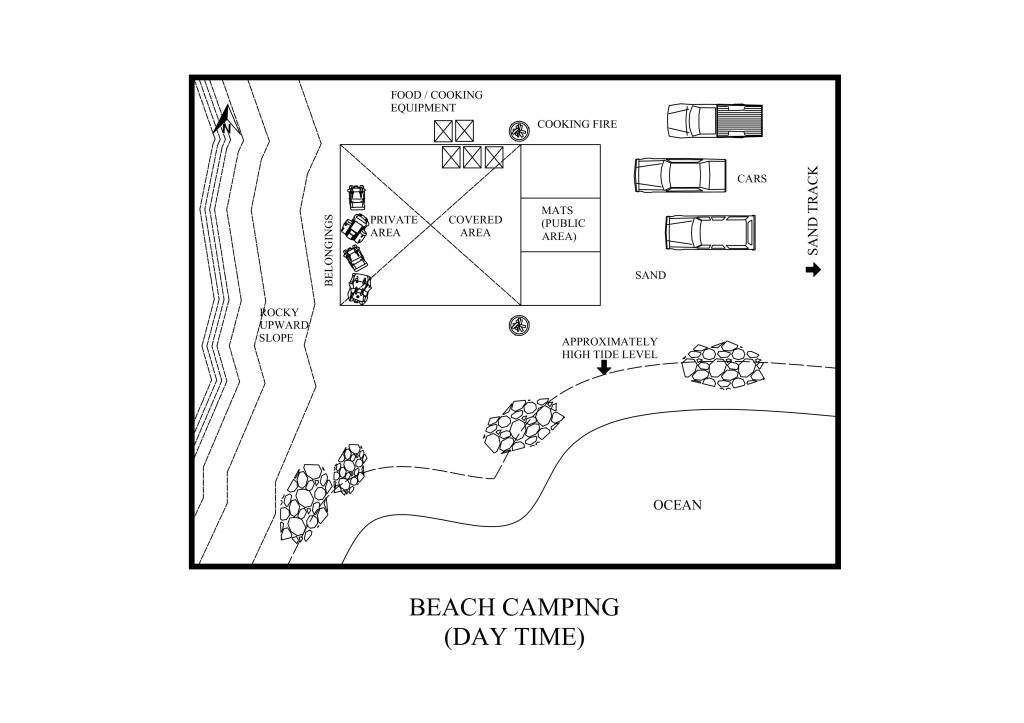
The first layer is where the cars are parked, an area that functions like a hosh. Anyone can walk on the far side of the cars without acknowledging/ being acknowledged. On beaches, the area below the high tide mark is see as a free passageway. The passer-by might lift his hand or call out, but a man walking next to the water or beyond the cars is like a man walking on the far side of a house wall. A stranger who approaches a camping area and needs help will not come closer than the cars. For example, he will stand on the far side and call out his request for a tow or a tow-rope.

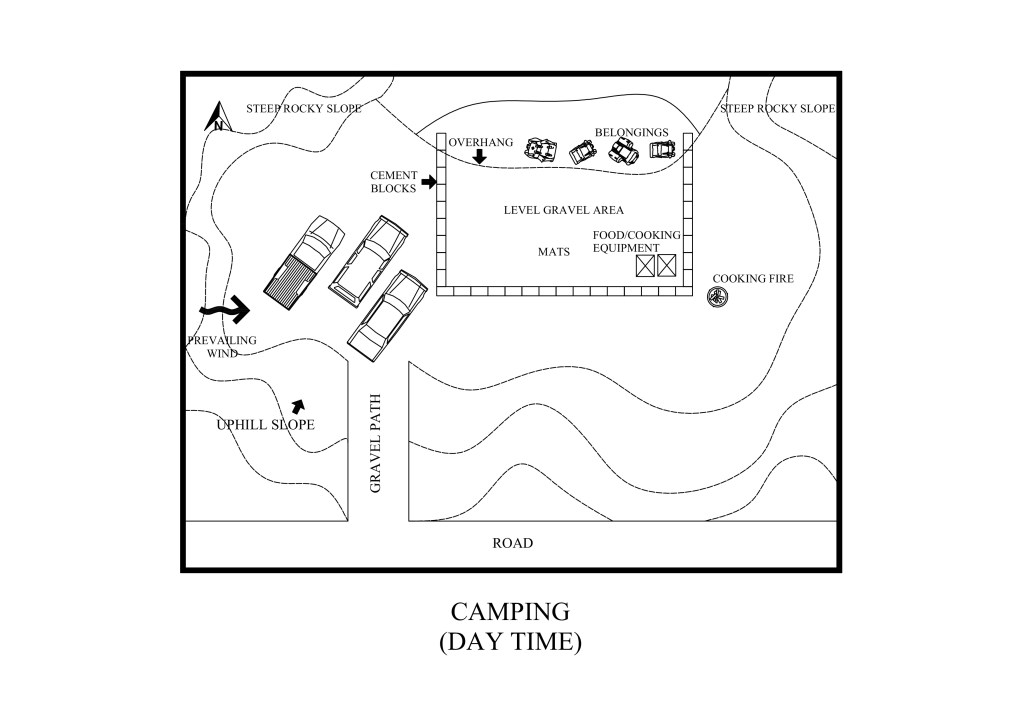
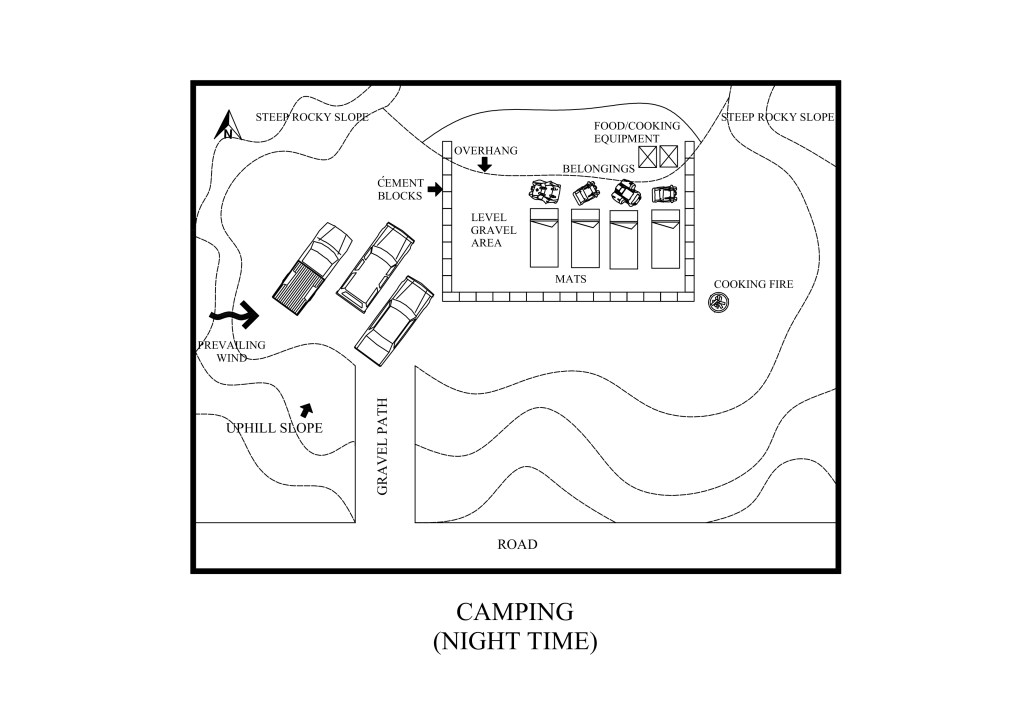
The second space, like a majlis, is the public area for friends and family, usually delineated by mats in the space bounded by the cars and whatever natural features are used such as the ocean, wadi walls, rocks and drop offs. Once a man has approached, called out and been invited “in,” he may join the group and sit on the mat. If he is older, younger men will offer him their chairs or pillows to lean on. The new-comer, as in a majlis, will be offered whatever there is to eat or drink.

The third space, corresponding to the bedroom, is the area used for sleeping. This can be all or part of the inside of the shelter or the area closest to the overhang and is delineated by either piled or set out sleeping mats, pillows, bags of clothing, etc. This zone should never be acknowledged or approached by anyone who is not spending the night; sleeping bags, blankets and personal gear are treated as invisible. A man might reach over and take his blanket to use as a pillow to lean against, but no one else should touch it unless the owner offers it although food, juice, soda, water and the accoutrements for tea are available to everyone.
Safety on picnics and while camping is first and foremost about wild animals: scorpions and snakes in sandy and rocky places, wolves and hyenas in unpopulated areas. The site has to be chosen with care and a fire needs to be lit after dark. Foodstuffs need to be put in cars or well-packed and placed near the fire/ sleeping people to keep them safe from foxes. Animal attacks are very rare but keeping a fire going is essential in areas away from towns.

Example of set-ups for picnic on a beach and camping. Note cooking fire is away from mat and sited in reference to prevailing wind; cars are parked to provide privacy.
Model

Dreaming of Dhofari Picnics

Houseways: How to “Read” a House for Information about the Occupants

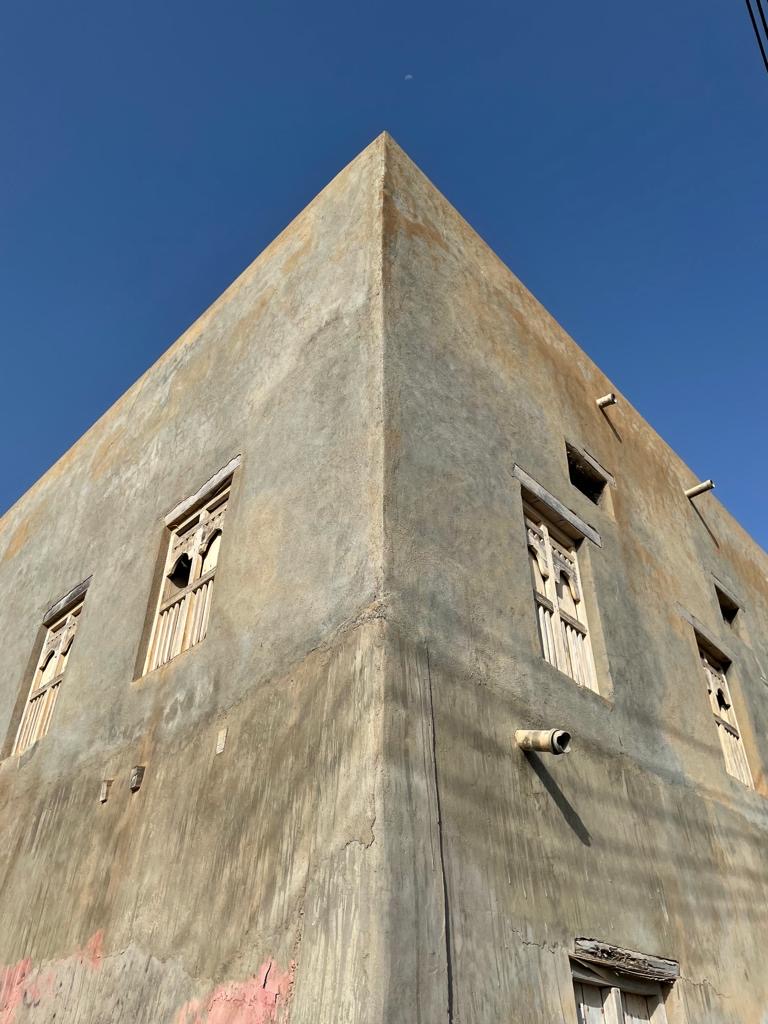
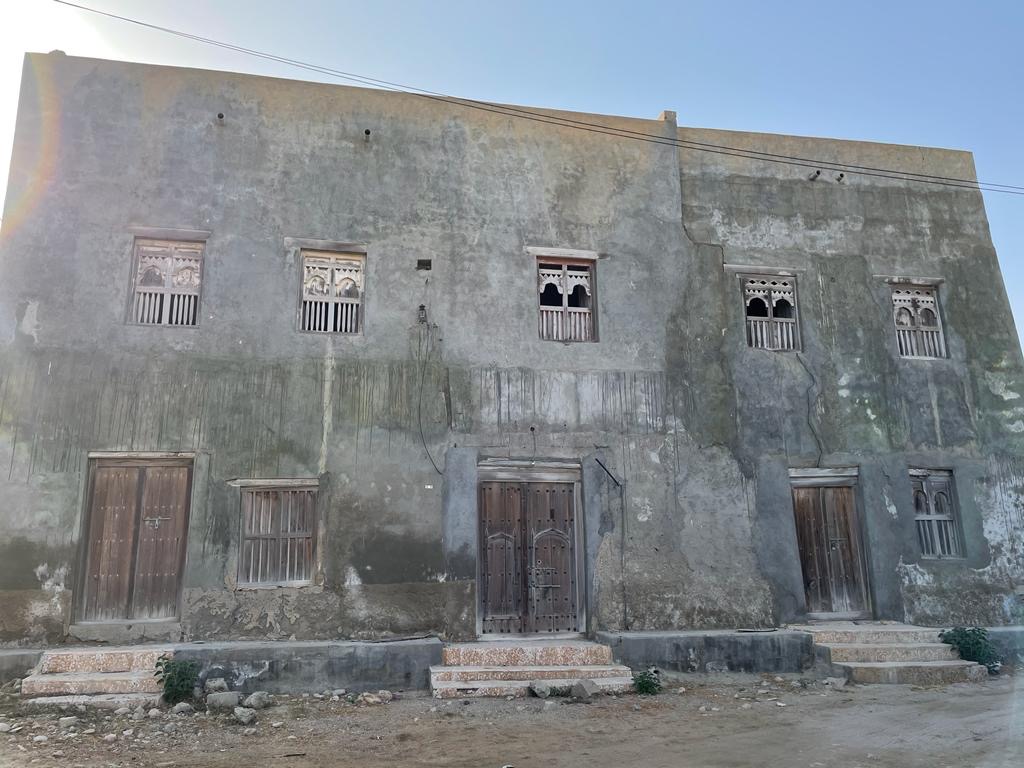
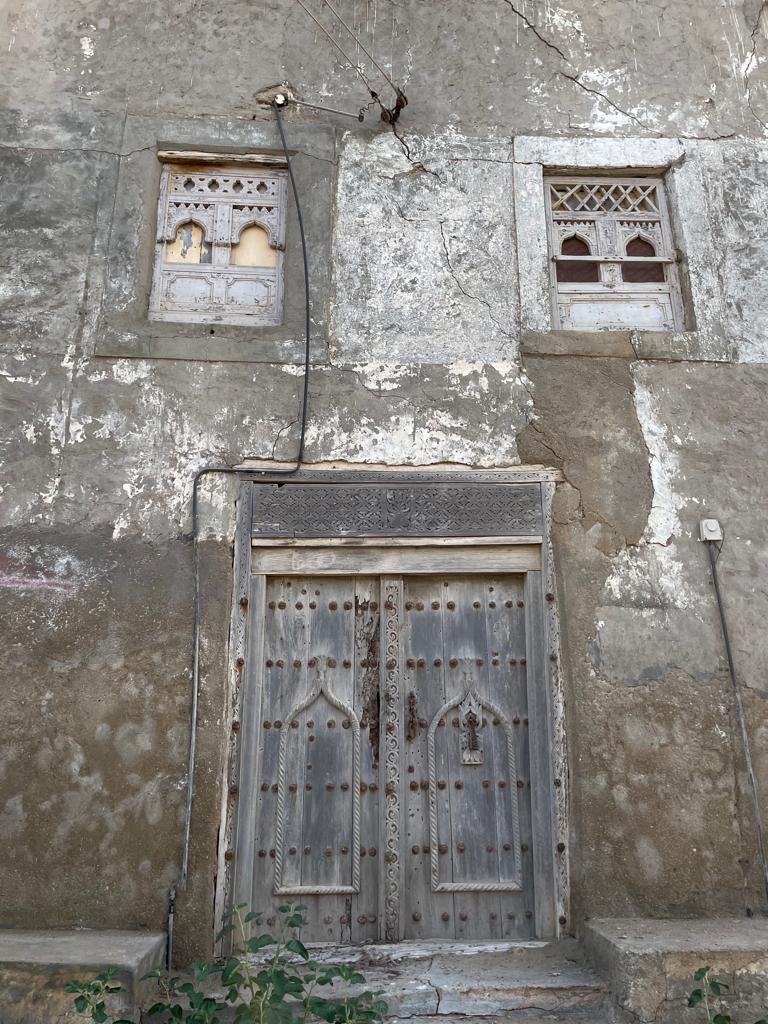
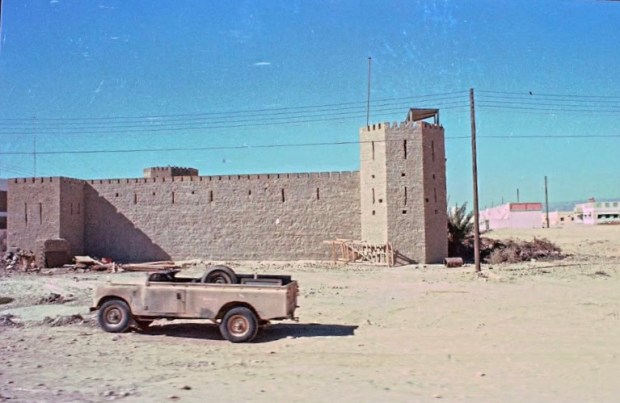
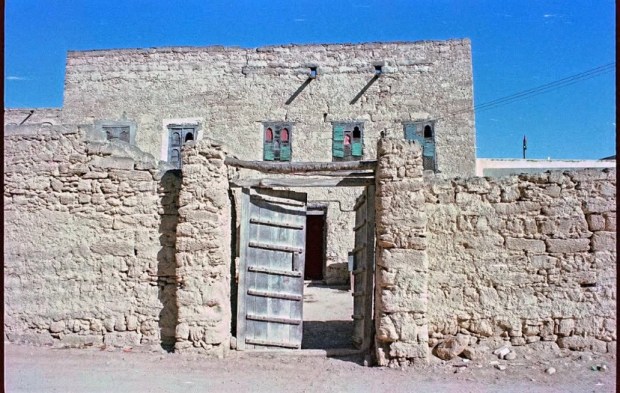
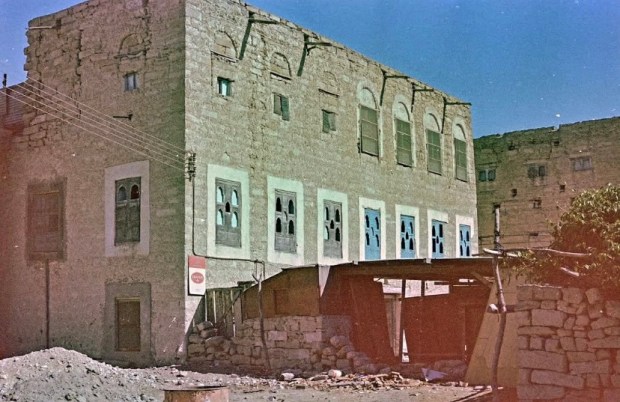
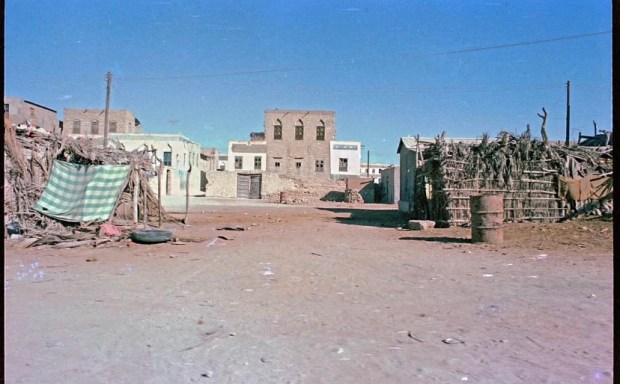
Photos of houses in the Salalah area

Houseways – Balancing Privacy and Hospitality within an Apartment


Houseways: Roofs (how one aspect of house design affects other aspects)

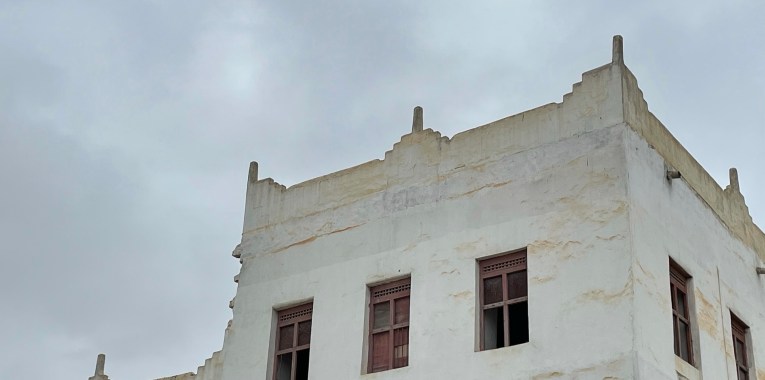
[this essay is part of a series about the practicalities and pragmatics of one-, two- or three-story houses built within the last few decades on one or two plots of land in the Dhofar region of Oman; extremely expensive houses often take up three or more plots and have very different architectural styles; first published in Spring, 2021] – photo by Onaiza Shaikh

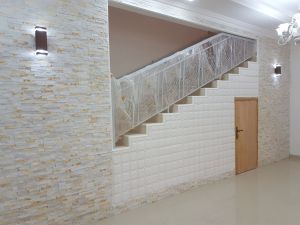
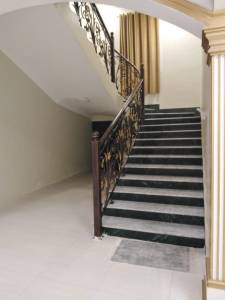
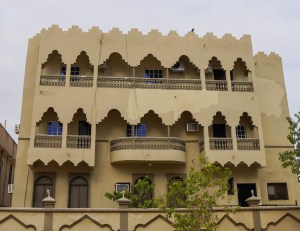
In Dhofari-designed houses the roof is accessed by an internal staircase; this necessity creates certain ‘rules’ about house architecture and space use. First, because the floor, roof and steps are from poured cement and there needs to be space for the support poles, there are always landings and an empty space next to the main staircase (see below 1). Even the back set of stairs (in large houses) are wide with an open area at the bottom. As stairs aren’t built narrowly between two walls, it is easy to get large pieces of furniture to the upper stories. Further, because there is always open space on at least one side of the main staircase, there are always banisters [handrails supported by balusters].

Second, there is always empty space under the stairs which can be used for storage or decorated with a piece of furniture. Third, there is always a landing at the top of the stairs which is usually used as a storage space. This landing space can look like, from outside, a small, four-sided “hat” or cupola. Normally the cupola has windows on several or all sides which, depending on the house design, brings light into the hallway below. The roof of this small space is accessed by a ladder and often holds satellite dishes and the round, white plastic water tank. Water comes from the municipal supply or a well and comes into the house using gravity, although some houses have a small pump to increase force water up into the tank.

In some larger houses, there is both a square room at the top of the stairs and a decorative cupola which is round and is entirety made of glass.

Another aspect of house patterns is that while almost all modern houses have flat roofs, looking at roof accessibility can tell you if the house is Dhofari-designed [meaning either the architect is Dhofari or a Dhofari is planing to live in the house.] While Dhofaris don’t necessarily use the roof space, it is always very easy to enter. If one can only get on the roof by a ladder, the house is not Dhofari-designed.

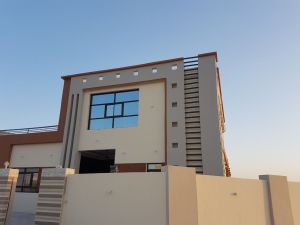
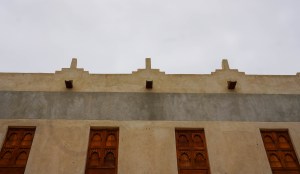
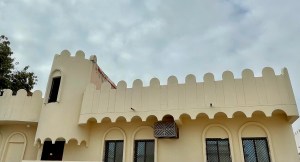
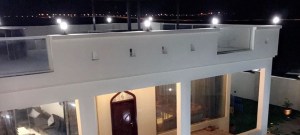
When cement block houses started to be built, roof-lines often looked like battlements with the edge wall as a parapet with crenellations, sometimes fashioned to look like the distinctive local style of incense burners, majmar (see below 2). Now there are many choices including closely spaced decorated balusters, glass inserts, metal railing, etc. (see below 3).

By law, all roofs have some sort of wall around the edge for safety. The most common type is plastered cement blocks up to waist height.  Sometimes there is no discernible difference between wall of the highest floor and the roofwall, e.g. there is a smooth facade until the top of the roof wall, which often has a cornice with a dentil pattern. Sometimes there is a clear division in that the roofwall protrudes slightly and is painted/ decorated. Some newer houses have a flat roof that is smaller than the footprint, a wall at the edge, then a slope of three to five courses of clay tile which meet the wall of the upper story.
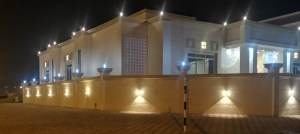
Most roofs have a series of lights, often looking like small lanterns, placed at intervals along the roof wall (see below 3).

Roofs are not seen as part of the living space although there might be a metal or poured cement roofed area for women and children to sit outside, instead of sitting on the front steps. If there is not enough room in the hosh (courtyard), there might be a clothesline (as clothes dryers are rare) and miscellaneous objects which wouldn’t be damaged by being outside, such as leftover tiles. Sometimes there is a laundry room, an extra room for the maid and/ or small room for storage, either free-standing or sharing a wall with the small room at the top of the stairs.

A roof can be finished, meaning that the homeowner does not mean to build another story, or unfinished, meaning although the roof might be tiled and/ or have decorations such as crenelations the owner might build an additional story. This type will have distinctive short, poured cement pillars which cover reinforcing bars, aka rebar. When an upper story is added, the tiles, decorations and tops of the short pillars are broken. [I will discuss the cement/ rebar pillars in a later essay about house building.]

Two personal notes about roofs:

– Hurricane Mekunu (2018) and roofs: Given the infrequent, but heavy, water accumulation after rainstorms, there are often holes drilled at the bottom of the edge wall to allow the water to drain. One neighbor did not have this and after Mekunu hit, his roof looked like a swimming pool for over a week. The day after the storm, I told my landlord who called the neighbor, but he did not come and fix the problem, perhaps because he would have needed to climb up a ladder carrying a pump. Opening the roof door would have meant all that water coursing into the house. As the water very slowly evaporated, I could see the damp seeping into the cement blocks, eventually reaching halfway down the side of the house.

My roof had holes for the water escape and the roof door had a ledge in front of it but the huge amount of water from Mekunu meant that rain came into the landing at the top of the stairs. However, the stairs were slightly canted so that the rain ran down the left side of the stairs and at the first landing spilled over the edge into the stairwell instead of continuing down the stairs. For several hours there was a waterfall in the stairwell but no roof water entered my apartment or the apartment downstairs as the water seeped out in the gap under the front door.

I wonder how the neighbor’s roof door was so watertight. The water was at least two feet deep and took many days to evaporate. I don’t know that neighbor well enough to ask if I can prowl around his house but it is an interesting question.

– When I lived in my previous house, I paid a gardener to keep the roof clean and water various plants in pots. When I looked at the area where I lived on satellite maps, I realized the mine was the only house with a clean roof. (Which begs the question of the tradeoff between having a lower electricity bill because a clean, white-tiled roof reflects heat and wasting water to keep the roof clean.)

Examples of staircases: photos from social media (newly-built house for sale) and an informant

example of stairs with empty space closed off for storage
example of stair with empty space to the side

Examples of recently-built roofs: photos from social media (newly-built house for sale and rental house)

example of roof lights
example of recently-built roof-line

Examples of typical Dhofari-designed rooflines: photos by Onaiza Shaikh

close-up of roof-line – older house
roof line typical in first two decades of concrete houses

example of recently-built roof with glass inserts in roof wall

Photos of houses in the Salalah area

Crafting a Home: Interior Home Design in Southern Oman


Ramadan in Dhofar: Iftar Photos and Essays

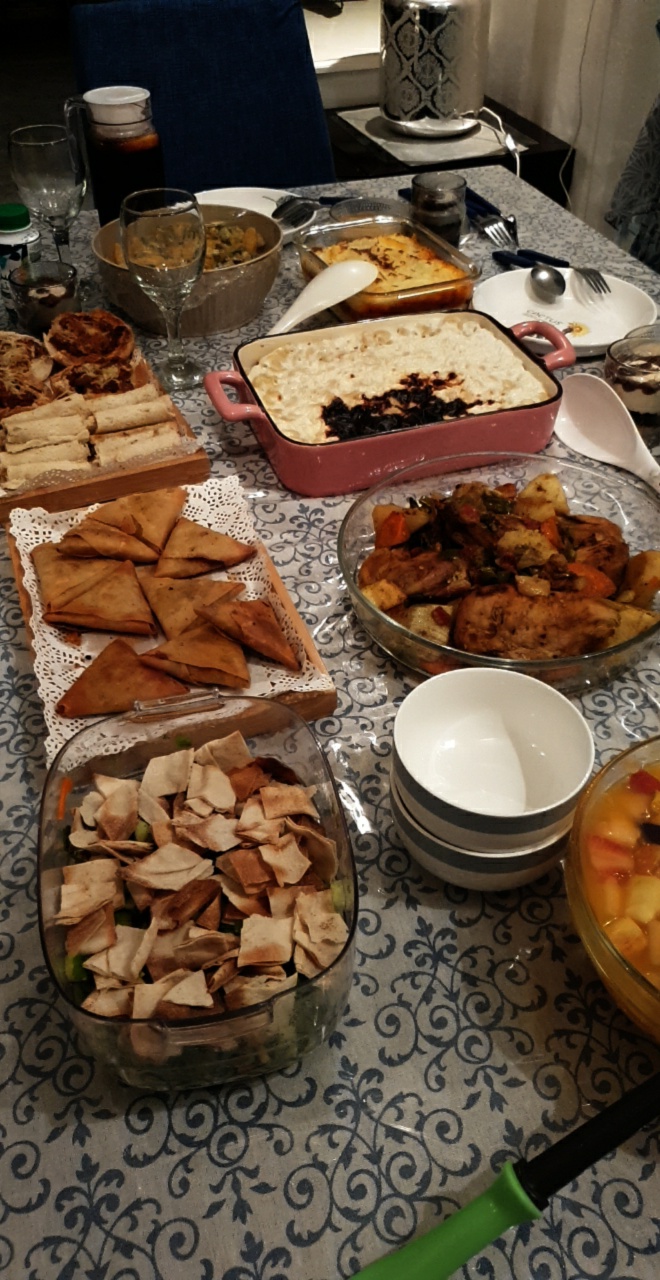
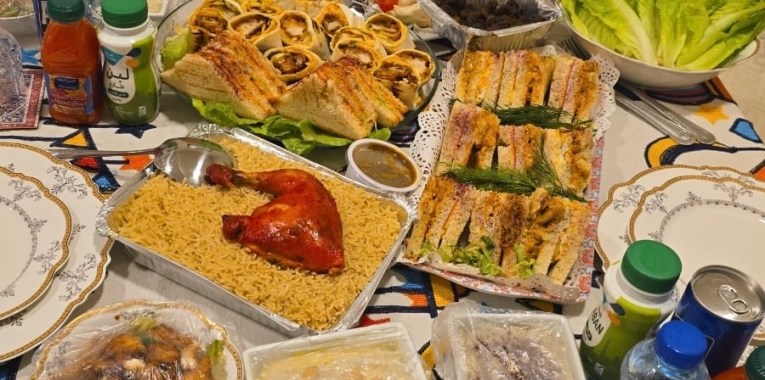
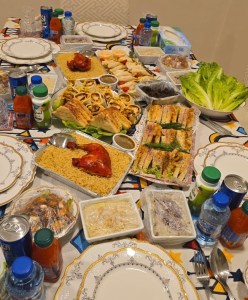
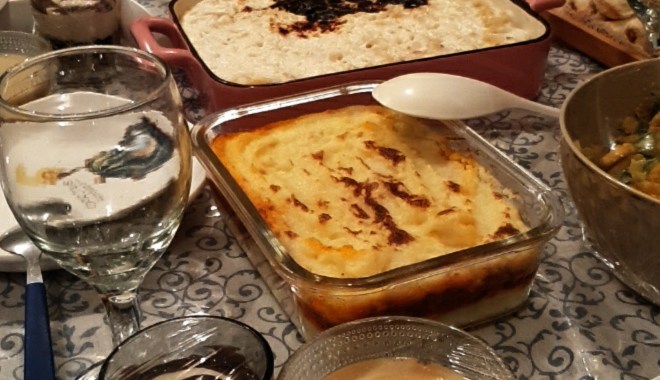
Here are a series of posts with photos and descriptions of iftar (the meal eaten to break one’s fast at sunset during Ramadan) in Dhofar.

Iftar in Dhofar – Typical Food Choices

Foodways: Thoughts on Iftars, Food and Cultures

Foodways: Iftars in Ramadan

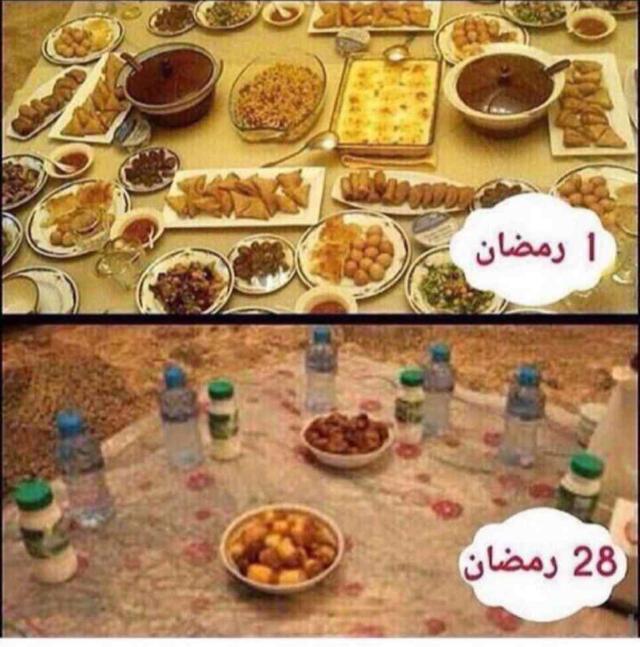
Images of Food during Ramadan – Iftar Humor and Iftar in Beautiful Places

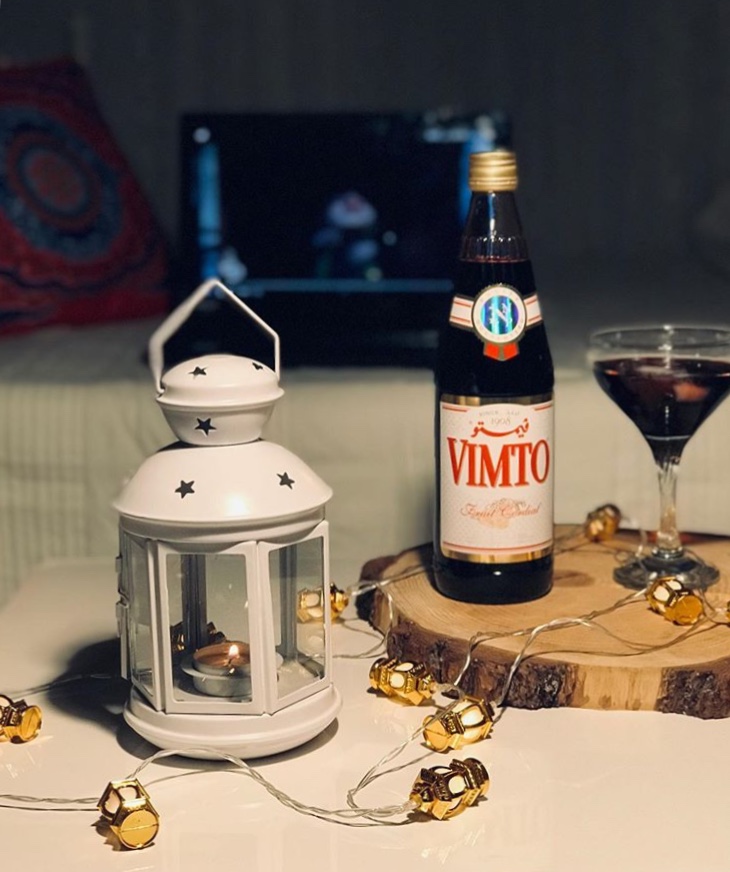
Ramadan Kareem رمضان كريم (greetings with Vimto)

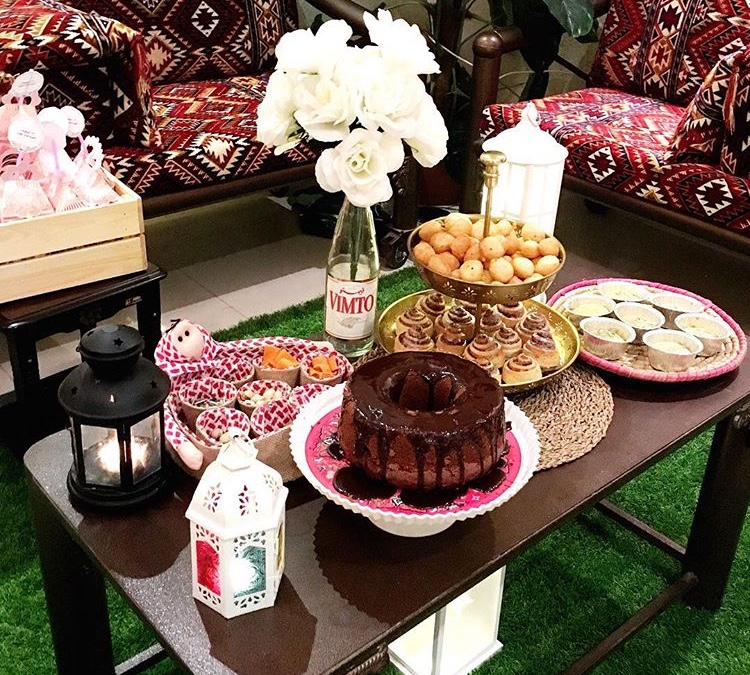
Ramadan and Foodways – Images of food in connection to greetings and good behavior, Vimto and selling food

Reflections on Ethnographic Research: Deciding to Hire Expat Workers (part 1 of 4), repost

A book group I am in recently had an interesting discussion about the ethics of employing porters and Sherpas while traveling in the Himalayas. The conversation about what do you owe the people you employ made me think of this essay, originally published on Sept. 28, 2023.

Overview

By chance in the past few weeks I have read several articles about labor and migration on the Arabian Peninsula such as

  • Gardner, Andrew and Sharon Nagy. (2008). “Introduction: New Ethnographic Fieldwork Among Migrants, Residents and Citizens in the Arab States of the Gulf.” City and Society 20.1: 1-4.
  • Nagy, Sharon. (1998). “‘This Time I Think I’ll Try a Filipina’: Global and Local Influences on Relations Between Foreign Household Workers and Their Employers in Doha, Qatar.” City and Society 10: 83-103.
  • Sarmadi, Behzad. (2013). “‘Bachelor’ in the City: Urban Transformation and Matter Out of Place in Dubai.” Journal of Arabian Studies 3: 196-214.

There are lots of numbers, data sets, opinions and ideas in these texts – but no sense of what it’s like to interact with other expat workers. There is ethnographic work with and about them, but nothing about the writer’s personal economic exchanges: how to hire, discuss and pay wages, decide work load, etc. This isn’t a fault of the articles which have different objectives, but reading these texts made me reflect on my connections to other expat workers, how I manage them and how they manage me.

This essay will talk about my decision to hire help, later essays will talk in detail about some of the people who have worked for me and the types of adjustments that we both make. [The information about wages and dates are from monthly lists of expenses that I have kept since I moved to Dhofar. 1 Omani Riyal is about $2.40; there are 1000 baisa in one Riyal so the 500 baisa bill is worth about $1.20.]

***********

(photo by S. B.)

It is difficult to write about hiring people without sounding complacent, a point that was brought home when I read an ethnographic text about Western expats on the Arabian Peninsula who hired nannies and housekeepers. The author vilified the employers as spoiled, lazy, racist and delusional. The author had obviously never hired anyone to do work for them and had a healthy dislike of those who did.

Writing back against that attitude is not easy. I know I could do all the housework myself but I choose to hire someone to clean my house. This can be seen as indolent but I think it’s more helpful to situate one’s positionality when being critical. “I would never…” is very different than “I have never been in the position to…”.

My decision to hire help is predicated on several lifestyle differences such as how housing designs here allow bugs and sand to enter, the monsoon season and the size of houses.

When I visit my mom in the summer it always takes me a few days to tone down my bug vigilance. “MOM, CRUMBS!!!” I yell on the first morning when I walk into the kitchen and see evidence of sliced bread on the countertop. I quickly rinse the bread board, wipe down the bread knife and inspect the countertops for any speck of bread. Luckily, she has great tolerance for this and within a day or two I mellow out as I remember that a few crumbs on the counter sink will not induce hordes of critters to invade her kitchen.

When I get back to my own kitchen in Dhofar, I return to my watchful ways because I live in a cement block house where ants and cockroaches come out from cracks in the tiling and up from the sink and floor drains. They even crawl out though the electric outlet openings. Twice I have had mice scurry up to my first-floor apartment through the washing machine outtake pipe. There are lizards on the walls, bees flying in through the AC vents and spiders galore.

When I talk about the people I have hired to help me by cleaning my house, I know it can seem like I am lazy. I moved to the Middle East with bona fides of self-sufficiency. When I was a child, I had daily chores and once I lived on my own, I have doing all the cleaning myself. But life is different herein Oman.

For example, I have done my own laundry since I was in 6th grade and it’s simple: put everything in washing machine, then the dryer, fold and put away. But there are no dryers here and my top-loading washer has two bins. You put the clothes in the left-hand side bin, add soap, let it fill with water and turn the knob to agitate the water. Then you let the water drain and lift the sopping wet fabric up and place it in the right-hand bin which spins the water out. Then you hang everything on drying racks, wait for it all to dry, fold and put away. Going to a friend’s house and using her washer/dryer combo in the States makes me ask, “What do you do with all your spare time? Put your clothes in the machine, come back an hour later to find everything clean and dry? It’s a dream!”

Also, my friends’ houses are not in close proximity to deserts. “Sweeping the floor” means one thing in my mom’s house and something very different after a 3-day, 40 kph sandstorm in my Dhofari house where you can see daylight between the window frames and house walls. It’s a joy to sweep in my mom’s house; it takes about 5 minutes and you end up with a tiny pile to discard. After a sandstorm here I need to sweep the entire house and dust everything which takes hours. And there are usually more than 5 sandstorms every winter.

In addition, from June until the end of August, Dhofar has a monsoon season with drizzle and fog on most days. As this is also the time of annual vacation, if there is no one to clean the floors, turn fans on and off and keep watch, mold can grow. I brought a friend home from the airport when she returned to start the school year and when we walked into her living room, her sofas were coated with black mold. When I came back from vacation this summer and opened my car door, the front seats and dashboard cover were green with mold, there were even threads of mold hanging down from steering wheel.

When I lived in Madison, Boston, Minneapolis, and Grand Forks, I had a studio or one-bedroom apartment which was easy to take care of. In Salalah, apartment buildings are usually exclusively expat and I want to live in Omani neighborhoods, which means renting a small house or a floor of a house which are built for extended families. My “small” apartment has a salle, majlis, kitchen, 3 small bedrooms and 3 bathrooms. Friends who have rented houses with 4 or 5 bedrooms just shut the doors of the rooms they don’t use but I would rather hire someone to clean all the spaces.

A related point is that it’s better for me to have a slightly larger place to live as there are fewer “third spaces” here. In the month of Ramadan, for example, cafes are closed until after sunset. In the monsoon season, roads can be so crowded, it’s better to stay home. During Covid lockdowns and curfews I was really grateful I could turn the 3rd bedroom into a work space for on-line teaching. I also like that the woman who cleans my house has a key and can feed the cats if I am away for the weekend camping.

In addition to the calculations of spending time (washing clothes, sweeping, getting rid of mold) vs. spending money (paying someone to clean my house), there is the aspect of how easy it is to get help from someone who wants to work.

When I owned a car in the States, I would wash it now and then but here it is a government regulation that cars must be clean. So I could either spend ten minutes every morning wiping the sand off my truck or I hire someone to do it for me. In most parking lots of large stores, there are expat men who do this work for a small fee. Where I work, there are two men who come every morning to the covered parking area. You can pay them 500 baisa for each cleaning if you want it now and then or 10 Riyal for the month.

There are many such opportunities and I usually much hire and/ or tip everyone both because it makes my life easier and because I have been in need in my own life. I spent years without health insurance because I couldn’t afford it. I have always worked since I was in high school but I had to take out student loans for college. If my older brother had not kindly settled my student loans, it would have taken me at least a decade to pay them off. After the 1997 Red River flood, I ate Red Cross meals for weeks. Having received so much help in my life, I feel I need to be generous.

Every week, I give a money to the people who clean the building where I work and I tip the men who bag groceries. Although it’s not habitually done here, I always tip wait-staff and delivery men. When expat government employees are cutting weeds near my house, I hand out cash and bottles of water. If it’s safe to pull to the side of the road and I have cash in dashboard cubby hole, I give cash to the men who sweep streets. If I have time when there is a team of expat men gardening along the roadside near my house, I will buy cookies, as well as liters of water and soda, and hand them over.

Before I became an Associate Professor, I worked in sandwich shops, restaurants, libraries, a bookstore and an antique store and I can push my own grocery cart. But if I am walking in the parking lot of a grocery store and a man in the jumpsuit uniform of a cleaner walks towards me with his hands extended, I know he is asking to bring my cart to my car for a 1 Riyal tip. So I step away from my cart and let him push – a move that can be seen as being lazy/ exploitative or giving someone a chance to earn extra money.

Reflections on Ethnographic Research: Situating Expat Workers (part 2 of 4)

Reflections on Ethnographic Research: Expat Workers and Reciprocity (part 3 of 4)

Reflections on Ethnographic Research: Expat Workers and Issues of Payment (part 4 of 4)

Frankincense in Dhofar, Oman

Getting Ready for Ramadan

I love the Dhfoari tradition of “killing the snake” (hunger) by inviting close friends to a pre-Ramadan gathering with a beautiful and delicious array of food.

Common Food Terms in Dhofar, Oman (updated)

Food Essays – Grocery Stores, Recipes, Expat Food and Littering

Practicalities of Moving to the Arabian Peninsula: Cultural Understandings of Water and Food

You Have Nothing to Fear from Sheep’s Eyes but Beware the Carrot Sweet: Researching Foodways in Southern Oman


I am happy to announce that my new book is now available for pre-order: Ethnographic Reflections on Marriage in Dhofar, Oman

Ethnographic Reflections on Marriage in Dhofar, Oman

(book cover photo and post photo by Onazia Shaikh)

https://anthempress.com/books/ethnographic-reflections-on-marriage-in-dhofar-oman-hb

Examines how middle-class Muslim men and women in Dhofar, Oman, make and negotiate marital choices, tracing every stage of marriage through their own personal accounts.

Studying Marriage in Dhofar, Oman explains the choices middle-class, Muslim, tribal Dhofari men and women make when creating a life together. Based on 19 years observations of and discussions about Omani marriages, the book shows all the steps of marriage, including how people decide to get married, the wedding invitations and parties are arranged, the newlyweds’ home is organised, the work within a marriage is delineated, and a marriage succeeds or falls apart. Unlike many texts about family life on the Arabian Peninsula, the author spoke extensively to both men and women, so that the book is rich with examples of Omanis explaining their personal decisions.

There are no comparable texts which look at the complete scope of a marriage from deciding to marry, to asking to marry, arranging the wedding parties, creating a successful marriage, and coping with stresses such as children, divorce, polygamy and widowhood.

The book starts with a discussion of how a man might find a bride and how a young woman might create or avoid situations in which she would be asked to marry. There is a discussion of how people might fight to (or not to) marry and all the steps taken after the engagement, including sending out announcements and preparing where the new couple will live. All types of marriage parties are described, including taking photos and displaying the gifts. Next, there is an overview of how the couple can create a marital relationship, followed by an examination of what might go wrong in a marriage, which looks at topics such as incompatibility, gross misconduct and divorce. There is a chapter on pregnancy, which includes a discussion on how children are named. The books ends with a short overview of specific aspects of marriage such as who has free time and what ‘family time’ means.

Recreating Culture – Lessons from Bakeries and Cafeterias

Reflections – Dhofari Conversations

Photographs of Dhofar by Onazia Shaikh 

Frankincense in Dhofar, Oman

Frankincense in Dhofar, Oman

Onaiza Shaikh, whose photographs I have used for several projects, sent me several gorgeous photos so I thought I would do a short post on frankincense in Dhofar. 

two reputable stores which sell Dhofari frankincense:

We Remember What Frankincense Was Meant to Be. For thousands of years, frankincense was an offering. Carried by hand. Burned with intention. Passed down through memory. Sacrasoul exists to remember. To keep ancient materials whole. The resins. The oils. The traditions. And the people who have guarded them, quietly, for generations. We are not here to improve what already knows how to endure. We are here to pass it on — unchanged.

Pure Aromatics Since 1997 – Established in 1997, stands as New York’s quintessential shop for natural aromatics, including essential oils, absolutes, and enfleurages. Our steadfast commitment to natural essence means we strictly avoid synthetics in all our offerings. Alongside aromatic oils, we’re proud to present an exquisite selection of hydrosols, bespoke botanical perfumes, skincare, haircare, and specialty items like roll-ons, raw incense, and handcrafted frankincense candles.

essay about the use of frankincense in Dhfoari homes

Crafting a Home: Interior Home Design in Southern Oman

a few texts about frankincense/ the ecology of Dhofar

Al-Hikmani, Hadi and Andrew Spalton. 2021. Dhofar: Monsoon Mountains to Sand Seas – Sultanate of Oman. Chicago: Gilgamesh Publishing.

Ball, Lawrence, Douglas MacMillan, Joseph Tzanopoulos, Andrew Spalton, Hadi Al Hikmani and Mark Moritz. 2020. “Contemporary Pastoralism in the Dhofar Mountains of Oman.” Human Ecology. https://doi.org/10.1007/s10745-020-00153-5

Boom, Andrea. 2024. “Small, Green, and Prickly: Local Botanical Knowledge in Modern South Arabian Languages.” Proceedings of the Semitic Studies Section at the 34th DOT at Freie Universität Berlin. Simona Olivieri and Shabo Talay, eds. 85-99.

Janzen, Jorg. 2000. “The Destruction of Resources among the Mountain Nomads of Dhofar,” in The Transformation of Nomadic Society in the Arab East, University of Cambridge Oriental Publications 58. Martha Mundy and Basim Musallam, eds. Cambridge: Cambridge University Press. 160-75.

—. 1986. Nomads in the Sultanate of Oman: Tradition and Development in Dhofar. London: Westview Press.

“Frankincense Research and Conservation.” n.d. Environmental Society of Oman. https://eso.org.om/frankincense/

Johnson, Stephen, Ali Bait Said, Petr Vahalík, Lukáš Karas, Maïa Sarrouf Willson, Frans Bongers. 2025. Rapid Conservation Assessment of Boswellia Sacra in Oman Reveals Complex Threat and Population Patterns.” Journal of Arid Environments 229.

Lewis, Krista. 2022. “The Land of Frankincense: Dhofari Sites as National and World Heritage,” in Sultan Qaboos and Modern Oman, 1970–2020. Allen James Fromherz and Abdulrahman al-Salimi, eds. Edinburgh: Edinburgh University Press.67-88.

Miller, Anthony, Miranda Morris, and Susanna Stuart-Smith, Plants of Dhofar, the Southern Region of Oman: Traditional, Economic, and Medicinal Uses, (Muscat: Office of the Adviser for Conservation of the Environment, Diwan of Royal Court, 1988).

Morris, Miranda. “The Aloe and the Frankincense Tree in Southern Arabia: Different Approaches to Their Use.” Herbal Medicines in Yemen: Traditional Knowledge and Practice, and Their Value for Today’s World. Ingrid Hehmeyer and Hanne Schönig, eds. Brill: Boston, 2012. 103-126.

—. “The Harvesting of Frankincense in Dhofar.” In Alessandra Avanzini, ed.  Profumi d’Arabia. Rome: L’Erma Bretschneider, 1997. 231-250.

Sale, J. 1980. “The Ecology of the Mountain Region of Dhofar.” The Journal of Oman Studies: Special Report 2: The Oman Flora and Fauna Survey 1975. Muscat: Diwan of H. M. for Protocol. 25-54.

Tabook, Salim Bakhit. 1997. Tribal Practices and Folklore of Dhofar, Sultanate of Oman. Unpublished PhD thesis, Faculty of Arts, Exeter University.

Watson, Janet, Jon Lovett and Roberta Morano, eds. 2023. Language and Ecology in Southern and Eastern Arabia. London: Bloomsbury.

Wilson, Jack, Janet C.E. Watson, Andrea Boom and Saeed al-Qumairi. 2022. “Language, Gesture and Ecology in Modern South Arabian Languages,” in Language and Ecology in Southern and Eastern Arabia. Janet Watson, Jon Lovett and Roberta Morano, eds. 15-44.

Zimmerle, William. 2017. Crafting Cuboid Incense Burners in the Land of Frankincense: The Dhofar Ethnoarchaeology Preservation Project. Washington: Sultan Qaboos Cultural Center/Liberty House Press.

‘Reflections on Marriage in Dhofar, Oman’ is accepted for publication

Photographs of Dhofar by Onazia Shaikh 

My Favorite Description of Anthropology

Reflections – Dhofari Conversations

Crafting a Home: Interior Home Design in Southern Oman

This essay is based on the presentation given at the Home/Making Symposium, Concordia University, Montreal on May 12, 2023, with editing suggestions from Elaine Cheasley Paterson and Molly-Claire Gillett

  • Introduction
  • My Positionality
  • Designing a house
  • Rooms
  • Foyer/ main hallway
  • Majlis
  • Salle     
  • Kitchen/ Dining Room
  • Bedrooms
  • Bathrooms
  • Who decorates
  • Decorating a house
  • Generating Ideas       
  • Handmade objects
  • Conclusion
  • Related bibliographies, books, publications and conference presentations

Introduction

Most of the writing about architecture and design on the Arabian Peninsula focuses on either ancient, archeological finds or huge modern edifices. This essay concentrates on the domestic sphere, specifically common practices in decorating a middle-class family house in Dhofar, the southernmost of the 11 governorates in Oman. Dhofar is 99,300 square km and the southern border is the coast of the Indian Ocean. Yemen lies to the west, Saudi Arabia is north, and the other Omani governates are to the east/ north-east.

This paper begins with an overview of how houses are designed, then gives a description of the types of rooms. There is then is a discussion of who decorates the house and how decorations are decided/ agreed on. At the end are several bibliographies on various aspects related to housing on the Arabian Peninsula and links to images of houses.

My Positionality

I lived in Salalah for 19 years, teaching at a small, local university. I taught education, literature and cultural studies classes; my research circled around the question: how do middle-class, Arab, Muslim, tribal, Dhofari people live day to day?

I started research on houses in the summer of 2019 as I was working on my book about foodways. I had to write about how kitchens are situated, designed, decorated and used in Dhofari houses and I found this work so interesting, I started taking notes and asking questions about other rooms in houses, as well as collecting photographs. When the food book was sent to the publisher, I began working on houses full-time by finding and reading texts about houses on the Arabian Peninsula. Between 2020-22, I did targeted interviews and went back through my research notes to compile charts about which houses I had been in and for what reason.

The information presented here is the result of academic research and interviews, as well as simply being friends with Dhofaris and thus being invited by women into their homes for social visits, birthday parties, wedding parties and condolence visits. There are Dhofari houses I have been in more than 30 times and “social visits” include Eid visits, iftar meals at sunset during Ramadan, to meet a new baby, a formal dinner party and to be given a tour of a new house.

With the men in my research group I have been on almost 400 picnics, more than 30 camping trips and over a dozen boat trips. As it is less common for an American woman to be friends with a Dhofari man, I have only been in a few of their houses, for a meal with other men, but eight of the men have sent me photos of their houses and explained the layout.

I also have been invited to see several houses that were being built by Dhofari friends and snuck into more than a dozen houses that were being built in the neighborhoods where I have lived. In addition, I lived in two Dhofari-designed houses within Dhofari neighborhoods for a total of 17 of the 19 years I lived in Oman.

There are no texts which deal with interior design/ room layout in the Dhofar region. As houses are predominately a space for family, the way people know what the inside of other houses look like are ads for rental houses and photos taken on special occasions which circulate through social media. So while I was focusing on houses, I spent a lot of time reviewing what Dhofari friends were posting about houses.

I would like to make clear two limitations of my knowledge. First, all the houses I was in/ saw photos of belonged to middle-class families. Extreme poverty is very rare among Omanis; the government gives subsidies for electricity, water and gas as well as monthly pensions for people in need. There is no homelessness, healthcare is free or with a minimal fee and students with high grades are given free university tuition. I do not know anyone with food scarcity or who could not afford the basics of shelter, clothing, transportation and the ability to host friends, celebrate religious days, hold weddings, etc. On the other side of the scale, I don’t know anyone with extreme wealth, e.g. multiple houses, several cars, ability to pay thousands of dollars for non-essentials such as vacations or jewelry.

Secondly, the houses I describe are Dhofari-designed and decorated. Most of the houses I visited belonged to people who were part of the hakli (Gibali-speaking) tribes. I visited many houses which are rented by expats, but have only included descriptions of the layout if the structures were Dhofari-designed. I have not included descriptions of interior decoration of houses which were lived in by expats or non-Dhofari Omanis.

I have aggregated the evidence I collected into the data presented below, with caveats about personal choices.

Finally, I would also like to be clear that I was visiting houses for many years before I approached design as an academic topic. When I decided to start research on houses, I let my Dhofari friends and informants know this. I asked permission to use descriptions of their houses and did over a dozen interviews. I asked them to please send me photos of their houses (as this was during Covid) if they wanted to. Thus for several houses, I first saw the space as a guest, then as a researcher, then again as a regular guest.

Designing a house

The Dhofar region is considered BWh [arid-desert-hot] in the Köppen-Geiger climate classification. But is often described in non-scientific texts, especially tourist brochures, as tropical or subtropical. From March to the beginning of June is the hot season, with temperatures often in the high 90s with high humidity. In the middle of June, temperatures drop as clouds move in for the South-East khareef (monsoon) season; there is frequent drizzle, occasional rain storms and high seas until the start of September. In the middle of September, the clouds disperse, leaving a green landscape and pleasantly warm weather with blue skies. By December, the grasses have died off, leaving the hills brown and people prepare for the frequent, strong, sand-bearing, north winds from December to March.

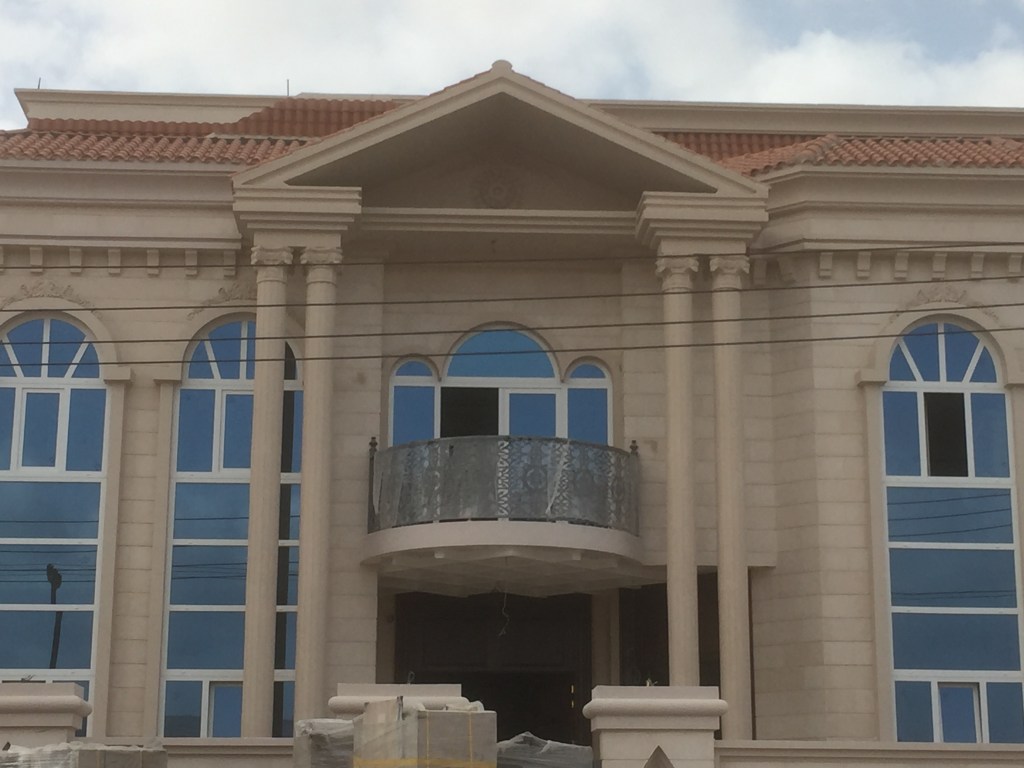
This weather pattern means that all houses built in the last 40 years are made of cement block which keeps the wind and drizzle out, but are not energy effective. The houses need air conditioners constantly working to keep cool and the metal and wood window frames and door frames often let in sand and rain during storms.

Dhofari houses are designed by the people who will live in the space so the rooms are built to the families’ specifications.[1] Given than most Dhofaris live in multi-generational clusters of thirty or more family members, this means consulting the wishes of many people. This also means that many people can help contribute. For example a sister might give cash from her salary for building supplies while a brother who does not have a job can do the work of finding the right equipment to rent, bringing workers to and from the job site, supervising, being on hand to answer questions, etc.

The decision to build does not rest solely with the men of a family. Mothers, wives, sisters and daughters are part of decisions relating to the home. Men may not say publicly that they are making decisions based on their relatives’ wishes, but it is expected that the women’s opinions will be consulted. I have heard complaints from Dhofari women that, for example, the kitchen is not well-designed, but among my informants in the hakli group of tribes and in the hakli houses I have visited and seen photos of, the women always had a say in how the house was set up. Several hakli men I know simply handed over the room location and decoration to the women.

Rooms

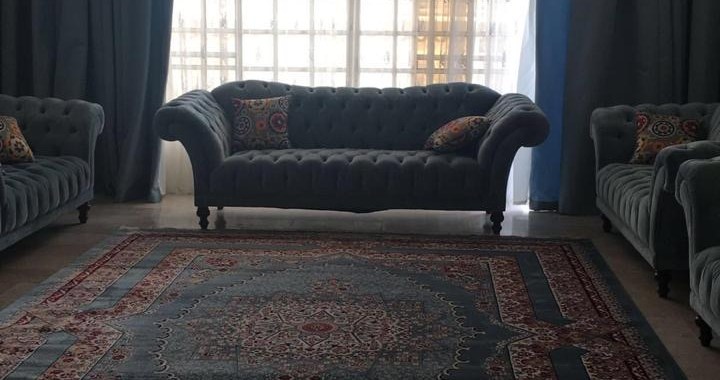
The most important rooms are the majlis, usually explained as the male or male visitor’s sitting room, and the salle, usually explained as the women’s or family’s sitting room.[2] As the majlis is used more frequently for guests, it is often more showy with a larger TV, elaborate curtains, wall hangings, and gypsum decorations on the ceiling. Care is taken that the two rooms do not have the same color scheme but the spaces are not color-coded for gender in Western terms. For example, the majlis might be light purple or peach while the salle is dark blue or brown.

I think of Dhofari houses as the antithesis of expensive Victorian-era houses in the United Kingdom with many little rooms which each have a separate purpose: the morning room, the seamstress’ room, billiard room, the music room, the library, etc.. In Dhofari houses, there are usually only four types of rooms: sitting room, bedroom, kitchen and bathroom and the first three types are furnished with the same pattern of furniture next to the walls and empty space in the middle.

Another way to think about types of rooms is to consider that many middle- and upper-class North American homes have rooms for work, relaxation and/ or exercise such as a home office, craft room, gym, yoga studio, etc. which might be the former bedroom of a child who has moved out. There is a standard trope of a child going to college and his/ her room ‘disappears’ as it has been entirely repurposed.

In Dhofar, while the people who stay in a room might change, the purpose seldom does. For example, three brothers might share a bedroom on the ground floor. In time, an additional story is added and two boys move to an upstairs bedroom while the original room is redone for the oldest boy and his bride. After this couple have a few children, they move to a suite on the first floor and the bedroom is refurbished for a grandparent who cannot manage to walk upstairs.

Foyer/ main hallway

Looking at the front of a Dhofar house, there are almost always two doors. The smaller/ less decorated door leads to the majlis, explained below, and the larger door opens into a large, wide hallway. This hallway, which runs from the front to the back of most houses, is widest by the front door. There is usually no furniture in the hallway except perhaps a tall, rectangular side table pushed against the wall near the door with a mirror above it or nearby. 

This is a staging-area that is used only for a few moments of time several times during the day but is necessary given common Dhofar behaviors. A large foyer is needed because there are usually more than five small children living in one house and they can use the space as a play area in hot weather; also, children love to run together to the door when someone knocks (or they are sent to see who it is).

As children like to move in groups, they often stand near the door to look at a person arriving or leaving; for example, younger children often gather in the entrance way when older children are going to school. With a large foyer, there is space for the mom, the children who are going to school and young children to all wait inside where it is cool. Or the space can be used by a group of sisters waiting for a car to take them shopping or visiting relatives so they don’t have to stand outside the house in view of the neighborhood.

In some large, recently-built houses, there is no hallway but a circular, open area with a salle through a wide-open archway, the door to the majlis, the door to the kitchen and the steps leading to upper floors. This space is sometimes big enough for chairs/ a sofa and is used as a play area for children, a pass-through/ staging area and an intermediate/ indeterminate location.

For example, a strange man would come to the majlis through the outside door, but a new bride’s brother who wants to visit might not want to ask her to come to the majlis (where there are other men) and might not be comfortable in the salle (where there are women he doesn’t know and is not related to) but could stand with her in this open space to chat.

Majlis

In some cultures on the Arabian Peninsula, the majlis is strictly male territory but in Dhofar among the hakli tribes, a woman, for example, might sit in the majlis and speak with her uncles or male cousins who have come to visit. Further, the space might be used for children to have lessons with a tutor in the early evening. Women use it to entertain female guests or for wedding parties, during which women usually take over the whole house while men are entertained outside. A husband might sit in the majlis in his wife’s parent’s house as a place to talk to his wife when she is temporarily living at her parent’s house if she is caring for a sick member of her family.

When I visit female Dhofari friends at home, where we sit depends on several factors. If their husbands and/ or brothers are not at home, we sit in the majlis. When I visited one male Dhofari friend, we sat in the majlis, but I went to the salle to eat lunch with the women.

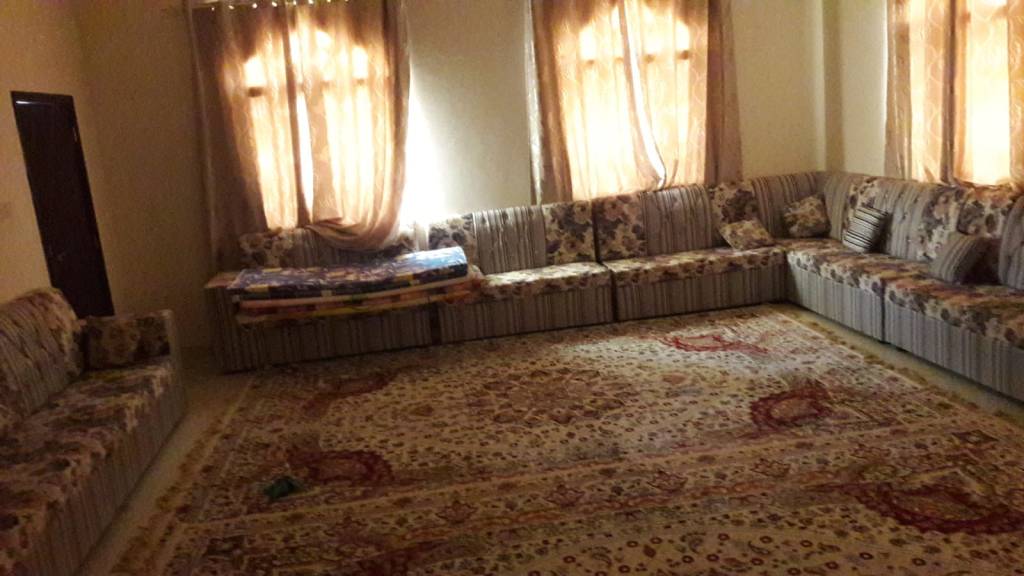
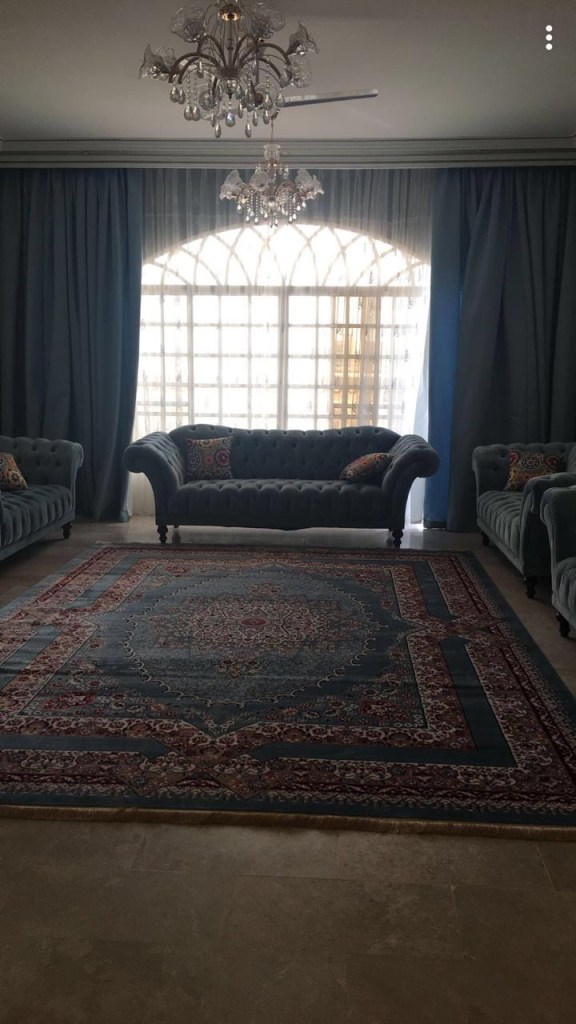
The majlis is usually decorated with sofas or cushions on a low wooden frame surrounding the sides of the room, a few coffee tables, a TV, and sometimes decorations such as photos of the Sultan Qaboos or Sultan Haitham. There is an AC and the walls are always painted to coordinate with the curtains and sofas. Often there is a rug in the (empty) center of the room; the color scheme might be shades of beige, pastels or dark shades of brown, blue, or green.

Majlis always have two doors; the first leads to the outside, so that guests may come and go without moving through or seeing other spaces in the interior of the house. The second door leads to the main hallway of the house and is always closed, if not locked. There is often an open sink, to wash hands before and after eating, and a small toilet/ shower room. 

In a very small house, sometimes the majlis is completely repurposed by becoming a bedroom. Then the salle functions as majlis. In one house which was arranged like this, when I was sitting with women and a man entered to meet with the husband, the women and I went to sit in the couple’s bedroom.

There can also be a majlis in the house as well as another majlis in a separate building. This is not common in Dhofar and is usually a marker of a religiously conservative and/ or wealthy family. The outside majlis is usually located close to the wall (sometimes with a doorway cut into the wall) so that visitors do not go anywhere near the house. This majlis often has a large sitting room and bathroom with sometimes a small kitchen (with its own entrance) and/ or a bedroom. When I was with some of the men in the research group visiting a man we knew, we sat in the separate majlis and lunch was brought to us, carried by our friend.

Salle

In the same way that the majlis can be used by women in Dhofar, the salle can be used by men who are not in the family, for example older men who are close, long-term neighbors might sit with women in the salle if there are no men in the house to entertain them.

The salle is always at the front of the house, close to but usually not visible from the front door. The room has three sides, often with windows to the front and side of the house, the side to the front hallway completely open, with a blank back wall. Like the majlis, it is usually decorated with sofas or cushions on a low wooden frame surrounding the sides of the room, a few coffee tables, a TV, and decorative elements such as vases. The bathroom area might be attached to the salle or further down the main hallway of the house.

Although the norm in Dhofar is for a house to have one majlis and one salle, some larger houses have a series of rooms, i.e., a formal salle at the front of the house and then a (usually less formal) salle further inside. Sometimes also a few sofas are placed upstairs in an open area at the head of the stairs (out of sight of the front door) for family members only.

A salle can be a place for siblings to watch horror movies at 1am, somber when the house is in mourning and women come to pay condolence visits, joyful for a graduation celebration, intimate when sisters come to visit and share all the family news, loud when the children are playing, and welcoming for neighbors and guests. The salle is the center of a Dhofari house.

This could be seen as valid for a North American family as well, i.e., someone in Wisconsin might say that the family room is the heart of the house, yet North Americans may also use different home spaces. They might gather in the kitchen or dining room for a meal; go to the den, basement or spare bedroom to watch TV; sit in the living room for formal visits and send children to their bedrooms to play with toys. All of those activities would take place in the salle of a Dhofari house.

Kitchen/ Dining Room

The kitchen is located to the side or back of the house; in newer houses it has its own entrance used by family members if there is parking near that entrance, as well as those who don’t live in the house, for example people bringing in supplies such as bags of groceries and/ or jugs of water for water dispensers. Like bathrooms, kitchens have tiled walls and floors, usually in shades of grey, beige or brown. There are florescent tube lights, a ceiling fan and an extractor fan, but usually not AC. If there is a window (most often over the sink) it has opaque glass.

Often there are long, high counters along one or two walls, with shelving underneath and cupboards above. The below-counter cupboards, as well as the stove, fridge and washing machine are set slightly above floor-level on platforms so that the floor can be cleaned by mopping/ sluicing. Usually the gas canisters for the stoves are located outside the house, next to the kitchen door, with a small hole drilled in the cement wall to bring the gas pipe to the stove/ oven.

As it is common to have thirty or more people (from different generations) in one house, kitchens are big enough to make large meals. Like most rooms, everything is placed around the sides of the room. Sometimes there is a table, but often you can find an empty area in the middle of the room that is five feet square or larger. This is so a lot of women can work together for parties and also because some cooking is done on the floor. For example, large pots of meat are sometimes cooked on gas rings set on the floor because it is easier to stir from a standing position than trying to reach into a pot set on the stovetop. Some kinds of bread are cooked using small gas burners set on the floor.

Kitchens are utilitarian; pretty trays might be leaned against the back-splash or there might be a vase to hold wooden spoons, etc., but kitchens are seldom decorated or set up as welcoming/ comforting spaces in which to sit and relax.

As soon as you walk in, it’s easy to visually orient yourself; often the cupboards have glass fronts so you can see inside them. Most families will have items for hosting in sight and easy to reach: several sets of teacups and saucers, tea and coffee pots, carafes, glass bowls or plates. There are usually several trays as almost all food, drinks and eating utensils, plates, cups, etc. are moved on trays, not carried by hand

Larger and newer houses may have small suites for each married son. This will usually consist of a bedroom with an attached bathroom and a sitting room which might have a galley kitchen with a small sink and microwave so they can make tea and simple meals for themselves. Thus, there will be one large kitchen for a house, with perhaps a few smaller mini-kitchens for couples.

Bedrooms

If the house has one floor, bedrooms are at the back of the house, usually behind the kitchen. In a two- or three-story house there are often one or two bedrooms on the ground floor for older and senior relatives with the rest of the bedrooms on the upper floors.

There is usually a bed with matching nightstands and large wardrobes, as well as a sofa or padded chairs and coffee table. Sometimes there is a desk and chair if the inhabitant is school-age. I have never seen a built-in closet; everything is stored on or in shelving units or cupboards.

In addition to the overhead, usually fluorescent, lights, bedrooms often have a sconce (wall light) with a low-watt or colored bulb so, if the room is shared, one person can move around and/ or parents can look in on children without turning on the bright overhead lights. There is always a fan and AC.  

It is very common for the upper stories to have a series of suites, meaning a door on the main corridor which leads to a small foyer space with three or four doors: two rooms and a bathroom, perhaps a storage room. This configuration can be easily changed as needed. For example, the two rooms might be used as a bedroom and a sitting room for a newly married couple or single older relative; a shared bedroom and a study/ play room for several children; or two shared bedrooms with a variety of configurations such as younger children in one room with an older child in the other or a married couple in one room, children in the other, etc. If the second room is used as a sitting room, there is often a small kitchen area.

If a man has more than one wife in the same house, each suite will be considered as belonging to the wife and the husband will move between the suites. If his second wife is in another house, he will move between houses as, in Islam, a man should spend equal time with each wife. In old-age or in times of sickness, an older man might sleep alone in what was a room for guests.

Sometimes a Dhofari woman will stay in her parent’s house and her husband will move in with her. This doesn’t happen often; usually it occurs when the husband works close to his wife’s family house, if she is the only daughter or her mother has no sons living with her.

Bathrooms

For some houses built in the mountains in the 1980s and before, the bathroom can be a small, separate building. In this case it is a low ceilinged, tiled space with a toilet, sink, shower and washing machine.

Since the 1980s, bathrooms are within the house, usually rectangular and built with the narrow end on an outside wall or lightwell to allow for the window and extractor fan. They usually have tiled walls and floors with an open design (e.g. no interior walls such as a low partition to screen the toilet) with a pedestal sink or sink on a counter with empty space beneath and a shelving unit next to the wall. The sink is always closest to the door.

The shower area usually does not have a curtain and is marked off with a slightly lowered floor with a drain. Some have tiled steps along one side. Bathtubs are rare; if there is one, it usually has a seat. The steps and seat are for the ritual washing before Muslim prayers during which face, hands and feet must be cleaned.

Bathrooms in the family/ private area of the house are often plainly decorated and are built open-plan for one person to use at a time, unless it is a parent helping a small child. Some North American bathrooms are set up with the toilet half-hidden behind a low wall and shower curtains so that two people might use the room at the same time but I have not heard of that in Dhofar. For unmarried inhabitants, if there is not a bathroom attached to the bedroom, there is one nearby.

The guest bathroom that is attached to or near the majlis and salle often has a space with one or more sinks, then there is an inner door which leads to a small room with a toilet, shower and sink so that guests might wash their hands while the toilet/ shower room is in use. These rooms are usually nicely appointed with fancy faucets and attractive tiles.

Who decorates

Given that most Dhofaris live in multi-generational clusters of thirty or more family members, interior design means consulting the wishes of many people. Usually older family members have a more decisive say but different people can be in control of different areas. For example, the senior woman might be in charge of decorating the kitchen, the senior man might choose the colors of the main sitting room, while a sister might design the room for her brother and his new wife. If there is one person in the family who is known for their flair, they might be given responsibility for the salle, main hallway and majlis. Adults usually decorate their own bedrooms.

Some Dhofari women are frustrated that they don’t have a say in designing and decorating but this is often a function of age and tribe. In the hakli families I know mothers, sisters, wives and/or daughters are always consulted or had design control over the parts of houses they lived in and used daily, i.e., salle, kitchen and bedroom.

However, unmarried women in their teens or early twenties might not be consulted, except for the color choices in their rooms, because of age and the expectation that they will not stay in the house for long given that almost all women move to their husband’s house when married.

When a man is getting married, he is either given a new room or his room is completely redone: re-painted, new furniture, new lighting and often a new dropped or decorated ceiling. This room, out of respect for whoever decorated it, should not be changed for several years, so a woman might not have power over her living space until she is in her late twenties or thirties, but from then on, the decorating is made in consultation with her or left entirely up to her.    

Decorating a house

Houses are decorated when they are new or when the family moves in. Usually, a family will bring all new furniture as the old furniture is given away. Refurbishment, new furniture and/ or painting, usually takes place before the two Eids (Muslim holidays) and/ or before a wedding.        

Generating Ideas

Getting design ideas for the exterior of houses is simple, one only has to drive around and see what other people have done. But there are not many chances to get design ideas about interior spaces beyond a few, large furnishing stores that have opened in the past few years. Dhofaris will visit relative’s houses and might stay in hotels or vacation rentals, but there are limited opportunities to see a wide variety of interior styles.

Dhofaris might post photos of a newly decorated room on social media and people who manage rental houses might post photos of interiors but there is, for example, no Omani equivalent of Zillow or Redfin with photos of the inside of millions of homes.

On the other hand, there are many carpenters, iron-mongers and tailors so that Dhofaris are not limited to furniture and curtains they find in stores. As with designing the house, people can take a photo or hand-drawn sketch to a workshop and have beds, wardrobes, sofas, chairs, drapes, etc. made to their specifications.   

Handmade objects

In North America, people often design their houses with personal items which reflect their travels, accomplishments and interests. But in a majlis or salle, there are usually few or no signs of the individuals who live in the house such as photos, books, souvenirs or knickknacks. The window might be decorated with five kinds of fabric, tassels, pull-backs, swags and ruffles, but you won’t be able to tell very much about the family.

While many Dhofaris have an interest in design per se, it is usually manifested in the design of clothes and making of perfumes, not in creating objects that would be on display such as quilts, crocheted afghans/ throws, needlepoint cushions and paintings. The one handmade object which is found is a majmar, a small clay, footed bowl which is used to hold a lit piece of charcoal with a piece of frankincense. The burning tree sap produces clouds of perfumed smoke which create a lovely fragrance in the house. 

Conclusion

Most Dhofaris follow the principle of “people, not things.” When visiting a hakli at home, the house itself is never the focus of the conversation. If it’s a new house, there will be compliments and a short discussion about where and how items were bought but that is only a few moments but the important most element of owning a house is to create a comfortable place for one’s family to gather.

 Risse – bibliographies, essays and images for Houseways

main webpages on research about houses: 

references list: Selected references related to Houseways in Southern Oman, Oct. 2022

images: 

Risse – publications – books

This book outlines strategies for current or soon-to-be business professionals, government employees, anthropologists, researchers and teachers to communicate, study and work effectively on the Arabian Peninsula. Using first-person accounts, as well as scholarly research from the fields of anthropology, history, literature, political science and travel writing, this text gives clear advice so long- and short-term visitors can create successful interactions with people from Arabian Peninsula societies. By discussing how the practicalities of work and research intersect with cultural norms, this book fills the gap between guides aimed at the casual tourists and academic texts on narrowly defined topics.

This book explains how modern, middle-class houses are sited, designed, built, decorated and lived in with an emphasis on how room-usage is determined by age, gender, time of day and the presence of guests. Dhofari houses are also compared to houses in other Arabian Peninsula countries and positioned within the theoretical frameworks of the “Islamic city” and the “Islamic house.”

This book examines the objects, practices and beliefs relating to producing, obtaining, cooking, eating and disposing of food in the Dhofar region of southern Oman. The chapters consider food preparation, who makes what kind of food, and how and when meals are eaten. Dr. Risse connects what is consumed to themes such as land usage, gender, age, purity, privacy and generosity. She also discusses how foodways are related to issues of morality, safety, religion, and tourism. The volume is a result of fourteen years of collecting data and insights in Dhofar, covering topics such as catching fish, herding camels, growing fruits, designing kitchens, cooking meals and setting leftovers out for animals.

This book explores how, in cultures which prize conformity, there is latitude for people who choose not to conform either for a short time and how the chances to assert independence change over time. The main focus is on how the traits of self-control and self-respect are manifested in the everyday actions of several groups of tribes whose first language is Gibali (Jebbali/ Jebali, also referred to as Shari/ Shahri), a non-written, Modern South Arabian language. Although no work can express the totality of a culture, this text describes how Gibalis are constantly shifting between preserving autonomy and signaling membership in family, tribal and national communities.

 Risse – publications

“Lifeways of Traditional Fishermen in Dhofar, Oman,” in Fish as Food: Lifestyle and a Sustainable Future. Helen Macbeth, ed. International Commission on the Anthropology of Food and Nutrition – Alimenta Populorum series. 2024: 155-170. https://archive.org/details/macbeth-young-and-roberts-ed-fish-as-food-anthropological-and-cross-disciplinary

“An Ethnographic Discussion of Fairy Tales from Southern Oman,” Fabula: Zeitschrift für Erzählforschung / Journal of Folktale Studies / Revue d’Etudes sur le Conte Populaire 60.3-4 (De Gruyter, Berlin) 2019: 318–335.

 “Understanding Communication in Southern Oman,” North Dakota Quarterly 84.1 (Special Issue on Transnationalism) 2017: 174-184.

“Generosity, Gift-giving and Gift-avoiding in Southern Oman,” Proceedings of the Seminar for Arabian Studies 45 (Oxford: Archeopress) 2015: 289-296. 

“Cultural Refraction: Using Travel Writing, Anthropology and Fiction to Understand the Culture of Southern Arabia,” Interdisciplinary Humanities 26:1, 2009: 63-78.

 Risse – conference presentations

“Conducting Research on the Arabian Peninsula: Creating Effective Interactions,” Middle East Studies Association Annual Conference. Upcoming, Nov. 11-15, 2024.

“Windguru and Other Gurus: Fishing off the Coast of Dhofar, Oman,” Navigating the Transcultural Indian Ocean: Texts and Practices in Contact Conference, sponsored by the Rutter Project. June 5, 2024

“Crafting a Home: Interior Home Design in Southern Oman.” Home/Making Symposium, Concordia University. Montreal. May 12, 2023. https://www.concordia.ca/finearts/events/home-making.html

“Good Governance and Open Spaces: How the State and Residents Negotiate the Use of Government Land in Dhofar, Oman.” AnthroState Talks for the European Association of Social Anthropologists Network on Anthropologies of the State. May 4, 2023. https://easaonline.org/networks/anthrostate/talks

“Private Lives in Public Spaces: Perceptions of Space-Usage in Southern Oman.” Middle East Studies Association annual conference. Montreal, Quebec. December 2, 2021.

“The Costs and Benefits of Fishing in Southern Oman.” Fish as Food: Lifestyle and a Sustainable Future, annual conference of the International Commission on the Anthropology of Food and Nutrition, hosted at the University of Liverpool. Sept. 1, 2021.

“Ethical Eating in Southern Oman.” Just Food, virtual conference of the Association for the Study of Food and Society; Agriculture, Food and Human Values Society; Canadian Association for Food Studies and the Society for the Anthropology of Food and Nutrition, hosted by the Culinary Institute of America and New York University. June 12, 2021.

“Foodways in Southern Oman,” for the session “Uncovering Truths, Building Responsibility in A Pandemic: Insights from Emerging Monographs at the Nexus of Culture, Food, and Agriculture.” American Anthropological Association. Nov. 9, 2020.

with Keye Tersmette. “Ghurba at Home – Views from Oman.” The Arab World as Ghurba: Citizenship, Identity and Belonging in Literature and Popular Culture, University of Warwick. June 21, 2019.

“Female, Femininity, Male and Masculinity in the Gibali-speaking Tribes of Southern Oman.” The Gulf Research Conference, Cambridge University. August 2, 2017.

“‘I Came to You for Good’: An Ethnographic Discussion of Folk Tales from Southern Oman.” Third Joint Seminar of The Folklore Society and the Royal Anthropological Institute, Royal Anthropological Institute, London. Oct. 26, 2017.

“‘Words Mean Nothing’: Fluency in Language and Fluency in Culture in Anthropology Fieldwork in Southern Oman.” British Society for Middle Eastern Studies, University of Wales. July 15, 2016.

 ***********

            [1] To help pay for the building costs, the house might be rented out for a few years before the owner moves in. Also, if a family moves into a new house, they may give their previous one to a relative.

            [2] Salle is pronounced ‘sall-la,’ not as the French, ‘sall.’


Outline and Chapter Abstracts for ‘Researching, Teaching and Working on the Arabian Peninsula: Creating Effective Interactions’

Practicalities: Managing a Short Research Trip to the Arabian Peninsula

Me Talk Pretty Never: Learning Arabic, part 1

Adjusting to Oman: My Dangerous Taxi

One Year Away – Missing Oman

I left Salalah a year ago and am still processing that loss. I miss my friends and so many aspects of Dhofari life, especially:

  • Long conversations – When you sit down to talk to a friend in Oman, it’s expected you will talk for hours. I miss having coffee with a female friend for 2 or 3 hours; picnic dinners with the research guys which could mean 6 or 7 hours of chatting.
  • Gorgeous Nature – Pristine, empty beaches; snorkeling over reefs; boat rides, skimming along next to pods of leaping dolphins; sitting in the desert or on a beach with no ambient lights so you could a dark night sky full of stars; green mountains in the monsoon season
  • Animals – lizards and chameleons; seeing foxes, hearing wolves; the parrots which came to my guava tree; flamingos; camels, especially baby camels
  • Plants – palm trees; banana trees; lemon trees; fig trees; my gardens with papaya trees, henna trees, neem trees, olive trees, hibiscus, bougainvillea, oleander, gardenia, jasmine, aloes, lemongrass, yellow trumpet flower
  • Food – fresh coconut milk, schwarmas, fresh Yemeni bread, lobsters cooked over coals, fresh fruit juice, Balbek (if you know, you know), fresh lemon and mint, fresh fish
  • Teaching literature and 98% of my students – Although it cost me $100s a year, it was fun buying and reading books as I searched for new poems and stories to teach. It was a joy to craft syllabi with texts from different time periods and cultures with similar characters, plots and/ or themes and then the best part, talking about these texts with students who had great insights and could make connections to other texts and their own lives. Some classes were an uphill climb but in some classes we laughed all semester.
  • Discussing religion – Everyone I knew believed in God and was up for talking about religious beliefs; I could say, “I will pray for you” and ask, “Will you pray for me?” as a part of ordinary conversations
  • Multi-cultural everythings – Walking through the grocery store and not knowing what I was looking at: new vegetables, new fruit, words I didn’t understand on jars; all different kinds of clothes and fabrics
  • Active ethnography – I was always watching, listening, trying to figure out what was going on: What was that word? Why did that person do that? It was exhausting but always interesting
  • Constantly learning – students were always teaching me new expressions and gestures; the research guys teaching me how to how to drive on sand (only getting stuck three times!), up steep inclines and over rocks
  • Language barriers – Being able to go through the day without understanding most of the conversations around me was relaxing; now I constantly overhear people venting when I walk home or sit in a café
  • My truck – Driving in Oman is so fun on flat desert roads, twisting mountain roads, roads that curve along the shoreline
  • Houses – High ceilings, archways, lots of counter-space in the kitchen, well-designed bathrooms

What’s nice about where I am

  • Being able to easily see/ talk to friends, my mom and family
  • Working with kind and competent people: no lying, no back-stabbing, no drama and every single person says “Hello”
  • Flower stores, especially Kendall Flower Shop, Brattle Square Florist and Petali
  • Breakfast sandwiches, pizza, salads and ice cream without freezer burn
  • Not sharing my apartment with mice, spiders, bees or armies of ants – quiet ACs

Outline and Chapter Abstracts for ‘Researching, Teaching and Working on the Arabian Peninsula: Creating Effective Interactions’

Practicalities of Moving to the Arabian Peninsula: Using the Arabic Language

Ethnography – Finding the Middle Ground, part 1 of Discussing Photographs

Returning to USA – Culture Shock essays