
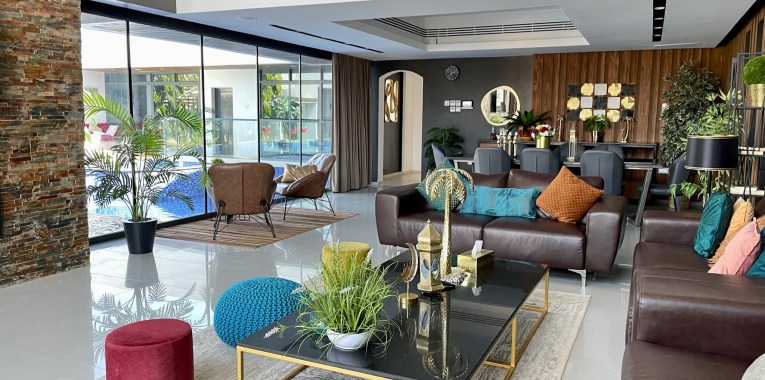
(photo by Onaiza Shaikh, living room in a rental house in Dhofar)
I had a great conversation yesterday with Ahmed Almaazmi and Ayesha Mualla for the Indian Ocean World – New Books Podcast.
https://newbooksnetwork.com/houseways-in-southern-oman
One interesting point that came up in our talk was how changes in house design affect the inhabitants. For much of the Arabian Peninsula, the most common type of house had a central courtyard until the 1970s, 1980s or 1990s depending on the area. With this type, not often found in Dhofar, all the rooms of the house open onto a center space that is exposed to the sky. Thus there are open sightlines in all directions; while more recently built houses are often ‘closed’ with hallways and corners which drastically cut down on the chance of seeing other inhabitants.
The reaction to this change can vary from person to person/ family to family. Some might celebrate the feeling of openness and togetherness found in a house with many vantage points to see most or all of the rooms, where it was easy to cross path with family members. Others see modern houses with limited sightlines as a great advantage in that people can come in and leave without others knowing.
One Dhofari friend told me that having a large open area near the front door, big enough for a few sofas, has been a blessing for her elderly father who can sit in that space all day and see every person as they move between the salle, majlis, kitchen, stairs and front door.
On the other hand, a different Dhofari woman told me about the early years of her marriage when she lived with her husband’s parents and felt a tremendous pressure to have herself and her children always well dressed and on-view in the public areas of the house. She and her husband eventually moved into a small rental hour so that she could have a more peaceful life.
This is one of Maneval’s main points in New Islamic Urbanism: The Architecture of Public and Private Space in Jeddah, Saudi Arabia (2019): the built elements for privacy (high walls, limited sightlines in houses etc.) allow for people to act as they chose as they can create non-observed spaces for themselves.
Thus one can imagine a courtyard house with an family member who rigidly watches, criticizes and controls all the movements or a house in which inhabitants happily greet each other and sit together in harmony. Just as there are modern houses in which people are thankful to have privacy and chances to live as they please and other modern houses in which people feel cut off from each other and lonely.
The only drawback to our talk was that, to prepare, I read a published copy of my Houseways in Southern Oman book and found numerous typos. It was disappointing to see so many mistakes: Salalah misspelled, the author R. Guest written with a small ‘g’ and Modern South Arabian languages referred to as “South Arabian languages.” The proof I was given to check was write-protected, so I could make edits but I could not ‘accept’ the changes to see what the corrected version would look like. The result is odd spacing, missing words and small errors. Very frustrating!
Houseways: Dhofari/ non-Dhofari house plans
Houseways is published and more examples of houseplans
Selected references related to Houseways in Southern Oman, Oct. 2022
 Come From Away
You must be logged in to post a comment.