
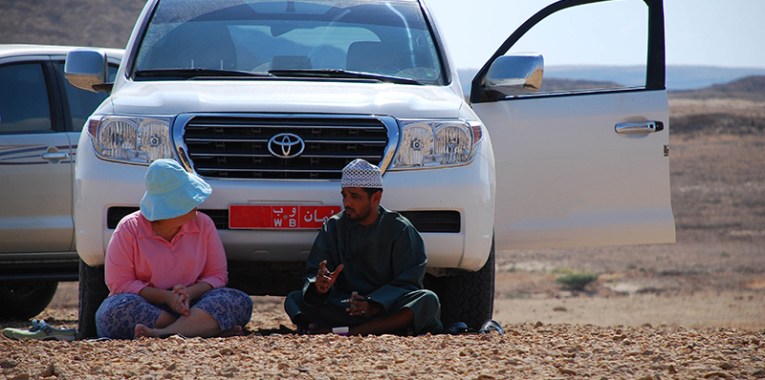
While working on an essay about marriages in Dhofar, I was writing about the issue of photographs, which made me realize that I have only one photograph of me with one of the research guys. It was taken by another one of the research guys and I think it’s an understated masterpiece that captures all the important parts of working with them.
We are in the nejd, the open, rocky area between the mountains, which are visible in the background, and the real desert. We are taking a rest from a long drive and have parked the cars at the right angle to create a small patch of shade. The mat was put down to take advantage of the shade and in accidental symmetry we each placed our shoes to the side because you try to never walk on a mat in shoes.
To stay in as much shade as possible, we are both sitting close to the truck and in another accidental symmetry, we are both cross-legged. In keeping with conventions, we sit with our bodies facing forward and turn our heads to see each other. These is a lot of empty space between us and our fore-arms and hands are kept within the space of our bodies. He is holding his pipe and has a cup of tea in front of him.
We are following the same conventions within our respective cultures: both of us have our hair covered, him with a kumma, me with a floppy hat. We both have our bodies covered in loose fabric from below the elbow to shoulders and down to below the knee. He is wearing a dark green dishdash and I have a long, pink tunic and loose, purple clam diggers.
I like the photo because it makes me remember thousands of happy hours in pretty much the same circumstances and because it makes me feel that I was finding a way to do research that was both on their terms and my terms.
We are sitting “on their terms”: on the ground, on a plastic mat, in the shade, with open space around us but our backs to something solid, with bare feet, bodies straight with shoulders at an angle, keeping our bodies self-contained (the over-arching idea is to not to move your arms or hands in a way that anyone standing behind you can see) and only the most necessary objects nearby (no chairs, tables, etc.) But I am wearing tropical pink – a shade I rarely saw any Dhofaris females wear.
We look different but equal. Whereas at the start of one of my essays, “Predator Anthropologists, Anthropologists Predators: Anthropological Metaphors in Popular Movies,” I wrote:
The cover of one of my anthropology textbooks has a white man in a white shirt, pressed pants, shoes and the accoutrements of academia (glasses, pen, notebook) talking to a woman with facial tattoos and cloth wrapped around her body. She’s “local,” with local knowledge and he’s the embodiment of knowledge derived from a Western-style education. He’s going to take her information, compare it to other knowledge from other cultures, add in some theory and publish.
I like this photo because it looks like a conversation, not an extraction.
“Predator Anthropologists, Anthropologists Predators: Anthropological Metaphors in Popular Movies” – https://openanthroresearch.org/index.php/oarr/preprint/view/121/187
Ethnography – Whatever You Do, Don’t Smile, part 2 of Discussing Photographs
Practicalities of Moving to the Arabian Peninsula: How to Sit, Not Wear Shoes and Use Your Hands
Practicalities of Moving to the Arabian Peninsula: Getting and Sending Mail/ Packages
How NOT to Describe People Who Are Foreign to You: Exoticizing Omanis

 Come From Away
You must be logged in to post a comment.