
I am grateful to A. Jaboob for allowing me to post these beautiful photos of the Dhofar mountains in khareef.
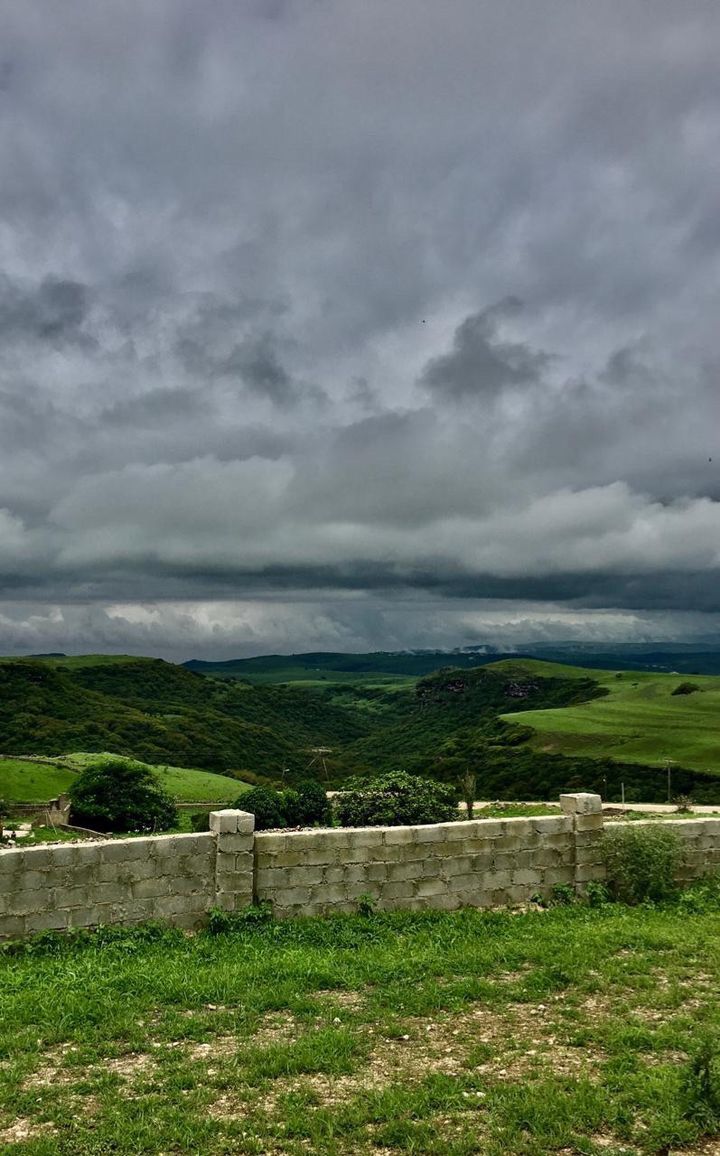
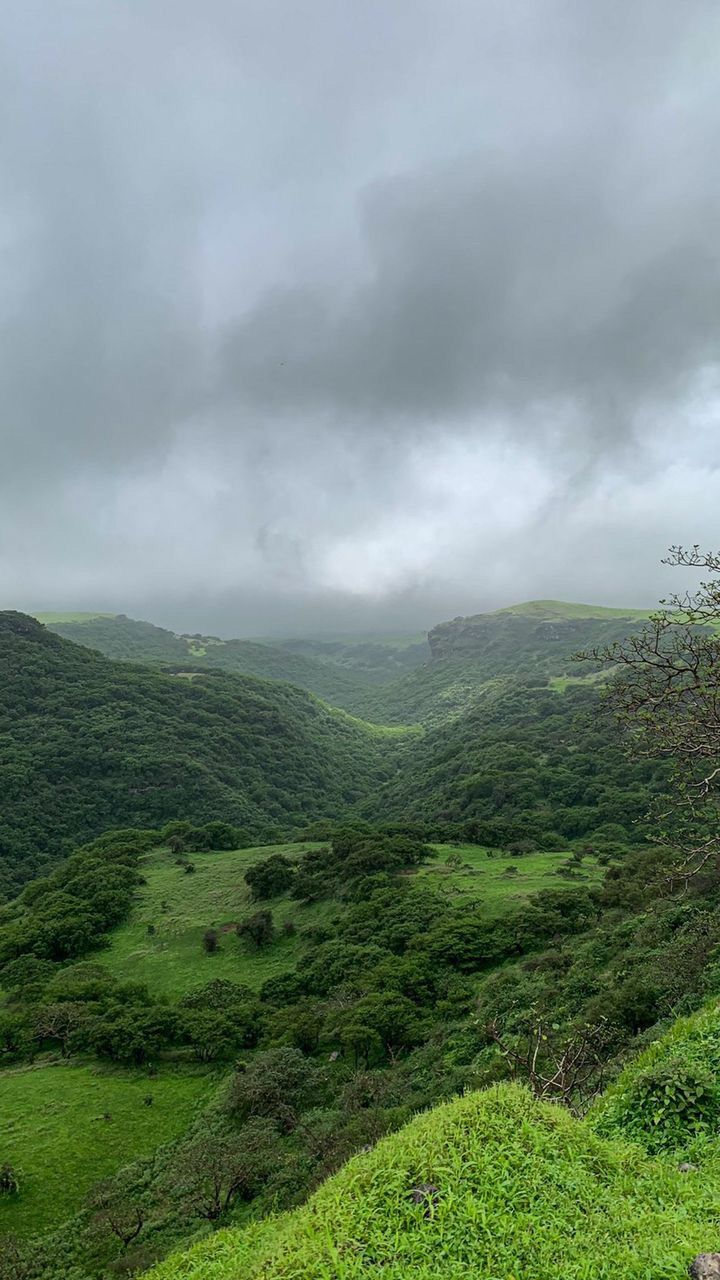

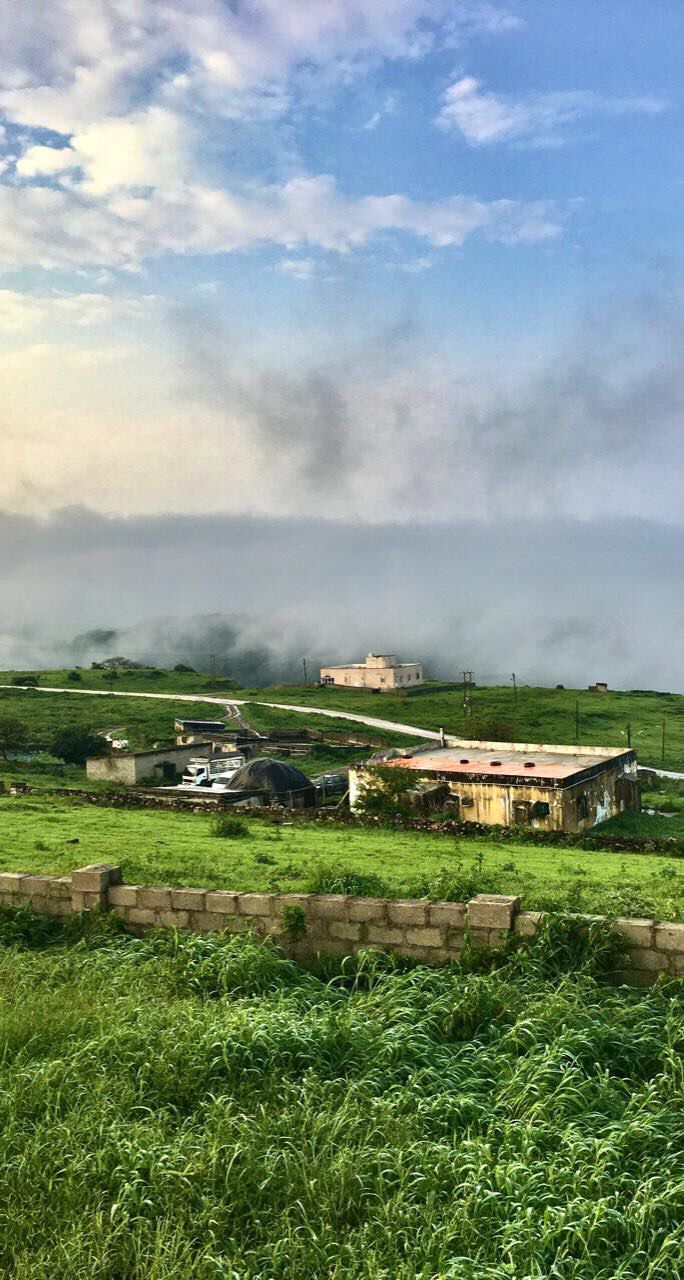

I am grateful to A. Jaboob for allowing me to post these beautiful photos of the Dhofar mountains in khareef.

I am happy to announce that my third book, Houseways in Southern Oman, is now available for pre-order
https://www.routledge.com/Houseways-in-Southern-Oman/Risse/p/book/9781032218595
https://www.amazon.com/Houseways-Southern-Oman-Marielle-Risse/dp/1032218592
https://www.amazon.com/Marielle-Risse/e/B08SKYD848/ref=dp_byline_cont_pop_book_1
التقاليد المتبعة في ترتيب المنازل بظفار: وضع الأثاث وعلاقته بمجال النظر
click here to see original post: Houseways in Dhofar: Placement of Furniture and Sightlines
I am very grateful to Arooba Al Mashikhi for her work in translating some of my essays about houses in Dhofar.
I am grateful to Maria Cristina Hidalgo [https://www.mariacristinah.com/ ] for her helpful plans and to my informants who have allowed me to chart their homes.
ممتنة لماريا كريستينا هيدالجو لسماحها لي بالاطلاع على خططها المفيدة، -ولأولئك الذين سمحوا لي برسم منازلهم.
[https://www.mariacristinah.com/]
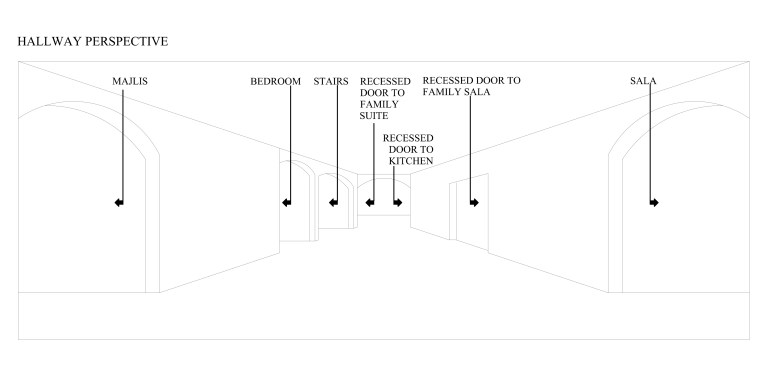
1) Perspective view of front hallway
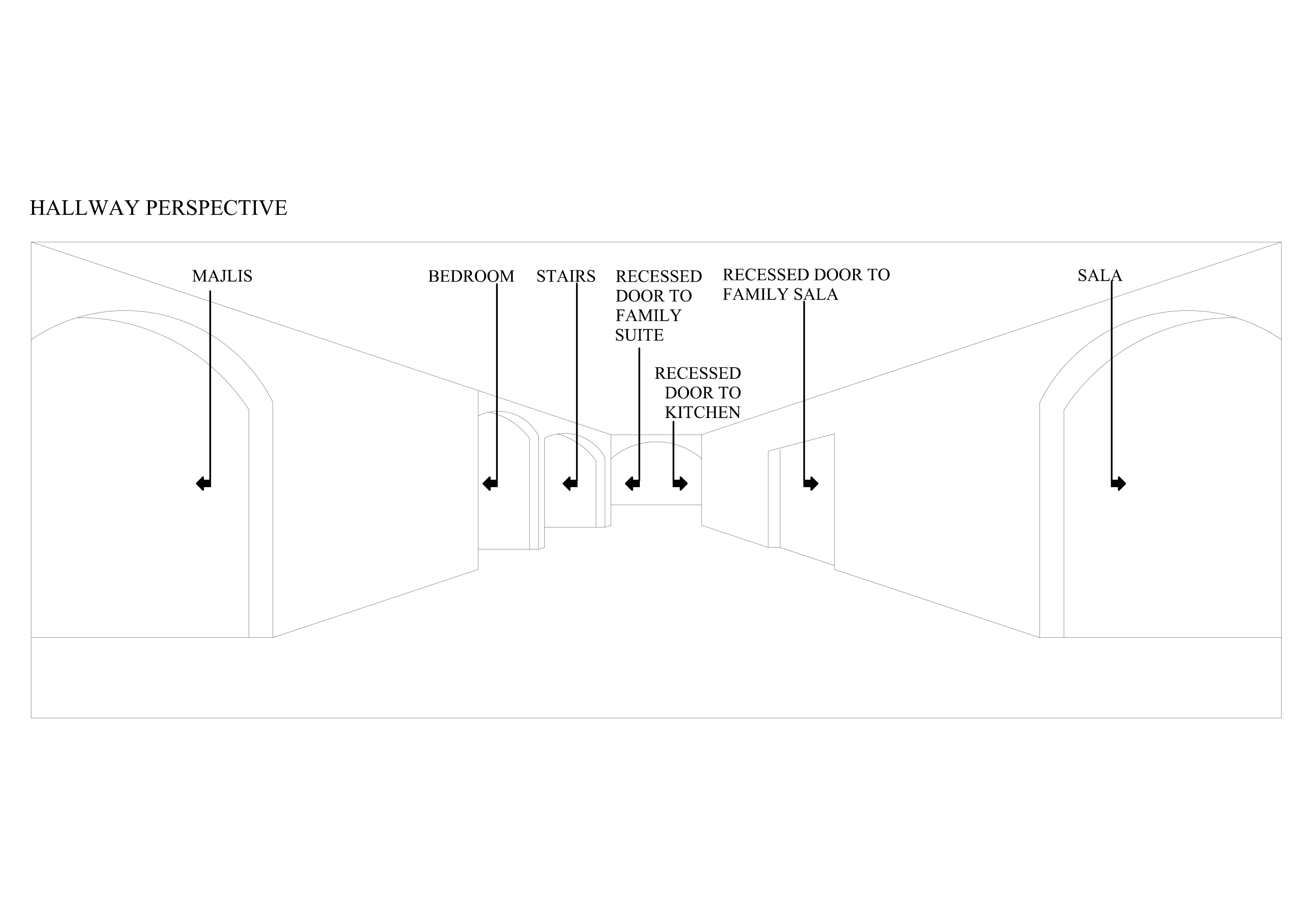
The first point is that when one walks through the main door, there is often no furniture in sight. Sometimes there is a high, narrow table near the door to set things on that will be out of reach of children or one might be able to get a glimpse into the salle but, as the perspective below illustrates, most of the furnishings are out of sight.
1 – عرض منظوري – للردهة – الأمامية
النقطة الأولى هي أنه عندما يمر المرء عبر الباب الرئيسي، – لا يجدُ في الغالب اثاثاً. -–توجد أحياناً طاولة مرتفعة وضيقة بالقرب من الباب لوضع أشياءٍ وإبقاءها – بعيدًا عن متناول الأطفال أو قد يتمكن المرء من إلقاء نظرة خاطفة على الصالة ولكن ، كما يوضح المنظور أدناه ، فإن معظم قطع الأثاث تبقى بعيدة عن الأنظار -.
2) Ground floor plan with furniture
Below is a bird’s eye view of the same house, showing how, as is usual in Dhofari houses, all the furniture is placed against the wall except for the small, moveable tables in the salle and majlis which are put in front of guests (represented here with small squares).
2) مخطط الطابق الأرضي مع الأثاث
نجدُ أدناه منظراً من الأعلى لنفس المنزل ، يوضح كيف يتم وضع الأثاث كما هو معتاد في المنازل الظفارية ، حيث توضع جميع قطع الأثاث – بمحاذاة الحائط باستثناء الطاولات الصغيرة المتحركة في الصالة والمجلس والتي توضع أمام الضيوف (- ممثلةً هنا بمربعات صغيرة)

A few notes about the ground floor plan:
بعض الملاحظات – عن مخطط الطابق الأرضي:
توضع جميع قطع الأثاث – بمحاذاة الحائط ، وتوضع أبرز قطع الاثاث في المطبخ الذي يحتوي على طاولة صغيرة مدمجة – في الجدار.
– الصالة مفتوحة على – الردهة الرئيسية ولكن يوجد أيضًا باب منزَلِق في الصالة العائلية وباب في المطبخ بالإضافة إلى الباب الخارجي في المجلس. وبالتالي ، يمكن أن يكون هناك أربعة أنواع مختلفة من زوار المنزل في نفس الوقت لا يرى بعضهم البعض الآخر لأن كلاً منهم كان يستخدم بابًا مختلفًا: الضيوف الذكور في المجلس ، و الضيوف الاناث في الصالة والأقارب في صالة العائلة، وعامل تنظيف او تصليح أوشخصا لجلب – الاحتياجات مثل مياة الشرب واسطوانة الغاز – إلى المطبخ.
– يفصل القوس – الذي يعلو نهاية الردهة؛ المنطقة العامة (صالة الضيوف والعائلة) عن المناطق المخصصة للعائلة فقط مثل المطبخ وأحد الأجنحة العائلية
– – تُركّبُ أبواب غرف النوم وغرفة العاملة المنزلية – بزاوية 180 درجة – عن – من يدخل من الباب الأمامي حتى لا يتم رؤية مابداخلها “بالصدفة”. علاوة على ذلك ، – توضعُ الأسرة بطريقة لا يمكن رؤيتها إلا – مِمَّن يدخلُ إلى الغرفة.
– هناك حركة هواء – مستمرة لأن المنزل – مزودٌ بمكيفات مركزية (بمعنى أن مروحة المكيف على سطح المنزل) وفي المطبخ وكل حمام مروحةُ شفط تعمل عادة طوال الوقت.
– توجد خمسة أجنحة عائلية في – الدور العلوي ، مما يعني أن الدرج هو الأقل استخدامًا من حيث الوقت (فلا أحد يجلس على الدرج) والأكثر استخدامًا ف- في ذات الوقت لأن كل فرد في المنزل سيستخدم السلالم عدة مرات في اليوم ، باستثناء الشخص الذي يعيش في غرفة النوم – بالدور السفلي. على سبيل المثال ، قد لا تدخل المرأة التي لا تطبخ إلى المطبخ كل يوم وقد لا يكون لدى الرجل سبباً لدخول الصالة – لأسبوع -.
3) Example of family suite

A door to the hallway which leads to a suite with a bathroom and two rooms is a very common floor plan in Dhofar; sometimes there is an additional store room. When a couple is newly married, one room is a bedroom and the other a sitting room. If they have several children, the suite will be set up as above, with one room for the parents and one for the children. When the children are older, they might be moved into a different suite which has one room with same gender relatives of the same age (siblings, cousins, etc.) and the second room as a study/ plan room. Only in very large houses would one person have a suite to themselves.
3) – نموذجٌ لجناح عائلي
يعد تخطيط باب – الردهة – المؤدي إلى جناح – مكوَّنٍ من حمام وغرفتين تخطيطاً شائعاً جدًا في ظفار ؛ وقد تكون هناكَ أحياناً -غرفة تخزين إضافية. عندما يتزوج شخصان حديثًا ، تكون إحدى الغرف غرفة نوم والأخرى غرفة جلوس. – وإن كان – للزوجين عدة أطفال ، فسيتم إعداد الجناح على النحو التالي ، – غرفة واحدة للوالدين وغرفة للأطفال. عندما يكبر الأطفال ، قد – ينقلوا إلى جناح مختلف – – فيه غرفة – يشاطرونها أقاربهم من نفس الجنس – والعمر (الأشقاء وأبناء العم ، وما إلى ذلك) – وغرفة – ثانية تُستخدمُ كغرفة دراسة أو تحضير. ولن تجدَ شخصاً يسكنُ جناحاً بأكمله إلا – في المنازل – الضخمة.

I am very grateful to Arooba Al Mashikhi for her work in translating some of my essays about houses in Dhofar.
click here to see original post: July 10, 2021
Upper-class, English, Victorian-era homes had a set of rooms for children which would include a day nursery, night nursery, schoolroom, bathroom and the nanny’s room. In present-day America, a middle-class child might play on the kitchen floor while a parent is cooking, do homework on the dining room table, watch TV in a basement rec room, sit by the fire in a den or study, i.e. sit in different rooms for different purposes during one day.
كانت منازل الطبقة العليا الإنجليزية في العصر الفيكتوري تحتوي على مجموعة من الغرف للأطفال والتي تشمل حضانة نهارية وحضانة ليلية ، وغرفة مدرسية ، وحمام وغرفة للمربية. أما الان في أمريكا ، قد يلعب طفل من الطبقة المتوسطة على أرضية المطبخ أثناء قيام أحد الوالدين بالطهي أو أداء واجباته المنزلية على طاولة غرفة الطعام أو مشاهدة التلفزيون في غرفة الاسترخاء في الطابق السفلي ، أو الجلوس أو الدراسة بجانب الموقد في غرفة الطعام أي الجلوس في غرف مختلفة لأغراض مختلفة خلال يوم واحد.
Whereas young Dhofari children spend most of their in-door time in their parent’s bedroom and the salle. When they are close to puberty they will move to their own bedroom or a room with several children who are the same gender and around the same age. Children are only in the majlis in the presence of adults and for a reason, for example an uncle is visiting or they are working with a tutor.
في حين أن الأطفال في ظفار يقضون معظم وقتهم في المنزل في غرفة نوم والديهم وفي الصالة. عندما يقتربون من سن البلوغ ، ينتقلون إلى غرفة نومهم الخاصة أو غرفة بها العديد من الأطفال من نفس الجنس وفي نفس العمر تقريبًا. يتواجد الأطفال في المجلس فقط بحضور الكبار ولسبب ما ، على سبيل المثال ، عندما يقوم العم أو الخال بزيارة أو عند دراستهم مع معلمهم.
Dhofari children spend a lot of their free time out of the house once they can walk: in the hosh if younger than 3 or 4, then in front/ near house, then within the neighborhood in mixed gender/ mixed age groups until close to puberty. They also know the salle or majlis of many houses (grandparents, uncles/ aunts and older siblings) but will usually not play/ hang out in a cousin’s bedroom, although they might sleep there if it is an overnight visit. Children sleeping over at relatives’ houses is common, even among families which live close to each other. For example, when one female Dhofari friend was sick, she sent her child to stay for two weeks with her parents who live nearby.
يقضي الأطفال في ظفار الكثير من أوقات فراغهم خارج المنزل بمجرد أن يتمكنوا من المشي: في الحوش إذا كان أصغر من 3 أو 4 سنوات ، ثم أمام أو بالقرب المنزل ، ثم داخل الحي في مجموعات مختلطة الجنس والأعمار حتى قرب سن البلوغ . إنهم يعرفون أيضًا الصالة أو المجلس للعديد من المنازل (الأجداد والأعمام / العمات والأشقاء الأكبر سنًا) ولكنهم عادة لا يلعبون أو يتسكعون في غرفة نوم ابن عمهم ، على الرغم من أنهم قد ينامون هناك لليوم التالي إذا كانت زيارة ليلية. إن نوم الأطفال في منازل الأقارب أمر شائع ، حتى بين العائلات التي تعيش بالقرب من بعضها البعض. على سبيل المثال ، عندما كانت صديقة ظفارية مريضة ، أرسلت طفلها للإقامة لمدة أسبوعين مع والديها اللذين يعيشان في مكان قريب.
As children grow older, they experience the same house differently as the use of rooms is linked to both gender and age. For example, a Gibali girl visiting her paternal uncle’s house: as a baby she might be taken into the majlis by her father who is holding her; as a five-year old, she might spend the visit playing outside with male and female cousins; as a 14 year old, she might sit in the salle with her mom and older sisters. If she marries a cousin from this family, she will be expected to go into the majlis when there are visitors to bring tea and, perhaps, sit and visit.
مع تقدم الأطفال في العمر ، يعيشون في نفس المنزل بشكل مختلف حيث يرتبط استخدام الغرف بكل من الجنس والعمر. فعلى سبيل المثال ، عند زيارة فتاة جبالية منزل عمها: كطفلة قد يمسك والدها يدها ويحملها إلى المجلس ؛ وعندما تبلغ من العمر خمس سنوات ، قد تقضي الزيارة تلعب في الخارج مع أبناء عمومتها من الذكور والإناث ؛ وعندما تبلغ من العمر 14 عامًا ، قد تجلس في الصالة مع والدتها وأخواتها الأكبر سنًا. وإذا تزوجت من ابن عم من هذه العائلة ، فمن المتوقع أن تذهب إلى المجلس عندما يكون هناك زوار لإحضار الشاي ، وربما للجلوس والزيارة.
Further, men experience houses differently according to what his relationship is with the house owners. A boy will spend time in the salle of relatives’ houses when young and the majlis when older but there are many variables. For example, a 25-year-old Gibali man with three sisters (A, B and C) would have different visiting patterns depending on who owns/ controls the house that the sister lives in. He visits sister A in her salle because A and her husband own their own home and visits sister B in her salle because B married a cousin, thus the other women in the salle are his relatives. But he visits sister C in the majlis because C lives in her husband’s father’s home who are not relatives, so the salle is for C’s mother- and sisters-in-law.
فضلا عن ذلك، يستشعر الرجل المنازل بشكل مختلف وفقًا لعلاقته مع أصحاب المنزل، حيث يقضي الصبي وقتًا في الصالة بمنزل الأقارب عندما يكون صغيراً وفي المجلس عندما يكبر ولكن هناك متغيرات كثيرة. فعلى سبيل المثال ، سيكون لرجل جبالي يبلغ من العمر 25 عامًا ولديه ثلاث أخوات (أ ، ب ، ج) أنماط زيارة مختلفة اعتمادًا على من يملك / يتحكم في المنزل الذي تعيش فيه الأخت. فيزور الأخت (أ) في صالتها لأنها هي وزوجها يمتلكون منزلهما الخاص بهما ويزور الأخت “ب” في صالتها لأن “ب” تزوجت من ابن عمها ، فباقي النساء في الصالة هم من أقاربه. ولكنه يزور الأخت (ج) في المجلس لأن (ج) تعيش في منزل والد زوجها وهم ليسوا أقارب ، لذلك فإن الصالة مخصصة لوالدة زوجها وأخواته.
In a similar way, a married man who visits his wife when she is at her parent’s house might sit in the salle (if he is closely related to her family) or the majlis (if he is not). As most Dhofari women stay with their mother or an older sister for 40 days after the birth of their first child, a husband’s behavior is on display. All the female relatives of the new mother will know how often he visits, how long he stays and what he brings with him. This information is passed on to the general community, for example when a general question such as “how is the new mom doing?” is answered with, “fine, alhamdulillah, and her husband came every day to visit in the majlis,” his reputation (and the reputation of his family) is increased. This is a man who respects his wife and takes his responsibilities seriously. When the sister of one friend had her first baby, the family tried not to use the majlis at certain times so the husband could visit his wife and baby in privacy.
وبطريقة مماثلة ، يمكن للرجل المتزوج الذي يزور زوجته عندما تكون في منزل والديها أن يجلس في الصالة (إذا كان على صلة وثيقة بأسرتها) أو في المجلس (إذا لم يكن كذلك). ونظرًا لأن معظم النساء الظفاريات يبقين مع أمهن أو أختهن الكبرى لمدة 40 يومًا بعد ولادة طفلهن الأول ، فإن سلوك الزوج يكون على مرأى من الجميع. فستعرف جميع قريبات الأم الجديدة عدد المرات التي يزورها ، ومدة إقامته وما الذي يجلبه معه عند الزيارة. وتنقل هذه المعلومات إلى المجتمع العام ، فعلى سبيل المثال عند طرح سؤال عام مثل “كيف حال الأم الجديدة؟” تكون الإجابة: “بخير ، الحمد لله ، وزوجها يأتي كل يوم لزيارتها في المجلس” ، فتزداد شهرته (وسمعة عائلته). فهذا رجل يحترم زوجته ويأخذ مسؤولياته على محمل الجد. وعندما رزقت أخت أحد الأصدقاء بمولودها الأول ، حاولت الأسرة عدم استخدام المجلس في أوقات معينة حتى يتمكن الزوج من زيارة زوجته وطفله في خصوصية.
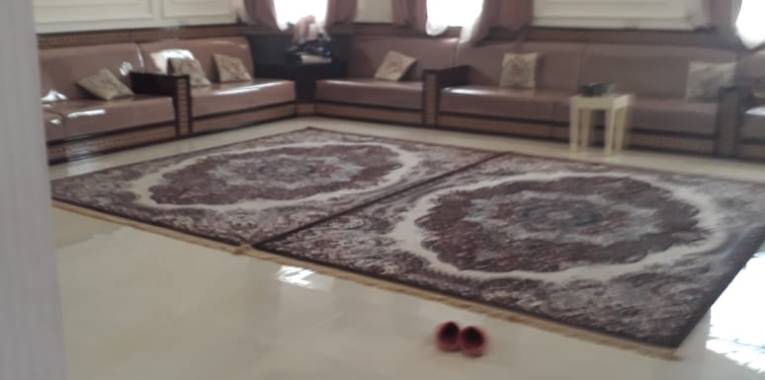
(photo of majlis by informant, used with permission)
(صورة للمجلس التقطها أحد مقدمي المعلومات، وعرضت بعد الموافقة)

During over a decade of picnics with men from southern Oman, I have never been offered the eyes, brain, tongue or tail of any animal. The cliché of guests being offered the ‘unloved’ parts of an animal doesn’t hold here in the Dhofar region. And it’s not that large platter of rice and meat that will cause you problems. Men will encourage you to eat, but if you gather up a few grains of rice in your hand and lift it towards your mouth, the host’s attention will move on.
If you are given a fish, you can turn the head away from you and start to eat from tail up, scattering by chance a few shreds of lettuce over the eyes. Then you declare yourself full before you need to deal with the stomach area, much less digging into the skull for the fish cheeks.
What you should fear is ladies’ parties with lots of very generous, caring, strong-arming women.
Men usually have dinner with friends on the beach or in a scenic place in the mountain. It’s dark, eating is done quickly and men come and go freely; there is little policing of who eats what. Although the cook might toss special pieces of meat or fish towards you, if you don’t want to eat them, simply leave them alone.
But women parties are usually indoors, with lots of light and everyone sits in their places for several hours so you are constantly under observation.
I love wedding parties because the air is full of beautiful perfumes and everyone is in gorgeous, comfortable, multi-color thobes (the loose, traditional Dhofari dress). And the food is delicious, but you cannot escape it. Either waitresses or relatives of the groom will bring around trays of drinks and sweets and everyone, not just the hostess, but all the other guests, will encourage you to partake.
You have had four cups of super-leaded, espresso-strength, cardamom-spiced Omani qahwa (coffee)? The generous women would like you to have a fifth cup! “You didn’t drink anything! Do you not like the coffee? Do you want tea! BRING TEA, SHE WANTS TEA!” they call.
You protest but, alas, give up. The tsunami of kindness is coming for you. Take up the tea cup and drink. And as soon as you set down the cup, here come someone with juice, soda, instant coffee, chai ahmar (“red tea,” black tea with only sugar added), chai haleeb (“milk tea,” black tea with milk and sugar), or karak (loose tea with spices and milk).
Then come the sweets accompanied by women benevolently asking you to take another spoonful of halwa, the traditional Omani dessert. And like a swan-dive into a bowl of whipped cream, you submit to your fate: a small plate of carrot sweet, a bowl of crème caramel, a slice of cake, a bowl of ice cream, fruit salad, luqaymat/ loqeemat (sweet fried dough with a sugar syrup), basbousa, and wrapped chocolates.
And now, just as you give up any thought of ever moving again, dinner is served. A generous woman hands you a plate heaped high with a selection of appetizers (hummus, fattoush, baba ghanoush, etc., with pita bread) and qabooli (a dish with spices, rice and meat). Then, of course, dessert is served.
There have been weekends in which I have inhabited both worlds. One night was spent wearing loose cotton trousers and a tunic top with a plain blue headscarf and sitting on a plastic mat on a beach out of sight from any man-made lights. Dinner was fresh-caught fish cooked over a fire. The men in my research group and I ate with our hands, drank Dew, looked at the stars, listened to the sea and talked until 1am. The next night I wore a decorated velvet thobe with full make-up, my meager supply of gold jewelry and a lot of duty-free perfume, in a room full of air-conditioning, bright lights, and delightful women who wanted to stuff me until I burst.
Omani people are very open-hearted and open-handed and doing research on foodways is a lot of fun, but it is not for the meek or the small of stomach.
I got the e-mail confirming that my Houseways book will be published in January 2023 while sitting in a living room that is completely opposite of the rooms I have described and lived in Oman. The Canadian house had wooden floors and furniture, windows without curtains, no AC, a big fireplace, floor lamps, crocheted afghans, many photos and bookshelves overflowing with novels, candles, puzzles, souvenirs and small wooden carvings of birds. Looking at the room while thinking of the descriptions of Omani houses in my book was a good reminder of how differently people arrange their living spaces.
Given that my academic background is literature and travel writing, it might seem odd that I decided to write about houses, but I grew up in a home in which everyone had strong opinions about how to live and an active interest in building decks, planting gardens, finding a rug in exactly the right shade of blue and putting the sofa there, no, not there, there, a little to the right, no, now forward a little.
As I child, I wanted to live in a Baroque castle; everyone else wanted to live in a modernist, northern European design-aesthetic structure. I wanted to read novels; everyone else wanted to figure out if it was possible to punch a hole in that wall to put in a window. For my 13th birthday I wanted a ball gown and was given my very own tool kit with hammer, pliers, wrench, level and screwdrivers.
I heard about Mansard roofs, color wheels, mixed-use developments and Frank Lloyd Wright. Our living room had a Barcelona chair, a Scandinavian Designs sofa and a Century House (Madison, WI) rug; when my father and I went to England, it was to see Milton Keynes and Welwyn Garden City. I watched my family build furniture, swatch paints, install insulation, build benches to strengthen community bonds in our neighborhood and weed. I read in cafés while they re-framed doorways.
The root of this problem was that when he was in his early 20s, my father walked into Louisburg Square in Boston and thought, “everyone should live like this.” That collection of houses changed his life; he became an urban planner and spent more than 60 years thinking, talking, writing and teaching about how to form better-organized houses, neighborhoods and cities. My mother creates gardens and both siblings have planned renovations of their houses down to the trim on the underside of cabinets.
I thought I had escaped this legacy until I got interested in how Dhofaris design kitchens as part of my Foodways project [ Foodways in Southern Oman – Short Essays and Images ]. I realized, while that I am not interested in decorating or remodeling, I love listening to people’s stories about how they live in their houses, what choices they make and why.
I am grateful to my family for all that early training and to the Omanis who have trusted me with their stories, opinions, photos and friendship.

To better understand issues related to housing and how house fit within cities, I have read many texts about the growth of cities on the Arabian Peninsula. Across differences between authors there are two similarities: writers often fail to put themselves in the location and scorn shopping. Perhaps the genres they are writing in (political science, urban studies, architecture, etc.) call for a distanced view but it’s odd to read so much information about a place by people who never talk about what it’s “like” to be there. Critiques of road placement, enclave developments, poorly designed open spaces, congestion etc. might be accurate, but there’s nothing in the text to show that the author was actually there except for some ‘taken by the author’ photos.
And there is widespread contempt for shopping with lots of remarks about mindless, over-consumerism but nothing about joy of walking into a shopping center with a mix of languages, scents, sights and people. I lived in Sharjah from 1997-99 and City Center Mall and the Blue Souq were my favorite places to shop and people-watch.
This summer I was in New York City, Boston and small towns in the Northeast. In each location, people blended together. Most clothes in NYC were black; most clothes in Boston were khaki. No feathers, no saris, no rhinestones, no apricot-colored silk dresses worn with sandals decorated with small birds, no little girls running around in 7-layer tulle dresses with bare feet, no long robes with pointed hoods, no teal leather slippers with the toes curled up, no purple fake-crocodile leather skirts. But that is what is waiting for you at a Dubai mall: uniforms from every kind of job, clothing from many countries and people strutting around in whatever dream they and their tailor could come up with, plus goods from Africa, Australia and New Zealand, Europe, Japan, Korea, South America and others.
And the souqs! When you read the disparaging comments about how inauthentic they are, how they are set up for tourists and what was torn down to build them, you get no sense of the wonder of, for example, the Sharjah Blue Souq. It’s lovely (and safe! more on that below). There are Emiratis and expats shopping and a wonderful cacophony of Iranian, Pakistani, Indian, Afghani, Syrian, etc. sellers.
To walk into Muttrah Souq in Muscat is to overwhelmed with rainbows of colors: scarves, shoes, dresses and ribbons. There are displays crowded with shells, colored glass lanterns, little metal oil lamps, spices, frankincense, gold necklaces and silver rings. It might not be completely authentic or following all best practices for urban design but it’s fun. And used by Omanis as well as tourists.
By not talking about the “feel” of urban spaces, writers miss another important aspect: safety. When I worked at the American University of Sharjah, I didn’t have a computer in my on-campus apartment, so I would often walk about 6 blocks to work in the evening. How many female academics can say that they can walk through any building and any part of their campus at any time of day or night and feel perfectly safe?
In Dubai, Sharjah and Muscat I get into taxis without a second thought. I walk through parking garages without threading my keys through my fingers or looking around. At Washington National airport I had to assess fellow passengers before deciding who I could ask to watch my carry-on bag when I went to buy a magazine. At Dubai and Muscat airports, I just leave the bag if I need to walk a short distance to get a soda. At my café in Salalah, men leave their laptops, phones and sunglasses on the table when they go to pray. At the grocery store, I can leave my purse in the cart as I go to get some apples and then stand in line to have them weighed.
I do not ever try to put myself in danger. I never camp alone but many times I have driven home from a research meeting at 2 or 3am. I worry about camels on the road, not about being harmed. The times when my car has broken down or gotten stuck in the sand, the men who have stopped were helpful.
Happily, Maneval’s New Islamic Urbanism (2019) does not follow the norms of talking about urban spaces in the abstract and disparaging shopping centers. Maneval has a thorough understanding of the history and architecture of Jeddah but he also muses on what “it’s like” to walk down the streets and through the buildings. The focus of his work is to reframe the concepts of public and private to
conceive of these spaces as variable products of social practice involving both people and artefacts…[e.g] walls, doors, curtains etc. are not enough to turn a building into a private space. It could just as well be used as an office or for the assembly of a political party. In order for it to become a private space, whether continuously or temporarily, people have to use it as such, that is, keep other people out to remain undisturbed, screen certain bodily appearances and activities from view, do what they only want to do alone or with a limited number of persons with whom they share an intimate bond (63)
However, to me, how he sets himself within the context of Jeddah is just as important as his academic framework. He is the only author I found who talks in first person about the difficulty of every-day actions such as crossing a street or finding the entrance to a building. [An article that also discusses “what it’s like” to walk in Arabian Peninsula cities is Nastasi’s excellent “A Gulf of Images: Photography and the Circulation of Spectacular Architecture” (2019), but this text concentrates on urbanscapes, not houses.]
When Maneval talks about how gender separation displaces both women and men, he discusses how he was not able to enter an art exhibit or sit in a café with a group of men. His opening example, of being guided/ guarded through a female-only university, is the only time I have read a male author explaining how it feels to be “othered” on the Arabian Peninsula.
I am grateful that I found his book early in my research on Houseways ; it was heartening to find someone who blends the academic with the personal to create a comprehensive view of how people navigate through houses and cities.

Selected references related to Houseways in Southern Oman, Dr. Marielle Risse
(photo by Ms. Onaiza Shaikh)
[references for pre-historic and pre-modern Dhofar are also listed in separate topic-specific bibliographies at the end]
Abdelghani, Montasser. 2013. “The Impact of Shopping Malls on Traditional Retail Stores in Muscat. Case Study of Al-Seeb Wilayat.” Regionalizing Oman. Steffen Wippel, ed. New York: Springer. 227-47.
Abu-Lughod, Janet. 1989. “What Is Islamic about a City? Some Comparative Reflections,” in Urbanism in Islam: The Proceedings of the International Conference on Urbanism in Islam (Tokyo: Middle Eastern Culture Center): 193-217.
—. 1987. “The Islamic City: Historical Myth, Islamic Essence and Contemporary Relevance.” International Journal of Middle East Studies 19.2: 155-76.
Adam, Khalid and Liudmila Cazacova, 2012. “The Round Dhofari House Popularity Uniting the Past and the Present.” Proceedings of the 6th International Seminar on Vernacular Settlements. Eastern Mediterranean University, Famagusta, North Cyprus. 365-74.
Akcan, Esra. 2014. “Postcolonial Theories in Architecture” in A Critical History of Contemporary Architecture (1960-2010). Elie Haddad and David Rifkind, eds. London: Ashgate. 119-40.
—. 2014. “Global Conflict and Global Glitter: Architecture in West Asia (1960-2010)” in A Critical History of Contemporary Architecture (1960-2010). Elie Haddad and David Rifkind, eds. London: Ashgate. 317-43.
Al Gandel, Thamna and Ibrahim Bryan Finn. 2017. Learn About Dhofar from 530 Questions and Answers. Muscat: Dar al Wraq.
Al Harthy, Sultan. 1992. The Traditional Architecture of Oman: A Critical Perspective. Unpublished M.Arch. thesis. The University of Arizona. https://repository.arizona.edu/bitstream/handle/10150/555398/AZU_TD_BOX353_YARP_1120.pdf?sequence=1 – https://repository.arizona.edu/handle/10150/555398
Al Hinai, H., W. J. Batty and S. D. Probert. 1993. “Vernacular Architecture of Oman: Features that Enhance Thermal Comfort Achieved within Buildings.” Applied Energy 44.3: 233-44. 10.1016/0306-2619(93)90019-L
Al Ismaili, Ahmed. 2018. “Ethnic, Linguistic, and Religious Pluralism in Oman: The Link with Political Stability.” Al Muntaqa 1.3: 58-73.
Al Kathiri, Muna Salim and Liudmila Cazacova. 2014. “Islamic Architecture Features and Modern Housing: A Case Study of the North Awqad District in Salalah, Oman.” The International Journal of the Constructed Environment 4: 1-18.
Al Mohannadi, Asmaa Saleh, Raffaelo Furlan and Mark David Major. 2019. “Socio-Cultural Factors Shaping the Spatial Form of Traditional and Contemporary Housing in Qatar: A Comparative Analysis based on Space Syntax.” Proceedings of the 12th Space Syntax Symposium.
Al Mohannadi, Asmaa Saleh and Raffaello Furlan. 2019. “Socio-cultural Patterns Embedded into the Built Form of Qatari Houses: Regenerating Architectural Identity in Qatar.” Journal of Urban Regeneration and Renewal 12.4: 1-23.
Al Thahab, Ali, Sabah Mushatat, and Mohammed Abdelmonem. 2014. “Between Tradition and Modernity: Determining Spatial Systems of Privacy in the Domestic Architecture of Contemporary Iraq.” ArchNet – International Journal of Architectural Research 8.3: 238-250.
Albright, Franklin. 1982. The American Archaeological Expedition in Dhofar, Oman, 1952-1953. Washington DC: American Foundation for the Study of Man.
Alexander, Christopher, Sara Ishikawa, Murray Silverstein, Max Jacobson, Ingrid Fiksdahl-King and Shlomo Angel. 1977. A Pattern Language: Towns, Buildings, Construction. Oxford: OUP (Center for Environmental Structure Series).
Alkhalidi, Abdulsamad. 2013. “Sustainable Application of Interior Spaces in Traditional Houses of the United Arab Emirates.” Procedia – Social and Behavioral Sciences 102: 288-299.
AlMutawa, Rana. 2022. “Navigating the Cosmopolitan City: Emirati Women and Ambivalent Forms of Belonging in Dubai,” in Migration in the Making of the Gulf Space Social, Political, and Cultural Dimensions. Antia Mato Bouzas and Lorenzo Casini, eds. New York: Berghahn Books. 67-85.
—. 2020, Dec. 9. “Dishdasha Blues: Navigating Multiple Lived Experiences in the Gulf.” London School of Economics Middle East Blog Posts https://blogs.lse.ac.uk/mec/2020/12/09/dishdasha-blues-navigating-multiple-lived-experiences-in-the-gulf/
—. 2019, Nov 8. “Dubai Mall or Souq Naif? The Quest for ‘Authenticity’ and Social Distinction.” London School of Economics Middle East Blog Posts. https://blogs.lse.ac.uk/mec/2019/11/08/dubai-mall-or-souq-naif-the-quest-for-authenticity-and-social-distinction/
—. 2019. “The Mall Isn’t Authentic!: Dubai’s Creative Class And The Construction of Social Distinction.” Urban Anthropology and Studies of Cultural Systems and World Economic Development 48: 1-2: 183-223.
—. 2018, Dec.4. “Challenging Concepts of ‘Authenticity’: Dubai and Urban Spaces in the Gulf.” London School of Economics Middle East Blog Posts. https://blogs.lse.ac.uk/mec/2018/12/04/challenging-concepts-of-authenticity-dubai-and-urban-spaces-in-the-gulf/
—. 2017. “Women and Restrictive Campus Environments: A Comparative Analysis Between Public Universities and International Branch Campuses in the UAE.” Higher Education in the Gulf States: Present and Future. 17-9.
Ammann. Ludwig. 2006. “Private and Public in Muslim Civilization,” in Islam in Public: Turkey, Iran and Europe. Nilüfer Göle and Ludwig Ammann, eds. Istanbul Bilgi University Press. 77-125.
—. 2002. “Islam in Public Space.” Public Culture 14.1: 277-79.
Anderson, Esther. 2021. “Positionality, Privilege, and Possibility: The Ethnographer ‘at Home’ as an Uncomfortable Insider.” Anthropology and Humanism 46.2: 212-25.
Anderson, John. 1896. “A Sketch of the Physical Features of the Coast of South-East Arabia.” A Contribution to the Herpetology of Arabia. London: R.H. Porter. 2-18.
Atlas of Archaeological Survey in the Governorate of Dhofar Sultanate of Oman. 2013. Muscat: Office of the Advisor to His Majesty the Sultan for Cultural Affairs.
Andraos, Amale. 2016. “The Arab City.” Places Journal. https://doi.org/10.22269/160531
Arnaud, Jean-Luc. 1995. “La Formation de l’Architecture Contemporaine à Sanaa,” in Sanaa hors les Murs, une Ville Arabe Contemporaine. Franck Mermier and Gilbert Grandguillaume, eds. Urbama – CFEY: Tours. 165-226.
Asmi, Rehenuma. 2016. “Finding a Place to Sit How Qatari Women Combine Cultural and Kinship Capital in the Home Majlis.” Anthropology of the Middle East 11.2: 18–38.
Avanzini, Alessandra, ed. 2008. A Port in Arabia between Rome and the Indian Ocean (3rd C.BC. – 5th C.AD) Khor Rori Report 2. Rome: L’Erma di Bretschneider.
—. 2007.“Sumhuram: A Hadrami Port on the Indian Ocean,” in The Indian Ocean in the Ancient Period: Definite Places, Translocal Exchange BAR International Series 1593. Eivind Heldaas Seland, ed. Oxford: Archaeopress. 23-31.
—. 2002. “Incense Routes and Pre-Islamic South Arabian Kingdoms.” Journal of Oman Studies 12: 17-24.
Avanzini, Alessandra and Alexander Sedov. 2005. “The Stratigraphy of Sumhuram: New Evidences.” Proceedings of the Seminar for Arabian Studies 35: 11-7.
Ball, Lawrence, Douglas MacMillan, Joseph Tzanopoulos, Andrew Spalton, Hadi Al Hikmani and Mark Moritz. 2020. “Contemporary Pastoralism in the Dhofar Mountains of Oman.” Human Ecology. https://doi.org/10.1007/s10745-020-00153-5
Bandyopadhyay, Soumyen. 2019. “The Bait as-Sail Rehabilitation and Restoration Project, Salalah, Oman.” Architecture and Cultural Heritage of India, Arabia and the Maghreb. https://www.archiam.co.uk/ghassani-house-adaptive-reuse-project/
—. 2011. Manah: An Omani Oasis, an Arabian Legacy Architecture and Social History of an Omani Settlement. Liverpool: Liverpool University Press.
—. 2006. “The Deconstructed Courtyard: Dwellings of Central Oman,” in Courtyard Housing: Past, Present and Future. B. Edwards, M. Sibley, M. Hakmi, and P. Land. eds. New York: Taylor & Francis. 109-21.
—. 2002. “Problematic Aspects of Synthesis and Interpretation in the Study of Traditional Built Environment.” Global Built Environment Review 2.2: 16-28.
Barth, Fredrik. 1983. Sohar: Culture and Society in an Omani Town. Baltimore: Johns Hopkins University Press.
Beeston, Alfred. 1976. “The Settlement at Khor Rori.” The Journal of Oman Studies 2: 39-41.
Belfioretti, Luca and Tom Vosmer. 2010. “Al-Balīd Ship Timbers: Preliminary Overview and Comparisons.” Proceedings of the Seminar for Arabian Studies 40: 111-18.
Belk, Russell. 2012. “People and Things,” in Handbook of Developments in Consumer Behavior. Victoria Wells and Gordon Foxall, eds. Cheltenham: Elgar. 15-46.
Benkari, Naima. 2021. “The Formation and Influence of the Military Architecture in Oman during the al Ya’ariba Period (1034-1162 AH/ 1624-1749 AD). Journal of Islamic Architecture 6.4: 217-228.
—. 2021. “Community-led Initiatives for the Rehabilitation and Management of Vernacular Settlements in Oman: A Phenomenon in the Making.” Built Heritage 5.1: 1-20.
—. 2019. “Local Community Involvement in the Adaptive Reuse of Vernacular Settlements in Oman,” in Vernacular and Earthen Architecture: Towards Local Development. Miles Lewis, Shao Yong, Gisle Jakhelln and Mariana Correia, eds. Shanghai: Tongji University Press. 557-64.
—. 2017. “Urban Development in Oman: An Overview.” Transactions on Ecology and the Environment 226.1: 143–156.
Benkari, Naima, and Alya Al-Hashim. 2015. “Omani Traditional Houses and Settlements: New Options for Developing a Sustainable Tourism.” unpublished.
Bent, J.T. 1895. “Exploration of the Frankincense Country, Southern Arabia.” The Geographical Journal 6.2: 109-33.
Bent, Theodore and Mabel. 2005/ 1900. Southern Arabia. London: Elibron.
Bianca, Stefano. 2000. “Basic Principles of Islam and Their Social, Spatial and Artistic Implications” in Urban Form in the Arab World. London: Thames & Hudson. 23-48.
Biancifiori, M. 1994. Works of Architectural Restoration in Oman. Rome: Edizioni De luca.
bin Zayyad, Sabeen and Brian Sinclair, 2017. “Culture, Context + Environmental Design: Reconsidering Vernacular in Modern Islamic Urbanism.” presented at the 10th EAAE/ARCC International Conference. https://www.researchgate.net/publication/314218959_Culture_context_environmental_design_Reconsidering_vernacular_in_modern_Islamic_urbanism
Blue, Lucy, Nasser Said Al-Jahwari, Eric Staples, Lorena Giorgio, Paolo Croce, Alessandro Ghidoni, Ayyoub Nagmoush Al Busaidi and Luca Belfioretti. 2014. “Maritime Footprints: Examining the Maritime Cultural landscape of Masirah Island, Oman, Past and Present.” Proceedings of the Seminar for Arabian Studies 44. 53-68.
Bontenbal, Marike. 2017. “Policy Brief – Opportunities and Constraints of Female Labour Participation in Oman’s Private Sector.” Economic Research Forum – German University of Technology in Oman. 1-8.
—. 2015. “Residential Satisfaction and Place Identity in a Traditional Neighborhood: The Case of Mutrah, Oman,” in Gateways to the World: Port Cities in the Gulf: Working Group Summary Report. Doha: Center for International and Regional Studies at the Georgetown University School of Foreign Service in Qatar. 189-215.
—. 2013. “Place Attachment and Sense of Belonging in Oasis Villages in the Capital Area of Muscat, Oman.” Trialog: A Journal for Planning and Building in the Global Context 3. 16-20.
Bortolini, Eugenio and Olivia Munoz. 2015. “Life and Death in Prehistoric Oman: Insights from Late Neolithic and Early Bronze Age Funerary Practices (4th – 3rd mill. BC).” Proceedings of the Symposium: The Archaeological Heritage of Oman. Paris: UNESCO. 61-80.
Bourdieu, Pierre. 1972. “The Kabyle House or the World Reversed,” in Algeria 1960. Cambridge: Cambridge University Press. 133-54.
Brandt. Marieke. 2021. “Introduction: The Concept of Tribe in the Anthropology of Yemen,” in Tribes in Modern Yemen: An Anthology (Denkschriften Der Philosophisch-historischen Klasse 531). Najwa Adra, Marieke Brandt, Steven Caton, Paul Dresch, Andre Gingrich, eds. Vienna: Institut für Sozialanthropologie der Österreichischen Akademie der Wissenschaften. 11-8.
—. 2021. “Some Remarks on Blood Vengeance (Tha’r) in Contemporary Yemen,” in Tribes in Modern Yemen: An Anthology (Denkschriften Der Philosophisch-historischen Klasse 531). Najwa Adra, Marieke Brandt, Steven Caton, Paul Dresch, Andre Gingrich, eds. Vienna: Institut für Sozialanthropologie der Österreichischen Akademie der Wissenschaften. 63-78.
Breteau, Marion. 2020. Amours à Mascate: Espaces, Rôles de Genre et Représentations Intimes chez les Jeunes (Sultanat d’Oman). Anthropologie Sociale et Ethnologie. Aix-Marseille Université.
Buffa, V and A.V. Sedov. 2008. “The Residential Quarter” in A Port in Arabia between Rome and the Indian Ocean (3rd C. BC – 5th C. AD). A. Avanzini, ed. Khor Rori Report 2, Roma: L’Erma di Bretschneider: 15-59.
Carter, Henry. 1852. “Memoir of the Geology of the South-East Coast of Arabia.” Journal of the Bombay Branch of the Royal Asiatic Society: 21-96.
—. 1851. “A Geographical Description of Certain Parts of the Southeast Coast of Arabia.” Journal of the Bombay Branch of the Royal Asiatic Society. 224-317.
—. 1847. “Notes on the Mahrah Tribe of Southern Arabia, with a Vocabulary of their Langauge, to which is appended additional Observations on the Gara Tribe.” Journal of the Bombay Branch of the Royal Asiatic Society 7.2: 339-64.
—. 1846. “The Ruins of El Balad.” Journal of the Royal Geographical Society of London 16: 187-99.
—. 1845. “Notes on the Gara Tribe.” Journal of the Bombay Branch of the Royal Asiatic Society: 195-201.
Carter, J. R. L. 1982. Tribes in Oman. London: Peninsular Publishing.
Carter, Robert and Daniel Eddisford. 2017. “The Vernacular Architecture of Doha, Qatar.” Post-Medieval Archaeology. 1-26. doi: 10.1080/00794236.2017.1320918
Caton, Steve. 2005. Yemen Chronicle: Anthropology of War and Mediation. New York: Hill and Wang.
Causevica, Senija and Mark Neal. 2019. “The Exotic Veil: Managing Tourist Perceptions of National History and Statehood in Oman.” Tourism Management 71: 504-17.
Cazacova, Liudmila., Maria Hidalgo, M. Farhan, F. Al-Masikhi, F. Al-Hafidh, H. Qatan, J. Hubais, L. Ghafoor, M. Al-Marhoon, M. Darwish, M. Al-Amri, S. Al-Baraami, S. Al-Shanfari and S. Al-Rawas, 2014. “Recognition of Mirbat Town’s Old Area as Historical Environment.” Proceedings of REHAB. Tomar, Portugal. 581-91. doi: 10.14575/gl/rehab2014
Cazacova, Liudmila and Balkiz Yapicioglu. 2021. “Residential Architecture: Evaluation of Tenants’ Satisfaction in Private Culture.” WIT Transactions on Ecology and the Environment 253: 409-22.
—. 2014. “Fertile Crescent Defensive Cities Architectural Features Influenced by the Land of Incense Culture.” Proceedings of the CAUMME II International Symposium: Architectural and Urban, Architectural and Urban Research, Education, and Practice in the Era of Post-Professionalism. Girne American University, Girne, North Cyprus. 322-46.
Charpentier, Vincent, Jean-Francois Berger, Rémy Crassard, Fredico Borgi and Philippe Béarez. 2016. “Les Premiers Chasseurs-collecteurs Maritimes d’Arabie (IXe-IVe millénaires avant notre ère) [Early Maritime Hunter-Gatherers in Arabia (9th – 4th Millennium before the Current Era)] Archéologie des Chasseurs-collecteurs Maritimes. Catherine Dupont and Gregor Marchand, eds. Paris: Société Préhistorique Française. 345-66. https://www.researchgate.net/publication/311650424_Les_premiers_chasseurs-collecteurs_maritimes_d’Arabie_IXe-IVe_millenaires_avant_notre_ere
Charpentier, Vincent, Alex de Voogt, Remy Crassard, Jean-Francois Berger, Federico Borgi and Ali Al-Mashani. 2014. “Games on the Seashore of Salalah: The Discovery of Mancala Games in Dhofar, Sultanate of Oman.” Arabian Archaeology and Epigraphy 25: 115-20.
Chatty, Dawn. 2013. “Rejecting Authenticity in the Desert Landscapes of the Modern Middle East: Development Processes in the Jiddat Il-Harasiis, Oman,” in Anthropology of the Middle East and North Africa. Sherine Hafez and Susan Slyomovics, eds. Bloomington: Indiana University Press. 145-64.
—. 2013. “Negotiating Authenticity and Translocality in Oman: The ‘Desertscapes’ of the Harasiis Tribe,” in Regionalizing Oman: Political, Economic and Social Dynamics. Steffen Wippel, ed. Heidelberg: Springer. 129-45.
—. 2000. “Women Working in Oman: Individual Choice and Cultural Constraints.” International Journal of Middle Eastern Studies 32: 241-54.
—. 2000. “Integrating Participation into Research and Consultancy: A Conservation Example from Arabia.” Social Policy and Administration 34.4: 408-18.
—. 1998. “Enclosures and Exclusions: Conserving Wildlife in Pastoral Areas of the Middle East.” Anthropology Today 14.4: 2-7.
—. 1997. Mobile Pastoralists: Development Planning and Social Change in Oman. New York: Columbia University Press.
—. 1976. “From Camel to Truck.” Folk 18: 114-28.
Clements, Frank. 1977. “The Islands of Kuria Muria: A Civil Aid Project in the Sultanate of Oman Administered from Salalah, Regional Capital of Dhofar.” Bulletin (British Society for Middle Eastern Studies) 4.1: 37-9.
Cleuziou, Serge and Maurizio Tosi. 2020. In the Shadow of the Ancestors: The Prehistoric Foundations of the Early Arabian Civilization in Oman, second edition. Dennys Frenez and Roman Garba, eds. Muscat: Ministry of Heritage and Tourism.
Cleveland, R. L. 1960. “The 1960 American Archaeological Expedition to Dhofar.” Bulletin of the American Schools of Oriental Research 159: 14-26.
—. 1959. “The Sacred Stone Circle of Khor Rori (Dhofar).” Bulletin of the American Schools of Oriental Research 155: 29-31.
Cordes, Rainer and Fred Scholz. 1980. “Changes in the Nomad Region of Oman” and “Settlement Projects in Inner Oman, and Other Measures to Develop the Rural/Nomad Region,” in Bedouins, Wealth, and Change: A Study of Rural Development in the United Arab Emirates and the Sultanate of Oman. Tokyo: United Nations University. https://archive.unu.edu/unupress/unupbooks/80143e/80143E00.htm
Costa, Paulo. 2001. Historic Mosques and Shrines of Oman. Oxford: British Archaeological Reports.
—. 1994. Studies in Arabian Architecture (Variorum Collected Studies). London: Routledge.
—. 1991. Musandam: Architecture and Material Culture of a Little Known Region of Oman. London: Immel.
—. 1983. “Notes on Settlement Patterns in Traditional Oman.” Journal of Oman Studies 6.2: 247-68.
—. 1979. “The Study of the City of Zafar (Al-Balid).” Journal of Oman Studies 5: 111-50.
Costa, Paulo and Stephen Kite. 1985. “The Architecture of Salalah and the Dhofar Littoral.” Journal of Oman Studies 7: 131-58.
Craufurd, C. 1919. “The Dhofar District.” The Geographical Journal 53.2: 97-105.
Cremaschi, Mauro, Andrea Zerboni, Vincent Charpentier, Remy Crassard, Ilaria Isola, Eleonora Regattieri, Giovanni Zanchetta. 2015. “Early-Middle Holocene Environmental Changes and pre-Neolithic Human Occupations as Recorded in the Cavities of Jebel Qara (Dhofar, southern Sultanate of Oman).” Quaternary International 382: 264-76.
Cruttenden, Charles. 1838. “Journal of an Excursion from Morbat to Dyreez, the Principal Town of Dhofar.” Transactions of the Bombay Geographical Society 1: 184-88.
Damluji, Salma Samar. 1998. The Architecture of Oman. Reading: Ithaca Press.
De Bel-Air, Françoise. 2015. “Demography, Migration, and the Labour Market in Oman.” Gulf Research Center – Gulf Labor Markets and Migration – EN – No. 9/2015. https://cadmus.eui.eu/bitstream/handle/1814/37398/GLMM_ExpNote_09_2015.pdf;jsessionid=D57068437CF3E9B040792393699299B9?sequence=1
de Cardi, Beatrice. 2002. “British Archeology in Oman: The Early Years.” Journal of Oman Studies 12.
De Koning, Anouk. 2009. Global Dreams: Class, Gender, and Public Space in Cosmopolitan Cairo. Cairo: American University in Cairo Press.
De Regt, Marina. 2010. “Ways to Come, Ways to Leave: Gender, Mobility, and Il/legality among Ethiopian Domestic Workers in Yemen.” Gender and Society 24.2: 237-60.
—. 2009. “Preferences and Prejudices: Employers’ Views on Domestic Workers in the Republic of Yemen.” Signs 34.3: 559-81.
De Siqueira, Gustavo and Amal Al Balush. 2020. “Co-designing the Pedestrian Revolution in Muscat.” City, Territory and Architecture 7.11: 1-15. doi: 10.1186/s40410-020-00119-6
Deeb, Lara and Jessica Winegar. 2012. “Anthropologies of Arab-Majority Societies.” Annual Review of Anthropology 41: 537-58.
Degli Esposti, Michele and Alexia Pavan. 2020. “Water and Power in South Arabia: The Excavation of “Monumental Building 1” (MB1) at Sumhuram (Sultanate of Oman).” Arabian Archeology and Epigraphy. 1-29. doi: 10.1111/aae.12159
Dorman, Deborah. 2017. “A Nasraniyya in Sanaa, 1988-99,” in Architectural Heritage of Yemen: Buildings that Fill my Eye. Trevor Marchand, ed. London: Ginko. 179-86.
Dorsky, Susan. 1986. Women of ‘Amran: A Middle Eastern Ethnographic Study. Salt Lake City: University of Utah Press.
Eickelman, Christine. 1988. “Women and Politics in an Arabian Oasis,” in A Way Prepared: Essays on Islamic Culture in Honor of Richard Bayly Winder. New York: New York University Press. 199-215.
—. 1984. Women and Community in Oman. New York: New York University Press.
Eickelman, Dale. 1989. “National Identity and Religious Discourse in Contemporary Oman.” International Journal of Islamic and Arabic Studies 6.1: 1-20.
—. 1983. “Omani Village: The Meaning of Oil,” in The Politics of Middle Eastern Oil. J. E. Peterson, ed. Washington, D.C.: The Middle East Institute. 211-19.
—. 1974. “Is There an Islamic City? The Making of a Quarter in a Moroccan Town.” International Journal of Middle East Studies 5.3: 274-94.
Eddisford, Daniel and Colleen Morgan, 2013. The Radwani House: Architecture, Archaeology and Social History. 1-92. https://www.academia.edu/33365222/The_Radwani_House_Architecture_Archaeology_and_Social_History
Eddisford, Daniel and Robert Carter. 2017. “The Vernacular Architecture of Doha, Qatar.” Post-Medieval Archaeology 51.1: 81-107.
Escher, Anton. 2019. “Eugen Wirth (1925-2012) – Geographer of the Oriental City in North Africa and the Near East.” Middle East – Topics & Arguments 12.1: 122-6. doi:10.17192/meta.2019.12.7940.
Flahive, Robert. 2021, Dec. 2. “Settler Colonialism Beyond the Settler State? Remaking the Past through Architectural Preservation in Casablanca.” Presentation at the Middle East Studies Association annual conference. Montreal, Quebec.
Fletcher, Richard and Erin Stepney. n.d. “Morphologies of Housing in Doha: from Bayt Sha’bi to Suburban Villa.” 1-23. https://www.academia.edu/41429399/Morphologies_of_Housing_in_Doha_from_bayt_shabi_to_suburban_villa
Franke-Vogt, Ute. 2002. “Remarks on the Classification of the Pottery from Al-Balid, Dhofar (Oman).” Unpublished ms., Office of the Advisor to HM the Sultan for Cultural Affairs: Muscat-Salalah.
Fusaro, Agnese. 2021. “The Islamic Port of al-Balīd (Oman), between Land and Sea: Place of Trade, Exchange, Diversity, and Coexistence.” Journal of Material Cultures in the Muslim World 1.1-2: 67-95. doi: https://doi.org/10.1163/26666286-12340003
Gallagher, Winifred. 2007. House Thinking: A Room-by-room Look at How We Live. New York: HarperCollins.
Galletti, Christopher, Billie Turner and Soe Myint. 2016. “Land Changes and their Drivers in the Cloud Forest and Coastal Zone of Dhofar, Oman, between 1988 and 2013.” Regional Environmental Change 16.7: 2141–53.
Garba, Roman. 2020. “Window 48- Triliths. Hinterland Monuments of Ancient Nomads. Window 48,” in In the Shadow of the Ancestors: The Prehistoric Foundations of the Early Arabian Civilization in Oman, second edition. Dennys Frenez and Roman Garba, eds.Muscat: Ministry of Heritage and Tourism. 500-10.
Garba, Roman, Alžběta Danielisová, Maria Pia Maiorano, Mahmoud Abbas, Dominik Chlachula, David Daněček, W. Al-Ghafri, Stephanie Neuhuber, Denis Štefanisko and Jakub Trubač. 20202. TSMO (Trilith Stone Monuments of Oman) Research Project Expedition Report of the 2nd Season 2019-2020 (campaigns TSMO 2A & 2B). Muscat: Ministry of Heritage and Culture, Sultanate of Oman. https://www.researchgate.net/publication/341193620_TSMO_EXPEDITION_REPORT_OF_THE_2nd_SEASON_2019-2020_campaigns_TSMO_2A_2B_Ministry_of_Heritage_and_Culture_Sultanate_of_Oman
Garba, Roman and Peter Farrington. 2011. “Walled Structures and Settlement Patterns in the South-western Part of Dhofar, Oman (poster).” Proceedings of the Seminar for Arabian Studies 41: 95–100.
Gardner, Andrew. 2015. “Migration, Labor and Business in the Worlding Cities of the Arabian Peninsula.” Institute of Developing Economies – Discussion Paper no. 513. 1-11.
Gardner, Andrew and Momina Zakzouk. 2014. “Car Culture in Contemporary Qatar,” in Everyday Life in the Muslim Middle East, third edition. Donna Lee Bowen, Evelyn Early, and Becky Schulthies, eds. Bloomington, IN: Indiana University Press. 133-42.
Gardiner, Ian. 2007. In the Service of the Sultan: A First-hand Account of the Dhofar Insurgency. South Yorkshire: Pen and Sword Military.
Gateways to the World: Port Cities in the Gulf: Working Group Summary Report. 2015. Doha: Center for International and Regional Studies at the Georgetown University School of Foreign Service in Qatar.
Gaube, Heinz, Lorenz Korn, Abdulrahman al-Salimi, Faysal al-Hafiyan, Ruba Kanaan, Seth M. N. Priestman, Birgit Mershen and Lorenz Korn. 2008. Islamic Art in Oman. Muscat: Al Roya Press.
Ghannam, Farah. 2011. “Mobility, Liminality, and Embodiment in Urban Egypt.” American Ethnologist 38.4: 790–800.
Giunta, Roberta. 2009. “Coins from Al Balid, A Preliminary Report.” Unpublished ms, Office of the Advisor to HM the Sultan for Cultural Affairs: Muscat-Salalah.
Göle, Nilüfer and Ludwig Ammann, eds. 2006. Islam in Public: Turkey, Iran and Europe. Istanbul: Istanbul Bilgi University Press.
Griffiths, Merlyn and Mary Gilly. 2012. “Sharing Space: Extending Belk’s (2010) ‘Sharing’.” Journal of Research for Consumers 22: 1-24. http://jrconsumers.com/Academic_Articles/issue_22/Griffiths-Gilly-AcademicArticle.pdf
Guest, R. 1935. “Zufar in the Middle Ages.” Islamic Culture 9: 402-10.
Hadimioglu, Çagla. 2001. “Black Tents.” Thresholds 22: 18-25.
Haggag, Mahmoud. 2004. “The Impact of Globalization on Urban Spaces in Arab Cities.” 35-46. https://www.irbnet.de/daten/iconda/CIB5930.pdf
Haines, Stafford. 1839. “Memoir to Accompany a Chart of the South Coast of Arabia from the Entrance of the Red Sea to Misenat, in 50, 43, 25 E. Part I.” Journal of the Royal Geographical Society of London 9: 125-56.
—. 1845. “Memoir of the South and East Coasts of Arabia: Part II.” Journal of the Royal Geographical Society of London 15: 104-60.
Haggag, Mahmoud. 2004. “The Impact of Globalization on Urban Spaces in Arab Cities.” 35-46. https://www.semanticscholar.org/paper/THE-IMPACT-OF-GLOBALIZATION-ON-URBAN-SPACES-IN-ARAB-Haggag/b0aa96129c20489f0c23166e7af080c388c21cbd
Hakim, Besim. 2008. Arabic-Islamic Cities: Building and Planning Principles. London: Kegan Paul.
Hanssen, Jens. 2010. “History, Heritage and Modernity: Cities in the Muslim world Between Destruction and Reconstruction,” in The New Cambridge History of Islam 6. R. Hefner (ed.). Cambridge: Cambridge University Press. 521-48.
Harvey, David. 2000. “Cosmopolitanism and the Banality of Geographical Evils.” Public Culture 12.2: 529-64.
Hawker, Ronald. 2008. Traditional Architecture of the Arabian Gulf: Building on Desert Tides. Southampton: WIT Press.
Hegazy, Soheir. 2015. “Cultural Sustainability between Traditional and Contemporary Omani Residences – A Comparative Case Study.” European Journal of Sustainable Development 42: 185-94.
—. 2014. “Conservation of Omani Archaeological Sites, Harat Al Bilad – A Case Study.” International Journal of Arts & Sciences 7.4: 435-48.
Heim, Bernhard, Marc Joosten, Aurel v. Richthofen and Florian Rupp. 2018. “Land-allocation and Clan-formation in Modern Residential Developments in Oman.” City Territory and Architecture 5.8: 1-9. https://doi.org/10.1186/s40410-018-0084-6
Hendawy, Gamal. 2015. “Socio-Demographic Characteristics of Indian Immigrants in the Sultanate of Oman (1993-2010).” Athens: ATINER’s Conference Paper Series, No. DEM2015-1514. 1-27.
Henderson, Joan. 2015. “The Development of Tourist Destinations in the Gulf: Oman and Qatar Compared.” Tourism Planning and Development 12:3: 350-61.
Hilbert, Yamandu. 2013. “Khamseen Rock Shelter and the Late Palaeolithic-Neolithic Transition in Dhofar.” Arabian Archeology and Epigraphy 24: 51-8.
Hilbert, Yamandu, Ash Parton, Mike Morley, Lauren Linnenlucke, Zenobia Jacobs, Laine Clark-Balzan, Richard Roberts, Chris Galletti, Jean-Luc Schwenninger and Jeff Rose. 2015. “Terminal Pleistocene and Early Holocene Archaeology and Stratigraphy of the Southern Nejd, Oman.” Quaternary International 282: 250-263. https://www.sciencedirect.com/science/article/abs/pii/S1040618215001603
Hilbert, Yamandu, Jeff Rose and Richard Roberts. 2012. “Late Paleolithic Core Reduction Strategies in Dhofar, Oman.” Proceedings of the Seminar for Arabian Studies 42: 1-18.
Hilbert, Yamandú, Vitaly Usik, Christopher Galletti, Ash Parton, Laine Clark-Balzan, Jean-Luc Schwenninger, Mike Morley, Zenobia Jacobs, Lauren Linnenlucke, Richard Roberts and Jeffrey Rose. 2015. “Archaeological Evidence for Indigenous Human Occupation of Southern Arabia at the Pleistocene/Holocene Transition: The Case of al-Hatab in Dhofar, Southern Oman.” Paléorient 41.2: 31-49.
Hulton, Jessop. 2003/1844. South Arabia: The ‘Palinurus’ Journals. W. A. Hulton, ed. London, Oleander. (original journal self-published by older brother)
Hulton, Jessop and James Smith. 1839. “Account of some Inscriptions found on the Southern Coast of Arabia.” Journal of the Royal Asiatic Society 5: 91-101.
—. 1835. “Report on some Inscriptions found at Hammam, on the Southern Coast of Arabia.” Journal of the Asiatic Society of Bengal 4: 533-7.
Ibn Battuta, 1929. Travels in Asia and Africa 1325-1354, H.A, R. Gibb, trans. London: Routeledge.
Ibn al-Mujawir. 2008. A Traveller in Thirteenth-century Arabia. 1204/ 1291. Hakluyt Soceity – third series; no. 19. trans. G. Rex. Smith. London: The Hakluty Soceity.
Ibrahim, Moawiyah and Ali Tigani ElMahi. 1997. “A Report on Two Seasons of Sultan Qaboos University Excavations at Al-Balid, Dhofar 1996-7.” Unpublished ms. Office of the Advisor to HM the Sultan for Cultural Affairs: Muscat- Salalah.
Jaidah, Ibrahim and Malika Bourennane. 2009. The History of Qatari Architecture from 1800 to 1950. Milano: Skira.
Jacobs, Jane. 1961/ 1992. The Death and Life of Great American Cities. New York City: Random House.
Jacobson, Max, Murray Silverstein and Barbara Winslow. 2002. Patterns of Home: The Ten Essentials of Enduring Design. Newtown, CT: Taunton Press.
Jansen, Michael, ed. 2015. “The Archaeological Park of Al-Baleed, Sultanate of Oman. Site Atlas along with selected Technical Reports 1995-2001.” Muscat: Office of the Adviser to His Majesty the Sultan for Cultural Affairs.
Janzen, Jorg. 2000. “The Destruction of Resources among the Mountain Nomads of Dhofar,” in The Transformation of Nomadic Society in the Arab East, University of Cambridge Oriental Publications 58. Martha Mundy and Basim Musallam, eds. Cambridge: Cambridge University Press. 160-75.
—. 1986. Nomads in the Sultanate of Oman: Tradition and Development in Dhofar. London: Westview Press.
The Journal of Oman Studies: Special Report 2: The Oman Flora and Fauna Survey 1975. 1980. Muscat: Diwan of H. M. for Protocol.
Julier, Alice. 2015. “Family and Domesticity,” in A Cultural History of Food in the Modern Age (The Cultural Histories Series). Amy Bentley, ed. London: Bloomsbury Academic. 145-64.
Khan, Hayder, Saleh Al-Saadi, Naima Benkari, and Aliya Al-Hashim. 2022. “Numerical Simulation of Ventilation Potential in Traditional Omani House: Bait Al Khandaq as an Example.” The Journal of Engineering Research 18.2: 91-100.
Kanafani, Aida Sami. 1979. Aesthetics and Ritual in the United Arab Emirates. unpublished dissertation, University of Texas at Austin.
Kay, Shirley and Dariush Zandi. 1991. Architectural Heritage of the Gulf. Dubai: Motivate Publishing.
Kelly, J.B. 1976. “Hadramaut, Oman, Dhufar: The Experience of Revolution,” Middle East Studies Association Bulletin, 12.2: 213-30.
Kite, Stephen. 2002. “The Poetics of Oman’s Traditional Architecture: Towards an Aesthetic Interpretation.” The Journal of Oman Studies 12: 133-55.
Klinger, Thibaut. 2022. L’Oman contemporain: Aménagement du territoire et identité nationale. Berlin: De Gruyter. https://doi.org/10.1515/9783110748222
Koch, Natalie. 2020. “The Desert as Laboratory: Science, State‐making, and Empire in the Drylands.” Transactions of the Institute of British Geographers. https://doi.org/10.1111/tran.12414
Komecoglu, Ugur. 2006. “New Sociabilities: Islamic Cafes in Istanbul,” in Islam in Public: Turkey, Iran and Europe. Nilüfer Göle and Ludwig Ammann, eds. Istanbul: Istanbul Bilgi University Press. 163-89.
Kotnik, Toni. 2005. “The Mirrored Public Architecture and Gender Relationship in Yemen.” Space and Culture 8.4: 472-83.
Lancaster, William and Fidelity Lancaster. 2020. “Some Relations between ‘Tribes’ and ‘Territory’ in the Arabian Peninsula in the Recent Past.” Semitica et Classica: International Journal of Oriental and Mediterranean Studies 13. 177-87. https://doi.org/10.1484/J.SEC.5.122987
Le Renard, Amélie. 2014. A Society of Young Women: Opportunities of Place, Power and Reform in Saudi Arabia. Stanford: Stanford University Press.
Lees, G. M. 1928. “The Physical Geography of South-Eastern Arabia.” Geographical Journal 71.5: 441-70.
Limbert, Mandana. 2010. In the Time of Oil: Piety, Memory and Social Life in an Omani Town. Stanford: Stanford University Press.
—. 2008. “The Sacred Date: Gifts of God in an Omani Town.” Ethnos 73.3: 361-76.
Liverani, Mario. 1997. “Beyond Deserts, Beyond Oceans” in Profumi d’Arabia. Alessandra Avanzini, ed. Rome: L’Erma Bretschneider. 557-64.
Maclagan, Ianthe. 1994. “Food and Gender in a Yemeni Community,” in Culinary Cultures of the Middle East. Sami Zubaida and Richard Tapper, eds. New York: I. B. Tauris Publishers. http://food.oregonstate.edu/ref/culture/middleeast/yemen_zubaida.html
Makhlouf, Carla. 1979. Changing Veils: Women and Modernisation in North Yemen. London: Croom Helm.
Maneval, Stefan. 2019. New Islamic Urbanism: The Architecture of Public and Private Space in Jeddah, Saudi Arabia. London: UCL Press.
—. 2019. “Navigating Urban Space: Jeddah, Early Twenty-first Century,” in New Islamic Urbanism: The Architecture of Public and Private Space in Jeddah, Saudi Arabia. London: UCL Press, 170-216.
Marchand, Trevor, ed. 2017. Architectural Heritage of Yemen: Buildings that Fill my Eye. London: Ginko.
McCorriston, Joy, Michael Harrower, Tara Steimer, Kimberly D. Williams, Matthew Senn, Mas‘ūd Al Hādhari, Mas‘ūd Al Kathīrī, ‘Ali Ahmad Al Kathīrī, Jean-François Saliège and Jennifer Everhart. 2014. “Monuments and Landscape of Mobile Pastoralists in Dhofar: The Arabian Human Social Dynamics (AHSD) Project 2009-2011.” Journal of Oman Studies 12: 117-44.
Meneley, Anne. 2017. “The Zabidi House,” in Architectural Heritage of Yemen: Buildings that Fill my Eye. Trevor Marchand, ed. London: Gingko Library. 195-203.
—. 2007. “Fashions and Fundamentalisms in Fin-De-Siecle Yemen: Chador Barbie and Islamic Socks.” Cultural Anthropology 22.2: 214–43.
—. 1996. Tournaments of Value: Sociability and Hierarchy in a Yemeni Town. Toronto: University of Toronto Press.
Menoret, Pascal. Joyriding in Riyadh: Oil, Urbanism, and Road Revolt. New York: Cambridge University Press, 2014.
Mershen, Birgit. 1999. “Settlement Space and Architecture in South-Arabian Oases: Preliminary Remarks on the Use and Division of Space in Omani Oasis Settlements.” Proceedings of the Seminar for Arabian Studies 29: 103-10.
Molotch, Harvey and Davide Ponzini. 2019. “The New Arab Urban: Test Beds, Work-arounds, and the Limits of Enacted Cities.” AlMuntaqa 2.1: 9-23. https://www.jstor.org/stable/10.31430/almuntaqa.2.1.0009
—, eds. 2019. The New Arab Urban: Gulf Cities of Wealth, Ambition and Distress. New York: New York University Press.
Montgomery, Charles. 2014. Happy City: Transforming Our Lives Through Urban Design. New York: Farrar, Strauss and Giroux.
Morris, Jan. 1957/ 2008. Sultan in Oman. London: Eland.
Morris, Miranda. 1997. “The Harvesting of Frankincense in Dhofar,” in Profumi d’Arabia. Alessandra Avanzini, ed. Rome: L’Erma Bretschneider. 231-50.
—. 1987. “Dhofar – What Made it Different” in Oman: Economic, Social and Strategic Development. B.R. Pridham, ed. London: Croom Helm. 51-78.
Nagieb, Maher, Stefan Siebert, Eike Luedeling, Andreas Buerkert, and Jutta Haser. 2004. “Settlement History of a Mountain Oasis in Northern Oman – Evidence from Land-use and Archaeological Studies.” Die Erde 135.1: 81-106.
Nagy, Sharon. 2004. “Keeping Families Together: Housing Policy, Social Strategies and Family in Qatar.” The MIT Electronic Journal of Middle East Studies 4: 42-58.
—. 1998. “Social Diversity and Changes in the Form and Appearance of the Qatari House.” Visual Anthropology 10.2: 281-304.
Nastasi, Michele. 2019. “A Gulf of Images: Photography and the Circulation of Spectacular Architecture,” in The New Arab Urban: Gulf Cities of Wealth, Ambition and Distress. Molotch, Harvey and Davide Ponzini, eds. New York: New York University Press. 99-129.
Newton, Lynne. 2010. “Shrines in Dhofar,” in Death and Burial in Arabia and Beyond: Multidisciplinary Perspectives, Society for Arabian Studies Monographs 10. Lloyd Week, ed. 329-40.
Newton, Lynne and Juris Zarins. 2017. The Archaeological Heritage of Oman. Dhofar Through the Ages. An Ecological, Archaeological and Historical Landscape. Muscat: Ministry of Heritage and Culture Sultanate of Oman.
—. 2014. “A Possible Indian Quarter at al-Baleed in the Fourteenth-Seventeenth Centuries AD?” Proceedings of the Seminar for Arabian Studies 44: 257-76.
Orazi, Roberto. 2002. “The Harbour and City of Khor Rawri.” Journal of Oman Studies 12: 210-22.
Othman, Zulkeplee, Rosemary Aird, and Laurie Buys. 2015. “Privacy, Modesty, Hospitality, and the Design of Muslim Homes: A Literature Review.” Frontiers of Architectural Research 4: 12–23. http://dx.doi.org/10.1016/j.foar.2014.12.001
Ovington, John. 1929. A Voyage to Surat in the Year 1689. H. G. Rawlinson, ed. London: Oxford University Press.
Pavan, Alexia. 2020. “The Port of Al Baleed (southern Oman), the Trade in Frankincense and Its Coveted Treasures.” Polish Archaeology in the Mediterranean 29.1. doi:10.31338/uw.2083-537X.pam29.1.13
—. 2017-2018. “Husn Al Baleed: Civil and Military Architecture along the Indian Ocean in Medieval Times.” Journal of Indian Ocean Archaeology 13-14: 28-41.
Pavan, Alexia and Michele Degli Esposti, 2016. The Urban Shrine in Quarter A at Sumhuram: Stratigraphy, Architecture, Material Culture. Quaderni di Arabia Antica 4, Roma: L’Erma di Bretschneider.
Pavan, Alexia, Agnese Fusaro, Chiara Visconti, Alessandro Ghidoni, and Arturo Annucci. 2020. “New Researches at The Port of Al Balid and Its Castle (Husn): Interim Report (2016-2018).” The Journal of Oman Studies 21: 172-99.
Pavan, Alexia, S. Laurenza, and R. Valentini, 2020. “Masonry and Building Techniques in a Medieval City Port of the Sultanate of Oman: Preliminary Typological Atlas at al-Balīd.” Newsletter Archeologia 10.
Pavan, Alexia and Chiara Visconti. 2020. “Trade and Contacts between Southern Arabia and East Asia: The Evidence from al-Balīd (southern Oman).” Proceedings of the Seminar for Arabian Studies 50: 243–57.
Pirenne, J. 1975. “The Incense Port of Moscha (Khor Rori) in Dhofar.” Journal of Oman Studies 1: 81-96.
“Population.” 2022. Data Portal – National Centre for Statistics and Information. https://data.gov.om/OMPOP2016/population. June 2.
Potts, Daniel. 2016. “Trends and Patterns in the Archaeology and Pre-Modern History of the Gulf Region,” in The Emergence of the Gulf States: Studies in Modern History. J.E. Peterson (ed.). London: Bloomsbury. 19-42.
Ragette, Friedrich. 2003. Traditional Domestic Architecture of the Arab Region. Felbach: Edition Axel Menges.
Raymond, André. 1994. “Islamic City, Arab City: Orientalist Myths and Recent Views.” British Journal of Middle Eastern Studies 21.1: 3-18. https://sci-hub.se/10.1080/13530199408705589
Remali, Adel, Ashraf Salama, Florian Wiedmann and Hatem G. Ibrahim. 2016. “A Chronological Exploration of the Evolution of Housing Typologies in Gulf Cities.” City, Territory and Architecture 3.14: 1-15. doi:10.1186/s40410-016-0043-z
Richthofen, Aurel von. 2019. Spatial Diversity and Sustainable Urbanisation in Oman. unpublished dissertation. Technische Universitaet Carolo-Wilhelmina zu Braunschweig. https://doi.org/10.24355/dbbs.084-201901220928-0
—. 2016. “Visualizing Urban Form as Mass Ornament in Muscat Capital Area” in Visual Culture(s) in the Gulf: An Anthology. N. Mounajjed, eds. Gulf Research Centre Cambridge. 137-58.
Risse, Marielle. 2021. Foodways in Southern Oman. London: Routledge.
—. 2021. “Private Lives in Public Spaces: Perceptions of Space-Usage in Southern Oman,” presentation at Middle East Studies Association annual conference. Montreal, Quebec. December 2.
—. 2019. Community and Autonomy in Southern Oman. Cham, Switzerland: Palgrave Macmillan.
—. 2018. “Accounts from the Journeys of the Brig ‘Palinurus’ Along the Dhofar Coast in the mid-1800s.” Maritime Exploration and Memory Conference, National Maritime Museum, Greenwich, England. Sept. 15.
—. 2015. “Generosity, Gift-giving and Gift-avoiding in Southern Oman.” Proceedings of the Seminar for Arabian Studies 45: 289-96.
—. 2013. “Verstehen/ Einfühlen in Arabian Sands (1959): Wilfred Thesiger as Traveler and Anthropologist.” Journeys: The International Journal of Travel & Travel Writing 14.1: 23-39.
—. 2009. “Cultural Refraction: Using Travel Writing, Anthropology and Fiction to Understand the Cultures of Southern Arabia.” Interdisciplinary Humanities 26:1: 63-78.
Roche, Thomas, Erin Roche and Ahmed Al Saidi. 2014. “The Dialogic Fashioning of Women’s Dress in the Sultanate of Oman.” Journal of Arabian Studies 4:1: 38-51.
Rose, Jeff. 2022. An Introduction to Human Prehistory in Arabia: The Lost World of the Southern Crescent. New York: Springer.
Rose, Jeff and Yamandu Hilbert. 2014. “New Paleolithic Sites in the Southern Rub’ Al Khali Desert, Oman.” Antiquity 88.341. https://antiquity.ac.uk/projgall/rose341
Rose, Jeff, Yamandu Hilbert, Anthony Marks and Vitaly Usik. 2018. The First People of Oman: Palaeolithic Archaeology of the Nejd Plateau. Sultanate. Muscat: Ministry of Heritage and Culture.
Rose, Jeff, Vitaly Usik, A. Marks, Yamandu Hilbert, Chris Galletti, A. Parton, V. Černý, J. Geiling, M. Morley, and R. Roberts. 2011. “The Nubian Complex of Dhofar, Oman: An African Middle Stone Age Industry in Southern Arabia.” PLoS ONE 6(11) e28239.
“Salalah al-Wusta & Gharbiya: Dhofar Governorate: Documentation and Heritage Management Plan.” 2016. University of Liverpool and the Ministry of Heritage and Culture. https://issuu.com/archiam/docs/20170908_hmp_salalah
Salama, Ashraf. 2015. “Urban Traditions in the Contemporary Lived Space of Cities on the Arabian Peninsula.” Traditional Dwellings and Settlements Review 27.1: 27-39.
—. 2014. “A Century of Architecture in the Arabian Peninsula: Evolving Isms and Multiple Architectural Identities in a Growing Region,” in Architecture from the Arab World (1914-2014): A Selection: Bahrain Catalogue in Biennale Venice. G. George Arbid (ed.). Manama: Bahrain Ministry of Culture. 137-43.
Sale, J. 1980. “The Ecology of the Mountain Region of Dhofar.” The Journal of Oman Studies: Special Report 2: The Oman Flora and Fauna Survey 1975. Muscat: Diwan of H. M. for Protocol. 25-54.
Saunders, J. P. 1846. “A Short Memoir of the Proceedings of the Honorable Company’s Surveying Brig ‘Palinurus,’ during Her Late Examination of the Coast between Ras Morbat and Ras Seger, and between Ras Fartak and the Ruins of Mesinah.” Journal of the Royal Geographical Society of London 16: 169-86.
Scholz, Fred. 1980. “Part III. Case Study: The Sultanate of Oman,” in Bedouins, Wealth, and Change: A Study of Rural Development in the United Arab Emirates and the Sultanate of Oman. Tokyo: United Nations University. https://archive.unu.edu/unupress/unupbooks/80143e/80143E07.htm
Singh, Kaushalendra. 2018., Jan 12. “A Saga of Legacy at Bait al Ghassani.” Oman Observer. https://www.omanobserver.om/article/64672/Front Stories/a-saga-of-legacy-at-bait-al-ghassani
Smith, G. Rex and Venetia Porter. 1988. “The Rasulids in Dhofar in the VIIth-VIIIth/XIII-XIVth Centuries.” The Journal of the Royal Asiatic Society of Great Britain and Ireland 1: 26-44.
Smith, John Alexander. 1991.“The Islamic Garden in Oman: Sanctuary and Paradise.” Garden History 19: 187-208.
—. 1983. “Desert Developments.” Building Design 11: 18-21.
Sobh, Rana and Russell Belk. 2011. “Domains of Privacy and Hospitality in Arab Gulf Homes.” Journal of Islamic Marketing 2.2: 125-37.
—. 2011. “Privacy and Gendered Spaces in Arab Gulf Homes.” Home Cultures 8.3: 317-40.
Sobh, Rana, Belk, Russell and Justin Gressel. 2010. “Conflicting Imperatives of Modesty and Vanity Among Young Women in the Arabian Gulf,” in Advances in Consumer Research 38. D. W. Dahl, G. V. Johar, and S. M. J. van Osselaer, eds. Duluth, MN: Association for Consumer Research.
Speck, Jeff. 2013. Walkable City: How Downtown Can Save America One Step at a Time. New York: North Point Press.
St Albans, Suzanne. 1980. Where Time Stood Still: Portrait of Oman. London: Quartet Books.
Stephenson, Lindsey. 2011. “Women and the Malleability of the Kuwaiti Dīwāniyya.” Journal of Arabian Studies 1.2: 183-99.
Stephenson, M.I., Karl, A.R. and David, E. 2010. “Islamic Hospitality in the UAE: Indigenization of Products and Human Capital.” Journal of Islamic Marketing 1.1: 9-24.
Tabook, Salim Bakhit. 1997. Tribal Practices and Folklore of Dhofar, Sultanate of Oman. Unpublished PhD thesis, Faculty of Arts, Exeter University.
Tabuki, Salim Bakhit. 1982. “Tribal Structures in South Oman.” Arabian Studies 6: 51-6. (same author as above)
Takriti, Abdul Razzaq. Monsoon Revolution: Republicans, Sultans and Empires in Oman 1965-1976. Oxford: Oxford University Press, 2013.
Thesiger, Wilfred. 1991/ 1959. Arabian Sands. New York: Penguin.
Thomas, Bertram. 1932, reprint. Arabia Felix: Across the Empty Quarter of Arabia. London: Jonathan Cape.
Usik, Vitaly, Jeff Rose, Yamandu Hilbert, P. Van Peer, and Anthony Marks. 2013. “Nubian Complex Reduction Strategies in Dhofar, Southern Oman.” Quaternary International 300: 244-66.
van Nes, Akkelies and Claudia Yamu. 2018. “Space Syntax: A Method to Measure Urban Space Related to Social, Economic and Cognative Factors,” in The Virtual and the Real in Planning and Urban Design: Perspectives, Practices and Applications. C. Yamu, A. Poplin, O. Devisch, and G. de Roo, eds. Routledge: New York. 136-150.
Varanda, Frenando. 2017. “The Domestic Architecture of the Northern Plateaux and Eastern Slopes of Yemen: Building Attitudes and Formal Identities,” in Architectural Heritage of Yemen: Buildings that Fill my Eye. Trevor Marchand, ed. London: Gingko Library. 89-99.
vom Bruck, Gabriele. 2018. Mirrored Loss: A Yemeni Woman’s Life Story. New York: Hurst.
—. 2017. “Bodies on the Move: Gender Dynamics on a Sanaani Minibus,” in Architectural Heritage of Yemen: Buildings that Fill my Eye. Trevor Marchand, ed. London: Gingko Library. 187-93.
—. 2005. “The Imagined ‘Consumer Democracy’ and Elite Re-Production in Yemen.” Journal of the Royal Anthropological Institute 11.2: 255-75.
—. 1997. “A House Turned Inside Out: Inhabiting Space in a Yemeni City.” Journal of Material Culture 2.2: 139-72.
Walsh, Tony. 2013. Walking Through History: Oman’s World Heritage Sites.
Wanucha, Elizabeth and Zahra Babar, eds. 2018. Hawwa, CIRS Special Issue: Family in the Arabian Peninsula 16.1-3.
Weir, Shelagh. 2007. A Tribal Order: Politics and Law in the Mountains of Yemen. Austin: University of Texas Press.
Wikan, Unni. 1982. Behind the Veil in Arabia: Women in Oman. Chicago: University of Chicago Press.
Winter, Tim. 2015. “Urban Sustainability in the Arabian Gulf: Air Conditioning and its Alternative.” Urban Studies. 1-15. doi: 10.1177/0042098015608782
Wolfe, Charles. 2020, Sept. 9. “Five Principles of the ‘Urbanism of Experience’.” Public Square. https://www.cnu.org/publicsquare/2020/09/09/five-principles-urbanism-experience
Yapicioglu, Balkiz and Liudmila Cazacova. 2018. “‘Omani Burqa’ vs. Decorated Facade of Modern Omani House: The Case of Salalah, Dhofar Region, Oman.” The Academic Research Community Publication. 101-111. ISSN online: 2537-0162
—. 2016. “The Building as a Statement of an Artefact: The Mijmara.” International Journal of Ecology & Development 31.3: 99-116.
—. 2016. “Culture Embedded in City’s Architecture; Incense Burning Custom and Its Effects on Modern Buildings’ Features of Salalah, Oman.” Proceedings of the 5th International Conference on Sustainable Tourism and Cultural Heritage. Istanbul, Turkey.
Yarwood, John. 2012. Urban Planning in the Middle East: Case Studies. Newcastle upon Tyne: Cambridge Scholars Publishing.
Yule, Paul and K.K. Mohammad. 2006/ 1998. “Report on Al-Baleed Pottery: Reference Collection, RWTH Aachen University” Muscat: Office of the Adviser to His Majesty the Sultan for Cultural Affairs.
Zarins, Juris. 2009. “The Latest on the Archaeology of Southern Oman.” Journal of the American Oriental Society 129.4: 665-74.
—. 2007. “Aspects of Recent Archaeological Work at al-Balid (Zafar), Sultanate of Oman.” Proceedings of the Seminar of Arabian Studies 37: 309-24.
—. 2001. The Land of Incense: Archaeological Work in the Governorate of Dhofar, Sultanate of Oman, 1990-1995. Muscat, Oman: Sultan Qaboos University Publications.
—. 1997. “Mesopotamia and Frankincense: The Early Evidence,” in Profumi d’Arabia. Alessandra Avanzini, ed. Rome: L’Erma Bretschneider. 251-72.
—. 1997. “Persia and Dhofar: Aspects of Iron Age International Politics and Trade,” in Crossing Boundaries and Linking Horizons. G. Young, M. Chavalas and R. Averbeck, eds. Bethesda: CDL Press. 615-89.
Zarins, Juris and Newton, Lynne. 2012 “Al Balid: Ancient Zafar, Sultanate of Oman. Report of Excavations, 2005-2011 and Salalah Survey.” Unpublished ms., Muscat-Salalah.
Zerboni, Andrea, Alessandro Perego, Guido S. Mariani, Filippo Brandolini, Mohammed Al Kindi, Eleonora Regattieri, Giovanni Zanchetta, Federico Borgi, Vincent Charpentier and Mauro Cremaschi. 2020. “Geomorphology of the Jebel Qara and Coastal Plain of Salalah (Dhofar, southern Sultanate of Oman).” Journal of Maps 16.2: 187-98.
Zimmerle, William. 2017. Cultural Treasures from the Cave Shelters of Dhofar: Photographs of the Painted Rock Art Heritage of Southern Oman. Washington: Sultan Qaboos Cultural Center/Liberty Press.
—. 2017. Crafting Cuboid Incense Burners in the Land of Frankincense: The Dhofar Ethnoarchaeology Preservation Project. Washington: Sultan Qaboos Cultural Center/Liberty House Press.
Selected references – Al Baleed and Sumhuram
Albright, Franklin. 1982. The American Archaeological Expedition in Dhofar, Oman, 1952-1953. Washington DC: American Foundation for the Study of Man.
Avanzini, Alessandra, ed. 2008. A Port in Arabia between Rome and the Indian Ocean (3rd C.BC. – 5th C.AD) Khor Rori Report 2. Rome: L’Erma di Bretschneider.
—. 2007.“Sumhuram: A Hadrami Port on the Indian Ocean,” in The Indian Ocean in the Ancient Period: Definite Places, Translocal Exchange BAR International Series 1593. Eivind Heldaas Seland, ed. Oxford: Archaeopress. 23-31.
—. 2002. “Incense Routes and Pre-Islamic South Arabian Kingdoms.” Journal of Oman Studies 12: 17-24.
Avanzini, Alessandra and Alexander Sedov. 2005. “The Stratigraphy of Sumhuram: New Evidences.” Proceedings of the Seminar for Arabian Studies 35: 11-7.
Belfioretti, Luca. and Tom Vosmer. 2010. “Al-Balīd Ship Timbers: Preliminary Overview and Comparisons.” Proceedings of the Seminar for Arabian Studies 40: 111-18.
Buffa, V and A.V. Sedov. 2008. “The Residential Quarter,” in A Port in Arabia between Rome and the Indian Ocean (3rd C. BC – 5th C. AD). A. Avanzini, ed. Khor Rori Report 2, Roma: L’Erma di Bretschneider: 15-59.
Carter, Henry. 1846. “The Ruins of El Balad.” Journal of the Royal Geographical Society of London 16: 187-99.
Cleveland, R. L. 1960. “The 1960 American Archaeological Expedition to Dhofar.” Bulletin of the American Schools of Oriental Research 159: 14-26.
—. 1959. “The Sacred Stone Circle of Khor Rori (Dhofar).” Bulletin of the American Schools of Oriental Research 155: 29-31.
Costa, Paulo. 1982. “The Study of the City of Zafar (Al-Balid).” Journal of Oman Studies 5: 111-50.
Degli Esposti, Michele and Alexia Pavan. 2020. “Water and Power in South Arabia: The Excavation of “Monumental Building 1” (MB1) at Sumhuram (Sultanate of Oman).” Arabian Archeology and Epigraphy. 1 – 29. DOI: 10.1111/aae.12159
Franke-Vogt, Ute. 2002. “Remarks on the Classification of the Pottery from Al-Balid, Dhofar (Oman).” Unpublished ms., Office of the Advisor to HM the Sultan for Cultural Affairs: Muscat-Salalah.
Fusaro, Agnese. 2021. “The Islamic Port of al-Balīd (Oman), between Land and Sea: Place of Trade, Exchange, Diversity, and Coexistence.” Journal of Material Cultures in the Muslim World 1.1-2: 67-95. doi: https://doi.org/10.1163/26666286-12340003
Giunta, Roberta. 2009. “Coins from Al Balid, A Preliminary Report.” Unpublished ms, Office of the Advisor to HM the Sultan for Cultural Affairs: Muscat-Salalah.
Ibrahim, Moawiyah and Ali Tigani ElMahi. 1997. “A Report on Two Seasons of Sultan Qaboos University Excavations at Al-Balid, Dhofar 1996-7.” Unpublished ms. Office of the Advisor to HM the Sultan for Cultural Affairs: Muscat- Salalah.
Jansen, Michael, ed. 2015. “The Archaeological Park of Al-Baleed, Sultanate of Oman. Site Atlas along with selected Technical Reports 1995-2001.” Muscat: Office of the Adviser to His Majesty the Sultan for Cultural Affairs.
Newton, Lynne and Zarins, Juris. 2014. “A Possible Indian Quarter at al-Baleed in the Fourteenth-Seventeenth Centuries AD?” Proceedings of the Seminar for Arabian Studies 44: 257-76.
Orazi, Roberto. 2002. “The Harbour and City of Khor Rawri.” Journal of Oman Studies 12: 210-222.
Pavan, Alexia. 2020. “The Port of Al Baleed (southern Oman), the Trade in Frankincense and Its Coveted Treasures.” Polish Archaeology in the Mediterranean 29.1. doi:10.31338/uw.2083-537X.pam29.1.13
—. 2017-2018. “Husn Al Baleed: Civil and Military Architecture along the Indian Ocean in Medieval Times.” Journal of Indian Ocean Archaeology 13-14: 28-41.
Pavan, Alexia and Michele Degli Esposti, 2016. The Urban Shrine in Quarter A at Sumhuram: Stratigraphy, Architecture, Material Culture. Quaderni di Arabia Antica, Roma: L’Erma di Bretschneider.
Pavan, Alexia, Agnese Fusaro, Chiara Visconti, Alessandro Ghidoni, and Arturo Annucci. 2020. “New Researches at The Port of Al Balid and Its Castle (Husn): Interim Report (2016-2018).” The Journal of Oman Studies 21: 172 – 199
Pavan, Alexia, S. Laurenza, and R. Valentini, 2020. “Masonry and Building Techniques in a Medieval City Port of the Sultanate of Oman: Preliminary Typological Atlas at al-Balīd.” Newsletter Archeologia 10.
Pavan, Alexia and Chiara Visconti. 2020. “Trade and Contacts between Southern Arabia and East Asia: The Evidence from al-Balīd (southern Oman).” Proceedings of the Seminar for Arabian Studies 50: 243–257.
Pirenne, J. 1975. “The Incense Port of Moscha (Khor Rori) in Dhofar.” Journal of Oman Studies 1: 81-96.
Yule, Paul and K.K. Mohammad. 2006/ 1998. “Report on Al-Baleed Pottery: Reference Collection, RWTH Aachen University” Muscat: Office of the Adviser to His Majesty the Sultan for Cultural Affairs.
Zarins, Juris. 2007. “Aspects of Recent Archaeological Work at al-Balid (Zafar), Sultanate of Oman.” Proceedings of the Seminar of Arabian Studies 37: 309-24.
Zarins, Juris and Newton, Lynne. 2012 “Al Balid: Ancient Zafar, Sultanate of Oman. Report of Excavations, 2005-2011 and Salalah Survey.” Unpublished ms., Muscat-Salalah.
Selected references: Himbert, Rose and Usik – Pre-historic
Hilbert, Yamandu. 2013. “Khamseen Rock Shelter and the Late Palaeolithic-Neolithic Transition in Dhofar.” Arabian Archeology and Epigraphy 24: 51-8.
Hilbert, Yamandu, Ash Parton, Mike Morley, Lauren Linnenlucke, Zenobia Jacobs, Laine Clark-Balzan, Richard Roberts, Chris Galletti, Jean-Luc Schwenninger and Jeff Rose. 2015. “Terminal Pleistocene and Early Holocene Archaeology and Stratigraphy of the Southern Nejd, Oman.” Quaternary International 282: 250-263. https://www.sciencedirect.com/science/article/abs/pii/S1040618215001603
Hilbert, Yamandu, Jeff Rose and Richard Roberts. 2012. “Late Paleolithic Core Reduction Strategies in Dhofar, Oman.” Proceedings of the Seminar for Arabian Studies 42: 1-18.
Hilbert, Yamandú, Vitaly Usik, Christopher Galletti, Ash Parton, Laine Clark-Balzan, Jean-Luc Schwenninger, Mike Morley, Zenobia Jacobs, Lauren Linnenlucke, Richard Roberts and Jeffrey Rose. 2015. “Archaeological Evidence for Indigenous Human Occupation of Southern Arabia at the Pleistocene/Holocene Transition: The Case of al-Hatab in Dhofar, Southern Oman.” Paléorient 41.2: 31-49.
Rose, Jeff. 2022. An Introduction to Human Prehistory in Arabia: The Lost World of the Southern Crescent. New York: Springer.
Rose, Jeff and Yamandu Hilbert. 2014. “New Paleolithic Sites in the Southern Rub’ Al Khali Desert, Oman.” Antiquity 88.341. https://antiquity.ac.uk/projgall/rose341
Rose, Jeff, Yamandu Hilbert, Anthony Marks and Vitaly Usik. 2018. The First People of Oman: Palaeolithic Archaeology of the Nejd Plateau. Sultanate. Muscat: Ministry of Heritage and Culture.
Rose, Jeff, Vitaly Usik, A. Marks, Yamandu Hilbert, Chris Galletti, A. Parton, V. Černý, J. Geiling, M. Morley, and R. Roberts. 2011. “The Nubian Complex of Dhofar, Oman: An African Middle Stone Age Industry in Southern Arabia.” PLoS ONE 6(11) e28239.
Usik, Vitaly, Jeff Rose, Yamandu Hilbert, P. Van Peer, and Anthony Marks. 2013. “Nubian Complex Reduction Strategies in Dhofar, Southern Oman.” Quaternary International 300: 244-66.
Other selected references – pre-modern
Adam, Khalid and Liudmila Cazacova, 2012. “The Round Dhofari House Popularity Uniting the Past and the Present.” Proceedings of the 6th International Seminar on Vernacular Settlements. Eastern Mediterranean University, North Cyprus. 365-74.
Bortolini, Eugenio and Olivia Munoz. 2015. “Life and Death in Prehistoric Oman: Insights from Late Neolithic and Early Bronze Age Funerary Practices (4th – 3rd mill. BC).” Proceedings of the Symposium: The Archaeological Heritage of Oman. Paris: UNESCO. 61-80.
Charpentier, Vincent, Jean-Francois Berger, Rémy Crassard, Fredico Borgi and Philippe Béarez. 2016. “Les Premiers Chasseurs-collecteurs Maritimes d’Arabie (IXe-IVe millénaires avant notre ère) [Early Maritime Hunter-Gatherers in Arabia] Archéologie des Chasseurs-collecteurs Maritimes. Catherine Dupont and Gregor Marchand, eds. Paris: Société Préhistorique Française. 345-66. https://www.researchgate.net/publication/311650424_Les_premiers_chasseurs-collecteurs_maritimes_d’Arabie_IXe-IVe_millenaires_avant_notre_ere
Charpentier, Vincent, Alex de Voogt, Remy Crassard, Jean-Francois Berger, Federico Borgi and Ali Al-Mashani. 2014. “Games on the Seashore of Salalah: The Discovery of Mancala Games in Dhofar, Sultanate of Oman.” Arabian Archaeology and Epigraphy 25: 115-120.
Cleuziou, Serge and Maurizio Tosi. 2020. In the Shadow of the Ancestors: The Prehistoric Foundations of the Early Arabian Civilization in Oman, second edition. Dennys Frenez and Roman Garba, eds. Muscat: Ministry of Heritage and Tourism.
Costa, Paulo. 2001. Historic Mosques and Shrines of Oman. Oxford: British Archaeological Reports.
—. 1983. “Notes on Settlement Patterns in Traditional Oman.” Journal of Oman Studies 6.2: 247-68.
Cremaschi, Mauro, Andrea Zerboni, Vincent Charpentier, Remy Crassard, Ilaria Isola, Eleonora Regattieri, Giovanni Zanchetta. 2015. “Early-Middle Holocene Environmental Changes and pre-Neolithic Human Occupations as Recorded in the Cavities of Jebel Qara (Dhofar, southern Sultanate of Oman).” Quaternary International 382: 264-76.
de Cardi, Beatrice. 2002. “British Archeology in Oman: The Early Years.” Journal of Oman Studies 12, 2002.
Garba, Roman. 2020. “Window 48- Triliths. Hinterland Monuments of Ancient Nomads. Window 48,” in In the Shadow of the Ancestors: The Prehistoric Foundations of the Early Arabian Civilization in Oman, second edition. Dennys Frenez and Roman Garba, eds.Muscat: Ministry of Heritage and Tourism. 500-10.
Garba, Roman, Alžběta Danielisová, Maria Pia Maiorano, Mahmoud Abbas, Dominik Chlachula, David Daněček, W. Al-Ghafri, Stephanie Neuhuber, Denis Štefanisko and Jakub Trubač. 20202. TSMO (Trilith Stone Monuments of Oman) Research Project Expedition Report of the 2nd Season 2019-2020. Muscat: Ministry of Heritage and Culture. https://www.researchgate.net/publication/341193620_TSMO_EXPEDITION_REPORT_OF_THE_2nd_SEASON_2019-2020_campaigns_TSMO_2A_2B_Ministry_of_Heritage_and_Culture_Sultanate_of_Oman
Garba, Roman and Peter Farrington. 2011. “Walled Structures and Settlement Patterns in the South-western Part of Dhofar, Oman (poster).” Proceedings of the Seminar for Arabian Studies 41: 95–100.
Hulton, Jessop and J. Smith. 1830. “Account of Some Inscriptions Found on the Southern Coast of Arabia.” Journal of the Royal Asiatic Society of Great Britain and Ireland 5.1: 91-101.
McCorriston, Joy, Michael Harrower, Tara Steimer, Kimberly D. Williams, Matthew Senn, Mas‘ūd Al Hādhari, Mas‘ūd Al Kathīrī, ‘Ali Ahmad Al Kathīrī, Jean-François Saliège and Jennifer Everhart. 2014. “Monuments and Landscape of Mobile Pastoralists in Dhofar: The Arabian Human Social Dynamics Project 2009-2011.” Journal of Oman Studies 12: 117-44.
Newton, Lynne. 2010. “Shrines in Dhofar,” in Death and Burial in Arabia and Beyond: Multidisciplinary Perspectives, Society for Arabian Studies Monographs 10. Lloyd Week, ed. 329-340.
Newton, Lynne and Juris Zarins. 2017. The Archaeological Heritage of Oman. Dhofar Through the Ages. An Ecological, Archaeological and Historical Landscape. Muscat: Ministry of Heritage and Culture Sultanate of Oman.
Potts. D. 2016. “Trends and Patterns in the Archaeology and Pre-Modern History of the Gulf Region,” in The Emergence of the Gulf States: Studies in Modern History. J.E. Peterson (ed.). London: Bloomsbury. 19-42.
Zarins, Juris. 2001. The Land of Incense: Archaeological Work in the Governorate of Dhofar, Sultanate of Oman, 1990-1995. Muscat: Sultan Qaboos University Publications.
Zerboni, Andrea, Alessandro Perego, Guido S. Mariani, Filippo Brandolini, Mohammed Al Kindi, Eleonora Regattieri, Giovanni Zanchetta, Federico Borgi, Vincent Charpentier and Mauro Cremaschi. 2020. “Geomorphology of the Jebel Qara and Coastal Plain of Salalah (Dhofar, southern Sultanate of Oman).” Journal of Maps 16:2, 187-198.
Zimmerle, William. 2017. Cultural Treasures from the Cave Shelters of Dhofar: Photographs of the Painted Rock Art Heritage of Southern Oman. Washington: Sultan Qaboos Cultural Center/Liberty Press.
—. Crafting Cuboid Incense Burners in the Land of Frankincense: The Dhofar Ethnoarchaeology Preservation Project. 2017. Washington: Sultan Qaboos Cultural Center/Liberty House Press.

I am very grateful to Ms. Onaiza Shaikh for these wonderful photos which show a range of design choices in the Salalah area of Dhofar. I would also like to mention that I asked for, and Ms. Shaikh kindly agreed to photograph, only houses that stood on main streets. As these are all private houses, I will not comment except by grouping them by styles and the selection is limited to houses whose owners know the structure will be always in the public eye, i. e. because of their location on heavily-trafficked roads, these houses are seen by hundreds of people every day. (Please note that colored swirls in the front of some of the houses are cars that were blurred out so the license plate does not appear.)
Examples of houses which incorporate older design elements such as load-bearing timbers and a wind tower
Examples of houses with arched windows
Examples of houses with Greco-Roman or Mediterranean style elements such as a pedimented portico and tiled roof-overhangs
Examples of modern-style houses with facades incorporating several types of materials, dark colors, intricate designs and non-arched windows (e.g. narrow, extremely large, curved and/ or square)
Example of rental house (the complete phone number of the rental company is written on the front, Ms. Shaikh has blurred out the last 4 digits)
I am grateful to Maria Cristina Hidalgo [https://www.mariacristinah.com/ ] for her helpful plans and to my informants who have allowed me to chart their homes.
1) Perspective view of front hallway
The first point is that when one walks through the main door, there is often no furniture in sight. Sometimes there is a high, narrow table near the door to set things on that will be out of reach of children or one might be able to get a glimpse into the salle but, as the perspective below illustrates, most of the furnishings are out of sight.
2) Ground floor plan with furniture
Below is a bird’s eye view of the same house, showing how, as is usual in Dhofari houses, all the furniture is placed against the wall except for the small, moveable tables in the salle and majlis which are put in front of guests (represented here with small squares).
A few notes about the ground floor plan:
3) Example of family suite
A door to the hallway which leads to a suite with a bathroom and two rooms is a very common floor plan in Dhofar; sometimes there is an additional store room. When a couple is newly married, one room is a bedroom and the other a sitting room. If they have several children, the suite will be set up as below, with one room for the parents and one for the children. When the children are older, they might be moved into a different suite which has one room with same gender relatives of the same age (siblings, cousins, etc.) and the second room as a study/ plan room. Only in very large houses would one person have a suite to themselves.
 Come From Away
You must be logged in to post a comment.