
(photo by M.A. Al Awaid)
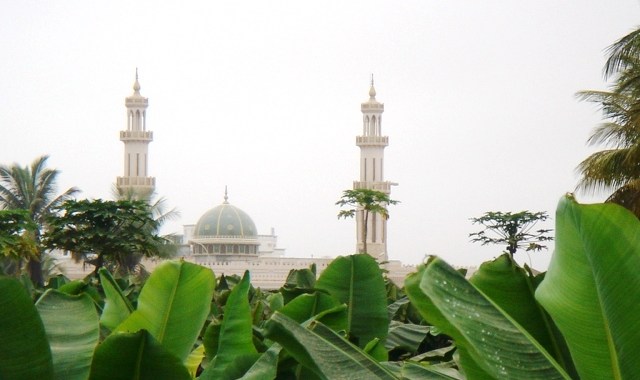
(photo by M.A. Al Awaid)

My short essays on cooking/ food in Dhofar are not meant to be exhaustive or prescriptive. From purchasing food, cooking, eating and doing formal interviews with Dhofari informants for over ten years, as well as academic inquiries, I am attempting to build up a general picture of Dhofari foodways, with the understanding that there are elements I am missing and there is a wide variety of practices between house-holds. When I write “Dhofari” I am referring to Omanis who live in Dhofar, although there are many people from different countries who live in Dhofar with their own food traditions. For more details, see: Foodways and Society in Dhofar, Oman
[image from Sono Moza, for full image see end of post – Vimto has become a steadfast of Iftar, some people hate it but it’s ubiquitous in Ramadan. It is usually served plain (mixed with water), but it can also be jazzed up, for example, as a ‘Vimto Mojito’ which has Vimto mixed with slices of lemon, sprigs of mint, ice and 7-Up or Sprite.]
Drinks
Fruit
Snacks
Sweets
Dinner – usually between 10 p.m and 1 a.m
Suhoor – before sunrise
Ramadan Traditions in Dhofar


[from social media]

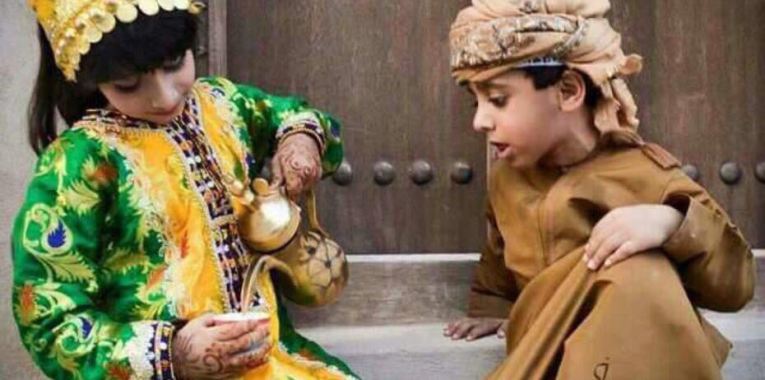
Most writing and visuals about food in the Middle East concentrate on one of four topics: food memories connected to loss (e.g. cookbook memoir of displaced people), food scarcity (areas of war/ poverty), elite food (extravagant meals, gourmet cuisine, social media photos) and sharing food at Ramadan (photos of giving away food and communal Iftar at mosques). I am interested in the often not-seen, not-discussed topic of everyday food: what is procured, produced, cooked, eaten, shared and disposed of by Omanis who have neither an insufficiency nor a super-abundance of food. These short essays on cooking/ food in Dhofar are not meant to be exhaustive or prescriptive. From purchasing food, cooking, eating and doing formal interviews with Dhofari informants for over ten years, as well as academic inquiries, I am attempting to build up a general picture of Dhofari foodways, with the understanding that there are elements I am missing and there is a wide variety of practices between house-holds (n.b., when I write “Dhofari” I am referring to Omanis who live in Dhofar, although there are people from different countries who live in Dhofar with their own food traditions). For more details, see: Foodways and Society in Dhofar, Oman
Drinks – offered by waitresses/ groom’s relatives
Snacks offered before dinner
Meals – at a rented house or hall, usually served 8pm – 2am, after the bride has arrived
Meal – at the bride’s house if she will be taken directly to the groom’s house or a hotel, usually served anytime from 5pm – 11pm
Sweets
Typical Foodways at Wedding Celebrations
Groom’s Side
The party for men is usually held on a Saturday (second day of the weekend) morning; it is best if the date is close to the end of the month, after the salary has arrived. The groom’s family will usually arrange a marquee near their house, near a mosque or at a space outside of town. The marquee will be rented for the day and be furnished with rugs and chairs, arranged in a circle. Sometimes there is a secondary tent to the side where the food is prepared. In many Dhofari tribes, the brothers, close friends and cousins of the groom will usually butcher the camels/ cows the night before, or very early in the morning; some meat is then distributed to close relatives and the rest given to restaurant workers to cook. The quantity of food shows the respect for the guests. No one is expecting (or would like) a new recipe or dishes. The two most important components are tea and meat with rice; Omani coffee, Omani sweet (halwa), fruit, soft drinks, water, salad are also served. Brothers and close friends come and go but there is always a core group next to the groom, i.e. he is never without a good friend and a brother or cousin to keep him company and help with the guests. The event ends at the ‘asr (mid afternoon) prayer when all the guests and the groom leave.
Bride’s Side
Sometimes the bride’s party will be quite simple. The bride’s friends and sisters help her get ready at home and serve dinner to female relatives and friends, while male relatives sit with her brothers and father outside the house or in a nearby relative’s house.
Then the bride is brought to the groom’s house by her relatives in a procession of cars. The groom’s sisters and her sisters take her to her new room. Her sisters help arrange her; then the bride’s female relatives come in to see the room and the groom’s female relatives come in to see the bride. She usually does not speak, and never smiles in keeping with the expected cultural ideal that she is “shy,” sad to leave her parents. Sometimes items bought with the mahar and gifts, especially of gold and perfume from friends and relatives, are put on display in the room.
The groom’s family gives the bride’s relatives dinner in the salle and majlis or in an open space near the house, then the bride’s family leaves except for the bride’s mother and/ or a close (older/ already married) sister or aunt. Then the groom, usually carrying a gun as a symbol of his ability to protect her, and his father will come into the room where her mom and (perhaps) sisters are sitting with her. After a short ice-breaker sort of conversation (the bride does not speak), everyone leaves the bride and groom alone.
A more elaborate wedding will be celebrated at a hotel or “hall,” basically an big empty enclosed space. Sometimes this is an issue of wealth but it also happens when there is more than one wedding (e.g. two brothers marrying), or if the bride and groom are from different tribes. In this kind of wedding, the women are invited by phone and sometimes given a ‘card’ for entrance by the groom’s family (who are paying for the event).
Close female relatives of the bride and of the groom show up in finery – often shimmering dresses they have designed themselves. They start to gather about 7 or 8pm; finger-food, sweets and drinks are passed around by waitresses. There is usually water, fruit and maybe snacks laid out on the tables, but no name cards – people sit where they like. The bride makes a triumphal entrance (think the fan fare from 2001: A Space Odyssey) late in the evening, perhaps 12 or even 1am. The main meal is usually served after the bride arrives. Then, with the bride seated on a sofa on the elevated stage, various women dance for her in an open space in front of her or on the elevated stage. At the end of the event, the bride will be brought in a procession of cars to the groom’s house, or the groom might actually come into the room (a very new innovation) and escort her out.

This is the first of a few posts about what kinds of food are eaten/ served to guests on different occasions in Dhofar. These short essays are not meant to be exhaustive or prescriptive. From purchasing food, cooking, eating and doing formal interviews with Dhofari informants for over ten years, as well as academic inquiries, I am attempting to build up a general picture of Dhofari foodways, with the understanding that there are elements I am missing and there is a wide variety of practices between house-holds (n.b., when I write “Dhofari” I am referring to Omanis who live in Dhofar, although there are many people from different countries who live in Dhofar with their own food traditions). For more details, see: Foodways and Society in Dhofar, Oman
All of my informants agree that guests should immediately be offered drinks and sweets, but what are “drinks and sweets”? Even saying “coffee” or “tea” is not that specific because there are several kinds.
There are three main kinds of coffee. The most important and most traditional is qahwa (in Arabic) or “Omani coffee” which is made from roasted coffee beans that are ground, then boiled (plain or with spices), then other spices and flavors (cardamom, ginger, rose water, etc.) are added. In the northern parts of Oman, it is required to serve this with dates; this is also offered in Dhofar, but tea with cakes or qahwa with halwa (see below) can also be served.
“Coffee” can also mean instant coffee, sometimes called Nescafe although there are other brands of instant coffee for sale, which is usually served with canned milk and sugar. “Coffee” can also mean a drink from one of the several kinds of recently introduced coffee-capsule machines. For example, a guest might be offered a caramel macchiato, cappuccino, latte or mochaccino.
Tea is usually “red” tea [chai ahmar] which is black tea with only sugar added, “milk” tea [chai haleeb] which is black tea with canned milk and sugar, or karak which is loose tea with spices and canned milk. Green tea is sometimes offered; iced tea (Lipton cans) is rarely offered.
A selection of cold drinks are usually offered; this includes bottled water because tap water is usually not given to guests. Sodas include Coke and Pepsi products as well as various flavored “malt beverages” which usually have young men playing or watching sports in their advertisements and are packaged in green glass bottles with a shape similar to beer bottles. [see images at the end of this post]
Juices come in cardboard packages with added sugar and marketed to children (e.g. Suntop), clear plastic bottles and large jugs from a Dhofari (A’Safwah) or Saudi (Almarai) brand, or freshly blended and served in a pitcher, usually melon. The Omanis I know usually order fresh lemon with fresh mint in restaurants, but I have never seen that served in a home although I assume some families do. Mango juice is also a popular drink in restaurants but I haven’t seen in homes, probably because it is more labor-intensive to make. There is a vast array of powered fruit drinks available; the powered drink section of one grocery store is about five feet high and over ten feet long. These are loved by kids, but not usually given to guests.
Some changes in drinks over the past ten years include the introduction of soy milk, almond milk and commercially produced camel milk in the refrigerator section of stores. There is a limited, but growing selection of specialty drinks, such as root beer, Arizona Ice Tea, coconut milk and drinks from the Philippines.
Processed milk comes from three firms: A’Safwah (Dhofari), Al Razat (Dhofari) and Al Almarai (Saudi) (see images below). There have been a lot of changes over the last ten years, including offering plain milk in different sized containers and new types of milk such as low-fat and flavored with chocolate and strawberry. A’Safwah (Dhofari) and Al Almarai (Saudi) have a long running competition with milk-based products: if one introduces a new product, the other will have the same within a few months so there are now all sorts of choices such as low-fat and flavored yogurts and different kinds of cooking creams.
Before modernization, the more frequent drink was milk from goats, cows or camels – many families still drink it unprocessed. In the past, and sometimes now on picnics if someone is feeling nostalgic, rocks are cleaned and then put on coals to be heated. Once hot, they were dropped one by one into a bowl of camel’s milk. [see images at end of this post]. Camels and cows are milked by men; with camels, the man and camel are both standing. Men usually milk goats, but women will also do so.
Omani halwa (the Arabic word for sweet) is made with sugar, water, clarified butter, cornstarch and flavorings such as cardamom, saffron, sesame seeds, almonds and cashews. It is slow cooked in large batches and then poured into various-sized plastic trays and bowls. The color varies from a light blond to almost black to reddish depending on ingredients. The consistency is like a tough Jell-O. To eat, one scoops out a teaspoon- to tablespoon-sized piece with a spoon and eats it plain or plops the piece on of a small piece of a thin, plain cracker-like bread (khoubz raqaq/ raqeeq or kak) and eats both together. You usually take some mouthful by mouthful.
Snacks for guests include home-made and store-bought mini-cheesecakes, basbousa (usually flavored with coconut), baklava, small pieces of fried dough, mini-pizzas, etc. Fresh fruit is usually also put out, either whole or as a fruit salad with small bowls to take a serving, Whole fruits are usually grapes, oranges, and apples, as well as bananas which are grown in Dhofar. Although guava, mangos, papayas are also grown in Dhofar, they are not set out but found chopped into the fruit salads.
Images of drinks
Stills from a Ramadan greeting video in which a man is taking a heated stone from the fire (left) and placing it into a pan of fresh camel milk (right)


Processed milk


The “beer” in Root beer and Ginger Beer are changed to “Bev”
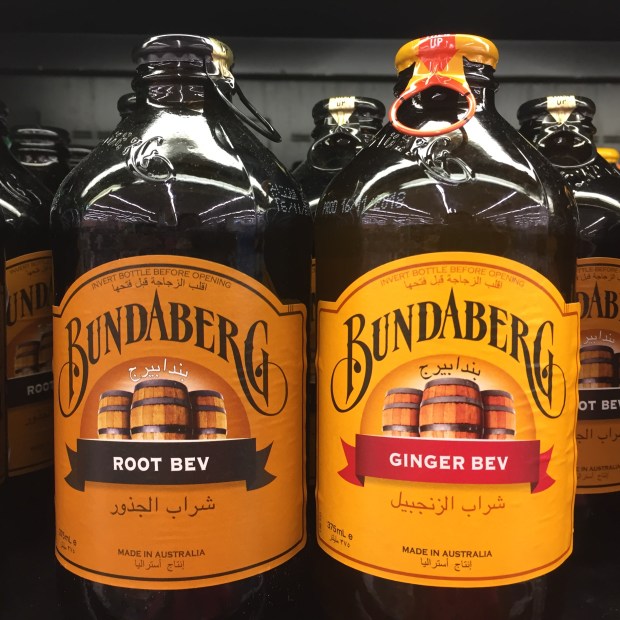
Various drinks packaged in ways that are similar to alcoholic beverages.


(photo by M. A. Al Awaid)
Ethnography is unlike literature and like science in that it endeavors to describe real people systematically and accurately, but it resembles literature in that it weaves facts into a form that highlights patterns and principles. As in good literature, so in good ethnography the message comes not through explicit statement of generalities but as concrete portrayal. (Peacock 1986 83).
What is significant is the vision of someone’s (the native’s) existence interpreted through he sensibilities of someone else (the ethnographer) in order to inform and enrich the understanding of the third party (the reader or listener). Ethnography in this sense is like literature: as a source of psychological and philosophical insight (and possibly aesthetic pleasure) when read as the author’s struggle to elucidate a perspective on life through his portrayal of a way of living – as he experienced it and analyzed it. (Peacock 1986 100)
The travel account is generally self-confident and authoritative in tone, and certain of a readership that wants a culturally shared translation of another way of life… but the realist ethnographic account has long been dogmatically dedicated to presenting material as if it were, or faithfully represented, the point of view of its cultural subjects rather than its own culture of reference (Marcus and Cushman 1982 34). [in anthropology] “the style of reportage was always pushed firmly toward generalization rather than maintained at the level of mere detailing of particular facts… it is impossible to work back from a final account to original fieldwork enterprise in anything like the way a chemist can work back through an experiment reported by another chemist (35).
the fact that one’s self is not expendable for a great many people, even when life offers turbulence and disaster; and self-representations shift and change, has two implications: It shelters you from some of the problems attendant on freedom to move ahead-that of keeping a hold of oneself through life. It also anchors you in a material world that clings to you and your biography…You are what you are by virtue of your connection to these things and this world: the same house, the same clothes, the same darned people. Your body, too anchors, you, being for most people a medium we cannot silence. This does not mean that things are fixed, immutable. But they persist, and you have to hang on to them, not just trade in the old car of a new one. (Wikan 1995 275)
(photo by M. A. Al Awaid)
Bibliography of Works Consulted for Research on Dhofar, Oman
Annotated Bibliography of Texts Pertaining to the Dhofar Region of Oman
Selected References for Research on Foodways and Society in Dhofar, Oman – primarily texts relating to food/ cooking/ cuisine and anthropology
Selected Bibliography: Primary and Secondary Texts for Literature Teachers on the Arabian Peninsula

(image from Instagram account of Tiny Spoon, tiny_spoon, full image below)
Food Practices in Southern Oman – My current research focuses on food practices in the Dhofar region, specifically how food is used to show personal generosity and how eating together defines and enhances social relationships.
[this post reflects my current reading – the permanent link for my updated food/ culture bibliography is: Selected References for Research on Foodways and Society in Dhofar]
Al-Hamad, Sarah. (2016). Cardamom and Lime: Flavors of the Arabian Gulf, the Cuisine of Saudi Arabia, Kuwait, Bahrain, Oman, Qatar and the U.A.E. Singapore: IMM Lifestyle Books.
Avieli, Nir and Rafi Grosglik. (2013). Food and Power in the Middle East and the Mediterranean: Practical Concerns, Theoretical Considerations. Food, Culture and Society 16.2: 181-195.
Appaduari, Arjun. (1985). Gratitude as a Social Mode in South India. Ethos 13.3: 236-245.
Boxhall, P. G. 1966. Socotra: ‘Island of Bliss’. The Geographical Journal 132.2: 213-222.
Brown, Victoria. (2014). Language: A Taste of Reality. One Dish Closer. http://www.onedishcloser.com/food-anthropology/2014/3/19/language-a-taste-of-reality.html
Campbell, Felicia. (2015). The Food of Oman: Recipes and Stories from the Gateway to Arabia. London: Andrew McMeel.
Clements, Frank. (1977). The Islands of Kuria Muria: A Civil Aid Project in the Sultanate of Oman Administered from Salalah, Regional Capital of Dhofar. Bulletin (British Society for Middle Eastern Studies) 4.1: 37-39.
Cleveland, Ray. (1960). The 1960 American Archaeological Expedition to Dhofar. Bulletin of the American Schools of Oriental Research 159: 14-26.
Ciezadlo, Annia. (2011, April 25). Eat, Drink, Protest: Stories of the Middle East’s Hungry Rumblings: Buying Peace, One Feast at a Time. Foreign Policy 186. https://foreignpolicy.com/2011/04/25/eat-drink-protest/
—. (2011, March 15). Eating My Way Through the Cedar Revolution (excerpt). Foreign Policy. http://foreignpolicy.com/2011/03/15/eating-my-way-through-the-cedar-revolution-2/
Coleman, Leo, ed. (2012). Food: Ethnographic Encounters (Encounters: Experience and Anthropological Knowledge). Oxford: Berg.
Counihan, Carole and Penny van Esterik, eds. (2012). Food and Culture: A Reader. London: Routledge.
Crowther, Gillian. (2018). Eating Culture: An Anthropological Guide to Food. Toronto Press: University of Toronto Press.
De Regt, Marina. (2010). Ways to Come, Ways to Leave: Gender, Mobility, and Il/legality among Ethiopian Domestic Workers in Yemen. Gender and Society 24.2: 237-260.
—. (2009). Preferences and Prejudices: Employers’ Views on Domestic Workers in the Republic of Yemen. Signs 34.3: 559-581.
Deeb, Lara and Jessica Winegar. (2012). Anthropologies of Arab-Majority Societies. Annual Review of Anthropology 41: 537-558.
Elie, Serge. (2006). Soqotra: South Arabia’s Strategic Gateway and Symbolic Playground. British Journal of Middle Eastern Studies 33.2: 131-160.
Ferguson, Priscilla. (2011). The Senses of Taste. American Historical Review 116.2: 371-384.
Fieldhouse, Paul. (1998). Food and Nutrition: Customs and Culture. Cheltenham, UK: Stanley Thomas.
Fisher, Jennifer. (2003-2004). “Arabian Coffee” in the Land of Sweets. Dance Research Journal 35.2: 146-163.
Fox, Robin. (2018). Food and Eating: An Anthropological Perspective. Social Issues Research Centre. http://www.sirc.org/publik/foxfood.pdf
Gilette, Maris. (2019). Muslim Foodways, in The Handbook of Food and Anthropology. Jakob Klein and James Watson, eds. London: Bloomsbury Academic. 48-73.
Goody, Jack. Cooking, Cuisine and Class. Cambridge: Cambridge University Press, 1982.
Julier, Alice. (2013). Eating Together: Food, Friendship, and Inequality. Chicago: University of Illinois, 2013.
—. (2013). Meals: ‘Eating In’ and ‘Eating Out’ in The Handbook of Food Research. Anne Murcott, Warren Belasco and Peter Jackson, eds. London: Bloomsbury Academic.
Julier, Alice and Lindenfeld. (2005). Mapping Men onto the Menu: Masculinities and Food. Food & Foodways, 13:1–16.
Jurafsky, Dan. (2014). The Language of Food: A Linguist Reads the Menu. New York: W. W. Norton.
Klein, Jakob and James Watson, eds. (2019). The Handbook of Food and Anthropology. London: Bloomsbury Academic.
Lichfield, Gideon. (2010, January 15). A Look Inside the Middle East’s New Weapons of Mass Consumption. Foreign Policy. https://foreignpolicy.com/2010/01/15/food-fight-4/
Maclagan, Ianthe. (1994). Food and Gender in a Yemeni Community, in A Taste of Thyme: Culinary Cultures of the Middle East. Sami Zubaida and Richard Tapper, eds. New York: I.B. Tauris Publishers. 159-72
Mauss, Marcel. (2011/ 1924). The Gift: Forms and Functions of Exchange in Archaic Societies. Mansfield Centre, CA: Martino Publishing.
Mbaga, Msafiri Daudi. (2015). The Prospects of Sustainable Desert Agriculture to Improve Food Security in Oman. Consilience 13: 114-128. http://www.jstor.org/stable/26427275
Meneley, Anne. (2007). Fashions and Fundamentalisms in Fin-De-Siecle Yemen: Chador Barbie and Islamic Socks. Cultural Anthropology 22.2: 214–243.
Miller, Anthony, Miranda Morris, and Susanna Stuart-Smith. (1988). Plants of Dhofar, the Southern Region of Oman: Traditional, Economic, and Medicinal Uses. Muscat: Office of the Adviser for Conservation of the Environment, Diwan of Royal Court.
Mintz, Sidney. (1996). Tasting Food, Tasting Freedom: Excursions into Eating, Culture, and the Past. Boston: Beacon Press.
Mintz, Sidney, and Du Bois, Christine. (2002). The Anthropology of Food and Eating. Annual Review of Anthropology 31:99-119.
Morris, Miranda. (1997). The Harvesting of Frankincense in Dhofar, Oman. In Alessandra Avanzini, ed. Profumi d’Arabia. Rome: L’Erma Bretschneider: 231-250.
—. (1987). ‘Dhofar – What Made it Different’ in Oman: Economic, Social and Strategic Development. B.R. Pridham, ed. London: Croom Helm. 51-78.
Nagy, Sharon. (2000). Dressing up Downtown: Urban Development and Government Public Image in Qatar. City and Society 12(1): 125-47.
—. (1998). “This Time I think I’ll try a Filipina”: Global and Local Influences on Relations between Foreign Household Workers and their Employers in Doha, Qatar. City and Society 10(1): 83-103.
Omezzine, Abdallah. (1998). On-shore Fresh Fish Markets in Oman. Journal of International Food and Agribusiness Marketing 10(1): 53-69.
Omezzine, Abdallah, Lokman Zaibet and Hamad Al-Oufi. (1996). The Marketing System of Fresh Fish Products on the Masirah Island ion the Sultanate of Oman. Marine Resources Economics 11: 203-210.
Popp, Georg. (2018). Notes on the Omani Kitchen Eating with Tradition. Just Landed. https://www.justlanded.com/english/Oman/Articles/Culture/Notes-on-the-Omani-Kitchen
Rodionov, Mikhail. (2012). Honey, Coffee, and Tea in Cultural Practices of Ḥaḍramawt in Herbal Medicines in Yemen: Traditional Knowledge and Practice, and Their Value for Today’s World. Ingrid Hehmeyer and Hanne Schönig, eds. Brill: Boston. 143-152.
Roseberry, William. (1996). The Rise of Yuppie Coffees and the Reimagination of Class in the United States. American Anthropologist, New Series, 98.4: 762-775.
Rubin, Aaron. (2015). Recent Developments in Jibbali. Journal of Semitic Studies 60: 431–441.
Sadeghin, Farideh. (2015, Oct. 27). The Food of Oman is Too Good to Ignore: Recipe-testing a Middle Eastern Cookbook Gives our Test Kitchen Director a New Love for an Under-appreciated Cuisine. Saveur. https://www.saveur.com/food-of-oman-cookbook-cuisine-felicia-campbell
Stoller, Paul and Cheryl Olkes. (1986). Bad Sauce, Good Ethnography. Cultural Anthropology 1.3: 336-352.
Stork, Joe. (1973, March). Socialist Revolution in Arabia: A Report from the People’s Democratic Republic of Yemen. MERIP Reports 15: 1-25.
Swift, Candice Lowe, ed. (2015). Teaching Food and Culture. London: Routledge.
vom Bruck, Gabriele. (2005). The Imagined ‘Consumer Democracy’ and Elite Re-Production in Yemen. Journal of the Royal Anthropological Institute 11.2: 255-275.
van Esterik, Penny, Alice Julier and Carole Counihan, eds. (2018). Food and Culture: A Reader. London: Routledge.
Watson, Janet C.E. (2013). Travel to Mecca in the Pre-motorized Period in The Hajj: Collected Essays. Venetia Porter and Liana Saif, eds. London: The British Museum. 96–99.
Watson, Janet C.E. & Abdullah al-Mahri. (2017). Language and Nature in Dhofar, in RiCOGNIZIONI. Rivisti di Lingue e Letterature straniere e Culture moderne. Simone Bettega and Fabio Gasparini, eds. Turin: University of Turin. 87–103.
Webster, Roger. (1991, October). Notes on the Dialect and Way of Life of the Āl Wahība Bedouin of Oman. Bulletin of the School of Oriental and African Studies 54.3: 473-485.
Weir, Shelagh. (2007). A Tribal Order: Politics and Law in the Mountains of Yemen. Austin: University of Texas Press.
Yamani, Mai. (2000). You Are What You Cook” Cuisine and Class in Mecca in A Taste of Thyme: Culinary Cultures of the Middle East. Sami Zubaida and Richard Tapper, eds. New York: I.B. Tauris Publishers. 159-72.
Blogs – Omani Food
Mariya. Omani Food. https://omanifood24.blogspot.com/
Omani Recipes. (2015). Arabic Recipes. http://www.encyclopediacooking.com/recipes_in_english/omani-recipes-53-1.html
Traditional Omani Food. (2008, March 1). https://ward-traditionalomanifood.blogspot.com/
Yasmeen. (2018). Omani Cuisine. http://www.omanicuisine.com/
Websites – Expat, Tourist and Commercial
The Delicious Cuisine of Oman! (n. d.). Holidify. https://www.holidify.com/pages/omani-food-230.html
Food and Drink – About Oman. (2018). Rough Guides. https://www.roughguides.com/destinations/middle-east/oman/food-drink/
Guide to Omani Cuisine. (2017, June 14). Expat Woman.com. https://www.expatwoman.com/oman/guide/guide-to-omani-cuisine
Medhat, Gehad. (2017, Dec, 27). The 10 Best Coffee and Tea Shops in Salalah, Oman. Culture Trip. https://theculturetrip.com/middle-east/oman/salalah/food-misc/
Medhat, Gehad. (2017, Dec, 27). The Top Restaurants in Salalah, Oman. Culture Trip. https://theculturetrip.com/middle-east/oman/articles/the-top-restaurants-in-salalah-oman/
Oman. (2018). Countries and Their Cultures. http://www.everyculture.com/No-Sa/Oman.html
Omani Food. (2015). Best Country. http://www.best-country.com/asia/oman/food
Omani recipes and cuisine. (2018). Nestle. http://www.nestle-family.com/english/omani-recipes.aspx
Popp, Georg. (2018). Notes on the Omani Kitchen Eating with Tradition. Just Landed. https://www.justlanded.com/english/Oman/Articles/Culture/Notes-on-the-Omani-Kitchen

(image from Instagram account: Tiny Spoon)

Website about Dhofari writers: Tafoul Books – https://dhofariwriters.home.blog/
Websites for Jokha Al Harthi, author of Celestial Bodies and other novels and short stories: http://jokha.com/ and http://jokha.com/novels/
Article about Omani writers: https://www.wordswithoutborders.org/issue/may-2019-no-center-omani-writers-on-identity
Some books by Omani authors:

On beach picnics, ocean water is often used to cook seafood, for example abalone (seen in photos above and below). Fish is cooked depending on type and how quickly people want to eat. For example, if there are several medium-size fish, they will often be cut into pieces of fish heads, fish tails and fish ‘steaks.’ The bigger pieces of meat are set aside; the heads and tails are boiled in sea water until cooked.
Fish steaks and lobster are usually cooked by simply putting them in coals. Lobsters, with the heads twisted off, are nestled into ashes near coals, sometimes wrapped in aluminum foil and sometimes covered with processed cheese. Fish steaks are doused with salt and/or fish masala powder, wrapped in aluminum foil and baked on the hot coals.
Sometimes fish or meat are cooked on small ‘hibachi’ style grills. Fish can also be grilled by setting a whole, gutted fish into a two-piece, hinged grill which is closed and set on rocks over a low fire. Although it is time consuming and labor intensive, meat can be cooked in the traditional method of being placed directly on heated rocks.
Meat and fish as discussed above are usually eaten with white rice. If the food is boiled, the cooked food is taken out of the pot and set on a metal plate. The pot is rinsed, then filled with bottled water and white rice with a few handfuls of salt. After it is cooked, the rice is transferred to a large round metal plate and “oil” (samn, clarified butter) or margarine is usually added. The fish or meat is put on top of the rice, with bottles of hot sauce and/ or limes placed next to the platter. If there is no rice and the people are picnicking near a town, someone will usually go to buy bread, either paratha or pita (khbus lebnani).
Another type of picnic meal is called a “curry.” One simple recipe is to put chopped potatoes and carrots with a little olive oil in pot which is balanced on three rocks over fire. They are stirred for a while, maybe with water added, then chopped tomatoes, onions, chili peppers, okra, eggplant are added; this is stirred until tomatoes break down, then covered and kept at a simmer. Chopped pieces of meat (cow, camel or goat) or chicken with the bone still attached are added, then salt and, possibly, spices but not necessary curry powder. This is cooked, then poured onto a platter with high sides and eaten with bread.
When the food is ready and the person in charge of the meal has decided it is time to eat, instructions are given to lay the “table” (thin sheets of plastic) and people will clear the area, brushing sand off the mat. The cook puts the food on a platter and brings it to the eating place; everyone else grabs whatever is necessary such as Kleenex, limes, bottles of hot sauce or drinks and washes their hands. Guests have no role beyond perhaps getting up to wash their hands if there is a rice dish. When everything is in place, someone, usually the cook, will say bismallah [in the name of God]; everyone else will repeat bismallah and dig in.
These examples also obtain for mountain picnics, but there meat is usually eaten, not chicken or seafood.

Abalone, a delicacy in Dhofar (which I think tastes like tire rubber, but don’t tell anyone!)


You must be logged in to post a comment.