
Oman offers the vaccines for FREE to citizens and residents.
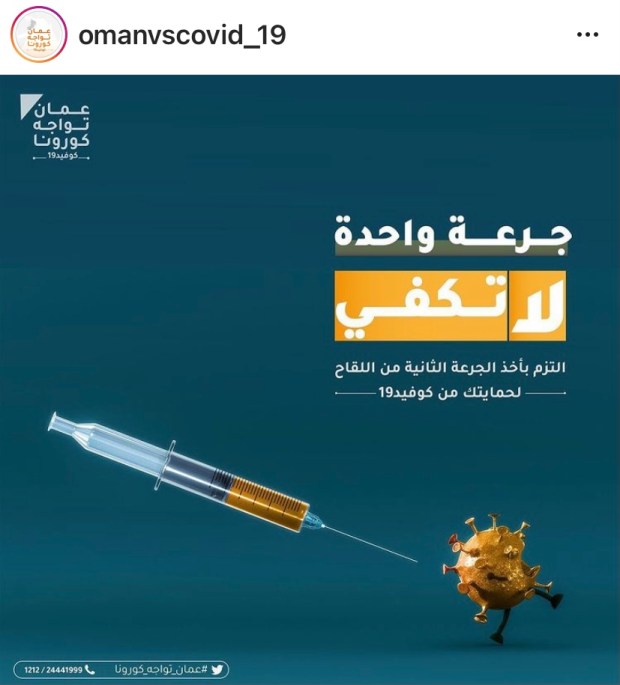

Oman offers the vaccines for FREE to citizens and residents.

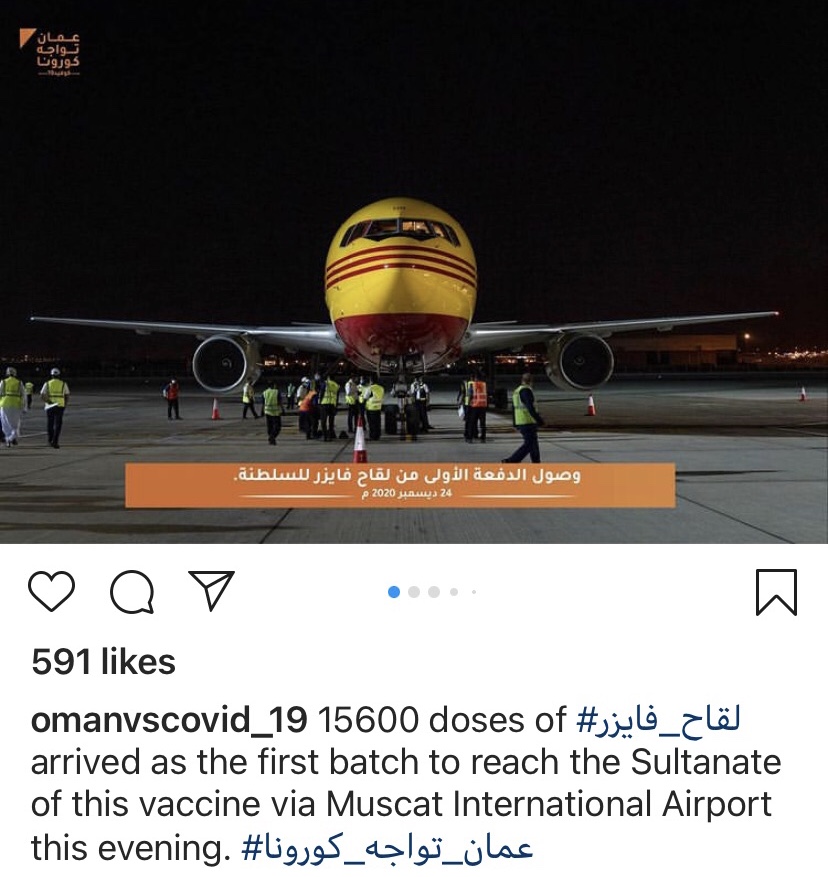
The government has started a new campaign to highlight safety procedures and encourage getting a vaccine. I think it’s important to note that one of the people in the vaccine photos is NOT Omani. The government is giving access to free vaccinations for citizens and residents equally.


(photo by Salwa Hubais)
I love those moments in which foodways and culture interact in ways that take me by surprise. When I lived in Cyrus, a friend from India kept trying to find “Indian Chinese,” Chinese food spiced the way it is in India. I didn’t really understand what she meant until I moved to the Arabian Peninsula and realized that what I had thought of a “Chinese” was really “American Chinese”; there is no General Tso’s chicken outside of North America!
A non-American friend asked me why all American breakfast foods are spiced with cinnamon in the same way I wonder why people in the UK insist on putting raisins in every dish.
It’s always impossible to say what foods you will miss most when you move abroad. When I lived in Europe, I asked my mom to send me crab seasoning, a spice I never liked before and never used, but that little tin sat on my bookshelf proudly for a year.
Moving overseas always means culinary adjustments. One friend is vegetarian by choice, but when he tried to be vegetarian on the Arabian Peninsula, what he ate became the main topic of every meal. After many conversations centered around his food choices, he decided that when he was in the Middle East, he would eat vegetarian when he could (which meant, when he was alone) and ate sparingly of what was offered when he was eating with friends.
When I used to do cultural orientations for new teachers, I would tell them that everyone has unspoken/ unacknowledged expectations about foreign cultures in that they will think, “I know that X will be different but of course Y will be the same.” And when they see their “of course Y will be the same…” start to fall apart, it is painful. Especially when it comes to basics such as grocery stores (no pastrami, scone mix, turkey, toasted onions, salad-in-a-bag or soft pretzels); potato flakes are shelved next to pancake mix and every Cheeto is ‘flaming hot’ here.
You are faced with “Party fever” spray deodorant, hokey-pokey (ask someone from New Zealand), Jaggery (isn’t that a Dickens’s character?), angel delight (?), Tim-Tams (ask someone from Australia), “Chicago Sauce,” fish maw soup, and jungle oats with a recipe on the side for “fish cakes” which begins with “one tin of sardines in tomato sauce.”
The oil aisle is a pure delight. Of course you have your basics: almond oil, sunflower, coconut oil, pure ghee, Mazola, grape seed, and peanut oil, then the flights of fancy take off: olive oil from Spain and Italy, toasted sesame oil, gingelly oil, olive pomace oil, ground nut, walnut oil from France, basil, lemon, soy bean, avocado oil. The spice aisle has “Zeal” (aka MSG), “Spice for Mince,” “Zulu Fine,” “Spice for Rice,” “Spice for Mince,” “Veggie Season,” juniper berries, and my favorite: bits of raw sugar and cinnamon sticks in a grinder.
Many texts about the Middle East talk about guests being forced to over-eat or the horrors of being given camel eyes to eat. I have not seen that – my issues are with the jalapenos lurking under the cheese on pizzas, never being able to drink filter coffee (it’s always hot water added to an espresso), being invited for dinner at 8pm and having the food actually served at midnight, discovering that the dessert is sweetened shredded carrots, being invited over to chat and given a glass of tap-water and nothing else… Salads don’t have dressings, bread is not served with butter, drinks are brought out after the meal is finished – it’s different. Not better, not worse – just different.
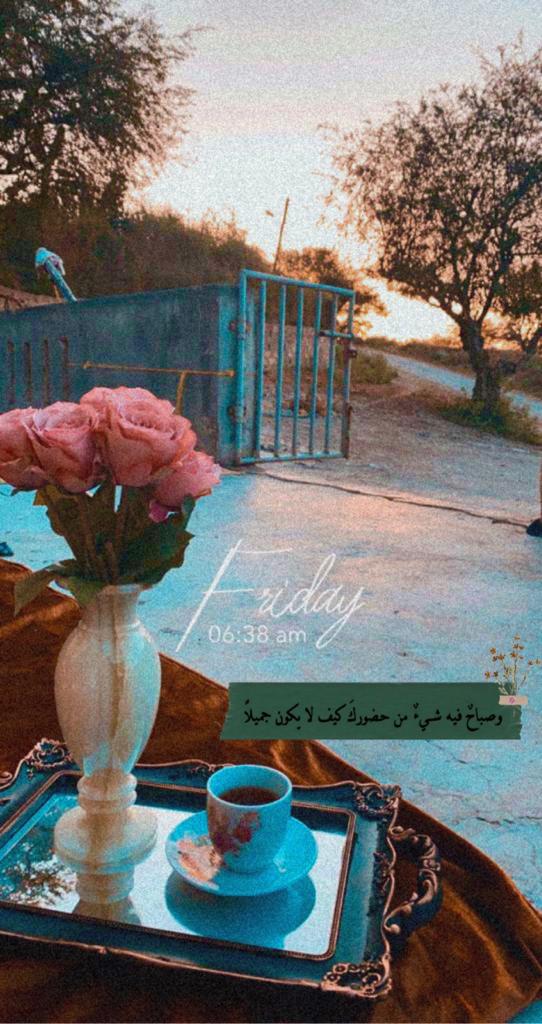

One of the issues I have run into doing research about food is trying to stay neutral when describing unfamiliar foodways. It’s easy to fall into finger-pointing about “bad food” such as Omanis discussing my oatmeal cookies (to them, they taste like sand) and my declining to try their dried, salted shark filet.
The men in my research group are disgusted at my eating “old” food (cold, leftover pizza) and it took me a long time to accept that a toasted white bread sandwich with processed cheese spread, crushed Chips Oman, a sliced boiled egg and hot sauce is a good snack.
They tease me because I can’t cook rice; I have yet to eat a decent muffin in Oman (and don’t get me started on the hollandaise sauce!) Even food metaphors fall apart cross-culturally: one store had a large sign: “if life doesn’t give you lemons, we deliver.” I think I have enough ‘lemons’ at the moment, I do not want any delivered!
Like at home, my friends know each other’s favorite restaurants, but since food appears and disappears in the grocery stores, we are all on the look-out for basics. You slowly learn what others crave and preform the basic kindness of standing in grocery aisles and calling/ sending messages: “they have blueberry yoghurt,” “molasses is here,” “vanilla powder is in” and “I see Dr. Pepper!”
Shopping is more stressful to me than at home – there’s a lot of hide and seek. Pasta sauce is in three different aisles, and often the salsa is mixed in. Salt has its own section not near the spices (and don’t even dream of finding tarragon or rosemary), sugar is with the coffee not the flour, muffin cups are on the other side of the store from the muffin mix, the few times cranberry sauce appears it is next to the golden syrup, croutons are next to dried soup mixes and crackers are in the cereal aisle.
Then, when you have found something – there is always the debate: is this going to be worth the money? The joy of seeing Ben and Jerry’s was canceled by the fact that the three times I have ventured to try it, the ice cream had freezer-burn. Many delicious-looking cakes and tortes have tasted liked wood shavings. I have bought many items because I was afraid the store would never have it again (green salsa), to encourage the store to keep it in stock (dried tortellini) or that I will never eat (Lindt bears as holiday decorations, cookies and 7-Up for workers).
Once covid hit, friends and I tag-teamed shopping so I learned to find all sorts of things I never knew existed: sprouted rice, coconut flour, beetroot powder and pea pasta.
There a lot of rabbit holes to fall down, especially in reading menus. There are misspellings: “frut” for “fruit, “pommel grenade” for “pomegranate,” “mashromme” for “mushroom,” and “pasilic” for “basil.” Some words are just transliterated so you can get quickly lost with “rocka,” “arais,” “pine” and “akkawi.”
Just as a person needs to learn that “Florentine” means “with spinach,” there are place adjectives in Middle Eastern cooking; for example, “hummus Beiruti” means “with garlic.” When I try to get a pizza the way I want it, I need to use all three ways to describe one thing: green peppers, capsicum, and fil-fil bard (“cold peppers”). And you can’t order a cheese pizza, you need to say “margarita,” but that word is often confused with “fajita” so you end up with a spicy chicken pizza instead of plain cheese.
In addition to food, it took me awhile to get used to how to eat – I still spill a lot of rice when eating with my hands. And, after a few years, I am finally accustomed to the eat-then-talk-for-hours routine in Dhofar. When a non-Omani friend invited me for dinner (sitting outside!), we arrived at 7:30, were done eating by 9 and as I was expecting that we were going to settle in to talk, she asked for the bill. I was amazed – weren’t we going to “visit”? I had forgotten my previous understanding that dinner in a restaurant took 1 ½ to 2 hours, 3 or 4 hours is normal to me now.
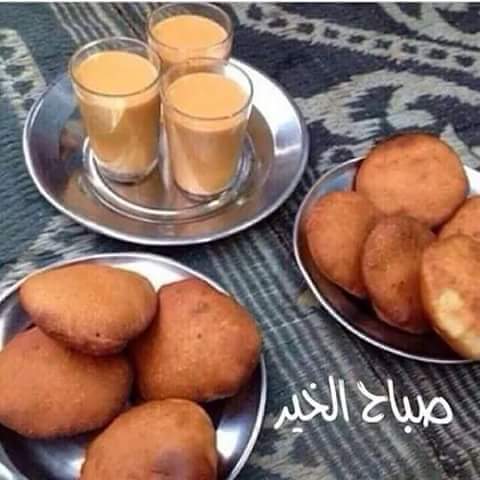
(photo from social media)

Andrew Spalton and Hadi Al Hikmani’s book, The Arabian Leopards of Oman (2014), is an important resource for anyone interested in the Dhofar region and I am so pleased to see that they have another book coming out soon: Dhofar: From Monsoon Mountains to Sand Seas, Celebrating the Natural Diversity of Oman’s Dhofar Region.
More information can be found at: https://www.gilgamesh-publishing.co.uk/dhofar-from-monsoon-forests-to-sand-seas.html
A few of Dr. Al Hikamni and Dr. Spalton’s other texts about Dhofar:
Al Hikmani, Hadi, Said Zabanoot, Talah Shahari, Nasser Zabanoot, Khalid Hikmani, and Andrew Spalton. 2015. “Status of the Arabian Gazelle, Gazella arabica (Mammalia: Bovidae), in Dhofar, Oman.” Zoology in the Middle East 61: 1-5. 10.1080/09397140.2015.1101905.
Al Hikmani, Hadi and Khaled al Hikmani. 2012. “Arabian Leopard in Lowland Region on the South face of Jebel Samhan, Oman.” Cat News 57: 4-5.
Ball, Lawrence, Douglas MacMillan, Joseph Tzanopoulos, Andrew Spalton, Hadi Al Hikmani and Mark Moritz. 2000. “Contemporary Pastoralism in the Dhofar Mountains of Oman.” Human Ecology. https://doi.org/10.1007/s10745-020-00153-5
Spalton, Andrew, Hadi Musalam al Hikmani, David Willis and Ali Salim Bait Said. 2006. “Critically Endangered Arabian Leopards (Panthera pardus nimrpersist) in the Jabal Samhan Nature Reserve, Oman.” Oryx 40.3: 287-294.

Cows
After camels, cows are the most important herd animal. Cow owners will argue that they are more useful than camels because they produce more milk and have more babies. They are also said to have sweeter temperaments, but that is an argument I am not getting into, nor will I discuss which animal is smarter.
Cows are usually kept in at night, especially calves, and let out to graze freely in the day like camels. Cows roaming free are a rarity on the Arabian Peninsula, so Gulf Arab tourists often stop to take photos of them as an exotic creature. During the khareef (monsoon season, June – August) they stay in the mountains but are usually kept in during the day, because of the numerous flies, and let out to graze at night. Owners will sometimes lit smoky fires to help get rid of flies.
The local type are small (shoulder-height), often with great curving horns, and are usually placid. In the mid- and late-1970s, new breeds were brought in to increase size and milk output [see Andrew Higgins (2011) and Janzen (1986)].
Like camels, cows stick together in groups and walk in line along the sides of roads but unlike camels, cows will often lie down or stand in the middle of roads as dark tarmac roads hold the warmth of the day.
Cows and camels don’t get along well and you seldom see them feeding near each other and very rarely intermixed in the same area. Most people have one or the other, a division which is partially based on tribes or family-clans within tribes. Some tribes are known for having a preference for one or the other; friends who have different animals will occasionally argue about the relative intelligence/ worth/ temperament of the two types of animals.
As with camels, cows are usually milked by men but a woman can do it if there are no men around. Cow’s milk is often turned into samn (clarified butter) which is kept in an urn-shaped metal container. This is seen as more valuable than milk and in the past was a primary exchange item in a system of barter with townsfolk.
The same customs for herding camels obtains for cows; either a man or an expat supervised by a local man will be responsible for a herd of around 20 to 50 cows which might be all owned by one person or several family members.
Goats
The third most important herd animal is the goat. Goats don’t have the prestige of cows or camels but are also named and looked after carefully. They are herded by Dhofari women or men, or an expat laborer. A herder usually stays with the goats all day. Both men and women milk goats.
Families in town will sometimes buy a goat and keep it in the yard of their house for a few hours or days, especially before the two Eids. I was reading in my garden one evening and felt something tugging and chewing on my shirt. I looked down to find two goats snacking on my L.L. Bean oxford. Turns out my neighbor had bought three goats to fatten up for the Eid. He let them out of his garden every day at 5 pm to let them forage and they would come over and snack on my flowers.
Goats with herder (from social media)

Cows on the road!


(photo by M. A. Al Awaid)
Camels are the most prestigious animal as they are seen as a link to the past, are the most expensive animal and are needed for marriages and funeral feasts. There is a small but growing interest in camel races and camel beauty contests, but those are events organized by the government (partially for tourism purposes) and while people participate and enjoy they aren’t seen as part of traditional Dhofari culture. No one travels by camels now except for men such as Ahmed Harib al Mahrouqi, who does camel treks to promote Omani culture. A few Gibali men I know remember riding them as children and have stories from the older generation (fathers/ uncles) about traveling by camel.
All camels, cows and goats in Dhofar are owned by someone. A person can have any number of each animal but will usually have only one kind. 20 to 50 camels with one owner is the median; some men have more than one hundred. A person with one or only a few will add them to a family member’s herd; relatives working together will rotating the daily responsibility of watching them, have one person do to the work or jointly hire a shepherd. Sometimes a child is given an animal when they are born so that animal is herded with the family’s animals and all its offspring belong to the child. Usually herds are all owned by people within one family. It is less common to have friends herd their animals together.
The herding is done by the animals’ owners or hired expat workers; the owners know the names and characteristics of all their camels, including parents, age and temperament. Some older men keep camels almost as pets, seldom selling them as meat and spending a lot of money on feed to the occasional consternation of their children. Now and in the past, dried sardines are used as feed during the dry months.
Some herds are kept near permanent homes. Other herds are moved among several different places depending on the season and rainfall. These places might be improved with a metal-framed tent which could be locked to hold supplies or a windbreak that a man or someone in his family made.
Camels are sometimes simply let loose during the day. As camels stick together and will not travel too far, some herds will come home by themselves when an owner or herder hits the metal feeding troughs and hollers. Hearing these familiar sounds, the camels will slowly perk up and start to move homewards, naturally clumping together and often organizing themselves in lines nose to tail. Once they get close to the corral/ feeding spot they will sometimes start to trot or race each other, shouldering each other; humans need to get out of the way. Mother camels have their teats tied up in a bag so babies can’t nurse; this (and the idea of extra food, water and safety) keeps most camels returning home every night.
Normal daily herding is done with one or two pick-ups or two or three men on motorbikes for longer distances; when the herders need to get camels moved across roads, the pick-ups will be parked on the shoulder with blinkers on to let traffic know camels are close to crossing. In the mountains, men will drive on dirt tracks to a spot on the far side of the camels and then walk, waving a stick and whooping occasionally, them back to the corral or to a long, stone or wood wind-break that the camels will bed down next to.
For the khareef (June-September monsoon season) camels are kept in camps on the flat plain (jarbaeb in Gibali/ Jibbali/ Shahri) at the foot of the mountains. To keep the camels from wandering into populated areas, between Salalah and the jarbaeb, the Dhofari municipality has built a road which has a shoulder-high divide and is steeply graded so camels can’t cross it; camels, either on their own or with the prompting of herders, use the roundabout to get to the other side of this divide.
Men milk the lactating camels after the animals have been fed and watered in the evening; as camels are so tall, men do this standing up, balancing the bowl on their raised knee. It’s somewhat precarious as it’s hard to keep one’s balance, even harder if the camel is moving about.
Young male camels are usually killed for meat as adult male camels are ornery and people usually only keep one or two males which are often kept in a coral. If a male camel is let out, it is usually hobbled.
Not all camels are herded home, so you need to be careful on roads in the mountains at night. A head-on collision is a forgone deadly conclusion. Camels have long legs so the body will hit the hood of the car and come straight through the windshield.
To prevent accidents, when you pass camels on or near a road, it is a driver’s duty to turn on the hazards to signal on-coming traffic. Older camels walking in line are normally safe and will not pay attention to traffic even if cars pass close to them at speed, but you never know when one might scare. Baby camels are the most dangerous, as they will take off in any direction at the slightest provocation, sometimes causing other camels to panic.
Throughout the region there are common vocalizations to tell camels to come or that there is water and food. Men raised with camels will stop and help herd camels which are in the middle of roads, but under no other circumstances should anyone interfere with another person’s camels. Only if dying of thirst should anyone milk a camel that isn’t theirs.
Children raised with camels have no fear, and as young as four or five will move about a herd easily, pushing camels out of their way. Girls might work with camels until they reach near puberty, then family/ social pressure will keep them from herding camels, but they might herd goats.


Food appears at unexpected times while teaching. I was discussing color metaphors (What does it mean to say, “she’s blue” or “he’s green with envy”?) and brought up “peachy” as a slang response to “How are you?” Then I had to stop to describe a ‘peach,’ not a common fruit on the Arabian Peninsula. I tried to triangulate as I know the Arabic words for orange and apricot but it turns out that no one in the class has seen a fresh apricot; they only know the dried ones. Getting the word “dried” straight somehow led to talking about how raisins are dried grapes and prunes are dried plums, but no one knew plums. So I tried to go by colors, looking around the class to see if anyone had ‘peach-’ or ‘plum-’ colored pen or notebook.
In one class we were confronted with the metaphor “chill iron,” so I did a quick run through the differences between chill (verb, to make cold), chill (verb, slang – to relax) and chilly (adjective). And then chili (similar to stew) and chili peppers.
Getting the vocabulary down is only the first step, as food interactions in stories almost always bring out cultural differences. Reading Peter Pan meant discussing that Mr. and Mrs. Darling were not horrible parents for leaving their children at home (and with a dog!) while they went out to eat. In Oman, children are almost always with their parents or relatives in the evening and would normally go out to dinner with the family.
Even my everyday actions spark conversations as bringing a cup of coffee with me to class and drinking it while teaching is not normal teacher behavior on the Arabian Peninsula. And I warn students that if they visit an American family, they will probably not be pushed again and again to eat. I tell them the story of one Arab administrator who, when he arrived at his host family in America, was asked if he wanted dinner once and only once. As he was expecting the offer to be repeated and food to be given to him as a matter of course, he refused. The Americans did not repeat the offer and he went to bed hungry.
This photo is from social media and I love it because the food in the back-left corner could be ‘read’ as pita (Lebanese bread) rolled with processed cheese or fried bread with cinnamon and sugar depending on your cultural back-ground.



My presentation is: “Finding the Right Texts for Teaching Literature, Cultures, and Empathy in the Middle East” with the panel “Teaching Empathy Through Literature.”
American Comparative Literature Association Conference. On-line conference. April 8-11, 2021.
https://acla.secure-platform.com/a/solicitations/2/sessiongallery/115


You must be logged in to post a comment.