

“Ṭâ Is For Talisman” from The Arabic Alphabet: A Guided Tour
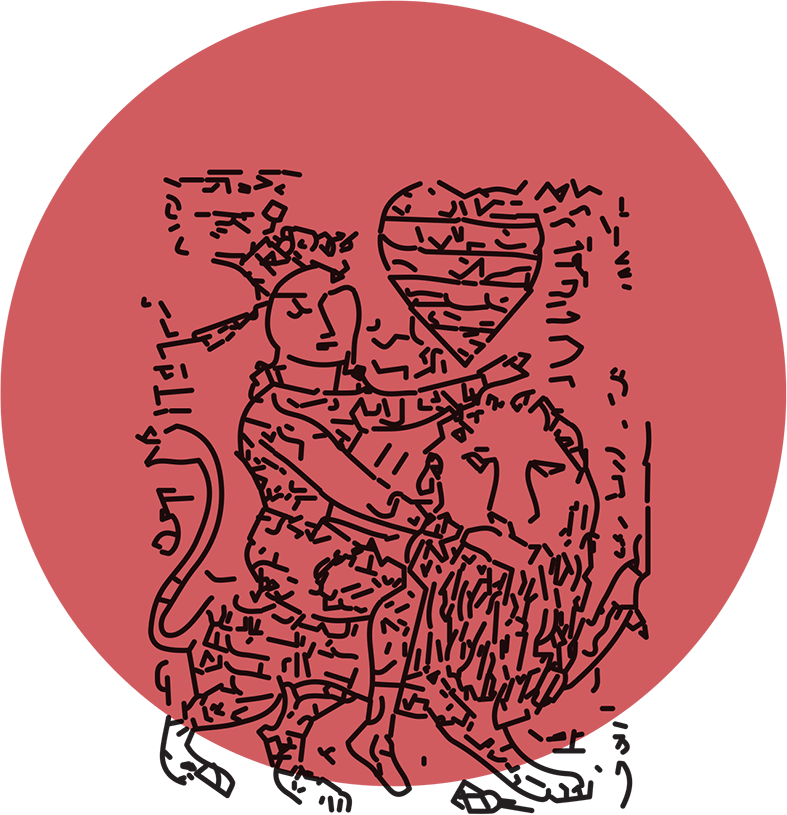
written by Michael Beard, illustrated by Houman Mortazavi
Ṭâ Is For Talisman – http://alifbatourguide.com/the-arabic-alphabet/taa/
main website – http://alifbatourguide.com/
excerpt:
Ṭâ Is For Talisman
A version of this chapter appeared in Scritti in onore di Biancamaria Scarcia Amoretti (Rome, 2008), vol. 1. (That’s vol. 1 out of three. How many people have enough admirers for a three-volume Festschrift?)
One of the shops a traveler in the Arab world is likely to see is a qarṭâsiyya, a stationery store, one of those small businesses which thrives wherever children need to buy school supplies. The source is qarṭâs, another one of those words borrowed from Greek which uses Ṭâ to transcribe a European T, the T in the Greek word khártes, Latin charta (as in Magna Charta). Qarṭâs appears in Surat al-An‘âm as a metonymy for the Qur’ân itself: “Wa law nazzalnâ ‘alayka kitâban fî qarṭâsin falamasû bi-aydîhim la-qâl alladhîn kafarû in hâdha illâ sihrun mubînun” (6.7): “If we had sent unto thee a written (message) on parchment (qarṭâs), so that they could touch it with their hands, The Unbelievers would have been sure to say; ‘This is nothing but obvious magic’” (Yusuf Ali translation). That qarṭâs, if it were to exist, would be an alternate Qur’ân, a physical qur’ân written rather than spoken. That qarṭâs would have been a spiritual option presented differently than the one we have. It may or may not be a mystical image, but it certainly has a paradoxical logic. To imagine revelation as a concrete object does not, to my ear, seem blasphemous. (Later in the same sura there is an account of Moses and the tablets “which warn and explain,” in which the physical tablets are clearly a legitimate revelation–7.145 ff). But ironically it would have been less convincing. Skeptics would call a physical qarṭâs simple magic, which is true, as later we would see the skepticism of Moses’s followers.
What that parchment (or tablet) would have been is a ṭalsam, to use another non-Qurânic word, a loan-word, like qarṭâs, originally from Greek. The source is τéλεσμα, télesma, “completion,” “performance,” “religious rite” (from telêin, “to complete”), in later Greek “a decorated object endowed with a magic virtue to avert evil.”
English “talisman” is attested as far back as the 17th century. It gained popularity in the 19th century andt seems to have become a kind of obsession in literature. Search the word and you get, among others, Carrie Lee’s Talisman: A Tale (anonymous, 1854); Johann Nestroy’s Der Talisman (a19th-century Austrian comedy); The King’s Talisman: or, the Young Lion of Mount Hor, an Eastern Romance by Sylvanus Cobb (1851); The Talisman Ring by Georgette Heyer; Queen Moo’s Talisman; The Fall of the Maya Empire by Alice le Plongeon (1902); The Talisman of Set by Sara Hylton (1984); and Ruth Burnett’s The Nurse and the Talisman (1974). The list is by no means restricted to obscure writers. Clifford Simac contributed The Fellowship of the Talisman (1978); even Stephen King added one (The Talisman, 1984). And we can see why. “Talisman” has become the word for a liminal object, an object in the physical world which partakes of the other, a moment of overlap between the two categories.
Wa ṭarîqî ma ṭarîqî? Aṭawîl am qasîr?
Ayyuhâ al-bahr atadurî kam maddit alf ‘alayka?
Lastu adri.
And my road–what is my road? How short? How long?
Do I climb or descend along it, or walk on a level path?
Or do both of us stand still while Time runs on?
I know not.
This is the question asked in 1927 by the great Lebanese-American poet Iliya Abu Mâdi in his collection Al-Jadâwil, in a translation by the late Mounah Khouri. The poem, usually referred to by its radîf, the refrain lastu adri, “I don’t know,” which concludes every stanza, is entitled “Aṭ-ṭalâsim.” With that act of naming, Abu Mâdi acknowledged an important element of the word. Khouri translated aṭ-ṭalâsim as “The Mysteries,” which captures the sense of the noumenal, but leaves out something too, the image of a material object suffused with inexplicable power from outside.
 Come From Away
You must be logged in to post a comment.