Houseways in Southern Dhofar: Selected References

Abu-Lughod, Janet. 1987. “The Islamic City: Historical Myth, Islamic Essence and Contemporary Relevance.” International Journal of Middle East Studies 19.2: 155-176.

Akcan, Esra. 2014. “Postcolonial Theories in Architecture” in A Critical History of Contemporary Architecture (1960-2010). Elie Haddad and David Rifkind, eds. London: Ashgate. 119-40.

—. 2014. “Global Conflict and Global Glitter: Architecture in West Asia (1960-2010)” in A Critical History of Contemporary Architecture (1960-2010). Elie Haddad and David Rifkind, eds. London: Ashgate. 317-43.

Al Hinai, H., W. J. Batty and S. D. Probert. 1993. “Vernacular Architecture of Oman: Features that Enhance Thermal Comfort Achieved within Buildings.” Applied Energy 44.3: 233-244. 10.1016/0306-2619(93)90019-L

Al Ismaili, Ahmed. 2018. “Ethnic, Linguistic, and Religious Pluralism in Oman: The Link with Political Stability.” Al Muntaqa 1.3: 58-73.

Al Kathiri, Muna Salim and Liudmila Cazacova. 2014. “Islamic Architecture Features and Modern Housing: A Case Study of the North Awqad District in Salalah, Oman.” The International Journal of the Constructed Environment 4: 1-18.

Al Mohannadi, Asmaa Saleh, Raffaelo Furlan and Mark David Major. 2019. “Socio-Cultural Factors Shaping the Spatial Form of Traditional and Contemporary Housing in Qatar: A Comparative Analysis based on Space Syntax.” Proceedings of the 12th Space Syntax Symposium.

Al-Mohannadi, Asmaa Saleh and Raffaello Furlan. 2019. “Socio-cultural Patterns Embedded into the Built Form of Qatari Houses: Regenerating Architectural Identity in Qatar.” Journal of Urban Regeneration and Renewal 12.4: 1-23.

Al Thahab, Ali, Sabah Mushatat, and Mohammed Abdelmonem. 2014. “Between Tradition and Modernity: Determining Spatial Systems of Privacy in the Domestic Architecture of Contemporary Iraq.” ArchNet – International Journal of Architectural Research 8.3: 238-250.

Albright, Franklin. 1982. The American Archaeological Expedition in Dhofar, Oman, 1952-1953. Washington DC: American Foundation for the Study of Man.

Alexander, Christopher, Sara Ishikawa, Murray Silverstein, Max Jacobson, Ingrid Fiksdahl-King and Shlomo Angel. 1977. A Pattern Language: Towns, Buildings, Construction. Oxford: OUP (Center for Environmental Structure Series).

Alkhalidi, Abdulsamad. 2013. “Sustainable Application of Interior Spaces in Traditional Houses of the United Arab Emirates.” Procedia – Social and Behavioral Sciences 102: 288-299.

AlMutawa, Rana. 2019, Nov 8. “Dubai Mall or Souq Naif? The Quest for ‘Authenticity’ and Social Distinction.” London School of Economics Middle East Blog Posts. https://blogs.lse.ac.uk/mec/2019/11/08/dubai-mall-or-souq-naif-the-quest-for-authenticity-and-social-distinction/

—. 2019. “The Mall Isn’t Authentic!: Dubai’s Creative Class And The Construction of Social Distinction.” Urban Anthropology and Studies of Cultural Systems and World Economic Development 48: 1-2: 183-223.

—. 2018, Dec.4. “Challenging Concepts of ‘Authenticity’: Dubai and Urban Spaces in the Gulf.” London School of Economics Middle East Blog Posts. https://blogs.lse.ac.uk/mec/2018/12/04/challenging-concepts-of-authenticity-dubai-and-urban-spaces-in-the-gulf/

—. 2017. “Women and Restrictive Campus Environments: A Comparative Analysis Between Public Universities and International Branch Campuses in the UAE.” Higher Education in the Gulf States: Present and Future. 17-19.

Ammann, Ludwig. 2002.“Islam in Public Space.” Public Culture 14.1: 277-279.

Arnaud, Jean-Luc. 1995. “La Formation de l’Architecture Contemporaine à Sanaa,” in Sanaa hors les Murs, une Ville Arabe Contemporaine. Franck Mermier and Gilbert Grandguillaume, eds. Urbama – CFEY: Tours. 165-226.

Asmi, Rehenuma. 2016. “Finding a Place to Sit How Qatari Women Combine Cultural and Kinship Capital in the Home Majlis.” Anthropology of the Middle East 11.2: 18–38.

Avanzini, Alessandra. 2007.“Sumhuram: A Hadrami Port on the Indian Ocean,” in The Indian Ocean in the Ancient Period: Definite Places, Translocal Exchange BAR International Series 1593. Eivind Heldaas Seland, ed. Oxford: Archaeopress. 23-31.

—. 2002. “Incense Routes and Pre-Islamic South Arabian Kingdoms.” Journal of Oman Studies 12: 17-24.

Ball, Lawrence, Douglas MacMillan, Joseph Tzanopoulos, Andrew Spalton, Hadi Al Hikmani and Mark Moritz. 2020. “Contemporary Pastoralism in the Dhofar Mountains of Oman.” Human Ecology. https://doi.org/10.1007/s10745-020-00153-5

Bandyopadhyay, Soumyen. 2011. Manah: An Omani Oasis, an Arabian Legacy Architecture and Social History of an Omani Settlement. Liverpool: ‎Liverpool University Press.

Belfioretti, Luca. and Tom Vosmer. 2010. “Al-Balīd Ship Timbers: Preliminary Overview and Comparisons.” Proceedings of the Seminar for Arabian Studies 40: 111-18.

Bent, Theodore and Mabel. 2005/ 1900. Southern Arabia. London: Elibron.

Bianca, Stefano. 2000. “Basic Principles of Islam and Their Social, Spatial and Artistic Implications” in Urban Form in the Arab World. London: Thames & Hudson. 23-48.

Bontenbal, Marike. 2017. “Policy Brief – Opportunities and Constraints of Female Labour Participation in Oman’s Private Sector.” Economic Research Forum – German University of Technology in Oman.1-8.

—. 2015. “Residential Satisfaction and Place Identity in a Traditional Neighborhood: The Case of Mutrah, Oman,” in Gateways to the World: Port Cities in the Gulf: Working Group Summary Report. Doha: Center for International and Regional Studies at the Georgetown University School of Foreign Service in Qatar. 189-215.

—. 2013. “Place Attachment and Sense of Belonging in Oasis Villages in the Capital Area of Muscat, Oman.” Trialog: A Journal for Planning and Building in the Global Context 3. 16-20.

Bortolini, Eugenio and Olivia Munoz. 2015. “Life and Death in Prehistoric Oman: Insights from Late Neolithic and Early Bronze Age Funerary Practices (4th – 3rd mill. BC).” Proceedings of the Symposium: The Archaeological Heritage of Oman. Paris: UNESCO. 61-80.

Bourdieu, Pierre. 1972. “The Kabyle House or the World Reversed,” in Algeria 1960. Cambridge: Cambridge University Press. 133-154.

Breteau, Marion. 2020. Amours à Mascate: Espaces, Rôles de Genre et Représentations Intimes chez les Jeunes (Sultanat d’Oman). Anthropologie Sociale et Ethnologie. Aix-Marseille Université.

Buffa, V and A.V. Sedov. 2008. “The Residential Quarter” in A Port in Arabia between Rome and the Indian Ocean (3rd C. BC – 5th C. AD). A. Avanzini, ed. Khor Rori Report 2, Roma: L’Erma di Bretschneider: 15-59.

Carter, Henry. 1846. “The Ruins of El Balad.” Journal of the Royal Geographical Society of London 16: 187-99.

—. 1845. “Notes on the Gara Tribe.” Journal of the Bombay Branch of the Royal Asiatic Society: 195-201.

Carter, Robert and Daniel Eddisford. 2017. “The Vernacular Architecture of Doha, Qatar.” Post-Medieval Archaeology. 1-26. DOI: 10.1080/00794236.2017.1320918

Causevica, Senija Causevica and Mark Neal. 2019. “The Exotic Veil: Managing Tourist Perceptions of National History and Statehood in Oman.” Tourism Management 71: 504-517.

Charpentier, Vincent, Alex de Voogt, Remy Crassard, Jean-Francois Berger, Federico Borgi and Ali Al-Mashani. 2014. “Games on the Seashore of Salalah: The Discovery of Mancala Games in Dhofar, Sultanate of Oman.” Arabian Archaeology and Epigraphy 25: 115-120.


Chatty, Dawn. 2013. “Negotiating Authenticity and Translocality in Oman: The ‘Desertscapes’ of the Harasiis Tribe,” in Regionalizing Oman: Political, Economic and Social Dynamics. Steffen Wippel, ed. Heidelberg: Springer. 129-45.

—. 2000. “Women Working in Oman: Individual Choice and Cultural Constraints.” International Journal of Middle Eastern Studies 32: 241-54.

—. 2000.“Integrating Participation into Research and Consultancy: A Conservation Example from Arabia.” Social Policy and Administration 34.4: 408-18.

—. 1997. Mobile Pastoralists: Development Planning and Social Change in Oman. New York: Columbia University Press.

Clements, Frank. 1977. “The Islands of Kuria Muria: A Civil Aid Project in the Sultanate of Oman Administered from Salalah, Regional Capital of Dhofar.” Bulletin (British Society for Middle Eastern Studies) 4.1: 37-39.

Cleveland, R. L. 1960. “The 1960 American Archaeological Expedition to Dhofar.” Bulletin of the American Schools of Oriental Research 159: 14-26.

—. 1959. “The Sacred Stone Circle of Khor Rori (Dhofar).” Bulletin of the American Schools of Oriental Research 155: 29-31.

Cordes, Rainer and Fred Scholz. 1980. “Changes in the Nomad Region of Oman” and “Settlement Projects in Inner Oman, and Other Measures to Develop the Rural/Nomad Region,” in Bedouins, Wealth, and Change: A Study of Rural Development in the United Arab Emirates and the Sultanate of Oman. Tokyo: United Nations University. https://archive.unu.edu/unupress/unupbooks/80143e/80143E00.htm

Costa, Paulo. 2001. Historic Mosques and Shrines of Oman. Oxford: British Archaeological Reports.

—. 1994. Studies in Arabian Architecture (Variorum Collected Studies). London: Routledge.

—. 1991. Musandam: Architecture and Material Culture of a Little Known Region of Oman. London: Immel.

—. 1983. “Notes on Settlement Patterns in Traditional Oman.” Journal of Oman Studies 6.2: 247-68.

—. 1979. “The Study of the City of Zafar (Al-Balid).” Journal of Oman Studies 5: 111-50.

Costa, Paulo and Stephen Kite. 1985. “The Architecture of Salalah and the Dhofar Littoral.” Journal of Oman Studies 7: 131-58.

Cremaschi, Mauro, Andrea Zerboni, Vincent Charpentier, Remy Crassard, Ilaria Isola, Eleonora Regattieri, Giovanni Zanchetta. 2015. “Early-Middle Holocene Environmental Changes and pre-Neolithic Human Occupations as Recorded in the Cavities of Jebel Qara (Dhofar, southern Sultanate of Oman).” Quaternary International.

Cruttenden, Charles. 1838. “Journal of an Excursion from Morbat to Dyreez, the Principal Town of Dhofar.” Transactions of the Bombay Geographical Society 1: 184-188.

De Siqueira, Gustavo and Amal Al Balush. 2020. “Co-designing the Pedestrian Revolution in Muscat.” City, Territory and Architecture 7.11: 1-15. DOI 10.1186/s40410-020-00119-6

Damluji, Salma Samar. 1998. The Architecture of Oman. Reading: Ithaca Press.

Deeb, Lara and Jessica Winegar. 2012. “Anthropologies of Arab-Majority Societies.” Annual Review of Anthropology 41: 537-558.

Degli Esposti, Michele and Alexia Pavan. 2020. “Water and Power in South Arabia: The Excavation of “Monumental Building 1” (MB1) at Sumhuram (Sultanate of Oman).” Arabian Archeology and Epigraphy. 1 – 29. DOI: 10.1111/aae.12159

Dorman, Deborah. 2017. “A Nasraniyya in Sanaa, 1988-99,” in Architectural Heritage of Yemen: Buildings that Fill my Eye. Trevor Marchand, ed. London: Ginko. 179-86.

Eickelman, Christine. 1988. “Women and Politics in an Arabian Oasis,” in A Way Prepared: Essays on Islamic Culture in Honor of Richard Bayly Winder. New York: New York University Press. 199-215.

—. 1984. Women and Community in Oman. New York: New York University Press.

Eickelman, Dale. 1989. “National Identity and Religious Discourse in Contemporary Oman.” International Journal of Islamic and Arabic Studies 6.1: 1-20.

—. 1983. “Omani Village: The Meaning of Oil,” in The Politics of Middle Eastern Oil. J. E. Peterson, ed. Washington, D.C.: The Middle East Institute. 211-219.

Eddisford, Daniel and Colleen Morgan, 2013. The Radwani House: Architecture, Archaeology and Social History. 1-92. https://www.academia.edu/33365222/The_Radwani_House_Architecture_Archaeology_and_Social_History

Eddisford, Daniel and Robert Carter. 2017. “The Vernacular Architecture of Doha, Qatar.” Post-Medieval Archaeology 51.1: 81-107.

Escher, Anton. 2019. “Eugen Wirth (1925-2012) – Geographer of the Oriental City in North Africa and the Near East.” Middle East – Topics & Arguments 12.1: 122-6. doi:10.17192/meta.2019.12.7940.

Fletcher, Richard and Erin Stepney. n.d. “Morphologies of Housing in Doha: from Bayt Sha’bi to Suburban Villa.” 1-23. https://www.academia.edu/41429399/Morphologies_of_Housing_in_Doha_from_bayt_shabi_to_suburban_villa

Franke-Vogt, Ute. 2002. “Remarks on the Classification of the Pottery from Al-Balid, Dhofar (Oman).” Unpublished ms., Office of the Advisor to HM the Sultan for Cultural Affairs: Muscat-Salalah.

Fusaro, Agnese. 2021. “The Islamic Port of al-Balīd (Oman), between Land and Sea: Place of Trade, Exchange, Diversity, and Coexistence.” Journal of Material Cultures in the Muslim World 1.1-2: 67-95. doi: https://doi.org/10.1163/26666286-12340003

Gallagher, Winifred. 2007. House Thinking: A Room-by-room Look at How We Live. New York: HarperCollins.

Garba, Roman and Peter Farrington. 2011. “Walled Structures and Settlement Patterns in the South-western Part of Dhofar, Oman (poster).” Proceedings of the Seminar for Arabian Studies 41: 95–100.

Gardner, Andrew and Momina Zakzouk. 2014. “Car Culture in Contemporary Qatar,” in Everyday Life in the Muslim Middle East, third edition. Donna Lee Bowen, Evelyn Early, and Becky Schulthies (eds.). Bloomington, IN: Indiana University Press. 133-142.

Gardiner, Ian. 2007. In the Service of the Sultan: A First-hand Account of the Dhofar Insurgency. South Yorkshire: Pen and Sword Military.

Gateways to the World: Port Cities in the Gulf: Working Group Summary Report. 2015. Doha: Center for International and Regional Studies at the Georgetown University School of Foreign Service in Qatar.

Ghannam, Farah. 2011. “Mobility, Liminality, and Embodiment in Urban Egypt.” American Ethnologist 38.4: 790–800.

Giunta, Roberta. 2009. “Coins from Al Balid, A Preliminary Report.” Unpublished ms, Office of the Advisor to HM the Sultan for Cultural Affairs: Muscat-Salalah.

Griffiths, Merlyn and Mary Gilly. 2012. “Sharing Space: Extending Belk’s (2010) ‘Sharing’.” Journal of Research for Consumers 22: 1-24. http://jrconsumers.com/Academic_Articles/issue_22/Griffiths-Gilly-AcademicArticle.pdf

Guest, R. 1935. “Zufar in the Middle Ages.” Islamic Culture 9: 402-10.

Hadimioglu, Çagla. 2001. “Black Tents.” Thresholds 22: 18-25.

Haggag, Mahmoud. 2004. “The Impact of Globalization on Urban Spaces in Arab Cities.” 35-46.

Haines, Stafford. 1839. “Memoir to Accompany a Chart of the South Coast of Arabia from the Entrance of the Red Sea to Misenat, in 50, 43, 25 E. Part I.” Journal of the Royal Geographical Society of London 9: 125-56.

—. 1845. “Memoir of the South and East Coasts of Arabia: Part II.” Journal of the Royal Geographical Society of London 15: 104-60.

Haggag, Mahmoud. 2004. “The Impact of Globalization on Urban Spaces in Arab Cities.” 35-46. https://www.semanticscholar.org/paper/THE-IMPACT-OF-GLOBALIZATION-ON-URBAN-SPACES-IN-ARAB-Haggag/b0aa96129c20489f0c23166e7af080c388c21cbd

Hakim, Besim. 2008. Arabic-Islamic Cities: Building and Planning Principles. London: Kegan Paul.

Hanssen, Jens. 2010. “History, Heritage and Modernity: Cities in the Muslim world Between Destruction and Reconstruction,” in The New Cambridge History of Islam 6. R. Hefner (ed.). Cambridge: Cambridge University Press. 521-548.

Harvey, David. 2000. “Cosmopolitanism and the Banality of Geographical Evils.” Public Culture 12.2: 529-64.

Hawker, Ronald. 2008. Traditional Architecture of the Arabian Gulf: Building on Desert Tides. Southampton: WIT Press.

Heim, Bernhard, Marc Joosten, Aurel v. Richthofen and Florian Rupp. 2018. “Land-allocation and Clan-formation in Modern Residential Developments in Oman.” City Territory and Architecture 5.8: 1-9. https://doi.org/10.1186/s40410-018-0084-6

Hendawy, Gamal. 2015. “Socio-Demographic Characteristics of Indian Immigrants in the Sultanate of Oman (1993-2010).” Athens: ATINER’s Conference Paper Series, No. DEM2015-1514. 1-27.

Henderson, Joan. 2015. “The Development of Tourist Destinations in the Gulf: Oman and Qatar Compared.” Tourism Planning and Development 12:3: 350-361.

Hilbert, Yamandu. 2013. “Khamseen Rock Shelter and the Late Palaeolithic-Neolithic Transition in Dhofar.” Arabian Archeology and Epigraphy 24: 51-58.

Hilbert, Yamandu, A. Parton, M. Morley, L.P. Linnenlucke, Z. Jacobs, L. Clark-Balzan, R. Roberts, Chris Galletti  J.-L. Schwenninger and Jeff Rose. 2015. “Terminal Pleistocene and Early Holocene Archaeology and Stratigraphy of the Southern Nejd, Oman.” Quaternary International 282: 250-263. https://www.sciencedirect.com/science/article/abs/pii/S1040618215001603

Hilbert, Yamandu, J. Rose, and R. Roberts. 2012. “Late Paleolithic Core Reduction Strategies in Dhofar, Oman.” Proceedings of the Seminar for Arabian Studies 42 1-18.

Hilbert, Yamandu, V. Usik, Chris Galletti, M. Morley, A. Parton, L. Clark-Balzan, J-L Schwenninger, L. Linnenlucke, R. Roberts, Z. Jacobs, and Jeff Rose. 2015. “Archaeological Evidence for Indigenous Human Occupation of Southern Arabia at the Pleistocene/Holocene Transition: The Case of al-Hatab Dhofar, Southern Oman.” Paléorient 41.2: 31-49.

Ibrahim, Moawiyah and Ali Tigani ElMahi. 1997. “A Report on Two Seasons of Sultan Qaboos University Excavations at Al-Balid, Dhofar 1996-7.” Unpublished ms. Office of the Advisor to HM the Sultan for Cultural Affairs: Muscat- Salalah.

Jaidah, Ibrahim and Malika Bourennane. 2009. The History of Qatari Architecture from 1800 to 1950. Milano: Skira.

Jacobs, Jane. 1961/ 1992. The Death and Life of Great American Cities.

Jacobson, Max, Murray Silverstein and Barbara Winslow. 2002. Patterns of Home: The Ten Essentials of Enduring Design. Newtown, CT: Taunton Press.

Jansen, Michael, ed. 2015. “The Archaeological Park of Al-Baleed, Sultanate of Oman. Site Atlas along with selected Technical Reports 1995-2001.” Muscat: Office of the Adviser to His Majesty the Sultan for Cultural Affairs.

Janzen, Jorg. 1986. Nomads in the Sultanate of Oman: Tradition and Development in Dhofar. London: Westview Press.

—. 2000. “The Destruction of Resources among the Mountain Nomads of Dhofar,” in The Transformation of Nomadic Society in the Arab East, University of Cambridge Oriental Publications 58. Martha Mundy and Basim Musallam, eds. Cambridge: Cambridge University Press. 160-175.

The Journal of Oman Studies: Special Report 2: The Oman Flora and Fauna Survey 1975. 1980. Muscat: Diwan of H. M. for Protocol.

Julier, Alice. 2015. “Family and Domesticity,” in A Cultural History of Food in the Modern Age (The Cultural Histories Series). Amy Bentley, ed. London: Bloomsbury Academic. 145-164.

Kanafani, Aida Sami. 1979. Aesthetics and Ritual in the United Arab Emirates. unpublished dissertation, University of Texas at Austin.

Kay, Shirley and Dariush Zandi. 1991. Architectural Heritage of the Gulf. Dubai: Motivate Publishing.

Kite, Stephen. 2002. “The Poetics of Oman’s Traditional Architecture: Towards an Aesthetic Interpretation.” The Journal of Oman Studies 12: 133-155.

Koch, Natalie. 2020. “The Desert as Laboratory: Science, State‐making, and Empire in the Drylands.” Transactions of the Institute of British Geographers. https://doi.org/10.1111/tran.12414

Kotnik, Toni. 2005. “The Mirrored Public Architecture and Gender Relationship in Yemen.” Space and Culture 8.4: 472-483.

Le Renard, Amélie. 2014. A Society of Young Women: Opportunities of Place, Power and Reform in Saudi Arabia. Stanford: Stanford University Press.

Limbert, Mandana. 2010. In the Time of Oil: Piety, Memory and Social Life in an Omani Town. Stanford: Stanford University Press.

—. 2008. “The Sacred Date: Gifts of God in an Omani Town.” Ethnos 73.3: 361-376.

Liverani, Mario. 1997. “Beyond Deserts, Beyond Oceans” in Profumi d’Arabia. Alessandra Avanzini, ed. Rome: L’Erma Bretschneider. 557-64.

McCorriston, Joy, Michael Harrower, Tara Steimer, Kimberly D. Williams, Matthew Senn, Mas‘ūd Al Hādhari, Mas‘ūd Al Kathīrī, ‘Ali Ahmad Al Kathīrī, Jean-François Saliège and Jennifer Everhart. 2014. “Monuments and Landscape of Mobile Pastoralists in Dhofar: the Arabian Human Social Dynamics (AHSD) Project 2009-2011.” Journal of Oman Studies 12: 117-44.

Maneval, Stefan. 2019. New Islamic Urbanism: The Architecture of Public and Private Space in Jeddah, Saudi Arabia. London: UCL Press.

—. 2019. “Navigating Urban Space: Jeddah, Early Twenty-first Century,” in New Islamic Urbanism: The Architecture of Public and Private Space in Jeddah, Saudi Arabia. London: UCL Press, 170-216.

Marchand, Trevor, ed. 2017. Architectural Heritage of Yemen: Buildings that Fill my Eye. London: Ginko.

Meneley, Anne. 2017. “The Zabidi House,” in Architectural Heritage of Yemen: Buildings that Fill my Eye. Trevor Marchand, ed. London: Gingko Library. 195–203.

—.1996. Tournaments of Value: Sociability and Hierarchy in a Yemeni Town. Toronto: University of Toronto Press.

—. 2007. “Fashions and Fundamentalisms in Fin-De-Siecle Yemen: Chador Barbie and Islamic Socks.” Cultural Anthropology 22,2: 214–43.

Molotch, Harvey and Davide Ponzini. 2019. “The New Arab Urban: Test Beds, Work-arounds, and the Limits of Enacted Cities.” AlMuntaqa 2.1: 9-23. https://www.jstor.org/stable/10.31430/almuntaqa.2.1.0009

Molotch, Harvey and Davide Ponzini, eds. 2019. The New Arab Urban: Gulf Cities of Wealth, Ambition and Distress. New York: New York University Press.

Montgomery, Charles. 2014. Happy City: Transforming Our Lives Through Urban Design. New York: Farrar, Strauss and Giroux.

Morris, Miranda. 1987. “Dhofar – What Made it Different” in Oman: Economic, Social and Strategic Development. B.R. Pridham, ed. London: Croom Helm. 51-78.

Nagy, Sharon. 2004. “Keeping Families Together: Housing Policy, Social Strategies and Family in Qatar.” The MIT Electronic Journal of Middle East Studies 4: 42-58.

—. 1998. “Social Diversity and Changes in the Form and Appearance of the Qatari House.” Visual Anthropology 10.2: 281-304.

Newton, Lynne and Zarins, Juris. 2014. “A Possible Indian Quarter at al-Baleed in the Fourteenth-seventeenth Centuries AD?” Proceedings of the Seminar for Arabian Studies 44: 257-76.

Orazi, Roberto. 2002. “The Harbour and City of Khor Rawri.” Journal of Oman Studies 12: 210-222.

Othaman, Zulkeplee, Rosemary Aird, and Laurie Buys. 2015. “Privacy, Modesty, Hospitality, and the Design of Muslim Homes: A Literature Review.” Frontiers of Architectural Research 4: 12–23. http://dx.doi.org/10.1016/j.foar.2014.12.001

Newton, Lynne. 2010. “Shrines in Dhofar,” in Death and Burial in Arabia and Beyond: Multidisciplinary Perspectives, Society for Arabian Studies Monographs 10. Lloyd Week, ed. 329-340.

Newton, Lynne and Juris Zarins. 2017. The Archaeological Heritage of Oman. Dhofar Through the Ages. An Ecological, Archaeological and Historical Landscape. Muscat: Ministry of Heritage and Culture Sultanate of Oman.

—. 2014. “A Possible Indian Quarter at al-Baleed in the Fourteenth-Seventeenth Centuries AD?” Proceedings of the Seminar for Arabian Studies 44: 257-76.

Pavan, Alexia. 2020. “The Port of Al Baleed (southern Oman), the Trade in Frankincense and Its Coveted Treasures.” Polish Archaeology in the Mediterranean 29.1. doi:10.31338/uw.2083-537X.pam29.1.13

—. 2017-2018. “Husn Al Baleed: Civil and Military Architecture along the Indian Ocean in Medieval Times.” Journal of Indian Ocean Archaeology 13-14: 28-41.

Pavan, Alexia and Michele Degli Esposti, 2016. The Urban Shrine in Quarter A at Sumhuram: Stratigraphy, Architecture, Material Culture. Quaderni di Arabia Antica 4, Roma: L’Erma di Bretschneider.

Pavan, Alexia, Agnese Fusaro, Chiara Visconti, Alessandro Ghidoni, and Arturo Annucci. 2020. “New Researches at The Port of Al Balid and Its Castle (Husn): Interim Report (2016-2018).” The Journal of Oman Studies 21: 172-99.

Pavan, Alexia, S. Laurenza, and R. Valentini, 2020. “Masonry and Building Techniques in a Medieval City Port of the Sultanate of Oman: Preliminary Typological Atlas at al-Balīd.Newsletter Archeologia 10.

Pavan, Alexia and Chiara Visconti. 2020. “Trade and Contacts between Southern Arabia and East Asia: The Evidence from al-Balīd (southern Oman).” Proceedings of the Seminar for Arabian Studies 50: 243–57.

Pirenne, J. 1975. “The Incense Port of Moscha (Khor Rori) in Dhofar.” Journal of Oman Studies 1: 81-96.

Potts. D. 2016. “Trends and Patterns in the Archaeology and Pre-Modern History of the Gulf Region,” in The Emergence of the Gulf States: Studies in Modern History. J.E. Peterson (ed.). London: Bloomsbury. 19-42.

Ragette, Friedrich. 2003. Traditional Domestic Architecture of the Arab Region. Felbach: Edition Axel Menges.

Remali, Adel, Ashraf Salama, Florian Wiedmann and Hatem G. Ibrahim. 2016. “A Chronological Exploration of the Evolution of Housing Typologies in Gulf Cities.” City, Territory and Architecture 3.14: 1-15. DOI 10.1186/s40410-016-0043-z

Risse, Marielle. 2019. Community and Autonomy in Southern Oman. Cham, Switzerland: Palgrave Macmillan.

—. 2015. “Generosity, Gift-giving and Gift-avoiding in Southern Oman.” Proceedings of the Seminar for Arabian Studies 45: 289-96.

—. 2013. “Verstehen/ Einfühlen in Arabian Sands (1959): Wilfred Thesiger as Traveler and Anthropologist.” Journeys: The International Journal of Travel & Travel Writing 14.1: 23-39.

Roche, Thomas, Erin Roche and Ahmed Al Saidi. 2014. “The Dialogic Fashioning of Women’s Dress in the Sultanate of Oman.” Journal of Arabian Studies 4:1: 38-51.

Rose, Jeff and Yamandu Hilbert. 2014. “New Paleolithic Sites in the Southern Rub’ Al Khali Desert, Oman.” Antiquity 88.381.

Rose, Jeffery, Yamandu Hilbert, Anthony Marks and Vitaly Usik. 2018. The First People of Oman: Palaeolithic Archaeology of the Nejd Plateau. Sultanate. Muscat: Ministry of Heritage and Culture.

Rose, Jeff, Vitaly Usik, A. Marks, Yamandu Hilbert, Chris Galletti, A. Parton, V. Černý, J. Geiling, M. Morley, and R. Roberts. 2011. “The Nubian Complex of Dhofar, Oman: An African Middle Stone Age Industry in Southern Arabia.” PLoS ONE 6(11) e28239.

Salama, Ashraf. 2014. “A Century of Architecture in the Arabian Peninsula: Evolving Isms and Multiple Architectural Identities in a Growing Region,” in Architecture from the Arab World (1914-2014): A Selection: Bahrain Catalogue in Biennale Venice. G. George Arbid (ed.). Manama: Bahrain Ministry of Culture. 137-143.

—. 2015. “Urban Traditions in the Contemporary Lived Space of Cities on the Arabian Peninsula.” Traditional Dwellings and Settlements Review 27.1: 27-39.

Sale, J. 1980. “The Ecology of the Mountain Region of Dhofar.” The Journal of Oman Studies: Special Report 2: The Oman Flora and Fauna Survey 1975. Muscat: Diwan of H. M. for Protocol. 25-54.

Saunders, J. P. 1846. “A Short Memoir of the Proceedings of the Honorable Company’s Surveying Brig ‘Palinurus,’ during Her Late Examination of the Coast between Ras Morbat and Ras Seger, and between Ras Fartak and the Ruins of Mesinah.” Journal of the Royal Geographical Society of London 16: 169-86.

Smith, John Alexander. 1991.“The Islamic Garden in Oman: Sanctuary and Paradise.” Garden History 19: 187-208.

—. 1983. “Desert Developments.” Building Design 11: 18-21.

Sobh, Rana and Russell Belk. 2011. “Domains of Privacy and Hospitality in Arab Gulf Homes.” Journal of Islamic Marketing 2.2: 125-137.

Sobh, Rana and Russell Belk. 2011. “Privacy and Gendered Spaces in Arab Gulf Homes.” Home Cultures 8.3: 317-340.

Sobh, Rana, Belk, Russell and Justin Gressel. 2010. “Conflicting Imperatives of Modesty and Vanity Among Young Women in the Arabian Gulf,” in Advances in Consumer Research 38. D. W. Dahl, G. V. Johar, and S. M. J. van Osselaer, eds. Duluth, MN: Association for Consumer Research.

Speck, Jeff. 2013. Walkable City: How Downtown Can Save America One Step at a Time. New York: North Point Press.

Stephenson, Lindsey. 2011. “Women and the Malleability of the Kuwaiti Dīwāniyya.” Journal of Arabian Studies 1.2: 183-199.

Stephenson, M.I., Karl, A.R. and David, E. 2010. “Islamic Hospitality in the UAE: Indigenization of Products and Human Capital.” Journal of Islamic Marketing 1.1: 9-24.

Tabook, Salim Bakhit. 1997. Tribal Practices and Folklore of Dhofar, Sultanate of Oman. Unpublished PhD thesis, Faculty of Arts, Exeter University.

Thesiger, Wilfred. 1991/ 1959. Arabian Sands. New York: Penguin.

Thomas, Bertram. 1932, reprint. Arabia Felix: Across the Empty Quarter of Arabia. London: Jonathan Cape.

Usik, V., J. Rose, Y. Hilbert, P. Van Peer, and A. Marks. 2013. “Nubian Complex Reduction Strategies in Dhofar, Southern Oman.” Quaternary International 300: 244-266.

van Nes, Akkelies and Claudia Yamu. 2018. “Space Syntax: A Method to Measure Urban Space Related to Social, Economic and Cognative Factors,” in The Virtual And the Real in Planning and Urban Design: Perspectives, Practices and Applications. C. Yamu, A. Poplin, O. Devisch, and G. de Roo, eds. Routledge: New York.

vom Bruck, Gabriele. 2005. “The Imagined ‘Consumer Democracy’ and Elite Re-Production in Yemen.” Journal of the Royal Anthropological Institute 11.2: 255-275.

Von Richtoffen, A., 2016. “Vizualizing Urban Form as Mass Ornament in Muscat Capital Area” in Visual Culture(s) in the Gulf: An Anthology. N. Mounajjed, eds. Gulf Research Centre Cambridge. 137-158.

Walsh, Tony. 2013. Walking Through History: Oman’s World Heritage Sites.

Wanucha, Elizabeth and Zahra Babar, eds. 2018. Hawwa, CIRS Special Issue: Family in the Arabian Peninsula 16.1-3.

Weir, Shelagh. 2007. A Tribal Order: Politics and Law in the Mountains of Yemen. Austin: University of Texas Press.

Wikan, Unni. 1982.  Behind the Veil in Arabia: Women in Oman. Chicago: University of Chicago Press.

Winter, Tim. 2015. “Urban Sustainability in the Arabian Gulf: Air Conditioning and its Alternative.” Urban Studies. 1-15. DOI: 10.1177/0042098015608782

Yapicioglu, Balkiz and Liudmila Cazacova. 2018. “‘Omani Burqa’ vs. Decorated Facade of Modern Omani House: The Case of Salalah, Dhofar Region, Oman.” The Academic Research Community Publication. 101-111. ISSN online: 2537-0162

—. 2016. “The Building as a Statement of an Artefact: The Mijmara.” International Journal of Ecology & Development 31.3: 99-116.

Yarwood, John. 2012. Urban Planning in the Middle East: Case Studies. Newcastle upon Tyne: Cambridge Scholars Publishing.

Yule, Paul and K.K. Mohammad. 2006/ 1998. “Report on Al-Baleed Pottery: Reference Collection,  RWTH Aachen University” Muscat: Office of the Adviser to His Majesty the Sultan for Cultural Affairs.

Zarins, Juris. 2007. “Aspects of Recent Archaeological Work at al-Balid (Zafar), Sultanate of Oman.” Proceedings of the Seminar of Arabian Studies 37: 309-24.

—. 2001. The Land of Incense: Archaeological Work in the Governorate of Dhofar, Sultanate of Oman, 1990-1995. Muscat, Oman: Sultan Qaboos University Publications.

—. 1997. “Mesopotamia and Frankincense: The Early Evidence,” in Profumi d’Arabia. Alessandra Avanzini, ed. Rome: L’Erma Bretschneider. 251-72.

—. 1997. “Persia and Dhofar: Aspects of Iron Age International Politics and Trade,” in Crossing Boundaries and Linking Horizons. G. Young, M. Chavalas and R. Averbeck, eds.. Bethesda: CDL Press. 615-89.

Zarins, Juris and Newton, Lynne. 2012 “Al Balid: Ancient Zafar, Sultanate of Oman. Report of Excavations, 2005-2011 and Salalah Survey.” Unpublished ms., Muscat-Salalah.

Zerboni, Andrea, Alessandro Perego, Guido S. Mariani, Filippo Brandolini, Mohammed Al Kindi, Eleonora Regattieri, Giovanni Zanchetta, Federico Borgi, Vincent Charpentier and Mauro Cremaschi. 2020. “Geomorphology of the Jebel Qara and Coastal Plain of Salalah (Dhofar, southern Sultanate of Oman).” Journal of Maps 16:2, 187-198.

Zimmerle, William. 2017. Cultural Treasures from the Cave Shelters of Dhofar: Photographs of the Painted Rock Art Heritage of Southern Oman. Washington: Sultan Qaboos Cultural Center/Liberty Press.


—. 2017. Crafting Cuboid Incense Burners in the Land of Frankincense: The Dhofar Ethnoarchaeology Preservation Project. Washington: Sultan Qaboos Cultural Center/Liberty House Press.

Communication in Dhofar: Getting Information and (not) Giving Compliments

The patience and tolerance to live harmoniously in an unfamiliar culture; the fortitude to be content with less than comfortable circumstances for prolonged periods; an understanding of and sympathy with a foreign history and religion; a willingness to learn a new language; the flexibility, imagination and humility necessary to climb into the head of people who live by a very different set of assumptions; none of these are found automatically in our modern developed Euro-Atlantic culture.  (Gardiner, In the Service of the Sultan, 174)

I have lived overseas in four countries and spent significant amounts of time in a fifth – it is easy to change what you wear, what you eat, when you eat, what side of the road to drive on, what days are the weekend, where the light switches are located, and what time stores are open. It’s difficult to learn a foreign language, but it is far more difficult to learn and understand new communication strategies.

I am still trying to understand and articulate how the Dhofaris who I do research with use language. Some people compare understanding a foreign culture as peeling back the layers of an onion, but to me that implies that there is finite level. To me, understanding culture is like mountains beyond mountains. You get to one level only to find there are infinitely more layers to discover.

How do I learn how to read communication exchanges? I was once talking to another American about my research and how difficult it is to get access and insight into Dhofari cultures. He said, “So you must ask a lot of questions.” I said, “No, I don’t ask any questions.” The look on his face was the look of a person struggling to reframe their whole conceptual framework of what “research” means. “Research” means asking questions, right? Socratic dialog, give and take, write a plan and make enquiries, figure out what you want to know and go look for the answers. You “pursue” research; you “hunt” for answers; you “capture” data; you “acquire” answers; there are so many metaphors of the “chase” for information.

But those metaphors don’t work here. For example, when Dhofaris greet each other, “how are you” is repeated over and over. Between good friends, the first 3 or 4 passes are expected to have a positive answer. After that, and after a little time, the actual answer can finally be revealed.

No one would think of saying, “Hey, you just said four times that you are ok and now you tell me that you didn’t get the job you wanted.”  “Everything is fine,” was the appropriate thing to say before, but now it’s appropriate to reveal what is really going on. You have to wait for the information; you can’t force it.

Another communication difference is compliments. When I had moved into a new villa with a large living room I had decorated with paintings, Arabian rugs, colored glass lanterns, pillows in abundance. When men from my research group stopped by, I asked, “What do you think of the living room?” The three men stood rooted, observed everything carefully, made expressions of surprise and approval, they waved their hands elegantly; they vowed that in their lives they have never seen such decorating; they swore they did not know that such marvelous decorating was possible on this earth; they wondered out loud how was it possible to take a plain room and turn it into a palace, a castle, a dream; they declared that I must come immediately to their own houses and commence redecorating their own homes.

Compliments are often seen as something for children. A grown person should not need positive verbal reinforcements on how they look or what they have done, so my research partners were teaching me that when I disingenuously asked for compliments, I was going to get enough compliments to choke on. Either ask and accept the fake whipped cream compliments with proper abashment or (better) don’t ask. In that case I had spent three days rearranging the living room and was not really interested in the truth; the cotton candy compliments were perfect.

Compliments between adults are often used to point out a mistake. Being told I look like a bride or “nice” means I am inappropriately dressed or look exhausted. Good food is eaten without comment; over-spiced, under-cooked, burnt or over-salted food is lavishly admired. When a man receives praise on his behavior, dishdash, car, fishing ability or singing voice, there is usually a problem.

I worked for several years at MIT which has managed to connect almost all the buildings on campus to each other through underground tunnels or above-ground walkways. When you map out a path between two buildings which are distant from each other, you need to remember which floor the connection is on. For example going through a line of four buildings, you might walk between the first two building on the 3rd floor, go up the 4th floor to walk to the next building and then up to the 6th floor to get to the last building.

This is the perfect metaphor of intercultural communication – if I stayed on my own floor with my own style, I would hit cement walls. Messages sent will never be received and I won’t be able make headway. With halting steps and many mistakes, I have to try to walk up to their level of communication.

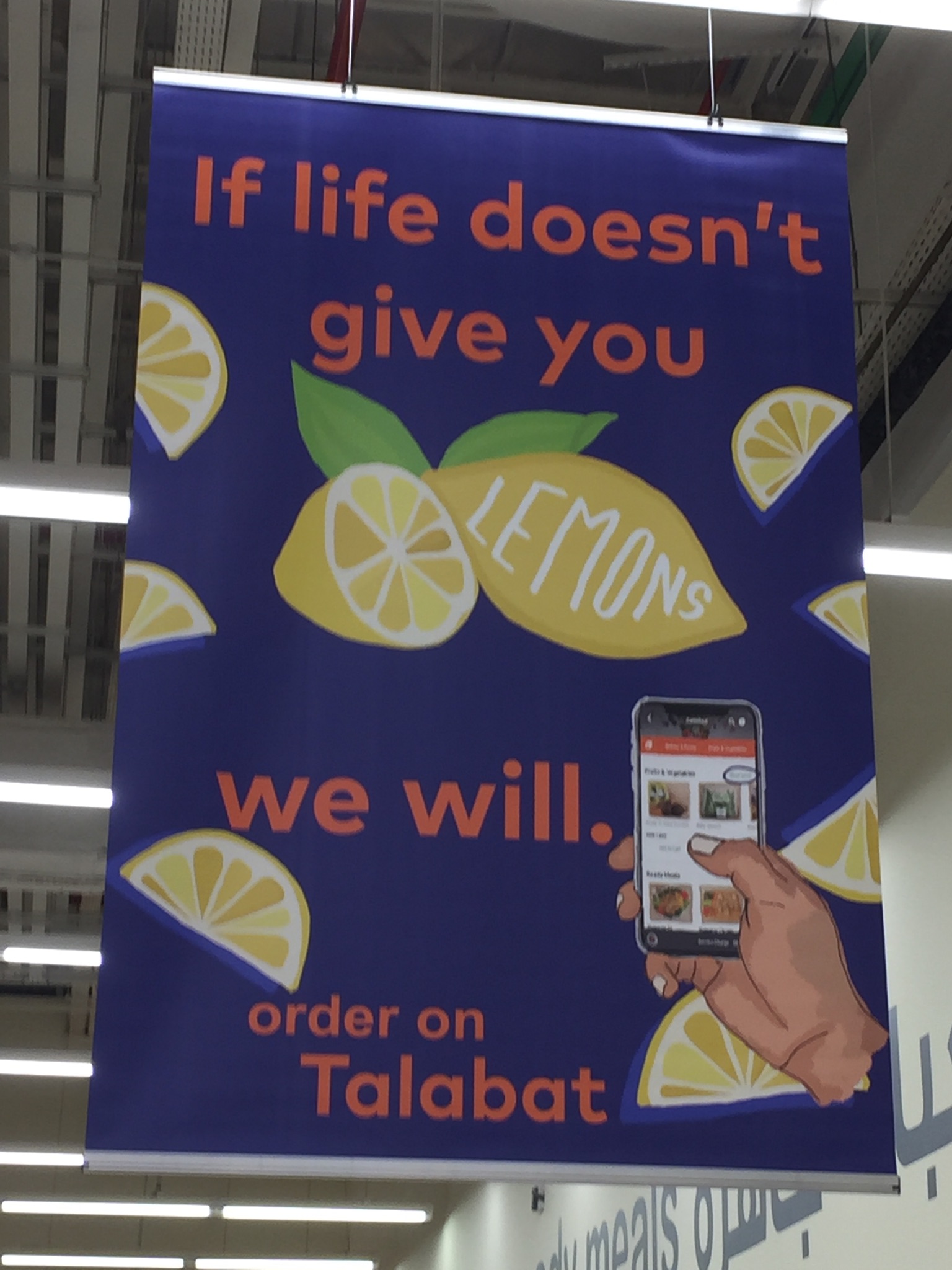
(a favorite example of cultural misunderstanding: the saying in English is ‘if life gives you lemons, make lemonade’, in which ‘lemons’ is a metaphor for something difficult. Someone who works for Talabat misunderstood this and, to a North American, this sign means: if you don’t have enough problems in your life, we will bring you some.)

lemons

Conference presentation: Bringing Language Teaching into Literature Classrooms

Bringing Language Teaching into Literature Classrooms, Dr. Marielle Risse

English Scholars Beyond Borders International Conference, Dec. 4, 2021

Outline of ‘Bringing Language Teaching into Literature Classrooms’

1 – Introduction

2 – Choosing texts

3 – Teaching strategies

4 – Short lessons

5 – Assignments

6 – Examples: “July” by John Clare and Philoketes by Sophocles

Introduction

The title of this conference is crossing borders and that is a good metaphor for discussing literature and language teaching because it’s easy for a language teacher to cross the border between disciplines and become a literature teacher. Language teachers read books, poems and dramas and understand the concepts of genre, narrator, metaphor, connotations, etc.

But for a literature teacher to cross the border in the opposite direction and become language teacher is much more difficult. I can tell you from first-hand experience that a literature teacher in a language classroom is a miserable and lost creature.

I studied German and French at university so I am well acquainted with the grammar of those two languages, but in English – explaining the difference between when to use the present simple and present continuous? Rules for doubling consonants when making a present participle? Forming nouns off of verbs by adding ‘y’? Conditional clauses? When I have to teach a grammar class and explain ‘count’ vs. ‘non-count’ nouns or the present perfect or when to use ‘for instance’ instead of ‘for example’ – painful!

But I need to do some language teaching in all my literature class. When I walked into my first Middle Eastern literature classroom at the American University of Sharjah more than 20 years ago, I had students from 15 countries with varying levels of English. I had to blend some language information into my discussion of texts so I made a series of changes in my teaching.

In this presentation I want to explain how I teach literature differently with English major students than with literature majors, concentrating on four main areas: choosing texts, teaching strategies, short lessons and assignments.

Choosing texts

I have several publications on how to choose appropriate texts for literature classes and my main point is that it is vital to pick a text that students can connect to in some way as they are already fighting language and sometimes cultural difficulties and differences.

Dickens has written many classics, but his diction is difficult and the recurrent theme of a child cast out from the family, in novels such as Oliver Twist, Great Expectations and David Copperfield, create hurdles for understanding and appreciation.  

Whereas, my students have really enjoyed Beowulf’s and Sir Gawain’s lessons about protecting one’s leader and staying loyal to one’s family.

For Shakespeare, I choose the accessible plays such as Much Ado about Nothing, The Tempest, A Midsummer Night’s Dream, As You Like It, Romeo and Juliet, and Henry V with selections from King Lear and Macbeth. Not Julius Caesar or Merchant of Venice.

As 99% of my students are female, for other dramas, I often pick ones with interesting heroines caught between conflicting duties such as:

  • Alcestis, Euripides
  • Deanira, Sophocles
  • Antigone, Sophocles
  • The Importance of Being Earnest, Oscar Wilde
  • Lady Windemere’s Fan, Oscar Wilde
  • Arms and the Man, Shaw
  • Quality Street, J.M. Barrie
  • Our Town, Thornton Wilder
  • Princess Sunshine, Tawfiq Al Hakim

In terms of fiction, I use Jane Austen, Edith Wharton’s Age of Innocence and Rebecca West’s The Return of the Soldier to spark class discussion.

Teaching strategies – using scaffolding to create a strong foundation

reading aloud – every class, every student reads to improve pronunciation and enunciation

  • poem – one line
  • fiction – one sentence
  • drama – one character’s words

comparing narrative structures

For example, I give students the first page of an autobiography from an Omani writer and from an English writer and ask them to work in groups to figure out what is similar and what is different. English writers usually have exact dates, list full names of family members, give specific place names etc., while local writers give more general impressions. This leads to a discussion of how cultures tell stories and give opinions differently

comparisons with Arabic

  • using the evocative O = ya
  • starting sentences with verb, often used in Arabic but in English = command or question

Short lessons

word attack/ word meanings

  • homonyms – prey / pray – bear / bare
  • teach prefix/ suffix/ root – Latin and Greek – like: auto-bio-graphy

explicit grammar

e’en – ‘Tis – apostrophe for missing letter

explicit teaching of archaic speech

  • thou, thee, thy, thine
  • ye, yon, yonder, yore
  • -th ending for verbs like thinketh

explicit metaphor teaching

  • color metaphors – I’m blue, he’s yellow, I’m green
  • animals – monkey, positive and negative
  • objects – the moon (positive in Arab cultures, negative in North America/ Europe)

Assignments

recitation

helps with pronunciation, enunciation and emotion

acting

helps students use the language in a natural way

with so many essays on the internet, make assignments which check for understanding and are personal

  • compare character to someone you know
  • have a conversation with a character
  • explain the drama or novel with a friend, your mom, your husband and write a short paper explaining what you agree and disagree on – my mom thought…

supporting opinions with proof/ evidence to help get ready for IELTS and standardized English exams

‘Some people’ or ‘everyone’ vs. I think Alcestis made the right choice because I think…

Two examples

1 -teaching grammar, vocabulary and literary terminology through poetry

“July” by John Clare

Loud is the Summer’s busy song,

The smallest breeze can find a tongue,

While insects of each tiny size

Grow teasing with their melodies,

Till noon burns with its blistering breath

Around, and day lies still as death

The cricket on its bank is dumb;

The very flies forget to hum;

And, save the wagon rocking round,

The landscape sleeps without a sound.

The breeze is stopped, the lazy bough

Hath not a leaf that danceth now;

  • topic students can relate to – hot weather, sleeping in the middle of the day
  • metaphors and simile – Summer’s busy song, day lies still as death
  • alliterations – sleeps without a sound
  • expand vocabulary – breeze, tiny, melodies
  • double meanings – bank and dumb 
  • grammar – hath, danceth

2 – picking an interesting text so that students want to read and discuss

Philoketes by Sophocles        

This drama is based on one of the stories from the siege of Troy. On the way to Troy, the soldier Philoketes is hurt and his wound does not heal, so he is left on a desert island by Odysseus. After ten years of fighting against Troy, Odysseus is told that the Greeks will never win Troy without Philoketes and his magic bow so Odysseus goes back to the island,

Odysseus tries to play a trick, he stays hidden and tells a young soldier, Neoptolemus, to find Philoketes, become friends with him, and then convince Philoketes to allow Neoptolemus to hold the bow – then Neoptolemus will run to the boat with the bow and they will sail away, leaving Philoketes stranded.

The play works well because:

1) a lot of suspense – Will Odysseus’ trick work? it seems to, but at the last minute, Neoptolemus tells Philoketes the truth

2) themes of forgiveness and trust – Should Philoketes forgive Odysseus for leaving him on the island for 10 years? Should he trust that Odysseus will bring him back to his country?

3) connection to Omani society – The dilemma is solved when Hercules appears and tells Philoketes to get on the boat, that he will be safe. This highlights the importance of mediators, a very important part of Omani cultures; when two people are at an impasse, they should look for someone older/ wiser to both give advice and guarantee correct behavior.

(photo by S. B.)

Related publications

Risse, M. “Teaching Paired Middle Eastern and Western Literary Texts,” in Advancing English Language Education. Wafa Zoghbor and Thomaï Alexiou, eds.. Dubai: Zayed University Press, 2020. 221-223.

Risse, M. “Ok Kilito, I Won’t Speak Your Language: Reflections after Reading Thou Shalt Not Speak My Language,” in Octo-Emanations. Carter Kaplan, ed. Brookline, MA: International Authors, 2020: 233-236.

Risse, M. “Teaching Literature on the Arabian Peninsula,” Anthropology News website, October 7 2019. http://www.anthropology-news.org/index.php/2019/10/07/teaching-literature-on-the-arabian-peninsula/

 Risse, M. and Miriam Al Sabbah. “Don’t Be Afraid of the Novel: Austen for ESL Students,” Proceedings of the 16th Oman International ELT Conference. Muscat: Sultan Qaboos University Press, 2017: 28-35.

Risse, M. “Writing Prompts to Facilitate Creativity and Interesting Texts,” Proceedings of the 15th Oman International ELT Conferences. Muscat: Sultan Qaboos University Press, 2016: 46-52.

Risse, M. “Selecting the Right Literary Texts for Middle Eastern Students: Challenges and Reactions,” in Focusing on EFL Reading: Theory and Practice. Rahma Al-Mahrooqi, ed. Muscat: Sultan Qaboos University Press, 2014: 165-188.

Risse, M.  “Frosty Cliffs, Frosty Aunt and Sandy Beaches: Teaching Aurora Leigh in Oman,” Ariel: A Review of International English Literature 43.4, 2013: 123-145.

Risse, M. “Who Are You Calling ‘Coddled’?: ‘Cloistered Virtue’ and Choosing Literary Texts in a Middle Eastern University,” Pedagogy 13.3, 2013: 415-427.

Risse, M. “Do You know a Creon?: Making Literature Relevant in an Omani University,” in Literature Teaching in EFL/ESL: New Perspectives. Rahma Al-Mahrooqi, ed. Muscat: Sultan Qaboos University Press, 2012: 302-314.

Risse, M.  “Using Local Voices in Literature Classrooms,” Learning and Teaching in Higher Education: Gulf Perspectives 9.1, 2012. http://lthe.zu.ac.ae/index.php/lthehome/article/view/71

Risse, M.  “John Clare Looks Good in a Dishdash: Linking John Clare to Middle Eastern Poetry,” John Clare Society Journal 30, 2011: 53-63.

Risse, M. “An Open Letter to Alice Walker,” The Chronicle of Higher Education. Feb. 20, 2009: B11. http://chronicle.texterity.com/chronicle/20090220b/?pg=11#pg11

Oman Football

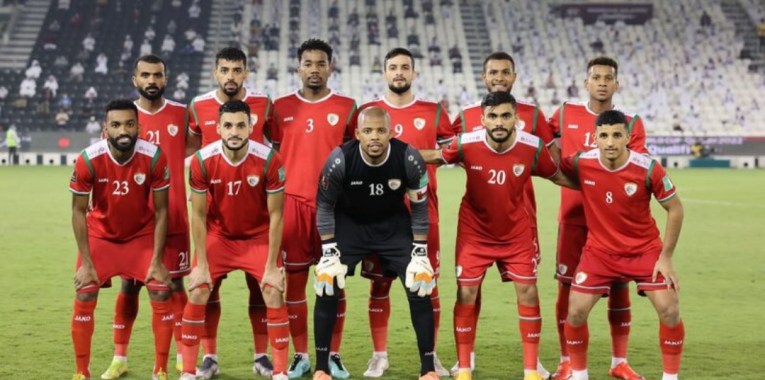
It’s time for the FIFA Arab Cup [ https://www.fifa.com/tournaments/mens/arabcup/arabcup2021/match-center ] so I am re-posting an essay I wrote a few years ago about rooting for sports teams in Oman.

I grew up watching Washington football with my father and brother so I have a deep, fulfilling, unshakeable hatred for the Dallas Cowboys. Later, when I moved to Boston, I watched the Patriots pursue a perfect season and the Redsox chase the World Series, so I thought I knew all about being a sports fan and supporting the home team. Then I moved to a small city in the Middle East.

I teach at a university and one of the best ways to create links with my students is to connect what we are reading with their culture. And since ‘football’ (soccer) is a major part of their lives, I pull sports metaphors into my literature classes, explaining Queen Elizabeth and the Spanish Armada in terms of offense and defense, comparing the queen protecting her country to the famous Omani goal-keeper Ali al Habsi.

But I have gradually realized that soccer here is quite different than in the States. My sister’s children play soccer. They have uniforms, scheduled practices, a coach, fields with clipped grass and painted white lines, goals with a net to catch the ball. And that ball is white, fully-inflated and regulation-sized. There is organization. There is a season with a beginning, an end, and a referee with a whistle. The kids wear cleats and matching shirts. The parents car-pool, have phone-trees, stand on the side-lines and watch. Everyone knows who, what, when, where. The ‘why’ is for the kids to enjoy themselves, get some exercise, and learn to be part of a team.

In Salalah, football is for anyone who feels like playing. Young girls play together or with male brothers and cousins in empty areas. Men gather in loose-knit teams every afternoon and whoever shows up plays, sometimes 20 players on one side. They play on the beach or gravel lots with rocks to mark the goal. The side lines are either lines drawn in the sand, quickly obliterated by scuffling for the ball, or a line of small rocks. The ball is whatever color, size and shape happens to be around. And when the kids play, there are no adults anywhere near. Everyone has a great time.

I got my second lesson in Omani-style sports when the Gulf Cooperation Council (GCC) met in the capital city of Muscat. The meeting of the government leaders was enlivened by the Gulf Cup, a football (i.e. soccer) tournament. I first realized something was odd when the DJs on the English-language radio station seemed weirdly humble. “Of course all the teams will play well,” they would declare. “We are rooting for all the teams!” “We wish everyone good luck!” When I asked an Omani friend for a “Go Oman – let’s vanquish our opponent” photo to put on my social media… I got a photo of the football team.

This is team-spirit? I asked myself. This is the battle cry? During a call-in show, one DJ asked the listener to predict the score of the first game (Oman vs. Kuwait). “Oman will win!” chirped the guest, “1-0.” 1-0? What kind of score is that? What happened to annihilating the enemy? Crushing them in devastating defeat? Humiliation! 24-0! I remembered the public buses in Boston during World Series frenzy displaying “Go Sox” instead of the route number. Everyone in the city had blood lust.

But, this is Oman. Public displays of bravado are not encouraged; the culture supports working together. I should have known better than to expect the whole ‘who’s your daddy’ insult-fest. When I watched the end of the Saudi-Kuwait game, as the camera panned the stadium full of fans from both sides calmly standing and applauding, it was hard to tell which side won. Sedate appreciation is the expectation. When a player falls on the field, it is normal to offer him a hand; but in the GCC Cup, a fallen player is grabbed from behind and scooped up onto his feet. Players arguing with the referee are quietly talked down by members of both teams.

Not that there isn’t deep emotion attached to the sports teams. A few members of the national team came to visit the University for a Pep Rally and the entire auditorium was packed. Students, male and female, wore their Omani football scarves to class during the tournament. Many young men decorated their cars with the Omani flag or striped in the Omani colors (red, green and white). After every Omani victory, guys would drive around the city honking and singing. There was even a spontaneous parade near the old souq. The celebrations were positive and family-friendly, without vandalism or  ‘hooligan’ behavior.

Playing well is important, but acting well is even more important.

I will be presenting ”Private Lives in Public Spaces: Perceptions of Space-Usage in Southern Oman” on Dec. 2 at the MESA annual meeting

‘Private Lives in Public Spaces: Perceptions of Space-Usage in Southern Oman’ – Dr. M. Risse

photos by: Onaiza Shaikh; plans by: Maria Cristina Hidalgo https://www.mariacristinah.com/

Middle East Studies Association annual meeting

https://mesana.org/annual-meeting/current-meeting

abstract

This presentation discusses issues related to the cultural perceptions of space and privacy on the Arabian Peninsula. The Merriam-Webster definition of privacy is: the quality or state of being apart from company or observation, and it’s the “apart from observation” aspect that I want to focus on because if someone is in public spaces, they aren’t alone (i.e. can’t be “apart from company”) but they can be unobserved.  Based on fifteen years of experience and research in southern Oman, I will focus on how men and women navigate the same or nearby public spaces at the same time. Using examples from shops, grocery stores, universities, restaurants, cafes, airports and hospitals I will discuss who moves where according to cultural rules about position and proximity. For example, an initiative at one bank to have a “women’s only” teller fizzled out (as did a scheme to give women customers pink bank cards), but customers and clerks continue to follow strict, unwritten rules about who stands where. Another example is universities. In some Gulf countries, there are separate campuses for men and women. Omani institutions of higher learning have only one campus yet there are both physical (having two sets of doors for classrooms) and mental (where students choose to sit) barriers to gender-mixing.

I am happy to announce that I will be presenting “Bringing Language Teaching into Literature Classrooms”

l will be presenting “Bringing Language Teaching into Literature Classrooms” at the English Scholars Beyond Borders – Dhofar University International Conference. Dec. 4-5, 2021.

My presentation will argue that in non-Anglospheric institutions such as Dhofar University, literature teachers will always need to be language and culture teachers. Given that many students on the Arabian Peninsula will use English when traveling or teaching primary or secondary students, texts must be chosen for their linguistic and cultural, as well as literary, qualities. I will use examples from teaching literature, cultural studies and education on the Arabian Peninsula for over 15 years to discuss how to create syllabi which reflect both the literary canon and students’ needs, with an emphasis on teaching multi-level classes and explicating cultural narration differences, as well as sneaking in language lessons. For example, folding language teaching into literature classes means both silent editing (such as not calling attention to spoken mistakes but repeating the student’s words with the correct pronunciation and/ or grammar) and short, explicit lessons. Lastly, it is vital to foreground cultural differences in plot, characters, settings and themes, in addition to narrative structures as an analysis of a literary text in English is expected to have the author’s opinion clearly stated with proof in the form of quotes and specific details, a format that Arabian Gulf students sometimes have not learned.

Houseways: ‘Homespaces’ Away from Home

plans by Maria Cristina Hidalgo, https://www.mariacristinah.com/

This essay focuses on areas which are perceived as a home. For both picnics and camping, all the general understandings of etiquette followed in houses apply although usually everyone takes on the role as host to some degree. For example, rather than the host pushing people to eat or drink, when any person opens the coolbox, they will act like a host (asking each person what they would like) before they take something to drink. Food that is opened is passed around before the person who opened the package takes any. The man who is cooking might ask a man who comes late to bring fresh bread or more supplies such as water although no one would ever ask a “guest” to bring anything to one’s house.

Further, the cook decides when to eat, but unlike inside a home, in which the hosting family must do all the work, all the people should share by clearing space on the mat, setting out a plastic cover, getting the hot sauce, cutting the limes, etc. And people should, of their own accord, help with the clean-up.

In general, picnicking in open space means creating a private salle. Dhofaris on picnics see themselves as inhabiting a homespace which is inviolate. The space is always clearly defined either by bodies (a group of women sitting in a tight circle) or mats; if there are women, the space must never be approached unless there is specific, immediate need. Men will approach other groups of men to ask for information or share food, but not a group of woman. Cars are always parked to block the groups from view.

Some families share one large mat; other families might make two seating areas, one near the car and one at more of a distance. The two spaces act as salle and majlis; as in a house, small children will act as messengers and carriers and have freedom of both mats and the space between them.  

 The exact amount of space depends on the landscape. The zone under temporary control of the family might be very large or, in crowded places like beaches on the night of the full moon, might only encompass a few meters more than the mat with the car at an angle chosen for privacy. In open areas like the desert or near-desert open spaces, people should camp out of sight of others.

Government- and hand-built straha (“hut”) are important in that they are roofed; shade is essential in Dhofar for most of the year. Both kinds of shelters are first come-first serve. Even if a man made the structure himself, if someone has parked in front of it and set up camp, the builder has no recourse and must wait until that person has left. Sometimes, men will leave bundles of wood, their blankets and some supplies in a shelter and go fishing; no one will take the space or steal the provisions.  

Once the car is parked in front; the shelter is treated like a person’s house whether it is occupied for a few hours or days. As with picnics, the car acts as the bab, the gate in the wall around the house. No one will come nearer than the car without calling out loudly and waiting to be greeted. Normally, even if the person is invited to come closer, they will stay on the far side of the car and explain what they want, to ask for something or give away food. Since there are no internal divisions in strahas, the space is like a salle and a man will usually not accept to sit down or come close unless he is a close friend.

Camping is slightly different as there are three layers while strahas and picnics have only the dichotomy of being outside (the far side of the cars, mats or circle of bodies) and inside (where the people are sitting).

The first layer is where the cars are parked, an area that functions like a hosh. Anyone can walk on the far side of the cars without acknowledging/ being acknowledged. On beaches, the area below the high tide mark is see as a free passageway. The passer-by might lift his hand or call out, but a man walking next to the water or beyond the cars is like a man walking on the far side of a house wall. A stranger who approaches a camping area and needs help will not come closer than the cars. For example, he will stand on the far side and call out his request for a tow or a tow-rope.

The second space, like a majlis, is the public area for friends and family, usually delineated by mats in the space bounded by the cars and whatever natural features are used such as the ocean, wadi walls, rocks and drop offs. Once a man has approached, called out and been invited “in,” he may join the group and sit on the mat. If he is older, younger men will offer him their chairs or pillows to lean on. The new-comer, as in a majlis, will be offered whatever there is to eat or drink.

The third space, corresponding to the bedroom, is the area used for sleeping. This can be all or part of the inside of the shelter or the area closest to the overhang and is delineated by either piled or set out sleeping mats, pillows, bags of clothing, etc. This zone should never be acknowledged or approached by anyone who is not spending the night; sleeping bags, blankets and personal gear are treated as invisible. A man might reach over and take his blanket to use as a pillow to lean against, but no one else should touch it unless the owner offers it although food, juice, soda, water and the accoutrements for tea are available to everyone.

Safety on picnics and while camping is first and foremost about wild animals: scorpions and snakes in sandy and rocky places, wolves and hyenas in unpopulated areas. The site has to be chosen with care and a fire needs to be lit after dark. Foodstuffs need to be put in cars or well-packed and placed near the fire/ sleeping people to keep them safe from foxes. Animal attacks are very rare but keeping a fire going is essential in areas away from towns.

Example of picnic site on a beach- note cooking fire is away from mat and cars are parked to provide privacy

Model

Examples of camping sites


This slideshow requires JavaScript.


Bibliographies on topics connected to Dhofar, Oman

(photo by S. B.)

Bibliography of the Modern South Arabian languages, compiled by Janet Watson and Miranda Morris, updated October 2021

https://www.researchgate.net/publication/345983960_Bibliography_of_the_Modern_South_Arabian_languages_Compiled_by_Janet_Watson_and_Miranda_Morris

Bibliographies I have compiled

Houseways

Pre-historical and Historical Houseways in the Dhofar Region: Selected References

Foodways

Updated bibliography from my research on Foodways in Southern Oman

Selected Bibliography: Animals, Birds and Fish in Southern Oman

What I’ve Been Reading: Food, Cooking, Cuisine, Culture, Anthropology, & History

General

Bibliography of Works Consulted for Research on Dhofar, Oman

Annotated Bibliography of Texts Pertaining to the Dhofar Region of Oman

Short bibliography of books about Dhofar in Arabic

Teaching Literature

Selected Bibliography: Primary and Secondary Texts for Literature Teachers on the Arabian Peninsula

Houseways: House plans

(drawings by Maria Cristina Hidalgo, https://www.mariacristinah.com/ )

Below are three houseplans with comments to help illustrate living spaces in Dhofar.Model

House 1 – It is easy to note that this is an older house, probably built in the 1980s or 90s, as it has the salle as the main, not separate, room. The second (back) door is also built off the salle, not from the kitchen as is usual in more modern houses. The unmarked room would be for storage. Also note that the internal door to the majlis opens directly into the salle; now there is usually a short hallway, or at least the entrance is set at an angle so there are no direct sight lines.

Model

House 2- Note that now the salle is now a separate room and there are two doors between the  majlis and the rest of the interior of the house so that the house feels more segmented. Also there is an internal door in the hallway, to give the two back bedrooms more privacy.

IMG_2010

House 3 – built approximately 2010.

These three examples show how the trend in housing is towards creating more closed off/ divided spaces. In house 1, a person sitting in the salle would have visual access to anyone coming or leaving; in house 2 someone in the salle could see the front door but in house 3 only a person sitting opposite the salle entrance could know who was coming or leaving. Likewise in house 1, someone in the kitchen could hear what was being said in the salle; in house 2, it would be more difficult but one could hear the sounds of people in the hallway. In house 3, the kitchen is very cut off from the rest of the house. In both houses 1 and 2, the majlis is separated from the rest of the house by the bathroom area and two doors. 


I am pleased to announce the publication of my essay “Questions about Food and Ethics”

“Questions About Food and Ethics,” in Emanations: When a Planet was a Planet. Brookline, MA: International Authors, 2021. 403-408.

(photo by Salwa Hubais)

selection from “Questions about Food and Ethics”

Is there a benefit to stating kind intentions? Should you explain that you planned to do something thoughtful (but couldn’t actually do it) or simply keep quiet? I would like to use this question as a starting point to think about how what’s “good” and “right” in terms of eating and disposing of food as perceptions can change dramatically between cultures.

What interests me about this topic is the question of whose ethics are you talking about? A behavior which makes perfect sense in one culture, looks odd in another. There is no way to resolve the issues with one ‘best’ answer, but I think it’s helpful to see examples of how ethical systems differ.

First, if I bring cookies to a picnic, I don’t want to open the package because if no one wants them the cookies will get soggy from the humidity and the cookies will be ‘wasted.’ This is not acceptable in Oman. I should open the box, pass the cookies around and then set them out for birds if no one eats them.

I don’t want to feed the birds, especially not my prized Fortnum and Mason cookies but in Dhofar it is shameful to bring something to a picnic/ group meeting and then try to leave with it. If you have brought any kind of prepared food or foodstuff, it should not return to your car and be brought back to your home. If I have brought cookies, either the box needs to be opened or I should give the unopened box to one of the men to give to his children.

A second example is that unwanted food is never spread on sand or dirt as that is seen as unkind to the animals. If there are no rocks, the food is left on pieces of plastic. A few times when I have tried to pick up the plastic that leftover food was placed on, not wanting to leave litter, I was told to leave it. The Gibali men in my research group pick up all the trash from campsites, but it is judged worse to put leftover food on sand than it is to leave it on plastic bags.

Leaving plastic on the ground is not just litter; when eaten by camels and cows, it can cause illness and death. But even a man who owns camels will leave food on a piece of plastic so foxes and birds can have ‘clean’ food, valuing the idea of making sure that the food is eaten, more than the idea of keeping the area clean and preventing a possible future harm.