I wish I could use this page to concentrate on anthropology, books, cultural studies and Oman but at this point in America, silence can be seen as agreement and it is better to be clear. I do not support this war with Iran.
I condemn the bombing of the Shajareh Tayyebe school and any Iranian school or university.
Every student, faculty member and staff member in every educational institution in every country deserves to learn, teach and work in peace.
I taught for two years at the American University of Sharjah, for one semester at University of Sharjah-Women’s and 19 years at Dhofar University in Oman. I have presented at conferences at AUS and Sultan Qaboos University in Muscat, as well as Al Ain University and Zayed University in the Emirates. I have attended a conference at NYU-Abu Dhabi and visited Education City in Qatar.
Every student, faculty member and staff member in every educational institution in every country deserves to learn, teach and work in peace.
I was a student St. Mary’s College of Maryland (first year of college); Middlebury Language School (summer semester-German); Rhenish Friedrich Wilhelm University of Bonn, Germany (junior year aboard); University of Wisconsin-Madison (BA); University of Maryland-College Park (MEd); Frederick University, Nicosia, Cyprus (semester abroad for research); the University of North Dakota (PhD) and the Center for International Learning, Muscat (two summers for Arabic classes). I have taught at the University of North Dakota, the University of Minnesota-Crookston, the Community College of Vermont-Montpelier and for the American Red Cross, Massachusetts Bay Chapter. I have presented at conferences at New York University, the University of Minnesota, Concordia University in Montreal and the Universities of Utrecht, Edinburgh, Lancaster, Leeds, Liverpool, Wales and Warwick.
Every student, faculty member and staff member in every educational institution in every country deserves to learn, teach and work in peace.
I wish America, the countries of the Arabian Peninsula and the countries near the Persian/ Arabian Gulf would follow the example of Oman, a country which exemplifies a commitment to peace.
We continue to stand against injustice and darkness and remain on the side of justice, light and harmony. Mankind will only enjoy happiness and a sense of security if there is justice and respect for all those qualities that guarantee human beings their legitimate rights. First and foremost among these being their right to dignity, liberty and independence.
In the area of international relations, our foreign policy is based on firm foundations and principles: support for right and justice and a desire to work together with other peace-loving countries of the world to resolve international conflicts through dialogue and negotiation, so that everyone can enjoy security and stability and all the peoples of the earth can reap the benefits. Sultan Qaboos bin Said
what I wrote Feb. 28, 2026
I have always kept this website apolitical because politics is not my métier but there are times when one must nail the colors to the mast. I do not support this war with Iran. I do not support Donald Trump, Pete Hegseth or their war agenda.
One of the reasons I moved to Oman in 2005 is that I do not think soldiers should be the only Americans in the Middle East. Every day during the 19 years I was in Salalah I tried to represent the States in a positive way. I was very aware that, for many people I met, I was the first American they talked to and I wanted to leave a good impression.
I am so sorry for all the people living in fear because of American bombs. It was a joy and a blessing to live in Oman, a country so committed to peace. I hope there will be peace throughout the Arabian Peninsula and Middle East soon.
The path we have followed in our foreign policy over the past decades has shown itself to be both sound and effective, with God’s guidance. We are committed to this approach, which supports justice, peace and security, and tolerance and love; which calls for international cooperation in order to reinforce stability, promote growth and prosperity and tackle the causes of tension in international relations by producing just and permanent solutions to critical problems; which fosters peaceful coexistence between nations; and which generates well-being and prosperity for the whole of mankind. Sultan Qaboos, 14.11.2006
Several people have asked me, “Aren’t you glad you aren’t in Oman right now?” Actually, no. I wish I was there, but I have aged out of work visas and can’t afford one of the housing units that comes with a residence visa. I do not support this war and I think America should stop bombing Iran. It must be terrifying for the people who are staying and all the photos of expats leaving the Arabian Peninsula make me reflect on how difficult it was to leave Oman, even with plenty of notice and in peacetime.
In remembrance of happier times, this is an essay I wrote in 2017. May peace come soon to all troubled lands.
“I’ve never such a beautiful ocean” – tourist
“Holy sweet Jesus he’s got no clue” – local
“Public Relations” lyrics from the musical Don’t Stop the Carnival
Tourists burble. Tourists gush. If I hear a woman is raving about how “the food is so natural and healthy!” you can be sure that she’s got a plane ticket back to the Land of Whole Foods and Mexican restaurants within a week or two. It’s amusing to watch a man coo about how relaxing life is here, all the while checking his Blackberry and reading e-mail on his laptop at one of the two cafes in town with wi-fi.
Expats don’t coo. Expats don’t prattle. The people who live here, we send SMSs: “Flaxseed oil in at the pharmacy,” “Sandstorm coming – batten down hatches,” “Did you hear X is in the hospital?” and “Do you know a good carpenter?”
I call an expat friend and ask, “What’s the name of the place you hang your clothes?”
He starts throwing off fancy French furniture terms: armoire…
“No, no,” I say, “What’s the simple word. I forgot it.”
Pause.
“You mean ‘closet’?”
“Yes!” We say goodbye and hang up the phone.
A woman who came to town for an extended visit mentioned to me that she had a rental car. I told her to be careful; any problem that happened to the car while she had it was her responsibility.
She said, “I didn’t sign a contract.”
I said, “It doesn’t matter, the understanding here is, unless you go to Budget which is twice as expensive as normal rentals and has insurance, that any problem is your fault and you pay for the repair, as well as the regular daily charge.”
She said, “But I didn’t agree to that and I didn’t sign a contract.”
Expats do not say “I didn’t sign a contract.” They would laugh and tell you about the rental car in Uruguay, which would segue into a story about Nepal, and then into that fabulous B& B in Dorset. Expats know that this is not a theme park full of natural and healthy food, beautiful scenery and exotic folkways. It is a working community. You either stay cut-off by cycling between your job, the two expat grocery stores and the big hotels or you become part of it – whether you agree or not. Expats are normal people who have evolved and devolved into a new species.
Expat – Definition
The first part of my definition of living expat is that it’s voluntary: moving to another country by choice to study, work, retire, create art etc. I am talking about a narrow band of middle-class experiences – not forced immigration or those ‘on the wind’ fleeing war, disease and/ or poverty. I made the decision to live on the Arabian Peninsula.
The second part is that I live middle-class. I live alone (not in a camp or apartment with co-workers), I can move about when and how I choose (not being driven in a bus), I have two days off every week (not only an afternoon or no free-time at all). On the other hand, I know nothing of upper class life beyond what I read in Town and Country. My car is 8 years old and has over 300,000 km; I worry about retirement. I don’t think I am ever going to have a set of Ghurka luggage or diamond stud earrings, much less one of those really gorgeous Persian rugs.
My third point is that it’s living expat. I have traveled to 38 countries but have lived overseas only 4 times. “Living” I define as having an address where mail is delivered, having a bank account in a local bank, and having a set of places to go to – your café, your beach, your tailors, your schwarma stand.
The fourth part of “living expat” is what does “expat” convey? Mawuna Remarque Koutonin’s article [https://www.theguardian.com/global-development-professionals-network/2015/mar/13/white-people-expats-immigrants-migration%5D discusses how “expat” is a racially charged term. I can’t speak for other areas of the world, but I’ve lived in the Middle East for 14 years and on the Arabian Peninsula, “expat” it is an indicator of economic status not country of origin. Here, “expat” means people who have a position which allows them to sponsor bringing over a spouse and/or kids and people who are free to move about as they please outside of work hours. To talk about one group, people put qualifiers in front, such as Arab expats, Indian expats, Western expats. “Expats” is used as opposed to “workers,” almost always men, who live in single-sex compounds whose movements are more closely controlled.
I have never heard of anyone referred to as a “guest” and “guest-worker” is not a configuration used here. I have only heard “foreigner” used by Gulf Arabs referring to non-Muslims. My personal pet peeve is people who call themselves “nomads;” just as bad are businesses which cater to this nonsense: “tools for nomads” with $600 backpacks. Do you carry all your worldly possessions yourself or with a pack animal? Are you without bank account and/ or property? Do you sleep in structures you erected yourself? Do you roam around a wide geographical area without changing continents? No? Then you aren’t a nomad.
Expat Talking
There are many positives of living expat. When British Airways lost my luggage, I had to make a list of the items lost: handmade slippers from Muscat; shoes from Edinburgh; shoes from Leiden; dress from Victoria, BC; skirt from my tailors; shirts from Boston and San Francisco; jean jacket from Denver; Swiss cosmetics; earrings from Maine. Reassembling that small suitcase would take thousands of dollars’ worth of airplane tickets as I pick up clothes as I travel to see family and friends and for conferences.
This is normal for people who live middle-class expat but can be really annoying for those who don’t. We are used to have objects and experiences from a myriad of places and with other expats, ordinary conversations can quickly turn insufferable for normal people: the waterfalls in Vancouver airport vs. the mini-tropical forest in Bali’s airport, Taba in Egypt vs. Aqaba in Jordan, foot massages in Phuket vs. head massages in Delhi, Rhodes vs. Crete, water-taxis from the airport in the Maldives vs. water-taxis in Dubai, island hopping in the Seychelles vs. island-hopping in the Caribbean, Malta vs. Corsica, the Khan el Khalili in Cairo vs. the Blue Souq in Sharjah, Stockholm vs. Amsterdam, Doha airport vs. Chicago airport, throwbacks to crossing into Turkish Cyprus vs. crossing into East Germany. As I said, it gets old fast for people who have built their lives in one or only a few communities.
Every expat has had the experience of being asked “What’s it like” as if one can sum up living in a country for a year in two sentences. And then there are people at home who never even ask that, who avoid any mention of the life overseas.
Expats learn to keep quiet about their lives and open up only with other expats with whom they can trade experiences and opinions freely: making fun of Jumeirah Janes, debating the best college to stay at during the summer in Cambridge, complaining about being woken up by the sound of kookaburras in Brisbane and loons on a Wisconsin lake, comparing Swiss Christmas markets vs. southern German Christmas markets. Expats who have lived in the toughest conditions are usually the nicest. People who lived in Cairo and Dubai are never as friendly or helpful as those who lived in Afghanistan and Papua New Guinea where cooperation meant survival.
Expat Travel
Baltimore, Lisbon, Mousehole, Heidelberg, Petra, Charlotte Amalie, Santa Fe, Al Mukulla: expats get to used to the chance for travel during vacations and the perks of travel seem so obvious, it’s useless to complain about the times I have walked off a plane after a 10+ hour flight trying to remember what country I was in, looking at the signs at passport control trying to remember which line to stand in, all the methods of coping with jet-lags, the stupid mistakes done under the blight of jet lag, and most importantly, the sense that you can never have all the things you like together.
It is useless to grumble but inside most expats’ hearts there is a wish for impossible meals and events: Dutch pancakes with American coffee, an English pub lunch with waiters who come to the table, Bangkok with the air quality of Edinburgh, Winnipeg’s summers with Puerto Rico’s winters, Dubai shopping but with taxi drivers who speak English; bookstores in Oxford that stay open later than 6pm; Tartine pastries at the Hong Kong airport.
An expat’s life is always a mosaic, never a unified whole. My favorite way to travel is the 8-seater plane from Logan to visit my mom, the train from Sydney to Melbourne, a sailboat in the Strait of Juan de Fuca, and the DC metro. My favorite stores are Ragamuffin on the Isle of Sky, the main Jim Thompson store in Bangkok, gold stores on the Ponte Vecchio, and M & S. My favorite hotels are the Charles Hotel in Cambridge, MA and the Peninsula in Bangkok but my favorite places to eat are the Palm Court at the Balmoral Hotel in Edinburgh, the Windmill café in Kingston, Ontario, pretty much any restaurant in Rome and the Lime Tree Café in Jumeriah. I want to walk off my favorite beach in the BVI, have a ‘rice table’ in the Netherlands for dinner then fall asleep to the blinking of Grand Forks, ND fireflies.
Expat Decor
I always think that a person’s home should be like a 3D collection of Girl Scout badges; it should reflect who you are and where you have been. Living middle-class expat means that it’s easy to collect pieces from all over. In my living room I have a sofa I bought in Bali, a chair from India that I got in the Emirates, and an Egyptian rosewood chest. The three pieces are nice, but don’t really coordinate with each other or my dark wood IKEA desk or my dark wood book cabinet which had a glass front section resting on top of a (non-coordinating) set of cupboards. That’s one of drawbacks: you pick up pieces as you go along, and you simply have to tell your furniture to get along with each other because it’s almost impossible to get things to match.
Another characteristic of expat living is that pieces usually develop narratives. I have a dish a friend brought me from her trip to Iran; one rug is from the store run by two Iranian brothers at Mutrah souq. There are very few things that I have bought anonymously, so to speak, at a store which I can’t remember. When I go to a friend’s house and admire something its: “I picked that up in a little village in Cambodia when I worked there” or “Got that in Siberia.”
Every piece has a story. The rug I bargained for with a friend standing by amazed at my ability to spin tales about the poverty of teachers to lower the price. The coffee table was bought at X store on Y street with my friend Pat pretending to be my husband and saying I was spending too much money in an effort to get the price down (that trick worked). Even my computer has a story of the how I got it and what happened when it broke down (four hours of sitting in the store reading a novel because I was not leaving until it worked).
Even as a single woman, there’s not much shopping I do on my own – there is often an Omani or western friend to give advice, and I willingly go on shopping expeditions in turn. When I walk thought my apartment I see the pieces connected to my friends Marlene, Tom, Rosemary, Samantha, Barbara, Sophie, Margie, Sanda, and Helen, all of whom have since left town but whose memories remain.
Another effect of living expat is that decorating is usually very personal – you often incorporate other people’s lives and they incorporate yours. In my sitting room, my sofas are from a dear friend who was selling them when she left Salalah. Given how much turnover there is, if you see something you like that a friend has, if they leave you have a chance to get it in a way that would seem predatory in the States. Several times I have had the unsettling experience of walking through a good friend’s house and deciding which of their pieces to buy.
On the other hand, when I want to get rid of something, it doesn’t go out anonymously on the street to be picked up or to someplace like Salvation Army. I give it to the woman who cleans my house. In the Middle East, almost all middle-class households have maids, who either live-in or have keys and come to clean a few times a week. Mine has worked for me for almost ten years and, like most expats, I give her her salary, bonus twice a year and whatever I no longer need.
My old sofa, coffee table, pillows, even shoes and purses are set in a pile for her and she takes everything. I wonder if they are all in her house or if they are handed on to her friends. That angst of “I can’t get rid of it because it still has some use in it” doesn’t exist here – if I don’t need something, don’t like it anymore or have bought a replacement, I can pass it on knowing it will be used. I see it as a ladder: an Omani friend gave me a gorgeous wooden bookshelf; I give the woman who cleans for me my old fridge.
Expat Fitting In
As you live expat, and start to understand the culture, the prevailing wisdom is that you should try to fit in. I agree with this most of the time, but there are also times when I think deliberate dissonance is helpful. Sometimes speaking, dressing and acting in ways that mark you as a foreigner can create a more positive interaction, especially in dealing with Arabian cultures in which people usually dislike being surprised.
I learned this point when I went to two social events with a non-Omani Muslim woman (I’ll call her Muna). We were both wearing the right kind of clothes for the event but Muna greeted each Omani guest in the correct way but I said, “salam aleikum” – the wrong thing to say. This greeting should be said by a person who comes into the room, but I was sitting down. It is such a blatant mistake, each woman who was greeting me paused for a moment, looked at me carefully, then carried on with greeting the other attendees, often gesturing towards me and asking other women, “Who is she?”
My incorrect greeting immediately signaled that I was foreign and the women could immediately adjust their expectations and assumptions about me. Older women did not wonder why I don’t stand up and kiss them on the head, etc. There was a momentary flutter, but I was quickly forgotten.
On the other hand, several women tried to speak to Muna after she gave the correct greeting. Then Muna would explain she didn’t understand Arabic, which would cause surprise and begin a several minutes conversation about how the woman THOUGHT Muna was Arabic-speaking, but she wasn’t and where was Muna from and why was she at the event and wasn’t it a surprise! Several Omani would say they thought Muna was from X country, Muna would explain she was from Y country, the women would say “Oh you look like you are from X,” Muna would affirm that she was from Y, the women would ask “Is your mother from X?” Muna would answer no; her mother was also from Y. This happened several times and after her country of origin was cleared up, there was no more conversation.
What happened with me was opposite. The women sitting near me would usually ignore me for an hour or so, then ask me a question or two (how long had I lived in town, was I married, did I have children, was I Muslim etc.) which would slowly grow into a longer conversation. After two or so hours, all the women around me would have talked to me. As I was sitting quietly, smiling at the children, accepting tea, looking as benign as possible, the women would socialize with each other, occasionally glancing at me, then slowly one or two would start the process of figuring out who I was and passing that information around.
I had given them space and time to adjust to me and I happily answered all their questions with answers that made sense: I am a teacher, I have learned Arabic from my students, I am a friend of the groom’s sister, etc. There was always a sense of wonder – this American Christian sitting amongst us! – but I made no sudden moves, gave ready and plain answers, smiled at children and (with honesty) professed myself delighted with the house, food, tea, party and the company. Slow, easy and steady but always marked as different and foreign.
This insight was found by chance (the first time I did this, I really didn’t know the right thing to say) but I realized that, on the Arabian Peninsula, the more you speak and act correctly, the more it is believed you know all the culture’s rules. In my experience it is far better to start off with an obvious stumble and rehabilitate yourself later than to start strong only to fall off. Set the bar low, make it clear you don’t have all the necessary cultural knowledge and mistakes are forgiven or at least not coded as deliberate rudeness.
Expat Friends
Expats friends can sometimes turn to gold. When I met The Divine Ms. S., I felt like I was reunited with my birth sister. Just as my idea of ‘plot’ is add another shark attack, my idea of decorating is throw a few more rhinestones on. She had a living room with floor to ceiling red velvet curtains on all the walls and a four-foot mirrored snarling jaguar statue. Truly a woman after my own taste.
Living overseas in a small community everyone knows each other – most people live next to or near people they work with; you see all the same people at the same (few) restaurants and shops. You can’t move unobserved. You and your car are known entities and, maliciously or not, information is passed around. If you go to Lulu’s you either see someone you know or someone was driving by and saw your car, or someone saw you take the Lulu’s bags out of your car.
You learn not to lie, but to preserve some sense of privacy, to be circumspect. You seldom use names in conversation or discuss your specific plans. Everyone says, “Oh I am busy that night” or “Yes, I know that restaurant. I went there with a friend once.”
Once you become part of a circle, you have to take care of those people; you have to help. Like it or not you are in for giving rides to the airport, rides if their car went in for service, borrowing books, handing out whatever medicine you have, sharing the names of good dentists and plumbers. Unlike a small town in America, it is impossible to find basic information here. There is no Yellow Pages, much less store web-sites. The opening times change, stores close or move locations. You have to tell the newcomers the name of the good tailor and about the Japanese dollar store. The gardeners have to tell each other when a certain plant (mint, yellow hibiscus, almond trees, olive trees) is available at the nursery and when there is a delivery of clay pots. The person you told about the good new shawarma stand is the person who, tomorrow, will tell you about a good place to have curtains made. You have to walk people into stores and hand them over to your ‘cushion guy,’ your ‘frame guy,’ your ‘copy guy’ and your ‘coconut guy.’
You get to know what everyone in your groups likes to eat and drink. As I walk around the grocery store, I send off messages: “Hey, they have tortilla chips!” and “Hey, they have dried cherries.” I get calls now and then, “Hey, they have cranberry juice!” and “Candy canes are in.” When I leave town, I ask for requests. When my friends return from trips, I get goodies: Halloween candy, vitamins, clothes dye, doughnuts, curtain fabric.
Expats almost always develop a veneer; whoever you meet you can manage a pleasant conversation about something. You go to a party, end up sitting next to someone you didn’t know – you two look at each other and there is an almost palpable assessment, “Ok, let’s get on with it” and you make a go at figuring out something in common: How long have you been in town, where do you live, where do you work? You smile and wave when you see acquaintances, “How are you?!”
Nothing serious, no soul-baring, no sharing, no real talk, just simple chat, do you know where to get a good hair cut? Have you heard anything about the new Al Jazeera flights? A bit of complaining about the weather, a little discussion about what’s available at the grocery store, “Strawberries are in at Isteqrar!” and “I saw real Hershey’s chips at Al Haq.”
Expats know: you do what you can with what you have where you are.
Risse, M. “Living Expat.” Emanations: Chorus Pleiades. Carter Kaplan, ed. Brookline, MA: International Authors, 2018: 308-318.
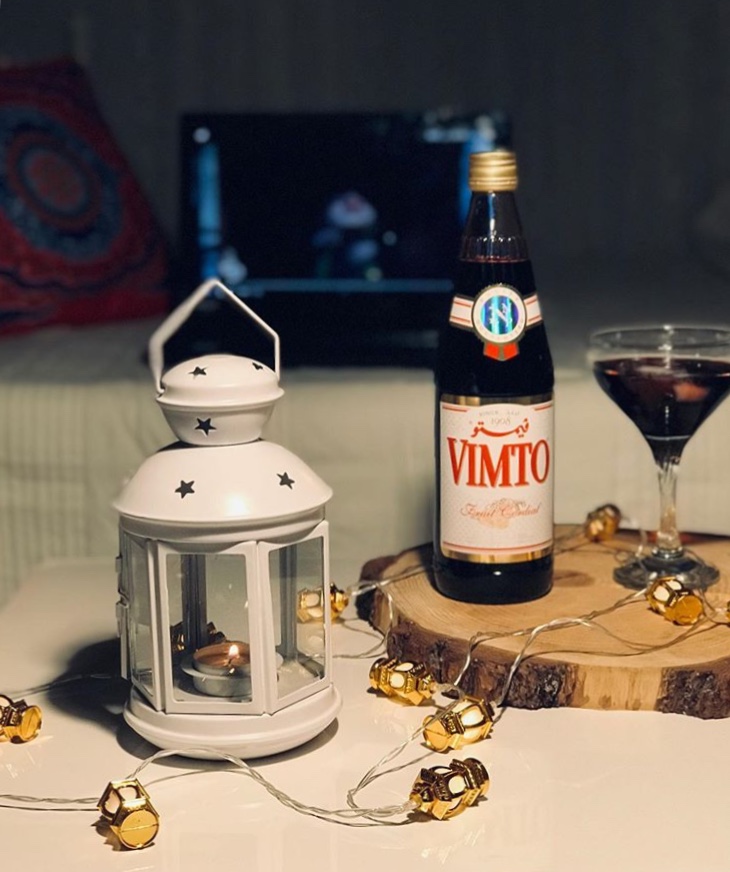
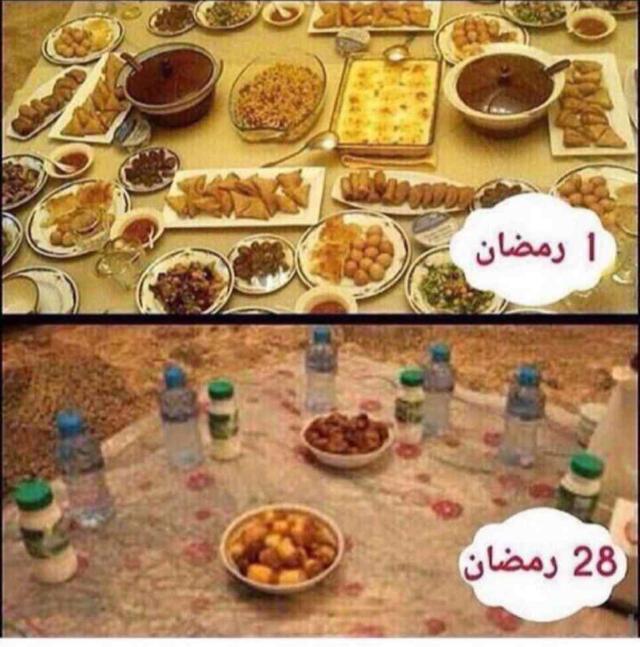
I meant to publish this several days ago, but recent events have overtaken the usual quiet, home-based focus of Ramadan on the Arabian Peninsula. I know that many expats are currently trying to leave but I want to put this up as a reminder that, whatever else is happening, it is still Ramadan.
the section on how to behave respectfully during Ramadan from ‘Researching and Working on the Arabian Peninsula’ (2025)
Ask questions about Islam, but frame those questions respectfully. During Ramadan, one male student at the Arabic school where I studied ridiculed a female, Muslim student who was fasting, “She said she was fasting but then I saw her drinking water – she’s a liar!” The woman had her period, so she couldn’t fast but there was no way a woman would tell that to a new, male acquaintance. She was acting appropriately; women act in public as if they are fasting but eat/drink out of sight, then ‘make up’ those days at some point before the advent of the next Ramadan.
Before you leave, look up when Ramadan will fall; Freya Stark (1940) famously made the mistake of not checking before her difficult trip with Gertrude Caton-Thomas. Unless you are Muslim, male, and specifically doing research related to Ramadan/Islam, doing research during Ramadan will probably be difficult. Muslims will be concentrating on prayers and family. You might be invited for iftars (the meal to break the day’s fast) but there probably won’t be time/opportunity to have private conversations/ask questions.
In addition, it’s a good idea to pay more attention to your appearance and behavior. Ramadan is not just about fasting from food from sunrise to sunset; Muslims should also refrain from anything that pulls them away from spiritual reflection, for example being angry, lying, cheating, or listening to non-religious music. You should live in a way that allows everyone else to also concentrate on spiritual matters.
There might be specific laws in your location, but in general I suggest trying to blend in with your surroundings, be it a university, archive, or business. This often means dressing more modestly than usual, e.g., switching from short-sleeved to long-sleeved shirts with rolled up cuffs if you want, tea-length instead of knee-length skirts, less or no jewelry, make-up perfume, etc. Before the month starts, ask if there are changes people often make.
If you are not fasting, keep food and drink out of sight. Don’t leave your bottle of water clipped to the outside of a backpack, put it inside. Various people don’t fast for various reasons (such as being pregnant or ill), so it’s understood and accepted that people are going to eat, just do it behind a closed door or in a hidden corner. Some businesses will set aside a room for non-Muslim to eat meals in or employees will informally co-opt a room, so ask around. If you are in a new space or are the only person not-fasting, try stairwells. Usually there is an empty area at the top of the last flight of stairs.
Behavior in Ramadan relates to two concepts I will discuss further in the sections about tribes and clothes in Chapter 5. First, many cultures on the Arabian Peninsula are tribe-based, meaning it is expected that you will try to fit in to prevailing mores in the same way that people fit into tribal expectations. During the day in Ramadan I cover my hair and the most frequent comment I hear is, “Good, you are with the people.” The fact that I am attempting to blend is seen as positive; yet at the same time there is no expectation that I will adopt every behavior of a Muslim women.
During Ramadan I drink coffee, eat, and play music in my office but my door is always closed. When someone knocks, I drape my scarf over my head, cover my coffee cup with a Kleenex, turn off the music, then call out “Come in.” Everyone knows I am hiding my coffee while they wait outside my door, but in 19 years, no one has complained because I am making an effort to respect the rules and that is sufficient.
The second concept is that people who alter what they wear, what they say, how they act can be viewed with suspicion. Hence, decide if you are going to change anything and what you are going to change, then stick with it throughout the whole month. Dressing modestly one day and not modestly the next is often viewed as worse than dressing non-conservatively because the person is viewed as playing with/making fun of cultural norms. Several years ago, when I decided to wear a head-scarf during daylight hours in Ramadan, I knew that was an irrevocable decision and I have stuck with it. Ramadan creates a framework for my changes and gives a clear explanation of why I am behaving differently.
My last point is that modifying your clothing and behavior (not playing music during the day where people can hear it, not showing anger, not reacting to anger, etc.) helps you navigate smoothly. Yes, sometimes it’s hot to wear a headscarf and sometimes it’s awkward to get it correctly arranged. I hate walking out of the house without lipstick and perfume. On the other hand, these adjustments mean a month without women shooting me angry glances, men acting as if I don’t exist (cutting in front of me in line), clerks pretending that they don’t see me and government officials refusing to help me. When I tell a male student to stop yelling in the hallways, he is not going to backtalk me.
Sometimes other expats show frustration with me and ask “Why are you making your life difficult?” I see my actions in terms of helping to create a peaceful atmosphere. I know it’s silly that I carry my coffee cup at my side or behind my back when I walk to rinse it out in a sink. I know the sight of my coffee cup will not ruin someone’s day, but why should I flaunt the fact that I am drinking? It doesn’t hurt me to be discreet.
I have always kept this website apolitical because politics is not my métier but there are times when one must nail the colors to the mast. I do not support this war with Iran. I do not support Donald Trump, Pete Hegseth or their war agenda.
One of the reasons I moved to Oman in 2005 is that I do not think soldiers should be the only Americans in the Middle East. Every day during the 19 years I was in Salalah I tried to represent the States in a positive way. I was very aware that, for many people I met, I was the first American they talked to and I wanted to leave a good impression.
I am so sorry for all the people living in fear because of American bombs. It was a joy and a blessing to live in Oman, a country so committed to peace. I hope there will be peace throughout the Arabian Peninsula and Middle East soon.
The path we have followed in our foreign policy over the past decades has shown itself to be both sound and effective, with God’s guidance. We are committed to this approach, which supports justice, peace and security, and tolerance and love; which calls for international cooperation in order to reinforce stability, promote growth and prosperity and tackle the causes of tension in international relations by producing just and permanent solutions to critical problems; which fosters peaceful coexistence between nations; and which generates well-being and prosperity for the whole of mankind. Sultan Qaboos, 14.11.2006
In Arabian Sands (1959) Thesiger recounts his travels on the Arabian Peninsula between 1945 and 1950, including two crossings of the Empty Quarter. In 1997 taught sections from the book in a non-fiction writing class at American University of Sharjah. I did so again when I lived in Salalah and also presented a lecture at the university where I worked: “Thesiger and the Persistence of Cultural Memory: How Arabian Sands Can Help Improve Teaching in Oman.”
Thinking about how the lifeways Thesiger describes are still extant in Dhofar, I then wrote an essay about his book: “Verstehen/ Einfühlen in Arabian Sands: Wilfred Thesiger as Traveler and Anthropologist” (2013).
Hence, I have been on team Thesiger for 30 years. The only travel book I would put as an equal is Apsley Cherry-Garrard’s magnificent The Worst Journey in the World (1922) about the South Pole Terra Nova expedition (1910–1913) led by Robert Scott.
So when my bookclub choose to read Into Thin Air: A Personal Account of the Mt. Everest Disaster (1997) by Jon Krakauer I was the only person not enamored of that book. After reading of Oates’ self-sacrifice and Cherry-Garrard’s warning:
There is no chance of a ‘cushy’ wound: if you break your leg on the Beardmore you must consider the most expedient way of committing suicide, both for your own sake and that of your companions.
It is jarring to read Krakauer describe himself and other stepping over dying people. It is also jarring that he published the book the year after the disaster. I can understand Krakauer wanting to explain his version of the events, but there was no time for reflection
Then we read The Abominable Snowman (1955) by Ralph Izzard, one of those travel books by men who had their own WWII experiences (or someone else’s) in front of them and went to foreign countries as a way to continue (or start) to test themselves. Blind White Fish in Persia Hardcover (1953) by Anthony Smith is a classic of that genre.
Our next book was The Snow Leopard (1980) by Peter Matthiessen. I have read several positive reviews of it, but I was afraid it would be too much of an internal-focused travel book. Like Thesiger (and Cherry-Garrard) there was a space of more than seven years between when he traveled and the publication, but the result is an emphasis on reflection: 1 page of walking to 3 pages of thinking.
The reflections about Buddhism, with digressions to explain the history of the religion, are interesting, but the personal reflections are unsettling. He and George Schaller are both clear that they are glad to be away from civilization, but they are traveling with 14 porters and 4 guides, porters who are carrying all the supplies so the two western men have only “rucksacks.”
Then there is a brief mention of Matthiessen’s wife death, followed a few pages later by a copy of letter from his youngest son and a description of his leave-taking from this boy, leading me to wonder why he was walking around the Himalayas when his son was grieving.
Thesiger and Cherry-Garrard had it easy, no sentimental attachments to pull their thinking back to home. Cherry-Garrard was also working in one of the few landscapes on earth that had no people who he was displacing, nor was he asking (or forcing) anyone to work for him. Thesiger paid the men he walked with, but he also lived by their standards, wearing their clothes, speaking their language and eating what they ate. If they starved, he starved.
Matthiessen has interesting information about Buddhism but after so many comments about how his porters were “childish” and eating the wrong time of day, I started to hope that he would not see a snow leopard. It was petty of me but the whiplash between his mediations and omening with the mountains vs. his scolding the men he was traveling with was jarring. And his creating a mystic “otherness” about one of the men was creepy: his smile meant this and his was thinking that and we are somehow connected and he is my teacher… about a man Matthiessen can’t communicate with but the letters from about his son go unread so as not to spoil the precious mountain atmosphere.
It’s a good book, I can see why it is acclaimed, but I ended my essay “Verstehen/ Einfühlen in Arabian Sands” with:
Thesiger is one of the few writers about southern Oman who has managed to manifest an appreciation of and respect for the local population, as well as convey their beliefs and habits accurately.
Twelve years on, after reading dozens more travel books, I would change that to say
Thesiger is one of very few travel writers who respects and appreciates the local population, as well as conveying their beliefs and habits accurately.
Below is a section from my Thesiger essay and as a side note, books about the Himalayas follow the familiar arc of travel books in English:
1) the Western “first” books
High Adventure: The True Story of the First Ascent of Everest, Edmund Hillary, 1955
The Crystal Horizon: Everest-The First Solo Ascent, Reinhold Messner, 1989
Seven Years in Tibet, Heinrich Harrer, 1952/ 1954
2) place as setting for the creating a persona after WWII
The Abominable Snowman, Ralph Izzard, 1955 (adventurer)
A Short Walk in the Hindu Kush, Eric Newby, 1958 (humor)
3) place as setting for personal growth/ discovery
The Snow Leopard, Peter Matthiessen, 1980 (traveled 1973)
To a Mountain in Tibet: A Haunting and Intimate Memoir of Pilgrimage, Loss, and the Journey to Mount Kailas, Colin Thubron, 2011
A Glimpse of Eternal Snows: A Family’s Journey of Love and Loss in Nepal, Jane Wilson-Howarth, 2012
4) women
Annapurna: A Woman’s Place, Arlene Blum, 1980 (traveled 1978)
5) disaster, place as setting of personal survival
Into Thin Air: A Personal Account of the Mt. Everest Disaster, Jon Krakauer, 1997
The Climb: Tragic Ambitions on Everest, Anatoli Boukreev and G. Weston DeWalt, 1999
5) fiction, place as background
Thin Air, Michelle Paver, 2016, set in 1935; her Dark Matter (2010, set in the Arctic in 1937 is also excellent)
The Snow Line, Tessa McWatt, 2021
With or Without You, Carole Matthews, 2005
6) the locals speak
Beyond Everest: One Sherpa’s Summit and Hope for Nepal, Corinne Richardson and Pem Dorjee Sherpa, 2024
section from “Verstehen/ Einfühlen in Arabian Sands: Wilfred Thesiger as Traveler and Anthropologist” in Journeys: The International Journal of Travel & Travel Writing (2013)
Tabook, as a member to the community he describes, can be expected to demonstrate Verstehen and Einfühlen; it is harder to understand how Thesiger, as an outsider, also managed to display both understanding and empathy. Thesiger also had an ability to reflect on the why he traveled and what the possible effect of his travels would be. Before the first crossing of the Empty Quarter, an old man comes to his encampment “to see the Christian” (82). His eyes are “bleary” and Thesiger’s companions mock him, but he
wondered fancifully if he had seen more clearly than they did, had sensed the threat which my presence implied–the approaching disintegration of his society and the destruction of his beliefs. Here especially it seemed that the evil that comes with sudden change would far outweigh the good. While I was with the Arabs I wished only to live as they lived and, now that I have left them, I would gladly think that nothing in their lives was altered by my coming. Regretfully, however, I realize that the maps I made helped others, with more material aims, to visit and corrupt a people whose sprit once lit the desert like a flame. (82)
It is clear that Thesiger’s most important attribute is his appreciation of and attempts to comprehend the people he was traveling with. “Above all however his life there is [sic] a measure of the love that he bears to the people among whom he traveled, without which he never would have been able to do what he has done” (Rennell 1948: 21). In his obituary, Maitland (2004) quotes Thesiger as saying “Ever since then [serving in the Sudan Political Service] it has been people that have mattered to me, rather than places” (93). In the Guardian Weekly’s obituary, Asher (2003) writes that “Few other explorers in the last century have tried so genuinely to see the world through the eyes of foreign people” (22).
That Thesiger thought the local people were the essential part of a journey is clear from his (1951) obituary for Bertram Thomas. Thesiger praises Thomas by highlighting the people, not the place: “the measure of his achievement is that he won the confidence of these proud and difficult tribesmen, and with no authority behind him, persuaded them by patience and fair dealing to take him across the Empty Quarter” (199). Of his own travels, he says “My achievement was to win their [his tribal companions’] confidence” (Glancey 2002).
But beyond the personal connection and mutual respect, i.e. Einfühlen, his books are also praised as “invaluable as anthropology” (Woodward 2007). It is his Verstehen, the ability to explain the different cultural features he encountered in a way that makes sense to readers, few of whom have ever been to this part of the world, which makes his book both a classic and valuable. Of course, the main caveat often mentioned is that he has no information on women or settled habitations, but if one takes the book strictly within the terms of ‘male Bedu traveling through the mountains surrounding Salalah, Yemen and in the desert’ Thesiger illuminates life on an almost epic-scale including food, clothing, religion, sickness, death, war, animals, plants, weather, and the importance of family and tribe connections. As someone who has lived in Salalah for seven years, what is most impressive is that after fifty-three years, Thesiger’s book is still an accurate guide to the culture I see every day.
A good anthropologist explains not just the surface appearance of the culture, but the bedrock structure which changes slowly if at all. Southern Omanis I know from my academic life, friends and the men in my research group are fluent in modern technology; they have university degrees, work in the mechanical and computer engineering fields, and travel widely. Yet, time and again, an example of Thesiger’s Verstehen presents itself when I am with them.
When greeting people, the news is always “good” and one has to ask several times, or simply wait awhile, to learn what is actually going on (102). His description of how to eat (86) is a letter-perfect description of how many Dhofaris eat dinner. It is still true that “Bedu have no desire for variety in their meals” (113). While camping it is often mentioned that someone should not relieve himself under a tree (where someone might sit for shade) or on a path (62). I have heard people swear on the divorce oath (169).
Often, when driving with the men in my research group, they will point towards a road or animal that is “right there, so close” that I cannot see and I think of Thesiger not seeing camels or oryx (164, 233). Several times while driving through a wadi at night, a colleague would say to me “go that way.” When I informed him that I couldn’t see his hand to know which way he was pointing, I was answered in lines similar to Thesiger’s companions who told him that “you would have sat there, without seeing them until they came to cut your throat” (233).
Even the remarks I found hard to believe or disliked have come true. At one point, Thesiger asks the Rashid men about crossing the Empty Quarter and Mohammed answers, “We are your men. We will go where you go. It is for you to decide” (219). When I first read this, it seemed a fantastic, wildly romantic over-statement. Then one day I asked the men in my research group where they wanted to drive to on the weekend, and one said, straight-faced and without irony, “You decide and we follow you.” Another time, in trying to decide where to go, one informant said to me, “I am a box,” i.e. a package to be picked up and carried. These were older, married, educated Gibali men and they certainly didn’t mean that I had any control of their lives, but in the specific point of traveling on a certain day – they were happy to leave the choice of destination up to me.
I thought also Thesiger was too tetchy about progress: “I resented modern inventions; they made the road too easy” (278). Then I went camping with a group of Westerners. As usual, I pulled out a sleeping pad, pillow, blanket, knapsack with clothes, small bag of food and a small cooler and set up in about ten minutes. One of the man took over an hour to erect a mini-Waldorf-Astoria complete with three mats, dining table, chairs, food prep table, stove, two mattresses, sheets, blanket and bed cover. When he pulled out a small box full of condiments, three kinds of ketchup, three kinds of mustard, brown sauce, soy sauce, etc., I had to stifle a groan.
Interconnectedness
To take an extended example of the depth of Thesiger’s understanding of the men he traveled with I would like to explore the concept of interconnectedness. Thomas (1932) understands the “corporate consciousness on the part of the tribesmen by which the acts done by or to any member of his tribe are virtually acts done by or to himself, with all the consequences that involves” (67). But the reality is that the interlocked/ interdependent tribal system goes farther than ‘acts’ to include, for example, possessions. Nanda and Warms (2002) explain that “The idea of scarcity is a fundamental assumption of Western microeconomic theory. Economists assume that human wants are unlimited but the means of achieving them are not” (170). This is not the underlying assumption among Bedu and Gibalis. The actuality of scarcity is not perceived as long as someone in one’s social circle has X object. If a brother/ cousin/ close friend has X, then access to X is assumed.
This can be a little heart-stopping from a Western point of view. I once offered a flashlight to a man in my research group and he took it saying, “I know that everything you have is mine.” The male and female informants I worked with would relate waking up to find that their sisters/ brothers or visiting cousins has “borrowed” shoes and/ or clothes. Cash flew from hand to hand; whoever had it was duty-bound to share with those who needed it, even sums as large as several thousand dollars. Cars could be borrowed for weeks or months. The only two items I found that did need to be returned quickly were a khanjar (traditional dagger) and guns which were borrowed to attend wedding parties.
Again and again, Thesiger explains this point from the simple, “no one ever smoked without sharing his pipe with the others” to “Bedu will never take advantage over a companion by feeding while he was absent” (60, 65). He writes “I have never heard a man grumble that he has received less than his share” (86) and how his companions praised a man who had ruined himself by excessive generosity (71).
What is refreshing about Thesiger is he makes it clear that this cultural necessity was grating: “In my more bitter moments I thought that Bedu life was one long round of cadging and being cadged from” (64). Twice Thesiger complains about bin Kabina giving away his clothes because someone has asked for them (137, 315). It is possible, therefore, to see both how the culture is organized and Thesiger’s reaction to that organization.
When, at the end of the book, Thesiger describes the men he traveled with as men “who possessed, in so much greater measure than I, generosity and courage, endurance, patience, and light-hearted gallantry,” it is clear this is not meaningless praise or hyperbole (329). He saw, recorded and reacted to their generosity. The Bedu insistence on sharing comes through as one of the key components of the culture but this is not described in a simplistic, formulaic cliché.
Thesiger shows the unrelenting requests he was subjected to and the inability of the Bedu to refuse a request even if they did not want to agree. He shows himself as the one who gives and the one who takes advantage of the laws of hospitality, i.e. Verstehen and Einfühlen. During his first crossing, he accepts milk from camel herders in the desert: “I drank again, knowing even as I did so that they would go hungry and thirsty that night, for they had nothing else, no other food and no water” (136).
Thesiger from the Omani Point of View
Although most academics would agree with the need to describe the culture with respect, there is a debate within the field about the necessity of communicating the locals’ point of view by using terms that make sense to both the reader and the people described. Thesiger was clearly on the side of living and describing events from the local point of view: “whoever lives with the Bedu must accept Bedu conventions, and conform to Bedu standards” (52). His method agrees with Geertz’s as explained by Abu-Lughod (1989) “[Geertz’s] ethnography consists in interpreting people’s actions in terms of the interpretations with which they themselves work” (272).
Agreeing with him are, for example, Michrina and Richards (1996) who write in their standard anthropology textbook, “it becomes the anthropologist’s task to give sense to the reader of what it feels like for a native live in his or her culture” (130). Further, Marcus and Cushman (1982) assert that it is imperative that the “ethnographer’s conceptual and descriptive language make (common) sense to his readers within their own cultural framework, but it must communicate meanings to these same readers which they are persuaded would make (again, common) sense to the ethnographer’s subjects” (46). The simplest way to check if this “common sense” has been applied is to give the finished work to members of the culture and ask them to comment.
In the interest of gathering this insight, I asked a group of informants (working with me on a different project) who had read Thesiger’s book in Arabic to discuss their opinions, The three men are Gibali while Thesiger’s Dhofari travel companions were from the Bait Kathir (Gibali and Bedu) and Rashid (Bedu) tribes. Gibali and Bedu cultures are seen as quite similar by outsiders; both communities place a great deal of emphasis on courtesy to guests, self-control, and self-reliance. For example, after researching Southern Omani culture for several years, it is easy for me as a teacher to differentiate students as being from Salalah, from other parts of Oman or Gibali/ Bedu, but I can’t immediately tell the difference between Gibali and Bedu students. Thus, although my informants were not from the tribes which are described by Thesiger, they are culturally close enough to the culture to tell if his descriptions are correct.
Their first reaction was straight-forward and positive: “what he describes is accurate” and Thesiger “was understanding the culture.” When I asked for more details, I was told “I like his hunger,” i.e. my informant respected Thesiger’s willingness to live the same life as the men he was traveling with. Another informant told me that he is “wide” like Bedu and Gibalis, in the sense of being patient, able to accept difficult situations. On the other hand, one informant’s reaction to reading Thomas’ book was “I didn’t hate it.”
The two negative reactions were perceptions that Thesiger was a government spy and that he was homosexual. No one I have talked to believes he was traveling because of locusts. Neither was my argument that “some people like to travel, he just wanted to see something new” believed. I was told, “His real job was not looking for locusts, sure, [he was traveling] to know the people and lands and the strengths of the tribes to make maps to make the way for oil.”
There was also uneasiness about his sexuality. Thesiger, like T.E. Lawrence, addresses the issue directly, but says that is was not part of the Bedu’s life: “during all the time I was with them I saw no sign of it” (125). The men I spoke to about the book were ready to believe that was true of the Bedu, but not of Thesiger himself. I was asked directly several times if he was gay, based on his careful descriptions of the men, the close-up photos of the men and caring for bin Kabina when he was sick, an extreme example of Einfühlen:
The others crowded round and discussed the chances of his dying until I could scarcely stand it; and then someone asked where we were going tomorrow and I said that there would be no tomorrow if bin Kabina died (189).
Conclusion
Thesiger’s praise of the Bedu seems at times a desire to keep their lifeways intact for his benefit. He could return to British settlements when his “mind was taut with the strain of living too long among Arabs,” but for the Bedu to similarly cross cultures would mean their ruin (266). This is his most important Verstehen, not simply Einfühlen, for this contradiction is experienced by all of the Omanis I have met – not simply nostalgia for the past or childhood, but a sense that modernization has brought both benefits and drawbacks. To most Westerners, especially Westerners I have talked to in Salalah, modernization is only positive. In discussing the changes in Oman over the last 40 years, informants have told me that while life is much better, yet they are also reconstructing a more traditional way of life. One man with a technical job decided to start sleeping outside for months at a time. He would camp, wash himself in one of the open showering rooms [for men only, a shoulder-high, 15-foot square cement square with spigots for men to wash off for prayers and after fishing/ swimming] and then go to his work which involved communicating with satellites. Another man whose father practices transhumance taking care of camels, has an older brother who, after a successful career, now assists the father.
Travel writers roughly divide into Verstehen, with the focus on accurate reportage of language, distances, flora, fauna and closely observed behaviors, and Einfühlen, in which the author’s emotional connections to the place are foregrounded. Peter Mayne’s (1953) The Alleys of Marrakesh, has and is expected to have, a quite different description of a Moroccan suq than Clifford Geertz’s (1979) “Suq: The Bazaar Economy in Sefrou.” Thesiger is one of the few writers about southern Oman who has managed to manifest an appreciation of and respect for the local population, as well as convey their beliefs and habits accurately.
A book group I am in recently had an interesting discussion about the ethics of employing porters and Sherpas while traveling in the Himalayas. The conversation about what do you owe the people you employ made me think of this essay, originally published on Sept. 28, 2023.
Overview
By chance in the past few weeks I have read several articles about labor and migration on the Arabian Peninsula such as
Gardner, Andrew and Sharon Nagy. (2008). “Introduction: New Ethnographic Fieldwork Among Migrants, Residents and Citizens in the Arab States of the Gulf.” City and Society 20.1: 1-4.
Nagy, Sharon. (1998). “‘This Time I Think I’ll Try a Filipina’: Global and Local Influences on Relations Between Foreign Household Workers and Their Employers in Doha, Qatar.” City and Society 10: 83-103.
Sarmadi, Behzad. (2013). “‘Bachelor’ in the City: Urban Transformation and Matter Out of Place in Dubai.” Journal of Arabian Studies 3: 196-214.
There are lots of numbers, data sets, opinions and ideas in these texts – but no sense of what it’s like to interact with other expat workers. There is ethnographic work with and about them, but nothing about the writer’s personal economic exchanges: how to hire, discuss and pay wages, decide work load, etc. This isn’t a fault of the articles which have different objectives, but reading these texts made me reflect on my connections to other expat workers, how I manage them and how they manage me.
This essay will talk about my decision to hire help, later essays will talk in detail about some of the people who have worked for me and the types of adjustments that we both make. [The information about wages and dates are from monthly lists of expenses that I have kept since I moved to Dhofar. 1 Omani Riyal is about $2.40; there are 1000 baisa in one Riyal so the 500 baisa bill is worth about $1.20.]
***********
(photo by S. B.)
It is difficult to write about hiring people without sounding complacent, a point that was brought home when I read an ethnographic text about Western expats on the Arabian Peninsula who hired nannies and housekeepers. The author vilified the employers as spoiled, lazy, racist and delusional. The author had obviously never hired anyone to do work for them and had a healthy dislike of those who did.
Writing back against that attitude is not easy. I know I could do all the housework myself but I choose to hire someone to clean my house. This can be seen as indolent but I think it’s more helpful to situate one’s positionality when being critical. “I would never…” is very different than “I have never been in the position to…”.
My decision to hire help is predicated on several lifestyle differences such as how housing designs here allow bugs and sand to enter, the monsoon season and the size of houses.
When I visit my mom in the summer it always takes me a few days to tone down my bug vigilance. “MOM, CRUMBS!!!” I yell on the first morning when I walk into the kitchen and see evidence of sliced bread on the countertop. I quickly rinse the bread board, wipe down the bread knife and inspect the countertops for any speck of bread. Luckily, she has great tolerance for this and within a day or two I mellow out as I remember that a few crumbs on the counter sink will not induce hordes of critters to invade her kitchen.
When I get back to my own kitchen in Dhofar, I return to my watchful ways because I live in a cement block house where ants and cockroaches come out from cracks in the tiling and up from the sink and floor drains. They even crawl out though the electric outlet openings. Twice I have had mice scurry up to my first-floor apartment through the washing machine outtake pipe. There are lizards on the walls, bees flying in through the AC vents and spiders galore.
When I talk about the people I have hired to help me by cleaning my house, I know it can seem like I am lazy. I moved to the Middle East with bona fides of self-sufficiency. When I was a child, I had daily chores and once I lived on my own, I have doing all the cleaning myself. But life is different herein Oman.
For example, I have done my own laundry since I was in 6th grade and it’s simple: put everything in washing machine, then the dryer, fold and put away. But there are no dryers here and my top-loading washer has two bins. You put the clothes in the left-hand side bin, add soap, let it fill with water and turn the knob to agitate the water. Then you let the water drain and lift the sopping wet fabric up and place it in the right-hand bin which spins the water out. Then you hang everything on drying racks, wait for it all to dry, fold and put away. Going to a friend’s house and using her washer/dryer combo in the States makes me ask, “What do you do with all your spare time? Put your clothes in the machine, come back an hour later to find everything clean and dry? It’s a dream!”
Also, my friends’ houses are not in close proximity to deserts. “Sweeping the floor” means one thing in my mom’s house and something very different after a 3-day, 40 kph sandstorm in my Dhofari house where you can see daylight between the window frames and house walls. It’s a joy to sweep in my mom’s house; it takes about 5 minutes and you end up with a tiny pile to discard. After a sandstorm here I need to sweep the entire house and dust everything which takes hours. And there are usually more than 5 sandstorms every winter.
In addition, from June until the end of August, Dhofar has a monsoon season with drizzle and fog on most days. As this is also the time of annual vacation, if there is no one to clean the floors, turn fans on and off and keep watch, mold can grow. I brought a friend home from the airport when she returned to start the school year and when we walked into her living room, her sofas were coated with black mold. When I came back from vacation this summer and opened my car door, the front seats and dashboard cover were green with mold, there were even threads of mold hanging down from steering wheel.
When I lived in Madison, Boston, Minneapolis, and Grand Forks, I had a studio or one-bedroom apartment which was easy to take care of. In Salalah, apartment buildings are usually exclusively expat and I want to live in Omani neighborhoods, which means renting a small house or a floor of a house which are built for extended families. My “small” apartment has a salle, majlis, kitchen, 3 small bedrooms and 3 bathrooms. Friends who have rented houses with 4 or 5 bedrooms just shut the doors of the rooms they don’t use but I would rather hire someone to clean all the spaces.
A related point is that it’s better for me to have a slightly larger place to live as there are fewer “third spaces” here. In the month of Ramadan, for example, cafes are closed until after sunset. In the monsoon season, roads can be so crowded, it’s better to stay home. During Covid lockdowns and curfews I was really grateful I could turn the 3rd bedroom into a work space for on-line teaching. I also like that the woman who cleans my house has a key and can feed the cats if I am away for the weekend camping.
In addition to the calculations of spending time (washing clothes, sweeping, getting rid of mold) vs. spending money (paying someone to clean my house), there is the aspect of how easy it is to get help from someone who wants to work.
When I owned a car in the States, I would wash it now and then but here it is a government regulation that cars must be clean. So I could either spend ten minutes every morning wiping the sand off my truck or I hire someone to do it for me. In most parking lots of large stores, there are expat men who do this work for a small fee. Where I work, there are two men who come every morning to the covered parking area. You can pay them 500 baisa for each cleaning if you want it now and then or 10 Riyal for the month.
There are many such opportunities and I usually much hire and/ or tip everyone both because it makes my life easier and because I have been in need in my own life. I spent years without health insurance because I couldn’t afford it. I have always worked since I was in high school but I had to take out student loans for college. If my older brother had not kindly settled my student loans, it would have taken me at least a decade to pay them off. After the 1997 Red River flood, I ate Red Cross meals for weeks. Having received so much help in my life, I feel I need to be generous.
Every week, I give a money to the people who clean the building where I work and I tip the men who bag groceries. Although it’s not habitually done here, I always tip wait-staff and delivery men. When expat government employees are cutting weeds near my house, I hand out cash and bottles of water. If it’s safe to pull to the side of the road and I have cash in dashboard cubby hole, I give cash to the men who sweep streets. If I have time when there is a team of expat men gardening along the roadside near my house, I will buy cookies, as well as liters of water and soda, and hand them over.
Before I became an Associate Professor, I worked in sandwich shops, restaurants, libraries, a bookstore and an antique store and I can push my own grocery cart. But if I am walking in the parking lot of a grocery store and a man in the jumpsuit uniform of a cleaner walks towards me with his hands extended, I know he is asking to bring my cart to my car for a 1 Riyal tip. So I step away from my cart and let him push – a move that can be seen as being lazy/ exploitative or giving someone a chance to earn extra money.
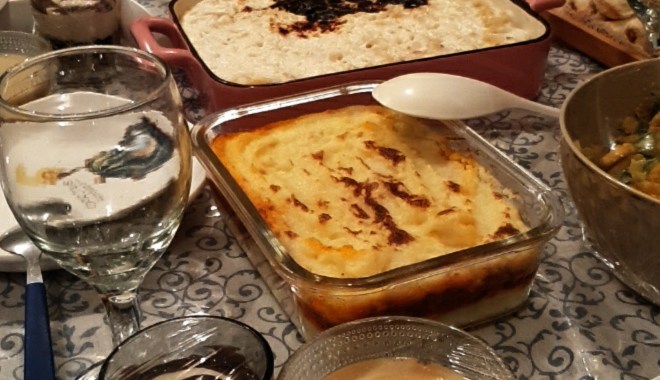
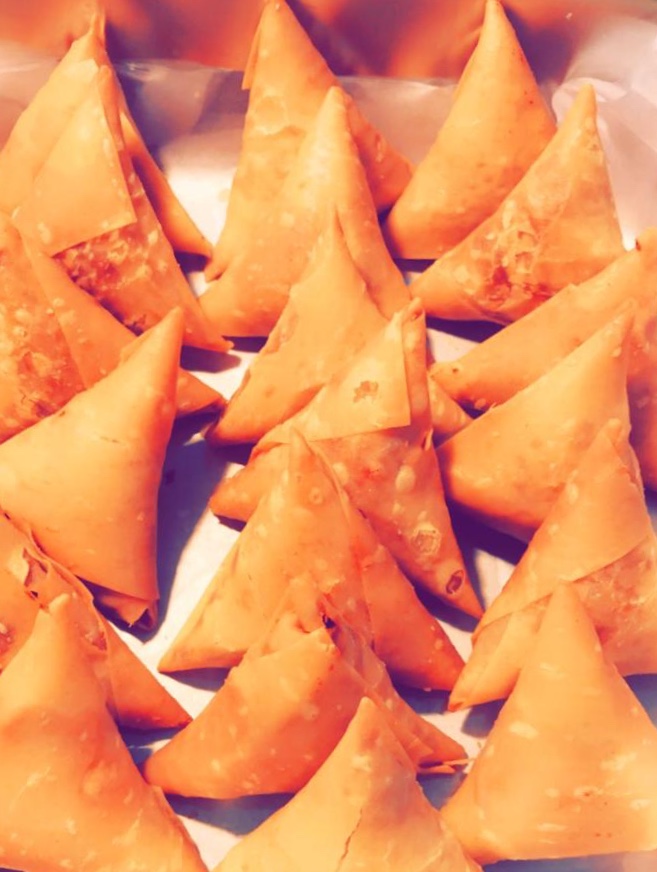
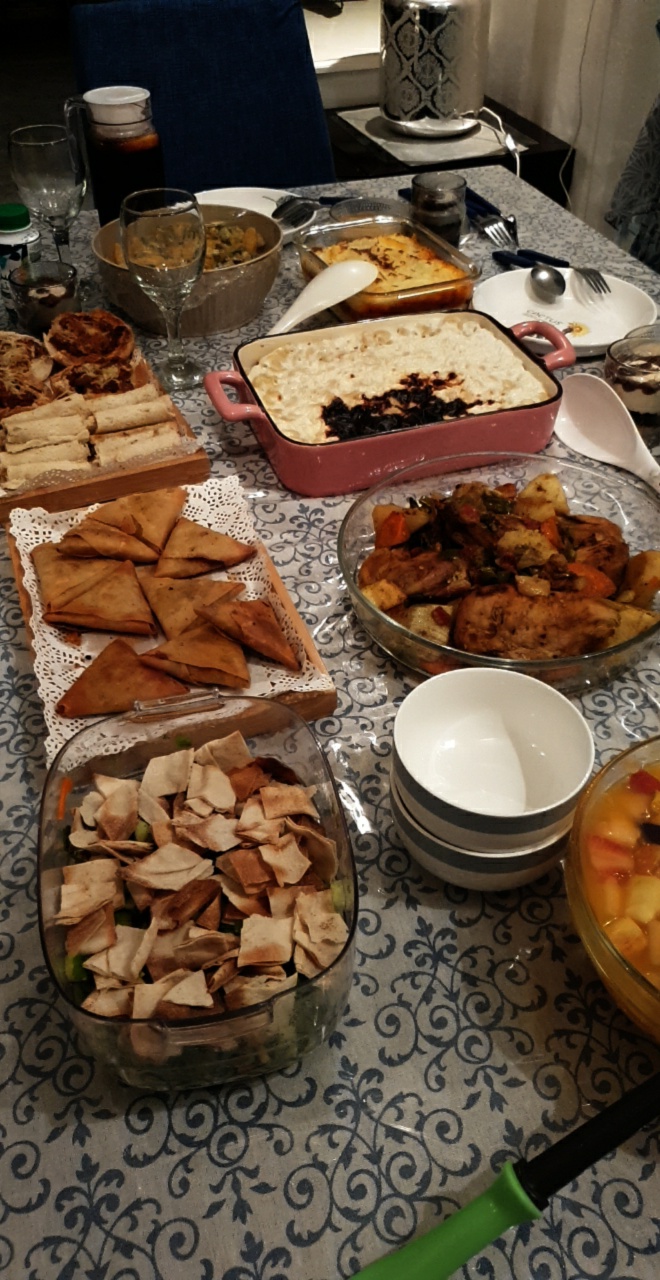
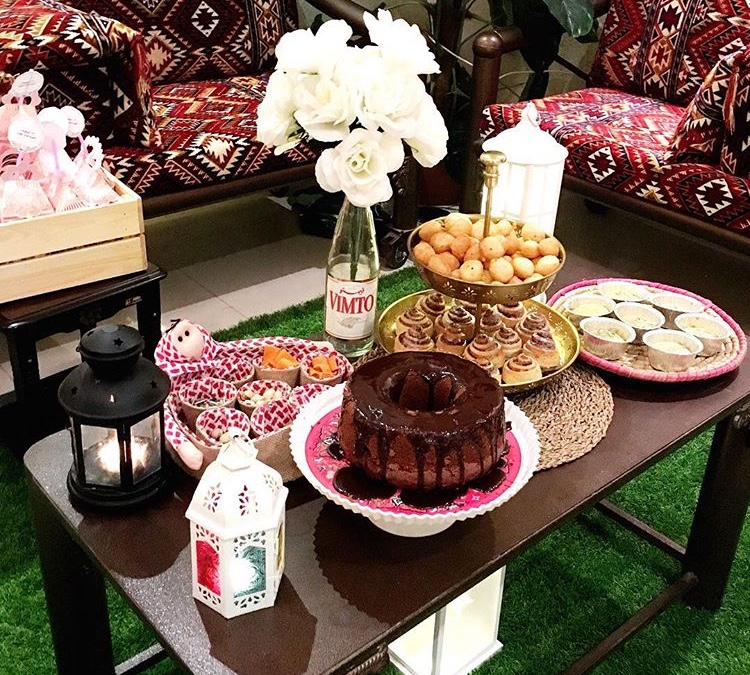
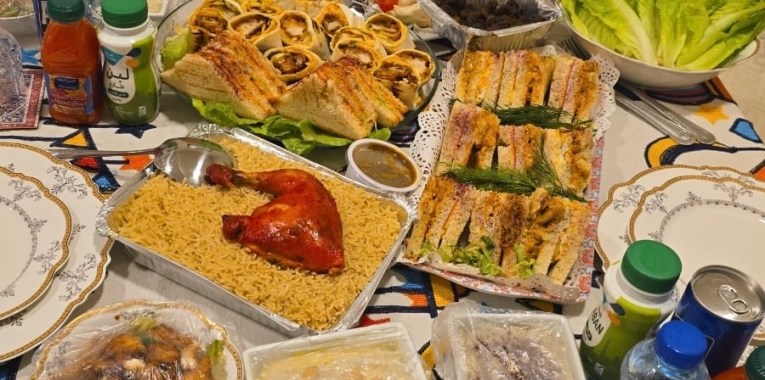
I love the Dhfoari tradition of “killing the snake” (hunger) by inviting close friends to a pre-Ramadan gathering with a beautiful and delicious array of food.
I was looking through posts and found this one from Aug. 2022 – in relation to my forthcoming book on marriages, it’s a good example of how I do research in terms of what I ask and what I am told
“What is your favorite fruit?”
I stared in surprise at the younger relative who had just asked me that. There are a group of us eating breakfast and chatting; the question seemed odd to me, but I answered. Then I realized that I should ask “back.” So I asked her what her favorite fruit is.
Thinking about that exchange, I decided that I am out of practice for being asked questions. With my friends in Dhofar, I usually follow their pattern which is “if you want someone to know something, tell them.” Direct questions are rare, especially questions about expressing a preference.
At a friend’s house a few weeks later, I was talking to her son about of interest of his and ran into the opposite problem. I recognized afterwards that I should have asked what “his favorite” was – I had missed a good chance to hear his opinions.
Remembering those two moments in which I felt out of tune with American conversational tactics made me consider how I use and don’t use questions while doing research. Part of my hesitation about asking Dhofaris about their ideas and lives comes from trying to find a balance between a good friend and a good researcher. It’s not necessarily a tension, but it means (as Dhofaris say) “holding myself,” trying to think before speaking and choosing the right time and reason for asking for information.
As one example, a few years ago I asked one of the research guys (X) if he was free to have a picnic with the group on a Thursday night. He told me that his sister was getting married. I read that statement as a way of shutting down, not opening up, further conversation. If he had simply said, “I am busy” I probably would have asked if he wanted to meet with the group on Friday. I interpreted him telling me about the wedding, as if he was saying, “I and the people who you know in my family and extended family will all be busy all weekend” given that weddings are usually held on Friday or Saturday nights and in the days before, all members of the household are getting ready.
Dhofaris usually only talk about relatives when there is a specific need and usually only ask if there is a specific reason, such as asking after someone who you were told was sick or going to travel. Hearing that his sister was getting married made me want to ask a lot of questions; with Americans, asking about a sibling’s wedding is a positive sign of interest in your friend. But I couldn’t justify asking him. In my opinion, there was no need for me to know details. Even though I wanted to know, I felt that I had to accept Dhofari standards so I replied with the conventional statements about how I wished the couple well and hoped everything would be well. The next time I saw him I asked about “the wedding” in general terms. He affirmed that everything went well and that was the end of the topic.
Later, the situation changed. I was writing the section of my Houseways book about how Dhofaris move rooms (or don’t) when they get married or divorced. One facet that came out in interviews was whether a married woman would spend the night in her family’s home with her husband. I had information from a few women, but I wanted to get a man’s perspective.
So during a picnic, I told X that, if it was ok, I wanted to ask a few questions about where couples stayed after they were married. He agreed.
The next time I saw him, I pulled out my notebook and, even though I had done other interviews with him about topics related to houses, I started again at the beginning by explaining the Houseways project, then about my current focus about how people moved between houses. I said I wanted to ask some questions on that topic and that I would not write his name, tribe or any details that would allow readers to identify him or any family members.
When he agreed, I picked up my pen, opened my book and started in. I asked him about which houses he had spent the night in as a child and after he was married. Then I said, “Is it ok if I ask about your sister?” When he agreed, I asked a whole series of questions: How often does your sister come to visit your family house (where she was raised)? When your sister comes to visit, does she spend the night? How often? Does her husband stay the night with her? etc.
Then I moved on to general questions (do you know of any examples of married women who spend the night in their family’s house with their husband?) and hypotheticals. Then I paged back to a previous interview. I told him that I had asked a woman (Y) from Z group of tribes about this issue, I was going to read what she said and could he please give his opinion on her attitude.
I wrote up the interviews, tried to figure out the variables of the decision tree of who stays where in which house, then discussed what I had written with X, Y and other informants. At the end, I had a few paragraphs which I think accurately sum up the issue.
In the general context of talking between friends, asking X about his sister was not OK. But in the specific context of me trying to figure out how married Dhofari women maneuver through various houses, asking X questions directly related to my research was acceptable. He was helping me understand a world-view, i.e. what choices people perceived they had and how those choices were decided.
Examines how middle-class Muslim men and women in Dhofar, Oman, make and negotiate marital choices, tracing every stage of marriage through their own personal accounts.
Studying Marriage in Dhofar, Oman explains the choices middle-class, Muslim, tribal Dhofari men and women make when creating a life together. Based on 19 years observations of and discussions about Omani marriages, the book shows all the steps of marriage, including how people decide to get married, the wedding invitations and parties are arranged, the newlyweds’ home is organised, the work within a marriage is delineated, and a marriage succeeds or falls apart. Unlike many texts about family life on the Arabian Peninsula, the author spoke extensively to both men and women, so that the book is rich with examples of Omanis explaining their personal decisions.
There are no comparable texts which look at the complete scope of a marriage from deciding to marry, to asking to marry, arranging the wedding parties, creating a successful marriage, and coping with stresses such as children, divorce, polygamy and widowhood.
The book starts with a discussion of how a man might find a bride and how a young woman might create or avoid situations in which she would be asked to marry. There is a discussion of how people might fight to (or not to) marry and all the steps taken after the engagement, including sending out announcements and preparing where the new couple will live. All types of marriage parties are described, including taking photos and displaying the gifts. Next, there is an overview of how the couple can create a marital relationship, followed by an examination of what might go wrong in a marriage, which looks at topics such as incompatibility, gross misconduct and divorce. There is a chapter on pregnancy, which includes a discussion on how children are named. The books ends with a short overview of specific aspects of marriage such as who has free time and what ‘family time’ means.













 Come From Away
You must be logged in to post a comment.