Culture Shock: Bumpy Reentry and Moral Dilemmas

Living in a small apartment with big windows in a tepid climate, until sunset on most days the only electricity I use is running the fridge.

Weather report predictions are usually way off. In Oman it was warm and humid for 9 months, drizzly and humid for 3 months and there was always plenty of warning about storms. Here, every day is a chance for an unannounced rainstorm or unexpected heat wave.

Amazing how everything is set up for people who are at least lower middle class. I got an e-mail which assumed I could print a document, sign it, scan it and send it as pdf within 10 minutes, as if it was normal for every person to have a multi-function printer at home.

I love my grocery store because it has all the daily requirements (Peeps, yellow mustard, frozen pretzels, crab cakes and fresh juices) but it is small. There is everything you need (chips, tea towels, flower bouquets, apple pie, mops) but with a limited selection so you don’t feel overwhelmed. But one item they don’t have is… matches. In fact, none of the stores have them so I had to order from an on-line store and have matches sent to me. Coming from a place in which many people smoked so matches and lighters were available everywhere, it is odd to buy matches by mail.

I was looking forward to being invisible in the States, i.e., wearing clothes that lots of other people were wearing, in particular sundresses! I have a collection of six brightly colored, floral, cotton sundresses and always felt like a parrot amongst sleek, tuxedoed penguins in Oman. But when I left my new apartment in a cotton candy pink dress with magenta flowers, I soon realized that there was not one other person in the neighborhood in anything similar. Day after day, store after store, I kept looking for a soulmate but after several weeks I have to concede defeat.

Moral dilemmas

People looking at their phone while waiting for crosswalks on the way home from work are so focused that they don’t notice when the ‘walk’ sign lights up. I start walking, hoping that their peripheral vision will alert them to motion, but once I crossed a street, glanced back and saw all ten people had not moved. Should I make a verbal comment? I am tempted to bark “ten-hut, forward march,” but that might be a bit muchish.

My wallet now has a coin pouch, so I decided to keep quarters in it and use them for parking meters about to expire. One day I came upon a parking policeperson giving a ticket to the first car in a line of six vehicles. I walked to the second parking meter and started slotting in quarters. She saw what I was doing and quickly briskly to the third car. I was just behind her and dropped in a quarter but she had already taken a photo of license plate and said, “They are getting a ticket.” So, I moved quickly to the last three cars and dropped quarters. She was scowling and I walked on wondering what would happen if the owner showed up and saw the ticket on the windshield when there was time left on the meter. Drama!

The post office near where I live has no postcard stamps, so I put on full price stamps. No problem. But then the main post office for the area also had no post card stamps and I had a buy a full sheet of full-price stamps to get the 2 stamps I needed for postcards. Complain? Stop writing postcards?

Culture Shock: (Not) Being Under Observation

(photo by Hussein Baomar)

As I am slowly settling into a new type of life, the biggest difference is the issue of observation. When I leave the house now, I am never noticed. Children in the USA are often told “it’s impolite to stare” but in Oman, there are many people from cultures in which it is usual/ expected to watch other people closely.

Oman has visual-based, high-context cultures, meaning adults learn by looking around. You have to know what is going on in nearby spaces. Plus, there are tribal-based cultures, part of which is the necessity of recognizing and acknowledging relatives and tribe-members. When men are in public places like a cafe or store, their heads swivel constantly; they need to make sure they are greeting all acquaintances. Women are also always on the look-out so, although there are less female-male exchanges of glances than in the States, everyone is constantly canvasing their surroundings.

Here, everyone here is walking distracted, staring at the middle distance or the ground, usually wearing earbuds or earphones. The goal is NOT to look at anyone. I had to live for years with two colleagues who refused to acknowledge the presence of me and several other department members, which created a very hostile work environment. But coping with that unpleasantness has helped me deal with my new reality; walking down the hallway of my apartment building people pass each other studiously examining the ground, never offering greetings.

One aspect of common Omani surveillance is a sort of, to use Anne Meneley’s term “Tournament of Value,” in that the good/ smart person is the one who identifies who they are looking at. It used to drive me crazy to go grocery shopping and hear whispered comments about me: “she’s a teacher,” “she’s at X university,” “she’s American,” etc. There was a social value in being able to place me so people who knew who I was would always display that knowledge to others.

The “tournament” part was that when people fail to acknowledge someone they know, they are judged negatively. The judgement might stay as a silent rebuke, but it might be brought out in front of family members and/ or peers, “I was sitting in Y cafe, and he came in and did not greet me, perhaps he was thinking of…” This is didactic teasing – teaching the person that they should take more care in looking at their surroundings.

In response to living in a benign panopticon in Oman, I was very careful about my appearance whenever I left my house. As a foreign teacher, I wanted to make sure that, if students pointed me out to their parents, I appeared sufficiently trust-worthy. And given my work with the research guys, I wanted to look frumpy so that no one would wonder why Z man was spending time with an immodestly dressed woman. The result was, to me, a very odd combination of being closely scrutinized while looking incredibly dowdy: long flower-print shirts, tunics in faded colors, the most uninteresting shoes on Earth, muted make-up.

So imagine my feeling of walking out of my house now wearing a bright pink sundress with messy hair and red lipstick! And no one looks! It’s both freeing and scary. In Oman, when I walked through the mall it sometimes felt like I was the star of a kind of The Truman Show as I constantly would overhear people commenting on me. Sometimes I would be told days or weeks or years later, that I had been seen in X place talking to Y person. But now I am nicely invisible.

And part of my current invisibility is when I walk into a cafe now, I look similar to other customers. For the first few years I was in Dhofar, there were many expats from North America, UK/ EU, New Zealand and Australia. The number declined steadily so that for the last ten years or so, everywhere I went I was a visible minority. At the two cafes I frequented, I was usually the only woman. On college-level committees at work I was always the only woman and the only person from a Western country; by the time I left, I was the only professor who was a native speaker of English.

A related cultural change is that my 19 years of learning how to constantly check my environment and place people, has resulted in a body of knowledge that is of no use here. In Oman, by asking questions and receiving warnings, I was taught that A item of clothing meant the wearer was from B place, that a man who sat in C cafe was D sort of person, that this kind of outfit meant the wearer had that kind of job. Now I can’t derive any information about a person by looking at them.

A friend who moved back to her country after more than a decade aboard told me she went through the same learning curve. When she first moved back, she couldn’t figure out anything about the people she was seeing in daily life; it took a long time to rebuild her knowledge base, e.g. X kind of purse was expensive and Y type of car meant the owner was probably Z. I have talked about the hunt to figure out meanings when watching foreign movies [ Teaching Literature and Staying au courant – The Man from Nowhere and the Ancient Greeks ] but what was once a distanced, intellectual exercise is now my every-day life.

Culture Shock: The Basics

Culture Shock: The Parable of the Boxes

Throwing Children in the Street: Culture Shock Omani Style

Intercultural Exchanges

Screenshot
Screenshot

Ethnography: Conversations about Men/ Masculinity, part 2

When reflecting about my conversation with the research guys [see: Ethnography: Conversations about Men/ Masculinity, part 1 ] a few themes emerged. First, I know Bristol-Rhys and Osella’s article (full cite below) and my discussion with the research guys is somewhat apples to oranges. I don’t know which questions were posed to elicit the answers discussed in the article. A conversation would go in very different directions if the opening query was: What is a man?, What is a good man?, What is the definition of an Emirati man?, or What should an Emirati man look like and do?

Also, I realized later that I had unconsciously hewed close to Dhofari cultural understandings by not asking about a ‘man’ (much less a ‘bad’ man) but focusing on a ‘good man’ as their conversations almost invariable focus on the positive; negative people or actions are not appropriate topics for discussions.

Given this, it is still interesting that there is a complete contrast between the Emirati answers with focus on appearance [clothing, beard, sandals, the people “he is seen to associate with in public” and looking “bored”] and the Omani answers which only mentioned one physical issue: that a man should sit up straight in the majlis. Further, there was a strong Omani emphasis that you can’t know anything about a man by looking at him, i.e. appearance tells you nothing of importance and even his speech can be deceiving.

This goes back to my first example in my first book which illustrates the Dhofari belief, especially prevalent among the qara tribes, that you can know a person for years but not know their true character. One’s personality is not an compared to the layers of an onion or mountains beyond mountains but is often completely unknowable. So people need to watch each other carefully. One of the worst things that can happen in a person you trust betrays you, so you need to always ready for that kind of surprise.

Another point was consistency of Omani understanding that good men control themselves. In my first book a man, who was not at the group discussion, called this “the quality of the bearable,” meaning the ability to handle your emotions and responsibilities. Thus, on this specific point, 7 men from 7 different tribes all explained the paramount importance of self-restraint.

I want to note that this is in contrast to other possibilities such as an understanding that a good man is strong and able to control others. There were no examples of commanding/ supervising/ managing other people, i.e. a good man has good children, a good man is in charge of people at his work or makes X group of people behave well.

All the Dhofari men I have talked to about this issue have explained that a good man acts politely, generously, helpfully and patiently with others. A good man is outward-oriented; he listens to the talk, he participates in the talk and in a majlis he is always aiming for the middle spot, avoiding both aloof and ingratiating behavior.

Also, it was interesting to me how the men lived out their opinions. For example, one of the research guys who is 15 years younger than me, X, had said that a good man will always respect those who are older than him and try to do their work for them. When we had finished the discussion, I got up and brought a container of cupcakes from my car, then I grabbed a box of Kleenex and started to walk around the circle as we were all sitting a little too far apart to easily hand the container from person to person. X jumped out of his chair and walked towards me with his hands out saying, “I will do this for you,” exactly as he has explained a younger person should act.

For all the differences, there is a broad, underlying similarity between Emirati and Omani responses: an understanding that as soon as you walk out of your house you are on display and may be judged. In the Emirates it seems this is more appearance-based, while in Oman this is more behavior-based.

Although I am not a Gulf, Arab man, I feel both those pressures intensely and when I go to my mom’s house in the summer, I celebrate the fact that I can go out in public without looking professional or constantly monitoring my surroundings. Sometimes when my mom asks if I want to go run errands, I make the freedom I feel explicit by saying, “Yes, let me just go put on a tank-top, long-sleeved sweater and a lined, tea-length skirt; get my hair up in a neat bun; use some anti-frizz spray; pencil in my eyebrows; put on lipstick, perfume and some jewelry…oh wait…I only need my sunglasses! Let’s go!”

In terms of behavior, I find myself scanning every café I go into, even in towns where I don’t know anyone, to make sure there is not as familiar face, as to fail to greet someone is very rude in Dhofar. And one slightly cranky older relative has benefited by my living in Oman because when the research guys heard me mention that this elder relative was a little difficult, I received repeated, lengthy, kindly admonishments to always show respect and never show impatience. When I am back in Oman after a visit I am quizzed on my behavior: Was I always polite and helpful to this relative? Did I always do what was asked of me? Did I always have a calm demeanor? Knowing I will face a gentle court of inquisition about my conduct makes it easier to live up to the expected standards.

article mentioned

Bristol-Rhys, Jane and Caroline Osella. 2016. “Neutralized Bachelors, Infantilized Arabs:  Between Migrant and Host Gendered and Sexual Stereotypes in Abu Dhabi,” in Masculinities Under Neoliberalism. Andrea Cornwall, Frank Karioris and Nancy Lindisfarne, eds. London: Zed.

related articles

Bristol-Rhys, Jane. 2009. “Emirati Historical Narratives.” History and Anthropology 20:2: 107-21.

—.  2007. “Weddings, Marriage and Money in the United Arab Emirates.” Anthropology of the Middle East 2.1: 20–36.

Bristol-Rhys, Jane and Caroline Osella. 2018. Contexts of Respectability and Freedom: Sexual Stereotyping in Abu Dhabi. New Diversities 20.2: 1-20.

Ethnography: Conversations about Men/ Masculinity, part 1

I often bring a quote from another author to the research guys and ask for their opinion. While reading Bristol-Rhys and Osella’s chapter on “Gendered and Sexual Stereotypes in Abu Dhabi” (2016, full cite below) I was struck by how their informants tied the definition of masculinity to clothing:

We turned first to masculinity as it is measured and judged by Emirati men. Through interviews and discussions with Emirati men from 18 to 65 years old, it became clear that physical presentation was paramount.  How a man presents in public is key; he must be in national dress and it must be perfect.

I wondered how the research guys would define what were the qualities of a man so during a picnic dinner, I asked if I could throw out a question and record (by writing) their answers. The six men (from six different tribes) agreed. Since I didn’t know how Bristol-Rhys and Osella framed their questions, I started with “What can you tell about a man by looking at him? Can you tell if a man is good by looking at him?” And the unanimous reaction was “you can’t know from the first time.” It was impossible to tell if a man was good by seeing him, one has to talk to a man to recognize what he is.

The consensus was that best quality of a man is that he is ethical/ moral (athlaq) and one can’t know that without a lot of interactions. As one man said, “I was told that to know a man you must trade with him or travel with him or live next to him.” Thus, by being in business (buying or selling something), going on a long trip or being neighbors you will see a man in enough different situations to come to an understanding of his personality. [To me, this is the Omani equivalent of the Maya Angelou quote: “I’ve learned that you can tell a lot about a person by the way they handle a rainy day, lost luggage, and tangled Christmas tree lights.”]

Then picking up on Bristol-Rhys and Osella’s discussion of behavior in the majlis (full quote below), I asked about how one could tell if a man was good or not from seeing him in a majlis. Again the unanimous decision was that one cannot know from his “talk in the majlis, maybe his talk is good but he is not.” You should “check his speech,” but it’s more important to pay attention to what he does. Specific points about how a good man acts include:

  • When others speak, he listens carefully and listens to all equally (i.e. not paying attention to men who are sitting close to him or have special status while ignoring others) [One man made the particular point that one cannot judge a man in his own house the same way, as in his own majlis a man has “his homework,” i.e. being generous, making sure there is enough tea and food so he might not be able to follow the conversation/ respond as carefully]
  • Speaks, but not too much, i.e. not dominating all the conversation
  • Does not try to give special greetings/ try to sit next to important men but treats all men equally [this point was illustrated by one of the men acting out how a groveling/ fawning man behaves]
  • Does not interrupt others
  • Does not talk badly about others
  • Does not show jealousy or anger
  • Never boasts
  • Never exaggerates
  • Never contradicts or corrects an older man, even if the older man is saying things that aren’t true or is speaking badly
  • If he stands up to get himself tea or water, he is happy to give to everyone (even younger men!); passes food and drinks; acts hospitable
  • Sits up straight (not slouching)

When we finished talked about behavior in the majlis, one of the man stated, “If someone you trust says a man is good, then one should listen [i.e. take it under advisement] but you have to check for yourself.”

Another man added that you can sometimes tell a good man by his talk when he makes statements about his actions. For example, a man is good if his conversation includes statements such as “I will” or “I did”:

  • visit this person who is sick
  • visit this person in the hospital
  • go to this person’s funeral
  • go to this person’s wedding

When I asked, “in general, if there is a man who have met a few times, so you know him but not every well, how can you learn if he is a good man or not?” all the answers hinged on seeing proper behavior such as:

  • Greeting all people
  • Helping all people (for example if a stranger has a flat tire – another man chimed in and said “a good man will help you from the first time,” meaning both ‘even if he doesn’t know you’ and ‘will help without you having to ask twice’)
  • Being generous (for example bringing food or drinks when meeting friends for a picnic)
  • Treating waiters/ people who work in stores politely
  • Being kind to children
  • Having patience (for example if the food is served late in a restaurant)
  • Doing the work/ doing extra work so that older people can “sit and take their rest”
  • Helping the members of their tribe (staying connected socially to people such as helping others when they are sick, going to social events of family members, etc.

One example that I thought was very interesting was one man said specifically, that a good man respects his religion and the religion of others. He gave the example that a good man knows his own religion, i.e. if he is a Muslim, then he should know to pray 5 times a day at the time of prayer.

As the conversation was winding down, three more points were raised. One man said, “a good man has a good heart, he will forgive quickly. If someone says something bad, he will smile and answer quietly.” He continued, “if there is a hard discussion, he will greet you the same the next day.”

Another man said, “a good man will not speak of [meaning “make fun of”] your clothes or your car.” And the last comment was, “a good man is always good with his family.”

As there were no more remarks, I paraphrased Bristol-Rhys and Osella’s conclusions and their reaction was a flat “no.” In his own way, each man expressed disagreement from a head shake to “we do not agree,” “not clothes!” and “we do not think like that.” No one expounded on his beliefs; they did not agree with the opinions of the Emirati men, but they did not feel that they needed to explain their disagreement in detail. I put away my research book and the topic turned to another subject.

I discuss this conversation further in: Ethnography: Conversations about Men/ Masculinity, part 2

Bristol-Rhys, Jane and Caroline Osella. 2016. “Neutralized Bachelors, Infantilized Arabs:  Between Migrant and Host Gendered and Sexual Stereotypes in Abu Dhabi,” in Masculinities Under Neoliberalism. Andrea Cornwall, Frank G. Karioris and Nancy Lindisfarne, eds. London: Zed.

(underlining – my emphasis)

We turned first to masculinity as it is measured and judged by Emirati men.  Through interviews and discussions with Emirati men from 18 to 65 years old, it became clear that physical presentation was paramount.  How a man presents in public is key; he must be in national dress and it must be perfect.  An Emirati man’s kandoura must be immaculate and, unless in winter, it should be gleaming white.  His gutra and agal must be worn correctly and he should not “fiddle” with it as if it were an unusual accessory.   A beard is mandatory and it should be trimmed perfectly (in fact, we were told that a man should have his beard trimmed “professionally” at least 3 times a week) What a man wears on his feet is important as well and it is unacceptable to wear trainers or sports sandals.  There are several acceptable styles, – even Birkenstocks are considered ‘aady (normal) – but the sandals should be white leather in summer.  During winter, darker sandals are acceptable and, if wearing a western style sport coat over a kandoura, then loafers or brogues, worn with socks, are also appropriate.  This critical scrutiny of attire might indicate the success of the nationalist project of Emirati, indeed Khaleeji, dress (cf. Al Qasimi 2010); it was the importance placed on the “correct kandoura” and the “correct sandals” and the “proper way of wearing the gutra and agal” that was emphasized, stressing the cultural competence necessary to negotiate the performative demands of “correctness.”

Cultural competence was stressed again and again throughout our interviews with Emirati men.  “A man recognizes a man by how he enters the majlis,” said one of our interlocutors.  Another man listed carefully the behaviors that are noticed and noted in a majlis“We watch how a person enters and then greets the people in the majlis.  Does he know whom to greet first?  Does he recognize those men like the sheikh of his tribe, younger sheikhs of the ruling family, and the men who are important to his father and uncles?”  In addition to knowing who is who, and the order in which important men must be greeted, the greeting itself was also critically assessed. “Does the man use the correct religious phrases in his greetings?  Does he know when to touch noses (ywayeh) and when to only shake hands?”   And a man’s knowledge of his society is judged as well. “In conversation with the men in attendance at the majlis, does he know his tribal history and lineage?  Does he know how his tribe connects – or not – to the other tribes?  All these things must be known well for a man to be thought a man.”  All of these behaviors require knowledge – gendered, culturally specific, and highlight exclusive knowledge – in order to perform them adequately.

Outside of the majlis, in more informal situations and in the public spheres of malls and universities, we learned that a man is measured by how he acts, by those with whom he is seen to associate with in public. According to our Emirati interlocutors, clothing is still important in public spaces because there they are judged not only by Emiratis, but also by foreigners. “We must dress and act appropriately in public because of the image, the image of the Emirati man.”

The young men at the university where Bristol-Rhys teaches have a hierarchy of dress with which they judge each other and establish boundaries between cliques of friends.  First, there are the men who wear only kandoura and gutra/agal to classes.  They describe themselves as “pure Emirati men”.  Then there are those who wear kandoura with an American baseball cap or nothing at all on their head – these are considered “okay Emirati, but too casual” and comments / assumptions usually follow fast that, “their mother is not Emirati.”  The third group is made up of those who wear jeans, t-shirts, and shorts to university; they are scorned by the “pure Emirati” and are only grudgingly accepted by the group who wear baseball caps.   They describe themselves as “trendy,” but others use words such as “fake, wannabe American, or zaalamat, the pejorative term for Levantine Arabs, that has, for lack of a better term, sleazy connotations in Emirati society.  “They try too hard to be seen, and that is not the Emirati way.  We are always supposed to be at ease, we don’t show anxiety, in fact, the best is if you can look bored.

Reflections on Ethnographic Research: Making Adjustments for Positive Multi-Cultural Exchanges/ Events

(photo by S. B.)

For the first few years I was in Oman, I often went on picnics with mixed groups of Omanis and expats but that gradually stopped as I got frustrated with what I perceived to be situations in which the Omanis were doing all/ most of the work. I started having picnics with just the research guys and the few times I brought an expat, I ended up frustrated or embarrassed by expat behavior such as showing up empty-handed, sitting passively, dominating the conversation and not showing gratitude.

But a dear friend, T, was coming for a short visit and I was sure that she had the temperament to enjoy and appreciate a beach picnic, so I got in touch with the guys. This started a series of adjustments on all sides which illustrate the importance of compromise in effective inter-cultural communications/ interactions.

First of all, the morning of the picnic I told the guys that T did not like fish and asked that they not bring fish for dinner. This is completely out-of-bounds behavior. People who meet up together should never show any preference (or really, any interest at all) in the dinner that someone else will bring. But given that some of the research guys are fishermen, I guessed that they would want to bring freshly caught fish and cook it over the fire as a special dinner. I wanted to stop that as I knew T would not enjoy it and I wanted to protect her from either being hungry or forcing herself to eat a dinner she didn’t like.

On the other side, before we left my house, I told T that wearing long, loose clothing was my way of being respectful and asked if she could please wear one of my long tunics over her pants and t-shirt. I held out a white tunic with a toile print, something she would ordinarily never wear, and she agreed. Then I said that I cover my hair in front of the guys and that while she didn’t have to… She instantly agreed so I grabbed a lossi (headscarf worn with a thobe, the Dhofari-style housedress). Usually you wouldn’t wear a lossi outside the house, but it was 105 degrees, so I thought the light cotton would be the most comfortable choice for her. I knew the guys would say that she didn’t have to, but I also knew they were going to make an effort to bring a good dinner and this was a small gesture she could make to be polite.

When we got to the beach, we set out the mat and then put out cushions, Kleenex and the cooler with water and soda. I made a fire and we chatted until we heard cars. Then we stood up and I draped the headscarf on her and wound mine tightly.

When the guys came to the mat, one began fussing with the fire, setting rocks in two lines which usually means that fish would be grilled. I was disappointed and said to one of the men quietly in Arabic, “she doesn’t like fish!” He said, “there is chicken.” I nodded, then I saw one of the men open a plastic bag with lobster tails, removed from the shell.

I should not have worried. The men had listened to my (unreasonable) request for no fish, but as I had suspected, wanted to bring something freshly caught, so it was lobster. And, as I have never seen them take the meat out of the shell before, I knew they were showing politeness to a guest. [In contrast, the first few times I had lobster with them, they handed me a whole one and I had to twist off its head, pull off the small limbs, etc. – if I wanted to eat a lobster, then I had to deal with the lobster!]

The whole night was a series of modifications on their part – actions I had never seen in over 15 years of picnics. For example, instead of placing their chairs right at the edge of the mat as usual, most of the men sat about 6 feet back. Instead of eating by lights from cell phones or small battery-powered lanterns, one man set up a large, area-light attached to a car battery. Instead of a usual dinner with one dish (rice with meat, chicken or fish), there was a big container of rice and chicken, plus the grilled lobster tails, a salad in a separate bowl and a dessert.

Instead of people dividing themselves into two equal groups (or one-off if there was an odd number) around the two platters, the best pieces of chicken were put on one platter for me, T and one of the research guys, while the other five gathered round the second plate. Half the lobster tails were put on our platter as well. I had forgotten that T might not be used to eating with her hands, but one of the men brought spoons. The man eating with us gave her a spoon, then proceeded to eat his dinner with a spoon, which I have never seen him do before. No one commented on any of these adjustments and T did not comment on the bother of wearing a tunic and headscarf.

T chatted, answered questions, gave profuse compliments and (bless her!) was happy to sit quietly and look at the stars and ocean during the times the men were speaking in Gibali (Jebbali).

I was a little nervous – hoping that there would be a comfortable meeting between my friend of 25 years who was only 2 days into her first visit to the Arabian Peninsula and the research guys, most of whom had never socialized with a North American besides myself but everything worked out well.

By giving up some comfort/ in doing something unusual, we all helped create a positive atmosphere. I am very grateful to T and the research guys for a lovely evening and a lovely example of the necessity of all sides making adjustments to create harmony.

Houseways: Podcast, a discussion with Ahmed Almaazmi and Ayesha Mualla

Houseways: Including/ Excluding Expats in Discussions about Housing

Reflections on Ethnographic Research: Changes within Cultures

Reflections on Ethnographic Research in Dhofar Oman

Reflections on Ethnographic Research: (Not) Asking Questions

I will be presenting ”Private Lives in Public Spaces: Perceptions of Space-Usage in Southern Oman” on Dec. 2 at the MESA annual meeting

‘Private Lives in Public Spaces: Perceptions of Space-Usage in Southern Oman’ – Dr. M. Risse

photos by: Onaiza Shaikh; plans by: Maria Cristina Hidalgo https://www.mariacristinah.com/

Middle East Studies Association annual meeting

https://mesana.org/annual-meeting/current-meeting

abstract

This presentation discusses issues related to the cultural perceptions of space and privacy on the Arabian Peninsula. The Merriam-Webster definition of privacy is: the quality or state of being apart from company or observation, and it’s the “apart from observation” aspect that I want to focus on because if someone is in public spaces, they aren’t alone (i.e. can’t be “apart from company”) but they can be unobserved.  Based on fifteen years of experience and research in southern Oman, I will focus on how men and women navigate the same or nearby public spaces at the same time. Using examples from shops, grocery stores, universities, restaurants, cafes, airports and hospitals I will discuss who moves where according to cultural rules about position and proximity. For example, an initiative at one bank to have a “women’s only” teller fizzled out (as did a scheme to give women customers pink bank cards), but customers and clerks continue to follow strict, unwritten rules about who stands where. Another example is universities. In some Gulf countries, there are separate campuses for men and women. Omani institutions of higher learning have only one campus yet there are both physical (having two sets of doors for classrooms) and mental (where students choose to sit) barriers to gender-mixing.

Houseways: Windows/ Sightlines

[this essay is part of a series about the practicalities and pragmatics of one-, two- or three-story houses built within the last twenty years on one or two plots of land in the Dhofar region of Oman; extremely expensive houses often take up three or more plots and have very different architectural styles]

One of the hardest concepts for language students to grasp is to rethink common metaphors. It’s ok to call kids “monkeys/ cheeky monkeys” in North America and the UK, but not in Oman. “Moon faced” is negative in the US, but not in Oman. In the Middle East, the full moon is seen as a time of safety and peace because you can see everything without the heat of the sun, unlike the negative connotations of danger found in North America.

It’s the same way with architectural details. Someone from the UK might argue that windows should be used to look out of, thus a window should be made of clear glass, uncovered during the day, often uncovered at night and, in good weather, left open to let in fresh air. The front door will usually be closed all the time.

None of this obtains in Dhofar. Windows are either made of opaque glass (in bathrooms and the kitchen) or are completely covered with treatments which usually have several layers, such as a heavy or lined, light-blocking fabric with a tulle/ sheer overlay which is sometimes tied back or swept to one side [jabot] with a fringe and/ or beading. There are usually heavy frame elements with a valance or pelmet/ cornice with swags. Sometimes there are three layers, a plain, dark fabric which hangs straight, a sheer overlay and then decorated drapes pulled to one side. This makes it look like one might be able to see out/ in but in fact the window is totally covered. [see examples below]

Drapes seldom have a simple, open style such as tabs and if there is a visible rod, there is almost always a finial. Café curtains are rare – usually the whole window is covered at all times. Ground-floor windows and the window at the first landing of a stairwell are frequently barred. However, depending on the weather and the neighborhood (how close are the other houses and whether the neighbors are ‘known’ and/ or family) the front door might be left open during the day.

Given that windows have reflective treatments which make it difficult/ impossible to see in, sometimes the heaver drapes might be opened during the day, leaving only the sheer covering.  If there are no possible sight lines, i.e. there is a high surrounding wall, the house is far from other houses and the road, etc. the heavier covering might not be closed at nightfall but windows that allow you to see directly  into a house is rare.

Another way to explain the non-use of windows is that before the infrequent, severe rainstorms, Dhofaris often cover the house windows with blue or grey/ opaque tarps, which are sometimes left up for weeks or months after the storm. Some houses are built with no windows on the side that is close to the surrounding wall and facing another property.

As Dhofaris are always fully dressed in their houses (see below), sometimes an upper story window in a public part of the house (for example, a family salle at the top of the stairs) will only be covered with sheet fabric if there are no direct, close sightlines. One can sometimes get a glimpse of an indistinct shape moving, but there is nothing like the large, uncovered, picture windows in the living rooms of most American mid-western towns.

Light indoors is provided by overhead florescent tube-lights and/ or chandeliers; sometimes there are transoms/ fanlights over doors. If someone needs to see something, they go to the front door and look out. During over ten years of visiting, I have never seen an adult pull back a curtain to look outside. Small kids will sometimes do so, then tell an adult in the room what they see, but usually grown-ups don’t show their faces in a window.

To say that a person “looks out of windows” is the only negative comment I have heard from informants and friends about a neighbor. I have heard that expression three different times and always with a sense of exasperation. The issue is not simply the “looking” but the interest in other people’s lives and telling others what was seen: two very unattractive traits. The correct behavior is, of course, to try not to see and, if seen, never discuss any speech or actions done by neighbors. If one has good neighbors, say alhumdulilah and if not, a dismissive wave of the hand is enough.

In the three cases I know of, I was told about the person because of circumstances that warranted me knowing. For example, a Dhofari friend (X) asked me to be sure to wear Dhofari clothing when I visited her because she had a neighbor (Y) who “looks out of windows” and if Y saw a Western person enter X’s house, Y would tell people and insist on knowing who I was and why was I visiting. In the other two cases, when asking Dhofaris if they were free to visit, the friends told me that there was a problem within the family because of a neighbor who misconstrued something seen and told other people.

As the exception that proves the rule, rental houses usually have sitting rooms with sheer curtains as such houses usually have higher than normal surrounding walls and are located outside of congested areas. The understanding is that no one can see in and everyone in the house is related, so window coverings are not necessary. Rental houses sometimes also have bigger windows because there are often small jungle gyms/ playground equipment and/ or pools so adults can easily sit inside and watch the children. [see example below]

The information above is for houses in and close to towns; outside of towns, as there are either no neighbors or the neighboring houses belong to relatives, there is less concern about privacy. The surrounding walls are low (waist-high) and serve primarily to keep livestock away from the home. Houses often have a dekka, an outside seating area accessible from the front door. Sometimes it is covered and furnished, sometimes it is simply clean swept mats to sit on. If the house is built up and there is only a small landing in front of the main door, people will sit on front steps in cool weather. Thus, although windows are similarly covered with fabric, people have far more visual access to their surroundings.

Housing/ Clothing: The point about Dhofaris always being fully dressed at home is very important. As I have explained in my first book: Once outside the bedroom, there is a chance to see any of the other people in the house, the live-in maid and/ or a repair person. Therefore, at all times, a man must wear at least a wazar (sarong) and t-shirt, a woman must be in a dhobe (loose housedress) and losi (light cotton headscarf), kids are dressed in at least shirts and underwear/ diapers.

Housing design and living patterns create this necessity of always being modestly dressed. For example, a man leaving his bedroom might see a brother’s wife who lives across the hallway, the teenage daughter of another brother or an older female relative. As he leaves the house, he might pass the salle [female/ family sitting room] which is open to the main hallway and see/ be seen by his mother’s sisters or female neighbors who are visiting.

I will discuss window design and construction in a following essay.

examples of covered windows

This slideshow requires JavaScript.

examples from rental house (larger windows, less covering)


Considering Cartoons/ Graphic Art about Foodways

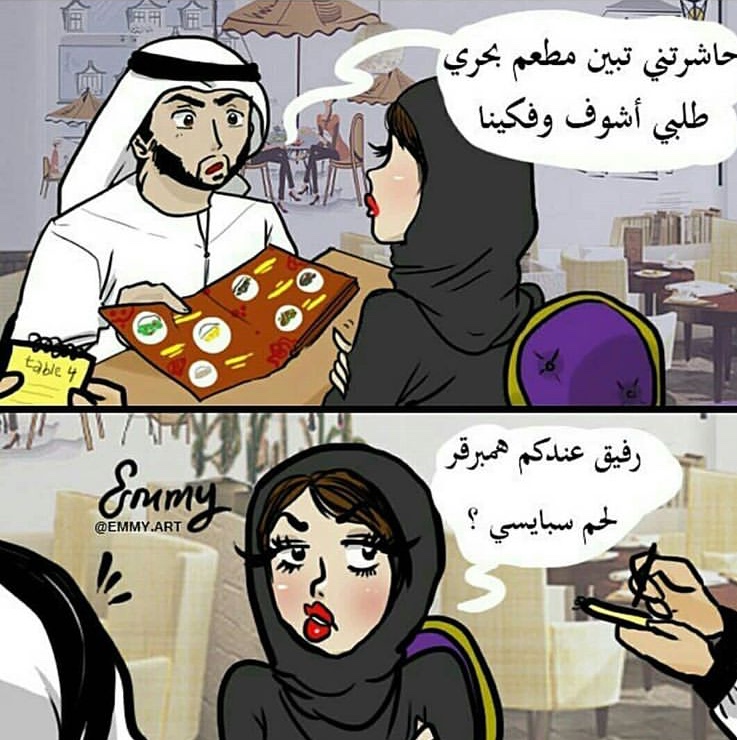
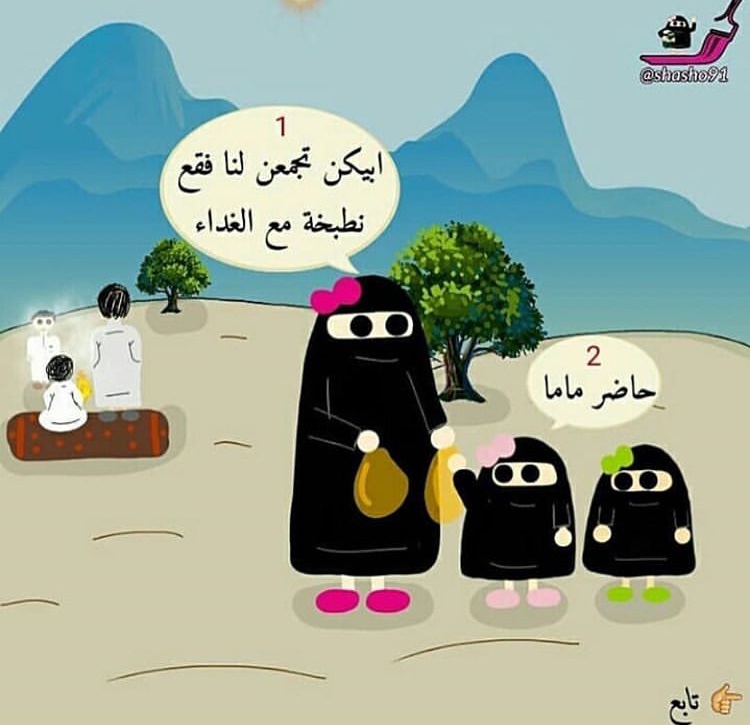
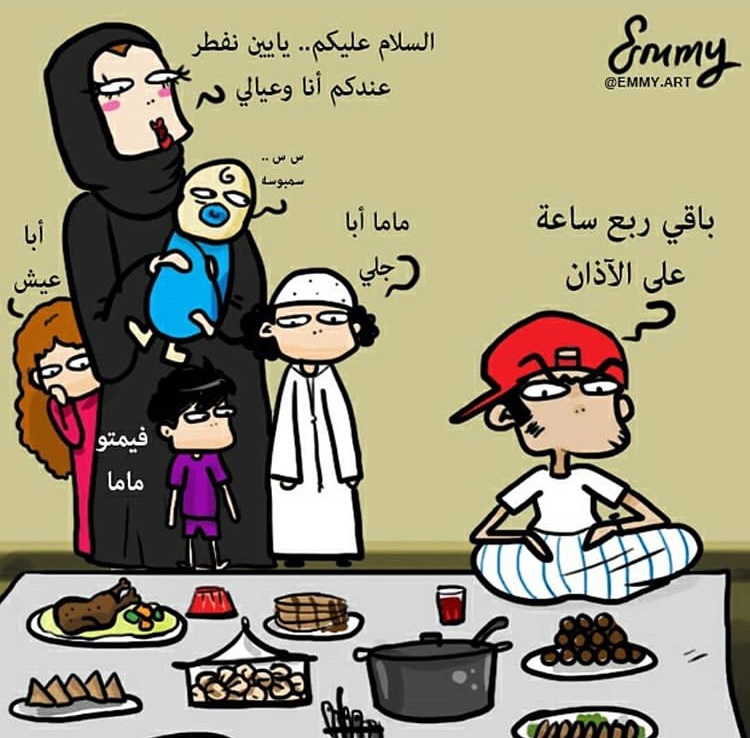
I started to look at cartoons (sent by Omani friends or posted on Instagram) because I wanted to see how buying, making, eating and sharing food was portrayed in graphic art. The cartoons are fascinating because they give personal insights into many aspects of Arab/ Muslim/ Gulf cultures, not just what food is eaten (when, where and why) but what is said (and the subtext), who is talking,  what clothes are worn (and what do the clothes signal?), body issues (how close do people stand to each other? do they face each other directly? how much can you tell about body size/ shape? can you see hair?), background (how is the place drawn? is it in the home or in public?), even how the words are spelled (are the people speaking formal Arabic?) and grammar choices mark the characters vis a vis status, nationality, sub-culture, etc.

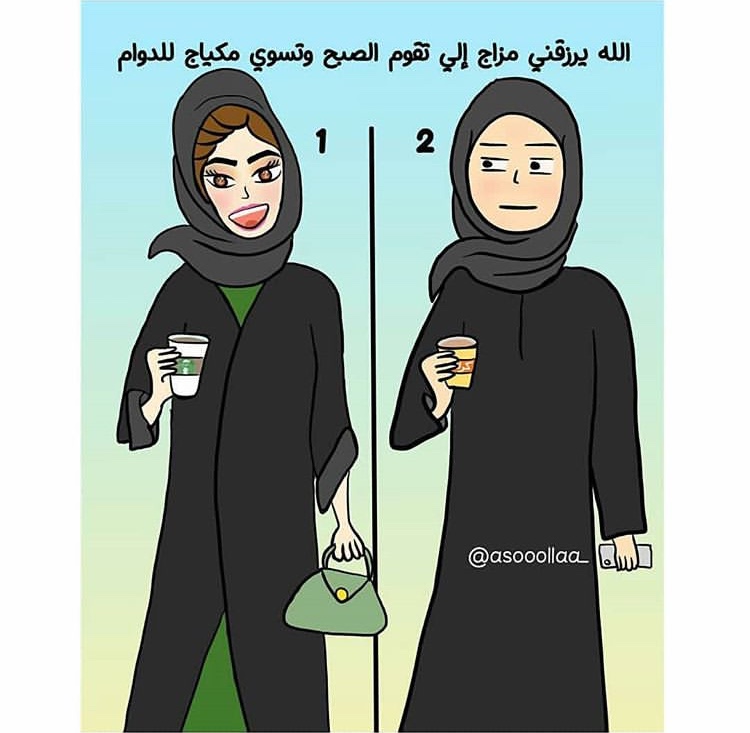
For example in this cartoon – the woman on the left is drawn as less traditional with hair piled up under her sheila, hair showing, shaped eyebrows, prominent eyes (eyeliner? mascara? colored lens?), open-mouth smile (lipstick?), open abayah, colored dress and purse, showing more of her forearm showing (is her lighter skin tone deliberate?) but also because she is carrying a coffee clearly drawn with a green round label like Starbucks. The coffee is grey and in a larger cup; while the other woman is carrying a small cup filled with a light brown liquid that looks like tea with milk. The woman with the less conservative look goes to the expensive and foreign coffee company – the woman with the more conservative appearance drinks tea in the (traditional) smaller cup.

2 women.jpg

Not all of the cartoons below have food but all give important insights into cultural issues.

ramadan love

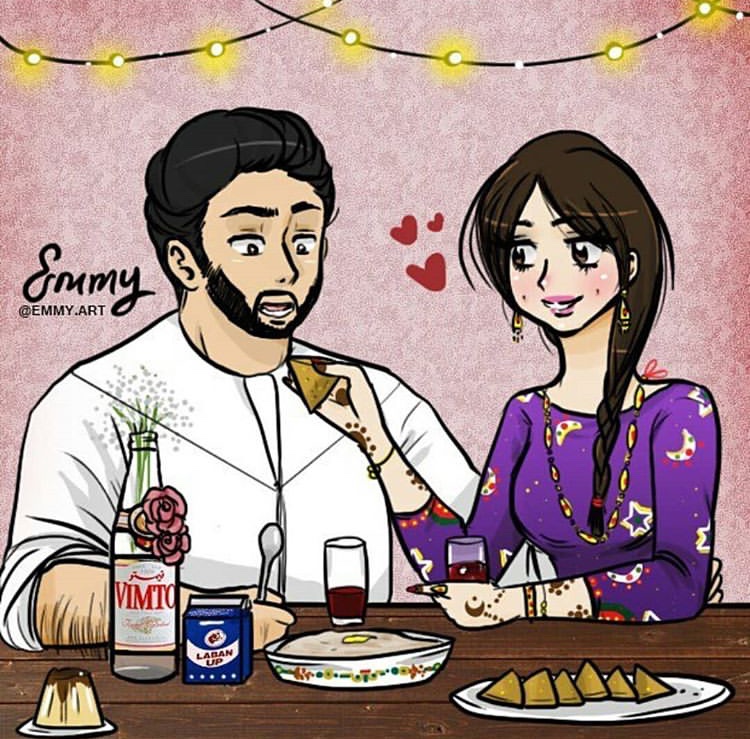
Vimto/ laban signal Ramadan because they are usually drunk at Iftar but henna is not usually worn during Ramadan so this image points towards Eid, especially with the moon design of the henna, the lights and the creme carmel.

looking at woman

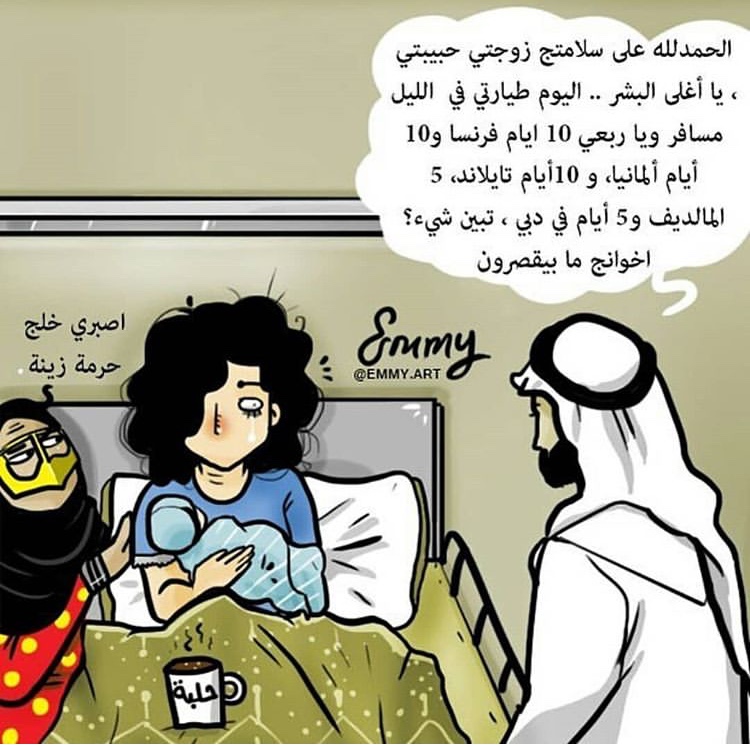
new baby

argue man and woman


abayahs

share ramadan


Relationship Cartoons – Worthy of Study

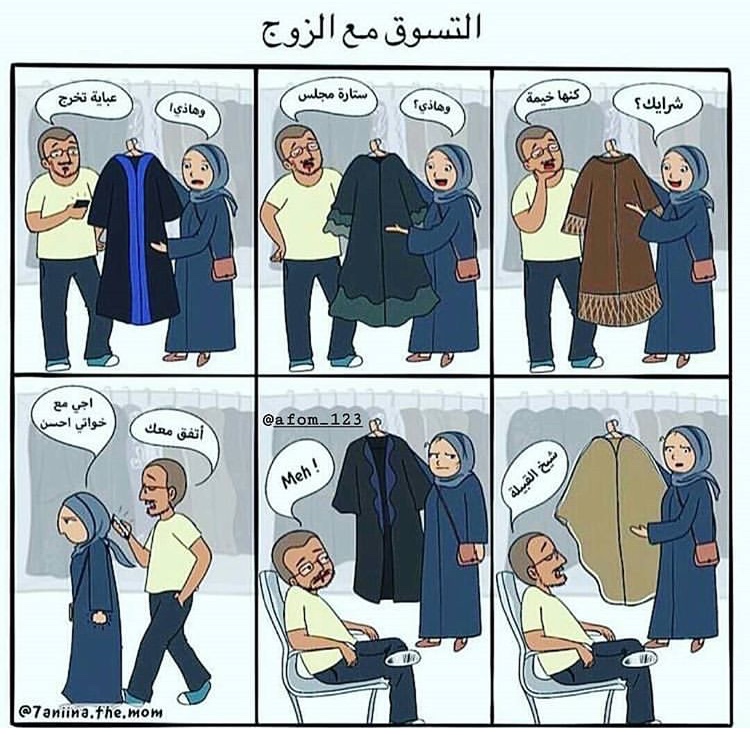
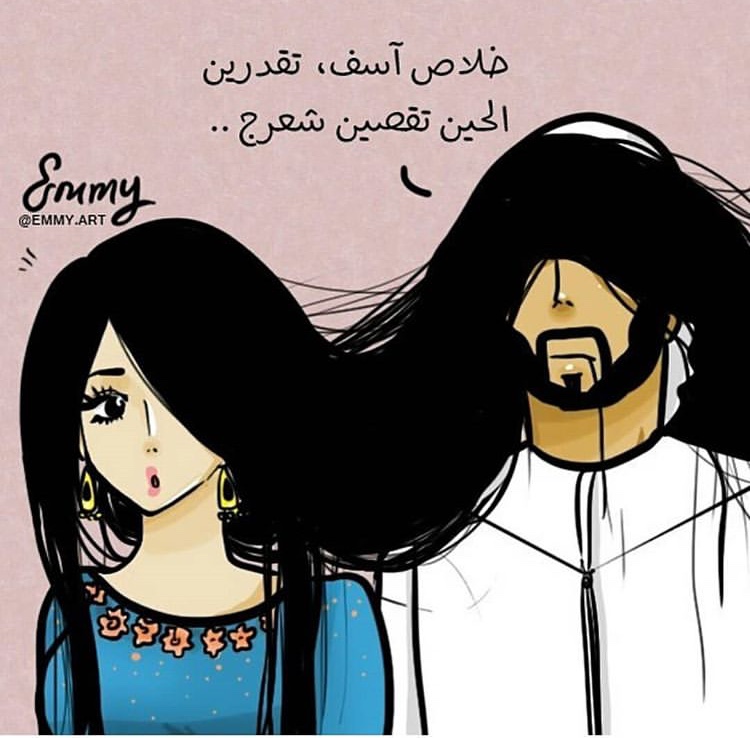
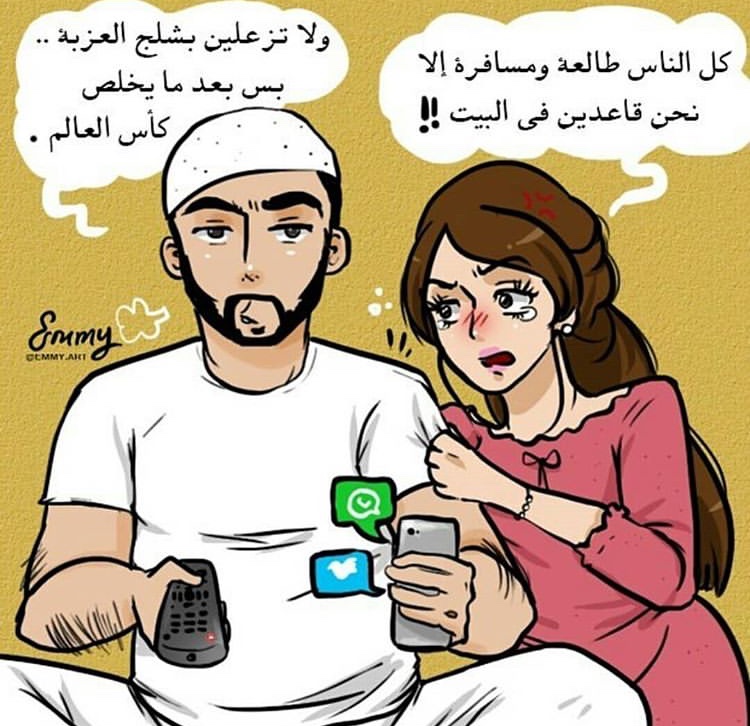
shopping with manIt’s not my area of expertise, but I find relationship cartoons posted on social media fascinating. There is so much cultural information to be unpacked for example, many have women with uncovered hair in settings with other women, whereas Dhofari women keep their hair covered even if sitting in the salle with other women. Here are a few I find particularly interesting. I hope someone from or living on the Arabian Peninsula does some kind of systematic study by country, topic, etc.


emmy - brother asking


dano - legal look


emmy - girl guy apart


emmy - hair


emmy - fight

Living Expat – Dressing, Covering, Swimming, and Mutual Respect

In all my twelve years of living here and two years of living in the United Arab Emirates, I have never been harassed, insulted, frightened, much less attacked, by any Omani or Emeriti for being American or a Christian. Devout Muslim friends, neighbors and colleagues wish me “Merry Christmas” and I say, “Thank you.” I wish them “Eid Mubarak” and “Ramdan Kareem” and they say, “Thank you.”

Likewise, I have never been made to feel different or foreign or wrong because I was wearing clothes which were normal in my culture. Because I choose to live and work here, I do make the small adjustment of wearing clothes that cover my knees and shoulders when teaching, but I wear the same clothes I wear when I’m in the States: JJill, Fresh Produce, LL Bean, Eddie Bauer, and April Cornell.

When I visit Omani friends at home, I wear what they are wearing out of respect. It is a simple adaptation like taking off my shoes before I walk into a friend’s house, learning to eat with my hands, shooing my cats out of the living room if a friend who is allergic comes to visit or not eating ice cream sundaes in front of a friend who is dieting.

In Omani houses, I wear an abayah (the long loose black cloak that women wear on the Arabian Peninsula) with a black headscarf or a dhobe (the long, loose, patterned cotton dress local women wear) with a lossi (a matching, light cotton headscarf). At first it was a little difficult to maneuver surrounded by almost 4 yards of fabric, but I learned how to gather up some of the extra while walking up stairs and to arrange my lossi to stay neatly in place, something akin to learning to French-braid my hair in middle school.

During Ramadan, I also wore a headscarf during the day out of respect for the culture and I was interested to see how it would feel psychologically to cover. In Oman, unlike some Muslim countries like Saudi Arabia, abayahs and headscarves are not required by law for daily life. Most women wear them because of personal beliefs and/ or traditions.

Some abayahs are very loose and plain black, some are black with colored decorations, some are colored (often navy blue or beige) and some are worn like an open cloak showing the jeans or skirts worn underneath. Some women wear tightly wrapped, plain black scarves, others wear colored scarves or have the scarf resting on their shoulders. Some women have suggested non-Muslim women should wear headscarves as a show of solidarity. I don’t agree with that, as not all Muslim women believe it is necessary to cover their hair.

The first time walking into the mall with a colored headscarf was tough – I felt self-conscious and hypocritical. I am in the mall usually once a week, reading at my café or shopping, and to walk in with a headscarf made me feel like I was playing a game.

When the Omani men in my research group saw me wearing a headscarf for the first time, they would smile, nod, make a quick comment and then ignore the issue; no one ever pressed me to wear a black sheila (headscarf) or abayah. It probably took me six or seven times wearing the headscarf in public until I became comfortable with it; then the only issues were finding scarves which co-ordinated with my clothes and were the right fabric weight, not too heavy or stiff.

My big insight about wearing a headscarf is that it gives you something to do. Standing in the grocery store trying to decide which spaghetti sauce to buy, I reach up, tighten, adjust, and smooth it down. Fussing with the scarf became a habit, a micro-control fidget, like men straightening their tie or shooting their cuffs. It’s a little uncomfortable when it’s hot and humid outside, but very helpful when I’m in a room with the AC on full blast. It’s another 2 minutes of getting ready time as I pull out my tiered hanger with 15 scarves and try to figure out which one looks best with my outfit.

When Ramadan ended, I went back to uncovered hair during the day but I still wear scarves when I see my Omani female friends at home. The result was I put a piece of fabric on my head and it was sometimes a little hot but that’s about it. I did not feel more religious, or less religious, or any particular change. I am a Methodist by baptism and by my own choice when I was in my 20s. Neither my religious devotion nor personal beliefs are diminished or altered by having a piece of fabric on my head. I didn’t feel closer to God – I didn’t feel farther away from God. I don’t believe God enjoins me to judge other people by what they have on their head or their body.

Most Sunday and Tuesday nights I go swimming with 60 or so Arab, Muslim women wearing burqinis. I first learned to swim in a public pool with a Red Cross instructor and over my 50 years I have swum in the Wilde Lake village center pool in Columbia MD, the Old Red Gym at the University of Wisconsin-Madison, the University of North Dakota pool when it was negative 10 outside, Canadian lakes, MIT, the Atlantic Ocean at Ocean City, and Tacoma, WA.

The women who swim at my pool now are just like the women I have swum with at all those other places, only they are wearing a bit more clothing. They are in swimming pants or leggings with short or long-sleeved tops as is consistent with the conservative culture, but no one has ever told me that I have to wear what they wear. I am a life-long feminist but I don’t believe my feminism allows me to dictate someone else’s feminism. The women at the pool and my Omani women friends (college-educated, multi-lingual, who work and have traveled/ lived abroad) don’t feel comfortable exposing their body to other women, much less men. Who am I to argue that with them?

When I go swimming, I get lots of smiles, waves, friendly glances and “hellos” from women I don’t know. In almost a year of twice weekly visits to the pool I have never received a harsh word, much less a lecture, on my bright blue Land’s End swimsuit. We all exercise mutual respect for different customs and religions while we exercise our bodies. And then we will go home happy.