Crafting a Home: Interior Home Design in Southern Oman

This essay is based on the presentation given at the Home/Making Symposium, Concordia University, Montreal on May 12, 2023, with editing suggestions from Elaine Cheasley Paterson and Molly-Claire Gillett

  • Introduction
  • My Positionality
  • Designing a house
  • Rooms
  • Foyer/ main hallway
  • Majlis
  • Salle     
  • Kitchen/ Dining Room
  • Bedrooms
  • Bathrooms
  • Who decorates
  • Decorating a house
  • Generating Ideas       
  • Handmade objects
  • Conclusion
  • Related bibliographies, books, publications and conference presentations

Introduction

Most of the writing about architecture and design on the Arabian Peninsula focuses on either ancient, archeological finds or huge modern edifices. This essay concentrates on the domestic sphere, specifically common practices in decorating a middle-class family house in Dhofar, the southernmost of the 11 governorates in Oman. Dhofar is 99,300 square km and the southern border is the coast of the Indian Ocean. Yemen lies to the west, Saudi Arabia is north, and the other Omani governates are to the east/ north-east.

This paper begins with an overview of how houses are designed, then gives a description of the types of rooms. There is then is a discussion of who decorates the house and how decorations are decided/ agreed on. At the end are several bibliographies on various aspects related to housing on the Arabian Peninsula and links to images of houses.

My Positionality

I lived in Salalah for 19 years, teaching at a small, local university. I taught education, literature and cultural studies classes; my research circled around the question: how do middle-class, Arab, Muslim, tribal, Dhofari people live day to day?

I started research on houses in the summer of 2019 as I was working on my book about foodways. I had to write about how kitchens are situated, designed, decorated and used in Dhofari houses and I found this work so interesting, I started taking notes and asking questions about other rooms in houses, as well as collecting photographs. When the food book was sent to the publisher, I began working on houses full-time by finding and reading texts about houses on the Arabian Peninsula. Between 2020-22, I did targeted interviews and went back through my research notes to compile charts about which houses I had been in and for what reason.

The information presented here is the result of academic research and interviews, as well as simply being friends with Dhofaris and thus being invited by women into their homes for social visits, birthday parties, wedding parties and condolence visits. There are Dhofari houses I have been in more than 30 times and “social visits” include Eid visits, iftar meals at sunset during Ramadan, to meet a new baby, a formal dinner party and to be given a tour of a new house.

With the men in my research group I have been on almost 400 picnics, more than 30 camping trips and over a dozen boat trips. As it is less common for an American woman to be friends with a Dhofari man, I have only been in a few of their houses, for a meal with other men, but eight of the men have sent me photos of their houses and explained the layout.

I also have been invited to see several houses that were being built by Dhofari friends and snuck into more than a dozen houses that were being built in the neighborhoods where I have lived. In addition, I lived in two Dhofari-designed houses within Dhofari neighborhoods for a total of 17 of the 19 years I lived in Oman.

There are no texts which deal with interior design/ room layout in the Dhofar region. As houses are predominately a space for family, the way people know what the inside of other houses look like are ads for rental houses and photos taken on special occasions which circulate through social media. So while I was focusing on houses, I spent a lot of time reviewing what Dhofari friends were posting about houses.

I would like to make clear two limitations of my knowledge. First, all the houses I was in/ saw photos of belonged to middle-class families. Extreme poverty is very rare among Omanis; the government gives subsidies for electricity, water and gas as well as monthly pensions for people in need. There is no homelessness, healthcare is free or with a minimal fee and students with high grades are given free university tuition. I do not know anyone with food scarcity or who could not afford the basics of shelter, clothing, transportation and the ability to host friends, celebrate religious days, hold weddings, etc. On the other side of the scale, I don’t know anyone with extreme wealth, e.g. multiple houses, several cars, ability to pay thousands of dollars for non-essentials such as vacations or jewelry.

Secondly, the houses I describe are Dhofari-designed and decorated. Most of the houses I visited belonged to people who were part of the hakli (Gibali-speaking) tribes. I visited many houses which are rented by expats, but have only included descriptions of the layout if the structures were Dhofari-designed. I have not included descriptions of interior decoration of houses which were lived in by expats or non-Dhofari Omanis.

I have aggregated the evidence I collected into the data presented below, with caveats about personal choices.

Finally, I would also like to be clear that I was visiting houses for many years before I approached design as an academic topic. When I decided to start research on houses, I let my Dhofari friends and informants know this. I asked permission to use descriptions of their houses and did over a dozen interviews. I asked them to please send me photos of their houses (as this was during Covid) if they wanted to. Thus for several houses, I first saw the space as a guest, then as a researcher, then again as a regular guest.

Designing a house

The Dhofar region is considered BWh [arid-desert-hot] in the Köppen-Geiger climate classification. But is often described in non-scientific texts, especially tourist brochures, as tropical or subtropical. From March to the beginning of June is the hot season, with temperatures often in the high 90s with high humidity. In the middle of June, temperatures drop as clouds move in for the South-East khareef (monsoon) season; there is frequent drizzle, occasional rain storms and high seas until the start of September. In the middle of September, the clouds disperse, leaving a green landscape and pleasantly warm weather with blue skies. By December, the grasses have died off, leaving the hills brown and people prepare for the frequent, strong, sand-bearing, north winds from December to March.

This weather pattern means that all houses built in the last 40 years are made of cement block which keeps the wind and drizzle out, but are not energy effective. The houses need air conditioners constantly working to keep cool and the metal and wood window frames and door frames often let in sand and rain during storms.

Dhofari houses are designed by the people who will live in the space so the rooms are built to the families’ specifications.[1] Given than most Dhofaris live in multi-generational clusters of thirty or more family members, this means consulting the wishes of many people. This also means that many people can help contribute. For example a sister might give cash from her salary for building supplies while a brother who does not have a job can do the work of finding the right equipment to rent, bringing workers to and from the job site, supervising, being on hand to answer questions, etc.

The decision to build does not rest solely with the men of a family. Mothers, wives, sisters and daughters are part of decisions relating to the home. Men may not say publicly that they are making decisions based on their relatives’ wishes, but it is expected that the women’s opinions will be consulted. I have heard complaints from Dhofari women that, for example, the kitchen is not well-designed, but among my informants in the hakli group of tribes and in the hakli houses I have visited and seen photos of, the women always had a say in how the house was set up. Several hakli men I know simply handed over the room location and decoration to the women.

Rooms

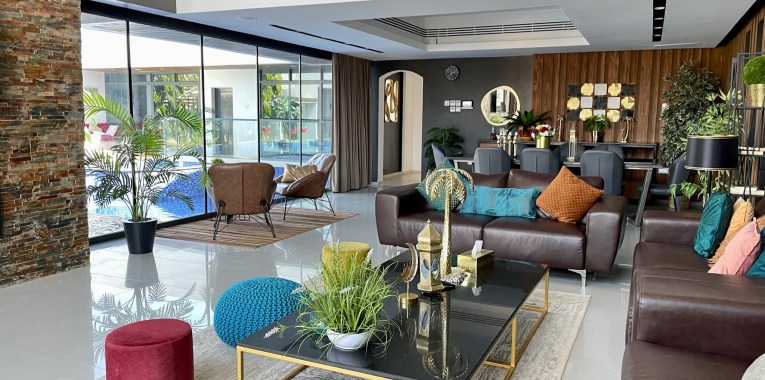
The most important rooms are the majlis, usually explained as the male or male visitor’s sitting room, and the salle, usually explained as the women’s or family’s sitting room.[2] As the majlis is used more frequently for guests, it is often more showy with a larger TV, elaborate curtains, wall hangings, and gypsum decorations on the ceiling. Care is taken that the two rooms do not have the same color scheme but the spaces are not color-coded for gender in Western terms. For example, the majlis might be light purple or peach while the salle is dark blue or brown.

I think of Dhofari houses as the antithesis of expensive Victorian-era houses in the United Kingdom with many little rooms which each have a separate purpose: the morning room, the seamstress’ room, billiard room, the music room, the library, etc.. In Dhofari houses, there are usually only four types of rooms: sitting room, bedroom, kitchen and bathroom and the first three types are furnished with the same pattern of furniture next to the walls and empty space in the middle.

Another way to think about types of rooms is to consider that many middle- and upper-class North American homes have rooms for work, relaxation and/ or exercise such as a home office, craft room, gym, yoga studio, etc. which might be the former bedroom of a child who has moved out. There is a standard trope of a child going to college and his/ her room ‘disappears’ as it has been entirely repurposed.

In Dhofar, while the people who stay in a room might change, the purpose seldom does. For example, three brothers might share a bedroom on the ground floor. In time, an additional story is added and two boys move to an upstairs bedroom while the original room is redone for the oldest boy and his bride. After this couple have a few children, they move to a suite on the first floor and the bedroom is refurbished for a grandparent who cannot manage to walk upstairs.

Foyer/ main hallway

Looking at the front of a Dhofar house, there are almost always two doors. The smaller/ less decorated door leads to the majlis, explained below, and the larger door opens into a large, wide hallway. This hallway, which runs from the front to the back of most houses, is widest by the front door. There is usually no furniture in the hallway except perhaps a tall, rectangular side table pushed against the wall near the door with a mirror above it or nearby. 

This is a staging-area that is used only for a few moments of time several times during the day but is necessary given common Dhofar behaviors. A large foyer is needed because there are usually more than five small children living in one house and they can use the space as a play area in hot weather; also, children love to run together to the door when someone knocks (or they are sent to see who it is).

As children like to move in groups, they often stand near the door to look at a person arriving or leaving; for example, younger children often gather in the entrance way when older children are going to school. With a large foyer, there is space for the mom, the children who are going to school and young children to all wait inside where it is cool. Or the space can be used by a group of sisters waiting for a car to take them shopping or visiting relatives so they don’t have to stand outside the house in view of the neighborhood.

In some large, recently-built houses, there is no hallway but a circular, open area with a salle through a wide-open archway, the door to the majlis, the door to the kitchen and the steps leading to upper floors. This space is sometimes big enough for chairs/ a sofa and is used as a play area for children, a pass-through/ staging area and an intermediate/ indeterminate location.

For example, a strange man would come to the majlis through the outside door, but a new bride’s brother who wants to visit might not want to ask her to come to the majlis (where there are other men) and might not be comfortable in the salle (where there are women he doesn’t know and is not related to) but could stand with her in this open space to chat.

Majlis

In some cultures on the Arabian Peninsula, the majlis is strictly male territory but in Dhofar among the hakli tribes, a woman, for example, might sit in the majlis and speak with her uncles or male cousins who have come to visit. Further, the space might be used for children to have lessons with a tutor in the early evening. Women use it to entertain female guests or for wedding parties, during which women usually take over the whole house while men are entertained outside. A husband might sit in the majlis in his wife’s parent’s house as a place to talk to his wife when she is temporarily living at her parent’s house if she is caring for a sick member of her family.

When I visit female Dhofari friends at home, where we sit depends on several factors. If their husbands and/ or brothers are not at home, we sit in the majlis. When I visited one male Dhofari friend, we sat in the majlis, but I went to the salle to eat lunch with the women.

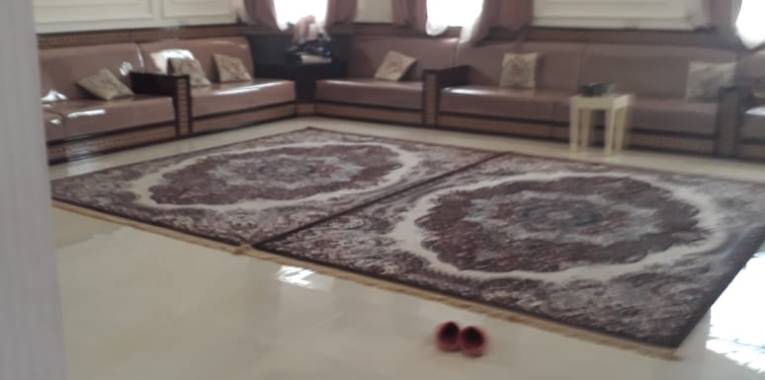
The majlis is usually decorated with sofas or cushions on a low wooden frame surrounding the sides of the room, a few coffee tables, a TV, and sometimes decorations such as photos of the Sultan Qaboos or Sultan Haitham. There is an AC and the walls are always painted to coordinate with the curtains and sofas. Often there is a rug in the (empty) center of the room; the color scheme might be shades of beige, pastels or dark shades of brown, blue, or green.

Majlis always have two doors; the first leads to the outside, so that guests may come and go without moving through or seeing other spaces in the interior of the house. The second door leads to the main hallway of the house and is always closed, if not locked. There is often an open sink, to wash hands before and after eating, and a small toilet/ shower room. 

In a very small house, sometimes the majlis is completely repurposed by becoming a bedroom. Then the salle functions as majlis. In one house which was arranged like this, when I was sitting with women and a man entered to meet with the husband, the women and I went to sit in the couple’s bedroom.

There can also be a majlis in the house as well as another majlis in a separate building. This is not common in Dhofar and is usually a marker of a religiously conservative and/ or wealthy family. The outside majlis is usually located close to the wall (sometimes with a doorway cut into the wall) so that visitors do not go anywhere near the house. This majlis often has a large sitting room and bathroom with sometimes a small kitchen (with its own entrance) and/ or a bedroom. When I was with some of the men in the research group visiting a man we knew, we sat in the separate majlis and lunch was brought to us, carried by our friend.

Salle

In the same way that the majlis can be used by women in Dhofar, the salle can be used by men who are not in the family, for example older men who are close, long-term neighbors might sit with women in the salle if there are no men in the house to entertain them.

The salle is always at the front of the house, close to but usually not visible from the front door. The room has three sides, often with windows to the front and side of the house, the side to the front hallway completely open, with a blank back wall. Like the majlis, it is usually decorated with sofas or cushions on a low wooden frame surrounding the sides of the room, a few coffee tables, a TV, and decorative elements such as vases. The bathroom area might be attached to the salle or further down the main hallway of the house.

Although the norm in Dhofar is for a house to have one majlis and one salle, some larger houses have a series of rooms, i.e., a formal salle at the front of the house and then a (usually less formal) salle further inside. Sometimes also a few sofas are placed upstairs in an open area at the head of the stairs (out of sight of the front door) for family members only.

A salle can be a place for siblings to watch horror movies at 1am, somber when the house is in mourning and women come to pay condolence visits, joyful for a graduation celebration, intimate when sisters come to visit and share all the family news, loud when the children are playing, and welcoming for neighbors and guests. The salle is the center of a Dhofari house.

This could be seen as valid for a North American family as well, i.e., someone in Wisconsin might say that the family room is the heart of the house, yet North Americans may also use different home spaces. They might gather in the kitchen or dining room for a meal; go to the den, basement or spare bedroom to watch TV; sit in the living room for formal visits and send children to their bedrooms to play with toys. All of those activities would take place in the salle of a Dhofari house.

Kitchen/ Dining Room

The kitchen is located to the side or back of the house; in newer houses it has its own entrance used by family members if there is parking near that entrance, as well as those who don’t live in the house, for example people bringing in supplies such as bags of groceries and/ or jugs of water for water dispensers. Like bathrooms, kitchens have tiled walls and floors, usually in shades of grey, beige or brown. There are florescent tube lights, a ceiling fan and an extractor fan, but usually not AC. If there is a window (most often over the sink) it has opaque glass.

Often there are long, high counters along one or two walls, with shelving underneath and cupboards above. The below-counter cupboards, as well as the stove, fridge and washing machine are set slightly above floor-level on platforms so that the floor can be cleaned by mopping/ sluicing. Usually the gas canisters for the stoves are located outside the house, next to the kitchen door, with a small hole drilled in the cement wall to bring the gas pipe to the stove/ oven.

As it is common to have thirty or more people (from different generations) in one house, kitchens are big enough to make large meals. Like most rooms, everything is placed around the sides of the room. Sometimes there is a table, but often you can find an empty area in the middle of the room that is five feet square or larger. This is so a lot of women can work together for parties and also because some cooking is done on the floor. For example, large pots of meat are sometimes cooked on gas rings set on the floor because it is easier to stir from a standing position than trying to reach into a pot set on the stovetop. Some kinds of bread are cooked using small gas burners set on the floor.

Kitchens are utilitarian; pretty trays might be leaned against the back-splash or there might be a vase to hold wooden spoons, etc., but kitchens are seldom decorated or set up as welcoming/ comforting spaces in which to sit and relax.

As soon as you walk in, it’s easy to visually orient yourself; often the cupboards have glass fronts so you can see inside them. Most families will have items for hosting in sight and easy to reach: several sets of teacups and saucers, tea and coffee pots, carafes, glass bowls or plates. There are usually several trays as almost all food, drinks and eating utensils, plates, cups, etc. are moved on trays, not carried by hand

Larger and newer houses may have small suites for each married son. This will usually consist of a bedroom with an attached bathroom and a sitting room which might have a galley kitchen with a small sink and microwave so they can make tea and simple meals for themselves. Thus, there will be one large kitchen for a house, with perhaps a few smaller mini-kitchens for couples.

Bedrooms

If the house has one floor, bedrooms are at the back of the house, usually behind the kitchen. In a two- or three-story house there are often one or two bedrooms on the ground floor for older and senior relatives with the rest of the bedrooms on the upper floors.

There is usually a bed with matching nightstands and large wardrobes, as well as a sofa or padded chairs and coffee table. Sometimes there is a desk and chair if the inhabitant is school-age. I have never seen a built-in closet; everything is stored on or in shelving units or cupboards.

In addition to the overhead, usually fluorescent, lights, bedrooms often have a sconce (wall light) with a low-watt or colored bulb so, if the room is shared, one person can move around and/ or parents can look in on children without turning on the bright overhead lights. There is always a fan and AC.  

It is very common for the upper stories to have a series of suites, meaning a door on the main corridor which leads to a small foyer space with three or four doors: two rooms and a bathroom, perhaps a storage room. This configuration can be easily changed as needed. For example, the two rooms might be used as a bedroom and a sitting room for a newly married couple or single older relative; a shared bedroom and a study/ play room for several children; or two shared bedrooms with a variety of configurations such as younger children in one room with an older child in the other or a married couple in one room, children in the other, etc. If the second room is used as a sitting room, there is often a small kitchen area.

If a man has more than one wife in the same house, each suite will be considered as belonging to the wife and the husband will move between the suites. If his second wife is in another house, he will move between houses as, in Islam, a man should spend equal time with each wife. In old-age or in times of sickness, an older man might sleep alone in what was a room for guests.

Sometimes a Dhofari woman will stay in her parent’s house and her husband will move in with her. This doesn’t happen often; usually it occurs when the husband works close to his wife’s family house, if she is the only daughter or her mother has no sons living with her.

Bathrooms

For some houses built in the mountains in the 1980s and before, the bathroom can be a small, separate building. In this case it is a low ceilinged, tiled space with a toilet, sink, shower and washing machine.

Since the 1980s, bathrooms are within the house, usually rectangular and built with the narrow end on an outside wall or lightwell to allow for the window and extractor fan. They usually have tiled walls and floors with an open design (e.g. no interior walls such as a low partition to screen the toilet) with a pedestal sink or sink on a counter with empty space beneath and a shelving unit next to the wall. The sink is always closest to the door.

The shower area usually does not have a curtain and is marked off with a slightly lowered floor with a drain. Some have tiled steps along one side. Bathtubs are rare; if there is one, it usually has a seat. The steps and seat are for the ritual washing before Muslim prayers during which face, hands and feet must be cleaned.

Bathrooms in the family/ private area of the house are often plainly decorated and are built open-plan for one person to use at a time, unless it is a parent helping a small child. Some North American bathrooms are set up with the toilet half-hidden behind a low wall and shower curtains so that two people might use the room at the same time but I have not heard of that in Dhofar. For unmarried inhabitants, if there is not a bathroom attached to the bedroom, there is one nearby.

The guest bathroom that is attached to or near the majlis and salle often has a space with one or more sinks, then there is an inner door which leads to a small room with a toilet, shower and sink so that guests might wash their hands while the toilet/ shower room is in use. These rooms are usually nicely appointed with fancy faucets and attractive tiles.

Who decorates

Given that most Dhofaris live in multi-generational clusters of thirty or more family members, interior design means consulting the wishes of many people. Usually older family members have a more decisive say but different people can be in control of different areas. For example, the senior woman might be in charge of decorating the kitchen, the senior man might choose the colors of the main sitting room, while a sister might design the room for her brother and his new wife. If there is one person in the family who is known for their flair, they might be given responsibility for the salle, main hallway and majlis. Adults usually decorate their own bedrooms.

Some Dhofari women are frustrated that they don’t have a say in designing and decorating but this is often a function of age and tribe. In the hakli families I know mothers, sisters, wives and/or daughters are always consulted or had design control over the parts of houses they lived in and used daily, i.e., salle, kitchen and bedroom.

However, unmarried women in their teens or early twenties might not be consulted, except for the color choices in their rooms, because of age and the expectation that they will not stay in the house for long given that almost all women move to their husband’s house when married.

When a man is getting married, he is either given a new room or his room is completely redone: re-painted, new furniture, new lighting and often a new dropped or decorated ceiling. This room, out of respect for whoever decorated it, should not be changed for several years, so a woman might not have power over her living space until she is in her late twenties or thirties, but from then on, the decorating is made in consultation with her or left entirely up to her.    

Decorating a house

Houses are decorated when they are new or when the family moves in. Usually, a family will bring all new furniture as the old furniture is given away. Refurbishment, new furniture and/ or painting, usually takes place before the two Eids (Muslim holidays) and/ or before a wedding.        

Generating Ideas

Getting design ideas for the exterior of houses is simple, one only has to drive around and see what other people have done. But there are not many chances to get design ideas about interior spaces beyond a few, large furnishing stores that have opened in the past few years. Dhofaris will visit relative’s houses and might stay in hotels or vacation rentals, but there are limited opportunities to see a wide variety of interior styles.

Dhofaris might post photos of a newly decorated room on social media and people who manage rental houses might post photos of interiors but there is, for example, no Omani equivalent of Zillow or Redfin with photos of the inside of millions of homes.

On the other hand, there are many carpenters, iron-mongers and tailors so that Dhofaris are not limited to furniture and curtains they find in stores. As with designing the house, people can take a photo or hand-drawn sketch to a workshop and have beds, wardrobes, sofas, chairs, drapes, etc. made to their specifications.   

Handmade objects

In North America, people often design their houses with personal items which reflect their travels, accomplishments and interests. But in a majlis or salle, there are usually few or no signs of the individuals who live in the house such as photos, books, souvenirs or knickknacks. The window might be decorated with five kinds of fabric, tassels, pull-backs, swags and ruffles, but you won’t be able to tell very much about the family.

While many Dhofaris have an interest in design per se, it is usually manifested in the design of clothes and making of perfumes, not in creating objects that would be on display such as quilts, crocheted afghans/ throws, needlepoint cushions and paintings. The one handmade object which is found is a majmar, a small clay, footed bowl which is used to hold a lit piece of charcoal with a piece of frankincense. The burning tree sap produces clouds of perfumed smoke which create a lovely fragrance in the house. 

Conclusion

Most Dhofaris follow the principle of “people, not things.” When visiting a hakli at home, the house itself is never the focus of the conversation. If it’s a new house, there will be compliments and a short discussion about where and how items were bought but that is only a few moments but the important most element of owning a house is to create a comfortable place for one’s family to gather.

 Risse – bibliographies, essays and images for Houseways

main webpages on research about houses: 

references list: Selected references related to Houseways in Southern Oman, Oct. 2022

images: 

Risse – publications – books

This book outlines strategies for current or soon-to-be business professionals, government employees, anthropologists, researchers and teachers to communicate, study and work effectively on the Arabian Peninsula. Using first-person accounts, as well as scholarly research from the fields of anthropology, history, literature, political science and travel writing, this text gives clear advice so long- and short-term visitors can create successful interactions with people from Arabian Peninsula societies. By discussing how the practicalities of work and research intersect with cultural norms, this book fills the gap between guides aimed at the casual tourists and academic texts on narrowly defined topics.

This book explains how modern, middle-class houses are sited, designed, built, decorated and lived in with an emphasis on how room-usage is determined by age, gender, time of day and the presence of guests. Dhofari houses are also compared to houses in other Arabian Peninsula countries and positioned within the theoretical frameworks of the “Islamic city” and the “Islamic house.”

This book examines the objects, practices and beliefs relating to producing, obtaining, cooking, eating and disposing of food in the Dhofar region of southern Oman. The chapters consider food preparation, who makes what kind of food, and how and when meals are eaten. Dr. Risse connects what is consumed to themes such as land usage, gender, age, purity, privacy and generosity. She also discusses how foodways are related to issues of morality, safety, religion, and tourism. The volume is a result of fourteen years of collecting data and insights in Dhofar, covering topics such as catching fish, herding camels, growing fruits, designing kitchens, cooking meals and setting leftovers out for animals.

This book explores how, in cultures which prize conformity, there is latitude for people who choose not to conform either for a short time and how the chances to assert independence change over time. The main focus is on how the traits of self-control and self-respect are manifested in the everyday actions of several groups of tribes whose first language is Gibali (Jebbali/ Jebali, also referred to as Shari/ Shahri), a non-written, Modern South Arabian language. Although no work can express the totality of a culture, this text describes how Gibalis are constantly shifting between preserving autonomy and signaling membership in family, tribal and national communities.

 Risse – publications

“Lifeways of Traditional Fishermen in Dhofar, Oman,” in Fish as Food: Lifestyle and a Sustainable Future. Helen Macbeth, ed. International Commission on the Anthropology of Food and Nutrition – Alimenta Populorum series. 2024: 155-170. https://archive.org/details/macbeth-young-and-roberts-ed-fish-as-food-anthropological-and-cross-disciplinary

“An Ethnographic Discussion of Fairy Tales from Southern Oman,” Fabula: Zeitschrift für Erzählforschung / Journal of Folktale Studies / Revue d’Etudes sur le Conte Populaire 60.3-4 (De Gruyter, Berlin) 2019: 318–335.

 “Understanding Communication in Southern Oman,” North Dakota Quarterly 84.1 (Special Issue on Transnationalism) 2017: 174-184.

“Generosity, Gift-giving and Gift-avoiding in Southern Oman,” Proceedings of the Seminar for Arabian Studies 45 (Oxford: Archeopress) 2015: 289-296. 

“Cultural Refraction: Using Travel Writing, Anthropology and Fiction to Understand the Culture of Southern Arabia,” Interdisciplinary Humanities 26:1, 2009: 63-78.

 Risse – conference presentations

“Conducting Research on the Arabian Peninsula: Creating Effective Interactions,” Middle East Studies Association Annual Conference. Upcoming, Nov. 11-15, 2024.

“Windguru and Other Gurus: Fishing off the Coast of Dhofar, Oman,” Navigating the Transcultural Indian Ocean: Texts and Practices in Contact Conference, sponsored by the Rutter Project. June 5, 2024

“Crafting a Home: Interior Home Design in Southern Oman.” Home/Making Symposium, Concordia University. Montreal. May 12, 2023. https://www.concordia.ca/finearts/events/home-making.html

“Good Governance and Open Spaces: How the State and Residents Negotiate the Use of Government Land in Dhofar, Oman.” AnthroState Talks for the European Association of Social Anthropologists Network on Anthropologies of the State. May 4, 2023. https://easaonline.org/networks/anthrostate/talks

“Private Lives in Public Spaces: Perceptions of Space-Usage in Southern Oman.” Middle East Studies Association annual conference. Montreal, Quebec. December 2, 2021.

“The Costs and Benefits of Fishing in Southern Oman.” Fish as Food: Lifestyle and a Sustainable Future, annual conference of the International Commission on the Anthropology of Food and Nutrition, hosted at the University of Liverpool. Sept. 1, 2021.

“Ethical Eating in Southern Oman.” Just Food, virtual conference of the Association for the Study of Food and Society; Agriculture, Food and Human Values Society; Canadian Association for Food Studies and the Society for the Anthropology of Food and Nutrition, hosted by the Culinary Institute of America and New York University. June 12, 2021.

“Foodways in Southern Oman,” for the session “Uncovering Truths, Building Responsibility in A Pandemic: Insights from Emerging Monographs at the Nexus of Culture, Food, and Agriculture.” American Anthropological Association. Nov. 9, 2020.

with Keye Tersmette. “Ghurba at Home – Views from Oman.” The Arab World as Ghurba: Citizenship, Identity and Belonging in Literature and Popular Culture, University of Warwick. June 21, 2019.

“Female, Femininity, Male and Masculinity in the Gibali-speaking Tribes of Southern Oman.” The Gulf Research Conference, Cambridge University. August 2, 2017.

“‘I Came to You for Good’: An Ethnographic Discussion of Folk Tales from Southern Oman.” Third Joint Seminar of The Folklore Society and the Royal Anthropological Institute, Royal Anthropological Institute, London. Oct. 26, 2017.

“‘Words Mean Nothing’: Fluency in Language and Fluency in Culture in Anthropology Fieldwork in Southern Oman.” British Society for Middle Eastern Studies, University of Wales. July 15, 2016.

 ***********

            [1] To help pay for the building costs, the house might be rented out for a few years before the owner moves in. Also, if a family moves into a new house, they may give their previous one to a relative.

            [2] Salle is pronounced ‘sall-la,’ not as the French, ‘sall.’


Outline and Chapter Abstracts for ‘Researching, Teaching and Working on the Arabian Peninsula: Creating Effective Interactions’

Practicalities: Managing a Short Research Trip to the Arabian Peninsula
Me Talk Pretty Never: Learning Arabic, part 1

Adjusting to Oman: My Dangerous Taxi

One Year Away – Missing Oman

I left Salalah a year ago and am still processing that loss. I miss my friends and so many aspects of Dhofari life, especially:

  • Long conversations – When you sit down to talk to a friend in Oman, it’s expected you will talk for hours. I miss having coffee with a female friend for 2 or 3 hours; picnic dinners with the research guys which could mean 6 or 7 hours of chatting.
  • Gorgeous Nature – Pristine, empty beaches; snorkeling over reefs; boat rides, skimming along next to pods of leaping dolphins; sitting in the desert or on a beach with no ambient lights so you could a dark night sky full of stars; green mountains in the monsoon season
  • Animals – lizards and chameleons; seeing foxes, hearing wolves; the parrots which came to my guava tree; flamingos; camels, especially baby camels
  • Plants – palm trees; banana trees; lemon trees; fig trees; my gardens with papaya trees, henna trees, neem trees, olive trees, hibiscus, bougainvillea, oleander, gardenia, jasmine, aloes, lemongrass, yellow trumpet flower
  • Food – fresh coconut milk, schwarmas, fresh Yemeni bread, lobsters cooked over coals, fresh fruit juice, Balbek (if you know, you know), fresh lemon and mint, fresh fish
  • Teaching literature and 98% of my students – Although it cost me $100s a year, it was fun buying and reading books as I searched for new poems and stories to teach. It was a joy to craft syllabi with texts from different time periods and cultures with similar characters, plots and/ or themes and then the best part, talking about these texts with students who had great insights and could make connections to other texts and their own lives. Some classes were an uphill climb but in some classes we laughed all semester.
  • Discussing religion – Everyone I knew believed in God and was up for talking about religious beliefs; I could say, “I will pray for you” and ask, “Will you pray for me?” as a part of ordinary conversations
  • Multi-cultural everythings – Walking through the grocery store and not knowing what I was looking at: new vegetables, new fruit, words I didn’t understand on jars; all different kinds of clothes and fabrics
  • Active ethnography – I was always watching, listening, trying to figure out what was going on: What was that word? Why did that person do that? It was exhausting but always interesting
  • Constantly learning – students were always teaching me new expressions and gestures; the research guys teaching me how to how to drive on sand (only getting stuck three times!), up steep inclines and over rocks
  • Language barriers – Being able to go through the day without understanding most of the conversations around me was relaxing; now I constantly overhear people venting when I walk home or sit in a café
  • My truck – Driving in Oman is so fun on flat desert roads, twisting mountain roads, roads that curve along the shoreline
  • Houses – High ceilings, archways, lots of counter-space in the kitchen, well-designed bathrooms

What’s nice about where I am

  • Being able to easily see/ talk to friends, my mom and family
  • Working with kind and competent people: no lying, no back-stabbing, no drama and every single person says “Hello”
  • Flower stores, especially Kendall Flower Shop, Brattle Square Florist and Petali
  • Breakfast sandwiches, pizza, salads and ice cream without freezer burn
  • Not sharing my apartment with mice, spiders, bees or armies of ants – quiet ACs

Outline and Chapter Abstracts for ‘Researching, Teaching and Working on the Arabian Peninsula: Creating Effective Interactions’

Practicalities of Moving to the Arabian Peninsula: Using the Arabic Language

Ethnography – Finding the Middle Ground, part 1 of Discussing Photographs

Returning to USA – Culture Shock essays

Recent publications on important archeological sites in the Dhofar region, updated April 10, 2024

Aston, Warren. 2022. “Mysteries in Stone: The Enigmatic Minjui – Potential Traces of a Forgotten Dynasty in Dhofar.” Popular Archaeology. 1-17. https://popular-archaeology.com/article/mysteries-in-stone/

Degli Esposti, Michele. 2022. “Khor Kharfut (Dhofar). A Reassessment of the Archaeological Remains.” Archeologie tra Oriente e Occidente (CISA) 1: 15-34. http://www.serena.unina.it/index.php/cssaunior/article/view/9559

Ghidoni, Alessandro and Alexia Pavan. 2022. “Boats, Horses, and Moorings: Maritime Activities at al-Balīd in the Medieval Period.” Proceedings of the Seminar for Arabian Studies Volume 51: 169-82. https://archaeopresspublishing.com/ojs/index.php/PSAS/article/view/599

Giunta, Roberta and Alexia Pavan. 2022. “First Archaeological Activities by the University of Naples L’Orientale in Dhofar, Sultanate of Oman.” Archeologie tra Oriente e Occidente 1: 1-10. https://doi.org/10.6093/archeologie/9712

Lischi, Silvia. 2023. “A First Definition of the Dhofar Coastal Culture Archaeological Exploration on the Inqitat Promontory in the Khor Rori Area (Dhofar, Sultanate of Oman).” Ancient Civilizations and Cultural Resources 1: 23-38. https://www.academia.edu/104462977/A_First_Definition_of_the_Dhofar_Coastal_Culture_Archaeological_Exploration_on_the_Inqitat_Promontory_in_the_Khor_Rori_Area_Dhofar_Sultanate_of_Oman

Pavan, Alexia. 2024. “After the Fall of the Caravan Kingdoms: Notes about the Occupation of Sumhuram and the Area of ​​Khor Rori (Oman) from the Fifth Century AD to the Islamic Period.” Études et Travaux 36: 111–31. https://doi.org/10.12775/EtudTrav.36.006

—. 2020. “The Port of Al Baleed (southern Oman), the Trade in Frankincense and its Coveted Treasures.” Polish Archaeology in the Mediterranean 29.1: 249-65.  https://doi.org/10.31338/uw.2083-537X.pam29.1.13.

Pavan, Alexia, Agnese Fusaro, Chiara Visconti, Alessandro Ghidoni, and Arturo Annucci. 2020. “New Researches at The Port of Al Balid and Its Castle (Husn): Interim Report (2016-2018).” The Journal of Oman Studies 21: 172-99.

Rose, Jeffrey. 2023. “Conclusion: Progress Report on the State of Palaeolithic Research in Arabia.” Paléorient: Revue pluridisciplinaire de préhistoire et de protohistoire de l’Asie du Sud-Ouest et de l’Asie centrale 49.1: 155-60.

Houseways: Podcast, a discussion with Ahmed Almaazmi and Ayesha Mualla

(photo by Onaiza Shaikh, living room in a rental house in Dhofar)

I had a great conversation yesterday with Ahmed Almaazmi and Ayesha Mualla for the Indian Ocean World – New Books Podcast.

https://newbooksnetwork.com/houseways-in-southern-oman

One interesting point that came up in our talk was how changes in house design affect the inhabitants. For much of the Arabian Peninsula, the most common type of house had a central courtyard until the 1970s, 1980s or 1990s depending on the area. With this type, not often found in Dhofar, all the rooms of the house open onto a center space that is exposed to the sky. Thus there are open sightlines in all directions; while more recently built houses are often ‘closed’ with hallways and corners which drastically cut down on the chance of seeing other inhabitants.

The reaction to this change can vary from person to person/ family to family. Some might celebrate the feeling of openness and togetherness found in a house with many vantage points to see most or all of the rooms, where it was easy to cross path with family members. Others see modern houses with limited sightlines as a great advantage in that people can come in and leave without others knowing.

One Dhofari friend told me that having a large open area near the front door, big enough for a few sofas, has been a blessing for her elderly father who can sit in that space all day and see every person as they move between the salle, majlis, kitchen, stairs and front door.

On the other hand, a different Dhofari woman told me about the early years of her marriage when she lived with her husband’s parents and felt a tremendous pressure to have herself and her children always well dressed and on-view in the public areas of the house. She and her husband eventually moved into a small rental hour so that she could have a more peaceful life.

This is one of Maneval’s main points in New Islamic Urbanism: The Architecture of Public and Private Space in Jeddah, Saudi Arabia (2019): the built elements for privacy (high walls, limited sightlines in houses etc.) allow for people to act as they chose as they can create non-observed spaces for themselves.

Thus one can imagine a courtyard house with an family member who rigidly watches, criticizes and controls all the movements or a house in which inhabitants happily greet each other and sit together in harmony. Just as there are modern houses in which people are thankful to have privacy and chances to live as they please and other modern houses in which people feel cut off from each other and lonely.

The only drawback to our talk was that, to prepare, I read a published copy of my Houseways in Southern Oman book and found numerous typos. It was disappointing to see so many mistakes: Salalah misspelled, the author R. Guest written with a small ‘g’ and Modern South Arabian languages referred to as “South Arabian languages.” The proof I was given to check was write-protected, so I could make edits but I could not ‘accept’ the changes to see what the corrected version would look like. The result is odd spacing, missing words and small errors. Very frustrating!

Houseways: House plans

Houseways: Dhofari/ non-Dhofari house plans

Houseways is published and more examples of houseplans

Selected references related to Houseways in Southern Oman, Oct. 2022

Houseways in Southern Oman

Selected references related to Houseways in Southern Oman, Oct. 2022

(photo by Onaiza Shaikh)

Selected references related to Houseways in Southern Oman – Dr. Marielle Risse

bibliography last updated Oct. 2022

[references for pre-historic and pre-modern Dhofar are also listed in separate topic-specific bibliographies at the end]

Abdelghani, Montasser. 2013. “The Impact of Shopping Malls on Traditional Retail Stores in Muscat. Case Study of Al-Seeb Wilayat.” Regionalizing Oman. Steffen Wippel, ed. New York: Springer. 227-47.

Abu-Lughod, Janet. 1989. “What Is Islamic about a City? Some Comparative Reflections,” in Urbanism in Islam: The Proceedings of the International Conference on Urbanism in Islam (Tokyo: Middle Eastern Culture Center): 193-217.

—. 1987. “The Islamic City: Historical Myth, Islamic Essence and Contemporary Relevance.” International Journal of Middle East Studies 19.2: 155-76.

Adam, Khalid and Liudmila Cazacova, 2012. “The Round Dhofari House Popularity Uniting the Past and the Present.” Proceedings of the 6th International Seminar on Vernacular Settlements. Eastern Mediterranean University, Famagusta, North Cyprus. 365-74.

Akcan, Esra. 2014. “Postcolonial Theories in Architecture” in A Critical History of Contemporary Architecture (1960-2010). Elie Haddad and David Rifkind, eds. London: Ashgate. 119-40.

—. 2014. “Global Conflict and Global Glitter: Architecture in West Asia (1960-2010)” in A Critical History of Contemporary Architecture (1960-2010). Elie Haddad and David Rifkind, eds. London: Ashgate. 317-43.

Al Gandel, Thamna and Ibrahim Bryan Finn. 2017. Learn About Dhofar from 530 Questions and Answers. Muscat: Dar al Wraq.

Al Harthy, Sultan. 1992. The Traditional Architecture of Oman: A Critical Perspective. Unpublished M.Arch. thesis. The University of Arizona. https://repository.arizona.edu/bitstream/handle/10150/555398/AZU_TD_BOX353_YARP_1120.pdf?sequence=1https://repository.arizona.edu/handle/10150/555398

Al Hinai, H., W. J. Batty and S. D. Probert. 1993. “Vernacular Architecture of Oman: Features that Enhance Thermal Comfort Achieved within Buildings.” Applied Energy 44.3: 233-44. 10.1016/0306-2619(93)90019-L

Al Ismaili, Ahmed. 2018. “Ethnic, Linguistic, and Religious Pluralism in Oman: The Link with Political Stability.” Al Muntaqa 1.3: 58-73.

Al Kathiri, Muna Salim and Liudmila Cazacova. 2014. “Islamic Architecture Features and Modern Housing: A Case Study of the North Awqad District in Salalah, Oman.” The International Journal of the Constructed Environment 4: 1-18.

Al Mohannadi, Asmaa Saleh, Raffaelo Furlan and Mark David Major. 2019. “Socio-Cultural Factors Shaping the Spatial Form of Traditional and Contemporary Housing in Qatar: A Comparative Analysis based on Space Syntax.” Proceedings of the 12th Space Syntax Symposium.

Al Mohannadi, Asmaa Saleh and Raffaello Furlan. 2019. “Socio-cultural Patterns Embedded into the Built Form of Qatari Houses: Regenerating Architectural Identity in Qatar.” Journal of Urban Regeneration and Renewal 12.4: 1-23.

Al Thahab, Ali, Sabah Mushatat, and Mohammed Abdelmonem. 2014. “Between Tradition and Modernity: Determining Spatial Systems of Privacy in the Domestic Architecture of Contemporary Iraq.” ArchNet – International Journal of Architectural Research 8.3: 238-250.

Albright, Franklin. 1982. The American Archaeological Expedition in Dhofar, Oman, 1952-1953. Washington DC: American Foundation for the Study of Man.

Alexander, Christopher, Sara Ishikawa, Murray Silverstein, Max Jacobson, Ingrid Fiksdahl-King and Shlomo Angel. 1977. A Pattern Language: Towns, Buildings, Construction. Oxford: OUP (Center for Environmental Structure Series).

Alkhalidi, Abdulsamad. 2013. “Sustainable Application of Interior Spaces in Traditional Houses of the United Arab Emirates.” Procedia – Social and Behavioral Sciences 102: 288-299.

AlMutawa, Rana. 2022. “Navigating the Cosmopolitan City: Emirati Women and Ambivalent Forms of Belonging in Dubai,” in Migration in the Making of the Gulf Space Social, Political, and Cultural Dimensions. Antia Mato Bouzas and Lorenzo Casini, eds. New York: Berghahn Books. 67-85.

—. 2020, Dec. 9. “Dishdasha Blues: Navigating Multiple Lived Experiences in the Gulf.” London School of Economics Middle East Blog Posts https://blogs.lse.ac.uk/mec/2020/12/09/dishdasha-blues-navigating-multiple-lived-experiences-in-the-gulf/

—. 2019, Nov 8. “Dubai Mall or Souq Naif? The Quest for ‘Authenticity’ and Social Distinction.” London School of Economics Middle East Blog Posts. https://blogs.lse.ac.uk/mec/2019/11/08/dubai-mall-or-souq-naif-the-quest-for-authenticity-and-social-distinction/

—. 2019. “The Mall Isn’t Authentic!: Dubai’s Creative Class And The Construction of Social Distinction.” Urban Anthropology and Studies of Cultural Systems and World Economic Development 48: 1-2: 183-223.

—. 2018, Dec.4. “Challenging Concepts of ‘Authenticity’: Dubai and Urban Spaces in the Gulf.” London School of Economics Middle East Blog Posts. https://blogs.lse.ac.uk/mec/2018/12/04/challenging-concepts-of-authenticity-dubai-and-urban-spaces-in-the-gulf/

—. 2017. “Women and Restrictive Campus Environments: A Comparative Analysis Between Public Universities and International Branch Campuses in the UAE.” Higher Education in the Gulf States: Present and Future. 17-9.

Ammann. Ludwig. 2006. “Private and Public in Muslim Civilization,” in Islam in Public: Turkey, Iran and Europe. Nilüfer Göle and Ludwig Ammann, eds. Istanbul Bilgi University Press. 77-125.

—. 2002. “Islam in Public Space.” Public Culture 14.1: 277-79.

Anderson, Esther. 2021. “Positionality, Privilege, and Possibility: The Ethnographer ‘at Home’ as an Uncomfortable Insider.” Anthropology and Humanism 46.2: 212-25.

Anderson, John. 1896. “A Sketch of the Physical Features of the Coast of South-East Arabia.” A Contribution to the Herpetology of Arabia. London: R.H. Porter. 2-18.


Atlas of Archaeological Survey in the Governorate of Dhofar Sultanate of Oman. 2013. Muscat: Office of the Advisor to His Majesty the Sultan for Cultural Affairs.

Andraos, Amale. 2016. “The Arab City.” Places Journal. https://doi.org/10.22269/160531

Arnaud, Jean-Luc. 1995. “La Formation de l’Architecture Contemporaine à Sanaa,” in Sanaa hors les Murs, une Ville Arabe Contemporaine. Franck Mermier and Gilbert Grandguillaume, eds. Urbama – CFEY: Tours. 165-226.

Asmi, Rehenuma. 2016. “Finding a Place to Sit How Qatari Women Combine Cultural and Kinship Capital in the Home Majlis.” Anthropology of the Middle East 11.2: 18–38.

Avanzini, Alessandra, ed. 2008. A Port in Arabia between Rome and the Indian Ocean (3rd C.BC. – 5th C.AD) Khor Rori Report 2. Rome: L’Erma di Bretschneider.

—. 2007.“Sumhuram: A Hadrami Port on the Indian Ocean,” in The Indian Ocean in the Ancient Period: Definite Places, Translocal Exchange BAR International Series 1593. Eivind Heldaas Seland, ed. Oxford: Archaeopress. 23-31.

—. 2002. “Incense Routes and Pre-Islamic South Arabian Kingdoms.” Journal of Oman Studies 12: 17-24.

Avanzini, Alessandra and Alexander Sedov. 2005. “The Stratigraphy of Sumhuram: New Evidences.” Proceedings of the Seminar for Arabian Studies 35: 11-7.

Ball, Lawrence, Douglas MacMillan, Joseph Tzanopoulos, Andrew Spalton, Hadi Al Hikmani and Mark Moritz. 2020. “Contemporary Pastoralism in the Dhofar Mountains of Oman.” Human Ecology. https://doi.org/10.1007/s10745-020-00153-5

Bandyopadhyay, Soumyen. 2019. “The Bait as-Sail Rehabilitation and Restoration Project, Salalah, Oman.”  Architecture and Cultural Heritage of India, Arabia and the Maghreb. https://www.archiam.co.uk/ghassani-house-adaptive-reuse-project/

—. 2011. Manah: An Omani Oasis, an Arabian Legacy Architecture and Social History of an Omani Settlement. Liverpool: ‎Liverpool University Press.

—. 2006. “The Deconstructed Courtyard: Dwellings of Central Oman,” in Courtyard Housing: Past, Present and Future. B. Edwards, M. Sibley, M. Hakmi, and P. Land. eds. New York: Taylor & Francis. 109-21.

—. 2002. “Problematic Aspects of Synthesis and Interpretation in the Study of Traditional Built Environment.” Global Built Environment Review 2.2: 16-28.

Barth, Fredrik. 1983. Sohar: Culture and Society in an Omani Town. Baltimore: Johns Hopkins University Press.

Beeston, Alfred. 1976. “The Settlement at Khor Rori.” The Journal of Oman Studies 2: 39-41.

Belfioretti, Luca and Tom Vosmer. 2010. “Al-Balīd Ship Timbers: Preliminary Overview and Comparisons.” Proceedings of the Seminar for Arabian Studies 40: 111-18.

Belk, Russell. 2012. “People and Things,” in Handbook of Developments in Consumer Behavior. Victoria Wells and Gordon Foxall, eds.  Cheltenham: Elgar. 15-46.

Benkari, Naima. 2021. “The Formation and Influence of the Military Architecture in Oman during the al Ya’ariba Period (1034-1162 AH/ 1624-1749 AD). Journal of Islamic Architecture 6.4: 217-228.

—. 2021. “Community-led Initiatives for the Rehabilitation and Management of Vernacular Settlements in Oman: A Phenomenon in the Making.” Built Heritage 5.1: 1-20.

—. 2019. “Local Community Involvement in the Adaptive Reuse of Vernacular Settlements in Oman,” in Vernacular and Earthen Architecture: Towards Local Development. Miles Lewis, Shao Yong, Gisle Jakhelln and Mariana Correia, eds. Shanghai: Tongji University Press. 557-64.

—. 2017. “Urban Development in Oman: An Overview.” Transactions on Ecology and the Environment 226.1: 143–156.

Benkari, Naima, and Alya Al-Hashim. 2015. “Omani Traditional Houses and Settlements: New Options for Developing a Sustainable Tourism.” unpublished.

Bent, J.T. 1895. “Exploration of the Frankincense Country, Southern Arabia.” The Geographical Journal 6.2: 109-33.

Bent, Theodore and Mabel. 2005/ 1900. Southern Arabia. London: Elibron.

Bianca, Stefano. 2000. “Basic Principles of Islam and Their Social, Spatial and Artistic Implications” in Urban Form in the Arab World. London: Thames & Hudson. 23-48.

Biancifiori, M. 1994. Works of Architectural Restoration in Oman. Rome: Edizioni De luca.

bin Zayyad, Sabeen and Brian Sinclair, 2017. “Culture, Context + Environmental Design: Reconsidering Vernacular in Modern Islamic Urbanism.” presented at the 10th EAAE/ARCC International Conference. https://www.researchgate.net/publication/314218959_Culture_context_environmental_design_Reconsidering_vernacular_in_modern_Islamic_urbanism

Blue, Lucy, Nasser Said Al-Jahwari, Eric Staples, Lorena Giorgio, Paolo Croce, Alessandro Ghidoni, Ayyoub Nagmoush Al Busaidi and Luca Belfioretti. 2014. “Maritime Footprints: Examining the Maritime Cultural landscape of Masirah Island, Oman, Past and Present.” Proceedings of the Seminar for Arabian Studies 44. 53-68.

Bontenbal, Marike. 2017. “Policy Brief – Opportunities and Constraints of Female Labour Participation in Oman’s Private Sector.” Economic Research Forum – German University of Technology in Oman. 1-8.

—. 2015. “Residential Satisfaction and Place Identity in a Traditional Neighborhood: The Case of Mutrah, Oman,” in Gateways to the World: Port Cities in the Gulf: Working Group Summary Report. Doha: Center for International and Regional Studies at the Georgetown University School of Foreign Service in Qatar. 189-215.

—. 2013. “Place Attachment and Sense of Belonging in Oasis Villages in the Capital Area of Muscat, Oman.” Trialog: A Journal for Planning and Building in the Global Context 3. 16-20.

Bortolini, Eugenio and Olivia Munoz. 2015. “Life and Death in Prehistoric Oman: Insights from Late Neolithic and Early Bronze Age Funerary Practices (4th – 3rd mill. BC).” Proceedings of the Symposium: The Archaeological Heritage of Oman. Paris: UNESCO. 61-80.

Bourdieu, Pierre. 1972. “The Kabyle House or the World Reversed,” in Algeria 1960. Cambridge: Cambridge University Press. 133-54.

Brandt. Marieke. 2021. “Introduction: The Concept of Tribe in the Anthropology of Yemen,” in Tribes in Modern Yemen: An Anthology (Denkschriften Der Philosophisch-historischen Klasse 531). Najwa Adra, Marieke Brandt, Steven Caton, Paul Dresch, Andre Gingrich, eds. Vienna: Institut für Sozialanthropologie der Österreichischen Akademie der Wissenschaften. 11-8.

—. 2021. “Some Remarks on Blood Vengeance (Tha’r) in Contemporary Yemen,” in Tribes in Modern Yemen: An Anthology (Denkschriften Der Philosophisch-historischen Klasse 531). Najwa Adra, Marieke Brandt, Steven Caton, Paul Dresch, Andre Gingrich, eds. Vienna: Institut für Sozialanthropologie der Österreichischen Akademie der Wissenschaften. 63-78.

Breteau, Marion. 2020. Amours à Mascate: Espaces, Rôles de Genre et Représentations Intimes chez les Jeunes (Sultanat d’Oman). Anthropologie Sociale et Ethnologie. Aix-Marseille Université.

Buffa, V and A.V. Sedov. 2008. “The Residential Quarter” in A Port in Arabia between Rome and the Indian Ocean (3rd C. BC – 5th C. AD). A. Avanzini, ed. Khor Rori Report 2, Roma: L’Erma di Bretschneider: 15-59.

Carter, Henry. 1852. “Memoir of the Geology of the South-East Coast of Arabia.” Journal of the Bombay Branch of the Royal Asiatic Society 3: 21-96.

—. 1851. “A Geographical Description of Certain Parts of the Southeast Coast of Arabia.” Journal of the Bombay Branch of the Royal Asiatic Society 3: 224-317.

—.  1847. “Notes on the Mahrah Tribe of Southern Arabia, with a Vocabulary of their Language, to which is appended additional Observations on the Gara Tribe.” Journal of the Bombay Branch of the Royal Asiatic Society 7.2: 339-64.

—. 1846. “The Ruins of El Balad.” Journal of the Royal Geographical Society of London 16: 187-99.

—. 1845. “Notes on the Gara Tribe.” Journal of the Bombay Branch of the Royal Asiatic Society 2: 195-201.

Carter, J. R. L. 1982. Tribes in Oman. London: Peninsular Publishing.

Carter, Robert and Daniel Eddisford. 2017. “The Vernacular Architecture of Doha, Qatar.” Post-Medieval Archaeology. 1-26. doi: 10.1080/00794236.2017.1320918

Caton, Steve. 2005. Yemen Chronicle: Anthropology of War and Mediation. New York: Hill and Wang.

Causevica, Senija and Mark Neal. 2019. “The Exotic Veil: Managing Tourist Perceptions of National History and Statehood in Oman.” Tourism Management 71: 504-17.

Cazacova, Liudmila., Maria Hidalgo, M. Farhan, F. Al-Masikhi, F. Al-Hafidh, H. Qatan, J. Hubais, L. Ghafoor, M. Al-Marhoon, M. Darwish, M. Al-Amri, S. Al-Baraami, S. Al-Shanfari and S. Al-Rawas, 2014. “Recognition of Mirbat Town’s Old Area as Historical Environment.” Proceedings of REHAB. Tomar, Portugal. 581-91. doi: 10.14575/gl/rehab2014

Cazacova, Liudmila and Balkiz Yapicioglu. 2021. “Residential Architecture: Evaluation of Tenants’ Satisfaction in Private Culture.” WIT Transactions on Ecology and the Environment 253: 409-22.

—. 2014. “Fertile Crescent Defensive Cities Architectural Features Influenced by the Land of Incense Culture.” Proceedings of the CAUMME II International Symposium: Architectural and Urban, Architectural and Urban Research, Education, and Practice in the Era of Post-Professionalism. Girne American University, Girne, North Cyprus. 322-46.

Charpentier, Vincent, Jean-Francois Berger, Rémy Crassard, Fredico Borgi and Philippe Béarez. 2016. “Les Premiers Chasseurs-collecteurs Maritimes d’Arabie (IXe-IVe millénaires avant notre ère) [Early Maritime Hunter-Gatherers in Arabia (9th – 4th Millennium before the Current Era)] Archéologie des Chasseurs-collecteurs Maritimes. Catherine Dupont and Gregor Marchand, eds. Paris: Société Préhistorique Française. 345-66. https://www.researchgate.net/publication/311650424_Les_premiers_chasseurs-collecteurs_maritimes_d’Arabie_IXe-IVe_millenaires_avant_notre_ere

Charpentier, Vincent, Alex de Voogt, Remy Crassard, Jean-Francois Berger, Federico Borgi and Ali Al-Mashani. 2014. “Games on the Seashore of Salalah: The Discovery of Mancala Games in Dhofar, Sultanate of Oman.” Arabian Archaeology and Epigraphy 25: 115-20.


Chatty, Dawn. 2013. “Rejecting Authenticity in the Desert Landscapes of the Modern Middle East: Development Processes in the Jiddat Il-Harasiis, Oman,” in Anthropology of the Middle East and North Africa. Sherine Hafez and Susan Slyomovics, eds. Bloomington: Indiana University Press. 145-64.

—. 2013. “Negotiating Authenticity and Translocality in Oman: The ‘Desertscapes’ of the Harasiis Tribe,” in Regionalizing Oman: Political, Economic and Social Dynamics. Steffen Wippel, ed. Heidelberg: Springer. 129-45.

—. 2000. “Women Working in Oman: Individual Choice and Cultural Constraints.” International Journal of Middle Eastern Studies 32: 241-54.

—. 2000. “Integrating Participation into Research and Consultancy: A Conservation Example from Arabia.” Social Policy and Administration 34.4: 408-18.

—. 1998. “Enclosures and Exclusions: Conserving Wildlife in Pastoral Areas of the Middle East.” Anthropology Today 14.4: 2-7.

—. 1997. Mobile Pastoralists: Development Planning and Social Change in Oman. New York: Columbia University Press.

—. 1976. “From Camel to Truck.” Folk 18: 114-28.

Clements, Frank. 1977. “The Islands of Kuria Muria: A Civil Aid Project in the Sultanate of Oman Administered from Salalah, Regional Capital of Dhofar.” Bulletin (British Society for Middle Eastern Studies) 4.1: 37-9.

Cleuziou, Serge and Maurizio Tosi. 2020. In the Shadow of the Ancestors: The Prehistoric Foundations of the Early Arabian Civilization in Oman, second edition. Dennys Frenez and Roman Garba, eds. Muscat: Ministry of Heritage and Tourism.

Cleveland, R. L. 1960. “The 1960 American Archaeological Expedition to Dhofar.” Bulletin of the American Schools of Oriental Research 159: 14-26.

—. 1959. “The Sacred Stone Circle of Khor Rori (Dhofar).” Bulletin of the American Schools of Oriental Research 155: 29-31.

Cordes, Rainer and Fred Scholz. 1980. “Changes in the Nomad Region of Oman” and “Settlement Projects in Inner Oman, and Other Measures to Develop the Rural/Nomad Region,” in Bedouins, Wealth, and Change: A Study of Rural Development in the United Arab Emirates and the Sultanate of Oman. Tokyo: United Nations University. https://archive.unu.edu/unupress/unupbooks/80143e/80143E00.htm

Costa, Paulo. 2001. Historic Mosques and Shrines of Oman. Oxford: British Archaeological Reports.

—. 1994. Studies in Arabian Architecture (Variorum Collected Studies). London: Routledge.

—. 1991. Musandam: Architecture and Material Culture of a Little Known Region of Oman. London: Immel.

—. 1983. “Notes on Settlement Patterns in Traditional Oman.” Journal of Oman Studies 6.2: 247-68.

—. 1979. “The Study of the City of Zafar (Al-Balid).” Journal of Oman Studies 5: 111-50.

Costa, Paulo and Stephen Kite. 1985. “The Architecture of Salalah and the Dhofar Littoral.” Journal of Oman Studies 7: 131-58.

Craufurd, C. 1919. “The Dhofar District.” The Geographical Journal 53.2: 97-105.

Cremaschi, Mauro, Andrea Zerboni, Vincent Charpentier, Remy Crassard, Ilaria Isola, Eleonora Regattieri, Giovanni Zanchetta. 2015. “Early-Middle Holocene Environmental Changes and pre-Neolithic Human Occupations as Recorded in the Cavities of Jebel Qara (Dhofar, southern Sultanate of Oman).” Quaternary International 382: 264-76.

Cruttenden, Charles. 1838. “Journal of an Excursion from Morbat to Dyreez, the Principal Town of Dhofar.” Transactions of the Bombay Geographical Society 1: 184-88.

Damluji, Salma Samar. 1998. The Architecture of Oman. Reading: Ithaca Press.

De Bel-Air, Françoise. 2015. “Demography, Migration, and the Labour Market in Oman.” Gulf Research Center – Gulf Labor Markets and Migration – EN – No. 9/2015. https://cadmus.eui.eu/bitstream/handle/1814/37398/GLMM_ExpNote_09_2015.pdf;jsessionid=D57068437CF3E9B040792393699299B9?sequence=1

de Cardi, Beatrice. 2002. “British Archeology in Oman: The Early Years.” Journal of Oman Studies 12: 11-15.

De Koning, Anouk. 2009. Global Dreams: Class, Gender, and Public Space in Cosmopolitan Cairo. Cairo: American University in Cairo Press.

De Regt, Marina. 2010. “Ways to Come, Ways to Leave: Gender, Mobility, and Il/legality among Ethiopian Domestic Workers in Yemen.” Gender and Society 24.2: 237-60.

—. 2009. “Preferences and Prejudices: Employers’ Views on Domestic Workers in the Republic of Yemen.” Signs 34.3: 559-81.

De Siqueira, Gustavo and Amal Al Balush. 2020. “Co-designing the Pedestrian Revolution in Muscat.” City, Territory and Architecture 7.11: 1-15. doi: 10.1186/s40410-020-00119-6

Deeb, Lara and Jessica Winegar. 2012. “Anthropologies of Arab-Majority Societies.” Annual Review of Anthropology 41: 537-58.

Degli Esposti, Michele and Alexia Pavan. 2020. “Water and Power in South Arabia: The Excavation of “Monumental Building 1” (MB1) at Sumhuram (Sultanate of Oman).” Arabian Archeology and Epigraphy. 1-29. doi: 10.1111/aae.12159

Dorman, Deborah. 2017. “A Nasraniyya in Sanaa, 1988-99,” in Architectural Heritage of Yemen: Buildings that Fill my Eye. Trevor Marchand, ed. London: Ginko. 179-86.

Dorsky, Susan. 1986.  Women of ‘Amran: A Middle Eastern Ethnographic Study. Salt Lake City: University of Utah Press.

Eickelman, Christine. 1988. “Women and Politics in an Arabian Oasis,” in A Way Prepared: Essays on Islamic Culture in Honor of Richard Bayly Winder. New York: New York University Press. 199-215.

—. 1984. Women and Community in Oman. New York: New York University Press.

Eickelman, Dale. 1989. “National Identity and Religious Discourse in Contemporary Oman.” International Journal of Islamic and Arabic Studies 6.1: 1-20.

—. 1983. “Omani Village: The Meaning of Oil,” in The Politics of Middle Eastern Oil. J. E. Peterson, ed. Washington, D.C.: The Middle East Institute. 211-19.

—. 1974. “Is There an Islamic City? The Making of a Quarter in a Moroccan Town.” International Journal of Middle East Studies 5.3: 274-94.

Eddisford, Daniel and Colleen Morgan, 2013. The Radwani House: Architecture, Archaeology and Social History. 1-92. https://www.academia.edu/33365222/The_Radwani_House_Architecture_Archaeology_and_Social_History

Eddisford, Daniel and Robert Carter. 2017. “The Vernacular Architecture of Doha, Qatar.” Post-Medieval Archaeology 51.1: 81-107.

Escher, Anton. 2019. “Eugen Wirth (1925-2012) – Geographer of the Oriental City in North Africa and the Near East.” Middle East – Topics & Arguments 12.1: 122-6. doi:10.17192/meta.2019.12.7940.

Flahive, Robert. 2021, Dec. 2. “Settler Colonialism Beyond the Settler State? Remaking the Past through Architectural Preservation in Casablanca.” Presentation at the Middle East Studies Association annual conference. Montreal, Quebec.

Fletcher, Richard and Erin Stepney. n.d. “Morphologies of Housing in Doha: from Bayt Sha’bi to Suburban Villa.” 1-23. https://www.academia.edu/41429399/Morphologies_of_Housing_in_Doha_from_bayt_shabi_to_suburban_villa

Franke-Vogt, Ute. 2002. “Remarks on the Classification of the Pottery from Al-Balid, Dhofar (Oman).” Unpublished ms., Office of the Advisor to HM the Sultan for Cultural Affairs: Muscat-Salalah.

Fusaro, Agnese. 2021. “The Islamic Port of al-Balīd (Oman), between Land and Sea: Place of Trade, Exchange, Diversity, and Coexistence.” Journal of Material Cultures in the Muslim World 1.1-2: 67-95. doi: https://doi.org/10.1163/26666286-12340003

Gallagher, Winifred. 2007. House Thinking: A Room-by-room Look at How We Live. New York: HarperCollins.

Galletti, Christopher, Billie Turner and Soe Myint. 2016. “Land Changes and their Drivers in the Cloud Forest and Coastal Zone of Dhofar, Oman, between 1988 and 2013.” Regional Environmental Change 16.7: 2141–53.

Garba, Roman. 2020. “Window 48- Triliths. Hinterland Monuments of Ancient Nomads. Window 48,” in In the Shadow of the Ancestors: The Prehistoric Foundations of the Early Arabian Civilization in Oman, second edition. Dennys Frenez and Roman Garba, eds.Muscat: Ministry of Heritage and Tourism. 500-10.

Garba, Roman, Alžběta Danielisová, Maria Pia Maiorano, Mahmoud Abbas, Dominik Chlachula, David Daněček, W. Al-Ghafri, Stephanie Neuhuber, Denis Štefanisko and Jakub Trubač. 20202. TSMO (Trilith Stone Monuments of Oman) Research Project Expedition Report of the 2nd Season 2019-2020 (campaigns TSMO 2A & 2B). Muscat: Ministry of Heritage and Culture, Sultanate of Oman. https://www.researchgate.net/publication/341193620_TSMO_EXPEDITION_REPORT_OF_THE_2nd_SEASON_2019-2020_campaigns_TSMO_2A_2B_Ministry_of_Heritage_and_Culture_Sultanate_of_Oman

Garba, Roman and Peter Farrington. 2011. “Walled Structures and Settlement Patterns in the South-western Part of Dhofar, Oman (poster).” Proceedings of the Seminar for Arabian Studies 41: 95–100.

Gardner, Andrew. 2015. “Migration, Labor and Business in the Worlding Cities of the Arabian Peninsula.” Institute of Developing Economies – Discussion Paper no. 513. 1-11.

Gardner, Andrew and Momina Zakzouk. 2014. “Car Culture in Contemporary Qatar,” in Everyday Life in the Muslim Middle East, third edition. Donna Lee Bowen, Evelyn Early, and Becky Schulthies, eds. Bloomington, IN: Indiana University Press. 133-42.

Gardiner, Ian. 2007. In the Service of the Sultan: A First-hand Account of the Dhofar Insurgency. South Yorkshire: Pen and Sword Military.

Gateways to the World: Port Cities in the Gulf: Working Group Summary Report. 2015. Doha: Center for International and Regional Studies at the Georgetown University School of Foreign Service in Qatar.

Gaube, Heinz, Lorenz Korn, Abdulrahman al-Salimi, Faysal al-Hafiyan, Ruba Kanaan, Seth M. N. Priestman, Birgit Mershen and Lorenz Korn. 2008. Islamic Art in Oman. Muscat: Al Roya Press.

Ghannam, Farah. 2011. “Mobility, Liminality, and Embodiment in Urban Egypt.” American Ethnologist 38.4: 790–800.

Giunta, Roberta. 2009. “Coins from Al Balid, A Preliminary Report.” Unpublished ms, Office of the Advisor to HM the Sultan for Cultural Affairs: Muscat-Salalah.

Göle, Nilüfer and Ludwig Ammann, eds. 2006. Islam in Public: Turkey, Iran and Europe. Istanbul: Istanbul Bilgi University Press.

Griffiths, Merlyn and Mary Gilly. 2012. “Sharing Space: Extending Belk’s (2010) ‘Sharing’.” Journal of Research for Consumers 22: 1-24. http://jrconsumers.com/Academic_Articles/issue_22/Griffiths-Gilly-AcademicArticle.pdf

Guest, R. 1935. “Zufar in the Middle Ages.” Islamic Culture 9: 402-10.

Hadimioglu, Çagla. 2001. “Black Tents.” Thresholds 22: 18-25.

Haggag, Mahmoud. 2004. “The Impact of Globalization on Urban Spaces in Arab Cities.” 35-46. https://www.irbnet.de/daten/iconda/CIB5930.pdf

Haines, Stafford. 1839. “Memoir to Accompany a Chart of the South Coast of Arabia from the Entrance of the Red Sea to Misenat, in 50, 43, 25 E. Part I.” Journal of the Royal Geographical Society of London 9: 125-56.

—. 1845. “Memoir of the South and East Coasts of Arabia: Part II.” Journal of the Royal Geographical Society of London 15: 104-60.

Haggag, Mahmoud. 2004. “The Impact of Globalization on Urban Spaces in Arab Cities.” 35-46. https://www.semanticscholar.org/paper/THE-IMPACT-OF-GLOBALIZATION-ON-URBAN-SPACES-IN-ARAB-Haggag/b0aa96129c20489f0c23166e7af080c388c21cbd

Hakim, Besim. 2008. Arabic-Islamic Cities: Building and Planning Principles. London: Kegan Paul.

Hanssen, Jens. 2010. “History, Heritage and Modernity: Cities in the Muslim world Between Destruction and Reconstruction,” in The New Cambridge History of Islam 6. R. Hefner (ed.). Cambridge: Cambridge University Press. 521-48.

Harvey, David. 2000. “Cosmopolitanism and the Banality of Geographical Evils.” Public Culture 12.2: 529-64.

Hawker, Ronald. 2008. Traditional Architecture of the Arabian Gulf: Building on Desert Tides. Southampton: WIT Press.

Hegazy, Soheir. 2015. “Cultural Sustainability between Traditional and Contemporary Omani Residences – A Comparative Case Study.” European Journal of Sustainable Development 42: 185-94.

—. 2014. “Conservation of Omani Archaeological Sites, Harat Al Bilad – A Case Study.” International Journal of Arts & Sciences 7.4: 435-48.

Heim, Bernhard, Marc Joosten, Aurel v. Richthofen and Florian Rupp. 2018. “Land-allocation and Clan-formation in Modern Residential Developments in Oman.” City Territory and Architecture 5.8: 1-9. https://doi.org/10.1186/s40410-018-0084-6

Hendawy, Gamal. 2015. “Socio-Demographic Characteristics of Indian Immigrants in the Sultanate of Oman (1993-2010).” Athens: ATINER’s Conference Paper Series, No. DEM2015-1514. 1-27.

Henderson, Joan. 2015. “The Development of Tourist Destinations in the Gulf: Oman and Qatar Compared.” Tourism Planning and Development 12:3: 350-61.

Hilbert, Yamandu. 2013. “Khamseen Rock Shelter and the Late Palaeolithic-Neolithic Transition in Dhofar.” Arabian Archeology and Epigraphy 24: 51-8.

Hilbert, Yamandu, Ash Parton, Mike Morley, Lauren Linnenlucke, Zenobia Jacobs, Laine Clark-Balzan, Richard Roberts, Chris Galletti, Jean-Luc Schwenninger and Jeff Rose. 2015. “Terminal Pleistocene and Early Holocene Archaeology and Stratigraphy of the Southern Nejd, Oman.” Quaternary International 282: 250-263. https://www.sciencedirect.com/science/article/abs/pii/S1040618215001603

Hilbert, Yamandu, Jeff Rose and Richard Roberts. 2012. “Late Paleolithic Core Reduction Strategies in Dhofar, Oman.” Proceedings of the Seminar for Arabian Studies 42: 1-18.

Hilbert, Yamandú, Vitaly Usik, Christopher Galletti, Ash Parton, Laine Clark-Balzan, Jean-Luc Schwenninger, Mike Morley, Zenobia Jacobs, Lauren Linnenlucke, Richard Roberts and Jeffrey Rose. 2015. “Archaeological Evidence for Indigenous Human Occupation of Southern Arabia at the Pleistocene/Holocene Transition: The Case of al-Hatab in Dhofar, Southern Oman.” Paléorient 41.2: 31-49.

Hulton, Jessop. 2003/1844. South Arabia: The ‘Palinurus’ Journals. W. A. Hulton, ed. London, Oleander. (original journal self-published by older brother)

Hulton, Jessop and James Smith. 1839. “Account of some Inscriptions found on the Southern Coast of Arabia.” Journal of the Royal Asiatic Society 5: 91-101.

—. 1835. “Report on some Inscriptions found at Hammam, on the Southern Coast of Arabia.” Journal of the Asiatic Society of Bengal 4: 533-7.

Ibn Battuta, 1929. Travels in Asia and Africa 1325-1354, H.A, R. Gibb, trans. London: Routeledge.

Ibn al-Mujawir. 2008. A Traveller in Thirteenth-century Arabia. 1204/ 1291. Hakluyt Soceity – third series; no. 19. trans. G. Rex. Smith. London: The Hakluty Soceity.

Ibrahim, Moawiyah and Ali Tigani ElMahi. 1997. “A Report on Two Seasons of Sultan Qaboos University Excavations at Al-Balid, Dhofar 1996-7.” Unpublished ms. Office of the Advisor to HM the Sultan for Cultural Affairs: Muscat- Salalah.

Jaidah, Ibrahim and Malika Bourennane. 2009. The History of Qatari Architecture from 1800 to 1950. Milano: Skira.

Jacobs, Jane. 1961/ 1992. The Death and Life of Great American Cities. New York City: Random House.

Jacobson, Max, Murray Silverstein and Barbara Winslow. 2002. Patterns of Home: The Ten Essentials of Enduring Design. Newtown, CT: Taunton Press.

Jansen, Michael, ed. 2015. “The Archaeological Park of Al-Baleed, Sultanate of Oman. Site Atlas along with selected Technical Reports 1995-2001.” Muscat: Office of the Adviser to His Majesty the Sultan for Cultural Affairs.

Janzen, Jorg. 2000. “The Destruction of Resources among the Mountain Nomads of Dhofar,” in The Transformation of Nomadic Society in the Arab East, University of Cambridge Oriental Publications 58. Martha Mundy and Basim Musallam, eds. Cambridge: Cambridge University Press. 160-75.

—. 1986. Nomads in the Sultanate of Oman: Tradition and Development in Dhofar. London: Westview Press.

The Journal of Oman Studies: Special Report 2: The Oman Flora and Fauna Survey 1975. 1980. Muscat: Diwan of H. M. for Protocol.

Julier, Alice. 2015. “Family and Domesticity,” in A Cultural History of Food in the Modern Age (The Cultural Histories Series). Amy Bentley, ed. London: Bloomsbury Academic. 145-64.

Khan, Hayder, Saleh Al-Saadi, Naima Benkari, and Aliya Al-Hashim. 2022. “Numerical Simulation of Ventilation Potential in Traditional Omani House: Bait Al Khandaq as an Example.” The Journal of Engineering Research 18.2:  91-100.

Kanafani, Aida Sami. 1979. Aesthetics and Ritual in the United Arab Emirates. unpublished dissertation, University of Texas at Austin.

Kay, Shirley and Dariush Zandi. 1991. Architectural Heritage of the Gulf. Dubai: Motivate Publishing.

Kelly, J.B.  1976. “Hadramaut, Oman, Dhufar: The Experience of Revolution,” Middle East Studies Association Bulletin, 12.2: 213-30.

Kite, Stephen. 2002. “The Poetics of Oman’s Traditional Architecture: Towards an Aesthetic Interpretation.” The Journal of Oman Studies 12: 133-55.

Klinger, Thibaut. 2022. L’Oman contemporain: Aménagement du territoire et identité nationale. Berlin: De Gruyter. https://doi.org/10.1515/9783110748222

Koch, Natalie. 2020. “The Desert as Laboratory: Science, State‐making, and Empire in the Drylands.” Transactions of the Institute of British Geographers. https://doi.org/10.1111/tran.12414

Komecoglu, Ugur. 2006. “New Sociabilities: Islamic Cafes in Istanbul,” in Islam in Public: Turkey, Iran and Europe. Nilüfer Göle and Ludwig Ammann, eds. Istanbul: Istanbul Bilgi University Press. 163-89.

Kotnik, Toni. 2005. “The Mirrored Public Architecture and Gender Relationship in Yemen.” Space and Culture 8.4: 472-83.

Lancaster, William and Fidelity Lancaster. 2020. “Some Relations between ‘Tribes’ and ‘Territory’ in the Arabian Peninsula in the Recent Past.” Semitica et Classica: International Journal of Oriental and Mediterranean Studies 13. 177-87. https://doi.org/10.1484/J.SEC.5.122987

Le Renard, Amélie. 2014. A Society of Young Women: Opportunities of Place, Power and Reform in Saudi Arabia. Stanford: Stanford University Press.

Lees, G. M. 1928. “The Physical Geography of South-Eastern Arabia.” Geographical Journal 71.5: 441-70.

Limbert, Mandana. 2010. In the Time of Oil: Piety, Memory and Social Life in an Omani Town. Stanford: Stanford University Press.

—. 2008. “The Sacred Date: Gifts of God in an Omani Town.” Ethnos 73.3: 361-76.

Liverani, Mario. 1997. “Beyond Deserts, Beyond Oceans” in Profumi d’Arabia. Alessandra Avanzini, ed. Rome: L’Erma Bretschneider. 557-64.

Maclagan, Ianthe. 1994. “Food and Gender in a Yemeni Community,” in Culinary Cultures of the Middle East. Sami Zubaida and Richard Tapper, eds. New York: I. B. Tauris Publishers. http://food.oregonstate.edu/ref/culture/middleeast/yemen_zubaida.html

Makhlouf, Carla. 1979. Changing Veils: Women and Modernisation in North Yemen. London: Croom Helm.

Maneval, Stefan. 2019. New Islamic Urbanism: The Architecture of Public and Private Space in Jeddah, Saudi Arabia. London: UCL Press.

—. 2019. “Navigating Urban Space: Jeddah, Early Twenty-first Century,” in New Islamic Urbanism: The Architecture of Public and Private Space in Jeddah, Saudi Arabia. London: UCL Press, 170-216.

Marchand, Trevor, ed. 2017. Architectural Heritage of Yemen: Buildings that Fill my Eye. London: Ginko.

McCorriston, Joy, Michael Harrower, Tara Steimer, Kimberly D. Williams, Matthew Senn, Mas‘ūd Al Hādhari, Mas‘ūd Al Kathīrī, ‘Ali Ahmad Al Kathīrī, Jean-François Saliège and Jennifer Everhart. 2014. “Monuments and Landscape of Mobile Pastoralists in Dhofar: The Arabian Human Social Dynamics (AHSD) Project 2009-2011.” Journal of Oman Studies 12: 117-44.

Meneley, Anne. 2017. “The Zabidi House,” in Architectural Heritage of Yemen: Buildings that Fill my Eye. Trevor Marchand, ed. London: Gingko Library. 195-203.

—. 2007. “Fashions and Fundamentalisms in Fin-De-Siecle Yemen: Chador Barbie and Islamic Socks.” Cultural Anthropology 22.2: 214–43.

—. 1996. Tournaments of Value: Sociability and Hierarchy in a Yemeni Town. Toronto: University of Toronto Press.

Menoret, Pascal. Joyriding in Riyadh: Oil, Urbanism, and Road Revolt. New York: Cambridge University Press, 2014.

Mershen, Birgit. 1999. “Settlement Space and Architecture in South-Arabian Oases: Preliminary Remarks on the Use and Division of Space in Omani Oasis Settlements.” Proceedings of the Seminar for Arabian Studies 29: 103-10.

Molotch, Harvey and Davide Ponzini. 2019. “The New Arab Urban: Test Beds, Work-arounds, and the Limits of Enacted Cities.” AlMuntaqa 2.1: 9-23. https://www.jstor.org/stable/10.31430/almuntaqa.2.1.0009

—, eds. 2019. The New Arab Urban: Gulf Cities of Wealth, Ambition and Distress. New York: New York University Press.

Montgomery, Charles. 2014. Happy City: Transforming Our Lives Through Urban Design. New York: Farrar, Strauss and Giroux.

Morris, Jan. 1957/ 2008. Sultan in Oman. London: Eland.

Morris, Miranda. 1997. “The Harvesting of Frankincense in Dhofar,” in Profumi d’Arabia. Alessandra Avanzini, ed. Rome: L’Erma Bretschneider. 231-50.

—. 1987. “Dhofar – What Made it Different” in Oman: Economic, Social and Strategic Development. B.R. Pridham, ed. London: Croom Helm. 51-78.

Nagieb, Maher, Stefan Siebert, Eike Luedeling, Andreas Buerkert, and Jutta Haser. 2004. “Settlement History of a Mountain Oasis in Northern Oman – Evidence from Land-use and Archaeological Studies.” Die Erde 135.1: 81-106.

Nagy, Sharon. 2004. “Keeping Families Together: Housing Policy, Social Strategies and Family in Qatar.” The MIT Electronic Journal of Middle East Studies 4: 42-58.

—. 1998. “Social Diversity and Changes in the Form and Appearance of the Qatari House.” Visual Anthropology 10.2: 281-304.

Nastasi, Michele. 2019. “A Gulf of Images: Photography and the Circulation of Spectacular Architecture,” in The New Arab Urban: Gulf Cities of Wealth, Ambition and Distress. Molotch, Harvey and Davide Ponzini, eds. New York: New York University Press. 99-129.

Newton, Lynne. 2010. “Shrines in Dhofar,” in Death and Burial in Arabia and Beyond: Multidisciplinary Perspectives, Society for Arabian Studies Monographs 10. Lloyd Week, ed. 329-40.

Newton, Lynne and Juris Zarins. 2017. The Archaeological Heritage of Oman. Dhofar Through the Ages. An Ecological, Archaeological and Historical Landscape. Muscat: Ministry of Heritage and Culture Sultanate of Oman.

—. 2014. “A Possible Indian Quarter at al-Baleed in the Fourteenth-Seventeenth Centuries AD?” Proceedings of the Seminar for Arabian Studies 44: 257-76.

Orazi, Roberto. 2002. “The Harbour and City of Khor Rawri.” Journal of Oman Studies 12: 210-22.

Othman, Zulkeplee, Rosemary Aird, and Laurie Buys. 2015. “Privacy, Modesty, Hospitality, and the Design of Muslim Homes: A Literature Review.” Frontiers of Architectural Research 4: 12–23. http://dx.doi.org/10.1016/j.foar.2014.12.001

Ovington, John. 1929.  A Voyage to Surat in the Year 1689. H. G. Rawlinson, ed. London: Oxford University Press.

Pavan, Alexia. 2020. “The Port of Al Baleed (southern Oman), the Trade in Frankincense and Its Coveted Treasures.” Polish Archaeology in the Mediterranean 29.1. doi:10.31338/uw.2083-537X.pam29.1.13

—. 2017-2018. “Husn Al Baleed: Civil and Military Architecture along the Indian Ocean in Medieval Times.” Journal of Indian Ocean Archaeology 13-14: 28-41.

Pavan, Alexia and Michele Degli Esposti, 2016. The Urban Shrine in Quarter A at Sumhuram: Stratigraphy, Architecture, Material Culture. Quaderni di Arabia Antica 4, Roma: L’Erma di Bretschneider.

Pavan, Alexia, Agnese Fusaro, Chiara Visconti, Alessandro Ghidoni, and Arturo Annucci. 2020. “New Researches at The Port of Al Balid and Its Castle (Husn): Interim Report (2016-2018).” The Journal of Oman Studies 21: 172-99.

Pavan, Alexia, S. Laurenza, and R. Valentini, 2020. “Masonry and Building Techniques in a Medieval City Port of the Sultanate of Oman: Preliminary Typological Atlas at al-Balīd.Newsletter Archeologia 10: 321-46.

Pavan, Alexia and Chiara Visconti. 2020. “Trade and Contacts between Southern Arabia and East Asia: The Evidence from al-Balīd (southern Oman).” Proceedings of the Seminar for Arabian Studies 50: 243–57.

Pirenne, J. 1975. “The Incense Port of Moscha (Khor Rori) in Dhofar.” Journal of Oman Studies 1: 81-96.

“Population.” 2022. Data Portal – National Centre for Statistics and Information. https://data.gov.om/OMPOP2016/population. June 2.

Potts, Daniel. 2016. “Trends and Patterns in the Archaeology and Pre-Modern History of the Gulf Region,” in The Emergence of the Gulf States: Studies in Modern History. J.E. Peterson (ed.). London: Bloomsbury. 19-42.

Ragette, Friedrich. 2003. Traditional Domestic Architecture of the Arab Region. Felbach: Edition Axel Menges.

Raymond, André. 1994. “Islamic City, Arab City: Orientalist Myths and Recent Views.” British Journal of Middle Eastern Studies 21.1: 3-18. https://sci-hub.se/10.1080/13530199408705589

Remali, Adel, Ashraf Salama, Florian Wiedmann and Hatem G. Ibrahim. 2016. “A Chronological Exploration of the Evolution of Housing Typologies in Gulf Cities.” City, Territory and Architecture 3.14: 1-15. doi:10.1186/s40410-016-0043-z

Richthofen, Aurel von. 2019. Spatial Diversity and Sustainable Urbanisation in Oman. unpublished dissertation. Technische Universitaet Carolo-Wilhelmina zu Braunschweig. https://doi.org/10.24355/dbbs.084-201901220928-0

—. 2016. “Visualizing Urban Form as Mass Ornament in Muscat Capital Area” in Visual Culture(s) in the Gulf: An Anthology. N. Mounajjed, eds. Gulf Research Centre Cambridge. 137-58.

Risse, Marielle. 2021. Foodways in Southern Oman. London: Routledge.

—. 2021. “Private Lives in Public Spaces: Perceptions of Space-Usage in Southern Oman,” presentation at Middle East Studies Association annual conference. Montreal, Quebec. December 2.

—. 2019. Community and Autonomy in Southern Oman. Cham, Switzerland: Palgrave Macmillan.

—. 2018. “Accounts from the Journeys of the Brig ‘Palinurus’ Along the Dhofar Coast in the mid-1800s.” Maritime Exploration and Memory Conference, National Maritime Museum, Greenwich, England. Sept. 15.

—. 2015. “Generosity, Gift-giving and Gift-avoiding in Southern Oman.” Proceedings of the Seminar for Arabian Studies 45: 289-96.

—. 2013. “Verstehen/ Einfühlen in Arabian Sands (1959): Wilfred Thesiger as Traveler and Anthropologist.” Journeys: The International Journal of Travel & Travel Writing 14.1: 23-39.

—. 2009. “Cultural Refraction: Using Travel Writing, Anthropology and Fiction to Understand the Cultures of Southern Arabia.” Interdisciplinary Humanities 26:1: 63-78.

Roche, Thomas, Erin Roche and Ahmed Al Saidi. 2014. “The Dialogic Fashioning of Women’s Dress in the Sultanate of Oman.” Journal of Arabian Studies 4:1: 38-51.

Rose, Jeff. 2022. An Introduction to Human Prehistory in Arabia: The Lost World of the Southern Crescent. New York: Springer.

Rose, Jeff and Yamandu Hilbert. 2014. “New Paleolithic Sites in the Southern Rub’ Al Khali Desert, Oman.” Antiquity 88.341. https://antiquity.ac.uk/projgall/rose341

Rose, Jeff, Yamandu Hilbert, Anthony Marks and Vitaly Usik. 2018. The First People of Oman: Palaeolithic Archaeology of the Nejd Plateau. Sultanate. Muscat: Ministry of Heritage and Culture.

Rose, Jeff, Vitaly Usik, A. Marks, Yamandu Hilbert, Chris Galletti, A. Parton, V. Černý, J. Geiling, M. Morley, and R. Roberts. 2011. “The Nubian Complex of Dhofar, Oman: An African Middle Stone Age Industry in Southern Arabia.” PLoS ONE 6(11) e28239.

“Salalah al-Wusta & Gharbiya: Dhofar Governorate: Documentation and Heritage Management Plan.” 2016. University of Liverpool and the Ministry of Heritage and Culture. https://issuu.com/archiam/docs/20170908_hmp_salalah

Salama, Ashraf. 2015. “Urban Traditions in the Contemporary Lived Space of Cities on the Arabian Peninsula.” Traditional Dwellings and Settlements Review 27.1: 27-39.

—. 2014. “A Century of Architecture in the Arabian Peninsula: Evolving Isms and Multiple Architectural Identities in a Growing Region,” in Architecture from the Arab World (1914-2014): A Selection: Bahrain Catalogue in Biennale Venice. G. George Arbid (ed.). Manama: Bahrain Ministry of Culture. 137-43.

Sale, J. 1980. “The Ecology of the Mountain Region of Dhofar.” The Journal of Oman Studies: Special Report 2: The Oman Flora and Fauna Survey 1975. Muscat: Diwan of H. M. for Protocol. 25-54.

Saunders, J. P. 1846. “A Short Memoir of the Proceedings of the Honorable Company’s Surveying Brig ‘Palinurus,’ during Her Late Examination of the Coast between Ras Morbat and Ras Seger, and between Ras Fartak and the Ruins of Mesinah.” Journal of the Royal Geographical Society of London 16: 169-86.

Scholz, Fred. 1980. “Part III. Case Study: The Sultanate of Oman,” in Bedouins, Wealth, and Change: A Study of Rural Development in the United Arab Emirates and the Sultanate of Oman. Tokyo: United Nations University. https://archive.unu.edu/unupress/unupbooks/80143e/80143E07.htm

Singh, Kaushalendra. 2018., Jan 12. “A Saga of Legacy at Bait al Ghassani.” Oman Observerhttps://www.omanobserver.om/article/64672/Front Stories/a-saga-of-legacy-at-bait-al-ghassani

Smith, G. Rex and Venetia Porter. 1988. “The Rasulids in Dhofar in the VIIth-VIIIth/XIII-XIVth Centuries.” The Journal of the Royal Asiatic Society of Great Britain and Ireland 1: 26-44.

Smith, John Alexander. 1991.“The Islamic Garden in Oman: Sanctuary and Paradise.” Garden History 19: 187-208.

—. 1983. “Desert Developments.” Building Design 11: 18-21.

Sobh, Rana and Russell Belk. 2011. “Domains of Privacy and Hospitality in Arab Gulf Homes.” Journal of Islamic Marketing 2.2: 125-37.

—. 2011. “Privacy and Gendered Spaces in Arab Gulf Homes.” Home Cultures 8.3: 317-40.

Sobh, Rana, Belk, Russell and Justin Gressel. 2010. “Conflicting Imperatives of Modesty and Vanity Among Young Women in the Arabian Gulf,” in Advances in Consumer Research 38. D. W. Dahl, G. V. Johar, and S. M. J. van Osselaer, eds. Duluth, MN: Association for Consumer Research.

Speck, Jeff. 2013. Walkable City: How Downtown Can Save America One Step at a Time. New York: North Point Press.

St Albans, Suzanne. 1980. Where Time Stood Still: Portrait of Oman. London: Quartet Books.

Stephenson, Lindsey. 2011. “Women and the Malleability of the Kuwaiti Dīwāniyya.” Journal of Arabian Studies 1.2: 183-99.

Stephenson, M.I., Karl, A.R. and David, E. 2010. “Islamic Hospitality in the UAE: Indigenization of Products and Human Capital.” Journal of Islamic Marketing 1.1: 9-24.

Tabook, Salim Bakhit. 1997. Tribal Practices and Folklore of Dhofar, Sultanate of Oman. Unpublished PhD thesis, Faculty of Arts, Exeter University.

Tabuki, Salim Bakhit. 1982. “Tribal Structures in South Oman.” Arabian Studies 6: 51-6. (same author as above)

Takriti, Abdul Razzaq. Monsoon Revolution: Republicans, Sultans and Empires in Oman 1965-1976. Oxford: Oxford University Press, 2013.

Thesiger, Wilfred. 1991/ 1959. Arabian Sands. New York: Penguin.

Thomas, Bertram. 1932, reprint. Arabia Felix: Across the Empty Quarter of Arabia. London: Jonathan Cape.

Usik, Vitaly, Jeff Rose, Yamandu Hilbert, P. Van Peer, and Anthony Marks. 2013. “Nubian Complex Reduction Strategies in Dhofar, Southern Oman.” Quaternary International 300: 244-66.

van Nes, Akkelies and Claudia Yamu. 2018. “Space Syntax: A Method to Measure Urban Space Related to Social, Economic and Cognative Factors,” in The Virtual and the Real in Planning and Urban Design: Perspectives, Practices and Applications. C. Yamu, A. Poplin, O. Devisch, and G. de Roo, eds. Routledge: New York. 136-150.

Varanda, Frenando. 2017. “The Domestic Architecture of the Northern Plateaux and Eastern Slopes of Yemen: Building Attitudes and Formal Identities,” in Architectural Heritage of Yemen: Buildings that Fill my Eye. Trevor Marchand, ed. London: Gingko Library. 89-99.

vom Bruck, Gabriele. 2018. Mirrored Loss: A Yemeni Woman’s Life Story. New York: Hurst.

—. 2017. “Bodies on the Move: Gender Dynamics on a Sanaani Minibus,” in Architectural Heritage of Yemen: Buildings that Fill my Eye. Trevor Marchand, ed. London: Gingko Library. 187-93.

—. 2005. “The Imagined ‘Consumer Democracy’ and Elite Re-Production in Yemen.” Journal of the Royal Anthropological Institute 11.2: 255-75.

—. 1997. “A House Turned Inside Out: Inhabiting Space in a Yemeni City.” Journal of Material Culture 2.2: 139-72.

Walsh, Tony. 2013. Walking Through History: Oman’s World Heritage Sites.

Wanucha, Elizabeth and Zahra Babar, eds. 2018. Hawwa, CIRS Special Issue: Family in the Arabian Peninsula 16.1-3.

Weir, Shelagh. 2007. A Tribal Order: Politics and Law in the Mountains of Yemen. Austin: University of Texas Press.

Wikan, Unni. 1982. Behind the Veil in Arabia: Women in Oman. Chicago: University of Chicago Press.

Winter, Tim. 2015. “Urban Sustainability in the Arabian Gulf: Air Conditioning and its Alternative.” Urban Studies. 1-15. doi: 10.1177/0042098015608782

Wolfe, Charles. 2020, Sept. 9. “Five Principles of the ‘Urbanism of Experience’.” Public Square. https://www.cnu.org/publicsquare/2020/09/09/five-principles-urbanism-experience

Yapicioglu, Balkiz and Liudmila Cazacova. 2018. “‘Omani Burqa’ vs. Decorated Facade of Modern Omani House: The Case of Salalah, Dhofar Region, Oman.” The Academic Research Community Publication. 101-111. ISSN online: 2537-0162

—. 2016. “The Building as a Statement of an Artefact: The Mijmara.” International Journal of Ecology & Development 31.3: 99-116.

—. 2016. “Culture Embedded in City’s Architecture; Incense Burning Custom and Its Effects on Modern Buildings’ Features of Salalah, Oman.” Proceedings of the 5th International Conference on Sustainable Tourism and Cultural Heritage. Istanbul, Turkey.

Yarwood, John. 2012. Urban Planning in the Middle East: Case Studies. Newcastle upon Tyne: Cambridge Scholars Publishing.

Yule, Paul and K.K. Mohammad. 2006/ 1998. “Report on Al-Baleed Pottery: Reference Collection,  RWTH Aachen University” Muscat: Office of the Adviser to His Majesty the Sultan for Cultural Affairs.

Zarins, Juris. 2009. “The Latest on the Archaeology of Southern Oman.” Journal of the American Oriental Society 129.4:  665-74.

—. 2007. “Aspects of Recent Archaeological Work at al-Balid (Zafar), Sultanate of Oman.” Proceedings of the Seminar of Arabian Studies 37: 309-24.

—. 2001. The Land of Incense: Archaeological Work in the Governorate of Dhofar, Sultanate of Oman, 1990-1995. Muscat, Oman: Sultan Qaboos University Publications.

—. 1997. “Mesopotamia and Frankincense: The Early Evidence,” in Profumi d’Arabia. Alessandra Avanzini, ed. Rome: L’Erma Bretschneider. 251-72.

—. 1997. “Persia and Dhofar: Aspects of Iron Age International Politics and Trade,” in Crossing Boundaries and Linking Horizons. G. Young, M. Chavalas and R. Averbeck, eds. Bethesda: CDL Press. 615-89.

Zarins, Juris and Newton, Lynne. 2012 “Al Balid: Ancient Zafar, Sultanate of Oman. Report of Excavations, 2005-2011 and Salalah Survey.” Unpublished ms., Muscat-Salalah.

Zerboni, Andrea, Alessandro Perego, Guido S. Mariani, Filippo Brandolini, Mohammed Al Kindi, Eleonora Regattieri, Giovanni Zanchetta, Federico Borgi, Vincent Charpentier and Mauro Cremaschi. 2020. “Geomorphology of the Jebel Qara and Coastal Plain of Salalah (Dhofar, southern Sultanate of Oman).” Journal of Maps 16.2: 187-98.

Zimmerle, William. 2017. Cultural Treasures from the Cave Shelters of Dhofar: Photographs of the Painted Rock Art Heritage of Southern Oman. Washington: Sultan Qaboos Cultural Center/Liberty Press.


—. 2017. Crafting Cuboid Incense Burners in the Land of Frankincense: The Dhofar Ethnoarchaeology Preservation Project. Washington: Sultan Qaboos Cultural Center/Liberty House Press.

Selected references – Al Baleed and Sumhuram

Albright, Franklin. 1982. The American Archaeological Expedition in Dhofar, Oman, 1952-1953. Washington DC: American Foundation for the Study of Man.

Avanzini, Alessandra, ed. 2008. A Port in Arabia between Rome and the Indian Ocean (3rd C.BC. – 5th C.AD) Khor Rori Report 2. Rome: L’Erma di Bretschneider.

—. 2007.“Sumhuram: A Hadrami Port on the Indian Ocean,” in The Indian Ocean in the Ancient Period: Definite Places, Translocal Exchange BAR International Series 1593. Eivind Heldaas Seland, ed. Oxford: Archaeopress. 23-31.

—. 2002. “Incense Routes and Pre-Islamic South Arabian Kingdoms.” Journal of Oman Studies 12: 17-24.

Avanzini, Alessandra and Alexander Sedov. 2005. “The Stratigraphy of Sumhuram: New Evidences.” Proceedings of the Seminar for Arabian Studies 35: 11-7.

Belfioretti, Luca. and Tom Vosmer. 2010. “Al-Balīd Ship Timbers: Preliminary Overview and Comparisons.” Proceedings of the Seminar for Arabian Studies 40: 111-18.

Buffa, V and A.V. Sedov. 2008. “The Residential Quarter,” in A Port in Arabia between Rome and the Indian Ocean (3rd C. BC – 5th C. AD). A. Avanzini, ed. Khor Rori Report 2, Roma: L’Erma di Bretschneider: 15-59.

Carter, Henry. 1846. “The Ruins of El Balad.” Journal of the Royal Geographical Society of London 16: 187-99.

Cleveland, R. L. 1960. “The 1960 American Archaeological Expedition to Dhofar.” Bulletin of the American Schools of Oriental Research 159: 14-26.

—. 1959. “The Sacred Stone Circle of Khor Rori (Dhofar).” Bulletin of the American Schools of Oriental Research 155: 29-31.

Costa, Paulo. 1982. “The Study of the City of Zafar (Al-Balid).” Journal of Oman Studies 5: 111-50.

Degli Esposti, Michele and Alexia Pavan. 2020. “Water and Power in South Arabia: The Excavation of “Monumental Building 1” (MB1) at Sumhuram (Sultanate of Oman).” Arabian Archeology and Epigraphy. 1 – 29. DOI: 10.1111/aae.12159

Franke-Vogt, Ute. 2002. “Remarks on the Classification of the Pottery from Al-Balid, Dhofar (Oman).” Unpublished ms., Office of the Advisor to HM the Sultan for Cultural Affairs: Muscat-Salalah.

Fusaro, Agnese. 2021. “The Islamic Port of al-Balīd (Oman), between Land and Sea: Place of Trade, Exchange, Diversity, and Coexistence.” Journal of Material Cultures in the Muslim World 1.1-2: 67-95. doi: https://doi.org/10.1163/26666286-12340003

Giunta, Roberta. 2009. “Coins from Al Balid, A Preliminary Report.” Unpublished ms, Office of the Advisor to HM the Sultan for Cultural Affairs: Muscat-Salalah.

Ibrahim, Moawiyah and Ali Tigani ElMahi. 1997. “A Report on Two Seasons of Sultan Qaboos University Excavations at Al-Balid, Dhofar 1996-7.” Unpublished ms. Office of the Advisor to HM the Sultan for Cultural Affairs: Muscat- Salalah.

Jansen, Michael, ed. 2015. “The Archaeological Park of Al-Baleed, Sultanate of Oman. Site Atlas along with selected Technical Reports 1995-2001.” Muscat: Office of the Adviser to His Majesty the Sultan for Cultural Affairs.

Newton, Lynne and Zarins, Juris. 2014. “A Possible Indian Quarter at al-Baleed in the Fourteenth-Seventeenth Centuries AD?” Proceedings of the Seminar for Arabian Studies 44: 257-76.

Orazi, Roberto. 2002. “The Harbour and City of Khor Rawri.” Journal of Oman Studies 12: 210-222.

Pavan, Alexia. 2020. “The Port of Al Baleed (southern Oman), the Trade in Frankincense and Its Coveted Treasures.” Polish Archaeology in the Mediterranean 29.1. doi:10.31338/uw.2083-537X.pam29.1.13

—. 2017-2018. “Husn Al Baleed: Civil and Military Architecture along the Indian Ocean in Medieval Times.” Journal of Indian Ocean Archaeology 13-14: 28-41.

Pavan, Alexia and Michele Degli Esposti, 2016. The Urban Shrine in Quarter A at Sumhuram: Stratigraphy, Architecture, Material Culture. Quaderni di Arabia Antica, Roma: L’Erma di Bretschneider.

Pavan, Alexia, Agnese Fusaro, Chiara Visconti, Alessandro Ghidoni, and Arturo Annucci. 2020. “New Researches at The Port of Al Balid and Its Castle (Husn): Interim Report (2016-2018).” The Journal of Oman Studies 21: 172 – 199

Pavan, Alexia, S. Laurenza, and R. Valentini, 2020. “Masonry and Building Techniques in a Medieval City Port of the Sultanate of Oman: Preliminary Typological Atlas at al-Balīd.Newsletter Archeologia 10.

Pavan, Alexia and Chiara Visconti. 2020. “Trade and Contacts between Southern Arabia and East Asia: The Evidence from al-Balīd (southern Oman).” Proceedings of the Seminar for Arabian Studies 50: 243–257.

Pirenne, J. 1975. “The Incense Port of Moscha (Khor Rori) in Dhofar.” Journal of Oman Studies 1: 81-96.

Yule, Paul and K.K. Mohammad. 2006/ 1998. “Report on Al-Baleed Pottery: Reference Collection,  RWTH Aachen University” Muscat: Office of the Adviser to His Majesty the Sultan for Cultural Affairs.

Zarins, Juris. 2007. “Aspects of Recent Archaeological Work at al-Balid (Zafar), Sultanate of Oman.” Proceedings of the Seminar of Arabian Studies 37: 309-24.

Zarins, Juris and Newton, Lynne. 2012 “Al Balid: Ancient Zafar, Sultanate of Oman. Report of Excavations, 2005-2011 and Salalah Survey.” Unpublished ms., Muscat-Salalah.

Selected references: Himbert, Rose and Usik – Pre-historic

Hilbert, Yamandu. 2013. “Khamseen Rock Shelter and the Late Palaeolithic-Neolithic Transition in Dhofar.” Arabian Archeology and Epigraphy 24: 51-8.

Hilbert, Yamandu, Ash Parton, Mike Morley, Lauren Linnenlucke, Zenobia Jacobs, Laine Clark-Balzan, Richard Roberts, Chris Galletti, Jean-Luc Schwenninger and Jeff Rose. 2015. “Terminal Pleistocene and Early Holocene Archaeology and Stratigraphy of the Southern Nejd, Oman.” Quaternary International 282: 250-263. https://www.sciencedirect.com/science/article/abs/pii/S1040618215001603

Hilbert, Yamandu, Jeff Rose and Richard Roberts. 2012. “Late Paleolithic Core Reduction Strategies in Dhofar, Oman.” Proceedings of the Seminar for Arabian Studies 42: 1-18.

Hilbert, Yamandú, Vitaly Usik, Christopher Galletti, Ash Parton, Laine Clark-Balzan, Jean-Luc Schwenninger, Mike Morley, Zenobia Jacobs, Lauren Linnenlucke, Richard Roberts and Jeffrey Rose. 2015. “Archaeological Evidence for Indigenous Human Occupation of Southern Arabia at the Pleistocene/Holocene Transition: The Case of al-Hatab in Dhofar, Southern Oman.” Paléorient 41.2: 31-49.

Rose, Jeff. 2022. An Introduction to Human Prehistory in Arabia: The Lost World of the Southern Crescent. New York: Springer.

Rose, Jeff and Yamandu Hilbert. 2014. “New Paleolithic Sites in the Southern Rub’ Al Khali Desert, Oman.” Antiquity 88.341. https://antiquity.ac.uk/projgall/rose341

Rose, Jeff, Yamandu Hilbert, Anthony Marks and Vitaly Usik. 2018. The First People of Oman: Palaeolithic Archaeology of the Nejd Plateau. Sultanate. Muscat: Ministry of Heritage and Culture.

Rose, Jeff, Vitaly Usik, A. Marks, Yamandu Hilbert, Chris Galletti, A. Parton, V. Černý, J. Geiling, M. Morley, and R. Roberts. 2011. “The Nubian Complex of Dhofar, Oman: An African Middle Stone Age Industry in Southern Arabia.” PLoS ONE 6(11) e28239.

Usik, Vitaly, Jeff Rose, Yamandu Hilbert, P. Van Peer, and Anthony Marks. 2013. “Nubian Complex Reduction Strategies in Dhofar, Southern Oman.” Quaternary International 300: 244-66.

Other selected references – pre-modern

Adam, Khalid and Liudmila Cazacova, 2012. “The Round Dhofari House Popularity Uniting the Past and the Present.” Proceedings of the 6th International Seminar on Vernacular Settlements. Eastern Mediterranean University, North Cyprus. 365-74.

Bortolini, Eugenio and Olivia Munoz. 2015. “Life and Death in Prehistoric Oman: Insights from Late Neolithic and Early Bronze Age Funerary Practices (4th – 3rd mill. BC).” Proceedings of the Symposium: The Archaeological Heritage of Oman. Paris: UNESCO. 61-80.

Charpentier, Vincent, Jean-Francois Berger, Rémy Crassard, Fredico Borgi and Philippe Béarez. 2016. “Les Premiers Chasseurs-collecteurs Maritimes d’Arabie (IXe-IVe millénaires avant notre ère) [Early Maritime Hunter-Gatherers in Arabia] Archéologie des Chasseurs-collecteurs Maritimes. Catherine Dupont and Gregor Marchand, eds. Paris: Société Préhistorique Française. 345-66. https://www.researchgate.net/publication/311650424_Les_premiers_chasseurs-collecteurs_maritimes_d’Arabie_IXe-IVe_millenaires_avant_notre_ere

Charpentier, Vincent, Alex de Voogt, Remy Crassard, Jean-Francois Berger, Federico Borgi and Ali Al-Mashani. 2014. “Games on the Seashore of Salalah: The Discovery of Mancala Games in Dhofar, Sultanate of Oman.” Arabian Archaeology and Epigraphy 25: 115-120.

Cleuziou, Serge and Maurizio Tosi. 2020. In the Shadow of the Ancestors: The Prehistoric Foundations of the Early Arabian Civilization in Oman, second edition. Dennys Frenez and Roman Garba, eds. Muscat: Ministry of Heritage and Tourism.

Costa, Paulo. 2001. Historic Mosques and Shrines of Oman. Oxford: British Archaeological Reports.

—. 1983. “Notes on Settlement Patterns in Traditional Oman.” Journal of Oman Studies 6.2: 247-68.

Cremaschi, Mauro, Andrea Zerboni, Vincent Charpentier, Remy Crassard, Ilaria Isola, Eleonora Regattieri, Giovanni Zanchetta. 2015. “Early-Middle Holocene Environmental Changes and pre-Neolithic Human Occupations as Recorded in the Cavities of Jebel Qara (Dhofar, southern Sultanate of Oman).” Quaternary International 382: 264-76.

de Cardi, Beatrice. 2002. “British Archeology in Oman: The Early Years.” Journal of Oman Studies 12, 2002.

Garba, Roman. 2020. “Window 48- Triliths. Hinterland Monuments of Ancient Nomads. Window 48,” in In the Shadow of the Ancestors: The Prehistoric Foundations of the Early Arabian Civilization in Oman, second edition. Dennys Frenez and Roman Garba, eds.Muscat: Ministry of Heritage and Tourism. 500-10.

Garba, Roman, Alžběta Danielisová, Maria Pia Maiorano, Mahmoud Abbas, Dominik Chlachula, David Daněček, W. Al-Ghafri, Stephanie Neuhuber, Denis Štefanisko and Jakub Trubač. 20202. TSMO (Trilith Stone Monuments of Oman) Research Project Expedition Report of the 2nd Season 2019-2020. Muscat: Ministry of Heritage and Culture. https://www.researchgate.net/publication/341193620_TSMO_EXPEDITION_REPORT_OF_THE_2nd_SEASON_2019-2020_campaigns_TSMO_2A_2B_Ministry_of_Heritage_and_Culture_Sultanate_of_Oman

Garba, Roman and Peter Farrington. 2011. “Walled Structures and Settlement Patterns in the South-western Part of Dhofar, Oman (poster).” Proceedings of the Seminar for Arabian Studies 41: 95–100.

Hulton, Jessop and J. Smith. 1830. “Account of Some Inscriptions Found on the Southern Coast of Arabia.” Journal of the Royal Asiatic Society of Great Britain and Ireland 5.1: 91-101.

McCorriston, Joy, Michael Harrower, Tara Steimer, Kimberly D. Williams, Matthew Senn, Mas‘ūd Al Hādhari, Mas‘ūd Al Kathīrī, ‘Ali Ahmad Al Kathīrī, Jean-François Saliège and Jennifer Everhart. 2014. “Monuments and Landscape of Mobile Pastoralists in Dhofar: The Arabian Human Social Dynamics Project 2009-2011.” Journal of Oman Studies 12: 117-44.

Newton, Lynne. 2010. “Shrines in Dhofar,” in Death and Burial in Arabia and Beyond: Multidisciplinary Perspectives, Society for Arabian Studies Monographs 10. Lloyd Week, ed. 329-340.

Newton, Lynne and Juris Zarins. 2017. The Archaeological Heritage of Oman. Dhofar Through the Ages. An Ecological, Archaeological and Historical Landscape. Muscat: Ministry of Heritage and Culture Sultanate of Oman.

Potts. D. 2016. “Trends and Patterns in the Archaeology and Pre-Modern History of the Gulf Region,” in The Emergence of the Gulf States: Studies in Modern History. J.E. Peterson (ed.). London: Bloomsbury. 19-42.

Zarins, Juris. 2001. The Land of Incense: Archaeological Work in the Governorate of Dhofar, Sultanate of Oman, 1990-1995. Muscat: Sultan Qaboos University Publications.

Zerboni, Andrea, Alessandro Perego, Guido S. Mariani, Filippo Brandolini, Mohammed Al Kindi, Eleonora Regattieri, Giovanni Zanchetta, Federico Borgi, Vincent Charpentier and Mauro Cremaschi. 2020. “Geomorphology of the Jebel Qara and Coastal Plain of Salalah (Dhofar, southern Sultanate of Oman).” Journal of Maps 16:2, 187-198.

Zimmerle, William. 2017. Cultural Treasures from the Cave Shelters of Dhofar: Photographs of the Painted Rock Art Heritage of Southern Oman. Washington: Sultan Qaboos Cultural Center/Liberty Press.

—. 2017. Crafting Cuboid Incense Burners in the Land of Frankincense: The Dhofar Ethnoarchaeology Preservation Project. Washington: Sultan Qaboos Cultural Center/Liberty House Press.

I will be presenting my talk “Good Governance and Open Spaces in Dhofar, Oman” hosted by AnthroState Talks, for the European Association of Social Anthropologists Network on Anthropologies of the State

(photos by Onaiza Shaikh)

“Good Governance and Open Spaces: How the State and Residents Negotiate the Use of Government Land in Dhofar, Oman.” AnthroState Talks for the European Association of Social Anthropologists Network on Anthropologies of the State. May 4, 2023. https://easaonline.org/networks/anthrostate/talks

“Good Governance and Open Spaces” explores a central question that developed from my work on houses and neighborhoods in Oman: how do the federal and municipal government structures create pleasant, well-used public areas within the southern Dhofar region? First I situate my work on housing within three common paradigms: the “happy” city, the Islamic City and the bifurcation within some large, modern Arabian Peninsula cities. I explain how the Omani government has concentrated on a few basics such as trash pick-up and a few amenities such as shelters in scenic areas, leaving many open spaces for citizens and residents to use as they see fit. The result is an unspoken pact in which residents use open areas as they like within certain self-imposed guidelines which prevents harm to the land. If this pact is broken, the government carefully steps in to restore balance.

Dr. Marielle Risse has taught cultural studies, literature and education for 20 years on the Arabian Peninsula. Her latest book, Houseways in Southern Oman (Routledge, 2023), explores how houses are created, maintained and conceptualized in southern Oman. Based on long-term research in Dhofar, it draws on anthropology, sociology, urban studies and architectural history to explain the physical, functional, cultural and social aspects of homes. Her other books are Community and Autonomy in Southern Oman (Palgrave Macmillan, 2019) and Foodways in Southern Oman (Routledge, 2021).

2cfa9799-d7fc-47ce-b059-455da1628dbf

Houseways: Including/ Excluding Expats in Discussions about Housing

All authors know that as you write in detail about a topic, you sometimes lose sight of the bigger picture. In my first draft of  Houseways, I wrote:

And as only GCC citizens can buy land in Dhofar, non-GCCexpats live in Dhofari-designed houses or various types of apartment buildings designed for expats, without affecting the choices for house designs. In the one small, expat compound I lived in for a few years, I had Italian, French, Indian, Iraqi, American and English neighbors. In the two Omani neighborhoods I have lived in for a total of 12 years, I am the only non-Omani in whole area.

As I looked over my draft later, I realized I was not being clear; of course there are many non-Omanis in my neighborhood. I rewrote the section to read:

In the two Omani neighborhoods I have lived in for a total of 12 years, I am the only non-Omani who rents an apartment or house in whole area.

Other expats move through the neighborhood for various reasons. Some expats work as cleaners, either living in or coming a few times a week. Some expat men work as house builders; others come through regularly to go through the dumpsters for anything salvageable or recyclable. Knowing this, Omanis usually put anything that might be of value next to (not in) dumpsters so that it is easy to take. In the afternoons, men who work for small grocery stores bike around ringing a small bell, signaling that they have snacks to sell come.

Another issue is that sending in a manuscript and getting back the published book back is sometimes like sending a beloved pet for grooming. The animal that returns is your pet but looks completely different.

My abstract for the book is:

Houseways in Southern Oman explains how modern, middle-class houses are sited, designed, built, decorated and lived in with an emphasis on how room-usage is determined by age, gender, time of day and the presence of guests. Combing ethnography and architectural studies, the author draws on over sixteen years of living in the Dhofar region to analyze the cultural perceptions regarding houses and how residential areas fit within the urban areas of the southern Dhofar region.

From the average height of the walls surrounding houses to the color schemes of kitchen to the use of curtains, the book examines the material features of houses using formal interviews, visits to many Dhofari houses and the author’s ten years of living in Dhofari-designed houses in Dhofari neighborhoods. The book also discusses cultural expectations such as how and when rooms are used, who is in control of decorating choices, which spaces a guest might see and how to understand if a house is ready for visitors or if its inhabitants are celebrating or mourning. Dhofari houses are also compared to houses in other Arabian Peninsula countries and positioned within the theoretical frameworks of the “Islamic city” and the “Islamic house.”

the official abstract is:

This book explores how houses are created, maintained and conceptualized in southern Oman. Based on long-term research in the Dhofar region, it draws on anthropology, sociology, urban studies and architectural history. The chapters consider physical and functional aspects, including regulations governing land use, factors in siting houses, architectural styles and norms for interior and exterior decorating. The volume also reflects on cultural expectations regarding how and when rooms are used and issues such as safety, privacy, social connectedness and ease of movement. Houses and residential areas are situated within the fabric of towns, comparison is made with housing in other countries in the Arabian peninsula, and consideration is given to notions of the ‘Islamic city’ and the ‘Islamic house’. The book is valuable reading for scholars interested in the Middle East and the built environment.

The line: “This book explores how houses are created, maintained and conceptualized in southern Oman” is somewhat problematic for me as “houses” here is too general a term. My work is on modern, middle-class houses designed by and built for Dhofaris. There are other types of housing which I don’t have expertise in and don’t engage with.

To illustrate my point, I would like to explain one housing example I know of. For many years I visited a large nursery on the eastern side of Salalah. There was a high wall around the area, with a monumental gate as an entrance, as if eventually a large house would be built there, but in the meantime the land was used to grow plants/ turn a profit.

There were large trees planted on the perimeter, inside the high wall, and the middle area was netted over and planted with small shrubs and flowering plants. To the right was a small path which meandered past the planted areas into a section with trees which had small bags of soil tied to limbs so that the trees would put forth roots; the section would then be cut off and a new tree could be planted. To the right of this area was a small, paved courtyard, surrounded on three sides by a variety of one-story rooms made from cement blocks where the men who worked in the nursery lived.

In front of one of the rooms was a large trough sink and a basic open-air kitchen with a woven palm frond cover. A few of the rooms had open holes for windows, a few had window panes and doors. There was electricity and running water. The air was rich with tropical fragrances and birds were chattering everywhere. When I first saw it, my reaction was “I want to live there!”

I imagined how lovely it must be to sit outside at night and watch bats flit among the trees, the sound of palm fronds rustling and the air thick with jasmine. Or maybe not. Maybe there were endless swarms of mosquitos and the sound of insects was maddening. Did the men who worked there love their small courtyard? Did they wish they were in a big compound which was closer to stores with lots of other men to talk to? I don’t know; we didn’t have a language in common besides all of us knowing the names of the plants and the basics of “sun,” “too much sun,” and “no sun.”

It is with this (and many other) examples in mind that I have tried to clear that my focus on Dhofari houses means houses that are Dhofari-designed, -built, -owned and -lived in.

As a final note, I wish I had photographs of house builders as to not include them seems in a way to erase them and their work. But I haven’t figured out a way do this ethically. The person who takes most of the photographs I need is young, female and does not speak the languages common among house-builders. I do not feel comfortable asking her to engage in conversations requiring her to ask for permission to take photos and explain how those photos would be used. At some point I hope to find a way to have pictures taken with informed consent.

Houseways is published and more examples of houseplans

Houseways is published

I was thinking of moving houses this fall and it was fun to look at new houses in the context of the work I have done about houses in Dhofar.

One house had a floor plan that I had never seen before but makes sense in terms of how Omanis don’t think the smell of cooking/ cooked food is positive. The house had the common set up of a separate majlis and a large open salle. There was also a bedroom on the ground floor. However, as the house was small and the bedroom was to one side, the salle extended all the way to the back of the house. Along the far wall was sliding glass doors which led out to the hosh.

The home owner and I walked around the outside of the house and I walked into the kitchen, which had its own entrance. As I looked around, I realized that there was no connecting door from the kitchen to the inside of the house. I asked the home-owner and he showed me a narrow, raised walkway which led from the door of the kitchen to the sliding glass doors at the back of the salle. Food would have to carried from the kitchen to the salle for every meal.

As the walkway was about 4 feet above the level of the hosh, all I could think of was the possible dangers of navigating that ledge at night in khareef when the tiles would be slick with drizzle.

Another house also had a plan that was new to me. There was a majlis to the right (east) of the main door and then a large open area for the salle, but no main hallway. After the majlis on the eastern side, there was a large bedroom; its bathroom shared a wall with the bathroom of the majlis on the north side. On the south side, the bedroom shared a wall with the kitchen. The rest of the space on the ground floor was open with a stair case that started in the north-east corner (near the interior door to the majlis) and then wrapped around the north and west walls. There was a small bedroom tucked under the stair case.

There are two understandings at play here: 1) often there is a bedroom for a senior family member that is near the majlis/ salle on the ground floor so that they don’t have to walk up-stairs and 2) often the maid’s room is next to the kitchen. Given that the bedroom between the majlis and kitchen was large, I guessed that it was for an older relative and the small room under that stairs was for the maid.

I also looked at an apartment connected to a house. Facing the road there was a main entrance to the house and a door to the majlis, then a third door on the side which led to a landing with one door (the ground-floor flat) and a staircase up the first floor flat. As I walked through the first-floor flat, I realized there was no majlis. The apartment had been built for the families of sons who were not yet married. The owner was renting the apartments to help pay for the building costs, and when the sons were older, they would live in them. Thus, there was no need for a majlis in the apartment as the sons would meet in the main majlis of the family house.

I will be talking about “Changing Kitchens in Southern Oman” at the annual conference of The Association for the Study of Food and Society & The Agriculture, Food and Human Values Society

Risse, M. “Changing Kitchens in Southern Oman.” Knowing Food: The Association for the Study of Food and Society & The Agriculture, Food and Human Values Society Conference, sponsored by Boston University. Forthcoming, May 31, 2023.

My presentation will focus on the changes to kitchen design and use in Dhofar, the southern region of Oman, over the past 40 years. Using photos from my extensive collection and data from interviews, I will explain how newly-built kitchens look different, and are used differently, from kitchens built in the 1980/90s. I will discuss aspects such as placement within the house, color choices, cupboards and tables. In addition, I will show how kitchens are used by different people at different times in comparison to the late 1900s. My goal is to use kitchens as a microcosm of changes within Dhofari society as how people prepare and eat meals is a reflection of how families interact.

One example of the type of change that has happened is that now expatriate workers are often cooking within kitchens. As many families hire a male cleaner to come for a few hours every day, kitchens now should have a door so that male workers do not walk through the main parts of the house. One aspect that has not changed it that kitchens are designed for passive safety. For example, countertops are set higher than in Western countries, sometimes so high that a family member must stand on a footstool, and stoves are placed on pedestals several inches above the kitchen floor. This is done so that children cannot see or reach food or implements (such as knives) that are on the countertop, nor can they reach the controls for the stove.