Foodways Images – Humor, Disseminating Information, and the Instagram Food/ Money Connection

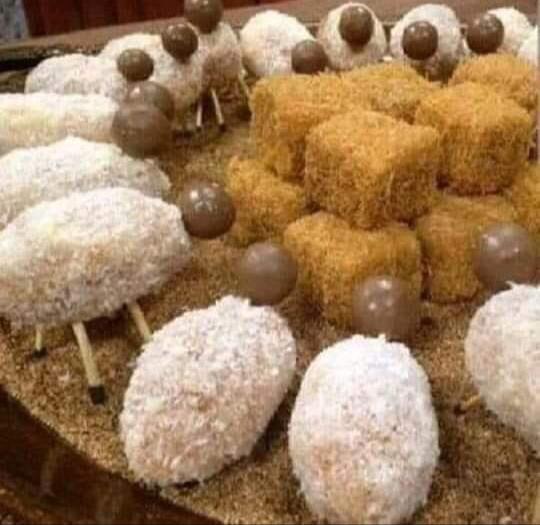
Since Ramadan is the time for religious devotion, reflection and family, I have not been able to meet with my research groups so I have spent a lot of time over the last 4 weeks looking for images connected to food. These posts are a kind of rough draft of research as the first step is to gather data, then comes the comparisons and analysis. I have had a lot of fun, some of the images (like the sheep cake) are amusing, But I am also gathering insights into how social media is connected to foodways in Oman. One thread that has become clear is that varies entities use images to help spread useful information (halal Oreos, raising food prices, etc.) A second thread is that people use social media to monetize food (catering ads and fish prices, etc.).  This will be the last ‘images’ post for awhile and I hope you enjoyed the brief excursion from words to pictures.

Getting creative with cakes:

funny cake

Joke – “the proper treatment for hands after making sambosas,” i.e. buy gold for the women who worked hard to make good Iftars

sambosa-gold.jpg

Notices about food price increases

Warnings about food

Advertisements for home-based catering companies

Food images from home-based catering companies

Announcing fish prices:


Research questions – this image caught my eye because, during more than ten years in Oman, I have never seen fish presented like this. When I looked closely, it was was ad for a Kuwaiti restaurant so I wonder if this is, in fact, a difference of presentation or if I have simply not had the chance to see Omanis serve fish in this manner.

kuweit

Food Perceptions – Honey

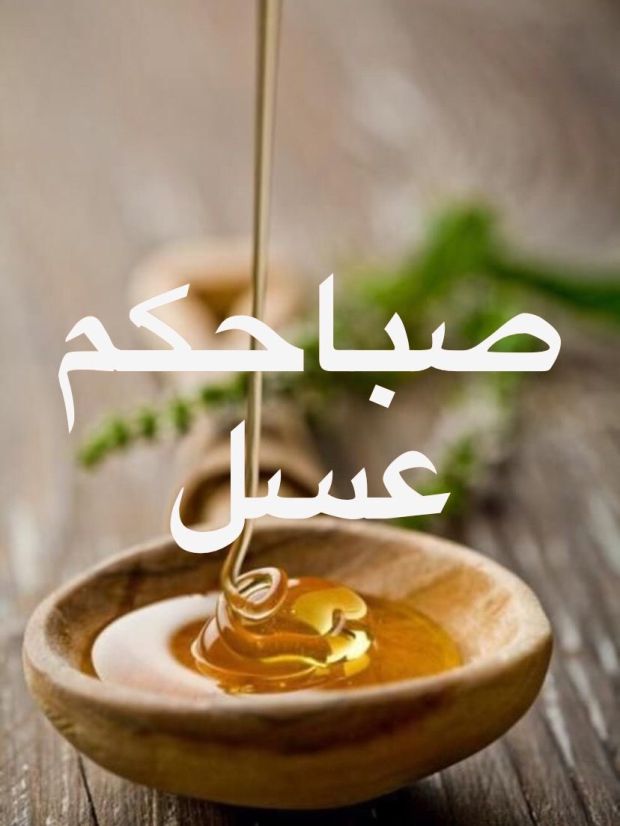
honey - wooden bowl!

The role of a food product often changes between cultures and sometimes even within a culture. A friend from India once complained to me about how many American desserts and breakfast products and were flavored with cinnamon, explaining that cinnamon is, “not for sweets!”

In Dhofar, local honey is mainly a medicinal product, taken straight by the spoonful for coughs, upper respiratory and stomach ailments. Honey from hives in the mountains is usually bottled into glass bottles (often Vimto) and given to family, friends and neighbors; sometimes a few bottles are sold. This honey is taken in small amounts daily or when a person is sick.

There are also stores and booths at local festivals staffed by Yemenis and selling Yemeni honey. Rodionov has an excellent article discussing the cultural practices with respect to honey in Hadramawt (see below). The Yemeni dish, bint al Sahn, is not served as dessert normally in Dhofar, but it can be found in Yemeni restaurants.

On the other hand, commercially produced honey is bought at a grocery store and drizzled liberally as a sweetener on bread at breakfast. It is not expensive, for example if non-local honey is brought on a camping trip, whatever is not used is often poured out and the container thrown away.

Thus honey inhabits two separate spheres with a huge difference in the cultural importance  and function. Honey from Yemen or Dhofar is valuable, not just in price but in worth. A bottle of local honey is a treasured gift, consumed slowly and entirely over weeks or months. The tall glass bottles are kept out in a safe place, out of reach of children. Honey bought at the grocery store usually comes in plastic squeeze bottles and if it is spilled or wasted, it is not perceived as a great loss.

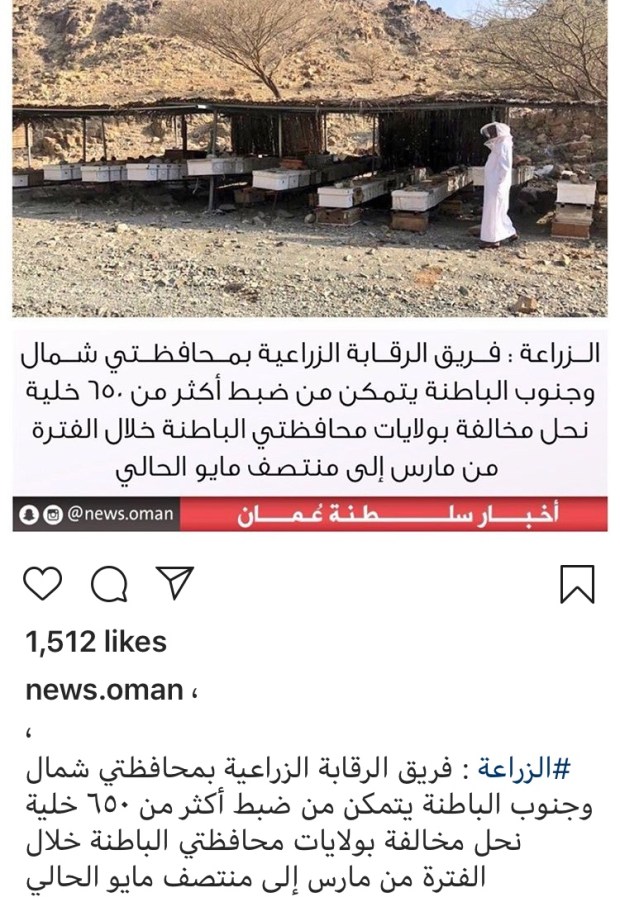
The Omani government supports bee-keeping both in terms of honey production and protecting/ increasing the bee population.

bees


Rodionov, Mikhail. “Honey, Coffee, and Tea in Cultural Practices of Ḥaḍramawt,” in Herbal Medicines in Yemen: Traditional Knowledge and Practice, and Their Value for Today’s World. Ingrid Hehmeyer and Hanne Schönig, eds. Brill: Boston, 2012, 143-152.

Images of Food during Ramadan – Iftar Humor and Iftar in Beautiful Places

Humor is a good way to get insight into cultures – what’s funny shows what’s important. Here are a few jokes circulating through Oman social media pertaining to food issues during Ramadan. I should be clear that there are no jokes about Ramadan itself, but about, for example, food for Iftar and who to have Iftar with. At the end are are few typical images of Iftar in a scenic place.

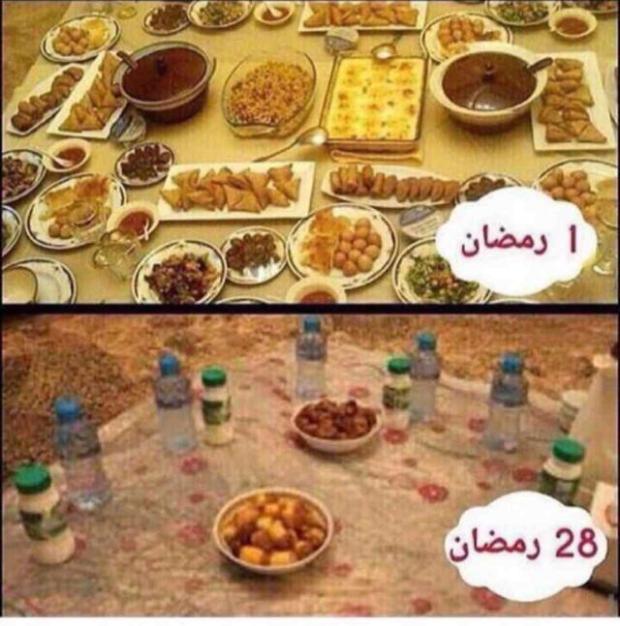
Joke about the differences in choices between Iftar on the first day of Ramadan and the last day.

ramadan joke

Joke about the difference between Iftar alone (in a strange place) and with your mom

ramadan - iftar

Stills from a video which makes fun of how prepared food is sold in front of shops for Iftar. Many bakeries and restaurants set up small tables with tents to sell samosas/ sambosas (fried triangles of filo dough filled with cheese, meat or vegetables; or a thicker, pyramid shaped dough filled with spiced mixed vegetables, meat or potatoes and fried) and sweets, but in this video a tailoring shop and a tire store have also set up tables to sell food.

Stills from a video making fun of issues of hospitality – people who insist on someone having Iftar/ a meal/ tea with them – this is one of several with the same theme. It opens with a man (A) inviting another man who refuses (B). The video them cuts to a movie scene in which a man who resembles B is trying to get away from a man who resembles A, the two fight and A eventually wins. The last scene is A and B eating in A’s house.  (Note the headscarves show that these are not Omanis, but there are Omani videos with the same theme of forced hospitality)

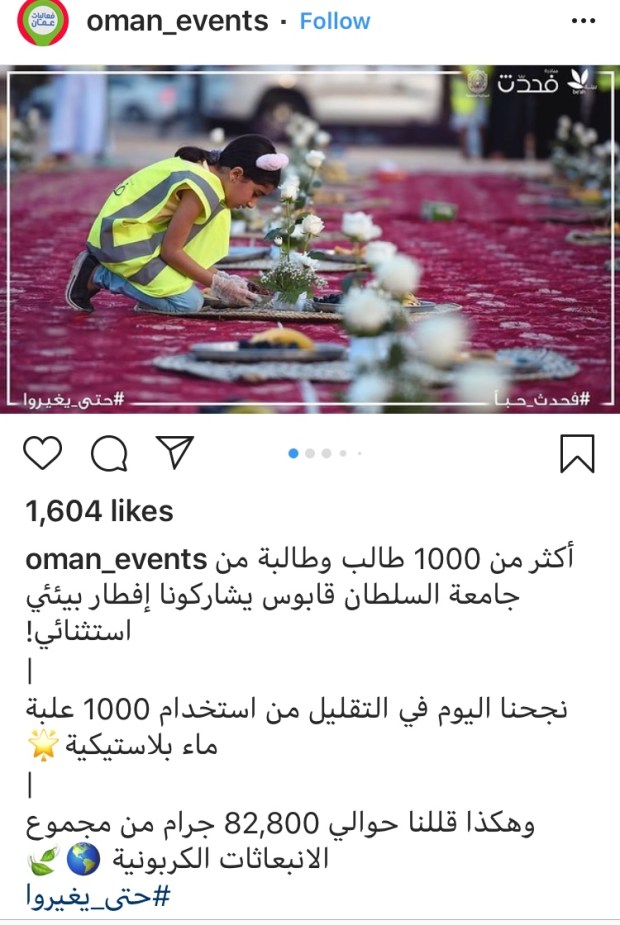
Iftar in a scenic place – the top left image is from Sultan Qaboos University in Muscat


Ramadan and Foodways – Images of food in connection to greetings and good behavior, Vimto and selling food

Marieke Brandt (2017) and John Postill (2016) have written about using social media to do anthropological research in places that are difficult to reach; it is also valuable when you are living in the same area. Scanning social media in Dhofar helps me to understand how food is conceptualized during the holy month of Ramadan. The analysis of the images comes next, but for now I am trying to discover the range of images and sorting through to see what kind of categories are found (and not found). In this post are some examples of food images in Ramadan greetings, different type of images with Vimto (a drink that has become associated with Ramadan), efforts by the government/ official channels to encourage good eating and generous behavior and an example of how prepared food is sold.

Food as a part of typical Ramadan greetings


The importance of Vimto!


Vimto at McDonald’s and Baskin-Robbins


Vimto as decoration


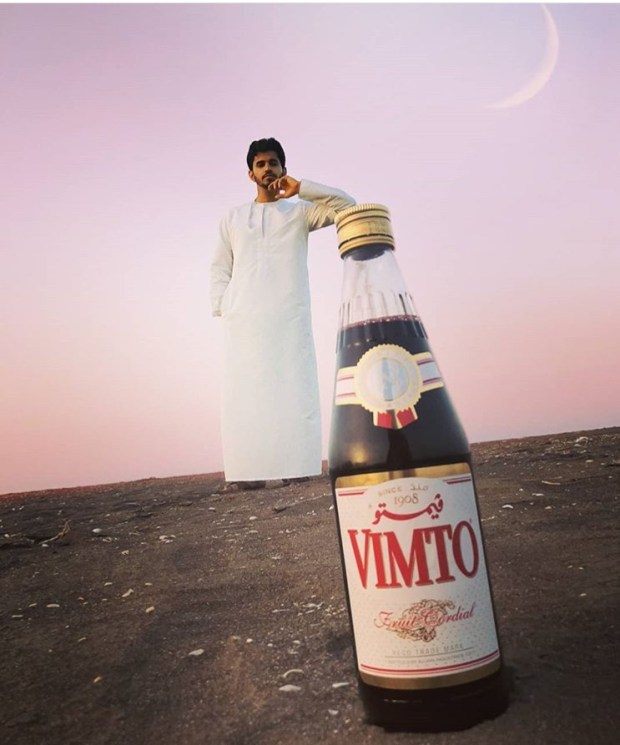
Fun with Vimto

vimto - moon

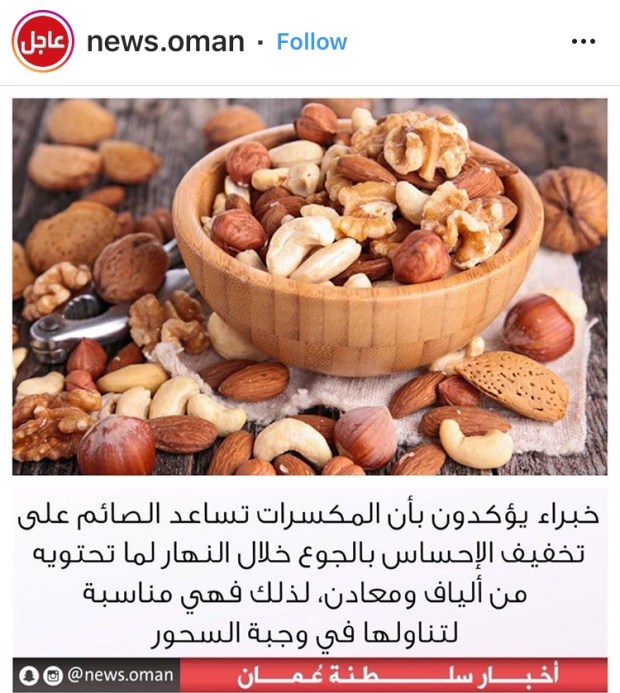
Efforts by government and private entities to improve eating habits during Ramadan

ramadan - nuts

This slideshow is stills from an ad which makes fun of people who have too much of something as a way to caution people against making too much (and then wasting) food at Iftar: a man who has several watches, a woman who has several TVs, a man wearing several hats, then the message.


This slideshow requires JavaScript.

Stills from a short video reminding people to not embarrass (judge) others during Ramadan. The video starts with 2 women preparing iftar, one is seen by a man as she eats a samosa. Then you see the family sitting at the table and enjoying iftar. The man pretends to ask the girl if she is enjoying the food, then humiliates for breaking her fast. As she looks sad, his wife pulls his dishdash and explains that she has a lawful reason not to fast.


There are many photos to children helping to prepare Iftar/ handing out food

iftar help

Selling prepared food for Iftar:


The photos of the woman selling food are taken from an ad on social media which shows close-ups of several types of food and an description of the exact location of her tent.


Bibliographies: Research on Dhofar, Food & Anthropology, and Teaching Literature

(photo by M. A. Al Awaid)

Bibliography of Works Consulted for Research on Dhofar, Oman

Annotated Bibliography of Texts Pertaining to the Dhofar Region of Oman

Selected References for Research on Foodways and Society in Dhofar, Oman  – primarily texts relating to food/ cooking/ cuisine and anthropology

Selected Bibliography: Primary and Secondary Texts for Literature Teachers on the Arabian Peninsula


What I’ve Been Reading: Food, Cooking, Cuisine, Culture, Anthropology, & History

(image from Instagram account of Tiny Spoon, tiny_spoon, full image below)

Food Practices in Southern Oman – My current research focuses on food practices in the Dhofar region, specifically how food is used to show personal generosity and how eating together defines and enhances social relationships.

[this post reflects my current reading – the permanent link for my updated food/ culture bibliography is: Selected References for Research on Foodways and Society in Dhofar] 


Al-Hamad, Sarah. (2016). Cardamom and Lime: Flavors of the Arabian Gulf, the Cuisine of Saudi Arabia, Kuwait, Bahrain, Oman, Qatar and the U.A.E. Singapore: IMM Lifestyle Books.

Avieli, Nir and Rafi Grosglik. (2013). Food and Power in the Middle East and the Mediterranean: Practical Concerns, Theoretical Considerations. Food, Culture and Society 16.2: 181-195.

Appaduari, Arjun. (1985). Gratitude as a Social Mode in South India. Ethos 13.3: 236-245.

Boxhall, P. G. 1966. Socotra: ‘Island of Bliss’. The Geographical Journal 132.2: 213-222.

Brown, Victoria. (2014). Language: A Taste of Reality. One Dish Closer. http://www.onedishcloser.com/food-anthropology/2014/3/19/language-a-taste-of-reality.html

Campbell, Felicia. (2015). The Food of Oman: Recipes and Stories from the Gateway to Arabia. London: Andrew McMeel.

Clements, Frank. (1977). The Islands of Kuria Muria: A Civil Aid Project in the Sultanate of Oman Administered from Salalah, Regional Capital of Dhofar. Bulletin (British Society for Middle Eastern Studies) 4.1: 37-39.

Cleveland, Ray. (1960). The 1960 American Archaeological Expedition to Dhofar. Bulletin of the American Schools of Oriental Research 159: 14-26.

Ciezadlo, Annia. (2011, April 25). Eat, Drink, Protest: Stories of the Middle East’s Hungry Rumblings: Buying Peace, One Feast at a Time. Foreign Policy 186. https://foreignpolicy.com/2011/04/25/eat-drink-protest/

—.  (2011, March 15). Eating My Way Through the Cedar Revolution (excerpt). Foreign Policy. http://foreignpolicy.com/2011/03/15/eating-my-way-through-the-cedar-revolution-2/

Coleman, Leo, ed. (2012). Food: Ethnographic Encounters (Encounters: Experience and Anthropological Knowledge). Oxford: Berg.

Counihan, Carole and Penny van Esterik, eds. (2012). Food and Culture: A Reader. London: Routledge.

Crowther, Gillian. (2018). Eating Culture: An Anthropological Guide to Food. Toronto Press: University of Toronto Press.

De Regt, Marina. (2010). Ways to Come, Ways to Leave: Gender, Mobility, and Il/legality among Ethiopian Domestic Workers in Yemen. Gender and Society 24.2: 237-260.

—.  (2009). Preferences and Prejudices: Employers’ Views on Domestic Workers in the Republic of Yemen. Signs 34.3: 559-581.

Deeb, Lara and Jessica Winegar. (2012). Anthropologies of Arab-Majority Societies. Annual Review of Anthropology 41: 537-558.

Elie, Serge. (2006). Soqotra: South Arabia’s Strategic Gateway and Symbolic Playground. British Journal of Middle Eastern Studies 33.2: 131-160.

Ferguson, Priscilla. (2011). The Senses of Taste. American Historical Review 116.2:  371-384.

Fieldhouse, Paul. (1998). Food and Nutrition: Customs and Culture. Cheltenham, UK: Stanley Thomas.

Fisher, Jennifer. (2003-2004). “Arabian Coffee” in the Land of Sweets. Dance Research Journal 35.2: 146-163.

Fox, Robin. (2018). Food and Eating: An Anthropological Perspective. Social Issues Research Centre. http://www.sirc.org/publik/foxfood.pdf

Gilette, Maris. (2019). Muslim Foodways, in The Handbook of Food and Anthropology. Jakob Klein and James Watson, eds. London: Bloomsbury Academic. 48-73.

Goody, Jack. Cooking, Cuisine and Class. Cambridge: Cambridge University Press, 1982.

Julier, Alice. (2013). Eating Together: Food, Friendship, and Inequality. Chicago: University of Illinois, 2013.

—. (2013). Meals: ‘Eating In’ and ‘Eating Out’ in The Handbook of Food Research. Anne Murcott, Warren Belasco and Peter Jackson, eds. London: Bloomsbury Academic.

Julier, Alice and Lindenfeld. (2005). Mapping Men onto the Menu: Masculinities and Food. Food & Foodways, 13:1–16.

Jurafsky, Dan. (2014). The Language of Food: A Linguist Reads the Menu. New York: W. W. Norton.

Klein, Jakob and James Watson, eds. (2019). The Handbook of Food and Anthropology. London: Bloomsbury Academic.

Lichfield, Gideon. (2010, January 15). A Look Inside the Middle East’s New Weapons of Mass Consumption. Foreign Policy. https://foreignpolicy.com/2010/01/15/food-fight-4/

Maclagan, Ianthe. (1994). Food and Gender in a Yemeni Community, in A Taste of Thyme: Culinary Cultures of the Middle East. Sami Zubaida and Richard Tapper, eds. New York: I.B. Tauris Publishers. 159-72

Mauss, Marcel. (2011/ 1924). The Gift: Forms and Functions of Exchange in Archaic Societies. Mansfield Centre, CA: Martino Publishing.

Mbaga, Msafiri Daudi. (2015). The Prospects of Sustainable Desert Agriculture to Improve Food Security in Oman. Consilience 13: 114-128. http://www.jstor.org/stable/26427275

Meneley, Anne. (2007). Fashions and Fundamentalisms in Fin-De-Siecle Yemen: Chador Barbie and Islamic Socks. Cultural Anthropology 22.2: 214–243.

Miller, Anthony, Miranda Morris, and Susanna Stuart-Smith. (1988). Plants of Dhofar, the Southern Region of Oman: Traditional, Economic, and Medicinal Uses. Muscat: Office of the Adviser for Conservation of the Environment, Diwan of Royal Court.

Mintz, Sidney. (1996). Tasting Food, Tasting Freedom: Excursions into Eating, Culture, and the Past. Boston: Beacon Press.

Mintz, Sidney, and Du Bois, Christine. (2002). The Anthropology of Food and Eating. Annual Review of Anthropology 31:99-119.

Morris, Miranda. (1997). The Harvesting of Frankincense in Dhofar, Oman. In Alessandra Avanzini, ed.  Profumi d’Arabia. Rome: L’Erma Bretschneider: 231-250.

—. (1987). ‘Dhofar – What Made it Different’ in Oman: Economic, Social and Strategic Development. B.R. Pridham, ed. London: Croom Helm. 51-78.

Nagy, Sharon. (2000). Dressing up Downtown: Urban Development and Government Public Image in Qatar. City and Society 12(1): 125-47.

—. (1998). “This Time I think I’ll try a Filipina”: Global and Local Influences on Relations between Foreign Household Workers and their Employers in Doha, Qatar. City and Society 10(1): 83-103.

Omezzine, Abdallah. (1998). On-shore Fresh Fish Markets in Oman. Journal of International Food and Agribusiness Marketing 10(1): 53-69.

Omezzine, Abdallah, Lokman Zaibet and Hamad Al-Oufi. (1996). The Marketing System of Fresh Fish Products on the Masirah Island ion the Sultanate of Oman. Marine Resources Economics 11: 203-210.

Popp, Georg. (2018). Notes on the Omani Kitchen Eating with Tradition. Just Landed. https://www.justlanded.com/english/Oman/Articles/Culture/Notes-on-the-Omani-Kitchen

Rodionov, Mikhail. (2012). Honey, Coffee, and Tea in Cultural Practices of Ḥaḍramawt in Herbal Medicines in Yemen: Traditional Knowledge and Practice, and Their Value for Today’s World. Ingrid Hehmeyer and Hanne Schönig, eds. Brill: Boston. 143-152.

Roseberry, William. (1996). The Rise of Yuppie Coffees and the Reimagination of Class in the United States. American Anthropologist, New Series, 98.4: 762-775.

Rubin, Aaron. (2015). Recent Developments in Jibbali. Journal of Semitic Studies 60: 431–441.

Sadeghin, Farideh. (2015, Oct. 27). The Food of Oman is Too Good to Ignore: Recipe-testing a Middle Eastern Cookbook Gives our Test Kitchen Director a New Love for an Under-appreciated Cuisine. Saveur. https://www.saveur.com/food-of-oman-cookbook-cuisine-felicia-campbell

Stoller, Paul and Cheryl Olkes. (1986). Bad Sauce, Good Ethnography. Cultural Anthropology 1.3: 336-352.

Stork, Joe. (1973, March). Socialist Revolution in Arabia: A Report from the People’s Democratic Republic of Yemen. MERIP Reports 15: 1-25.

Swift, Candice Lowe, ed. (2015). Teaching Food and Culture. London: Routledge.

vom Bruck, Gabriele. (2005). The Imagined ‘Consumer Democracy’ and Elite Re-Production in Yemen. Journal of the Royal Anthropological Institute 11.2: 255-275.

van Esterik, Penny, Alice Julier and Carole Counihan, eds. (2018). Food and Culture: A Reader. London: Routledge.

Watson, Janet C.E. (2013). Travel to Mecca in the Pre-motorized Period in The Hajj: Collected Essays. Venetia Porter and Liana Saif, eds. London: The British Museum. 96–99.

Watson, Janet C.E. & Abdullah al-Mahri. (2017). Language and Nature in Dhofar, in  RiCOGNIZIONI. Rivisti di Lingue e Letterature straniere e Culture moderne.  Simone Bettega and Fabio Gasparini, eds. Turin: University of Turin. 87–103.

Webster, Roger. (1991, October). Notes on the Dialect and Way of Life of the Āl Wahība Bedouin of Oman. Bulletin of the School of Oriental and African Studies 54.3: 473-485.

Weir, Shelagh. (2007). A Tribal Order: Politics and Law in the Mountains of Yemen. Austin: University of Texas Press.

Yamani, Mai. (2000). You Are What You Cook” Cuisine and Class in Mecca in A Taste of Thyme: Culinary Cultures of the Middle East. Sami Zubaida and Richard Tapper, eds. New York: I.B. Tauris Publishers. 159-72.

Blogs – Omani Food

Mariya. Omani Food. https://omanifood24.blogspot.com/

Omani Recipes. (2015). Arabic Recipeshttp://www.encyclopediacooking.com/recipes_in_english/omani-recipes-53-1.html

Traditional Omani Food. (2008, March 1). https://ward-traditionalomanifood.blogspot.com/

Yasmeen. (2018). Omani Cuisine. http://www.omanicuisine.com/

Websites – Expat, Tourist and Commercial

The Delicious Cuisine of Oman! (n. d.). Holidify. https://www.holidify.com/pages/omani-food-230.html

Food and Drink – About Oman. (2018). Rough Guides. https://www.roughguides.com/destinations/middle-east/oman/food-drink/

Guide to Omani Cuisine. (2017, June 14). Expat Woman.com. https://www.expatwoman.com/oman/guide/guide-to-omani-cuisine

Medhat, Gehad. (2017, Dec, 27). The 10 Best Coffee and Tea Shops in Salalah, Oman. Culture Trip. https://theculturetrip.com/middle-east/oman/salalah/food-misc/

Medhat, Gehad. (2017, Dec, 27). The Top Restaurants in Salalah, Oman. Culture Trip. https://theculturetrip.com/middle-east/oman/articles/the-top-restaurants-in-salalah-oman/

Oman. (2018). Countries and Their Cultures.  http://www.everyculture.com/No-Sa/Oman.html

Omani Food. (2015). Best Country. http://www.best-country.com/asia/oman/food

Omani recipes and cuisine. (2018). Nestle.  http://www.nestle-family.com/english/omani-recipes.aspx

Popp, Georg. (2018). Notes on the Omani Kitchen Eating with Tradition. Just Landed. https://www.justlanded.com/english/Oman/Articles/Culture/Notes-on-the-Omani-Kitchen


mini truck

(image from Instagram account: Tiny Spoon)


Examples of Picnic Cooking – Dhofar

On beach picnics, ocean water is often used to cook seafood, for example abalone (seen in photos above and below). Fish is cooked depending on type and how quickly people want to eat. For example, if there are several medium-size fish, they will often be cut into pieces of fish heads, fish tails and fish ‘steaks.’ The bigger pieces of meat are set aside; the heads and tails are boiled in sea water until cooked.

Fish steaks and lobster are usually cooked by simply putting them in coals. Lobsters, with the heads twisted off, are nestled into ashes near coals, sometimes wrapped in aluminum foil and sometimes covered with processed cheese. Fish steaks are doused with salt and/or fish masala powder, wrapped in aluminum foil and baked on the hot coals.

Sometimes fish or meat are cooked on small ‘hibachi’ style grills. Fish can also be grilled by setting a whole, gutted fish into a two-piece, hinged grill which is closed and set on rocks over a low fire. Although it is time consuming and labor intensive, meat can be cooked in the traditional method of being placed directly on heated rocks.

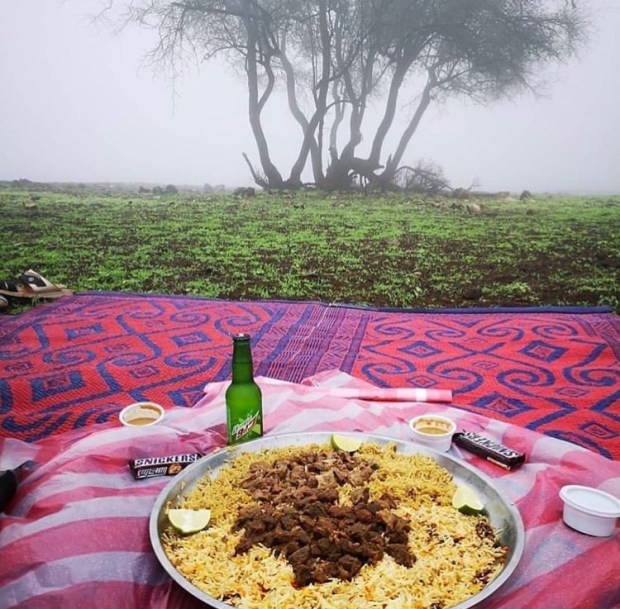
Meat and fish as discussed above are usually eaten with white rice. If the food is boiled, the cooked food is taken out of the pot and set on a metal plate. The pot is rinsed, then filled with bottled water and white rice with a few handfuls of salt. After it is cooked, the rice is transferred to a large round metal plate and “oil” (samn, clarified butter) or margarine is usually added. The fish or meat is put on top of the rice, with bottles of hot sauce and/ or limes placed next to the platter. If there is no rice and the people are picnicking near a town, someone will usually go to buy bread, either paratha or pita (khbus lebnani).

Another type of picnic meal is called a “curry.” One simple recipe is to put chopped potatoes and carrots with a little olive oil in pot which is balanced on three rocks over fire. They are stirred for a while, maybe with water added, then chopped tomatoes, onions, chili peppers, okra, eggplant are added; this is stirred until tomatoes break down, then covered and kept at a simmer. Chopped pieces of meat (cow, camel or goat) or chicken with the bone still attached are added, then salt and, possibly, spices but not necessary curry powder. This is cooked, then poured onto a platter with high sides and eaten with bread.

When the food is ready and the person in charge of the meal has decided it is time to eat, instructions are given to lay the “table” (thin sheets of plastic) and people will clear the area, brushing sand off the mat. The cook puts the food on a platter and brings it to the eating place; everyone else grabs whatever is necessary such as Kleenex, limes, bottles of hot sauce or drinks and washes their hands. Guests have no role beyond perhaps getting up to wash their hands if there is a rice dish. When everything is in place, someone, usually the cook, will say bismallah [in the name of God]; everyone else will repeat bismallah and dig in.

These examples also obtain for mountain picnics, but there meat is usually eaten, not chicken or seafood.

abalone 1

Abalone, a delicacy in Dhofar (which I think tastes like tire rubber, but don’t tell anyone!)

Considering Cartoons/ Graphic Art about Foodways

I started to look at cartoons (sent by Omani friends or posted on Instagram) because I wanted to see how buying, making, eating and sharing food was portrayed in graphic art. The cartoons are fascinating because they give personal insights into many aspects of Arab/ Muslim/ Gulf cultures, not just what food is eaten (when, where and why) but what is said (and the subtext), who is talking,  what clothes are worn (and what do the clothes signal?), body issues (how close do people stand to each other? do they face each other directly? how much can you tell about body size/ shape? can you see hair?), background (how is the place drawn? is it in the home or in public?), even how the words are spelled (are the people speaking formal Arabic?) and grammar choices mark the characters vis a vis status, nationality, sub-culture, etc.

For example in this cartoon – the woman on the left is drawn as less traditional with hair piled up under her sheila, hair showing, shaped eyebrows, prominent eyes (eyeliner? mascara? colored lens?), open-mouth smile (lipstick?), open abayah, colored dress and purse, showing more of her forearm showing (is her lighter skin tone deliberate?) but also because she is carrying a coffee clearly drawn with a green round label like Starbucks. The coffee is grey and in a larger cup; while the other woman is carrying a small cup filled with a light brown liquid that looks like tea with milk. The woman with the less conservative look goes to the expensive and foreign coffee company – the woman with the more conservative appearance drinks tea in the (traditional) smaller cup.

2 women.jpg

Not all of the cartoons below have food but all give important insights into cultural issues.

ramadan love

Vimto/ laban signal Ramadan because they are usually drunk at Iftar but henna is not usually worn during Ramadan so this image points towards Eid, especially with the moon design of the henna, the lights and the creme carmel.

looking at woman

new baby

argue man and woman


abayahs

share ramadan