Food Tastes Better in the Rain – Khareef in Salalah

I had been in Salalah about ten months and it was the first day of my first khareef (the word means ‘autumn’ in Arabic, it’s used in Salalah to mean the monsoon season from the end of June until the end of August). I walked outside my house, felt the drizzle on my face and walked back in. With a washcloth I dried my face and thought about how could I possibly keep my hair de-frizzed in such humidity.

A few hours later, some of the Omani men in my research group stopped by. I made tea and set the carafe on a tray with cups and cookies and brought it into the majlis. One of the men picked up the tray and brought it out to the garden.

“We are NOT eating out there, it’s wet!” I yelled.

Oh, we were most certainly eating out there; it’s khareef. Time to eat outside.

For me then (and to a certain extent, even now) I don’t get it. Omanis are always so clean, so well-turned out: impeccable clothes, gorgeous perfumes and everything spotless. Why would you want to go sit in muddy fields and get rained on? And the mosquitos! Let’s not forget the mosquitos and some other smaller insect that leaves a welt that lasts for three days. And what happens to the food? Rained on. Damp cookies, soggy bread, a film of water on everything and you have to constantly drink tea to stay warm in your damp clothes.

“Isn’t it gorgeous?” Omanis say to me.

I try to smile, using a mushy Kleenex to dry off my face, “Oh lovely!” And it is, the grass turning green, the fog rolling in, that wonderful damp earth smell – but could we not enjoy this through a plate glass window? No, we could not.

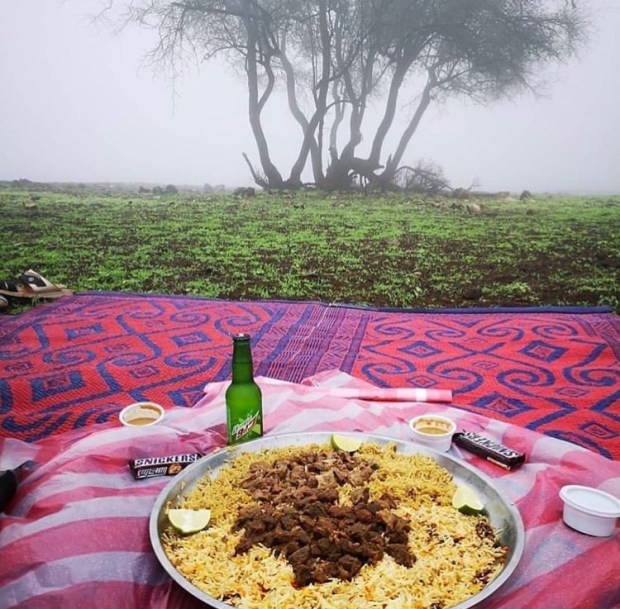
I have bowed to the inevitable and bought a water-proof purse; I wear washable Crocs. I have learned to always keep a stick or two of wood in my car so that it stays dry enough to get a fire started. I used to try to keep all the food covered but have given on that. Rain on the kabsa, rain on the briyani, rain on the mandi, rain on the mishgak (meat kebabs).

I have been on magical picnics. If you are sitting near the edge of a cliff, the clouds move in and out, opening and closing the vista down to the sea or over the plains. In the mountains, the ground is a carpet of green, with beautiful white flowers and purple flowers later in the season.

The culture you are born into is hard to shake; there are times I long for an umbrella, a rain jacket and a crisp cookie. But, food tastes better in the rain, or so I am told.

IMG_3202

(photo from social media)


Cognitive Dissonance and Food Identification

The monsoon season (finally) started yesterday so, in celebration, I went for the first time to a small, cute shop which sells food made by a local woman. I had driven by and seen it but never gone in. With the drizzle coming down at a steady pace, I decided to have a small party, support women who are selling food, and, of course, continue my food research!

As I viewed the sandwiches, cooked food and cakes on display, I discussed the food in a mixture of Arabic and English with the expat man who was working. “Is this strawberry cake?” I asked, pointing to a cake with a pink layer of what looked like jam. He said yes. I repeated the question in Arabic to make sure, then moved on, “Is this cake with coffee flavor? Is this chicken? Is the chicken spicy or normal?” etc. I bought a selection of things, went home and produced them for my guests: this is non-spicy chicken, this is strawberry cake, this is coffee cake.

Wrong. All of it wrong. The chicken was fiery hot, it wasn’t strawberry and the brown cake was ‘Lotus’ flavored, not coffee. Sigh. Last week it was at KFC, I ordered 4 chicken strips and Dew with ice; I got someone else’s order and was told that the Dew, which had no ice, has “ice inside.” Sigh. In these kinds of example, it’s a mixture of linguistics and culture. I would not think of a ‘biscuit-flavored cake’; a white cake with medium brown frosting looks like ‘coffee’ to me. ‘Ice’ to me is cubes the size of cherry tomatoes, not that the soda is cold.

good morning - wood

Sometimes it is an issue of what you ask for is not what you get but sometimes it’s a visual and cultural problem, as in the photo above – I enlarged that photo several times, tilting my head, thinking “WHAT is that in the little bowl?” Finally I decided it was walnuts and date maamoul (dates with spices cooked into a paste, surrounded by a heavy sugar cookie dough and baked). I don’t think of  walnuts as breakfast food so I had to wait until my eyes could “see” them. Several times I have seen shallow bowls of dates and assumed it was pieces of meat and vice versa. One trick I learned is that if there is a coffee dallah (traditional Arabian coffee pot) it is dates; if there are cups of tea, it is probably meat. [Or in the above photo, the piece of wood doesn’t look like what I expect ‘camp fire wood’ to look like: it’s dark, full of holes, almost insubstantial looking. But from camping in the desert, I know this is typical of wood you can find or buy and it serves as a marker, “we are very far from town.”]

There is another level of difficulties: seeing various food items and not understanding how they fit together. A friend remembers being in a grocery store with me when we were in grad school. As we came around the corner of an aisle and the end cap had: cans of tuna, cans of peas, cans of sliced mushrooms, egg noodles, salt and canned cream of mushroom soup. I looked at her and said how this combination of food was a culturally-bound signifier of middle-class American in middle America, an implied recipe without stated recipe. Everyone who saw that display would know that all these items should be bought and cooked together to create a tuna casserole. But someone from outside that culture would see a collection of disparate items. Such as the photo below: chips, processed cheese and bread. This might be read as “put cheese on bread and eat with chips.” But Omanis know, you open the bag a little then crush the chips. Put cheese on bread, sprinkle on chip fragments and then roll up into a tube.

Eating begins with the eyes and everyone sees food through their cultures, upbringing and experiences. Learning to see again, see new, and re-see is a long process that I am still in the middle of.

tea with chips


‘Little c’ Culture: Flooded Roads and Cheese Triangles

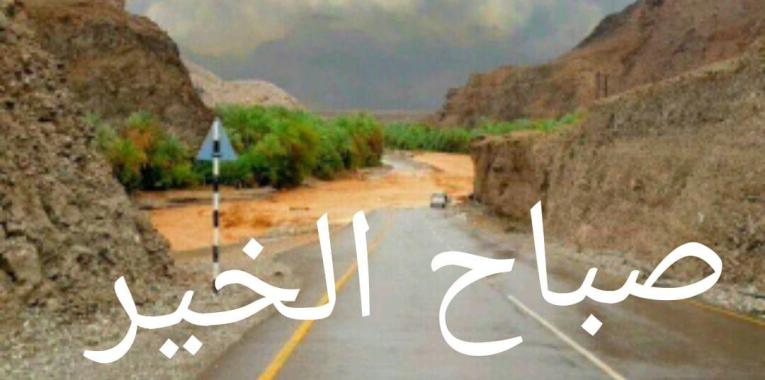
I am interested in ‘little c’ culture – everyday life examples of the values and principles of a culture, not the grand statements. For example, I love this ‘good morning’ greeting (see end of essay). It looks odd at first: “Good morning! The road is flooded and you can’t drive!” In some cultures it might be seen as sarcastic, but here it is heartfelt. Water is a blessing and it’s wonderful to have the wadis full. On the other hand, flooding can be dangerous and both the central government and civic entities work to limit damage by installing flood markers along roads; giving frequent forecasts and warnings; sending military personal to make sure no one attempts to go into flooded areas; and maintaining and training rescue teams, including helicopters.

Two keys to the image (which is don’t think is from Dhofar) are the trees and the clouds. The trees give the reason that the flood is good – periodic inundation means healthy plants and abundant crops. In Western cultures, clouds are a negative symbol, meaning something unclear, blighted, disappointing, but on the Arabian Peninsula clouds are positive. These clouds (which might be a little photoshopped) bring joy, not just for the rain but a respite from the sun. It’s telling that Arab cultures celebrate the moon (the nicest compliment for a woman is that she looks like the moon) while Western songs and poems celebrate the sun (“You are My Sunshine,” “Here Comes the Sun,” “I’ll Tell You How the Sun Rose” by Emily Dickinson, “The Sun Rising” by John Donne and “Solar” by Philip Larkin:

Suspended lion face
Spilling at the centre
Of an unfurnished sky
How still you stand,
And how unaided
Single stalkless flower
You pour unrecompensed.

The eye sees you
Simplified by distance
Into an origin,
Your petalled head of flames
Continuously exploding.
Heat is the echo of your
Gold.

Coined there among
Lonely horizontals
You exist openly.
Our needs hourly
Climb and return like angels.
Unclosing like a hand,
You give for ever.

Another examples of  “little c” culture is the cheese sambosas that are a common Iftar treat in Dhofar. My first year here, I attended an all expat women’s Iftar and someone brought cheese sambosas. I was in heaven! Fried cheese pastries, what more could I want? I asked where they came from and was told a bakery. A few days later, I went to a bakery to buy some but none were available. I checked several more places and no luck.

I asked a Dhofari and was told that they usually made at home. Only a few places sold them and then only during Ramadan, which by now had ended. So I waited until the next Ramadan and went searching again, no luck. WHERE ARE THEY HIDING? I asked Dhofari friends and finally learned that they are usually only sold in the 2 hours before Iftar, and only in bakeries with special outdoor stands. I had been walking into bakeries during the morning when I should gone looking at 5pm for bakeries with sloping glass-front display cases set up outside the store.The clues had been there – but I hadn’t read them correctly. Now I am an expert at buying cheese sambosas, but I will never ever tell a Dhofari how I eat them (cold for breakfast with English-style chutney).

good moring - road flooded

My article “An Ethnographic Discussion of Fairy Tales and Folktales from Southern Oman” will be published in Fabula

I am pleased to announce that my article “An Ethnographic Discussion of Fairy Tales and Folktales from Southern Oman” will be published in Fabula [https://www.degruyter.com/view/j/fabl]

This article discusses a collection of fairy and folktales from southern Oman to explain how some of the physical and cultural markers described in the texts which are still extant today. The tales, most of which were recorded in the 1970s, were originally spoken in Gibali (also known as Jibbali or Shahri, a non-written, Modern South Arabian language) and are published in Rubin’s The Jibbali Language of Oman: Grammar and Texts (2014). This paper does not place these texts within established codices; rather, the exegesis turns inward, examining how these stories, recorded at the beginning of modernization in the Dhofar region, reflect many traditional elements of Gibali cultures. Further, the article compares the texts to other Dhofari/ Omani fairy and folktales from Al Thahab’s Stories of My Grandmother: Folk Tales from Dhofar (2012), Al Taie and Pickersgill’s Omani Folk Tales (2008), and Todino-Gonguet’s Halimah and the Snake and other Omani Folk Tales (2008) to highlight how the Johnstone/ Al Mahri/ Rubin texts show Dhofari beliefs about oath-taking and the importance of teaching morality in written, but not oral, texts.


Foodways Images – Humor, Disseminating Information, and the Instagram Food/ Money Connection

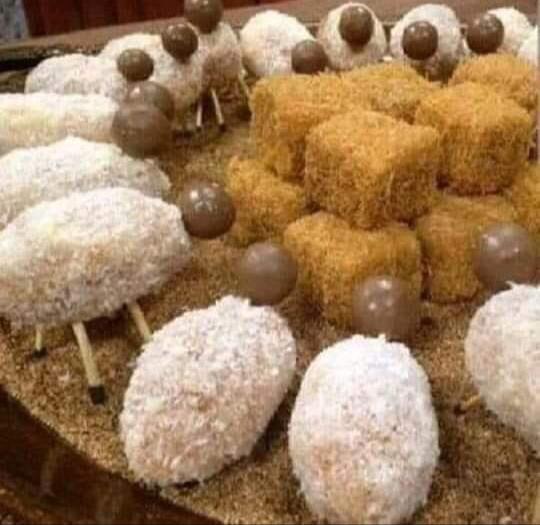
Since Ramadan is the time for religious devotion, reflection and family, I have not been able to meet with my research groups so I have spent a lot of time over the last 4 weeks looking for images connected to food. These posts are a kind of rough draft of research as the first step is to gather data, then comes the comparisons and analysis. I have had a lot of fun, some of the images (like the sheep cake) are amusing, But I am also gathering insights into how social media is connected to foodways in Oman. One thread that has become clear is that varies entities use images to help spread useful information (halal Oreos, raising food prices, etc.) A second thread is that people use social media to monetize food (catering ads and fish prices, etc.).  This will be the last ‘images’ post for awhile and I hope you enjoyed the brief excursion from words to pictures.

Getting creative with cakes:

funny cake

Joke – “the proper treatment for hands after making sambosas,” i.e. buy gold for the women who worked hard to make good Iftars

sambosa-gold.jpg

Notices about food price increases

Warnings about food

Advertisements for home-based catering companies

Food images from home-based catering companies

Announcing fish prices:


Research questions – this image caught my eye because, during more than ten years in Oman, I have never seen fish presented like this. When I looked closely, it was was ad for a Kuwaiti restaurant so I wonder if this is, in fact, a difference of presentation or if I have simply not had the chance to see Omanis serve fish in this manner.

kuweit

Food Perceptions – Honey

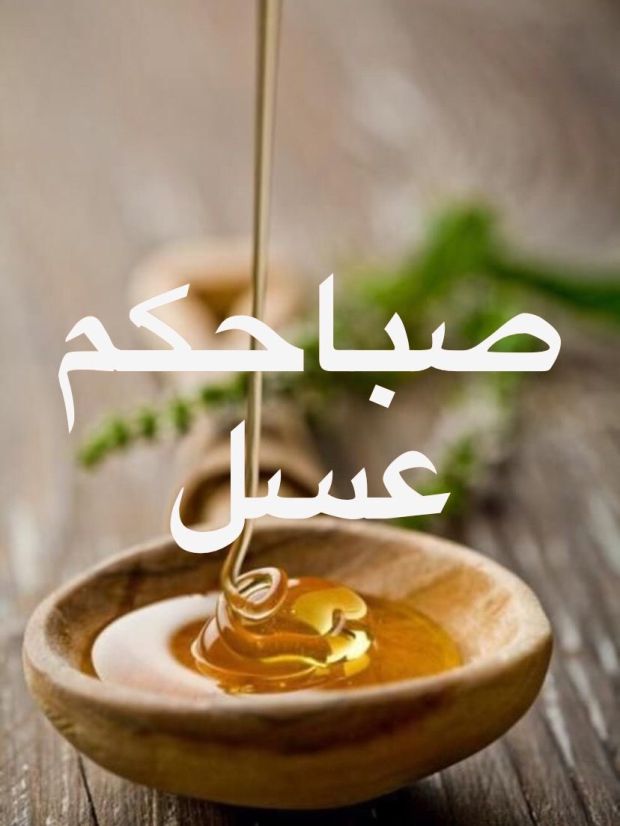
honey - wooden bowl!

The role of a food product often changes between cultures and sometimes even within a culture. A friend from India once complained to me about how many American desserts and breakfast products and were flavored with cinnamon, explaining that cinnamon is, “not for sweets!”

In Dhofar, local honey is mainly a medicinal product, taken straight by the spoonful for coughs, upper respiratory and stomach ailments. Honey from hives in the mountains is usually bottled into glass bottles (often Vimto) and given to family, friends and neighbors; sometimes a few bottles are sold. This honey is taken in small amounts daily or when a person is sick.

There are also stores and booths at local festivals staffed by Yemenis and selling Yemeni honey. Rodionov has an excellent article discussing the cultural practices with respect to honey in Hadramawt (see below). The Yemeni dish, bint al Sahn, is not served as dessert normally in Dhofar, but it can be found in Yemeni restaurants.

On the other hand, commercially produced honey is bought at a grocery store and drizzled liberally as a sweetener on bread at breakfast. It is not expensive, for example if non-local honey is brought on a camping trip, whatever is not used is often poured out and the container thrown away.

Thus honey inhabits two separate spheres with a huge difference in the cultural importance  and function. Honey from Yemen or Dhofar is valuable, not just in price but in worth. A bottle of local honey is a treasured gift, consumed slowly and entirely over weeks or months. The tall glass bottles are kept out in a safe place, out of reach of children. Honey bought at the grocery store usually comes in plastic squeeze bottles and if it is spilled or wasted, it is not perceived as a great loss.

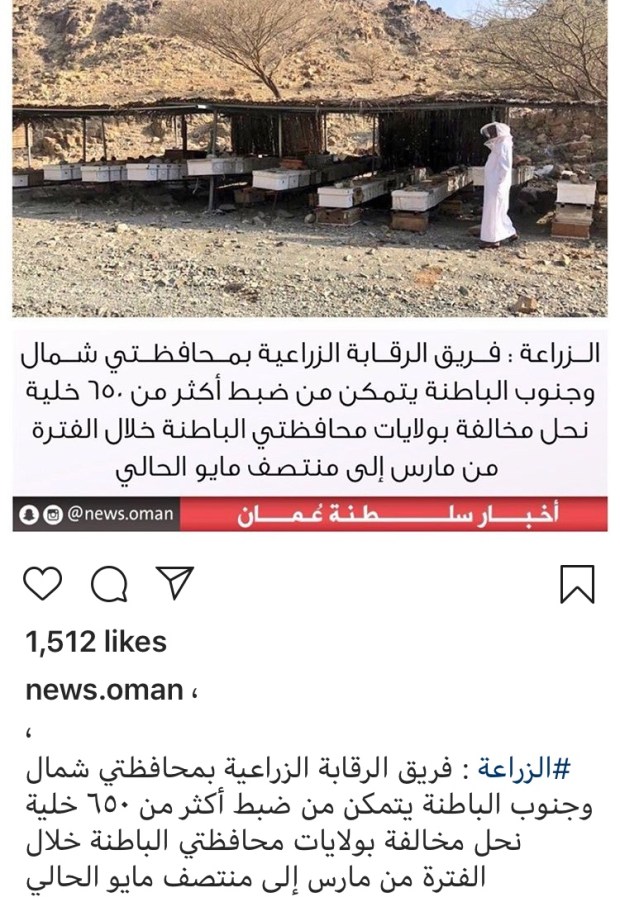
The Omani government supports bee-keeping both in terms of honey production and protecting/ increasing the bee population.

bees


Rodionov, Mikhail. “Honey, Coffee, and Tea in Cultural Practices of Ḥaḍramawt,” in Herbal Medicines in Yemen: Traditional Knowledge and Practice, and Their Value for Today’s World. Ingrid Hehmeyer and Hanne Schönig, eds. Brill: Boston, 2012, 143-152.

Images of Food during Ramadan – Iftar Humor and Iftar in Beautiful Places

Humor is a good way to get insight into cultures – what’s funny shows what’s important. Here are a few jokes circulating through Oman social media pertaining to food issues during Ramadan. I should be clear that there are no jokes about Ramadan itself, but about, for example, food for Iftar and who to have Iftar with. At the end are are few typical images of Iftar in a scenic place.

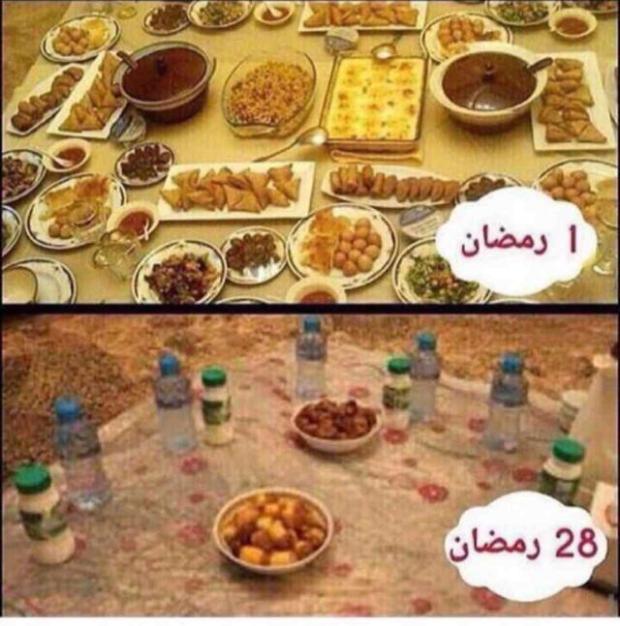
Joke about the differences in choices between Iftar on the first day of Ramadan and the last day.

ramadan joke

Joke about the difference between Iftar alone (in a strange place) and with your mom

ramadan - iftar

Stills from a video which makes fun of how prepared food is sold in front of shops for Iftar. Many bakeries and restaurants set up small tables with tents to sell samosas/ sambosas (fried triangles of filo dough filled with cheese, meat or vegetables; or a thicker, pyramid shaped dough filled with spiced mixed vegetables, meat or potatoes and fried) and sweets, but in this video a tailoring shop and a tire store have also set up tables to sell food.

Stills from a video making fun of issues of hospitality – people who insist on someone having Iftar/ a meal/ tea with them – this is one of several with the same theme. It opens with a man (A) inviting another man who refuses (B). The video them cuts to a movie scene in which a man who resembles B is trying to get away from a man who resembles A, the two fight and A eventually wins. The last scene is A and B eating in A’s house.  (Note the headscarves show that these are not Omanis, but there are Omani videos with the same theme of forced hospitality)

Iftar in a scenic place – the top left image is from Sultan Qaboos University in Muscat


Ramadan and Foodways – Images of food in connection to greetings and good behavior, Vimto and selling food

Marieke Brandt (2017) and John Postill (2016) have written about using social media to do anthropological research in places that are difficult to reach; it is also valuable when you are living in the same area. Scanning social media in Dhofar helps me to understand how food is conceptualized during the holy month of Ramadan. The analysis of the images comes next, but for now I am trying to discover the range of images and sorting through to see what kind of categories are found (and not found). In this post are some examples of food images in Ramadan greetings, different type of images with Vimto (a drink that has become associated with Ramadan), efforts by the government/ official channels to encourage good eating and generous behavior and an example of how prepared food is sold.

Food as a part of typical Ramadan greetings


The importance of Vimto!


Vimto at McDonald’s and Baskin-Robbins


Vimto as decoration


Fun with Vimto

vimto - moon

Efforts by government and private entities to improve eating habits during Ramadan

ramadan - nuts

This slideshow is stills from an ad which makes fun of people who have too much of something as a way to caution people against making too much (and then wasting) food at Iftar: a man who has several watches, a woman who has several TVs, a man wearing several hats, then the message.


This slideshow requires JavaScript.

Stills from a short video reminding people to not embarrass (judge) others during Ramadan. The video starts with 2 women preparing iftar, one is seen by a man as she eats a samosa. Then you see the family sitting at the table and enjoying iftar. The man pretends to ask the girl if she is enjoying the food, then humiliates for breaking her fast. As she looks sad, his wife pulls his dishdash and explains that she has a lawful reason not to fast.


There are many photos to children helping to prepare Iftar/ handing out food

iftar help

Selling prepared food for Iftar:


The photos of the woman selling food are taken from an ad on social media which shows close-ups of several types of food and an description of the exact location of her tent.