A version of this essay is published as:
Risse, Marielle. 2020. “Teaching Paired Middle Eastern and Western Literary Texts.” Advancing English Language Education, Wafa Zoghbor and Thomaï Alexiou (eds.). Dubai: Zayed University Press. 221-223
Click to access AELE_Book_ALLT_ZU_Web_V02.pdf
Abstract
This essay focuses on a technique which increases students’ participation, creativity and analytical ability in literature and language classrooms. By teaching two texts together, one from a Western and one from a Middle Eastern culture, students can compare and contrast a familiar text to one that has new settings, themes, people and opinions. This analysis allows students to see how characters, leitmotifs and points of view can be both similar and different across cultures, and in turn improves students’ reading, writing, speaking and critical thinking abilities. As some teachers might be hesitant to use literature in a language classroom or be unfamiliar with texts from a different culture, this essay gives several specific examples, in addition to explaining how to teach paired texts. When teachers overcome the fear of working with new texts, they can expand their students’ knowledge.
Introduction
This paper is designed to give practical advice about creating or augmenting syllabi for English language, English literature and literature in translation classes. It is for both teachers of English language and English literature in the Middle East because teaching literature, especially poetry, is a way for students to expand their vocabulary in a more fun, less regimented manner than textbook materials. Reading literature can also help introduce students to cultural differences in the use of metaphors. For example, when American people say, “I’m blue,” this means they are feeling sad. If students are not exposed to authentic, natural texts in the target language, they will miss the meaning of cultural idioms. This essay is also useful for teachers who want to use texts by Arab or Persian authors for World Literature or Literature in Translation classes.
Thus, the purpose of the paper is dual fold: to assist teachers who are familiar with literature by Middle Eastern writers by giving ideas in English literature, as well as suggestions about Middle Eastern literature for teachers who are more familiar with English literature.
My method is to explain the use of “pairing” texts, meaning to find an English text and a Middle Eastern text which have similar themes, characters and/ or setting so that the students will have a text in their own culture to compare to a text in the target culture. When students have one familiar text as a basis, it is easier to make the jump to reading in and about a foreign culture. To give examples of this technique, tables are included with texts from different genres.
The basis of my strategy comes from 14 years of teaching on the Arabian Peninsula. This extensive experience has shown me that to get students interested in learning, it is important to choose literature which is both accessible and relevant. An accessible text will fit the learner’s language ability. A relevant text will have characters, settings, and/ or situations that are familiar to the learners. A text with these criteria allows the teacher to keep the students’ attention while working through the vocabulary and grammar as a text that is utterly foreign to students in terms of style and language will be difficult or impossible to teach.
This paper will begin with an explanation of how to choose Arabic and English poems that complement each other with several examples. Then there will be a discussion of pairing short stories and dramas. Lastly, there will be a description of how to teach paired texts.
Finding Useful Poems
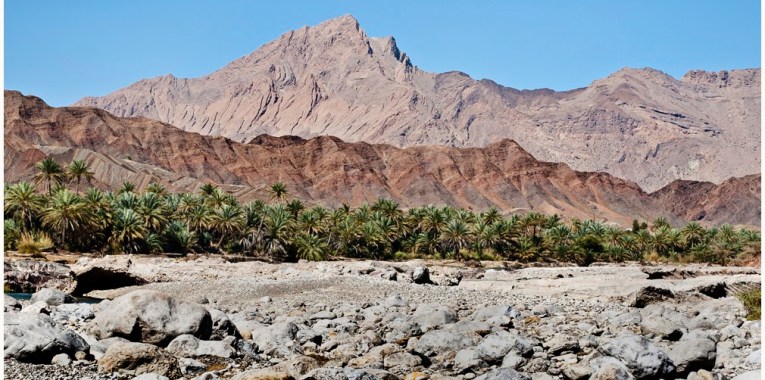
For an English teacher, the first step of pairing poems is to look for classic English poems which have some aspect such as setting or characters which students can relate to. For example, I teach in the town of Salalah, Oman which is surrounded by tree-covered mountains where different types of animals graze. I often use Marlow’s “The Passionate Shepherd to His Love” because as the students read the poem, they find vocabulary that they can use to describe their surroundings such as: “valley,” “rocks,” “shepherds,” and “flocks of sheep.” The poem has other nouns which have an Omani context such as “roses,” which are grown on Jebel Akhdar. Below are four of the stanzas with relevant vocabulary in bold:
Come live with me and be my love,
And we will all the pleasures prove
That valleys, groves, hills, and fields,
Woods, or steepy mountain yields.
And we will sit upon the rocks,
Seeing the shepherds feed their flocks,
By shallow rivers to whose falls
Melodious birds sing madrigals.
And I will make thee beds of roses
And a thousand fragrant posies,
A cap of flowers, and a kirtle
Embroidered all with leaves of myrtle;
A gown made of the finest wool
Which from our pretty lambs we pull;
Fair lined slippers for the cold,
With buckles of the purest gold
By focusing on the how the narrator’s words are connected to the students’ daily life in the context of Oman, I hope to motivate them try to understand and retain the new vocabulary. For example, in the above poem I can explain that “falls” is used here as a noun, not a verb, then give a local example of the “falls” in the town of Hasik. “Buckle” can be explained by discussing the belt that holds the traditional Omani dagger, the khanjar.
Similarly, Lord Bryon’s “She Walks in Beauty” is another famous English poem that is easy to teach in the Middle East because it is about a woman with dark hair and dark eyes, like most of my students. Many English poems celebrate a woman with blue eyes and blond hair, so it’s nice for my female students to have a text that describes someone like themselves. This similarity gives students a foundation of understanding when working through metaphors such as “she walks in beauty,” “tender light/ Which heaven to gaudy day denies” and “raven tress” which are in bold in part of the poem below.
She walks in beauty, like the night
Of cloudless climes and starry skies;
And all that’s best of dark and bright
Meet in her aspect and her eyes;
Thus mellowed to that tender light
Which heaven to gaudy day denies.
One shade the more, one ray the less,
Had half impaired the nameless grace
Which waves in every raven tress,
Or softly lightens o’er her face;
Where thoughts serenely sweet express,
How pure, how dear their dwelling-place.
Pairing Poems
After a teacher has found a few poems, the second step is to link those texts with Middle Eastern texts. This means finding a poem from the other culture which has a similar setting, theme or plot. The first poem, from their own culture, will be easy for students to understand; the similar poem in a foreign culture will allow students to smoothly cross cultural boundaries. Further, with two similar poems, students can move from merely understanding to the higher order tasks of compare/ contrast and analysis.
For example, in Herrick’s canonical poem “Corinna’s Going A-Maying” the narrator is calling to a woman to join him in enjoying the beauties of nature. There are several commands in the first two stanzas as noted in bold below:
GET up, get up for shame, the blooming morn
Upon her wings presents the god unshorn.
See how Aurora throws her fair
Fresh-quilted colours through the air :
Get up, sweet slug-a-bed, and see
The dew bespangling herb and tree.
Each flower has wept and bow’d toward the east
Above an hour since : yet you not dress’d ;
Nay ! not so much as out of bed?
When all the birds have matins said
And sung their thankful hymns, ’tis sin,
Nay, profanation to keep in,
Whereas a thousand virgins on this day
Spring, sooner than the lark, to fetch in May.
Rise and put on your foliage, and be seen
To come forth, like the spring-time, fresh and green,
And sweet as Flora. Take no care
For jewels for your gown or hair :
Fear not ; the leaves will strew
Gems in abundance upon you :
Besides, the childhood of the day has kept,
Against you come, some orient pearls unwept ;
Come and receive them while the light
Hangs on the dew-locks of the night :
And Titan on the eastern hill
Retires himself, or else stands still
These lines are direct requests from the narrator to a woman and are similar to the narrator in Ahmed Nedîm’s “Take Yourself to the Rose-Garden,” specifically the lines in bold below:
Take yourself to the rose-garden, it’s the season of our wandering
Oh swaying cypress, give back the ruined spring its reign
Pour down your dark curls, let your cheek be dressed in sable
Oh swaying cypress, give back the ruined spring its reign
Come rose-mouthed one, your nightingales are calling
Come to the garden, that we might forget the rose has gone
Come, before the meadow is ravaged by winter
Oh swaying cypress, give back the ruined spring its reign
Another example is the famous English poet John Clare, who wrote many poems about natural landscapes which pair well with Middle Eastern poems. His poems “June,” “July” and “Summer” are descriptions of hot days, linking heat and death instead of, for example, heat and love. Connecting heat and death is normal to Omani students who live through months of temperature in the 40s and descriptions of heat are common in Arab literature so there are a plethora of choices to pair with Clare’s poem. Some examples are Ahmed Muhammad Al Khalifa’s poem “The Deserted Valley” which begins with the lines “I came to it when the valley flowers were withered” and Abdalla Muhammad Jabr’s amusing poem “The Bursting out of Summer,” in which the second stanza begins “Tell the heat to spare me/ until another day.” Ibrahim Al-Hadrani’s poem “The Fountain” is another similar poem; it begins: “My love, we passed by this fountain once, / when our love was flowing freely, / we came back to it when the grass / was dry.”
An example of longer, more intricate poems which could be paired are “The Rider” by Qasim Haddad and “The Highwayman” by Alfred Noyes. They are both entertaining poems which depict the life of brigands in the Gulf and England in previous time periods. “Welcome rider, highwayman,” says the Bedouin narrator of Haddad’s poem to the robber. The narrator agrees to share his fire, clothes and horses, but warns the rider that justice, in the form of caravans which “Come for you.” Similarly, the robber in Noyes’ poem faces justice in a thrilling narrative.
Since most of my students are female, I like to use poems by women such as “Sojourn Forever,” “Free Harbor” and “You Alone” by Suad al-Mubarak al-Sabah together with “A Birthday” by Christina Rossetti. “Sojourn Forever” and “A Birthday” both have the metaphor of a woman in love being “on a throne”, while “Free Harbor” and “A Birthday” use metaphors of ships to show the happiness of shared love: “Your ships alone have the right to sail in my blood” trills the narrator of “Free Harbor”; “My heart is like a rainbow shell/ That paddles in a halcyon sea” echoes the narrator of “A Birthday”.
Below please find Table 1 which gives further suggestions for pairing poems.
Table 1: Poetry Suggestions
| Theme |
Poems by Western poets |
|
Poems by Middle Eastern poets
(in English) |
Middle Eastern Poets |
|
Sea |
Seafever, Masefield; The Sea View, Smith |
John Masefield, Charlotte Smith |
A Sailor’s Memoirs |
Muhammad al-Fayiz |
| Love |
A Birthday |
Christina Rossetti |
Sojourn Forever;
You Alone;
Free Harbor |
Suad al-Mubarak al-Sabah |
| Butterflies |
Fawziyya Abu Khalid |
| Unsuccessful love |
When We Two Parted |
Lord Bryon |
Love’s Wounds |
Abdullah al Faysal |
| Death |
Some Clouds |
Steve Kowit |
Clouds |
Sulaiman al-Fulayyih |
| Death of a child |
On My First Daughter, Jonson; For My Daughter, Ignatow |
Ben Jonson, David Ignatow |
Death in Life |
Ahmad Qandeel |
| Brigades |
The Highwayman |
Alfred Noyes |
The Rider |
Qasim Haddad |
| Depression |
Stanzas Written in Dejection, near Naples |
Percy Bysshe Shelley |
The Lost Mirage and The Deserted Valley |
Ahmad Muhammad Al Khalifa |
| Lullaby |
Wind of the Western Sea |
Alfred, Lord Tennyson |
ask students to write/ translate lullabies from their own culture |
| Patriotism |
Patriotism 1. Innominatus |
Sir Walter Scott |
A Page from a Bedouin Notebook |
Muhammad Al Thuhaiti |
| Motherhood |
For My Mother |
May Sarton |
A Pearl |
Fawziyya Abu Khalid |
| Muse |
Muse Not Muse |
Rosanna Warren |
The Poet and the Moth |
Ahmad Qandeel |
| Summer/ heat |
July, Summer, June |
John Clare |
The Deserted Valley |
Ahmed Muhammad Al Khalifa |
| The Bursting out of Summer |
Abdalla Muhammad Jabr |
| The Fountain |
Ibrahim Al-Hadrani |
Finding Useful Short Stories
Before discussing pairing short stories, I would like to highlight three stories which Omani students have reacted positively to. The texts all center on a younger and an older female character navigating the realistic life changes of growing up, making choices about preserving family history and growing older. These themes are familiar and important to many female students’ lives.
The first text is “Girl” by Jamaica Kincaid, a very short story made up of series of commands from a mother to a daughter. It takes a bit of time to unpack, but when students finally understand the set-up, they are amused, especially when they were asked to write their own version, using the commands and advice they heard as a young child.
The second is “Everyday Use” by Alice Walker which is about a simple country woman whose two daughters, one who lives with her and one who has moved to the big city, fight over a family heirloom quilt. The city daughter wants to preserve the quilt by hanging it on a wall, arguing that the other daughter would simply ‘use’ the quilt and thus wear it out. The mother finally decides to let the daughter who lives with her keep the quilt. The students could relate to the issue of preserving or using family artifacts, writing about the Omani khanjar (dagger), mandos (wooden chest), gold necklaces, and dresses that were their own family’s treasures.
The third text is “Going to Shrewsbury” by Sarah Orne Jewett, about an old woman moving from the simple house she has lived in all her life to the big city to live with nieces. The narrator meets Mrs. Peet on the train as she is going to the city; the older woman is worried about her unexpected and unwanted move. This text starts all kinds of class conversations about care of elderly relatives, specifically those who wish to preserve a more traditional life vs. younger generations who advocate for city living and modern amenities. The story ends happily, with Mrs. Peet making a successful adjustment and becoming the beloved ‘pet’ of the nieces.
All three of these stories have the same quality: the situation of the characters is similar to the situation of female college students in the Middle East. Although the texts are set in a foreign culture and written in a foreign language, Omani students can easily relate to a young girl who listens to her mother’s commands, a woman who wonders how best to preserve cultural artifacts and how to take care of an older relative who can no longer live alone.
Pairing Short Stories
In choosing short stories to pair, one of the easiest ways is to find two stories with a twist ending. For example, teachers could use a well-known English “surprise” short story such as “The Necklace” by Guy de Maupassant or anything by O. Henry with the Emirati author Mohammed al Murr’s “The Wink of the Mona Lisa.” In these kinds of texts, students want to read to find out what happens at the end and are rewarded with an unexpected ending. In “The Necklace” a woman borrows and then loses a rich friend’s diamond necklace. She forces herself and her husband into poverty in paying for a replacement. When she has finally paid for the piece of jewelry after years of hard work, she discovers that the necklace was made of fake diamonds and her hard work had no purpose.
In “The Wink of the Mona Lisa” a boy at his sister’s wedding party falls in love with one of his sister’s friends because she winks at him; he (as traditional) sends his mother and sisters to meet her and her family; his mother begs him to pick another girl with closer ties to his family but he insists on his choice. The students enjoyed condemning the shameless woman for such blatant behavior as winking at a strange man, until the last paragraph of the story when the happy protagonist, wedded to the ‘wanton’ woman, finally confesses to his wife after the birth of their first child, that is was her wink that stole his heart. Startled, she thinks back to the night of her friend’s wedding, the new contact lens that hurt her eyes, and decides not to tell her husband that she never even noticed him that evening.
A sadder Middle Eastern “surprise” short story is “The Persian Carpet” by Hanan Shaykh in which a girl realizes her adored mother gave a carpet to her lover but blamed a poor man in the neighborhood. There are many stories which fit into this category and the teacher can stop the reading part way through the text and ask students what they think will happen. After students have finished both texts, they can compare and contrast how the authors built by the suspense and misdirected the reader’s attention.
Another way to pick two similar texts is to try to match the protagonist’s feelings or the general atmosphere of the texts, instead of the characters or plot. For example, the dissipated, world-weary view expressed in “Another Evening at the Club” by Alifa Rifaat is a good companion-piece to F. Scott Fitzgerald’s novel “The Great Gatsby” or his short story “Babylon Revisited.” Similarly, “Love and Rain” by Muhammad Alwan about a boy’s failed attempt to impress a female classmate is the Arabic equal to James Joyce’s “Araby.”
A third way to pick two texts to teach together is to find an English short story and a Middle Eastern short story which have a similar metaphor. In Muhammad Al Murr’s two short story collections in English, Dubai Tales (2008) and The Wink of the Mona Lisa (1998) there are many descriptions of the dissolution of the traditional family life with the coming of oil wealth in the Emirates. One recurrent theme is that of cars, how the apparent motion of being in a vehicle is actually representative of a life that is stuck. For example, “In Transit,” is told from the perspective of a woman who becomes close friends with her female driving instructor, Laila. The emphasis is not on the narrator’s desire to learn how to drive (freedom as positive) but on her friendship with Leila who is “free,” i.e. without a family, but lonely and unable to sustain friendships (freedom as negative). Laila’s life is “in transit” – teaching women to drive but never at rest herself.
In Al Murr’s works, cars have a positive appearance but become traps, for example in the story “Road Accidents” in which a husband and wife are unhappily stuck in a car and “Pleasures of the Night” in which a man picks up a woman who he thinks is a prostitute but turns out to be mentally-impaired. This negative type of car imagery is used by other Gulf Arab writers, such as Abd al-Hameed Ahmad’s story “Khlalah SEL,” and can be taught in conjunction with Western writers who use the same kind of metaphor such as Louise Erdrich.
In Erdrich’s short story “The Red Convertible” the narrator’s brother, Henry, haunted by his life as a soldier in Vietnam, painstakingly restores his beloved car. The narrator, Lyman, and his brother had many adventures in his red convertible before Henry’s deployment but when Henry returns, he lives in a stupor. Lyman, in an attempt to bring his brother back to life, wrecks the car. Henry fixes it, but then kills himself. Lyman rolls the car into the river in which Henry has drowned himself. On the surface Al Murr’s stories and Erdrich’s story may appear to be very different, but the core metaphor is similar. Cars are usually a positive symbol of freedom and movement, but in these stories cars represent how characters are trapped in difficult circumstances.
Below please find Table 2 which gives further suggestions for pairing short stories.
Table 2 – Short Stories Suggestions
| Theme |
Stories by Western writers |
Western Writers |
Stories by Middle Eastern writers
(in English) |
Middle Eastern writers |
| Car/ Freedom |
The Red Convertible |
Louise Erdrich |
In Transit and Road Accidents, Al Murr; Khlalah SEL, Ahmad |
Mohammed Al Murr; Abd al-Hameed Ahmad |
| Surprise ending |
The Necklace, de Maupassant;
O. Henry stories, e.g. Love Medicine |
Guy de Maupassant; O. Henry |
The Wink of the Mona Lisa, al Murr; |
Mohammed Al Murr; Hanan Shaykh |
| Dreaming of a better life |
The Secret Life of Walter Mitty |
James Thurber |
The Staircase, Sayyar (A) and The Discontented, Abouzeid (A) |
Ali Sayyar, Leila Abouzeid |
| Importance of nature |
The White Heron |
Sarah Orne Jewett |
I Saw the Date Palms (A) |
Radwa Ashour |
| Nature/ memory |
The Worn Path |
Eudora Welty |
The Doum Tree of Wad Hamid |
Tayeb Salih |
| Love |
Mr. and Mrs. Dove |
Katherine Mansfield |
Dancing by the Light of the Moon (LMA) |
Salih Saeed Ba Amer |
| Childhood love |
Araby |
James Joyce |
Love and Rain |
Muhammad Alwan |
| World weariness |
The Great Gatsby or Babylon Revisited |
F. Scott Fitzgerald |
Another Evening at the Club |
Alifa Rifaat |
| Time shifts |
The Swimmer |
John Cheever |
Half a Day |
Naguib Mafouz |
Finding and Pairing Dramas
There are fewer plays in the Arab literary tradition than poems or stories. One way to find dramas for classroom use is to teach a play which is set in the Middle East, such as Mary Zimmerman’s The Arabian Nights. The language is not difficult, which makes the text accessible to English language learners, and some scenes have familiar Middle Eastern characters and scenarios, such as the vast wealth implied by a “wedding guest in all her jewels” (59). One of the advantages of the play is that several scenes teach morals, for example the plot of “The Forgotten Melody” was seen by students as both enjoyable and didactic, i.e. an amusing story with realistic underpinnings. After discussing the “Prince and the Tortoise,” several Omani students gave examples of how, when a man married a woman his father did not approve of, the daughter-in-law overcame her father-in-law’s disapproval with careful attention to him when he was sick.
A second way to find dramas to teach together is to find Middle Eastern authors who have reimaged Western stories. For example, The Arab Oedipus (Carlson 2005) collects four versions of the canonical Greek story written by Arab authors. Any of these four dramas could be taught in tandem with variations of the legend of Oedipus by Greek authors such as Homer, Hesiod, Aeschylus, Euripides or Sophocles’ plays Oedipus Rex and Oedipus at Colonus.
One drama from this book which is especially interesting is The Comedy of Oedipus by Ali Salim, a wonderful reimaging of the Oedipus story. In Salim’s version, Oedipus does not actually kill the Sphinx, but as the action happens out of sight of the citizens and the Sphinx disappears, he is celebrated for his achievement. Through most of the play, he wonders how he can tell the citizens, who hasten to buy “Oedipus Killed the Beast” action figures, that he never actually killed the Beast. At the end of the play, the Beast reappears and the citizens expect Oedipus to repeat his magic. When students read Sophocles’ and Salim’s versions of Oedipus, they can compare and contrast how the two authors approach this myth.
A third way to pair dramas is to find two texts with a similar theme, even if the settings and time periods are different. Plays, Prefaces and Postscripts of Tawfiq Al-Hakim (1981) has several thought-provoking plays. One that students have really enjoyed is Princess Sunshine because the drama has a serious theme which is leavened with many jokes. The play starts with Sunshine insisting that she choose her own husband. The man she chooses, Moonlight, takes her out of the castle with her disguised as a man. He teaches her how to work for herself, making dinner and living simply. They then catch two thieves and force them to return the stolen money to a Prince. At the end Moonlight leaves Sunshine to marry the “Prince” and continue to reform her country, as Moonlight continues on his way to teach other people his ideals of living simply and honestly.
Princess Sunshine’s theme of a woman deciding who she should marry and how she should live her life is similar to several plays such as Much Ado About Nothing by Shakespeare, Quality Street by J.M. Barrie (especially with the aspect of disguise) Lady Windemere’s Fan by Oscar Wilde and Arms and the Man by G. B. Shaw. Further, the pull between love and country (as Sunshine and Moonlight fall in love, but he convinces her to stay and spend her life helping her country) make it a great companion to, for example, Sophocles’ Antigone.
In addition to light-hearted plays, Al Hakim also wrote serious pieces, for example, the drama Death Song. This drama is about a man who returns to his village to discover that his mother expects him to carry out a revenge murder. He refuses, and his mother then has another man kill her own son. The theme of whether or not to revenge an insult is similar to Shakespeare’s Hamlet. This gives students a chance to discuss and analyze the author’s and their own opinions about the necessity and righteousness of vengeance.
Below please find Table 3 which lists these suggestions for pairing dramas.
Table 3 – Drama Suggestions
| Theme |
Plays by Western Writers |
Western Writers |
Plays by Middle Eastern Writers
(in English) |
Middle Eastern Writers |
| Revenge |
Hamlet |
Shakespeare |
Death Song |
Tawfiq al Hakim |
| Female protagonist – duty to country |
Antigone |
Sophocles |
Princess Sunshine |
Tawfiq al Hakim |
| Female protagonist – making decisions about her own life |
Much Ado About Nothing |
Shakespeare |
Princess Sunshine |
Tawfiq al Hakim |
| Quality Street |
J.M. Barrie |
| Lady Windemere’s Fan |
Oscar Wilde |
| Arms and the Man |
G. B. Shaw |
| The role of fate |
Oedipus Rex and Oedipus at Colonus |
Sophocles |
The Comedy of Oedipus |
Ali Salim |
Teaching Paired Texts
Once a teacher has found two accessible and relevant texts, the method of teaching depends on the kind of class. If it is a language class, teachers will concentrate on vocabulary and grammar; in literature classes, teachers will use literary terms such as “narrator,” “setting,” “characters,” and “plot.” When comparing the two texts, the teacher will help the students see what is similar and what is different. This analysis can then be used as the basis for compare/ contrast essays depending on the level of students. Teachers might also divide the class in two and give one text to one half and the other text to the other half. Each group of students can study their text, then explain it to the other group. Then they can work together to figure out what the similarities and differences are.
Because poems are the shortest and easiest to read, pairing poems is more suitable for lower level classes or classes which are only one hour. Working with short stories should be reserved for students who are at the beginning intermediate level; the class time will usually take 2 or 3 hours. Comparing dramas should only be done with higher level language students and the class time will be more than 10 hours to read, understand and compare the two texts.
The benefits of teaching paired texts are numerous. Students can increase their vocabulary in a more interesting way than simply memorizing lists of words. If the teacher has found poems, stories and dramas which have a connection to the students’ world, then they will be more engaged in reading and understanding. Further, having two texts to work with means student will have a chance to use higher order thinking skills such as comparing and analyzing.
Conclusion
Teachers who choose accessible (at the student’s level) and relevant (of interest to students) texts will discover that students will be more engaged and interested in reading. Students feel more comfortable reading texts which are familiar to them, but teachers also need to expand students’ horizons with information from different settings and cultures. An easy way to accomplish this is to use one familiar text from the student’s own culture, and one from a new culture. Sometimes teachers do not have information about texts in different cultures, so this paper has given specific examples in the three genres of poems, stories and dramas. This paper is in no way definitive guide to all texts that can be used as there are endless possible combinations of texts, but this paper illustrates ways in which teachers can choose similar texts. The list of references is divided by genre and includes all the texts mentioned in this paper, as well as further suggestions to help inspire teachers to discover new texts on their own.
References
Examples of Middle Eastern Authors: Poetry – single author
Elmusa, S. (2008). Flawed landscape: Poems 1987-2008. Northampton, MA: Interlink.
Kahf, M. (2003). E-mails from Scheherazade. Gainesville, FL: University Press of Florida.
Kabbani, N., trans. (1999). Arabian love poems. (B. K. Franieh and C. R. Brown, Trans.). London: Lynne Rienner.
Mersal, I. (2008). These are not oranges, my love. Riverdale, NY: Sheep Meadow Press.
Nye, N. S. (2002). 19 varieties of gazelle: Poems of the Middle East. New York: Greenwillow.
Williams, D. (1993). Traveling mercies. Cambridge, MA: Alice James Books.
Examples of Middle Eastern Authors: Poetry – anthologies
Charara, H. (Ed.). (2008). Inclined to speak: An anthology of contemporary Arab-American poetry. Fayetteville, AK: The University of Arkansas Press.
Fadiman, C., J. Major, and K. Washburn. (Eds.) (2000). World poetry: An Anthology of verse from antiquity to our time. New York: W.W. Norton.
Farrin, R.. (2011). Abundance from the desert: Classical arabic poetry. Syracuse: Syracuse University Press.
Hammond, Marlé. (2014). Arabic poems: A bilingual edition. New York: Knopf Everyman’s Library.
Handal, N. (Ed.). (2001). The poetry of Arab women: A contemporary anthology. New York: Interlink.
Nye, N.S. (Ed.). (1996). This same sky: A collection of poems from around the world. New York: Aladdin.
Sells, M. (Trans.). (1989). Desert tracings: Six classic arabian odes by Alqama, Shanfara, Labid, Antara, Al-Asha and Dhu al-Rumma. Middleton, CT: Wesleyan University Press.
Examples of Middle Eastern Authors: Fiction
Al‑Murr, M. (1998). “The wink of the Mona Lisa” and other stories from the Gulf. (J. Briggs, Trans.). Dubai: United Arab Emirates: Motivate Publishing.
Al-Murr, M. (2008). Dubai tales. (P. Clark and J. Briggs, Trans.). Dubai: Motivate Publishing.
Husni, R. and Newman, D. (Eds.) (2008). Modern arabic short stories: A bilingual reader. London: Saqi.
Johnson-Davies, D. (Ed.). (2006). The anchor book of modern Arabic fiction. New York: Anchor Books/ Random House.
Johnson-Davies, D. (1994). Arabic short stories. Berkeley: University of CA Press.
Kaldas, P. and Mattawa, K. (Eds.). (2009). Dinarzad’s children: An anthology of contemporary Arab American fiction. Fayetteville, AK: The University of Arkansas Press.
Kamal, M. (1999). Juha: Last of the errant knights. (J. Briggs, Trans.). Dubai: Motivate Publishing.
Lyons, M., Trans. (2014). Tales of the marvelous and mews of the strange. London: Penguin.
Examples of Middle Eastern Authors: Anthologies of Poetry and Fiction
Allen, R. (1998). The Arabic literary heritage: The development of its genres and criticism. Cambridge: Cambridge University Press.
Akash, M. and Mattawa, K. (Eds.). (1999). Post-Gibran: The anthology of new Arab-American writing. Klagenfurt, Austria: Kitab. Published in USA in Jusoor, 11 & 12, distributed by Syracuse University Press.
Bushrui, S. and James M. (2105). Desert songs of the night: 1500 Years of arabic literature. London: Saqi.
Jayyusi. S. K. (Ed.). (1988). The literature of modern Arabia: An anthology. London: Kegan Paul International.
Irwin, R. (2002). Night and horses and the desert: An anthology of classical arabic literature. New York: Anchor.
van Gelder, Geert Jan. (2013). Classical arabic literature: A library of arabic literature anthology. New York: New York University Press.
Dramas
Al-Hakim, T. (1981). Plays, prefaces and postscripts of Tawfiq Al-Hakim, Volume One. (W. M. Hutchins, Trans.). Washington D.C.: Three Continents Press.
Carlson, M. (Ed.). (2005). The Arab Oedipus: Four plays. New York: Martin E. Segal Theater Center Publications.
Zimmerman, M. (2005). The Arabian nights: A Play. Evanston, IL: Northwestern University Press.
Additional Suggestions
Risse, M. (2019, October 7). “Teaching Literature on the Arabian Peninsula,” Anthropology News website. http://www.anthropology-news.org/index.php/2019/10/07/teaching-literature-on-the-arabian-peninsula/
Risse, M. and Miriam Al Sabbah. (2017). “Don’t Be Afraid of the Novel: Austen for ESL Students,” Proceedings of the 16th Oman International ELT Conference. Muscat: Sultan Qaboos University Press, 2017, 28-35.
Risse, M. (2016). “Writing prompts to facilitate creativity and interesting texts,” Proceeding of the Oman 15th International ELT Conferences. Muscat: Sultan Qaboos University Press, 46-52.
Risse, M. (2014). “Selecting the right literary texts for Middle Eastern students: Challenges and reactions,” in Focusing on EFL Reading: Theory and Practice. Rahma Al-Mahrooqi, ed. Sultan Qaboos University Press, 165-188.
Risse, M. (2012). “Do you know a Creon?: Making literature relevant in an Omani university,” in Literature Teaching in EFL/ESL: New Perspectives. Rahma Al-Mahrooqi, ed. Muscat: Sultan Qaboos University Press, 302-314.




You must be logged in to post a comment.