I am happy to announce that my third book, Houseways in Southern Oman,  is now available for pre-order

I am happy to announce that my third book, Houseways in Southern Oman,  is now available for pre-order

https://www.routledge.com/Houseways-in-Southern-Oman/Risse/p/book/9781032218595

https://www.taylorfrancis.com/books/mono/10.4324/9781003270317/houseways-southern-oman-marielle-risse

https://www.barnesandnoble.com/s/%22Marielle%20Risse%22;jsessionid=5F50CF600F2E67884717DB4392396282.prodny_store02-atgap17?Ntk=P_key_Contributor_List&Ns=P_Sales_Rank&Ntx=mode+matchall

https://www.amazon.com/Houseways-Southern-Oman-Marielle-Risse/dp/1032218592

https://www.amazon.com/Marielle-Risse/e/B08SKYD848/ref=dp_byline_cont_pop_book_1

Teaching Literature and Staying au courantThe Man from Nowhere and the Ancient Greeks

There is a profound joy in introducing students to classic texts. I am very grateful that I have spent so much of my working life among the splendors of ancient Greek plays, Romantic Era poets, Jane Austen and Oscar Wilde.

And I am happy that as I teach I have gotten better at choosing classics which speak to my students, from 20th century writers such as Tawfiq al-Hakim to more modern writers such as Mohammed Al Murr and Badriyah al Bashar. And it’s fun help them get over the newness of Moushegh Ishkhan, Oriah Mountain Dreamer, Ryszard Krynicki, T’ao Yuan Ming, Tomas Tranströmer and Wisława Szymborska.

When I start the poetry class, I know that there is at least one student will be blown away by the Cold Mountain poems, Basho, Mary Oliver, Naomi Shihab Nye or Fowziyah Abu-Khalid. Someone will fall in love with  “Embroidered Memory” by Lorene Zarou-Zouzounis; someone else will champion “About Mount Uludag” by Nazim Hikmet.

It’s a delight to read familiar lines and see how students relate to familiar characters. Who is going to defend Ismene this semester? Who will argue on Creon’s behalf? Who is going to laugh when Patty in Quality Street talks about her hopefulness?  If we read Rebecca West’s The Return of the Soldier, who will my students pick as the one who deserves Chris – Kitty, Margaret or Jenny?

At the same time, it is good for me to be in the position of not knowing, to remember how it feels to be confused by a text. I became a better teacher after I spent two summers studying Arabic in Muscat. Sitting in a classroom as a student, panicking when a teacher asked me a question I did not understand, studying for a test and waiting anxiously for my grade made me more understanding of my own students.

So I try to seek out new texts to read and, perhaps, use for teaching. I scan shelves in bookstores and ask friends for suggestions. Since I don’t know Spanish writers, I asked a friend who has expertise and, following her suggestions, found “Marta Alvarado, History Professor” by Marjorie Agosín and “New Clothes” by Julia Alvarez, as well as “Tula” and “Turtle Came to See Me” by Margarita Engle.

Over the past few years, I have realized that I few students are into K-pop (BTS! Blackpink! Twice! NCT!) and so I decided to dip a toe into that cultural tradition.

The easiest way to start was movies so I duly looked at “top 10 Korean movie” lists and rented The Man from Nowhere (2010). One review mentioned that it was similar to Léon: The Professional (1994) in that it involved a young girl who is taken in and protected by a hired assassin. I thought knowing the plot would help me but there were a lot of differences, making the movie both interesting and confusing. For example, the ending surprised me. At the end of Léon, the girl is re-enrolled at her boarding school and she finally plants the small tree that she has been carrying around with her, symbolizing that she is now rooted.

At the end of The Man from Nowhere, the anti-hero asks the police for one favor and he brings the young girl he has been trying to protect back to her old neighborhood, goes into a small convenience store and buys her some composition books, writing supplies and a back-pack. Then he asks her if she will be ok. She nods, they hug and then he turns to go back into the police car.

I stared at the screen in astonishment. “That’s the end?!?” I wondered. Her father left long ago, her mother died at the start of the film, the girl was kidnapped and brutally treated for weeks, and now, with a few stationary supplies, the girl is now alone and supposed to take care of herself?

Over the next few weeks, I watched a few more and was astounded by whole new levels of plotting. It often feels like I am watching several movies at one: Assassination (2015) has freedoms fighters betrayed by team members (shades of Guns of Navarone), funny but doomed killers (shades of Butch Cassidy and the Sundance Kid) and twin sisters on opposite sides of an immense cultural, educational and temperamental divide (a grown-up, super spy equivalent of the Parent Trap).

I am often bewildered as I try out comedies, historical fiction and modern thrillers such as The Good, the Bad, the Weird (2008), Masquerade (2012), The Villainess (2017) and War of the Arrows (2011).

It takes a lot of concentration to understand each movie, not because of the sub-titles but the  work of trying to create new templates and figure out new tropes. How can I visually tell the difference between good guys and bad guys? Is the behavior of this woman showing that she is good or bad? Does this style of house indicate that the owners are rich, poor, old-fashioned or trend-setters? Is the meal the characters being served haute cuisine or everyday fare? Is this behavior normal or odd?

Sometimes it is good to be lost.

Houseways: Placement of Furniture and Sightlines – التقاليد المتبعة في ترتيب المناز بظفار

التقاليد المتبعة في ترتيب المنازل بظفار: وضع الأثاث وعلاقته بمجال النظر


click here to see original post: Houseways in Dhofar: Placement of Furniture and Sightlines

I am very grateful to Arooba Al Mashikhi for her work in translating some of my essays about houses in Dhofar.

I am grateful to Maria Cristina Hidalgo [https://www.mariacristinah.com/ ] for her helpful plans and to my informants who have allowed me to chart their homes.

ممتنة لماريا كريستينا هيدالجو لسماحها لي بالاطلاع على خططها المفيدة، -ولأولئك الذين سمحوا لي برسم منازلهم.

[https://www.mariacristinah.com/]


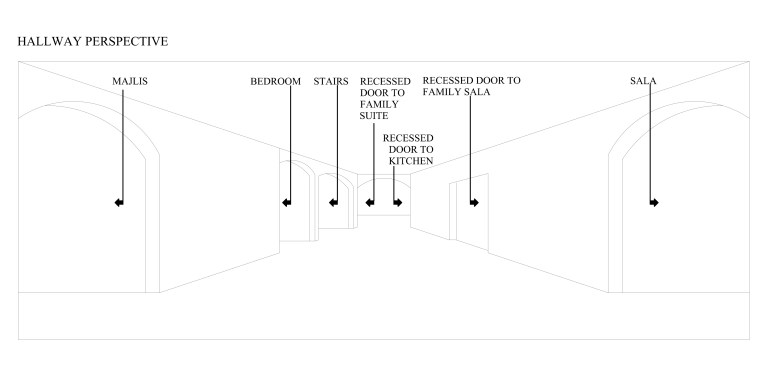
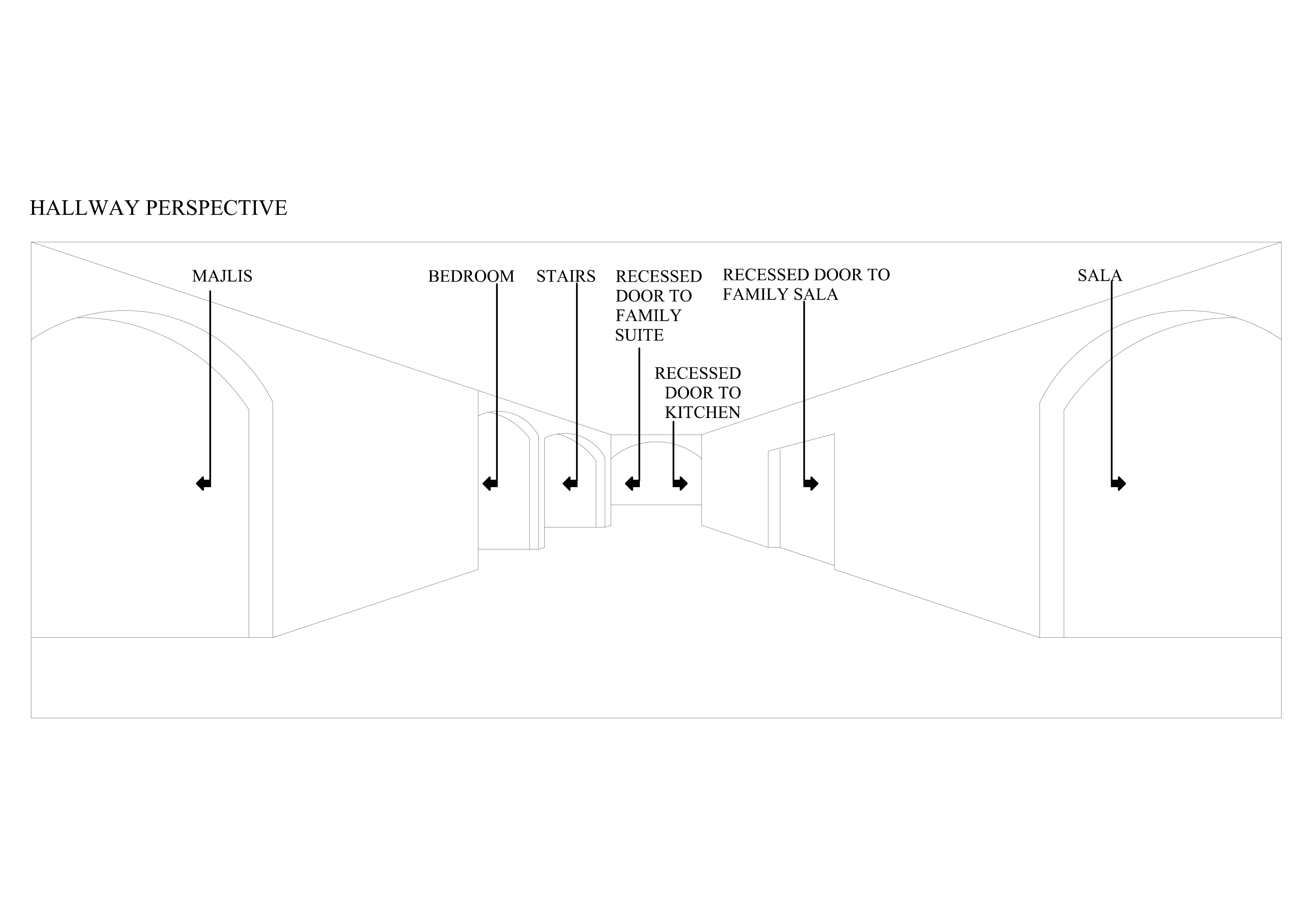
1) Perspective view of front hallway

Model

The first point is that when one walks through the main door, there is often no furniture in sight. Sometimes there is a high, narrow table near the door to set things on that will be out of reach of children or one might be able to get a glimpse into the salle but, as the perspective below illustrates, most of the furnishings are out of sight.

1 – عرض منظوري – للردهة – الأمامية

النقطة الأولى هي أنه عندما يمر المرء عبر الباب الرئيسي،  – لا يجدُ في الغالب اثاثاً. -–توجد أحياناً طاولة مرتفعة وضيقة بالقرب من الباب لوضع  أشياءٍ وإبقاءها – بعيدًا عن متناول الأطفال أو قد يتمكن المرء من إلقاء نظرة خاطفة على الصالة ولكن ، كما يوضح المنظور أدناه ، فإن معظم قطع الأثاث تبقى بعيدة عن الأنظار -.


2) Ground floor plan with furniture

Below is a bird’s eye view of the same house, showing how, as is usual in Dhofari houses, all the furniture is placed against the wall except for the small, moveable tables in the salle and majlis which are put in front of guests (represented here with small squares).

2) مخطط الطابق الأرضي مع الأثاث

نجدُ أدناه منظراً من الأعلى لنفس المنزل ، يوضح كيف يتم وضع الأثاث كما هو معتاد في المنازل الظفارية ، حيث توضع جميع قطع الأثاث – بمحاذاة الحائط باستثناء الطاولات الصغيرة المتحركة في الصالة والمجلس والتي توضع أمام الضيوف (- ممثلةً هنا بمربعات صغيرة)

Model


A few notes about the ground floor plan:

  • All the furniture is against the wall, most notable in the kitchen which has a small built-in table.
  • The salle is open to the main hallway but there is also a sliding door in the family salle and a door in kitchen, plus the outside door in the majlis. Thus, there could be four different types of visitors to the house at the same time who would not see each other because each were using a different door: male guests in the majlis, female guests in the salle, relatives in the family salle and a cleaner, repair person or someone bringing supplies such as drinking water or a gas canister into the kitchen.
  • The arch over the hallway at the far end separates the more public area (guest and family salles) from the family-only areas of the kitchen and one of the family suites.
  • The bedroom and maid’s room doors are set at 180 degrees from someone walking in from the front door; there is no way to see in “by chance.” Further, the beds are placed in such as way that they can only be seen if a person walks into the room.
  • There is constant air movement; the house has split ACs (meaning the motor is on the roof) and the kitchen and every bathroom has an exhaust fan which are usually on all the time.
  • There are five family suites on the upper floor, meaning the staircase is both the least used in terms of time (no one sits on the stairs) and most used in that every member of the house will use the stairs several times a day, except for the person living in the downstairs bedroom. For example, a women who does not cook might not enter the kitchen every day and a man might not have a reason to enter the salle for a week at a time.

بعض الملاحظات – عن مخطط الطابق الأرضي:

توضع جميع قطع  الأثاث  – بمحاذاة الحائط ،  وتوضع أبرز قطع الاثاث في المطبخ الذي يحتوي على طاولة صغيرة مدمجة – في الجدار.

– الصالة مفتوحة على – الردهة الرئيسية ولكن يوجد أيضًا باب منزَلِق في الصالة العائلية وباب في المطبخ بالإضافة إلى الباب الخارجي في المجلس. وبالتالي ، يمكن أن يكون هناك أربعة أنواع مختلفة من زوار المنزل في نفس الوقت  لا يرى بعضهم  البعض الآخر لأن كلاً منهم كان يستخدم بابًا مختلفًا: الضيوف الذكور في المجلس ، و الضيوف الاناث في الصالة والأقارب في صالة العائلة، وعامل تنظيف او تصليح أوشخصا لجلب – الاحتياجات مثل مياة الشرب واسطوانة الغاز – إلى المطبخ. 

– يفصل القوس – الذي يعلو نهاية الردهة؛ المنطقة العامة (صالة الضيوف والعائلة) عن المناطق المخصصة للعائلة فقط مثل المطبخ وأحد الأجنحة العائلية

– – تُركّبُ أبواب غرف النوم وغرفة العاملة المنزلية – بزاوية 180 درجة – عن – من يدخل من الباب الأمامي حتى لا يتم رؤية مابداخلها “بالصدفة”. علاوة على ذلك ، – توضعُ الأسرة بطريقة لا يمكن رؤيتها إلا – مِمَّن يدخلُ إلى الغرفة.

– هناك حركة هواء – مستمرة لأن المنزل – مزودٌ بمكيفات مركزية (بمعنى أن مروحة المكيف على سطح المنزل)  وفي المطبخ وكل حمام  مروحةُ شفط تعمل عادة طوال الوقت.

– توجد خمسة أجنحة عائلية في – الدور العلوي ، مما يعني أن الدرج هو الأقل استخدامًا من حيث الوقت (فلا أحد يجلس على الدرج) والأكثر استخدامًا ف-  في ذات الوقت لأن كل فرد في المنزل سيستخدم السلالم عدة مرات في اليوم ، باستثناء الشخص الذي يعيش في غرفة النوم – بالدور السفلي. على سبيل المثال ، قد لا تدخل المرأة التي لا تطبخ إلى المطبخ كل يوم وقد لا يكون لدى الرجل سبباً لدخول الصالة – لأسبوع -.


3) Example of family suite

Model


A door to the hallway which leads to a suite with a bathroom and two rooms is a very common floor plan in Dhofar; sometimes there is an additional store room. When a couple is newly married, one room is a bedroom and the other a sitting room. If they have several children, the suite will be set up as above, with one room for the parents and one for the children. When the children are older, they might be moved into a different suite which has one room with same gender relatives of the same age (siblings, cousins, etc.) and the second room as a study/ plan room. Only in very large houses would one person have a suite to themselves.

3) –  نموذجٌ لجناح عائلي

يعد تخطيط باب – الردهة – المؤدي إلى جناح – مكوَّنٍ من حمام وغرفتين تخطيطاً شائعاً جدًا في ظفار ؛  وقد تكون هناكَ أحياناً -غرفة تخزين إضافية. عندما يتزوج شخصان حديثًا ، تكون إحدى الغرف غرفة نوم والأخرى غرفة جلوس. – وإن كان – للزوجين عدة أطفال ، فسيتم إعداد الجناح على النحو التالي ، – غرفة واحدة للوالدين وغرفة للأطفال. عندما يكبر الأطفال ، قد – ينقلوا إلى جناح مختلف – – فيه غرفة – يشاطرونها أقاربهم من نفس الجنس – والعمر (الأشقاء وأبناء العم ، وما إلى ذلك) – وغرفة – ثانية تُستخدمُ  كغرفة دراسة أو تحضير. ولن تجدَ شخصاً يسكنُ جناحاً بأكمله إلا  – في المنازل – الضخمة.

Houseways: Who Visits Which Rooms? – التقاليد المتبعة في ترتيب المنازل: أي حجرة يحق للشخص الجلوس فيها؟

I am very grateful to Arooba Al Mashikhi for her work in translating some of my essays about houses in Dhofar.

click here to see original post:  July 10, 2021

Upper-class, English, Victorian-era homes had a set of rooms for children which would include a day nursery, night nursery, schoolroom, bathroom and the nanny’s room. In present-day America, a middle-class child might play on the kitchen floor while a parent is cooking, do homework on the dining room table, watch TV in a basement rec room, sit by the fire in a den or study, i.e. sit in different rooms for different purposes during one day.

كانت منازل الطبقة العليا الإنجليزية في العصر الفيكتوري تحتوي على مجموعة من الغرف للأطفال والتي تشمل حضانة نهارية وحضانة ليلية ، وغرفة مدرسية ، وحمام وغرفة للمربية. أما الان في أمريكا ، قد يلعب طفل من الطبقة المتوسطة على أرضية المطبخ أثناء قيام أحد الوالدين بالطهي  أو أداء واجباته المنزلية على طاولة غرفة الطعام  أو مشاهدة التلفزيون في غرفة الاسترخاء في الطابق السفلي ، أو الجلوس أو الدراسة بجانب الموقد في غرفة الطعام أي الجلوس في غرف مختلفة لأغراض مختلفة خلال يوم واحد.

Whereas young Dhofari children spend most of their in-door time in their parent’s bedroom and the salle. When they are close to puberty they will move to their own bedroom or a room with several children who are the same gender and around the same age. Children are only in the majlis in the presence of adults and for a reason, for example an uncle is visiting or they are working with a tutor.

في حين أن الأطفال في ظفار يقضون معظم وقتهم في المنزل في غرفة نوم والديهم وفي الصالة. عندما يقتربون من سن البلوغ ، ينتقلون إلى غرفة نومهم الخاصة أو غرفة بها العديد من الأطفال من نفس الجنس وفي نفس العمر تقريبًا. يتواجد الأطفال في المجلس فقط بحضور الكبار ولسبب ما ، على سبيل المثال ، عندما يقوم العم أو الخال بزيارة أو عند دراستهم مع معلمهم.

Dhofari children spend a lot of their free time out of the house once they can walk: in the hosh if younger than 3 or 4, then in front/ near house, then within the neighborhood in mixed gender/ mixed age groups until close to puberty. They also know the salle or majlis of many houses (grandparents, uncles/ aunts and older siblings) but will usually not play/ hang out in a cousin’s bedroom, although they might sleep there if it is an overnight visit. Children sleeping over at relatives’ houses is common, even among families which live close to each other. For example, when one female Dhofari friend was sick, she sent her child to stay for two weeks with her parents who live nearby.

يقضي الأطفال في ظفار الكثير من أوقات فراغهم خارج المنزل بمجرد أن يتمكنوا من المشي: في الحوش إذا كان أصغر من 3 أو 4 سنوات ، ثم أمام أو بالقرب المنزل ، ثم داخل الحي في مجموعات مختلطة الجنس والأعمار حتى قرب سن البلوغ . إنهم يعرفون أيضًا الصالة أو المجلس للعديد من المنازل (الأجداد والأعمام / العمات والأشقاء الأكبر سنًا) ولكنهم عادة لا يلعبون أو يتسكعون في غرفة نوم ابن عمهم ، على الرغم من أنهم قد ينامون هناك لليوم التالي إذا كانت زيارة ليلية. إن نوم الأطفال في منازل الأقارب أمر شائع ، حتى بين العائلات التي تعيش بالقرب من بعضها البعض. على سبيل المثال ، عندما كانت صديقة ظفارية مريضة ، أرسلت طفلها للإقامة لمدة أسبوعين مع والديها اللذين يعيشان في مكان قريب.

As children grow older, they experience the same house differently as the use of rooms is linked to both gender and age. For example, a Gibali girl visiting her paternal uncle’s house: as a baby she might be taken into the majlis by her father who is holding her; as a five-year old, she might spend the visit playing outside with male and female cousins; as a 14 year old, she might sit in the salle with her mom and older sisters. If she marries a cousin from this family, she will be expected to go into the majlis when there are visitors to bring tea and, perhaps, sit and visit.

مع تقدم الأطفال في العمر ، يعيشون في نفس المنزل بشكل مختلف حيث يرتبط استخدام الغرف بكل من الجنس والعمر. فعلى سبيل المثال ، عند زيارة فتاة جبالية منزل عمها: كطفلة قد يمسك والدها يدها ويحملها إلى المجلس ؛ وعندما تبلغ من العمر خمس سنوات ، قد تقضي الزيارة تلعب في الخارج مع أبناء عمومتها من الذكور والإناث ؛ وعندما تبلغ من العمر 14 عامًا ، قد تجلس في الصالة مع والدتها وأخواتها الأكبر سنًا. وإذا تزوجت من ابن عم من هذه العائلة ، فمن المتوقع أن تذهب إلى المجلس عندما يكون هناك زوار لإحضار الشاي ، وربما للجلوس والزيارة.

Further, men experience houses differently according to what his relationship is with the house owners. A boy will spend time in the salle of relatives’ houses when young and the majlis when older but there are many variables. For example, a 25-year-old Gibali man with three sisters (A, B and C) would have different visiting patterns depending on who owns/ controls the house that the sister lives in. He visits sister A in her salle because A and her husband own their own home and visits sister B in her salle because B married a cousin, thus the other women in the salle are his relatives. But he visits sister C in the majlis because C lives in her husband’s father’s home who are not relatives, so the salle is for C’s mother- and sisters-in-law.

فضلا عن ذلك، يستشعر الرجل المنازل بشكل مختلف وفقًا لعلاقته مع أصحاب المنزل، حيث يقضي الصبي وقتًا في الصالة بمنزل الأقارب عندما يكون صغيراً وفي المجلس عندما يكبر ولكن هناك متغيرات كثيرة. فعلى سبيل المثال ، سيكون لرجل جبالي يبلغ من العمر 25 عامًا ولديه ثلاث أخوات (أ ، ب ، ج) أنماط زيارة مختلفة اعتمادًا على من يملك / يتحكم في المنزل الذي تعيش فيه الأخت. فيزور الأخت (أ) في صالتها لأنها هي وزوجها يمتلكون منزلهما الخاص بهما ويزور الأخت “ب” في صالتها لأن “ب” تزوجت من ابن عمها ، فباقي النساء في الصالة هم من أقاربه. ولكنه يزور الأخت (ج) في المجلس لأن (ج) تعيش في منزل والد زوجها وهم ليسوا أقارب ، لذلك فإن الصالة مخصصة لوالدة زوجها وأخواته.

In a similar way, a married man who visits his wife when she is at her parent’s house might sit in the salle (if he is closely related to her family) or the majlis (if he is not). As most Dhofari women stay with their mother or an older sister for 40 days after the birth of their first child, a husband’s behavior is on display. All the female relatives of the new mother will know how often he visits, how long he stays and what he brings with him. This information is passed on to the general community, for example when a general question such as “how is the new mom doing?” is answered with, “fine, alhamdulillah, and her husband came every day to visit in the majlis,” his reputation (and the reputation of his family) is increased. This is a man who respects his wife and takes his responsibilities seriously. When the sister of one friend had her first baby, the family tried not to use the majlis at certain times so the husband could visit his wife and baby in privacy.

وبطريقة مماثلة ، يمكن للرجل المتزوج الذي يزور زوجته عندما تكون في منزل والديها أن يجلس في الصالة (إذا كان على صلة وثيقة بأسرتها) أو في المجلس (إذا لم يكن كذلك). ونظرًا لأن معظم النساء الظفاريات يبقين مع أمهن أو أختهن الكبرى لمدة 40 يومًا بعد ولادة طفلهن الأول ، فإن سلوك الزوج يكون على مرأى من الجميع. فستعرف جميع قريبات الأم الجديدة عدد المرات التي يزورها ، ومدة إقامته وما الذي يجلبه معه عند الزيارة. وتنقل هذه المعلومات إلى المجتمع العام ، فعلى سبيل المثال عند طرح سؤال عام مثل “كيف حال الأم الجديدة؟” تكون الإجابة: “بخير ، الحمد لله ، وزوجها يأتي كل يوم لزيارتها في المجلس” ، فتزداد شهرته (وسمعة عائلته). فهذا رجل يحترم زوجته ويأخذ مسؤولياته على محمل الجد. وعندما رزقت أخت أحد الأصدقاء بمولودها الأول ، حاولت الأسرة عدم استخدام المجلس في أوقات معينة حتى يتمكن الزوج من زيارة زوجته وطفله في خصوصية.

(photo of majlis by informant, used with permission)

 (صورة للمجلس التقطها أحد مقدمي المعلومات، وعرضت بعد الموافقة)

التحدث – Houseways: Talking Privately in Crowded Rooms – التحدث :على انفراد في الغرف المزدحمة

Houseways: Entrance Ways – Form Follows Function; طرق المداخل – الشكل يتبع الاختصاص

Houseways: Doorways – Design and Culture/ المداخل


I am happy to announce that I will be presenting about the research journeys of the ‘Palinurus’ for the conference: Research Expeditions to India and the Indian Ocean in Early Modern and Modern Times, sponsored by the German Maritime Museum / Leibniz Institute for Maritime History; Nov. 3 and 4, 2022

“Explorations in the North-west Indian Ocean: The Research Journeys of the ‘Palinurus’ along the Omani Coast in the mid-1800s.”

Research Expeditions to India and the Indian Ocean in Early Modern and Modern Times, sponsored by the German Maritime Museum / Leibniz Institute for Maritime History. Nov. 3 and 4, 2022.

https://www.dsm.museum/en/exhibition/news/call-for-papers-research-expeditions-to-india-and-the-indian-ocean-in-early-modern-and-modern-times

You Have Nothing to Fear from Sheep’s Eyes but Beware the Carrot Sweet: Researching Foodways in Southern Oman

During over a decade of picnics with men from southern Oman, I have never been offered the eyes, brain, tongue or tail of any animal. The cliché of guests being offered the ‘unloved’ parts of an animal doesn’t hold here in the Dhofar region. And it’s not that large platter of rice and meat that will cause you problems. Men will encourage you to eat, but if you gather up a few grains of rice in your hand and lift it towards your mouth, the host’s attention will move on.

If you are given a fish, you can turn the head away from you and start to eat from tail up, scattering by chance a few shreds of lettuce over the eyes. Then you declare yourself full before you need to deal with the stomach area, much less digging into the skull for the fish cheeks.

What you should fear is ladies’ parties with lots of very generous, caring, strong-arming women.

Men usually have dinner with friends on the beach or in a scenic place in the mountain. It’s dark, eating is done quickly and men come and go freely; there is little policing of who eats what. Although the cook might toss special pieces of meat or fish towards you, if you don’t want to eat them, simply leave them alone.

But women parties are usually indoors, with lots of light and everyone sits in their places for several hours so you are constantly under observation.

I love wedding parties because the air is full of beautiful perfumes and everyone is in gorgeous, comfortable, multi-color thobes (the loose, traditional Dhofari dress). And the food is delicious, but you cannot escape it. Either waitresses or relatives of the groom will bring around trays of drinks and sweets and everyone, not just the hostess, but all the other guests, will encourage you to partake.

You have had four cups of super-leaded, espresso-strength, cardamom-spiced Omani qahwa (coffee)? The generous women would like you to have a fifth cup! “You didn’t drink anything! Do you not like the coffee? Do you want tea! BRING TEA, SHE WANTS TEA!”  they call.

You protest but, alas, give up. The tsunami of kindness is coming for you. Take up the tea cup and drink. And as soon as you set down the cup, here come someone with juice, soda, instant coffee, chai ahmar (“red tea,” black tea with only sugar added), chai haleeb (“milk tea,” black tea with milk and sugar), or karak (loose tea with spices and milk).

Then come the sweets accompanied by women benevolently asking you to take another spoonful of halwa, the traditional Omani dessert. And like a swan-dive into a bowl of whipped cream, you submit to your fate: a small plate of carrot sweet, a bowl of crème caramel, a slice of cake, a bowl of ice cream, fruit salad, luqaymat/ loqeemat (sweet fried dough with a sugar syrup), basbousa, and wrapped chocolates.

And now, just as you give up any thought of ever moving again, dinner is served. A generous woman hands you a plate heaped high with a selection of appetizers (hummus, fattoush, baba ghanoush, etc., with pita bread) and qabooli (a dish with spices, rice and meat). Then, of course, dessert is served.

There have been weekends in which I have inhabited both worlds. One night was spent wearing loose cotton trousers and a tunic top with a plain blue headscarf and sitting on a plastic mat on a beach out of sight from any man-made lights. Dinner was fresh-caught fish cooked over a fire. The men in my research group and I ate with our hands, drank Dew, looked at the stars, listened to the sea and talked until 1am. The next night I wore a decorated velvet thobe with full make-up, my meager supply of gold jewelry and a lot of duty-free perfume, in a room full of air-conditioning, bright lights, and delightful women who wanted to stuff me until I burst.

Omani people are very open-hearted and open-handed and doing research on foodways is a lot of fun, but it is not for the meek or the small of stomach.

Foodways: Cultures, Food Selfishness and “Could I Have a Little Bite?”

“May I have a sip?” asks a much-loved older relative.

I stifle a sigh and hand over my coffee cup.

Three minutes later, “Can I have another sip?”

With a small sigh, I hand over the cup.

Two minutes later, “Can I…” and I hand the cup over while biting my lip.

I don’t want to share. That cup of caramel/ Brazil nut/ vanilla-flavored coffee is my first flavored filter coffee in 11 months and, since I probably won’t be back to that store again this summer, it’s the last of that kind for another year. And I want to savor every drop of it.

And cherished older relative could have bought their own, heck I would have paid for their own. But no, my relatives want “just a sip” and “just a bite.”

This might have turned me into a person happy to share, but it did not. I turned into a person who hates handing over my coffee cup, doing it only under duress and after chiding myself about the importance of generosity.

Then I moved to Oman and learned a whole new system of dealing of food. There is no “mine” and no “yours” when eating with my Dhofari friends. There is “ours” and everyone attempts to be the person who is fastest to pass the freshly poured cup of tea or the newly opened box of cookies to someone else.

When I am with female friends at restaurants; food is automatically pushed towards the center of the table. We cut off pieces of whatever we ordered and place it on each other’s plates, even if that person is protesting that they don’t want any. We unconsciously put some French fries on a plate in the middle of the table or turn our plates so it’s easy for someone to take some.

On picnics, the food is set out communally on a platter. No one takes anything out of the coolbox without asking each person what they want first. At the end of the night, you try as hard as possible to give the leftovers to someone else. Several times I have pushed others to take food (halwa or qibqab, a thin, plain cracker-like bread) that I really wanted to bring home.

I do this instinctively in Oman but when I am staying with family, my food protection systems engage, the remnant of years of fending off “just a bite” and “you should share.”

Seeing food (taco salad! cinnamon-raisin bread! potato salad! cranberry muffins!) that I haven’t had for almost a year, I get selfish. When I open a small (one person!) bag of Old Bay-spiced potato chips and a relative hovers and dives in, I fight my instinct to hold the bag out of reach.

When people ask for “just a sip,” I am still cranky but I envision my Omani friends’ horror at the thought of my behaving badly. I remember all the meals shared and all the French fries I have stolen as I hand over the coffee cup.

“It’s just pie, people are more important than pie,” I say to myself as a foreign fork appears at the side of my plate. I push my plate towards the fork, saying “go ahead” with a cheery tone. Ethnographic work changes you. For the better.


New essay: “Sîn is for Zenith” on the Arabic alphabet website

The Arabic Alphabet: A Guided Tour – http://alifbatourguide.com/

by Michael Beard, illustrated by Houman Mortazavi

“Sîn is for Zenith” – http://alifbatourguide.com/the-arabic-alphabet/sin/

excerpt:

The sound of Sîn (pronounced “scene”) is the clear sibilant we represent with our letter S. The S we know is all curves. Sîn is usually more angular, a little closer to the W shape of its Phoenician ancestor. Greek Sigma comes from the same source, the W shape tipped up 90 degrees clockwise.There was a Nabatean predecessor of Sîn in the form of a bowl shape with an upright growing out of it, something like Hebrew Shin. The shape of Sîn grows out of it: two miniature half-circles resting side by side. What strikes the eye are those three short uprights, referred to as “teeth” (Sîn word sinân in Arabic, the plural of sinn). It is not my job to say what is beautiful and what isn’t, but what I’m taken by in the most elegant handwritten Sîn is a slight asymmetry: the space between the first two teeth (reading right to left) is slightly narrower than the space between the second and third.

In terminal form Sîn ends with a rounded clockwise sweep, a shape which fledgling calligraphers struggle over, the clockwise descent and return, thickening along the bottom, tapering to a point as it rises on the left. The same curve reappears in Shin, Ṣad & Ḍad.

Sîn went through a period in its evolution when it had a triangle of dots suspended below the line, to distinguish it from the letter Shîn, the next in sequence, which has three dots above. (Shîn kept them. Present-day Sîn goes commando.) A streamlined variant of Sîn, still used, was developed in interests of efficiency: it can take the form, perhaps as a visual representation of the smooth prolonged sound of sibilance, of a straight unrippled line, often descending slightly, throwing the base line down a notch and continuing at a lower level. Easiest letter ever. In the initial or medial position the line simply continues on for a bit with nothing else happening.

The source of sinn, “tooth,” is the Arabic stem S–N–N, which, as a verb, means to sharpen, mold, shape. In one form, sunna, it means, in Hans Wehr’s definition, “habitual practice, customary procedure or action, norm, usage sanctioned by tradition; al-sunna or sunnat al-nabîy, the Sunna of the Prophet (nabîy), i.e. his sayings and doings, later established as legally binding precedents…” In other words, the ahl-al-sunna are the follows of the sunna, in English “Sunnis.” It’s an admirable definition, if only because Wehr defines the etymological stream of meanings without getting excited, or lost in detail. A history book, once it has said “Sunni,” has to go into teacher’s mode, including the actors and the theology, plus the alternative, Shiism, and to describe how Shiism ended up breaking away from “Sunnism.” Today everyone knows it, or can look it up, and the history hardly seems necessary. Hans Wehr defines shî‘a, the other major branch, as “followers, adherents, disciples, faction, party, sect”; al-shî‘a, the faction of Ali, the Shiah, the Shiites (that branch of the Muslims who recognize Ali, the Prophet’s son-in-law, as the rightful successor.)” It’s all the definition you need. They’re just words, ordinary words. Neither sunna nor shî‘a occur in the Qur’ân.

Reflections on Houseways Research

I got the e-mail confirming that my Houseways book will be published in January 2023 while sitting in a living room that is completely opposite of the rooms I have described and lived in Oman. The Canadian house had wooden floors and furniture, windows without curtains, no AC, a big fireplace, floor lamps, crocheted afghans, many photos and bookshelves overflowing with novels, candles, puzzles, souvenirs and small wooden carvings of birds. Looking at the room while thinking of the descriptions of Omani houses in my book was a good reminder of how differently people arrange their living spaces.

Given that my academic background is literature and travel writing, it might seem odd that I decided to write about houses, but I grew up in a home in which everyone had strong opinions about how to live and an active interest in building decks, planting gardens, finding a rug in exactly the right shade of blue and putting the sofa there, no, not there, there, a little to the right, no, now forward a little.

As I child, I wanted to live in a Baroque castle; everyone else wanted to live in a modernist, northern European design-aesthetic structure. I wanted to read novels; everyone else wanted to figure out if it was possible to punch a hole in that wall to put in a window. For my 13th birthday I wanted a ball gown and was given my very own tool kit with hammer, pliers, wrench, level and screwdrivers.

I heard about Mansard roofs, color wheels, mixed-use developments and Frank Lloyd Wright. Our living room had a Barcelona chair, a Scandinavian Designs sofa and a Century House (Madison, WI) rug; when my father and I went to England, it was to see Milton Keynes and Welwyn Garden City. I watched my family build furniture, swatch paints, install insulation, build benches to strengthen community bonds in our neighborhood and weed. I read in cafés while they re-framed doorways.

The root of this problem was that when he was in his early 20s, my father walked into Louisburg Square in Boston and thought, “everyone should live like this.” That collection of houses changed his life; he became an urban planner and spent more than 60 years thinking, talking, writing and teaching about how to form better-organized houses, neighborhoods and cities. My mother creates gardens and both siblings have planned renovations of their houses down to the trim on the underside of cabinets.

I thought I had escaped this legacy until I got interested in how Dhofaris design kitchens as part of my Foodways project [ Foodways in Southern Oman – Short Essays and Images ]. I realized, while that I am not interested in decorating or remodeling, I love listening to people’s stories about how they live in their houses, what choices they make and why.

I am grateful to my family for all that early training and to the Omanis who have trusted me with their stories, opinions, photos and friendship.

Houseways in Southern Oman

Houseways: Podcast, a discussion with Ahmed Almaazmi and Ayesha Mualla

Selected references related to Houseways in Southern Oman, Oct. 2022


Reflections on Ethnographic Work: Behaving Badly and Defending Grandpa

I was talking to a researcher about doing work in Oman and gave my usual spiel about the necessity of being honest and calm. Sometimes it’s better not to answer a question or get involved in a discussion about a certain topic, but you need to remain truthful and composed.

This reminded me of a conversation I had with some of the research guys when I had only known them a few years. I can see contours of the argument now that I couldn’t see then, but I clearly remember how uncertain I felt to wade into a heated disagreement.

A few of the research guys and I were sitting on a beach and somehow we got into a discussion about Masons. I said my grandfather was one. One man had read some conspiracy theories about Masons and started in on the evils of the organization. I am usually perfectly fine ignoring provocations or avoiding arguments, but this was about my grandfather’s morals and I refused to back down.

I was not close to my grandfather. He was slightly forbidding, somewhat reminiscent of a hawk, and the pillars of his life were the Methodist church, fishing, golfing, deer-hunting and the Masons. His career was in banking and he ran one of the few banks in Wisconsin that stayed open during the Depression, something I have always been proud of. That might seem a slender thread to hang family honor on but I cherish the fact that he had used his hard work and business acumen in the service of others. And while I was arguing with the research guys I thought about his funeral service. He was buried in his Masonic apron and there was no one who could say that he had ever cheated or lied in his entire life. I was not going to allow anyone to tarnish his reputation.

We went back and forth for almost two hours. I raised my voice, argued stridently, interrupted and refused to acquiesce. I felt uncomfortable quarreling with the guys but I would not let them have the last word. My upright grandfather would never have belonged to a group that caused harm in the world. I knew I was being rude and not adhering to the normal standards of our conversations but it felt like a betrayal of Grandpa’s memory if I quietly accepted what they were saying.

In the end, given the conventions of friendships, we had to find a way to resolve the argument so we hammered out an agreement that MAYBE upper levels of Masons had POTENTIALLY done bad activities in the past but these were HIDDEN from the lower level ranks who did good things like raise money for charity, thus my grandfather was a GOOD man who did good things.

Thinking about that fight now, I think that the guys were deliberately pushing the topic to see what I would do. The role of Masons in world politics is certainly not a subject of great concern to them. They had no personal investment in the topic which would warrant an extended attack on the organization. They had not seen me really mad before and I think were interested to see how much self control I would lose. And I think there was a level of understanding that I was fighting for the respect/ reputation of my grandfather, so while my anger showed a lack of self-control, they never brought up Masons again or teased me about the argument as an example of my behaving badly.

Reflecting on that conflict later made me realize that the general Dhofari expectation of keeping a pleasant atmosphere sometimes has to be broken. It’s impossible to foretell for yourself or anyone else when the time will come, but during the Masons argument, my cautious, ethnographic self went right out the window. Although I was afraid of angering the guys, I dug in and fought my corner.

When I talk to people about the need for staying peaceful, I remember my yelling and pounding my fist that night. And it’s hard to explain when it’s OK, or even justified, to lose your temper; each person needs to make that decision for themselves.

I was lucky that I didn’t get furious over something to my personal advantage which would be read as selfish. Of course it’s better to control yourself, but defending Grandpa was an acceptable reason to shout.