Houseways: ‘Homespaces’ Away from Home

plans by Maria Cristina Hidalgo, https://www.mariacristinah.com/

This essay focuses on areas which are perceived as a home. For both picnics and camping, all the general understandings of etiquette followed in houses apply although usually everyone takes on the role as host to some degree. For example, rather than the host pushing people to eat or drink, when any person opens the coolbox, they will act like a host (asking each person what they would like) before they take something to drink. Food that is opened is passed around before the person who opened the package takes any. The man who is cooking might ask a man who comes late to bring fresh bread or more supplies such as water although no one would ever ask a “guest” to bring anything to one’s house.

Further, the cook decides when to eat, but unlike inside a home, in which the hosting family must do all the work, all the people should share by clearing space on the mat, setting out a plastic cover, getting the hot sauce, cutting the limes, etc. And people should, of their own accord, help with the clean-up.

In general, picnicking in open space means creating a private salle. Dhofaris on picnics see themselves as inhabiting a homespace which is inviolate. The space is always clearly defined either by bodies (a group of women sitting in a tight circle) or mats; if there are women, the space must never be approached unless there is specific, immediate need. Men will approach other groups of men to ask for information or share food, but not a group of woman. Cars are always parked to block the groups from view.

Some families share one large mat; other families might make two seating areas, one near the car and one at more of a distance. The two spaces act as salle and majlis; as in a house, small children will act as messengers and carriers and have freedom of both mats and the space between them.  

 The exact amount of space depends on the landscape. The zone under temporary control of the family might be very large or, in crowded places like beaches on the night of the full moon, might only encompass a few meters more than the mat with the car at an angle chosen for privacy. In open areas like the desert or near-desert open spaces, people should camp out of sight of others.

Government- and hand-built straha (“hut”) are important in that they are roofed; shade is essential in Dhofar for most of the year. Both kinds of shelters are first come-first serve. Even if a man made the structure himself, if someone has parked in front of it and set up camp, the builder has no recourse and must wait until that person has left. Sometimes, men will leave bundles of wood, their blankets and some supplies in a shelter and go fishing; no one will take the space or steal the provisions.  

Once the car is parked in front; the shelter is treated like a person’s house whether it is occupied for a few hours or days. As with picnics, the car acts as the bab, the gate in the wall around the house. No one will come nearer than the car without calling out loudly and waiting to be greeted. Normally, even if the person is invited to come closer, they will stay on the far side of the car and explain what they want, to ask for something or give away food. Since there are no internal divisions in strahas, the space is like a salle and a man will usually not accept to sit down or come close unless he is a close friend.

Camping is slightly different as there are three layers while strahas and picnics have only the dichotomy of being outside (the far side of the cars, mats or circle of bodies) and inside (where the people are sitting).

The first layer is where the cars are parked, an area that functions like a hosh. Anyone can walk on the far side of the cars without acknowledging/ being acknowledged. On beaches, the area below the high tide mark is see as a free passageway. The passer-by might lift his hand or call out, but a man walking next to the water or beyond the cars is like a man walking on the far side of a house wall. A stranger who approaches a camping area and needs help will not come closer than the cars. For example, he will stand on the far side and call out his request for a tow or a tow-rope.

The second space, like a majlis, is the public area for friends and family, usually delineated by mats in the space bounded by the cars and whatever natural features are used such as the ocean, wadi walls, rocks and drop offs. Once a man has approached, called out and been invited “in,” he may join the group and sit on the mat. If he is older, younger men will offer him their chairs or pillows to lean on. The new-comer, as in a majlis, will be offered whatever there is to eat or drink.

The third space, corresponding to the bedroom, is the area used for sleeping. This can be all or part of the inside of the shelter or the area closest to the overhang and is delineated by either piled or set out sleeping mats, pillows, bags of clothing, etc. This zone should never be acknowledged or approached by anyone who is not spending the night; sleeping bags, blankets and personal gear are treated as invisible. A man might reach over and take his blanket to use as a pillow to lean against, but no one else should touch it unless the owner offers it although food, juice, soda, water and the accoutrements for tea are available to everyone.

Safety on picnics and while camping is first and foremost about wild animals: scorpions and snakes in sandy and rocky places, wolves and hyenas in unpopulated areas. The site has to be chosen with care and a fire needs to be lit after dark. Foodstuffs need to be put in cars or well-packed and placed near the fire/ sleeping people to keep them safe from foxes. Animal attacks are very rare but keeping a fire going is essential in areas away from towns.

Example of picnic site on a beach- note cooking fire is away from mat and cars are parked to provide privacy

Model

Examples of camping sites


This slideshow requires JavaScript.


Bibliographies on topics connected to Dhofar, Oman

(photo by S. B.)

Bibliography of the Modern South Arabian languages, compiled by Janet Watson and Miranda Morris, updated October 2021

https://www.researchgate.net/publication/345983960_Bibliography_of_the_Modern_South_Arabian_languages_Compiled_by_Janet_Watson_and_Miranda_Morris

Bibliographies I have compiled

Houseways

Pre-historical and Historical Houseways in the Dhofar Region: Selected References

Foodways

Updated bibliography from my research on Foodways in Southern Oman

Selected Bibliography: Animals, Birds and Fish in Southern Oman

What I’ve Been Reading: Food, Cooking, Cuisine, Culture, Anthropology, & History

General

Bibliography of Works Consulted for Research on Dhofar, Oman

Annotated Bibliography of Texts Pertaining to the Dhofar Region of Oman

Short bibliography of books about Dhofar in Arabic

Teaching Literature

Selected Bibliography: Primary and Secondary Texts for Literature Teachers on the Arabian Peninsula

Houseways: House plans

(drawings by Maria Cristina Hidalgo, https://www.mariacristinah.com/ )

Below are three houseplans with comments to help illustrate living spaces in Dhofar.Model

House 1 – It is easy to note that this is an older house, probably built in the 1980s or 90s, as it has the salle as the main, not separate, room. The second (back) door is also built off the salle, not from the kitchen as is usual in more modern houses. The unmarked room would be for storage. Also note that the internal door to the majlis opens directly into the salle; now there is usually a short hallway, or at least the entrance is set at an angle so there are no direct sight lines.

Model

House 2- Note that now the salle is now a separate room and there are two doors between the  majlis and the rest of the interior of the house so that the house feels more segmented. Also there is an internal door in the hallway, to give the two back bedrooms more privacy.

IMG_2010

House 3 – built approximately 2010.

These three examples show how the trend in housing is towards creating more closed off/ divided spaces. In house 1, a person sitting in the salle would have visual access to anyone coming or leaving; in house 2 someone in the salle could see the front door but in house 3 only a person sitting opposite the salle entrance could know who was coming or leaving. Likewise in house 1, someone in the kitchen could hear what was being said in the salle; in house 2, it would be more difficult but one could hear the sounds of people in the hallway. In house 3, the kitchen is very cut off from the rest of the house. In both houses 1 and 2, the majlis is separated from the rest of the house by the bathroom area and two doors. 


Houseways: House Construction, part 2

(photos by Onaiza Shaikh)

This is the second of two posts which show the stages of house construction in Dhofar. I am very grateful to Onaiza Shaikh for taking such clear and helpful photos of several houses to show the basic steps.

[Steps 1 – 6 are explained here: Houseways: House construction, part 1 ]

1 – prepare the plot by smoothing the ground and outlining the shape in white chalk

2 – excavating the footprint

3 – building a series of cement block squares that are painted with water-proof paint, then a rebar metal frame in placed inside and the inside is filled with liquid cement, then the surrounding space is re-filled with dirt

4 – creating the sub-base (plinth) and foundation slab by packing earth over the filled-in cement squares, then building up a low cement exterior wall (the outline of the house) and low cement block walls (the interior load-bearing walls), each of these sections are filled in packed earth then covered with a layer of cement – rebar is set into this foundation and sticks up from the smoothed cement base – the result is a base about one meter off the ground with smooth cement walls and a surface which is marked by the tops of cement blocks (6″ or more high) which show the outline of the interior walls

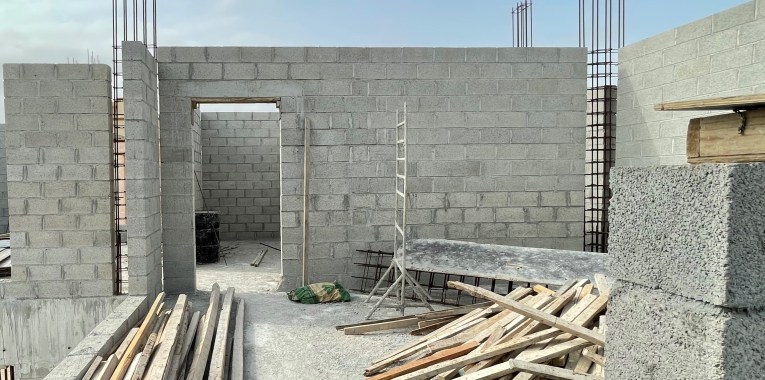
5 – building walls of cement block reinforced with columns of steel and cement (created from liquid cement that is poured into wooden forms constructed around the rebar)

6 – the house begins to take shape

(in this posting)

7 – poles are set up to support wooden forms for the ceilings/ roof/ floors of upper stories

8 – the second story is constructed

9 – the roof is poured using a stretch pumper and the roof wall is built

10 – the major construction is now finished and the house can stay in this unfinished state for months

11 – exterior finishing is added: plaster/ paint, windows and doors

12 – the boundary wall is built

Steps 7 – 9

This slideshow requires JavaScript.

Steps 10 – 12

This slideshow requires JavaScript.

Construction equipment

A note on house photos: I hired Onaiza Shaikh to take photos of design elements (such as windows) and house construction. Given that those photos show only a small part of the house or an unfinished house, it is not possible to tell whose house it is or where it is. Ms. Shaikh or I removed all identifying markers such as signs stating the owner’s name and any people, including workers. Photos of a complete house are a different matter. On one hand, I do not want to post a photo of a house that someone might recognize without the owner’s permission. On the other hand, if I post photos for which I have permission, i.e. photos of friends’ and informants’ houses, then many people in Dhofar will know the houses, thus know who my informants are. I have not yet figured out the answer to this problem.

Houseways: House construction, part 1

(photos by Onaiza Shaikh)

This is the first of two posts which show the stages of house construction in Dhofar. I am very grateful to Onaiza Shaikh for taking such clear and helpful photos of several houses to show the basic steps:

1 – prepare the plot by smoothing the ground and outlining the shape in white chalk

2 – excavating the footprint

3 – building a series of cement block squares that are painted with water-proof paint, then a rebar metal frame in placed inside and the inside is filled with liquid cement, then the surrounding space is re-filled with dirt

4 – creating the sub-base (plinth) and foundation slab by packing earth over the filled-in cement squares, then building up a low cement exterior wall (the outline of the house) and low cement block walls (the interior load-bearing walls), each of these sections are filled in packed earth then covered with a layer of cement – rebar is set into this foundation and sticks up from the smoothed cement base – the result is a base about one meter off the ground with smooth cement walls and a surface which is marked by the tops of cement blocks (6″ or more high) which show the outline of the interior walls

5 – building walls of cement block reinforced with columns of steel and cement (created from liquid cement that is poured into wooden forms constructed around the rebar)

6 – the house begins to take shape

(in second posting)

7 – poles are set up to support wooden forms for the ceilings/ roof/ floors of upper stories

8 – the second story is constructed

9 – the roof is poured using a stretch pumper and the roof wall is built

10 – the major construction is now finished and the house can stay in this unfinished state for months

11 – exterior finishing is added: plaster/ paint, windows and doors

12 – the boundary wall is built

Images for steps 1 – 3

This slideshow requires JavaScript.

Images for steps 4 – 6

This slideshow requires JavaScript.

Houseways: Dhofari/ non-Dhofari house plans

[illustration plan by Maria Cristina Hidalgo, https://www.mariacristinah.com/ ]

Sometimes you can only understand what is “normal” for you when you see the same object used differently or in a different place. That sudden shock can help you understand the unwritten/ unacknowledged rules of your culture.

One housing example is light switches. Americans who move to the Arabian Peninsula are confronted with 6 or 9 identical switches in a room or in a hallway. The switches will be placed higher than expected, almost shoulder height, and will be for the ceiling lights, wall lights and fans. As most ceiling lights are florescent which take a few seconds to turn on and the fan has a separate circular switch for speed-adjustment (but is also turned on and off by a switch) you can spend over a minute pushing switches trying to figure out how to turn things on and off. It’s even more confusing for bathroom fixtures as the switches are outside next to the door and will be for the ceiling light, vanity light and extractor fan, as well as hallway lights.

Another example is looking at house plans; since I have started on this project, I have spent a lot of time looking at house plans and seeing examples from other cultures helps me articulate what are some of the expectations of designing Dhofari houses.

Example 1:

example - walk into kitchen

In this home, you walk into the dining room, something that would not happen in a Dhofari house. Also the kitchen in open-air, with no separating wall, much less a door. This would not work in a culture in which cooking smells are considered as negative. Notice how someone standing at the sink has complete visual access to the dining area, living room and porch; there is no possibility of gender segregation. And there are 21 seats (including the 2 floor cushions in the living room), if the dining room table was rotated 90 degrees and the 2 chairs in the living room were turned, the space could easily hold 25 or more people. The space allows for a large, mixed gender party.

Example 2:

example - maids room - ready

What struck me about about this plan is how little seating there is: only 14 seats in the main area and there doesn’t look like there is enough room for 4 people on the small sofa in the private TV space. If the couple who live here invite another couple for dinner, someone is going to spend the evening sitting on a dining room table chair. Also interesting is the maid’s bedroom and bathroom. Having a female maid live-in is common in Dhofar and the room is usually next to or near the kitchen in a one-story house

Example 3:

example - 4 sitting rooms

I loved trying to figure out this house – it’s the perfect expression of a culture that has a lot of concern over who sees what and how in/ out of the group a person is.

In the bottom left is the most ‘out-group’ space:  it’s a majlis (male sitting room) with NO connection to the interior of the house and no bathroom. To the right is the main male entrance, leading to majlis with a bathroom opposite. Further ahead to the left is a dining room that is set up with two doors so the lower door (near majlis) can be closed/ locked while the table is set up, then the door near the majlis is opened while the upper door (leading into the house) is closed for family privacy. When the men leave, the door near the majlis is closed and the door to the house is opened for clean up, so male visitors can never see or hear any of the house occupants.

To the right, above the majlis, is the family entrance which opens into an entryway with a bathroom opposite the salle (sitting room for female relatives and visitors). If needed, female guests could use the dining room if the lower door (to the majlis) is locked. Notice how, if a female visitor left the salle and turned left, then left again to enter the dining room, there are NO sight-lines for the family seating section or even the doors to the kitchen or bedroom. To get to the family seating area, a visitor would have to turn right and cross the atrium; there is no way someone could do this ‘by accident’ so visitors will never be able to see who else was in the house. 

Family members would pass through the entryway and turn right into the family space, with the family bathroom to the left. Except for the bathroom that is inside the bedroom, all three bathrooms (near majlis, near salle and near family space) are built in two sections with a sink area, then an inner door leading to a toilet and sink.

The kitchen is in the upper right-hand corner (with door to prevent cooking odors from reaching the house) and a door to the outside, for bringing in supplies and taking out trash without entering the family section. The bedroom in the upper left hand corner is, to me, too big for a maid’s room (which I would expect to be on the roof or near the children’s rooms). I would assume that this would be for either an older family member, so that they don’t have to climb the stairs, or the couple most responsible for the house.

There are a lot of details that remind me of Dhofari houses, such as the storeroom off the kitchen that can be locked and the side tables in the corners of all four seating areas (external majlis, main majlis, salle and family sitting space) so that people are always sitting in a circle-shape.

Another detail is the set-back of the bedroom and kitchen doors. If you look at the bedroom door, for example, you can see that it could be moved forward (to the left) so that the doorframe is flush with the end of the lower wall. But in its current position, one can’t see if the door is open or shut unless you are standing in front of it. Further, given that the TV in the family sitting room is on the lower wall (shared with the bathroom for the salle), the people in that area can’t see who is coming out of/ going into the kitchen.

Details I see as non-Dhofari are the separate dining room, the circular table near the family seating area and the door to second staircase (below the family area bathroom). That door surprises me as there is no way from that staircase into the house, one can only go up to the upper floor where I  would expect 5, 6 or 7 bedrooms. In the houses I have seen in Dhofar, where there is a second staircase accessed from outside the house, I have always seen an internal door on the ground-level.

Also the separation of the male visitor (majlis) and female visitor/ family doors is not usual. In Dhofar, the two doors are usually a few feet apart, set at a 90 degree angle. Also the outdoor seating area is unusual in Dhofar. Outside of towns there is usually not a high wall around the house so inhabitants might sit on chairs or the steps with an open view. In towns, there is usually not outside seating by a door.

A last note on sight-lines. To me, the kitchen table next to the outside door is awkward. Anyone bringing in supplies needs to walk past the table and turn. It would make more sense to have the table on the lower wall (i.e. sharing the wall with the chairs for the family sitting room). But if the table were moved, then the people sitting at it would be able to see the door to the bedroom. As it is now, the people sitting at the kitchen table have no sight-lines.

Houseways: Doorways – Design and Culture

In an earlier essay, I discussed how rooms were arranged: https://mariellerisse.com/2021/07/03/houseways-comparisons-types-of-rooms-and-sightlines/

This essay is one of three related pieces about the interplay between behavior and space: how certain behaviors create a need for a certain kind of space (entryways), how a certain kind of space creates the need for certain behaviors (talking in the salle) and the intermix of house design and behavior (front doorways).

Talking about front doors is, to me, a chicken-and-egg issue. Did behaviors help form door shapes or did door shapes help form behaviors? Impossible to tell.

Whatever the cause, most Dhofari houses have two front doors of differing sizes. The main door, leading to the main hallway, usually faces is the street and is both larger and more decorated than the door which leads to the majlis, which is often at a 90 degree angle to the main door and the street.

In Salalah, main doors of houses that are set-back from the street are often Palladian-style with an arched transom window and thin vertical windows with opaque glass on either side. They are also often wider than average to allow large furniture to be moved in and out. This usually means either one wide door or double doors in which the right-side door is used daily while the left is locked in place and only opened when more space is needed. There is never a post between the two doors as this would defeat the purpose of having a large open space. Screen doors are seldom, if ever, used.

The majlis door is usually the standard size [apx. 115 cm wide, 210 cm high] and, while it might have a transom window, there are usually not windows on either side. It might be a double door, but I have never seen one that was as wide or wider than the main door.

In terms of the connection between structures and behaviors, having wider doors at the main entrance makes sense as this is used by the people who live in the house and women who are visiting. And a Dhofari woman does not often go visiting by herself, she will bring children, sisters, her mother and/ or aunts along and when they arrive, they are greeted by the children who live in the house so that perhaps ten people are standing in/ near the doorway or just inside in the foyer.

Whereas it is more usual for a man to visit a house by himself, and even if a group of men approach the majlis door together there are, as one Dhofari friend says, “protocols” of how men should enter a building. Anyone who visits Dhofar will get used to the logjam/ shuffle that occurs when several men walk up to a doorway. Younger men will step to the side or backwards to show respect; older men will move aside to avoid acting as if they want to go ahead, sometimes gently pulling on the shoulder of another man’s dishdash to allow him the honor of going first. Sometimes the negotiations will take 15 seconds until one man is persuaded to enter, then there might be further parleys until it is decided who will go second. Dhofari men go through doorways one at a time after careful demonstrations of respect and good-will.

The same sequence does not usually occur with women. If four women approach a doorway at the same time, there will not be a delay in entering. Perhaps a young woman might let an older woman go first but for example, children might race ahead or tug their mother’s abayah to pull her forward or a younger woman might enter, then turn around to help an older woman over the threshold.

When leaving, the same dichotomy exists. Women leave together by the main door, unconcerned about who goes through the door first and, in any case, the door is usually wide enough to allow two or more to walk through at the same time. The doorway cluster can be the group of women who came together or, if a single woman came to visit, then the hostess, children and perhaps other women in the house will be near the door to say “goodbye.”

From the majlis, unrelated men leave singly, trying to time “goodbyes” so that one is not approaching the door at the same moment as another man which would necessitate at least a symbolic “after you – oh no, you first – please, I insist – I couldn’t, please go ahead” sort of exchange.

Men who are related or friends can leave in groups as the order of precedence (or lack thereof) is established and will not require gestures of politeness.

To explain this phenomenon another way, there is a general cultural understanding in Dhofar that the person standing on the right hand side of a doorway should enter first. But whereas men will actively try to maneuver themselves towards the left and another man towards the right, women will not attempt to change their position or the position of another woman as they approach a door.

I don’t know all the reasons for the why of this behavior. I think it is partly due to women not wanting to draw attention to themselves in public and wanting to get to an inside space as quickly as possible. Women are also often carrying or leading children and a crying baby or sleeping toddler who needs to be settled is of more importance than who walks in the door first. Also, as women’s faces are usually covered while men’s aren’t, a man stepping aside to let another man go first is publicly showing his good behavior.

From watching men’s behaviors in cafe and on picnics and women’s behavior in the salle, the same dichotomy exists in terms of seating: men actively try to give other men the ‘best seat’ (most central, closest to AC, most comfortable) while women sit where there is space closest to women they know. If there are no seats open in the salle, younger women and/ or women who live in the house will stand up to make place, but if the guest waves them down, there is not a protracted back and forth. Some older women prefer to sit on cushions on the floor and if a woman has settled herself, no one will try to force her to another place.

Houseways: Talking Privately in Crowded Rooms

In an earlier essay, I discussed how rooms were arranged: https://mariellerisse.com/2021/07/03/houseways-comparisons-types-of-rooms-and-sightlines/

This essay is one of three related pieces about the interplay between behavior and space: how certain behaviors create a need for a certain kind of space (entryways), how a certain kind of space creates the need for certain behaviors (talking in the salle) and the intermix of house design and behavior (front doorways).

A majlis and salle are usually large enough to seat at least 20 people and square/ rectangular with all the furniture pushed against the walls. Houses are built from concrete block and have tile floors, sometimes partially covered with an area rug, thus everyone in the room can see and hear each other – in a sizable, echoing space, how do people manage to have private conversations?

Two types of behavior, non-verbal and talking very quietly, [as discussed in: https://mariellerisse.com/2021/07/03/houseways-comparisons-types-of-rooms-and-sightlines/ ], work for short communications such as imparting information, asking a question and giving a command. In this essay I would like to talk about another strategy: Dhofaris tuning out/ turning away/ politely ignoring visitors. This behavior means that people can have private conversations, after the requirements of hospitality and respect have been met, and that a person who is new to the group has time to adjust.

A female Dhofari friend (A) lived outside of Dhofar for several months where she met an Omani woman (X). When A’s brother (B) came to visit A, he met X’s husband (Y). So when X, Y and their children came to visit Dhofar, A invited them to dinner at her house with the understanding that B would host Y in the majlis with other of A’s male relatives and A would host X in the salle with other of A’s female relatives. I was invited as I had also met X previously.

When X and Y arrived, they were greeted by A and B who stood outside the door, then brought to the respective sitting rooms. When X walked into the salle, all the women (X’s mom, sisters, sisters-in-law, and nieces) greeted X and she was led to a sofa in the middle of the south wall, a few spaces down from A’s mom. A sat in the middle of the east wall and I was in the middle of the north wall. The first twenty minutes was the necessary polite, general conversation in which X asked about everyone’s health and everyone asked X about her health, her family’s health, her trip to Dhofar, where she was staying and did she like the hotel while A was offering drinks and snacks to X and her children. The first round done, the second round started in which more specific questions were asked about X’s health, the health of X’s children and female relatives, their trip to Dhofar and X started to ask about how A’s mother was doing and who were the other women in the room. A’s mother was included in all the questions and responses; X looked at her more frequently than anyone else and the other women, including me, listened to everything with polite attention.

Then we moved to the dining table (on the south side) to eat dinner, then back to the sofas. A few minutes later, with hands washing after dinner and X given a plate of sweets, there was a gradual change in that A’s mother and other female relatives turned their attention away from X by saying prayers using a misbaha (prayer beads), looking at their phone, talking to children or each other. A and X, more than 1 1/2 hours after X had arrived, were able to talk freely about people they knew/ experiences they had had in common.

There were the same number of people sitting in the same places as when X had arrived, but instead of one person talking at a time with X and A’s mother as the twin focal points, now A and X were a dyad. A’s female relatives and I sat quietly, sometimes listening, sometimes talking to each other. As the time to leave grew closer, the talk again became more general with people offering X suggestions about where to go site-seeing and what restaurants to eat at. X was invited back to the house, which she parried with how short their stay was and how they had relatives to visit.

In thinking about this visit beforehand, I had thought that it was too bad A and X would not get time alone (such as meeting at a coffee shop) to catch up. But what happened was that A’s family created that conversational freedom for them, without changing the space or their locations, by shifting their attention away. In a room with 10 women and five children, A and X were able to share reminiscences and catch up on mutual acquaintances.

To look at this issue from another angle, I was once visiting a Dhofari friend when an older female relative (M) stopped by. I had not met M before and was surprised that the younger women (N) with her was wearing elaborate make-up, a lot of jewelry and a highly decorated dress, shorter in front than in usual for normal visiting. My friend looked at me and said, “bride” in Arabic; women who are newly married usually dress up for visits in the weeks after the wedding. N had recently married M’s son and M was bringing N to meet M’s/ N’s husband’s relatives. N sat silently, looking bored, as we spoke; I felt kind of sorry for her as she must have had several of these types of visits with her new mother-in-law.

But about two years later I saw that situation from a different angle. A female Dhofari friend invited me to her wedding; I agreed but with some trepidation as I had not met any of her family before. I arrived at the house for the party and her mother took me into the salle. I could hear quiet comments of women “placing me” (telling each other who I was) as I walked around to greet each woman. But once I sat down, all the women ignored me. This might sound negative, but it was very freeing – I was in a tightly packed room with every seat taken. All the women were in pretty, loose dresses with lots of perfume, children ran in and out, maids came around offering tea, coffee, juice and water, as well as snacks – there was lots of see and do. Women who came in shook my hand and the women next to me encouraged me to eat and drink so I did not feel any hostility, just a sense that everyone had collectively decided to leave me alone. After about an hour, the woman next to me asked me a few simple questions, I think to test both my level of Arabic and my willingness to engage. When I answered readily, other women joined in with questions and we ended up having a lovely time – joking about husbands and driving cars and studying.

As I drove home, I thought about the silent bride (N) and wondered if perhaps what I marked as boredom was relief that the women in my friend’s house had given her the same sort of emotional/ psychological break of ignoring her so she could be with a lot of unfamiliar people without having to make conversation. These were women she would know and visit for the rest of her life and rather than perhaps making a misstep at the start of the relationship, she had the chance to look around, listen to the talk, and start to form ideas/ opinions about the women before being expected to join in.

The spaces within a house for visiting are few and large, thus Dhofaris have created a series of behaviors that make accommodations for others. In certain circumstances, everyone will tacitly ignore 1) people who want to talk about someone that is interest only to them and 2) people who they feel might not want to or be able to join in the conversation. Being able to see and hear others in the same room does not automatically mean it is necessary to engage with them, so privacy is possible even in a crowded salle.

Another example of creating privacy for others was discussed in https://mariellerisse.com/2021/07/10/houseways-who-visits-which-rooms/ . Women usually return to their mother’s house after they have their first child. One family I know lives in a house with a mother, several unmarried daughters and several married sons and their families. When a married daughter came back to stay for a few weeks with her new baby, she and husband met in the majlis. The husband was not a close relative so it would not be appropriate for him to spend a lot of time in the salle and it was not possible for him to come to her bedroom as this would mean entering the private area of the house. The men in the house willingly did not use the majlis at certain times so their sister’s husband could visit her and the baby alone.

Houseways: Entrance Ways – Form Follows Function

In an earlier essay, I discussed how rooms were arranged:

Houseways: Comparisons – Types of Rooms and Sightlines

This essay is one of three related pieces about the interplay between behavior and space: how certain behaviors create a need for a certain kind of space (entryways), how a certain kind of space creates the need for certain behaviors (talking in the salle) and the intermix of house design and behavior (front doorways).

Several members of my family work in the fields of design and planning, so I grew up listening to a lot of talk about architectural details and the effective organization between and within buildings. A favorite mantra was: form follows function, meaning the purpose of the space determines the size and shape of the space.

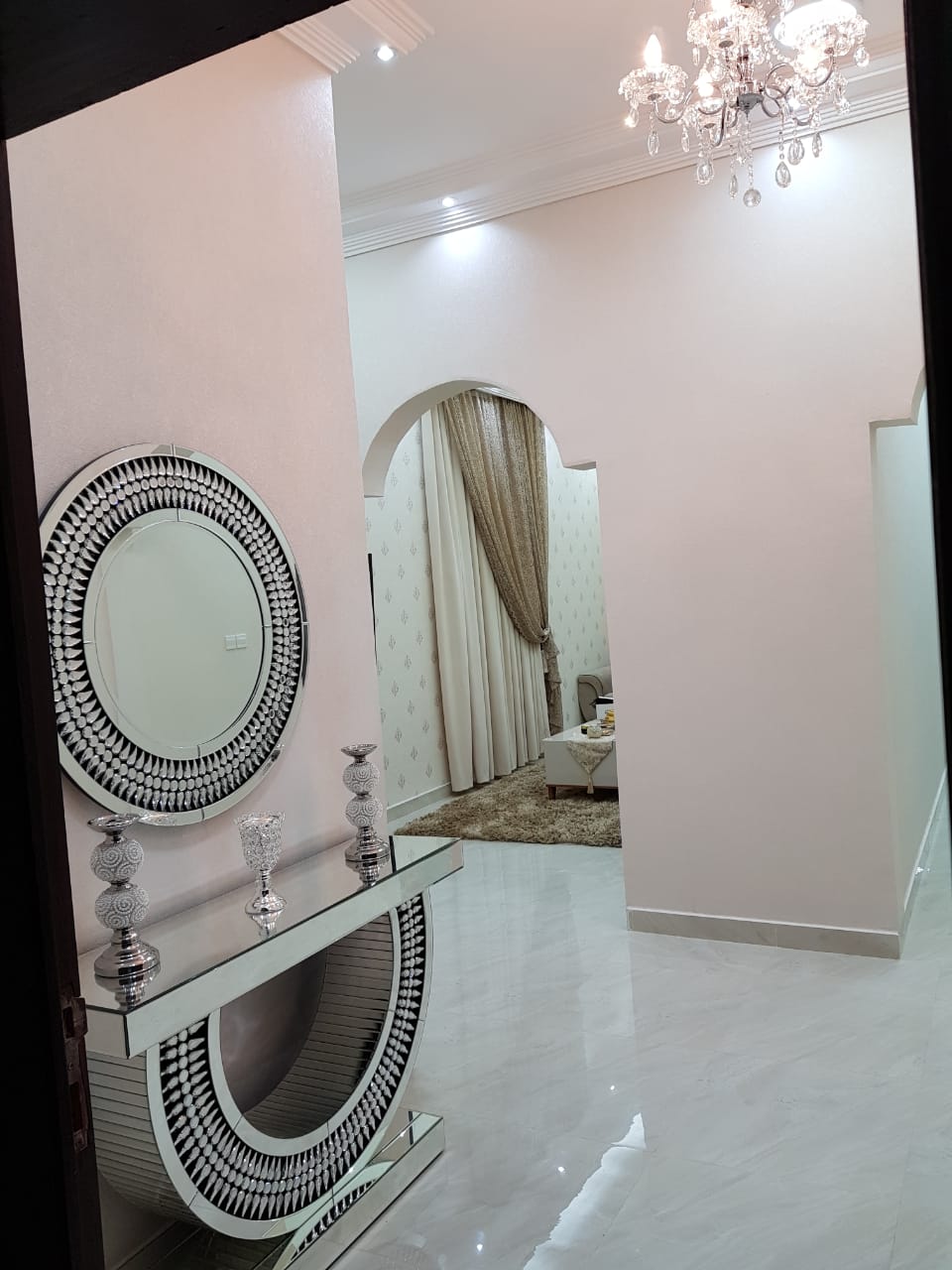
This is a good way to start to think of entrances to houses. When I first visited Dhofari houses I was surprised by the large space near the front door that leads to the main hall. The foyers were empty and, to me, unnecessary. Kids did not use the area to play in, no one sat there, there was no furniture except perhaps a rectangular side table pushed against the wall with a mirror above it or nearby – just a large empty space that had to be air-conditioned.

After more visits, I started to see the purpose and began to be very grateful for the entrance space as a helpful liminal space between being public (outside where everyone could see me) and private (in the salle in view of women and children).

To aggregate several dozen experiences, when I arrive at a house, I wear a dhobe (loose, Dhofari housedress) which is covered by a “head ababyah” (a large, black polyester square that is pulled over the head and drapes to cover my body down to the knees). It is often worn for short distances, such as from car to inside house or between neighbors’ houses; some older women wear it while shopping.

If the front door is open, I call out to show that I am there, step into the foyer, take off “head ababyah” and put it in my purse, check that my lossi (headscarf) is covering my hair, then walk into the salle. If the door is locked, I ring the bell and when it is answered, there is usually one woman with a group of children behind her who have come to see who it is. The woman will welcome me, but not ask me questions, and shoo the children away. She will stay back a few feet and not give any pressure such as saying “everyone’s waiting for you!” as I check that I am ready to go into the salle. When I start to move, she will walk to the opening of the salle with me and sit in her place. Once in the salle, all eyes will turn to me and there are sometimes questions and explanations as to who I am as I walk in a circle, greeting each woman and shaking her hand, then I find a place to sit and get ready to talk.

The large, empty foyer uses gives me the chance to move from outside presentation (shapeless black figure) to inside (still shapeless but brightly colored). I can check my hair and lipstick, smooth down my dhobe and get ready to be part of the conversation. Even if there is a wedding party with over 50 women in the house, the foyer is empty and women who are further down the hallway will not come to say “hello,” until I have moved away from the door area.

The area makes me think of texts from the 1800s and 1900s in which there are depictions of women going into a small dressing room to take off their wraps and change into dancing shoes such as Katherine Mansfield’s “Her First Ball.” It’s public, women in the hallway can see me and sometimes children stand nearby, but also private in that I am not expected to make small talk or answer questions.

When I leave the house, the space again is useful as, after I say my goodbyes, step out of the salle and into the foyer, I have a moment to get my “head ababyah” back on, check my phone and get out my car keys. Perhaps my friend will come stand with me, to walk to the portico with me to wave goodbye, but the talk is easy: “say hello to your mother for me” and “I hope you have a nice weekend” sort of phrases.

At the end of a wedding party, there might be several women standing near the door waiting for a car to drive them home, but there is plenty of space even with children running about. And there are no expectations of doing formal greetings; when I walk into the foyer, I don’t have to say ‘hello’ to each woman. We see each other and shift to give room for whoever is leaving to get to the door, but we don’t have to interact.

Thus, it’s a space that is used only for a few moments of time several times during the day but is necessary given common Dhofar behaviors. A large foyer is needed not because there are usually more than five small children living in one house, but the fact that children love to run to the door when someone knocks (or are sent to see who it is) and often stand near the door to look at a person arriving or leaving.

As children like to be together, they might all gather in the entrance way when school age children are leaving. Mini-vans/buses come into or next to the hosh as children don’t usually walk to and wait at a bus stop since it is often very hot. With a large foyer, there is space for the mom, the children who are going to school and young children to all wait inside where it is cool. Or the space can be used by a group of sisters waiting for a car to take them shopping or visiting relatives so they don’t have to stand outside the house in view of the neighborhood.

[There is a difference between houses in towns and in the countryside, as rural houses usually have a dekka, seating area in the front or side of the house which means you are on display as soon as you leave the car.]

(photo above: mirror in entry way; photo below: mirror in entry way to the left, ahead to the left is entry to salle, ahead to the right is doorway of short hall leading to majlis – both photos taken by informants and used with permission)

ta - hall

Houseways: Who Visits Which Rooms?

Upper-class, English, Victorian-era homes had a set of rooms for children which would include a day nursery, night nursery, schoolroom, bathroom and the nanny’s room. In present-day America, a middle-class child might play on the kitchen floor while a parent is cooking, do homework on the dining room table, watch TV in a basement rec room, sit by the fire in a den or study, i.e. sit in different rooms for different purposes during one day.

Whereas young Dhofari children spend most of their in-door time in their parent’s bedroom and the salle. When they are close to puberty they will move to their own bedroom or a room with several children who are the same gender and around the same age. Children are only in the majlis in the presence of adults and for a reason, for example an uncle is visiting or they are working with a tutor.

Dhofari children spend a lot of their free time out of the house once they can walk: in the hosh if younger than 3 or 4, then in front/ near house, then within the neighborhood in mixed gender/ mixed age groups until close to puberty. They also know the salle or majlis of many houses (grandparents, uncles/ aunts and older siblings) but will usually not play/ hang out in a cousin’s bedroom, although they might sleep there if it is an overnight visit. Children sleeping over at relatives’ houses is common, even among families which live close to each other. For example, when one female Dhofari friend was sick, she sent her child to stay for two weeks with her parents who live nearby.

As children grow older, they experience the same house differently as the use of rooms is linked to both gender and age. For example, a Gibali girl visiting her paternal uncle’s house: as a baby she might be taken into the majlis by her father who is holding her; as a five-year old, she might spend the visit playing outside with male and female cousins; as a 14 year old, she might sit in the salle with her mom and older sisters. If she marries a cousin from this family, she will be expected to go into the majlis when there are visitors to bring tea and, perhaps, sit and visit.

Further, men experience houses differently according to what his relationship is with the house owners. A boy will spend time in the salle of relatives’ houses when young and the majlis when older but there are many variables. For example, a 25-year-old Gibali man with three sisters (A, B and C) would have different visiting patterns depending on who owns/ controls the house that the sister lives in. He visits sister A in her salle because A and her husband own their own home and visits sister B in her salle because B married a cousin, thus the other women in the salle are his relatives. But he visits sister C in the majlis because C lives in her husband’s father’s home who are not relatives, so the salle is for C’s mother- and sisters-in-law.

In a similar way, a married man who visits his wife when she is at her parent’s house might sit in the salle (if he is closely related to her family) or the majlis (if he is not). As most Dhofari women stay with their mother or an older sister for 40 days after the birth of their first child, a husband’s behavior is on display. All the female relatives of the new mother will know how often he visits, how long he stays and what he brings with him. This information is passed on to the general community, for example when a general question such as “how is the new mom doing?” is answered with, “fine, alhamdulillah, and her husband came every day to visit in the majlis,” his reputation (and the reputation of his family) is increased. This is a man who respects his wife and takes his responsibilities seriously. When the sister of one friend had her first baby, the family tried not to use the majlis at certain times so the husband could visit his wife and baby in privacy.

(photo of majlis by informant, used with permission)