Ethnography: Conversations about Men/ Masculinity, part 2

When reflecting about my conversation with the research guys [see: Ethnography: Conversations about Men/ Masculinity, part 1 ] a few themes emerged. First, I know Bristol-Rhys and Osella’s article (full cite below) and my discussion with the research guys is somewhat apples to oranges. I don’t know which questions were posed to elicit the answers discussed in the article. A conversation would go in very different directions if the opening query was: What is a man?, What is a good man?, What is the definition of an Emirati man?, or What should an Emirati man look like and do?

Also, I realized later that I had unconsciously hewed close to Dhofari cultural understandings by not asking about a ‘man’ (much less a ‘bad’ man) but focusing on a ‘good man’ as their conversations almost invariable focus on the positive; negative people or actions are not appropriate topics for discussions.

Given this, it is still interesting that there is a complete contrast between the Emirati answers with focus on appearance [clothing, beard, sandals, the people “he is seen to associate with in public” and looking “bored”] and the Omani answers which only mentioned one physical issue: that a man should sit up straight in the majlis. Further, there was a strong Omani emphasis that you can’t know anything about a man by looking at him, i.e. appearance tells you nothing of importance and even his speech can be deceiving.

This goes back to my first example in my first book which illustrates the Dhofari belief, especially prevalent among the qara tribes, that you can know a person for years but not know their true character. One’s personality is not an compared to the layers of an onion or mountains beyond mountains but is often completely unknowable. So people need to watch each other carefully. One of the worst things that can happen in a person you trust betrays you, so you need to always ready for that kind of surprise.

Another point was consistency of Omani understanding that good men control themselves. In my first book a man, who was not at the group discussion, called this “the quality of the bearable,” meaning the ability to handle your emotions and responsibilities. Thus, on this specific point, 7 men from 7 different tribes all explained the paramount importance of self-restraint.

I want to note that this is in contrast to other possibilities such as an understanding that a good man is strong and able to control others. There were no examples of commanding/ supervising/ managing other people, i.e. a good man has good children, a good man is in charge of people at his work or makes X group of people behave well.

All the Dhofari men I have talked to about this issue have explained that a good man acts politely, generously, helpfully and patiently with others. A good man is outward-oriented; he listens to the talk, he participates in the talk and in a majlis he is always aiming for the middle spot, avoiding both aloof and ingratiating behavior.

Also, it was interesting to me how the men lived out their opinions. For example, one of the research guys who is 15 years younger than me, X, had said that a good man will always respect those who are older than him and try to do their work for them. When we had finished the discussion, I got up and brought a container of cupcakes from my car, then I grabbed a box of Kleenex and started to walk around the circle as we were all sitting a little too far apart to easily hand the container from person to person. X jumped out of his chair and walked towards me with his hands out saying, “I will do this for you,” exactly as he has explained a younger person should act.

For all the differences, there is a broad, underlying similarity between Emirati and Omani responses: an understanding that as soon as you walk out of your house you are on display and may be judged. In the Emirates it seems this is more appearance-based, while in Oman this is more behavior-based.

Although I am not a Gulf, Arab man, I feel both those pressures intensely and when I go to my mom’s house in the summer, I celebrate the fact that I can go out in public without looking professional or constantly monitoring my surroundings. Sometimes when my mom asks if I want to go run errands, I make the freedom I feel explicit by saying, “Yes, let me just go put on a tank-top, long-sleeved sweater and a lined, tea-length skirt; get my hair up in a neat bun; use some anti-frizz spray; pencil in my eyebrows; put on lipstick, perfume and some jewelry…oh wait…I only need my sunglasses! Let’s go!”

In terms of behavior, I find myself scanning every café I go into, even in towns where I don’t know anyone, to make sure there is not as familiar face, as to fail to greet someone is very rude in Dhofar. And one slightly cranky older relative has benefited by my living in Oman because when the research guys heard me mention that this elder relative was a little difficult, I received repeated, lengthy, kindly admonishments to always show respect and never show impatience. When I am back in Oman after a visit I am quizzed on my behavior: Was I always polite and helpful to this relative? Did I always do what was asked of me? Did I always have a calm demeanor? Knowing I will face a gentle court of inquisition about my conduct makes it easier to live up to the expected standards.

article mentioned

Bristol-Rhys, Jane and Caroline Osella. 2016. “Neutralized Bachelors, Infantilized Arabs:  Between Migrant and Host Gendered and Sexual Stereotypes in Abu Dhabi,” in Masculinities Under Neoliberalism. Andrea Cornwall, Frank Karioris and Nancy Lindisfarne, eds. London: Zed.

related articles

Bristol-Rhys, Jane. 2009. “Emirati Historical Narratives.” History and Anthropology 20:2: 107-21.

—.  2007. “Weddings, Marriage and Money in the United Arab Emirates.” Anthropology of the Middle East 2.1: 20–36.

Bristol-Rhys, Jane and Caroline Osella. 2018. Contexts of Respectability and Freedom: Sexual Stereotyping in Abu Dhabi. New Diversities 20.2: 1-20.

Ethnography: Conversations about Men/ Masculinity, part 1

I often bring a quote from another author to the research guys and ask for their opinion. While reading Bristol-Rhys and Osella’s chapter on “Gendered and Sexual Stereotypes in Abu Dhabi” (2016, full cite below) I was struck by how their informants tied the definition of masculinity to clothing:

We turned first to masculinity as it is measured and judged by Emirati men. Through interviews and discussions with Emirati men from 18 to 65 years old, it became clear that physical presentation was paramount.  How a man presents in public is key; he must be in national dress and it must be perfect.

I wondered how the research guys would define what were the qualities of a man so during a picnic dinner, I asked if I could throw out a question and record (by writing) their answers. The six men (from six different tribes) agreed. Since I didn’t know how Bristol-Rhys and Osella framed their questions, I started with “What can you tell about a man by looking at him? Can you tell if a man is good by looking at him?” And the unanimous reaction was “you can’t know from the first time.” It was impossible to tell if a man was good by seeing him, one has to talk to a man to recognize what he is.

The consensus was that best quality of a man is that he is ethical/ moral (athlaq) and one can’t know that without a lot of interactions. As one man said, “I was told that to know a man you must trade with him or travel with him or live next to him.” Thus, by being in business (buying or selling something), going on a long trip or being neighbors you will see a man in enough different situations to come to an understanding of his personality. [To me, this is the Omani equivalent of the Maya Angelou quote: “I’ve learned that you can tell a lot about a person by the way they handle a rainy day, lost luggage, and tangled Christmas tree lights.”]

Then picking up on Bristol-Rhys and Osella’s discussion of behavior in the majlis (full quote below), I asked about how one could tell if a man was good or not from seeing him in a majlis. Again the unanimous decision was that one cannot know from his “talk in the majlis, maybe his talk is good but he is not.” You should “check his speech,” but it’s more important to pay attention to what he does. Specific points about how a good man acts include:

  • When others speak, he listens carefully and listens to all equally (i.e. not paying attention to men who are sitting close to him or have special status while ignoring others) [One man made the particular point that one cannot judge a man in his own house the same way, as in his own majlis a man has “his homework,” i.e. being generous, making sure there is enough tea and food so he might not be able to follow the conversation/ respond as carefully]
  • Speaks, but not too much, i.e. not dominating all the conversation
  • Does not try to give special greetings/ try to sit next to important men but treats all men equally [this point was illustrated by one of the men acting out how a groveling/ fawning man behaves]
  • Does not interrupt others
  • Does not talk badly about others
  • Does not show jealousy or anger
  • Never boasts
  • Never exaggerates
  • Never contradicts or corrects an older man, even if the older man is saying things that aren’t true or is speaking badly
  • If he stands up to get himself tea or water, he is happy to give to everyone (even younger men!); passes food and drinks; acts hospitable
  • Sits up straight (not slouching)

When we finished talked about behavior in the majlis, one of the man stated, “If someone you trust says a man is good, then one should listen [i.e. take it under advisement] but you have to check for yourself.”

Another man added that you can sometimes tell a good man by his talk when he makes statements about his actions. For example, a man is good if his conversation includes statements such as “I will” or “I did”:

  • visit this person who is sick
  • visit this person in the hospital
  • go to this person’s funeral
  • go to this person’s wedding

When I asked, “in general, if there is a man who have met a few times, so you know him but not every well, how can you learn if he is a good man or not?” all the answers hinged on seeing proper behavior such as:

  • Greeting all people
  • Helping all people (for example if a stranger has a flat tire – another man chimed in and said “a good man will help you from the first time,” meaning both ‘even if he doesn’t know you’ and ‘will help without you having to ask twice’)
  • Being generous (for example bringing food or drinks when meeting friends for a picnic)
  • Treating waiters/ people who work in stores politely
  • Being kind to children
  • Having patience (for example if the food is served late in a restaurant)
  • Doing the work/ doing extra work so that older people can “sit and take their rest”
  • Helping the members of their tribe (staying connected socially to people such as helping others when they are sick, going to social events of family members, etc.

One example that I thought was very interesting was one man said specifically, that a good man respects his religion and the religion of others. He gave the example that a good man knows his own religion, i.e. if he is a Muslim, then he should know to pray 5 times a day at the time of prayer.

As the conversation was winding down, three more points were raised. One man said, “a good man has a good heart, he will forgive quickly. If someone says something bad, he will smile and answer quietly.” He continued, “if there is a hard discussion, he will greet you the same the next day.”

Another man said, “a good man will not speak of [meaning “make fun of”] your clothes or your car.” And the last comment was, “a good man is always good with his family.”

As there were no more remarks, I paraphrased Bristol-Rhys and Osella’s conclusions and their reaction was a flat “no.” In his own way, each man expressed disagreement from a head shake to “we do not agree,” “not clothes!” and “we do not think like that.” No one expounded on his beliefs; they did not agree with the opinions of the Emirati men, but they did not feel that they needed to explain their disagreement in detail. I put away my research book and the topic turned to another subject.

I discuss this conversation further in: Ethnography: Conversations about Men/ Masculinity, part 2

Bristol-Rhys, Jane and Caroline Osella. 2016. “Neutralized Bachelors, Infantilized Arabs:  Between Migrant and Host Gendered and Sexual Stereotypes in Abu Dhabi,” in Masculinities Under Neoliberalism. Andrea Cornwall, Frank G. Karioris and Nancy Lindisfarne, eds. London: Zed.

(underlining – my emphasis)

We turned first to masculinity as it is measured and judged by Emirati men.  Through interviews and discussions with Emirati men from 18 to 65 years old, it became clear that physical presentation was paramount.  How a man presents in public is key; he must be in national dress and it must be perfect.  An Emirati man’s kandoura must be immaculate and, unless in winter, it should be gleaming white.  His gutra and agal must be worn correctly and he should not “fiddle” with it as if it were an unusual accessory.   A beard is mandatory and it should be trimmed perfectly (in fact, we were told that a man should have his beard trimmed “professionally” at least 3 times a week) What a man wears on his feet is important as well and it is unacceptable to wear trainers or sports sandals.  There are several acceptable styles, – even Birkenstocks are considered ‘aady (normal) – but the sandals should be white leather in summer.  During winter, darker sandals are acceptable and, if wearing a western style sport coat over a kandoura, then loafers or brogues, worn with socks, are also appropriate.  This critical scrutiny of attire might indicate the success of the nationalist project of Emirati, indeed Khaleeji, dress (cf. Al Qasimi 2010); it was the importance placed on the “correct kandoura” and the “correct sandals” and the “proper way of wearing the gutra and agal” that was emphasized, stressing the cultural competence necessary to negotiate the performative demands of “correctness.”

Cultural competence was stressed again and again throughout our interviews with Emirati men.  “A man recognizes a man by how he enters the majlis,” said one of our interlocutors.  Another man listed carefully the behaviors that are noticed and noted in a majlis“We watch how a person enters and then greets the people in the majlis.  Does he know whom to greet first?  Does he recognize those men like the sheikh of his tribe, younger sheikhs of the ruling family, and the men who are important to his father and uncles?”  In addition to knowing who is who, and the order in which important men must be greeted, the greeting itself was also critically assessed. “Does the man use the correct religious phrases in his greetings?  Does he know when to touch noses (ywayeh) and when to only shake hands?”   And a man’s knowledge of his society is judged as well. “In conversation with the men in attendance at the majlis, does he know his tribal history and lineage?  Does he know how his tribe connects – or not – to the other tribes?  All these things must be known well for a man to be thought a man.”  All of these behaviors require knowledge – gendered, culturally specific, and highlight exclusive knowledge – in order to perform them adequately.

Outside of the majlis, in more informal situations and in the public spheres of malls and universities, we learned that a man is measured by how he acts, by those with whom he is seen to associate with in public. According to our Emirati interlocutors, clothing is still important in public spaces because there they are judged not only by Emiratis, but also by foreigners. “We must dress and act appropriately in public because of the image, the image of the Emirati man.”

The young men at the university where Bristol-Rhys teaches have a hierarchy of dress with which they judge each other and establish boundaries between cliques of friends.  First, there are the men who wear only kandoura and gutra/agal to classes.  They describe themselves as “pure Emirati men”.  Then there are those who wear kandoura with an American baseball cap or nothing at all on their head – these are considered “okay Emirati, but too casual” and comments / assumptions usually follow fast that, “their mother is not Emirati.”  The third group is made up of those who wear jeans, t-shirts, and shorts to university; they are scorned by the “pure Emirati” and are only grudgingly accepted by the group who wear baseball caps.   They describe themselves as “trendy,” but others use words such as “fake, wannabe American, or zaalamat, the pejorative term for Levantine Arabs, that has, for lack of a better term, sleazy connotations in Emirati society.  “They try too hard to be seen, and that is not the Emirati way.  We are always supposed to be at ease, we don’t show anxiety, in fact, the best is if you can look bored.

Reflections on Ethnographic Research: Making Adjustments for Positive Multi-Cultural Exchanges/ Events

(photo by S. B.)

For the first few years I was in Oman, I often went on picnics with mixed groups of Omanis and expats but that gradually stopped as I got frustrated with what I perceived to be situations in which the Omanis were doing all/ most of the work. I started having picnics with just the research guys and the few times I brought an expat, I ended up frustrated or embarrassed by expat behavior such as showing up empty-handed, sitting passively, dominating the conversation and not showing gratitude.

But a dear friend, T, was coming for a short visit and I was sure that she had the temperament to enjoy and appreciate a beach picnic, so I got in touch with the guys. This started a series of adjustments on all sides which illustrate the importance of compromise in effective inter-cultural communications/ interactions.

First of all, the morning of the picnic I told the guys that T did not like fish and asked that they not bring fish for dinner. This is completely out-of-bounds behavior. People who meet up together should never show any preference (or really, any interest at all) in the dinner that someone else will bring. But given that some of the research guys are fishermen, I guessed that they would want to bring freshly caught fish and cook it over the fire as a special dinner. I wanted to stop that as I knew T would not enjoy it and I wanted to protect her from either being hungry or forcing herself to eat a dinner she didn’t like.

On the other side, before we left my house, I told T that wearing long, loose clothing was my way of being respectful and asked if she could please wear one of my long tunics over her pants and t-shirt. I held out a white tunic with a toile print, something she would ordinarily never wear, and she agreed. Then I said that I cover my hair in front of the guys and that while she didn’t have to… She instantly agreed so I grabbed a lossi (headscarf worn with a thobe, the Dhofari-style housedress). Usually you wouldn’t wear a lossi outside the house, but it was 105 degrees, so I thought the light cotton would be the most comfortable choice for her. I knew the guys would say that she didn’t have to, but I also knew they were going to make an effort to bring a good dinner and this was a small gesture she could make to be polite.

When we got to the beach, we set out the mat and then put out cushions, Kleenex and the cooler with water and soda. I made a fire and we chatted until we heard cars. Then we stood up and I draped the headscarf on her and wound mine tightly.

When the guys came to the mat, one began fussing with the fire, setting rocks in two lines which usually means that fish would be grilled. I was disappointed and said to one of the men quietly in Arabic, “she doesn’t like fish!” He said, “there is chicken.” I nodded, then I saw one of the men open a plastic bag with lobster tails, removed from the shell.

I should not have worried. The men had listened to my (unreasonable) request for no fish, but as I had suspected, wanted to bring something freshly caught, so it was lobster. And, as I have never seen them take the meat out of the shell before, I knew they were showing politeness to a guest. [In contrast, the first few times I had lobster with them, they handed me a whole one and I had to twist off its head, pull off the small limbs, etc. – if I wanted to eat a lobster, then I had to deal with the lobster!]

The whole night was a series of modifications on their part – actions I had never seen in over 15 years of picnics. For example, instead of placing their chairs right at the edge of the mat as usual, most of the men sat about 6 feet back. Instead of eating by lights from cell phones or small battery-powered lanterns, one man set up a large, area-light attached to a car battery. Instead of a usual dinner with one dish (rice with meat, chicken or fish), there was a big container of rice and chicken, plus the grilled lobster tails, a salad in a separate bowl and a dessert.

Instead of people dividing themselves into two equal groups (or one-off if there was an odd number) around the two platters, the best pieces of chicken were put on one platter for me, T and one of the research guys, while the other five gathered round the second plate. Half the lobster tails were put on our platter as well. I had forgotten that T might not be used to eating with her hands, but one of the men brought spoons. The man eating with us gave her a spoon, then proceeded to eat his dinner with a spoon, which I have never seen him do before. No one commented on any of these adjustments and T did not comment on the bother of wearing a tunic and headscarf.

T chatted, answered questions, gave profuse compliments and (bless her!) was happy to sit quietly and look at the stars and ocean during the times the men were speaking in Gibali (Jebbali).

I was a little nervous – hoping that there would be a comfortable meeting between my friend of 25 years who was only 2 days into her first visit to the Arabian Peninsula and the research guys, most of whom had never socialized with a North American besides myself but everything worked out well.

By giving up some comfort/ in doing something unusual, we all helped create a positive atmosphere. I am very grateful to T and the research guys for a lovely evening and a lovely example of the necessity of all sides making adjustments to create harmony.

Houseways: Podcast, a discussion with Ahmed Almaazmi and Ayesha Mualla

Houseways: Including/ Excluding Expats in Discussions about Housing

Reflections on Ethnographic Research: Changes within Cultures

Reflections on Ethnographic Research in Dhofar Oman

Reflections on Ethnographic Research: (Not) Asking Questions

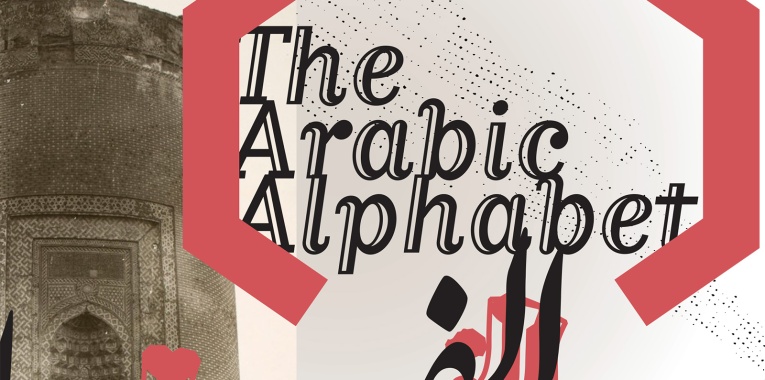
New essay: “D͎âd is for Drubbing” on the Arabic alphabet website

The Arabic Alphabet: A Guided Tour – http://alifbatourguide.com/

by Michael Beard, illustrated by Houman Mortazavi

D͎âd is for Drubbing http://alifbatourguide.com/the-arabic-alphabet/dad/

 excerpt:

If your informant is a speaker of Persian, Turkish or Urdu, and no doubt other languages about which I know even less, Ramadan will be pronounced Ramazan. This is because the D of Ramadan, in Arabic, represents a sound which exists hardly anywhere else, and (like ذ and ظ), it becomes just another way to say Z. Speakers of Arabic are aware they have a letter of their own: Arabic is called لغة الضاد lughat aḍ-Ḍâd, the language of Ḍâd. (For the record, an authoritative article in Wikipedia says that the sound of ض does occur in a few other languages, among them well-known languages like Dutch and Korean.)

As with Ṣâd, it may be useful to know that the tongue is pressed more tightly against the roof of the mouth than with the familiar D of Dâl. The vowel which follows ض sounds broader. The student who is not particularly fastidious about exact pronunciation does not need to know that D͎âd is a pharyngealized voiced alveolar lateral fricative. (Thank you, Wikipedia.) Steingass’s Persian dictionary makes the distinction clear from the Persian point of view, as clear as it needs to be: it is pronounced “in Persian very much like z, whilst in Arabic the pronunciation inclines toward d.”) To my ear, it is not unlike the D in the English word “duh.”

Official English transcription when it attempts to represent the Arabic pronunciation of ض probably deals with the dilemma as well as possible: a roman D with a dot underneath (Ḍ, like the Ṣ in Ṣâd). As for languages where ض is pronounced Z, you have a choice. You could just write Z, as it is pronounced, or, if you want to make it clear which written letter it is, you could write it as you transcribe it, not as you say it (Ḍ plus dot). The International Journal of Middle Eastern Studies, in their official list of equivalents, gives you a widely used way to transcribe ض with languages other than Arabic, which is Ż. It has the advantage that the dot is over the letter (like the dot in ض), but there is also something awkward about it – perhaps because it looks a little like, خ which is flowing and elegant, but a deformed خ made angular and flat. You won’t see it here. I’m going with Ẓ. (Granted, two chapters further on there’s another letter you could render as Ẓ. I’ll take my chances. TBD.)

Arabic includes, altogether, four such emphatic letters, which official transcription into English handles by adding dots underneath: in the standard sequence they occur huddled in a row: Ṣâd, Ḍâd Ṭâ and Ẓâ’ (ص,ض ,ط and ظ), no doubt to show their phonological kinship. All four are variants of other Arabic sounds : Sin, Dâl, Ta and Za (س,د, ت and ز).

Arabic seems to have sounds which didn’t exist in the predecessor languages. (There is evidently no equivalent of ض in Aramaic or Phoenician). Thus the dots over ض and ظ , which seem to be playing the same role as the dots in academic English, to identify newcomers.

The dots which distinguish ص from ض, (or ط, from ظ ) must have some other function than the dots we use in English transcription, since all four are emphatic. Evidently Ḍâd was heard at one time as a variant of Ṣâd, with the dot to differentiate them. I don’t hear the resemblance, but I assume the dots don’t lie.

Houseways: Podcast, a discussion with Ahmed Almaazmi and Ayesha Mualla

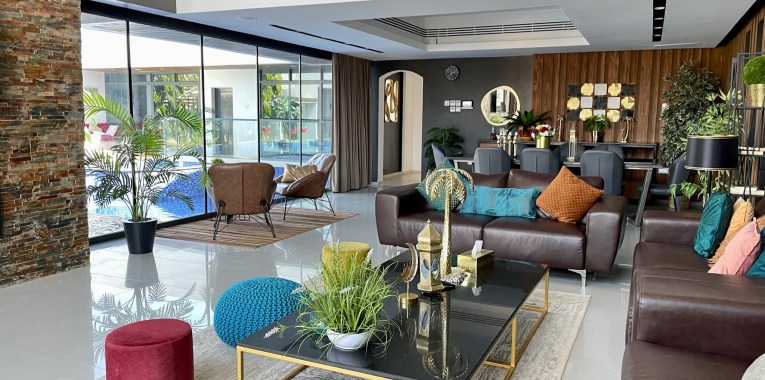
(photo by Onaiza Shaikh, living room in a rental house in Dhofar)

I had a great conversation yesterday with Ahmed Almaazmi and Ayesha Mualla for the Indian Ocean World – New Books Podcast.

https://newbooksnetwork.com/houseways-in-southern-oman

One interesting point that came up in our talk was how changes in house design affect the inhabitants. For much of the Arabian Peninsula, the most common type of house had a central courtyard until the 1970s, 1980s or 1990s depending on the area. With this type, not often found in Dhofar, all the rooms of the house open onto a center space that is exposed to the sky. Thus there are open sightlines in all directions; while more recently built houses are often ‘closed’ with hallways and corners which drastically cut down on the chance of seeing other inhabitants.

The reaction to this change can vary from person to person/ family to family. Some might celebrate the feeling of openness and togetherness found in a house with many vantage points to see most or all of the rooms, where it was easy to cross path with family members. Others see modern houses with limited sightlines as a great advantage in that people can come in and leave without others knowing.

One Dhofari friend told me that having a large open area near the front door, big enough for a few sofas, has been a blessing for her elderly father who can sit in that space all day and see every person as they move between the salle, majlis, kitchen, stairs and front door.

On the other hand, a different Dhofari woman told me about the early years of her marriage when she lived with her husband’s parents and felt a tremendous pressure to have herself and her children always well dressed and on-view in the public areas of the house. She and her husband eventually moved into a small rental hour so that she could have a more peaceful life.

This is one of Maneval’s main points in New Islamic Urbanism: The Architecture of Public and Private Space in Jeddah, Saudi Arabia (2019): the built elements for privacy (high walls, limited sightlines in houses etc.) allow for people to act as they chose as they can create non-observed spaces for themselves.

Thus one can imagine a courtyard house with an family member who rigidly watches, criticizes and controls all the movements or a house in which inhabitants happily greet each other and sit together in harmony. Just as there are modern houses in which people are thankful to have privacy and chances to live as they please and other modern houses in which people feel cut off from each other and lonely.

The only drawback to our talk was that, to prepare, I read a published copy of my Houseways in Southern Oman book and found numerous typos. It was disappointing to see so many mistakes: Salalah misspelled, the author R. Guest written with a small ‘g’ and Modern South Arabian languages referred to as “South Arabian languages.” The proof I was given to check was write-protected, so I could make edits but I could not ‘accept’ the changes to see what the corrected version would look like. The result is odd spacing, missing words and small errors. Very frustrating!

Houseways: House plans

Houseways: Dhofari/ non-Dhofari house plans

Houseways is published and more examples of houseplans

Selected references related to Houseways in Southern Oman, Oct. 2022

Houseways in Southern Oman