New essay: “Za” on the Arabic Alphabet website

“Za is for Saffron” by Michael Beard, illustrated by Houman Mortazavi

http://alifbatourguide.com/the-arabic-alphabet/za/

http://alifbatourguide.com/the-arabic-alphabet

Za is for Saffron

Za and Ra come from different ancestors, though you wouldn’t guess it from their appearance. Today only the dot distinguishes them. This was not always the case.

Among the letters which don’t connect on the left (Za is our fourth), there are other family connections you wouldn’t ordinarily see. It is a tangled genealogy. Today Ra and Za look like twins, except for the dot over Za, but in Nabataean, the R sound had a different twin. R was represented by a letter pretty much identical to the one which represented the sound of D. (Both looked like an inverted capital Roman L.) The Z sound was at that time a simple vertical stroke. None of the three had a dot. Gradually the shapes of Dal and Ra grew apart, who knows why, Dal with the sharper angle, while Ra grew smoother and began to sit lower on the line. Meanwhile Ra and Za converged. Sometime around the fourth century, Za and Ra became the look-alikes, too close for practical use. There was a separation, and Za got the dot. Then both shapes, Za and Ra, developed, thanks to the reed pen, the identical curved bodies we see today.

There is probably some scientific principle to explain the evolution of letters from one form to another, why one rotates 90 degrees, lengthens, thickens or bends. Perhaps the changes are arbitrary, or perhaps there is a process of natural selection, in which the most useful ones, the most legible, the easiest to distinguish, or the most beautiful, survive. The reed pen exerted its shaping power. As Islam spread, and there were frequent occasions to treat letters with respect, in calligraphy, inscriptions, seals and written prayers, the most beautiful (or malleable) were the survivors.

Zayn in Arabic means beauty. For years I thought that in Arabic Zayn was the name of the letter. (It isn’t.) Way back, as far back as the evidence goes, the Phoenician ancestor of Za, something like a capital H on its side, had a name (Zayin, in Phoenician “weapon,” evidently a sword). The current shape has lost the name, but it looks more like a sword.

continued at:  http://alifbatourguide.com/the-arabic-alphabet/za/

New essay: “Ra” on The Arabic Alphabet website

The Arabic Alphabet: A Guided Tour 

by Michael Beard, illustrated by Houman Mortazav

Ra is for Rigel (first section)

http://alifbatourguide.com/the-arabic-alphabet/ra/

Ra is proverbial for smallness (as iota is proverbial for the slight and diminutive in Greek): a simple swoop from the baseline downward. No connection on the left. It just descends, comes to a point and stops. Drawn with a reed pen it thickens half-way down and narrows again as the angle of the reed shifts. Add a dot overhead and you have the letter pronounced Z. (Add three dots and you have the sound added by Persian speakers in the 15th century, Zha.)

In their early forms the Ra and Dâl shapes look, to my eye at least, identical. Evidently early users felt the same way. Writers of Syriac distinguished them by a dot: Ra had a dot added above, Dâl had one added below. In later forms Ra (now dotless) came to descend below the base line and distinguish itself from Dâl by position. (Dâl was higher.) Dâl is often thicker at the top. Most Ra s seem aerodynamic, immersed in a right-left current which blows the thinner edges leftward. The lower point can curl up. In thulûth script Ra can extend until it almost connects on the left, because the lower point may curl up and seem to connect, as if to make the point tickle the underside of the letter which follows. In handwriting today Dal and Ra can still look very much the same.

The sound is a trilled R; when it is doubled (unlike doubled R in English, as in “current” or “barracks”), you hear the prolongation. This is the case of the two (or four) R sounds which occur in the basmala (Bism Allâh al-raḥmân al-raḥîm), where the Ra is doubled because “L-R” is pronounced as RR. (Long story. It requires knowing more about Lam.) Ra is one of those letters whose sound takes on a lot of disguises. In Sorani Kurdish it takes two identities: the familiar trilled R is written with a little V shape close underneath. The naked, stand-alone R shape is pronounced something like a glottal stop.

Anne Meneley, research on Yemen

(photo of Sarfait, close to the Dhofar border with Yemen, taken by M. A. Al Awaid)

I was so pleased that Anne Meneley came to the session on “Social Attitudes Toward Food and Eating” at the recent Just Food conference. It was her work on ‘food and morality’ that helped me start to think about the connections between food and ethical behavior in Dhofar. Although her research focus has moved beyond Yemen (see below) I would like to list four publications which have greatly helped me in understanding Southern Arabia.

Meneley, Anne. 2017. “The Zabidi House,” in Architectural Heritage of Yemen: Buildings that Fill my Eye. Trevor Marchand, ed. London: Gingko Library. 195–203.

—. 2011. “Food and Morality in Yemen,” in Food: Ethnographic Encounters. Leo Coleman, ed. New York: Berg. 17-29.

—. 2007. “Fashions and Fundamentalisms in Fin-De-Siecle Yemen: Chador Barbie and Islamic Socks.” Cultural Anthropology 22.2: 214–243.

—. 1996.  Tournaments of Value: Sociability and Hierarchy in a Yemeni Town. Toronto: University of Toronto Press, Re-released on the 10th and 20th anniversary of publication – https://www.goodreads.com/book/show/1436862.Tournaments_of_Value

Selected publications from her website:

https://www.trentu.ca/anthropology/faculty-research/anne-meneley

2020  Anthropology News, 29 June 2020 The Distance of a Hockey Stick, Pandemic Insights.

2020a Hope in the Ruins: Seeds, Plants, and Possibilities of Regeneration. Environment and Planning E: Nature and Space, online.

2020b The Olive and Imaginaries of the Mediterranean. History and Anthropology 31 (1):66-83.

2019 Walk This Way: Fitbit and Other Kinds of Walking in Palestine. Cultural Anthropology 34(1):130-154.

2018 Consumerism. Annual Review of Anthropology 47:117-32.

2017 The Zabidi House. Architectural Heritage of Yemen: Buildings that Fill My Eye. Ed. Trevor H.J. Marchand, pp. 194-203. London: Gingko Library.

2016 Checking Your Waistline at the Checkpoint: Dieting as a Peace Initiative. Jerusalem Quarterly 68:90-103.

2014a The Accidental Pilgrims: Olive Pickers in Palestine. Religion and Society: Advances in Research 5: 186-199.

2014b Resistance is Fertile! The Re-invention of Food: Connection and Mediation, Cristina Grasseni and Heather Paxson, guest editors. Special Edition of Gastronomica Vol. 14(4):70-79.

2014c The Qualities of Palestinian Olive Oil in Fat: Culture and Materiality, Christopher E. Forth and Alison Leitch, eds. pp. 17-31. New York: Bloomsbury.

2014d Discourses of Distinction in Contemporary Palestinian Extra-Virgin Olive Oil Production. Food and Foodways 22 (1-2): 48-64.

2014e Comment on Andrew Bevan’s “Mediterranean Containerism.” Current Anthropology 55 (4):408-409.

2011 Blood, Sweat and Tears in a Bottle of Palestinian Olive Oil.  Food, Culture and Society 14 (2): 275-290.

2011 Food and Morality in Yemen.  In Food: Ethnographic Encounters.  Editor, Leo Coleman.  New York: Berg. Pp. 17-29.

2008 Time in a Bottle: The Uneasy Circulation of Palestinian Olive Oil.  Middle East Research and Information Project (MERIP). Fall 248:18-23.

2007 Fashion and Fundamentalisms in Fin de Siècle Yemen: Chador Barbie and Islamic Socks. Cultural Anthropology 22:214-243.

2003 Scared Sick or Silly?  Social Analysis 47(2):21-39.   Also reprinted in Illness and Irony.  M. Lambek and P. Antze, eds. 2004  New York: Berghahn.

1999 Goods and Goodness. Social Analysis 43(3):69-88.

1999 Introduction to “The Structuring of Subjectivities in Material Worlds.”  Social Analysis 43(3):1-5.

1998 Analogies and Resonances in the Process of Ethnographic Understanding.  Ethnos 63:202-226.

New Essay: “Dha” on the ‘The Arabic Alphabet’ website

The Arabic Alphabet: A Guided Tour

by Michael Beard, illustrated by Houman Mortazavi

http://alifbatourguide.com/the-arabic-alphabet/dha/

Opening of Dha is for Zildjian

فی ذکری
PBW
(1945-2021)

It is unseemly, says a friend of the Persian poet Sa‘dî, and contrary to the judgment of the wise, for two things to happen:

ذو الفقار علی در نیام و زبان سعدی در کام
Dhû al-fiqâr-e ‘Ali dar niyâm va zabân-e Sa‘dî dar kâm
…for `Ali’s sword to remain in its scabbard and for Sa`dî’s tongue to remain in his mouth

Sa‘dî’s friend is revving him up to write his masterpiece, the Golestân. It was clearly a convincing argument.There are readers who may say that eloquence is more powerful when the tongue operates inside  the mouth rather than outside, but it’s not as if we didn’t know what Sa‘di’s friend means. It’s a powerful argument, cunningly located, since it makes the creation of the Golestân a kind of heroism, heroism without the sword.

Islamic tradition has tales of heroism and chivalry which will be understandable to western readers. As with us, a hero’s sword may have a name, in the manner of Excalibur in the Arthur stories and Roland’s Durendal. Ali, the Prophet’s nephew, was a historical figure, but he became a legendary hero with enough cachet to deserve a legendary sword. Dhû al-fiqâr (usually transliterated as Zulfiqâr) is etymologically that which possesses a backbone (from fiqâr, spine, from a stem meaning to pierce or perforate). Sa‘dî’s friend makes a clearer case: if you have a tongue with the power of Ali’s sword, out with it. En garde, miscreants.

Dhû means possessor, owner, holder or master of… You can be master of an object or a concept. Dhû al-Qa‘da and Dhû al-Ḥijja are names of months in the lunar calendar. During Dhû al-Qa‘da, military conflict was suspended (since it’s a month characterized by qa‘da, “sitting,” thus “sitting out the action”). Dhû al-Ḥijja is the month of pilgrimage (Ḥijja, the pilgrimage). Dhû ‘aql, possessing reason, understanding, is a term for an intelligent person. Dhû al-Ḥiyyâtayn, the possessor of two lives, is an amphibian. Dhû al-Qarnayn is “the one who possesses two horns” (from qarn, “horn”). In European tradition the hero with horns would be Moses (which we know from Michelangelo’s statue of a horned Moses with the ten commandments); in Islam Dhû al-Qarnayn is Alexander the Great, well known in the Islamic world as Iskandar, who is portrayed in Sura 18 of the Qur’ân, building a wall to keep out Yâ’jûj and Mâ’jûj , our Gog and Magog (Q 18.93-97). Dhû al-Nûn is an epithet of Jonah (Nûn can mean a Ḥût, “whale”): it demonstrates that dhû doesn’t always mean “possessor,” unless we think of Noah as owning the whale. “He of the whale.”

New essay: “Dâl” on “The Arabic Alphabet” website

Dâl is for Dinar

http://alifbatourguide.com/the-arabic-alphabet/dal/

Dâl is the fourth basic shape. We started with the shape of Alif (population one). Ba, with that simple plate shape, plus dots, gave us the second and least interesting of the shapes. Jîm was the mold for three or four additional letters. The Dâl shape marks the end of a series (with one companion letter to follow). The four shapes in sequence spell abjad. ابجد. ) .د .ج .ب .ا)

Dâl in its simplest form is just two lines which splay out leftward from a point usually at the base line. In calligraphy the upper line can be thick or thin, drawn with the full width of the reed’s edge, but it is almost always nearly upright, leaning at perhaps the 11:00 position. The lower line ramps down to the left, usually at a slight angle, perhaps 8:00.  From the Nabataean predecessor, an inverted L, Dâl has rotated not quite 180 degrees clockwise. More schematically, we can imagine it as simply two thirds of an equilateral triangle with the left side missing. Its Greek counterpart, Delta, adds the third side, to form the complete triangle.

Perhaps because it is a simple letter, in calligraphy there is room for considerable variation. It may curl up as it tapers. You may see the lower mandible almost join the upper one. There are lengthened versions which allow them to stretch out left in long, straight parallel lines.

The Arabic Alphabet: A Guided Tour

by Michael Beard

illustrated by Houman Mortazavi

Foodways – other avenues of research

(photo by Salwa Hubais)

The good news is my book, Foodways in Southern Oman (Routledge), is now officially published. The bad news is, as every author knows, I keep finding topics I should have mentioned. Just today I happened upon: Of Dishes and Discourse: Classical Arabic Literary Representations of Food by Geert Jan van Gelder – what a great-sounding book! I will try to find a copy and read it.

I know there is a whole sub-genre in Arabic literature of personified ‘fights’ between different type of foods (munazara) for example “The Delectable War between Mutton and the Refreshments of the Market Place” featuring King Mutton and King Honey (or Clive Holes’ work “The Dispute of Coffee and Tea: A Debate Poem from the Gulf,” in Tradition and Modernity in Arabic Language and Literature, ed. J.R. Smart, 1996, 302-315). But I did not include a discussion of these as they seemed a little too far from my topic, as did poems about being a host/ guest such as Abu al Hakam Al Maghribi’s “A Domestic Disaster” which is too ribald to teach but is a good match with Ben Jonson’s “Inviting a Friend to Supper.” Perhaps at some point I can look more closely at this type of writing.

I have also realized that I was never able to find government documents about the number of animals (cows, camels, goats) in Dhofar – that was on my to-do list, but got lost in the shuffle of work and dealing with corona. I also wanted to go to a fish market and meat market and write a lot more about cuts of meat/ types of seafood in terms of prices, how they are prepared and sold but the markets didn’t re-open until after the books was sent to press.

Another topic I want to reflect about more is cultural issues relating to TIME and PLACE of eating, i.e. [pre-corona] my surprise that many of my students do not eat or drink anything before coming to class while they are surprised to see me eating lunch at my desk (“Why don’t you have lunch at home? How can you eat in your office?” they wonder.) Or the surprise of me drinking or eating while walking, something that is not done here. Another difference is my habit of making a cup of coffee last over an hour, while most Dhofaris will finish their drink quickly. A small cup of tea is usually gone in three sips, while I nurse mine until it is cold.

Lastly, I wanted to do interviews with Dhofaris who made/ sold food on Instagram, at festivals and small stores. I have heard of one Dhofari man who opened his own restaurant where he not only supervised, but cooked. However, between the public and private mourning for Sultan Qaboos and the on-set of corona, spring 2020 was not the time to ask strangers to help with my research. I hope 2021 affords more chances to write, research, think and discuss about foodways!

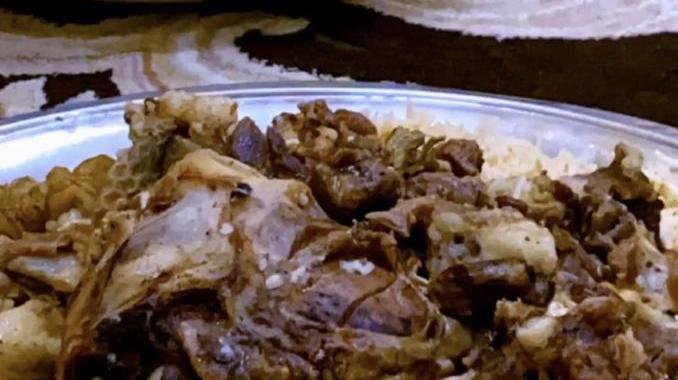
y - meat rice and fruit

Poems

September is the time to read lots of poems, trying to find good ones to teach. Here is one of my favorites:

My childhood is a long way off

My old age is a long way off

My country, my exile, a long way off.

Tourist!

Give me your binoculars

Perhaps I might glimpse a hand or a handkerchief

In this world

Waving at me

Take my photographs as I weep

Crouching in my tatters on the steps of the hotel

Write on the back of the picture

“This is a poet from the East.”

Spread your handkerchief on the pavement

And sit beside me under this tender rain  

Let me disclose to you a great secret:

“Go dismiss all your guides

Throw to the mud…to the fire

All the notes and impressions you’ve written

Any old peasant in this land

Can tell you with two verses from our sad ‘Ataba songs

All the history of the East

As he rolls his cigarette in front of his tent.”

            Muhammad Al-Maghut (1987)

Other good poems

“Arabic Coffee,” a poem by Naomi Shihab Nye

Favorite Poems

and the favorite poem of all poetry teachers:

Poems – “Finding Poems for my Students” by Mohja Kahf


I am pleased to announce that my chapter “Teaching Paired Middle Eastern and Western Literary Texts” has been published

Risse, Marielle. 2020. “Teaching Paired Middle Eastern and Western Literary Texts.” Advancing English Language Education,  Wafa Zoghbor and Thomaï Alexiou (eds.). Dubai: Zayed University Press. 221-223.

“Teaching Paired Middle Eastern and Western Literary Texts” – This chapter focuses on a technique which increases students’ participation, creativity and analytical ability in literature and language classrooms. By teaching two texts in English together, one from a Western and one from a Middle Eastern culture, students can compare and contrast a familiar text to one that has new settings, themes, people and opinions. This analysis allows students to see how characters, leitmotifs and points of view can be both similar and different across cultures, and in turn improves students’ reading, writing, speaking and critical thinking abilities. As some teachers might be hesitant to use literature in a language classroom or be unfamiliar with texts from a different culture, this chapter gives several specific examples, in addition to explaining how to teach paired texts. When teachers overcome the fear of working with new texts, they can pass on their insights to students.

Click to access AELE_Book_ALLT_ZU_Web_V02.pdf

New essays: “Ba”and “Ta” on “The Arabic Alphabet”website (by Michael Beard)

(illustration  by Houman Mortazavi)

Ba: http://alifbatourguide.com/the-arabic-alphabet/ba/

Peh: http://alifbatourguide.com/the-arabic-alphabet/peh/

Ta: http://alifbatourguide.com/the-arabic-alphabet/ta/

excerpt from “Ta is for Dragoman”

Ta is for the Arabic verb T-M-M tamma, to be complete. (Tamma, “it’s over.”) One verbal noun is the word tammâm, completion, perfection, the end, a word which readers of the first edition of FitzGerald’s Rubai‘yât of ‘Umar Khayyâm (1859) will see at the bottom of the page under the last poem, where he adds, without translation, “Tamám shud,” the Persian term for “It’s over,” “it’s complete,” “that’s all she wrote,” “finito,” “finis,” “khalâṣ,” “the end,” “ta ta.”

If we’re in this for the shape of the letters we should be ready for disappointment. Except for the dots, it’s just another saucer shape like Ba or Pa. Ta and Ba do not, however, come from the same ancestor. Ta (like the following letter, Tha) was, in an early Nabataean form, two vertical lines, one of which bends to touch the other, something like our lower-case “h.” In successive shapes it gets simpler and simpler, loses its visual identity, gives in to peer pressure, and assimilates to the shape of Ba, with nothing to distinguish it but the dots.

The two dots float side by side above the plate shape (or above the lip at the beginning of a word, or the little notch in the middle of one). In its terminal form two dots above the curved horizontal line seem a little like two eyes hovering over a narrow, wan smile. It would make a good emoticon.

Ta is one of the commonest prefixes in Arabic, and a common suffix as well, an alphabetical handyman who is likely to show up in any part of the word. At the end of a past tense verb (actually verb tenses in Arabic are complicated, but leave that to the experts), Ta can designate the first person. The same suffix can signal that the agent of a past-tense verb is feminine (object or person). In a present tense verb (present being, again, an approximate term) Ta at the beginning can mean it’s a second-person “you” who performs the action. The same prefix attached to a third-person verb signals feminine agent. For other reasons, independent of tense, it can show up in the middle of a word with no warning for the uninitiated reader.

Hard Worker

The new student of Arabic is greeted early on with a list of variations around the three consonants. The stem D-R-S, “to write,” in default form is darasa, “he studied” or “learned.” Double the middle consonant (i.e. darrasa) and we have the second form, “he caused to learn,” or “he taught.” Lengthen the first vowel, and it’s dârasa, “to study.” (There are seven other potential forms that I know of, not our subject.) That second form, darrasa, has a verbal noun with a Ta prefix, tadrîs, “learning,” “instruction.”

Arabic dictionaries are alphabetized by verbal stem, so Ta often just gets in the way. You see the word tadrîs and you may want to look it up: you won’t find it under Ta, but under Dâl, for D-R-S. Pick up a passage of Arabic and we see Ta words everywhere on the page, but most of them are prefixes. Actual Ta words take up only thirteen pages (out of 1301) of the Hans Wehr Arabic dictionary. It’s different in Persian or Turkish dictionaries, where the Arabic verbal nouns are heard as separate loan words and listed under Tay, so that all those Ta prefixes look like separate words, and the Ta entries in Persian or Turkish dictionaries go on for a while.

Tatmîm, “completion,” comes from a Ta verb, T-M-M. Taḥqiq, “research,” comes from a stem Ḥ-Q-Q, “to be correct.” (The noun Haqq, “truth,” is a family member.) The stem which gives us the Arabic numeral “one,” W-Ḥ-D, as a number is wâḥid. Tawḥîd means “unity,” but in a religious sense “belief in the oneness of God,” “profession of faith,” one of the five pillars of Islam.

ta-chapter-head