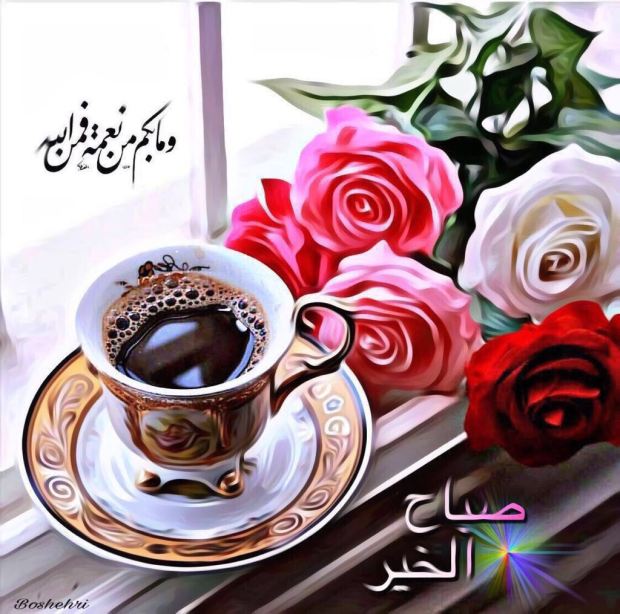
“Arabic Coffee,” a poem by Naomi Shihab Nye

A lovely poem by a wonderful poet.   (complete image is below)

It was never too strong for us:

make it blacker, Papa,

thick in the bottom,

tell again how the years will gather

in small white cups,

how luck lives in a spot of grounds.

Leaning over the stove, he let it

boil to the top, and down again.

Two times. No sugar in his pot.

And the place where men and women

break off from one another

was not present in that room.

The hundred disappointments,

fire swallowing olive-wood beads

at the warehouse, and the dreams

tucked like pocket handkerchiefs

into each day, took their places

on the table, near the half-empty

dish of corn. And none was

more important than the others,

and all were guests. When

he carried the tray into the room,

high and balanced in his hands,

it was an offering to all of them,

stay, be seated, follow the talk

wherever it goes. The coffee was

the center of the flower.

Like clothes on a line saying

You will live long enough to wear me,

a motion of faith. There is this,

and there is more.

Nye, Naomi Shihab. (2002). Arabic Coffee. Poems by Naomi Shihab Nye. Now Classroom. http://www.pbs.org/now/arts/nyepoems2.html

Essays about Teaching Poems

John Clare Looks Good in a Dishdash: Linking John Clare to Middle Eastern Poetry

Marlowe in Salalah: Making English Poetry Relevant – 2008

Teaching Literature and Staying au courant – The Man from Nowhere and the Ancient Greeks

Foodways and Literature – Food Stories and Poems

Foodways and Literature – Animal Poems

Teaching Paired Literary Texts

Translating Western Conceptions of “Nature” to the Middle East – 2009

gm - coffee 2

I am happy to announce that my article “مناقشة إثنوغرافية للحكايات الشعبية من جنوب عمان” [An Ethnographic Discussion of Folk Tales from Southern Oman] has been published in the journal Al Sha’ar (Alaan Publishers, Amman).

(photo by M. A. Al Awaid)

This paper examines the cultural markers within a set of folk tales recorded in southern Oman. In the 1970s Dr. Tom Johnstone documented the un-written, Modern South Arabian languages of Gibali (also known as Jibbali and Shehri) and Mehri in the Dhofar region of Oman. In 2014, Dr. Aaron Rubin’s published a book on Gibali grammar based on his own research, Johnstone’s notes and data from Gibali speakers living in America; the book includes 70 texts of taped speech transliterated into Gibali with an accompanying English translation which cover a variety of genres including folk tales, autobiography, grammar exercises, and fairy tales.

The paper explains how the folk tales texts are representative of southern Omani culture by analyzing the various textual elements such as characters, setting, plot events and theme, as well as physical markers such as landscape and animals. These texts are among the very few documents written in Gibali and help illustrate ways in which the Dhofari culture has, and has not changed, since the rapid modernization after the 1970s. I will also compare the elements from the Johnston/ Ali Al Mahri/ Rubin texts with folk tales from other texts Khadija bint Alawi al-Thahab’s Stories of My Grandmother: Folk Tales from Dhofar, Hatim Al Taie and Joan Pickersgill’s Omani Folk Tales, and Grace Todino-Gonguet’s Halimah and the Snake, and other Omani Folk Tales.


Food Tastes Better in the Rain – Khareef in Salalah

I had been in Salalah about ten months and it was the first day of my first khareef (the word means ‘autumn’ in Arabic, it’s used in Salalah to mean the monsoon season from the end of June until the end of August). I walked outside my house, felt the drizzle on my face and walked back in. With a washcloth I dried my face and thought about how could I possibly keep my hair de-frizzed in such humidity.

A few hours later, some of the Omani men in my research group stopped by. I made tea and set the carafe on a tray with cups and cookies and brought it into the majlis. One of the men picked up the tray and brought it out to the garden.

“We are NOT eating out there, it’s wet!” I yelled.

Oh, we were most certainly eating out there; it’s khareef. Time to eat outside.

For me then (and to a certain extent, even now) I don’t get it. Omanis are always so clean, so well-turned out: impeccable clothes, gorgeous perfumes and everything spotless. Why would you want to go sit in muddy fields and get rained on? And the mosquitos! Let’s not forget the mosquitos and some other smaller insect that leaves a welt that lasts for three days. And what happens to the food? Rained on. Damp cookies, soggy bread, a film of water on everything and you have to constantly drink tea to stay warm in your damp clothes.

“Isn’t it gorgeous?” Omanis say to me.

I try to smile, using a mushy Kleenex to dry off my face, “Oh lovely!” And it is, the grass turning green, the fog rolling in, that wonderful damp earth smell – but could we not enjoy this through a plate glass window? No, we could not.

I have bowed to the inevitable and bought a water-proof purse; I wear washable Crocs. I have learned to always keep a stick or two of wood in my car so that it stays dry enough to get a fire started. I used to try to keep all the food covered but have given on that. Rain on the kabsa, rain on the briyani, rain on the mandi, rain on the mishgak (meat kebabs).

I have been on magical picnics. If you are sitting near the edge of a cliff, the clouds move in and out, opening and closing the vista down to the sea or over the plains. In the mountains, the ground is a carpet of green, with beautiful white flowers and purple flowers later in the season.

The culture you are born into is hard to shake; there are times I long for an umbrella, a rain jacket and a crisp cookie. But, food tastes better in the rain, or so I am told.

IMG_3202

(photo from social media)


My article “An Ethnographic Discussion of Fairy Tales and Folktales from Southern Oman” will be published in Fabula

I am pleased to announce that my article “An Ethnographic Discussion of Fairy Tales and Folktales from Southern Oman” will be published in Fabula [https://www.degruyter.com/view/j/fabl]

This article discusses a collection of fairy and folktales from southern Oman to explain how some of the physical and cultural markers described in the texts which are still extant today. The tales, most of which were recorded in the 1970s, were originally spoken in Gibali (also known as Jibbali or Shahri, a non-written, Modern South Arabian language) and are published in Rubin’s The Jibbali Language of Oman: Grammar and Texts (2014). This paper does not place these texts within established codices; rather, the exegesis turns inward, examining how these stories, recorded at the beginning of modernization in the Dhofar region, reflect many traditional elements of Gibali cultures. Further, the article compares the texts to other Dhofari/ Omani fairy and folktales from Al Thahab’s Stories of My Grandmother: Folk Tales from Dhofar (2012), Al Taie and Pickersgill’s Omani Folk Tales (2008), and Todino-Gonguet’s Halimah and the Snake and other Omani Folk Tales (2008) to highlight how the Johnstone/ Al Mahri/ Rubin texts show Dhofari beliefs about oath-taking and the importance of teaching morality in written, but not oral, texts.


Ramadan and Foodways – Images of food in connection to greetings and good behavior, Vimto and selling food

Marieke Brandt (2017) and John Postill (2016) have written about using social media to do anthropological research in places that are difficult to reach; it is also valuable when you are living in the same area. Scanning social media in Dhofar helps me to understand how food is conceptualized during the holy month of Ramadan. The analysis of the images comes next, but for now I am trying to discover the range of images and sorting through to see what kind of categories are found (and not found). In this post are some examples of food images in Ramadan greetings, different type of images with Vimto (a drink that has become associated with Ramadan), efforts by the government/ official channels to encourage good eating and generous behavior and an example of how prepared food is sold.

Food as a part of typical Ramadan greetings


The importance of Vimto!


Vimto at McDonald’s and Baskin-Robbins


Vimto as decoration


Fun with Vimto

vimto - moon

Efforts by government and private entities to improve eating habits during Ramadan

ramadan - nuts

This slideshow is stills from an ad which makes fun of people who have too much of something as a way to caution people against making too much (and then wasting) food at Iftar: a man who has several watches, a woman who has several TVs, a man wearing several hats, then the message.


This slideshow requires JavaScript.

Stills from a short video reminding people to not embarrass (judge) others during Ramadan. The video starts with 2 women preparing iftar, one is seen by a man as she eats a samosa. Then you see the family sitting at the table and enjoying iftar. The man pretends to ask the girl if she is enjoying the food, then humiliates for breaking her fast. As she looks sad, his wife pulls his dishdash and explains that she has a lawful reason not to fast.


There are many photos to children helping to prepare Iftar/ handing out food

iftar help

Selling prepared food for Iftar:


The photos of the woman selling food are taken from an ad on social media which shows close-ups of several types of food and an description of the exact location of her tent.


Favorite Quotes on Anthropology

(photo by M. A. Al Awaid)

Ethnography is unlike literature and like science in that it endeavors to describe real people systematically and accurately, but it resembles literature in that it weaves facts into a form that highlights patterns and principles. As in good literature, so in good ethnography the message comes not through explicit statement of generalities but as concrete portrayal. (Peacock 1986 83).

What is significant is the vision of someone’s (the native’s) existence interpreted through he sensibilities of someone else (the ethnographer) in order to inform and enrich the understanding of the third party (the reader or listener). Ethnography in this sense is like literature: as a source of psychological and philosophical insight (and possibly aesthetic pleasure) when read as the author’s struggle to elucidate a perspective on life through his portrayal of a way of living – as he experienced it and analyzed it. (Peacock 1986 100)

The travel account is generally self-confident and authoritative in tone, and certain of a readership that wants a culturally shared translation of another way of life… but the realist ethnographic account has long been dogmatically dedicated to presenting material as if it were, or faithfully represented, the point of view of its cultural subjects rather than its own culture of reference (Marcus and Cushman 1982 34). [in anthropology] “the style of reportage was always pushed firmly toward generalization rather than maintained at the level of mere detailing of particular facts… it is impossible to work back from a final account to original fieldwork enterprise in anything like the way a chemist can work back through an experiment reported by another chemist (35).

the fact that one’s self is not expendable for a great many people, even when life offers turbulence and disaster; and self-representations shift and change, has two implications: It shelters you from some of the problems attendant on freedom to move ahead-that of keeping a hold of oneself through life. It also anchors you in a material world that clings to you and your biography…You are what you are by virtue of your connection to these things and this world: the same house, the same clothes, the same darned people. Your body, too anchors, you, being for most people a medium we cannot silence. This does not mean that things are fixed, immutable. But they persist, and you have to hang on to them, not just trade in the old car of a new one. (Wikan 1995 275)