

My essay “Living Expat” has been published:
“Living Expat.” Emanations: Chorus Pleiades. Carter Kaplan, ed. Brookline, MA: International Authors, 2018: 308-318.
My essay “Living Expat” has been published:
“Living Expat.” Emanations: Chorus Pleiades. Carter Kaplan, ed. Brookline, MA: International Authors, 2018: 308-318.
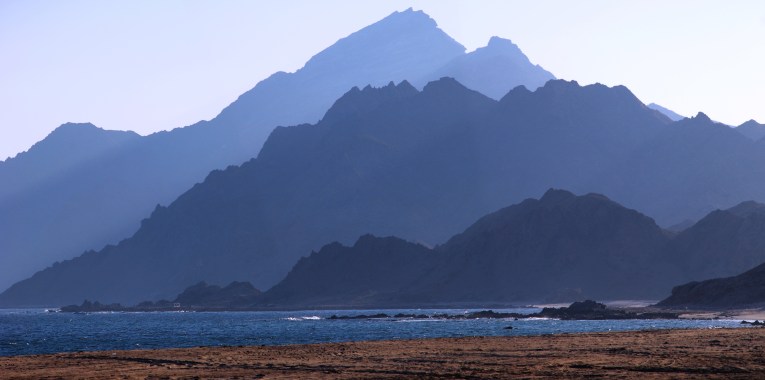
(photo by M.A. Al Awaid)
Abstract from “Issues of Autonomy in Southern Oman” by Dr. Marielle Risse
Gibali (also known as Jibbali, Śḥeret, Shari and Eḥkili) is a non-written, Modern South Arabian language spoken by several groups of tribes in the Dhofar region of Southern Oman. While teaching in Salalah for more than ten years, I have been working with several Gibali-speaking men researching the culture and life-ways of one particular group of tribes, the Qara. Gibalis, both in interviews and from my long-term observations, see their culture as giving both men and women opportunities to craft their own lives and, specifically, to gain a positive reputation for wisdom.
This paper will explore how the Gibalis create and maintain an atmosphere in which both men and women are seen as having access to positive virtues and some control over their own lives. In addition to my observations and interviews, I will include examples from the fields of political science and anthropology, as well as stories from the first set of written texts in the Gibali language.
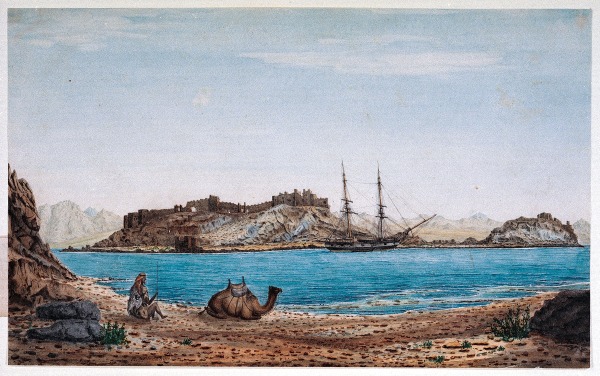
[painting: Island of Faroun near the head of the Sea of Akabah. Showing the HEIC’s surveying vessel Palinurus. © National Maritime Museum, Greenwich, London]
I will be presenting “Accounts from the journeys of the brig ‘Palinurus’ along the Dhofar Coast in the mid-1800s” at the Exploration and Memory Conference, Mational Maritime Museum, September 14 and 15th.
https://www.rmg.co.uk/see-do/exhibitions-events/exploration-and-memory-conference
This three-day conference, from Thursday to Saturday, will consider exploration from the vibrant perspective of memory studies. Presentations will focus on the history, poetics, and material and visual culture of exploration, exploring how these have changed over the years and what their legacies have been, and continue to be.
Unseen Art of Australia’s First Fleet; Naval collecting between Cook and Darwin; Sir Rex Nan Kivell: ‘Collecting the explorers’ and not recalling ones’ past
Mapping movement and memories of coastal South America, 1680–1750; Representations of James Cook in Australia during the 1920s and 1930s; Convicts and Cartography in the Australian Colonies
Remembering the shipwreck of the Querina, 1431–32; Lost and forgotten: the story of the first Cook memorial; 21st Century challenges to the memorialisation of explorers
British perceptions of difference in voyage narratives to the South Seas in the 1740 and 1760s; Encountering a “Savage” Land in the Romantic Era; Indigenous knowledge in New South Wales and London in the early nineteenth century
The Afro-Brazilian architectural heritage in Nigeria and the Republic of Benin; Exploring inter-personal spaces in India-Bangladesh borderlands
Pacific Encounters: museums and memory making; The Taonga have memories too; Rites of space at ‘the shrine of geography’: the Royal Geographical Society, memory and exploration
Arctic expedition and encounter; Fragmented Landscapes: Memory, Photography and the Polar Expedition
Cabeza de Vaca’s Naufragios: exploration, ethnography, and identity negotiation; The Battle of Goringhaiqua and the death of Viceroy D’Almeida: contested histories, popular memory and ancestral voices
Between poles of memory in Ed O’Loughlin’s Minds of Winter; Accounts from the journeys of the brig ‘Palinurus’ along the Dhofar Coast in the mid-1800s; Time and memory in Antarctic exploration literature for children
My first semester in Oman I didn’t read anything except texts for classes. I simply couldn’t get ahead of class preparations as there was so much to learn, process, translate and understand. When I lived in Boston I always had a book to read on the T (metro) so I started to carry Gulliver’s Travels with me when I left the house in Salalah. I finished it piece-meal: working through it while waiting at the phone or electric company, standing in line to pay a bill or at the grocery store or waiting for meetings to start.
Gradually, as I settled, I started back in on fiction only to find, somewhat to my horror, that there was a reverse correlation to what I was teaching. In Boston, I belonged to two book clubs at the Boston Athenaeum: Arcadia, Pale Fire, Invisible Cities, Passage to India, Trollope, Lolita, Racine’s Phaedra, Flaubert’s Parrot, The Movie-goer, etc.
Two different long-distance friends and I set up mini-book clubs; we would read the same book then make a phone-call date to thrash it out: The Forsyth Saga, Anna Karenina, Tristram Shandy, Herodotus, Brothers Karamazov, Reservation Blues, Tuchman, Tolkien, Wharton, various Greek and Latin dramas. On my own, I read all of Proust, most of Stendhal, Flaubert’s letters, The Decline and Fall of the Roman Empire, and the first part of Autonomy of Melancholy. There were a few mysteries mixed in (Ian Rankin, Charles Todd, Barry Maitland and Julia Spencer-Fleming) and some Robertson Davies, but I was reading mainly hard-core.
Then came Oman. The first non-class text I managed was Island of Sheep by John Buchan. Talk about a come-down. And worse: I really liked it. Restful. I remembered what I had tried to long suppress, that when I was teaching in the Emirates, I read all sorts of that type of late 1800s, early 1900s adventure books. Wordsworth Classics publishes “classics” for $3 each and living in Sharjah I read my way through most of H. Ridder Haggard, Beau Geste, Treasure Island, The Count of Monte Cristo, The Last of the Mohicans, Prisoner of Zenda, Hound of the Baskervilles. Feeling guilty, I read the Post-Colonial Reader and Candide to make up for novelistic slumming. I tried to up-grade to C.S. Forester and The Three Musketeers, but my heart was with Ivanhoe, The Scarlet Pimpernel and Lady Audley’s Secret.
In Boston, when I wasn’t teaching, I needed the intellectual challenge of good writing, but in Oman, teaching the “greats,” I drifted back into literary la-la land. After Island of Sheep, it was on to Greenmantle, The Children of New Forest, and Louisa May Alcott. I dabbled with a few travel writers (J. Maarten Troost, Chris Stewart, George Courtauld, and the always marvelous Mark Salzman) but my heart went back to the fluff: Beverly Nichols! The Green Archer! The Black Arrow! Swallows and Amazons! The Coral Island!
I have read almost every canonical book in English literature (Middlemarch is still out there), representative works from all stages of American, French and German literature, a sprinkling of translated works written in Spanish, Scandinavian languages, Greek and Russian. I am working my way through classical and modern literature written by Arab writers. Every semester I read several hundred pages of English and Arabic poetry and short stories looking for texts to teach, but after a nice dose of Persuasion, I sneak off with Gerald Durrell.
One summer, in the time before Kindles, I ran out of books a few weeks before the end of the semester. I couldn’t get out of town to the capital to restock and found nothing at the small English language bookstore in town but Clive Cussler. So I jumped, making it through three Cusslers and then several Douglas Preston/ Lincoln Child books.
Most modern literature leaves me cold. Everyone is suppressed and unable to be themselves. How damaging it all is. And everyone has a miserable childhood. Sigh. Of course you have a miserable childhood. That is the point. Either your childhood is miserable, or you think it is wonderful and realize later it was horrible, or it truly was wonderful but you later become miserable because nothing is as nice as your childhood. All three choices result in desolation; let’s not dwell on that.
And all these serious novels about people who lost themselves. Well really, how does one do that? You are there – there you are. How can you get lost? Modern novels always seem to be set in living rooms, airports, cafes, bars and uninteresting offices, grey carpeting, anguish, but no one is actually doing anything. Give me a sword-fight, tundra, cannons, water-falls, honor, wolf packs, revenge, frantic horse rides across the moors, palm trees, a leaky boat, pirates, tigers, someone mysterious and threatening in the hedgerows, snipers, tea thermoses, terror, floods, breaking the square, hip flasks. Let’s get to the 2-seater running out of fuel over the desert, let’s get to the polar bear attack.
Foodways and Literature – Food Stories and Poems
Foodways and Literature – Animal Poems
Teaching Literature and Staying au courant – The Man from Nowhere and the Ancient Greeks


You must be logged in to post a comment.