Foodways: Iftars in Ramadan

Ramadan started on Tuesday night in Oman. Given the circumstances of fighting Covid-19 there are fewer advertisements showing large gatherings/ family iftars (the meal eaten at sunset to break the fast). Families are highly encouraged to only share meals with those who live in the same household.

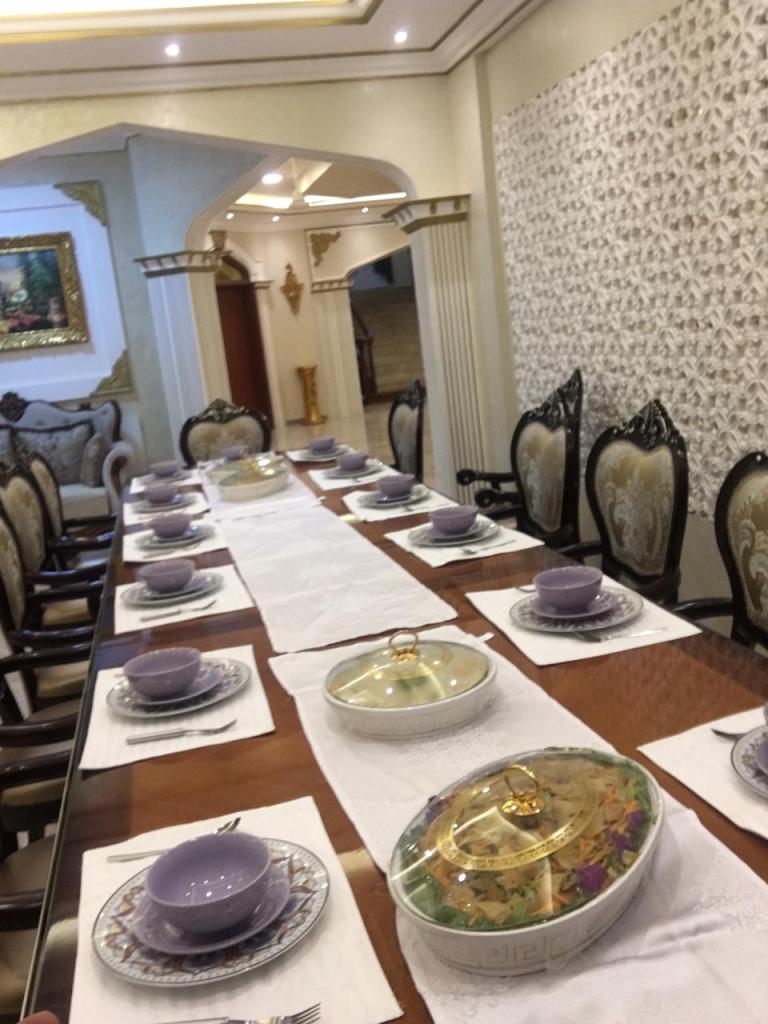
Photos such as these (above and below) are usually shared just within family members (usually with a ‘wish you were here’ kind of greeting). I asked X, who has helped me with my food research, if X might take a photo that I could use on this webpage to show a typical Dhofari iftar.

A few things to note:

  • Every-day family dinners usually have one large dish (fish or meat [cow, camel, goat] with rice or pasta) accompanied by salad and condiments, For rice dishes, plates are not needed as everyone shares from the platter. But for iftars, there is often soup (requiring bowls) and various choices, never only one dish. This means that everyone has a plate to take a little from the numerous dishes, including dates (the most important element), stuffed grape leaves, salads, sandwiches, a fruit bowl (bananas, grapes, oranges), cut fruit and/ or fruit salad with oranges, watermelon, apples, etc.
  • Three typical iftar dishes are 1) sambusas (aka samosas, a baked or fried pastry with a savory filling such as spiced vegetables, cheese or meat). Meat and vegetable sambusas are available all year, but cheese ones are usually only available during Ramadan. Sambusas are sometimes made at home but are usually bought at little covered stalls which are set up outside most bakeries from 4pm-6pm; they are sold by the kilo in brown paper bags. 2) shorba, a soup made with beef, vegetables and oats (sometimes with lemon) and 3) thareed, a dish made with khubz roqaq (raqeeq/ roqaqr, a round bread about 24 inches across and very thin) soaked in a beef or chicken stock with spices. Sweets include custards, kanafeh/ kunafa (shredded filo pastry or semolina dough that is baked in sugar-based syrup usually with a layer of cheese, sometimes served with cream or nuts), luqaymat/ loukoumades (sweet fried dumplings dipped in sugar syrup), saffron/ coconut/ chocolate cake, etc. The most important drink is laban/ labneh/ leben (fermented milk, known in America as buttermilk) which is usually taken with dates to break the fast. The second most common iftar drink is Vimto, a cordial of fruits and spices that is diluted with water. (I think of it as the Omani equivalent of eggnog, a pumpkin spice latte, or a peppermint-mocha coffee, a drink that it is ubiquitous during a holiday season; even the people who hate it admit it is part of the atmosphere.)
  • Another difference between every-day family dinners and an iftar is that normally the food is not served close to prayer times and everyone eats at the same time. There is little conversation while eating and the food is cleared away as soon as everyone is done. For iftars, as seen below, most of the food is kept in a covered containers as it has to be prepared and set out before the call to prayer. After the sunset prayer, family members will sit together for a longer time, eating slowly as they have been fasting all day. Some will eat a little, wait for some time, then eat again. Thus the iftar meal can be left out for hours and the food choices need to either be palatable at room temperature or kept in covered containers.
  • School-age children eat lunch at home, not at school, and most adults are also home for lunch which is the main meal of the day. Dhofaris who work will rarely eat a packed lunch at their desk. This means that kitchen are usually not equipped with the accoutrements for household members taking meals from the house like lunch boxes, mini ice-packs and single-serving size plastic containers. But most households share many-portion amounts of food with neighbors and relatives so there are usually inexpensive duplicates of items such as coffee carafes and glass or plastic serving dishes, and single-use thin metal containers with cardboard covers. For example the dish below with the green cover will hold a rice or pasta dish. This would be used as shown below, with the cover on to keep the food warm until the call for prayer has sounded, or filled with food and given away. A typical kitchen will have several of these so that there is no need to worry if/ when it will be returned if one is given away.

iftar k - 2

Houseways – Balancing Privacy and Hospitality within an Apartment

This is the first of several short essays about housing in Dhofar. After a few posts with photos illustrating types of homes, I will write about theories and cultural perceptions of safety and privacy within home-spaces. Before I begin I would like to thank my Dhofari friends and informants who are so patient in answering questions and so kind in allowing me to take and post these photos.

Normally, pictures are only taken while building a house or when someone has just moved in, in which case they are only shared between close friends. Rooms which have been prepared for a marriage (with wedding gifts on display) are sometimes circulated, without names, through social media. The only other time photos of interiors are taken is for a host or hostess to show that the house is ready for a party; photos of exteriors are usually only taken to be sent to delivery people so that they can recognize the house. So it is not normal to take “every-day” photos of a lived-in house. I am very grateful for their trust in me and their willingness to support my efforts to understand the cultures of Dhofar.  

These are photos from a newly-built, Dhofari-designed apartment that is at the side and back of a family house. The owner’s (X) family lives in a 3-story house which is accessible through a gate facing the main road. The apartment is on the south side, facing an unpaved alley, and is entered through a side gate which leads to a small paved area and steps up to the entry door. On the ground floor landing, there are two doors (with metal numbers attached so food delivery workers know which doorbell to ring) and then steps up to the upper floors. One of the ground floor apartments is my informant’s (Y, who is a member of X’s extended family) and the other is for a relative of X. On the first floor are two apartments: one used by X as a retreat and to entertain male guests without having to bother anyone in the main house; the other is for a relative of X. The top floor is one apartment rented by a relative of X, who is also related to Y.

I will discuss this sort of building in a later post, but briefly, this sort of structure is normal in the main city of Salalah. Until the last 5 or 10 years, houses were built as one entity, often one story, with additional stories added later to accommodate married sons and their families. Now, some homeowners find it easier to take (no-interest) loans from the bank or family/ friends, build a large (3-story) house with a few small, separate apartments which are entered through a second door. The flats are then rented out to help repay the loan and/ or given to older relatives, married sons or relatives in need (for example a young relative who is attending college in Salalah).

Larger homes have two front doors: one leading to the majlis, the men’s and male visitor’s sitting room. The other leads into the family/ private part of the house, with a long hallway which has a large opening for the salle (women’s, close family and female guests’ sitting room), e.g. the salle is a three-sided room with one side open to the hallway. But in an apartment with one entrance, the majlis is the open area is directly in front of the door and the salle is a room near the front of the apartment which can be closed off with its own door.

When you open Y’s door, directly ahead is the majlis area with a sectional sofa along the left wall and straight ahead with a coffee table in front of it. At the end of the sofa to the right is an archway leading into a hallway off of which are the family/ private areas. To the right of the archway is a door leading to the salle and to the far right is a guest bathroom (with the door partially hidden by a curtain). Thus male guests are placed on the longer part of sofa (under the AC, facing the front door) so that if women are in the salle, they can get up and move to the kitchen and bedrooms without being seen. Or women can simply stay in the salle and close the door.

fa - majlis entry

[edge of majlis sofa and coffee table, hallway, door to salle and door to guest bathroom]

fa - hall

[edge of majlis sofa and the hallway; looking down the hallway, the kitchen door is to the left, then there is a hallway door so that the two bedrooms (each with their own bathroom, one bedroom door can be seen, the other is out of sight to the right) can be completely shut off from the front of the apartment. Thus a man can entertain male friends in the majlis area, with access to the guest bathroom and the kitchen, without disturbing other inhabitants. Women, children and other men can also access the kitchen without disturbing guests.]

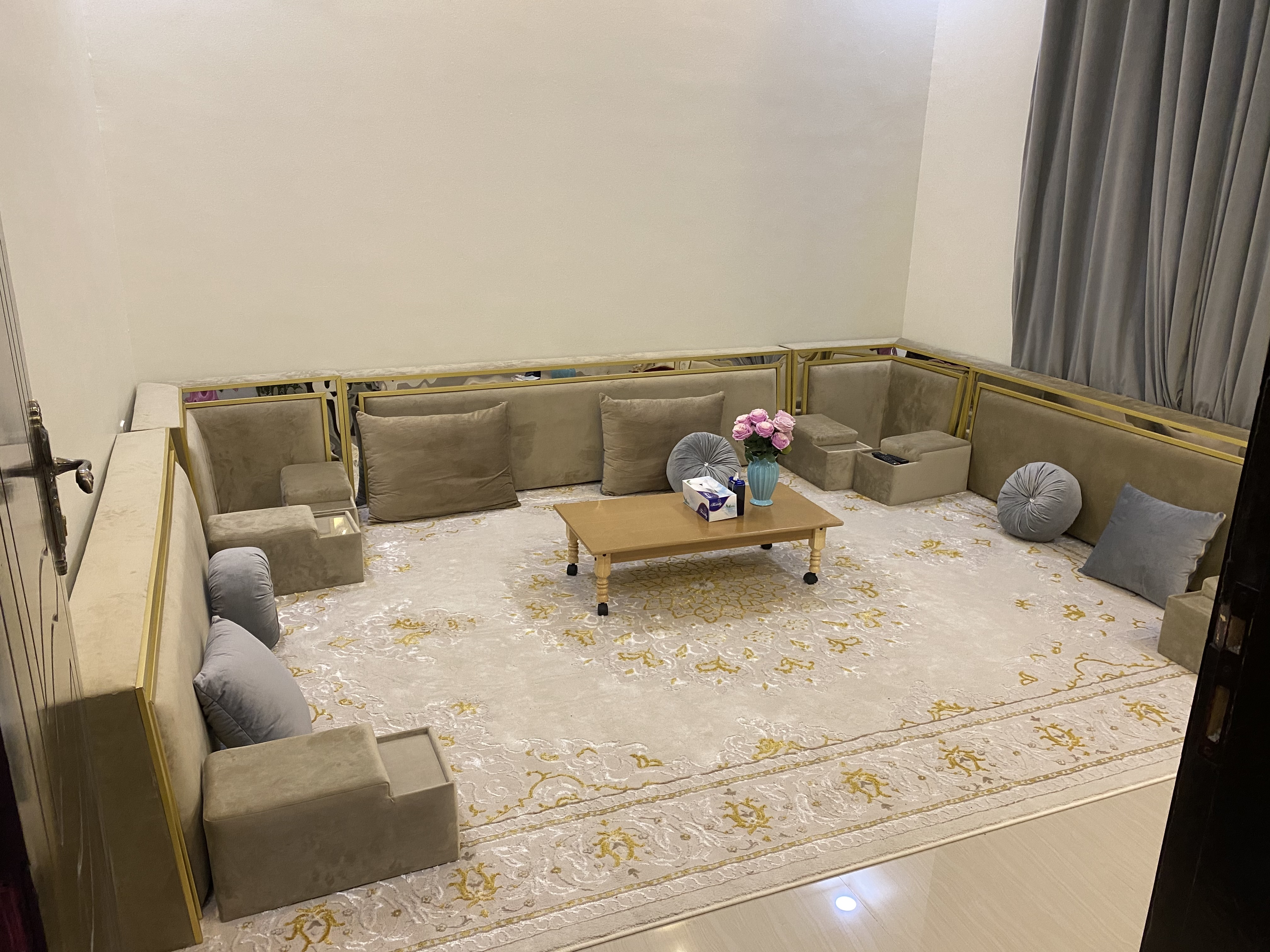
fa - salle

[salle, notice how there are many square armrests with a set-in-square of glass – they are for cups of tea and small plates. When eating a meal, it’s normal to set the platter of rice and meat on a plastic mat on the floor, along with cans of juice or soda. But for relaxing, it’s normal to have the cups of tea and small plates with sweets up off the floor.]

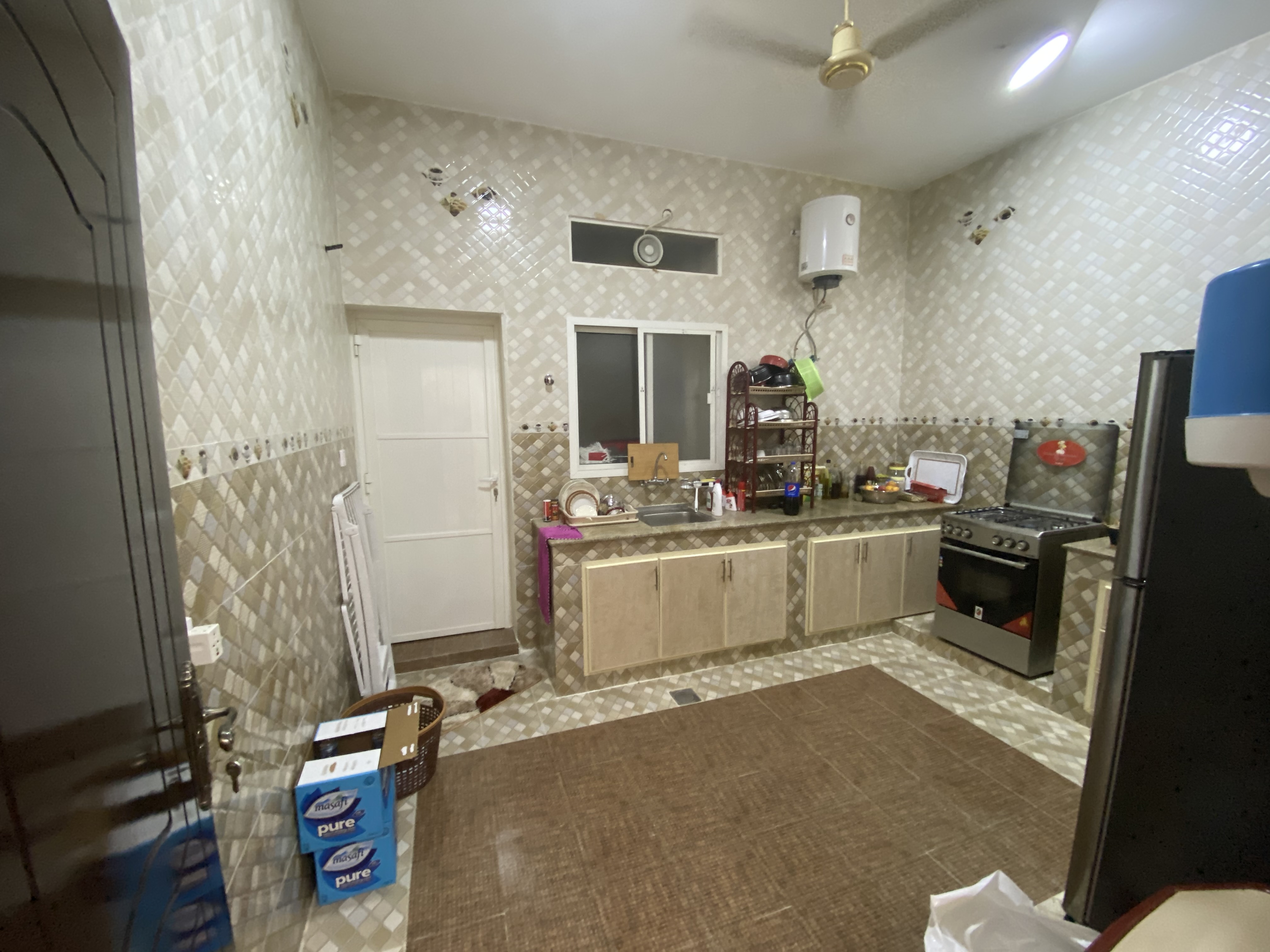
fa - kitchen

[kitchen, note that since this apartment is on the ground floor, this kitchen has access to the bottom of the light well (door straight ahead) where the washing machine is placed; apartments on upper floors have only window access (above the sink)]

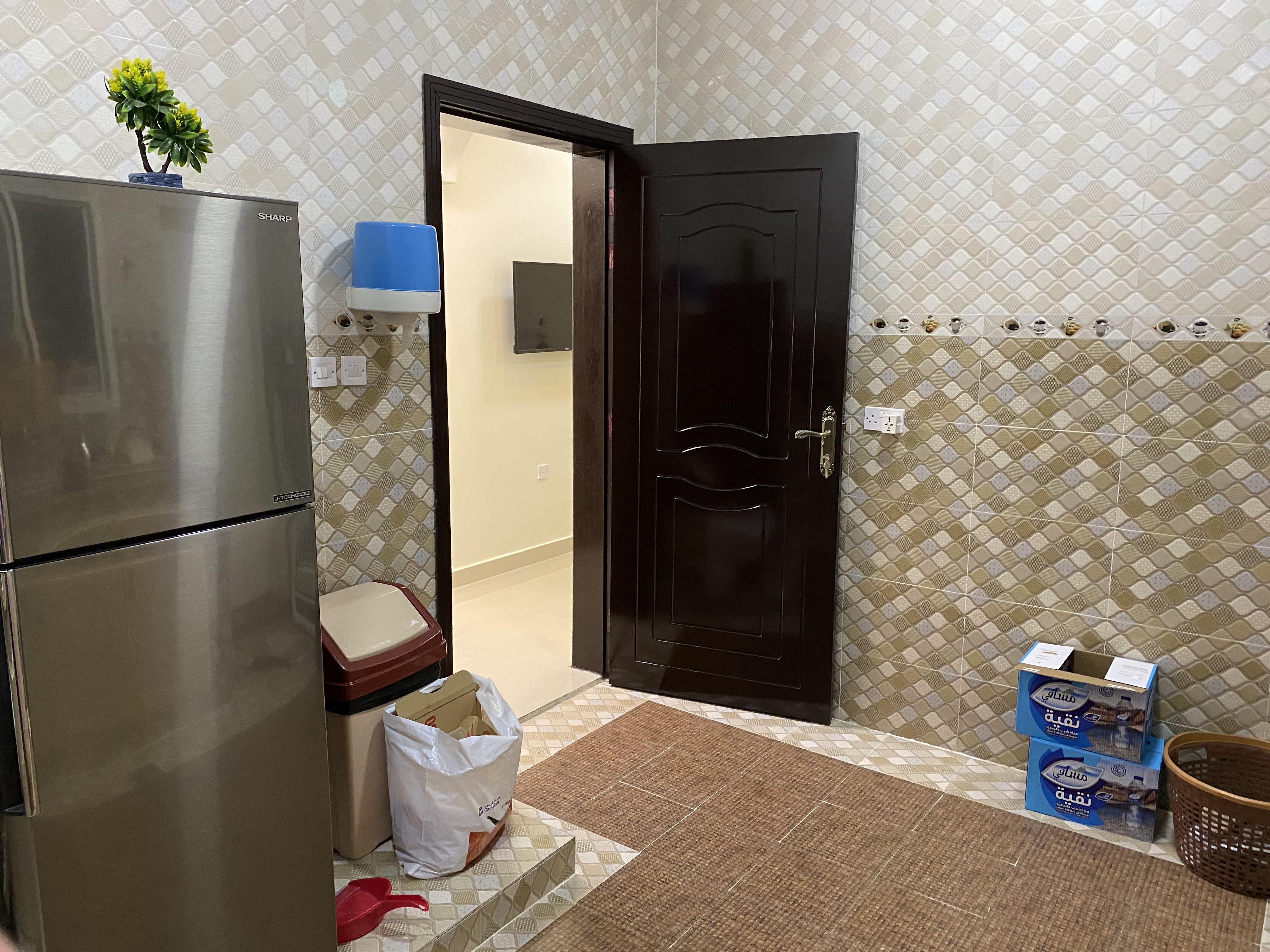
fa - kitchen2

[view from kitchen back towards hallway, note that walls are tiled up to the ceiling and the floor has a tile pattern that looks like a rug, the fridge (and stove) are slightly raised on platforms so that floor can be cleaned by sluicing water, which drains though an opening in the floor in front of the sink]

Foodways – Images of Galley Kitchens

All houses have one large kitchen for the household. However, sometimes a married couple will have their own, small kitchen as larger and newer houses may have small suites for each married son. This will usually consist of a bedroom with attached bathroom and a sitting room which might have a galley kitchen with a small sink and microwave so they can make tea and simple meals for themselves. Below is an example of a galley kitchen taken from a social media posting about a newly-wed’s room.


Foodways – Images of Interiors with Food: “We are Ready” and “Good Words”

In general, there are three times in which photos of house interiors are send out to friends, which are then sometimes forwarded on to general social media: newly-weds’ rooms, “we are ready” and “good words.”

Visiting other people’s houses is usually done between relatives and is almost always confined to the salle or majlis so sending out photos of the room prepared for newly-weds means that Dhofaris can share images of a room that normally only close relatives would see.

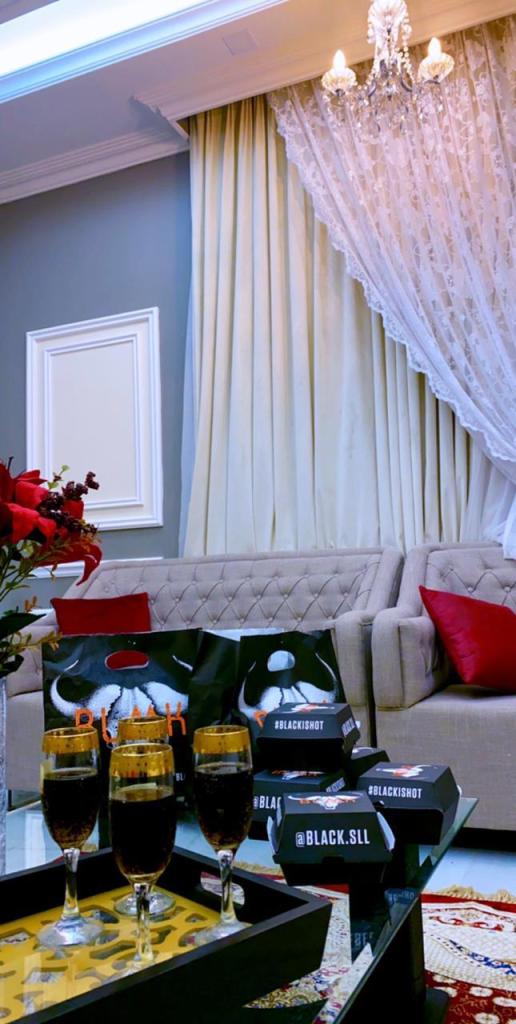
What I call “we are ready” photos show food that is prepared for a (birthday, graduation, promotion, received an award, special person visiting, etc.) party – this informs other people of a special event.

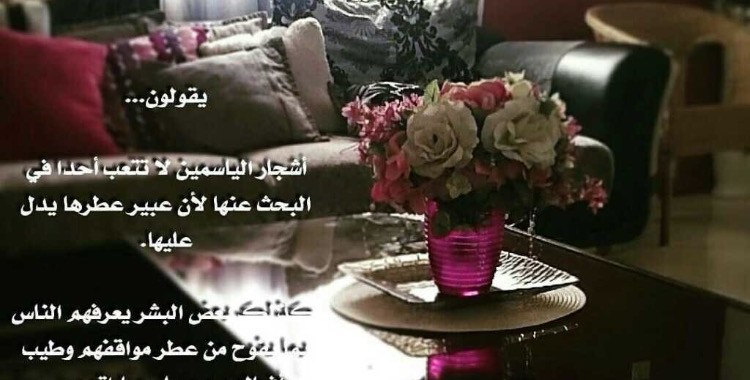
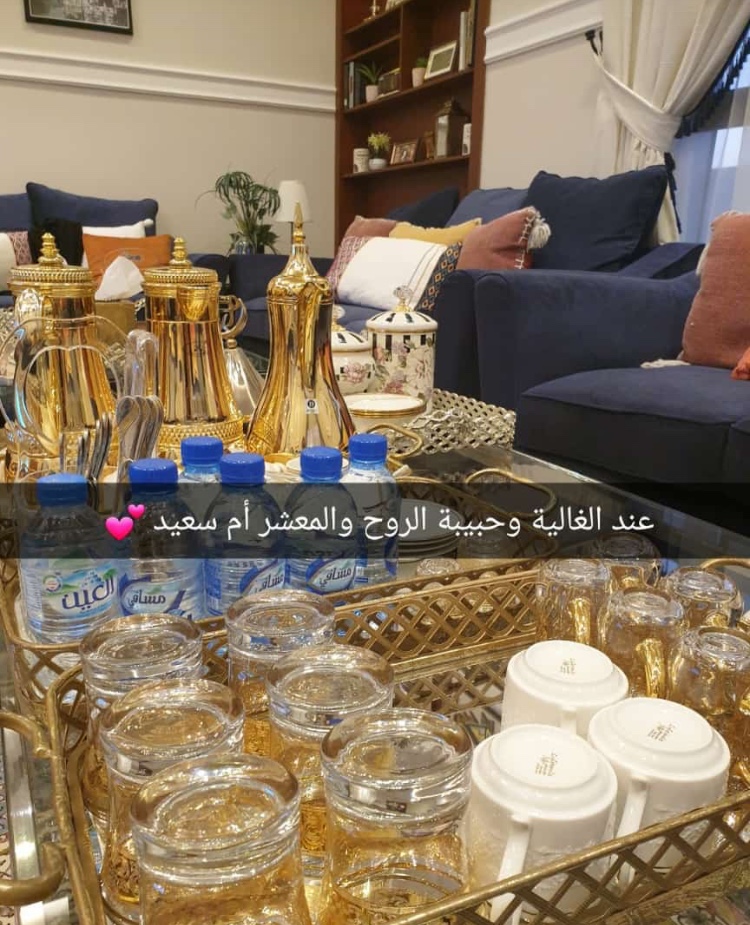
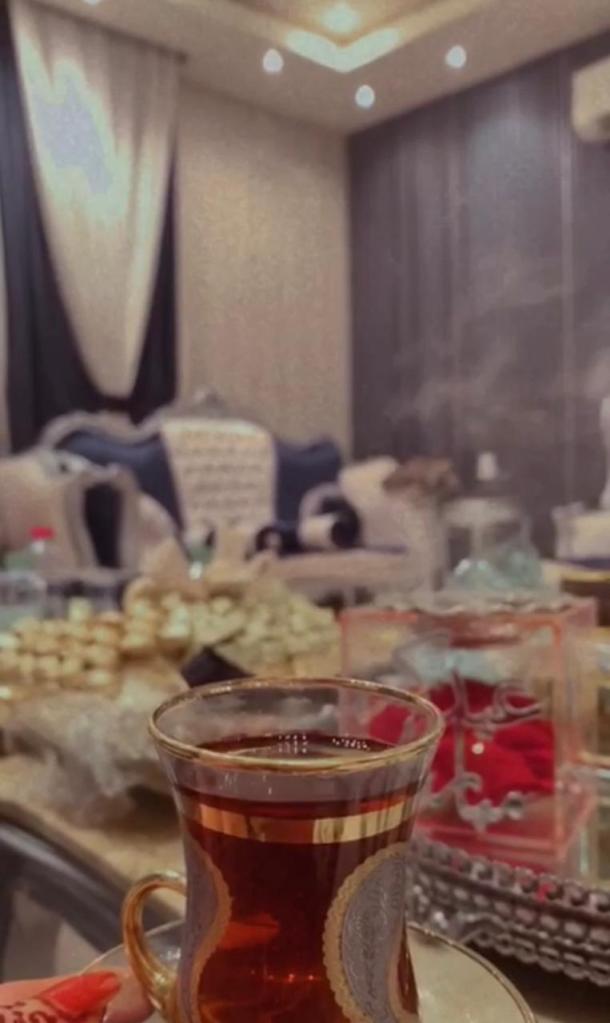
“Good words” images are commonly sent between friends and relatives in Dhofar. Some are images of flowers, nature (usually water or green trees/ fields), incense burners (as most Dhofaris burn frankincense (luban) in the house in the early morning and sunset), and/ or cups of Arabic coffee (qahwa). The texts can be a simple “good morning/ sabah al khair,” words of encouragement or a religious maxim.

All three types of images allow friends to see parts of the house that are usually not visible. If posted on social media, strangers can also see, but without knowing whose house it is so privacy is protected. The primary purpose is to increase bonds of friendship but these sorts of pictures can also be used to help gather design/ food preparation ideas. Home- and food-styling magazines are not common in Dhofar, so people use social media to get inspiration for their next party.

Examples of “good words”


Examples of “we are ready” photos

Foodways – Where to Eat: Kitchen, Salle, Majlis

As part of my Foodways in Southern Oman project, this is the one of several planned posts using photos with commentary to explain aspects of how food/ meals are cooked and served in the Dhofar region. Again, I would like to thank all of my Omani friends and informants who took and allowed me to use these photos. I am very grateful for your support of me and this project.

Many Omani families in Dhofar eat while sitting on the floor of the salle or majlis. When the food is ready and the person in charge of the meal has decided it is time to eat, instructions are given to lay the “table” (light plastic drop-cloth that comes in roll) and people will clear the area, moving toys if they are in the salle, brushing sand off the mat if on a picnic. The cook puts the dish on a platter and brings it to the eating place; everyone else grabs whatever is necessary such as Kleenex, limes, bottles of hot sauce or drinks and washes their hands.

Usually there is a round platter of rice and protein (camel, cow or goat meat, fish or chicken) in the middle and small plates with bread, salad or chutney set around it. Food such as rice is eaten with the right hand; bowls and spoons are used for soup, cut-up fruit, etc. If the food, for example baked vegetables, can’t be eaten by hand, a stack of plates are placed on the drop cloth and the woman in charge of cooking will ladle the food onto the places and pass them around.

Those who are eating gather in a circle around platters of food which are usually placed on the floor, with women bringing small children next to them to hand feed. Usually four to six people share one round platter, depending on its size. Men will either sit cross-legged or with one knee up and one tucked underneath them; women sit cross-legged or resting on one hip with legs to the side.

If there are guests, the men will eat in the majlis (the men’s sitting room); women will eat in the salle (the sitting room for women and close male relatives). Sometimes guests are put in the majlis alone, so they can “feel free” to eat as much as they want.

If the family eats at a table, there will usually be a glass and silverware at each setting, napkins/ Kleenex and a table cloth/ placemat on the table with a stack of plates in the middle or at one end where the platter of food will be placed. The cook or senior woman will serve up the plates which will be passed along the table.

When everything and everyone is in place, one of the senior people will say bismallah (in the name of God) and either start eating or begin putting food on plates. The others will say bismallah, signally that the meal has started and any food may now be consumed. 

When people are done, they say Alhamdulillah (praise be to God), stand up and wash their hands. The time for eating is devoted to eating; there is usually no drinking water, soda or fruit juice until the food is finished. Drinking is usually, like eating, done with concentration.

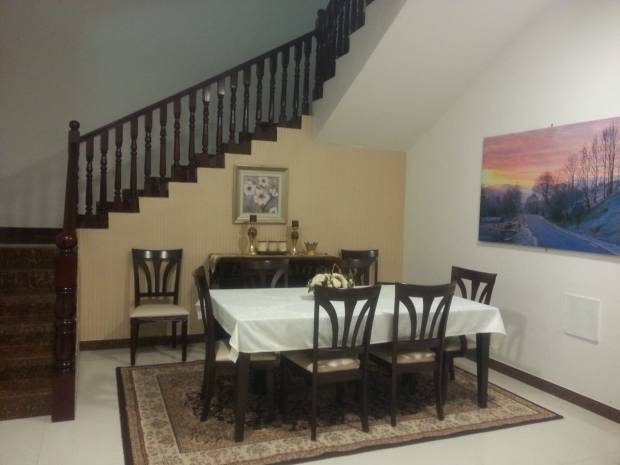
Although a separate dining room is rare, sometimes a dining table is set in the kitchen, salle, majlis or, if there is space, in the hall. Tables in the kitchen or hall are for people who live in the house or close friends and relatives.

Images of dining tables:

Foodways in Southern Oman – Images of Kitchens

As part of my Foodways in Southern Oman project, this is the first of several planned posts using photos with commentary to explain aspects of how food/ meals are cooked and served in the Dhofar region.

First, I would like to thank all of my Omani friends and informants who took and allowed me to use these photos. I am very grateful for your support of me and this project. [The photos of empty/ undecorated rooms are from either rental houses or houses that are for sale and the owner put the photos on social media.]

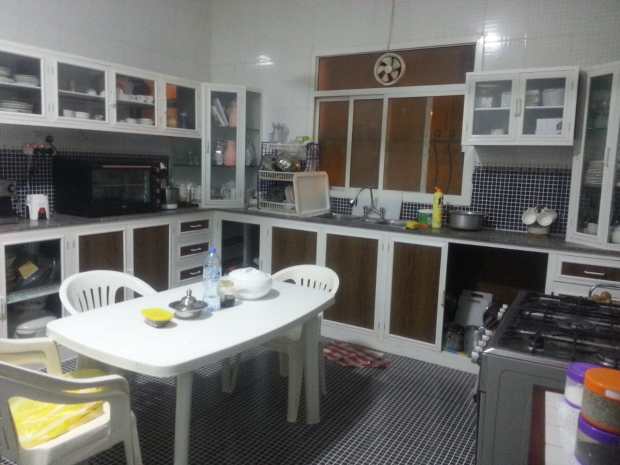
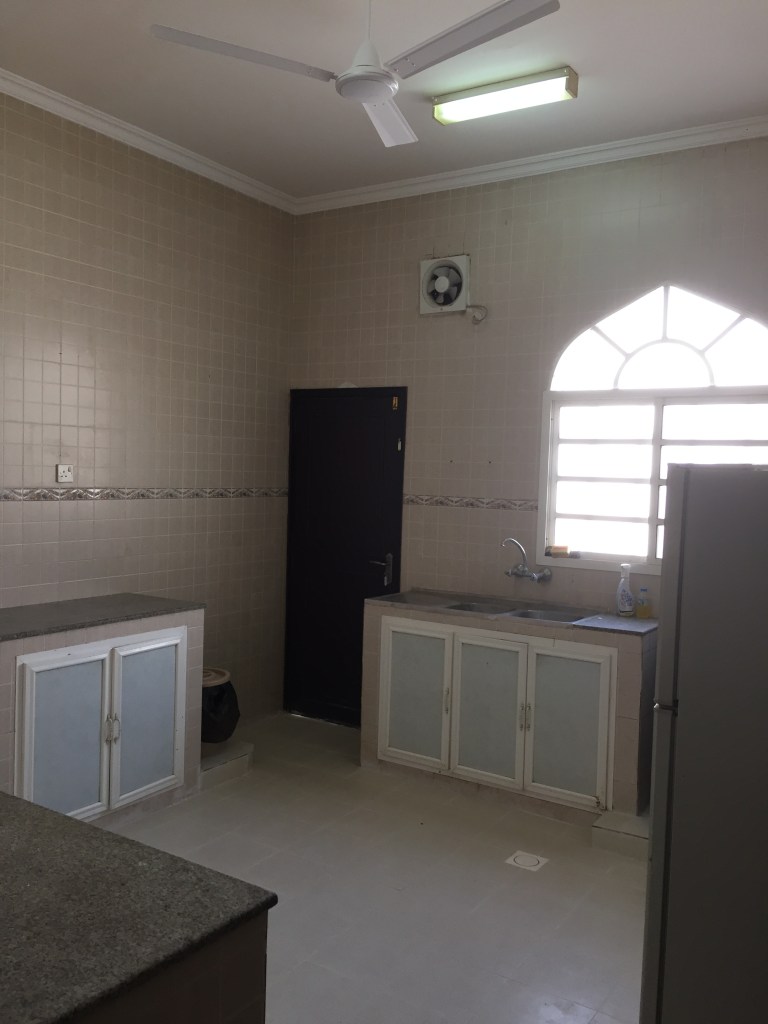
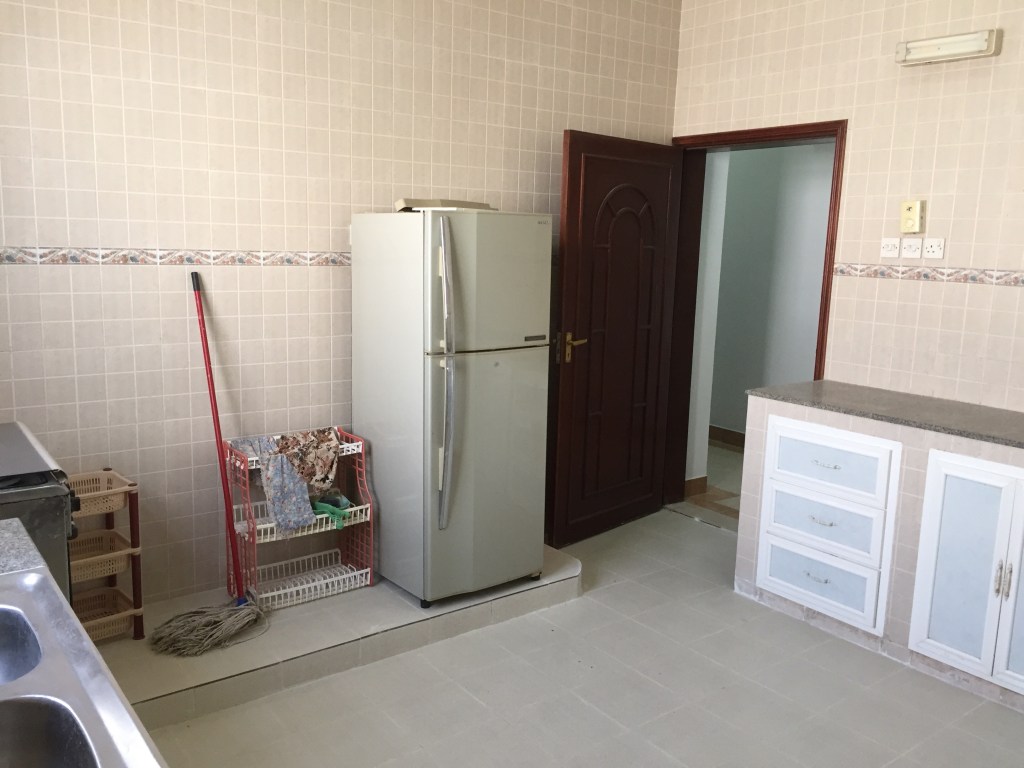
Overview – In general kitchen have tiled walls and floors (with a floor drain), high ceilings, a ceiling fan (but usually not AC), an extractor fan and florescent lighting. If there is a window (most often over the sink) it has opaque glass. There is often a door to the outside, which is not decorated as the front doors are.

As it is common to have twenty or more people (from different generations) in one house, kitchens are big enough to make large meals. Like most rooms in a Dhofari house, everything is placed around the sides of the room with an open space in the middle of the room or, sometimes, a table with chairs.

There is usually a lot of counter-space. Although I live an apartment built for one nuclear family, I have 24 feet of counter-space. In one house I lived in, there was 27 feet. Cupboards are built under the counters, with additional counters overhead, often with clear glass or plastic fronts. Accoutrements for entertaining (trays, tea and coffee cups and pots, thermoses, etc.) are always within sight and easy reach.

The refrigerator, stove and washing machine (if it is in the kitchen) are usually set up on a platform about 4 inches high. The below-counter cupboards are also set slightly above floor-level so that the floor can be cleaned by mopping/ sluicing.

two images of same kitchen – left: door to outside, extractor fan, window over double-sink, under-counter cupboards; above: door to the rest of house, fridge up on platform, tiled walls with decorative pattern, florescent light near door (and one on ceiling with fan) gas stove to right of sink

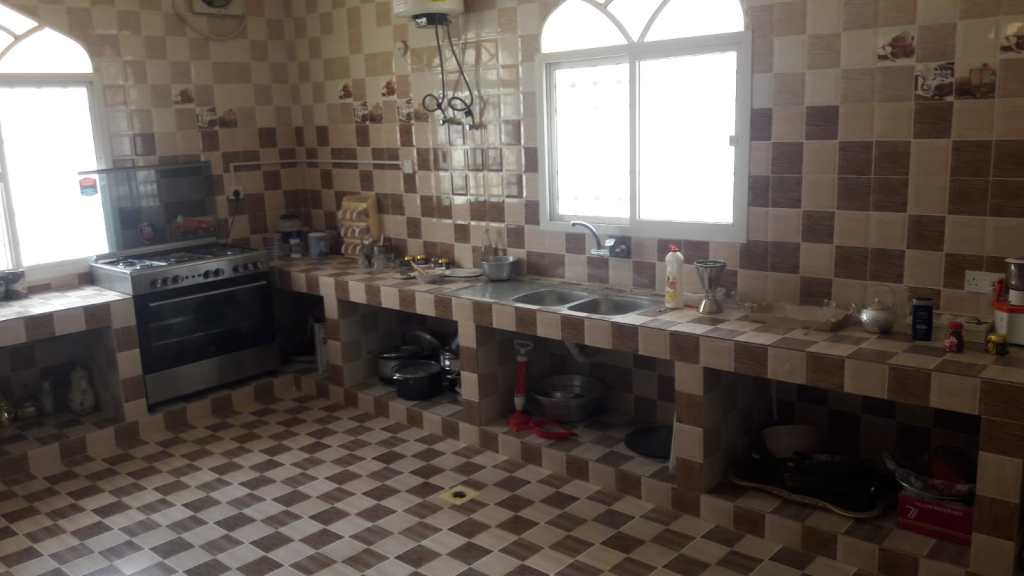
a more old-fashioned type of kitchen with all-over patterned tiles, no cupboard doors or dividers, window over double-sink
the small room to the left is a store-room for bulk foodstuffs and extra kitchen equipment

two other examples – left: note the hot water heater in upper left and clear fronted upper cupboards where tea/ coffee sets would be displayed (as in right photo) – the stoves integrated into the counter-top mark these as newer kitchens

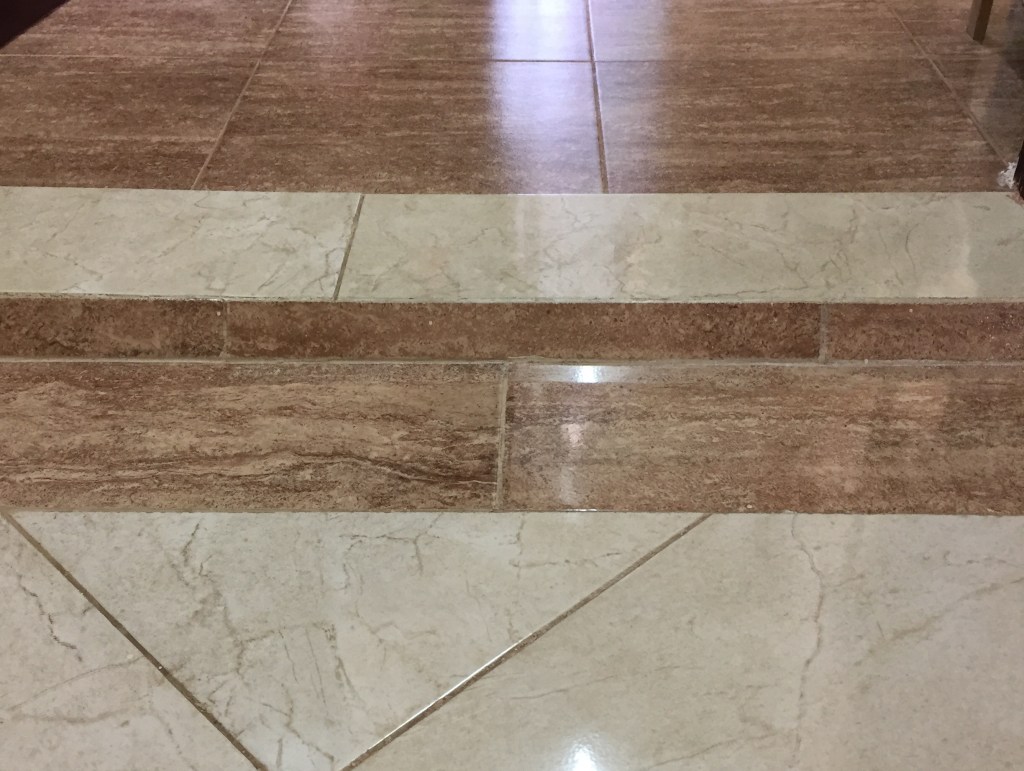
Kitchens (and bathrooms) are set at different level than the rest of the house so that even in the tiles are the same color, the cement base is lower or higher. Left: threshold of kitchen looking towards hallway with 1 inch ‘ramp’ to the white tile border; right: same threshold looking into kitchen, note the ‘ramp’ is much higher (4 inches to 1 inch) so that the kitchen is 3 inches HIGHER than the rest of the house. Thus the kitchen can be cleaned by sluicing water with the raised white tile border acting as a dam so whatever is spilled in the kitchen stays in the kitchen. Kitchens can also be set lower than the house (I have been in one which was set three steps down).

Example of landing outside of kitchen door used to hold cleaning supplies.