Foodways in Southern Oman – Images of Kitchens

As part of my Foodways in Southern Oman project, this is the first of several planned posts using photos with commentary to explain aspects of how food/ meals are cooked and served in the Dhofar region.

First, I would like to thank all of my Omani friends and informants who took and allowed me to use these photos. I am very grateful for your support of me and this project. [The photos of empty/ undecorated rooms are from either rental houses or houses that are for sale and the owner put the photos on social media.]

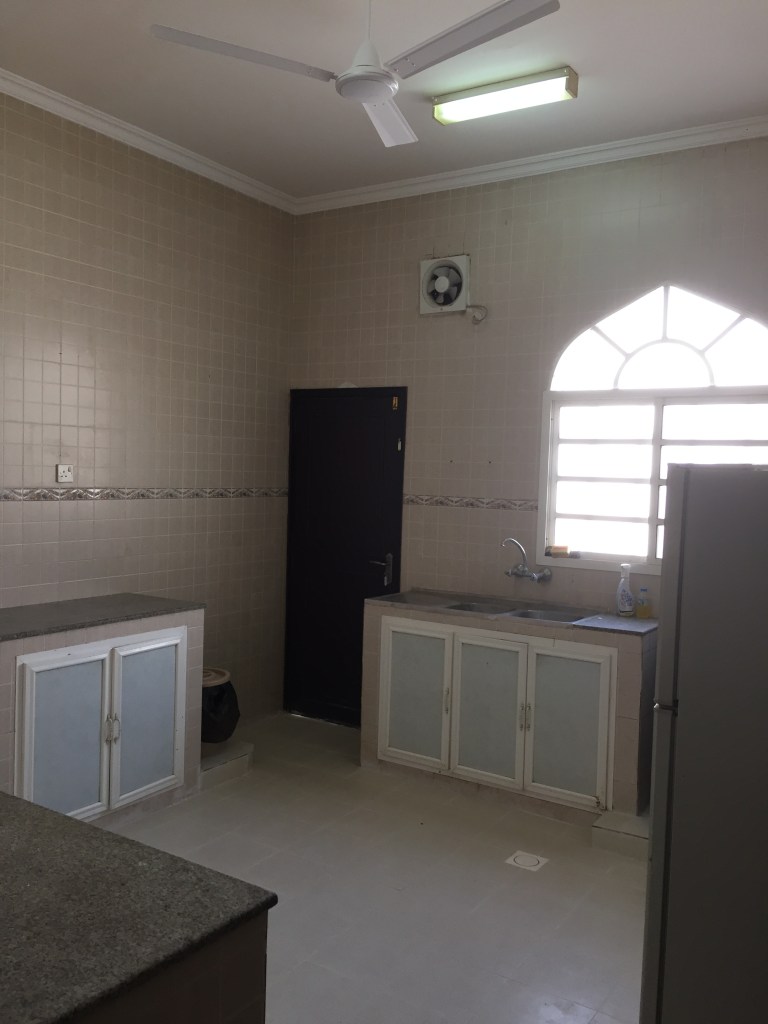
Overview – In general kitchen have tiled walls and floors (with a floor drain), high ceilings, a ceiling fan (but usually not AC), an extractor fan and florescent lighting. If there is a window (most often over the sink) it has opaque glass. There is often a door to the outside, which is not decorated as the front doors are.

As it is common to have twenty or more people (from different generations) in one house, kitchens are big enough to make large meals. Like most rooms in a Dhofari house, everything is placed around the sides of the room with an open space in the middle of the room or, sometimes, a table with chairs.

There is usually a lot of counter-space. Although I live an apartment built for one nuclear family, I have 24 feet of counter-space. In one house I lived in, there was 27 feet. Cupboards are built under the counters, with additional counters overhead, often with clear glass or plastic fronts. Accoutrements for entertaining (trays, tea and coffee cups and pots, thermoses, etc.) are always within sight and easy reach.

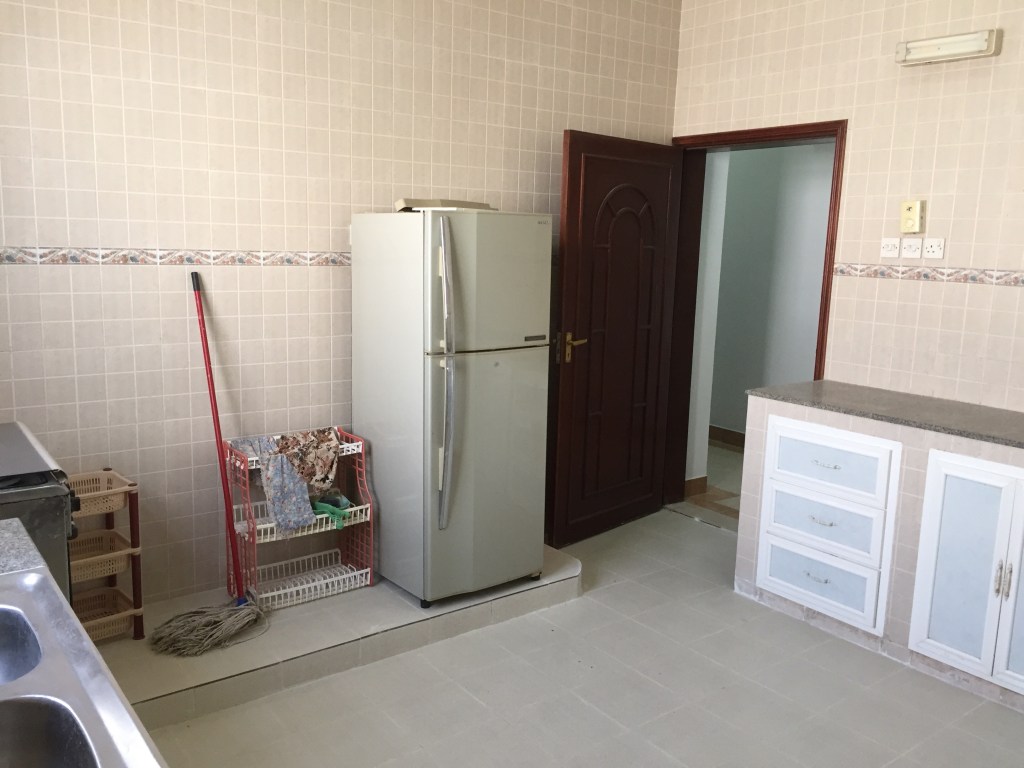
The refrigerator, stove and washing machine (if it is in the kitchen) are usually set up on a platform about 4 inches high. The below-counter cupboards are also set slightly above floor-level so that the floor can be cleaned by mopping/ sluicing.

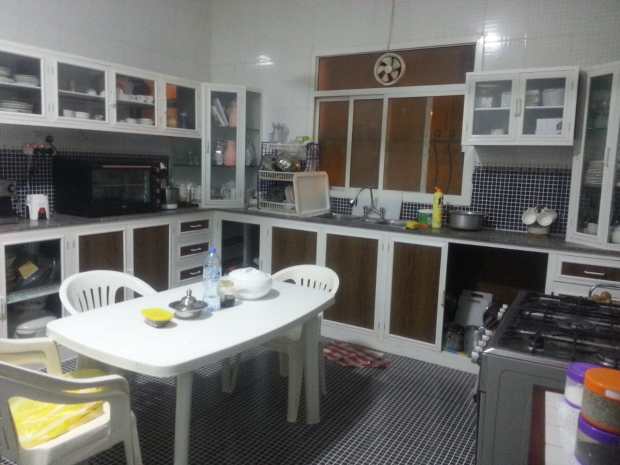
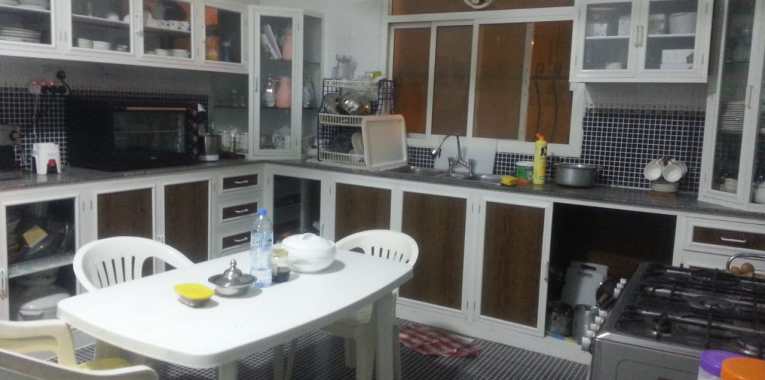
two images of same kitchen – left: door to outside, extractor fan, window over double-sink, under-counter cupboards; above: door to the rest of house, fridge up on platform, tiled walls with decorative pattern, florescent light near door (and one on ceiling with fan) gas stove to right of sink

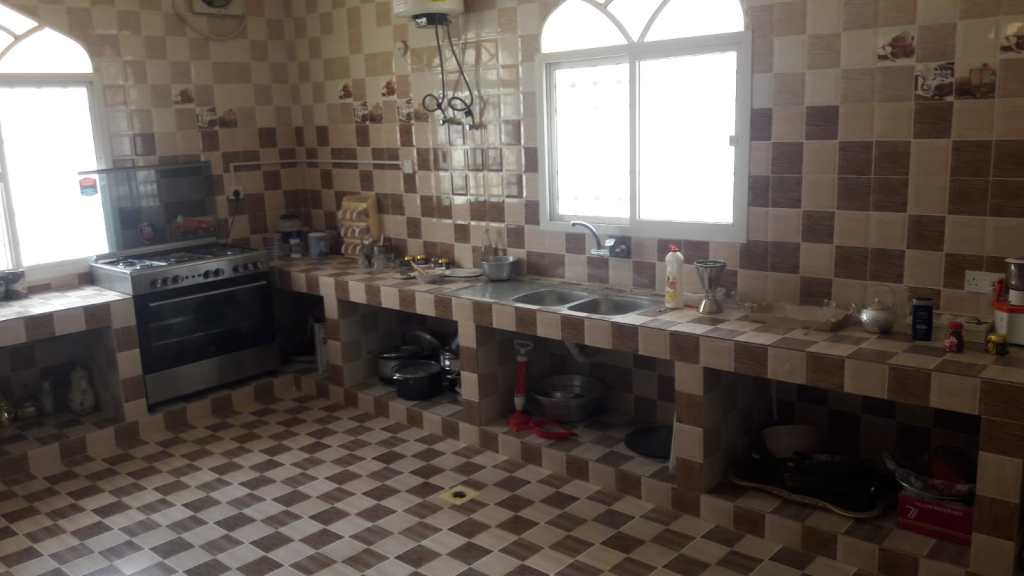
a more old-fashioned type of kitchen with all-over patterned tiles, no cupboard doors or dividers, window over double-sink
the small room to the left is a store-room for bulk foodstuffs and extra kitchen equipment

two other examples – left: note the hot water heater in upper left and clear fronted upper cupboards where tea/ coffee sets would be displayed (as in right photo) – the stoves integrated into the counter-top mark these as newer kitchens

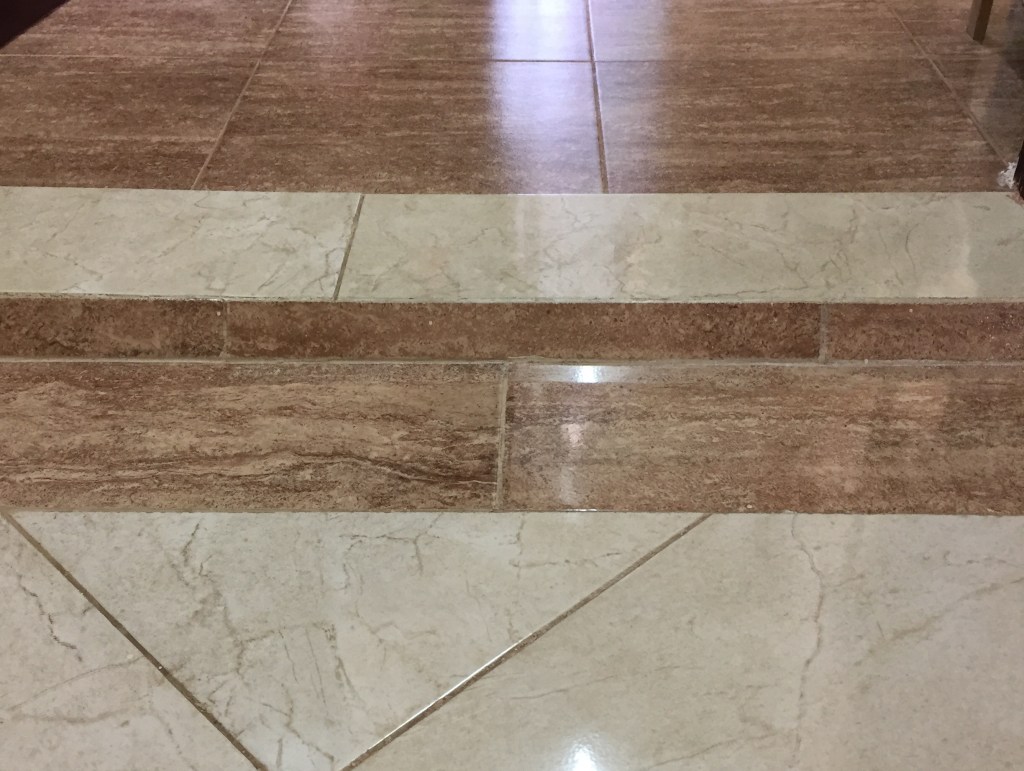
Kitchens (and bathrooms) are set at different level than the rest of the house so that even in the tiles are the same color, the cement base is lower or higher. Left: threshold of kitchen looking towards hallway with 1 inch ‘ramp’ to the white tile border; right: same threshold looking into kitchen, note the ‘ramp’ is much higher (4 inches to 1 inch) so that the kitchen is 3 inches HIGHER than the rest of the house. Thus the kitchen can be cleaned by sluicing water with the raised white tile border acting as a dam so whatever is spilled in the kitchen stays in the kitchen. Kitchens can also be set lower than the house (I have been in one which was set three steps down).

Example of landing outside of kitchen door used to hold cleaning supplies.

Foodways in Southern Oman – Historical Sources

There are several historical sources about what and how people in the Dhofar region ate in the past; here I would like to highlight a few authors.                                                             

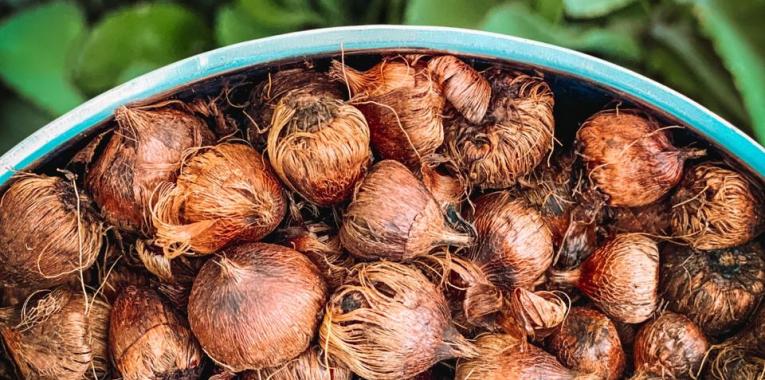
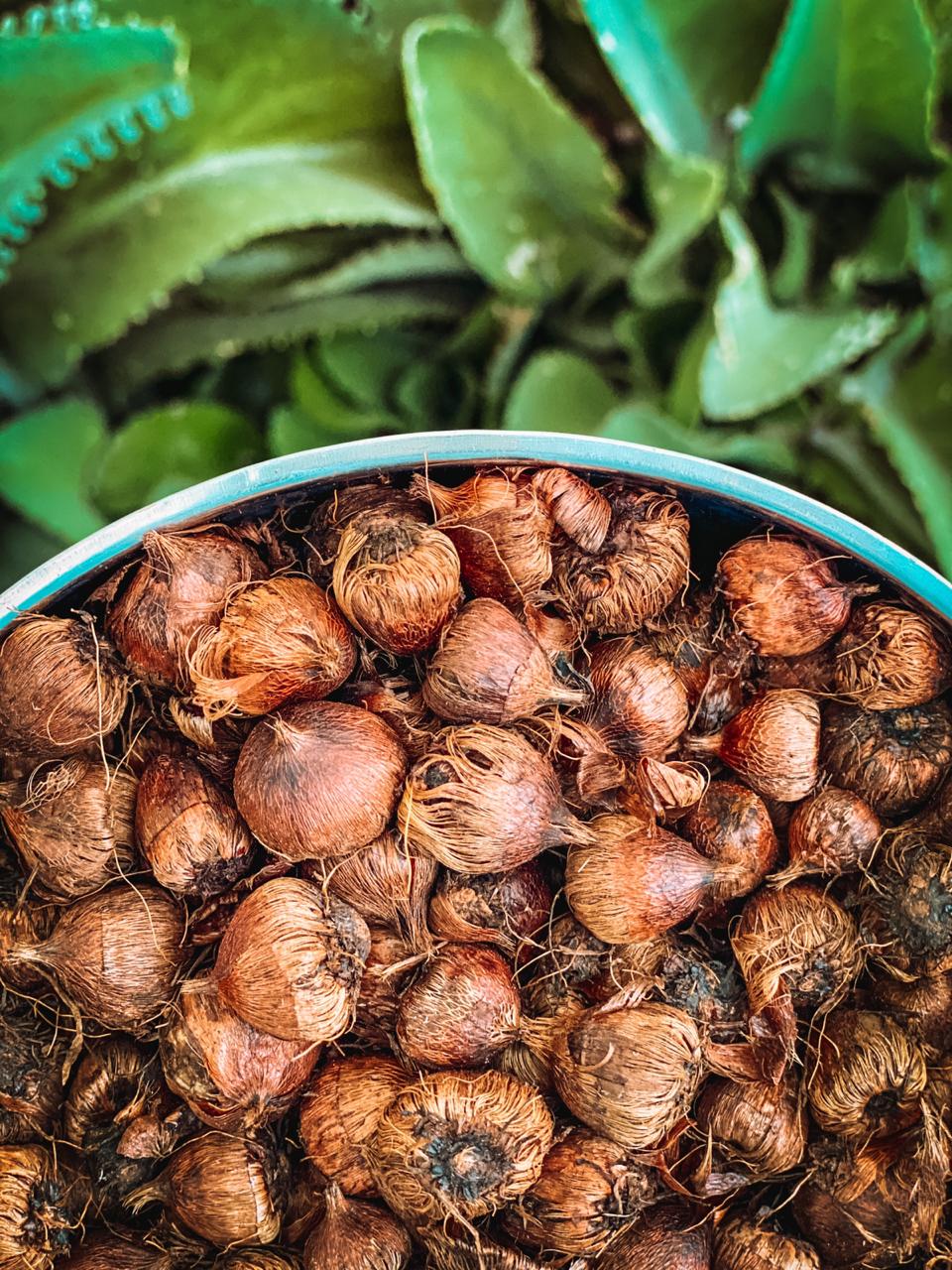
(the photo by Salwa Hubais is of bidah, the bulb from the white flower, gladiolus candidus, which is cooked and eaten)

 Bent, James. “Exploration of the Frankincense Country, Southern Arabia.” The Geographical Journal 6.2, 1895, 109-33.

Bent, James and Mabel Bent. Southern Arabia. London: Elibron, [1900] 2005.

Bent, Mabel. The Travel Chronicles of Mrs. J. Theodore Bent, Volume III: Deserts of Vast Eternity, Southern Arabia and Persia. Gerald Brisch, ed. London: Archaeopress, 2010.

Theodore and Mabel Bent were in the Dhofar region from December 20, 1893 until January 23, 1894. During their short stay, they traveled along the coast and a short distance in the mountains; I believe they are the first Westerners to visit the Dhofar mountains and write a description of it. In Southern Arabia (1900/ 2005), they recount that along the coast they saw coconut palms, “bright green fields,” “[t]obacco, cotton, Indian corn, and various species of grain” (233); as well as gardens with “the plantain, the papya, mulberries, melons, chilis, brinjols [eggplants], and fruits and vegetables of various descriptions” (234). During their journey through the mountains, they saw the still-used method of cooking meat on heated stones (250); plant-life including sycamores, acacia, jessamine, convolvulus, maidenhair ferns and fig trees (256); and describe how rice was eaten (275). They also met an elderly sheikh who had 500 head of cattle and 70 camels (250).

Thomas, Bertram. Arabia Felix: Across the Empty Quarter of Arabia. Jonathan Cape: London 1932. reprint.

In Arabia Felix (1932) Thomas recounts his journey across the Rub al Kahli (Empty Quarter) in the fall/ winter of 1930. His trip started in Salalah, so there are a few food references. For example, at the home of a prosperous merchant, he is given a meal of “beef grilled crisp and black, spaghetti drenched in tomato sauce, and slices of pineapple” (19). During a short trip in the mountains, he explains that the Gibali diet was milk, honey and beef (51) and that hyena, fox and “eggs, chicken and all manner of birds are under strict taboo” (59). He also discusses the custom of killing half of a man’s cows at his death (55-56).

Janzen, Jorg. Nomads in the Sultanate of Oman: Tradition and Development in Dhofar. London: Westview Press, 1986.

Janzen, who did his fieldwork from January to August 1977 and January to May 1978 (xxi), identifies nine bands of vegetation: the coastline belt, grassland of coastal plain, bush and tree vegetation of the foothills and escarpment, grassland of the lower and middle levels of the plateau, bush and tree vegetation of the mountain wadi area, grassland of the upper plateau, desert vegetation of the transition zone to the Nejd, desert vegetation of the Negd and sand desert vegetation (34-35). He notes that there “are many indications that the plateaus were once more thickly wooded than they are now” and that the “last stands of trees” on the coastal plain were cut down in the 1960s (35).

He discusses the traditional “monsoon-rain fields” in which millet and beans are grown along with cucumbers, tobacco, maize, “red” (chili) peppers, and tomatoes in the mountains (107, drawing 106, details of planting 108). In the mid-1950s, when diesel pumps could bring up water faster and cheaper than animal labor, crops included millet, wheat, maize, “watermelons, cucumbers, tomatoes, sweet potatoes, eggplants, onions and peppers,” as well as bananas, papayas and coconuts (154). In the mid-1970s, the composition of plantations changed in that cereals were no longer sown given that corn and flour became easily available and that land was given over to fruits and vegetables which were in higher demand (154).

His book also includes important historical data such as balance of trade data for 1896 which lists the top six exports: incense, butter fat (samn), cotton, skins, latex, sharks’ fins; and top six imports: rice, sugar, cotton cloth, dates, coffee, wheat (47) and a chart on the “Movement of  Livestock Prices in Dhofar” for cattle, camels and goats with data from 1965-70, 1971-75 ad 1976-78, showing, for example, the cost of a milk cow as 40-100 OR in 1971-75 and 250-330 OR in 1976-78 (102).

bidah

I am pleased to announce that I will be presenting about my ‘Foodways in Southern Oman’ project at the American Anthropological Association annual meeting

I will be presenting about my ‘Foodways in Southern Oman’ project at the annual meeting of the American Anthropological Association in November in the session: “Uncovering Truths, Building Responsibility in A Pandemic: Insights from Emerging Monographs at the Nexus of Culture, Food, and Agriculture.”

Cookbook, Coffee and and the “Omani Sandwich”

A few tidbits from my food research:

I recently found a cookbook about Omani food:

Al Maskiry, Fawziya Ali Khalifa. 2004. A Taste to Remember, 3rd edition. Muscat: Al Nahda Press. 

Al Maskiry states that her first edition (2005) was first cookbook in English published by an Omani. She has a practical approach to measurements, instead of the American system (cups), metric system or using weights, she uses “coffee cup” (the small, handle-less cup used for Arabic coffee, finjan), “tea cup” and “mug” in the recipes, with ml, flour ounce and sugar ounce equivalents at the beginning of the book (4).


I had socially distanced coffee with two friends a few days ago and after ten minutes, their cups were empty. I always forget this big cultural difference. When I have a cup of coffee it lasts at least half an hour, usually longer. When working, two cups last me about four hours. But most people from Arab countries approach coffee (and tea) drinking as serious business. The cups are smaller and ones focuses on getting the liquid down quickly, then it’s time to talk (or work).

Part of this difference is that Turks and Italians, for example, drink small cups of heavy/ thick coffee while North Americans normally drink bigger cups of weaker coffee. This has lead to the (ghastly) appearance of “Americanos” in coffee shops – an espresso with hot water added. This awful drink combines the worst of both worlds!


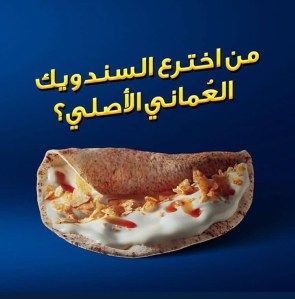
There is a cute new advertisement about “the Omani sandwich“:  bread with processed cheese spread and crushed spicy potato chips. People may argue about which type of bread to use (pita/ Lebanese or white bread, toasted) and which kind of cheese, but everyone agrees that it has to be Chips Oman!


I am pleased to announce that my chapter “Teaching Paired Middle Eastern and Western Literary Texts” has been published

Risse, Marielle. 2020. “Teaching Paired Middle Eastern and Western Literary Texts.” Advancing English Language Education,  Wafa Zoghbor and Thomaï Alexiou (eds.). Dubai: Zayed University Press. 221-223.

“Teaching Paired Middle Eastern and Western Literary Texts” – This chapter focuses on a technique which increases students’ participation, creativity and analytical ability in literature and language classrooms. By teaching two texts in English together, one from a Western and one from a Middle Eastern culture, students can compare and contrast a familiar text to one that has new settings, themes, people and opinions. This analysis allows students to see how characters, leitmotifs and points of view can be both similar and different across cultures, and in turn improves students’ reading, writing, speaking and critical thinking abilities. As some teachers might be hesitant to use literature in a language classroom or be unfamiliar with texts from a different culture, this chapter gives several specific examples, in addition to explaining how to teach paired texts. When teachers overcome the fear of working with new texts, they can pass on their insights to students.

Click to access AELE_Book_ALLT_ZU_Web_V02.pdf

Dreaming of Dhofari Picnics

I am very happy that my Dhofari friends are being careful about corona and not having social events and at the same time… I miss picnics! It’s almost time to go back to work but, even with all the lovely khareef drizzle, it doesn’t feel like there was a vacation as there were no picnics this summer.

“Picnic,” like all food terms, has different meanings as you move between cultures. Visiting family and friends at home, picnics mean making or buying food and then eating it on blankets in a scenic place. I miss deviled eggs, potato salad, coleslaw, and most of all: pie! Sometimes we grill hamburgers or hotdogs, but picnics usually do not mean cooking, especially a picnic with my mom. Her idea of a picnic is getting sandwiches or little containers of chicken salad, tangerine sodas and one bag of chips for me (because of course she doesn’t want any), then driving to a little cove near her house, sitting on a bench and watching the ocean. Pretty perfect except for her relentless chip-stealing.  

Picnics here usually involve cooking and a lot of communal work. One person will bring meat and vegetables, others will help cut everything, someone will cook and we will all eat off one plate. Really wonderful in normal times, but dangers abounding in the time of corona as most items are passed hand to hand, such as knives, plates, Tabasco, bottles of water, Kleenex, limes, etc.

I sometimes wish dinner was severed at a less than thermonuclear level of spiciness, but other than that, picnics in Dhofar are delightful and I am looking forward to the winter in which, I hope, corona goes away and I am back on a beach with good food and good friends.

Corona, Curfew and Dinner (and good graphics)

Oman now has a curfew – all stores/ restaurants closed and everyone inside from 7pm until 6am which is perfect timing because it is roughly sundown to sunrise. You don’t have look at your watch – just look for the sun. If you see the sun, it’s ok to be outside. If you don’t see the sun, stay in! 🙂

I am very interested in how the curfew might be changing planning for/ cooking dinner, which is usually eaten after 8pm, sometimes as late at midnight or 1am. With the curfew, one can’t order delivery or run to the store for anything. Some restaurants which previously closed mid-day, are now open straight until closing at 6pm (to do cleaning and give staff time to get home). This means no last-minute decisions or going for a schwarma-run at 2am!

When things quiet down, I would like to ask informants how the curfew changed eating habits. A few restaurants are advertising ‘buy at 5pm and reheat later’ – but reheating/ eating ‘old’ food is not often done here.

Restaurant delivery was common, so when the virus hit and restaurants were not allowed to have inside service, the loss of dine-in/ rise of delivery-only did not create a large change in eating patterns. Families could order delivery and then sit together at home, on a beach or in the flat open area to the north of Salalah. But to not have delivery or the chance to buy food after 7pm is a big change and I wonder how families are adjusting to it.

empty roads!

curfew - road

When the virus is beaten, I hope the graphic designers working with the Omani government get medals of appreciation! The government has, since day 1, been clear and unified about the risks of disease and has put out easy-to-understand public safety messages.

my favorite:

curfew - eyes

Selected Bibliography: Animals, Birds and Fish in Southern Oman

It is important to look at foodways in the context of the region, so I have been exploring what has been written about animals, birds, fish and the environment in southern Oman.  (photo by S. B.)

Selected Bibliography

Al Hikmani, Hadi and Khaled al Hikmani. 2012. “Arabian Leopard in Lowland Region on the South face of Jebel Samhan, Oman.” Cat News 57: 4-5.

Al-Jufaili, Saud Greg Hermosa, Sulaiman S. Al-Shuaily and Amal Al Mujaini. 2010. “Oman Fish Biodiversity.” Journal of King Abdulaziz University 21.1: 3-51.

Al Kindi, Nasser. 2014. Birds in Oman. Muscat: Muscat Printing Press.

Al-Marshudi, Ahmed Salim and Hemesiri Kotagama. 2006. “Socio-Economic Structure and Performance of Traditional Fishermen in the Sultanate of Oman.” Marine Resource Economics 21: 221-30.

Al Rashdi, K. and E. Mclean. 2014. “Contribution of Small-Scale Fisheries to the Livelihoods of Omani Women: A Case Study of the Al Wusta Governorate.” Gender in Aquaculture and Fisheries: Navigating Change – Asian Fisheries Science Special Issue 27S: 135-149.

Ball, Lawrence, Douglas MacMillan, Joseph Tzanopoulos, Andrew Spalton, Hadi Al Hikmani and Mark Moritz. 2000. “Contemporary Pastoralism in the Dhofar Mountains of Oman.” Human Ecology. https://doi.org/10.1007/s10745-020-00153-5

Choudri, B., Mahad Baawain, and Mustaque Ahmed. 2016. “An Overview of Coastal and Marine Resources and their Management in Sultanate of Oman.” Journal of Environmental Management and Tourism 7.1: 21-32.

Erikesen, Hanne and Jens Eriksen. 2010. Common Birds in Oman: An Identification Guide. Muscat: Roya Press.

—. 2005. Common Birds in Oman. Muscat: Roya Press.

Eriksen, Jens, Dave Sargeant and Reginald Victor. 2003. Oman Bird List. Muscat: Sultan Qaboos University, Centre for Environmental Studies and Research.

Galletti, Christopher, Billie Turner, and Soe Myint. 2016. “Land Changes and their Drivers in the Cloud Forest and Coastal Zone of Dhofar, Oman, between 1988 and 2013.” Regional Environmental Change 16.7: 2141–53

Gardner, Andrew. 2013. The Amphibians and Reptiles of Oman and the UAE. Frankfurt: Edition Chimaira.

Hildebrandt, Anke and Elfatih Eltahir. 2008. “Using a Horizontal Precipitation Model to Investigate the Role of Turbulent Cloud Deposition in Survival of a Seasonal Cloud Forest in Dhofar.” Journal of Geophysical Research: Biogeosciences 113 (G4). doi:10.1029/2008JG000727.

Hildebrandt, Anke, Mohammed Al Aufi, Mansoor Amerjeed, Mahaad Shammas, and Elfatih A. B. Eltahir. 2007.“Ecohydrology of a Seasonal Cloud Forest in Dhofar:1. Field Experiment.” Water Resources Research 43 (W10411). doi:10.1029/2006WR005261.

Hildebrandt, Anke and Elfatih Eltahir. 2007. “Ecohydrology of a Seasonal Cloud Forest in Dhofar: 2. Role of Clouds, Soil Type, and Rooting Depth in Tree-Grass Competition.” Water Resources Research 43 (W11411). doi: 10.1029/2006WR005262.

— . 2006. “Forest on the Edge: Seasonal Cloud Forest in Oman Creates its own Ecological Niche.” Geophysical Research Letters 33 (L11401). doi: 10.1029/2006GL026022.

The Journal of Oman Studies: Special Report 2: The Oman Flora and Fauna Survey 1975. 1980. Muscat: Diwan of H. M. for Protocol.

Lancaster, William and Fidelity Lancaster. 1995. “Nomadic Fishermen of Ja’alân, Oman.” Nomadic Peoples 36/37: 227-44.

McKoy, John, Neil Bagley, Stéphane Gauthier, and Jennifer Devine. 2009. Fish Resources Assessment Survey of the Arabian Sea Coast of Oman – Technical Report 1. Auckland: Bruce Shallard and Associates and the New Zealand National Institute of Water and Atmospheric Research.

Omezzine, Abdallah. 1998. “On-shore Fresh Fish Markets in Oman.” Journal of International Food and Agribusiness Marketing 10.1: 53-69.

Omezzine, Abdallah, Lokman Zaibet and Hamad Al-Oufi. 1996. “The Marketing System of Fresh Fish Products on the Masirah Island in the Sultanate of Oman.” Marine Resources Economics 11: 203-10.

Sale, J. 1980. “The Ecology of the Mountain Region of Dhofar.” The Journal of Oman Studies: Special Report 2: The Oman Flora and Fauna Survey 1975. Muscat: Diwan of H. M. for Protocol. 25-54.

Siddeek, M., M. Fouda and G. Hermosa. 1999. “Demersal Fisheries of the Arabian Sea, the Gulf of Oman and the Arabian Gulf.” Estuarine, Coastal and Shelf Science 49.1: 87-97.

Spalton, Andrew, Hadi Al Hikmani, and Khalid Mohammed Al Hikmani. 2014. The Arabian Leopards of Oman. London: Stacey International.

Spalton, Andrew, Hadi Musalam al Hikmani, David Willis and Ali Salim Bait Said. 2006. “Critically Endangered Arabian Leopards (Panthera pardus nimrpersist) in the Jabal Samhan Nature Reserve, Oman.” Oryx 40.3: 287-294.

Partial list of wild animals

from: Spalton, Andrew, Hadi Musalam al Hikmani, David Willis and Ali Salim Bait Said. 2006. “Critically Endangered Arabian Leopards (Panthera pardus nimr) Persist in the Jabal Samhan Nature Reserve, Oman.” Oryx 40.3: 287-294. 291

  • Arabian leopard
  • Wildcat
  • Arabian wolf
  • Striped hyaena
  • Honey badger
  • Blanford’s fox
  • Red fox
  • African small-spotted genet
  • White-tailed mongoose
  • Nubian ibex
  • Arabian gazelle
  • Rock hyrax
  • Indian crested porcupine
  • Ethiopian hedgehog
  • small rodents including gerbil, jird, mice, spiny mice, rat, and shrew
  • gecko, lizard, chameleon, skink, toad
  • bees, butterfly, dragonfly, grasshopper, locust, and moth
  • scorpion, tick, wasp, and snakes, including cobra and viper

Partial list of birds

from: Al Kindi, Nasser. 2014. Birds in Oman. Muscat: Muscat Printing Press.

  • Dhofari and/or migratory: bee-eater, dove, hoopoe, roller, silverbill, swallow and weaver
  • coast – avocet, bittern, coot, crake, duck (pintail), egret, grebe, flamingo, gull, heron, ibis, moorhen, spoonbill, tern, wader
  • grasslands – pipit, raven, grackle, stork
  • wadi/ mountains – courser, partridge, sandgrouse, owl
  • semi-wooded/ woodlands – bunting, cuckoo, flycatcher, grosbeak, kingfisher, pigeon, owl, shrike, sunbird, warbler
  • semi-desert/ desert – bunting, lark, owl, sand partridge, warbler, wheatear
  • raptors – eagle, falcon, kestrel. osprey, vulture


Common Food Terms in Dhofar, Oman (updated)

Common Food Terms in Dhofar, Oman – Foodways in Southern Oman project

Dr. Marielle Risse

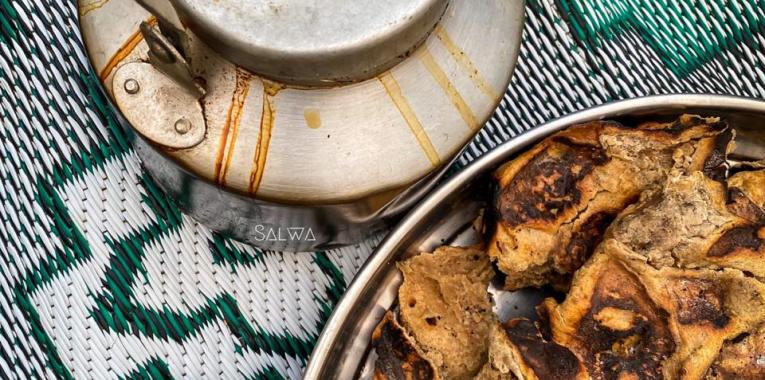
(photo by Salwa Hubais)

This list is in no way definitive and I will continue to update it. I hope to have Dhofari informants add in the words in Arabic, but the corona virus still has its hold on Dhofar and Oman. It is not the time to bother people with academic inquiries. I will wait for better days.

I have added some food-related words referring the animals, weather, locations, etc.

‘A’ means the word is Arabic, ‘G’ means the word is Gibali/ Jebbali/ Shahri. As there are always issues in transliterating Arabic vowels, I have arranged the words alphabetically in English, e.g. raqeeq/ roqaq


Abalone – sufela, see Seafood

Appetizers – usually baba ghanoush, fattoush, hummus, stuffed grape leaves etc., with pita bread (khubz lebnani)

Asida/ Asseda – cooked wheat with samn [clarified butter] and sometimes sugar

Baisa – smaller currency in Oman, there are 100 baisa in 1 Omani Riyal, which is worth about 1.9 British pounds (fluctuates) and 2.6 American dollars (steady)

Bamia – okra

Basbousa – semolina cake usually flavored with coconut in Dhofar

Bread – khubz A, types: kak kaek [qaleeb, tanoor (oven) or thakheen (thick) A/ dofdof or godom G], lebnani, luhuh, raqeeq/ roqaq or rekal, roti, qalib/ qibqab

Biscuits – used in the United Kingdom sense of sweet, crunchy baked goods eaten as snacks, not the American sense a type of roll (usually made of flour, baking powder, salt, butter/ shortening, and milk) usually with eaten warm with butter and jam or gravy

“Box” – local term for fish trap, flat-bottomed, metal trap with a rounded top and funnel opening. These are tied to buoys (usually empty plastic containers such as laundry soap jugs) and dropped in the sea. The color/ type of containers, color/ type of rope and knots mark an individual owner.

Branding – wasm, term for both animal and medicinal branding

Briyani – rice dish

Caracal – washq

Chai – see tea

Chutney – a condiment, in India this is usually fruit cooked with spices. In Dhofar the composition varies from family to family but usually made from blended spices with uncooked vegetables. A common one is made from pureed tomatoes, onions and spices and is similar to salsa. A more traditional one is made from pureed garlic and ginger with vinegar

Coffee – four main kinds: 1) qahwa (in Arabic) or “Omani coffee” 2) instant coffee, sometimes called Nescafe although there are other brands of instant coffee for sale, usually served with canned milk and sugar 3) espresso-based drink, American-style drip/ filter coffee is never served 4) drink from one of the several kinds of recently introduced coffee-capsule machines. Like tea, all coffee is served very hot and in cups that are much smaller than typical American mugs.

Coconut – A naregeel; A nakhla palm (coconut or date) tree, nargeel is also sometimes used for a coconut tree

Curry – refers to a stew or vegetables and meat, chicken or fish, not necessarily made with curry powder, which is poured onto a platter to be eaten by being scooped up with bread

Dal – Indian, cooked legumes with onions and spices such as curry leaves, cumin seeds, black mustard seeds, dried red chilies, etc.

Date – A tamr

Desserts: most important is halwa, others include: baklava, basbousa, cakes, cheese-cakes, crème caramel, custards, halwa, halawiyat, kanafeh/ kunafa, luqaymat/ loukoumades, Swiss Roll, “traditional sweet” (pita bread soaked in milk with sugar and cardamom), Umm/ Om Ali

Dhara – corn

Drinks – coffee (qahwa/ Arabic or Nescafe/ instant), tea (with sugar, with sugar and milk or with sugar, milk and spices), juice (fresh or bottled), soda, laban, and bottled water

Doum – fruit of the spina-christi tree

Dugarthareet, cowpeas

Eid – holy day in Islam, Eid al Fitr (see Ramadan) and Eid al Adha after the haj (pilgrimage)

Fatayer A – pie/ pastry, can also be used to mean “pancake,” 1) a thick pastry (with dough similar to but lighter than pizza dough) that is rolled out into an oblong shape with the dough pinched into two pointed ends usually 8-12 inches long and 4 to 6 inches wide, topped with savory (e.g. processed cheese spread and chopped hotdogs) or sweet toppings, usually honey. It is baked open-face and then covered in tin foil. Usually cooked upon order, they are available throughout the day and are sometimes served as part of a meal, especially picnics as they are easy to transport. 2) a very thin batter, similar to a crepe, which is spread on a flat, heated, round, oiled cooking surface. When the bottom is cooked, a filling (usually processed cheese) is spread over the surface. The sides are then turned in until it is rectangular-shaped, then it is flipped over. When cooked, it is transferred to a paper plate and cut into 12 square pieces and usually drizzled with honey. They should be eaten immediately as the dough becomes rubbery and gummy when cold.

Fig – teen A

Fil-fil A – spicy, hot, can mean either hot sauce or hot peppers

Fish – see Seafood

Fruit – most commonly grown in Dhofar: banana, coconut, fig, guava, jackfruit, lemon/ lime, mango, melon, mustafar (custard apple. soursop), papaya, pomegranate. Less common: almond, cherry, chikoo (aka sapodilla), coffee,  jamun (black plum), orange, olive, prickly pear, strawberries. Wild: doum (fruit of the spina-christi tree), fig

Halal – permissible in Islam, specifically here, food that is allowed to be eaten such as animals killed according to Islamic precepts

Halwa A – most popular Omani dessert made with sugar, water, clarified butter, and cornstarch, with various additions (sesame seeds, almonds, cashews, etc.) and flavorings (cardamom, saffron, smoked rose water, etc.). It is slow cooked in large batches and then poured into various-sized plastic trays and bowls. The color varies from a light blond to reddish to almost black depending on ingredients. The consistency is like a tough Jell-O. To eat, one scoops out a teaspoon- to tablespoon-sized piece with a spoon and eats it plain or plops the piece on of a small piece of a thin, plain cracker-like bread (qibqab) and eats both together. You usually take some mouthful by mouthful. It is necessary for special events such as Eid and weddings, but some people have a covered bowl on a tray in the majlis at all times.

Halawiyat A – sweets, fried dough or filo dough with various fillings and flavorings such as honey, nuts, rosewater, cardamom, cinnamon, etc.

Haleeb A – milk

Haram – forbidden in Islam specifically here, food that may not be eaten, including any part of a pig, an animal that was not specifically killed to be eaten (i.e. found dead)/ not killed following Islamic precepts, carnivorous animals, birds of prey, blood or any food with blood and alcohol

Herbs – commonly grown: mint, parsley; less commonly grown: cilantro, lemongrass, thyme; rayhan (basil) is grown for the smell, not for eating; sage is used for tea but not usually grown

Honey – ‘asl

Hyrax (rock) – wubar

Ibex – wael

Iftar – meal served at sunset in Ramadan, laban and dates are almost always taken as soon as the call for the sunset prayer is heard. Some families will break the fast, then the men will go to the mosque to do the sunset prayer, then return home for everyone to eat iftar together. Others will eat a variety of foods, then pray. Whereas a usual dinner consists of one main dish (rice or pasta with protein, vegetables and spices), an iftar should have different savory and sweet dishes. There should be a variety of food such as shorba, thareed, stuffed grape leaves, salads, sandwiches and sambusas, as well fruit, e.g. whole fruit (bananas, grapes, oranges), cut fruit and/ or fruit salad with oranges, watermelon, apples, etc. Sweets include custards, dumplings, Jell-O, kanafeh/ kunafa, luqaymat/ loukoumades “traditional sweet” (pita bread soaked in milk with sugar and cardamom), saffron/ coconut/ chocolate cake, etc. The prized drink of iftar is Vimto, a cordial of fruits and spices that is diluted with water.

Jarbaeb G – flat plain in the area around and behind (to the north of) Salalah

Jebel A – mountain, surrounding Salalah: Jebel Samhan to the west of Salalah, the highest at over 2000 meters, Jebel al Qara behind Salalah, and Jebel al Qara behind Salalah, it continues to the east to the Hadhramaut region in Yemen

Juice – the favorites are lemon with mint and melon, usually served freshly blended; widely available: fresh mango, orange, pomegranate

Kabsa/ kebsa – rice dish, also called maqboos, or mandi/ mehndi

Kak/ kaek, qaleeb, tanoor (oven) or thakheen (thick) A/ dofdof or godom G – bread about 6 inches across, ¾ of an inch thick with hebba sowda (black seeds) and marked with pressed fork tines on top. It can be cooked in wood-fired or gas ovens and can be eaten warm or kept for several days.

Kalhta – mixture, a sour/ spicy dip for cooked meat (usually on skewers) made from vinegar, lemon/ lime and spices

Kanafeh/ kunafa – shredded filo pastry or semolina dough that is baked in sugar-based syrup usually with a layer of cheese, sometimes served with cream or nuts

Karak – loose tea with spices (cardamom, cinnamon, saffron, etc.) and canned milk

Khabisah – flour or semolina cooked with milk and/ or butter with honey, dates, nuts, and/ or coconut and flavored with molasses, cardamom powder and/ or saffron, more usual in the northern parts of Oman than Dhofar

Keema/ Qeema – originally a Hindustani word meaning minced meat, usually beef. In Dhofar it means a warm sandwich filling of minced meat, vegetables (most notably tomatoes, onions and peas) and spices similar to an American “Sloppy Joe” except it is served in a rolled up paratha instead of on a hamburger bun

Khaliyat al nahla A – bee cells, small yeast rolls with processed cheese in the middle and a sugar/ honey syrup poured on top when still warm

Khareef A – autumn, in Dhofar this refers to the monsoon season, June-September

Khubz – bread A, types: kak kaek [qaleeb, tanoor (oven) or thakheen (thick) A/ dofdof or godom G], lebnani, luhuh, raqeeq/ roqaq/ raqeeq or rekal, roti, qalib/ qibqab

Khubz lebnani A – “Lebanese bread,” pita bread

Laban/ labneh/ leben  – fermented milk

Lemon – (pronounced lee-mon, not lem-on) used to refer to small, round, green, “Key West” limes

Lobster – shaarkha, see Seafood

Luban – frankincense (Boswellia sacra), the most important plant in Dhofar. Most women perfume their houses (and sometimes work places) with the fragrant smoke from the burning pieces of resin every day. It is not a food product per se, put high-quality pieces can chewed or put in warm water as medicine for stomach pains.

Luhuh – bread made from a dough with baking powder that is cooked in a skillet with a size/ consistency between an American pancake and a French crepe.

Luqaymat/ loukoumades A – round fried balls of dough, coated with a sweet topping such as sugar syrup, Nutella or sweetened coconut, need to be eaten soon after making

Mageen – meat that is cut into strips, air-dried for a few hours, then cooked in the animals’ fat

Madhbi – meat cooked on heated rocks

Maha – oryx

Majlis – male/ visitor’s sitting room, used by women if there are no male visitors

Mandi/ mehndi – rice dish

Maqboos – rice dish, also called kabsa/ kebsa

Meat – lahm A

Milk – haleeb A

Mishkak – grilled pieces of meat, usually on a skewer

Motbalat G – type of bread that is cooked by burying it under a small amount of ashes and putting the coals on top, shaped like a paratha bread but much harder

Monsoon – khareef, June-September

Mukuskus/ muqasqis – bread with a yeast dough a little lighter and sweeter than pizza dough which is deep fried into pillow shapes about 2 to 3 inches across. These can be kept up to 2 or 3 days after frying and are eaten with tea or milk.

Munj – peas

Nakhla – coconut

Nejd – rocky, mostly flat and barren area on the far side of the mountains as they slope down to the desert (to the north and north-east of Salalah)

“Oil” – clarified butter,  samn

Okra – bamia

Oryx – maha

Paratha  – Indian flatbread cooked in ghee or oil) served plain, with eggs or with dal

Ramadan – he lunar month in which Muslims abstain from food, drink, sex and smoking from sunrise to sunset. It is a time to focus on prayers, charitable giving, reading the Holy Qur’an and family so Muslims should avoid worldly concerns such as getting angry or secular music. Ramadan starts when the new moon is sighted (hence the symbol of Ramadan is a crescent moon) and ends when the next moon is seen and the celebration of Eid al Fitr.

Rice – most common dishes with rice, meat, vegetables and spices: briyani, kebsa/ kabsa/ maqboos, or mandi/ mehndi, qabooli/ qabuli

Riyal – paper currency in Oman, there are 100 baisa in 1 Omani Riyal, which is worth about 1.9 British pounds (fluctuates) and 2.6 American dollars (steady)

Ruman – pomegranate

Qabooli/ qabuli – rice dish

Qahwa A – coffee, also called “Omani coffee”, made from roasted coffee beans that are ground, then boiled (plain or with spices), then other spices and flavors such as cardamom, ginger, rose water, etc. are added. In the northern parts of Oman, it is required to serve this with dates; this is also offered in Dhofar, but tea with cakes or qahwa with halwa (see below) can also be served.

Qatil al-hanash – (“kill the snake,” i.e. hunger), a party with family, friends, or work colleagues in the week before Ramadan to ‘fatten up’ before fasting

Qibqab/ qalib A – ‘put in a mold’ or ‘turned’ or “thin kak” – bread  about 12 inches round and baked by slapping the dough onto the side of a sunken round oven with coals at the bottom. It is usually eaten with Omani halwa

Raqeeq/ roqaqr or  rekal – bread, round, about 24 inches across and very light. The dough is dabbed by hand onto a convex, oiled, heated surface and taken off (not flipped), most often used in Ramadan to make thareed/ threed/ farid, sometimes eaten with processed cheese, rolled up like a long cigar.

Roti – bread, in Indian restaurants it means a flatbread made with stoneground wheat and water (healthier than a paratha because it is not cooked in oil); in fast-food stands, roti means any kind of soft, white flour bun that is cut in half with a filling such as friend egg and cheese

Salona – a thin soup with chicken, meat or fish, usually with purred tomatoes as a base which makes it dark red. It is served in bowls or tin-foil containers

Salle – women’s sitting room, used for female guests and men who live in the house

Sambusas (samosas) – baked or fried pastry with a savory filling such as spiced vegetables, cheese or meat

Samn – clarified butter, called “oil” in English

Schwarma – a sandwich of shaved slices of chicken or meat on a pita bread with various condiments including pickled vegetables (beets, carrots, tubers, etc.), French fries, garlic spread, tahini sauce, ketchup, mayonnaise and hot sauce.

Sardines – see Seafood

Seafood – see end of list

Shaarkha – lobster, see Seafood

Shorba – soup served in Ramadan with beef, vegetables and oats, sometimes with lemon

Shuwa – lamb, goat or camel meat, marinated with spices, wrapped in banana leaves, placed in a pit with coals and covered, usually made in the north of Oman

Souq – market, also spelled souk

Siwiya – vermicelli with honey/ sugar/ molasses and milk, more usual in the northern parts of Oman than Dhofar

Subar – the bitter fruit of the tamarind (tamer hind) tree

Sufela – abalone, see Seafood

Suhoor – meal served before sunrise in Ramadan, not eaten by all Dhofaris as some go to bed late and sleep until mid-morning, but every household has food put out. It’s a fast meal with simple, filling food as people are eating in the time between waking up and the sunrise call to prayer, common foods include asseda/ asida, shorba, thareed or rice with meat or chicken and samn,

Sulhafa – turtle, tradiationaly not eaten in Dhofar,  now forbidden to be eaten by the governemtn

Sweets, see Desserts

Tawa – unleavened bread usually served at breakfast, similar to naan, but often square shaped and cooked on a flat heated metal cooking surface, also called saj

Tea – served as “red” tea [chai ahmar,  black tea with only sugar added], “milk” tea [chai haleeb, black tea with fresh goat, cow or camel milk/ canned milk and sugar], or karak [loose tea with spices (cardamom, cinnamon, saffron, etc.) and canned milk]. Green tea is available but usually not offered to guests, the same with canned iced tea. Tea must be served very hot and usually in cups which to Americans appear tiny (holding perhaps 1/3 cup) and drunk in a few sips.

Thareed – dish made with khubz roqaq soaked in a beef or chicken stock with spices

Traditional foods – in mountains until 1970s, breakfast was often just milk and/or tea, lunch was rice and meat when available/ rice and dugar, dinner was milk with bread if available – tradiaitonl diet was milk, doum, rice, meat, tea, some crops grown in khareef such as cucumbers and dugar (cowpeas)

Tuna – see Seafood

Turtle – sulhafa, tradiationaly not eaten in Dhofar,  now forbidden to be eaten by the government

Umm/ Om Ali – a pudding of bread or pastry baked with sugar, milk or cream, spices (usually cinnamon), perhaps with pistachios, almonds and/ or raisins

Vegetables – commonly grown: cowpeas, cucumber, eggplant, findal (sweet potatoes), peas; eaten but not commonly grown: carrots, chili peppers, garlic, green onions, green/ red/ yellow peppers, lettuce, okra, onions, potatoes, tomatoes – zucchini and gourds/ squash for sale

Vimto – commercially made cordial of fruits and spices that is diluted with water. Some people hate it but it’s ubiquitous in Ramadan. It can also be jazzed up, for example, as a ‘Vimto Mojito’ which has Vimto mixed with slices of lemon or other fruit, sprigs of mint, ice and 7-Up or Sprite.

Wadi – dry river bed, used interchangeably with dry, rocky valley, often with steep, vertical sides

Wael – ibex

Washq – caracal

Wasm – animal branding, also the term used for medicinal branding

Wubar –  rock hyrax


Seafood

abalone – sufela, regulated season for a few weeks at the end of November/ December, depending on quantity, some years the season is canceled

amberjack – A shathruch, G shatrach

barracuda –  A akama/ G ‘eqmat (not perceived as dangerous for swimmers close to shore but possibly dangerous for men diving for abalone as fish is attracted to anything sparkling, might bite hand, for example, if person is wearing something silvery)

belt fish – G sasul

black tip trevally – A thumkeri (thum-ker-ri), G thumkiri (thum-kir-ri)

cuttlefish – A habaar, G tarbha, common, usually used for BBQ (not seen as delicacy)

farsh – A gazelle/ G batemeera (only caught with ‘live’ bait, e.g. cut sardines)

grouper –  andak/ andaka/ G. anthka (usually in deepwater @ 200 meters, comes closer to shore in khareef when it can be caught by line)

hagmam – A shatruck/ G shatraq (2rd or 3rd most expensive fish after kingfish, only caught in boxes)

hamour – G difn (2nd or 3rd most expensive fish after kingfish, caught in boxes or by live, usually favorite fish to eat

king fish – A kanud/ G tharnak (most expensive fish at 3 or 4 OR per kilo, caught by line and net, now protected by a winter ‘season’ [allowed to be caught and publicly sold only at certain times], fairly rare in Dhorfar because it prefers flat, sandy seabeds and Dhofar coast/ seabed is usually rocky except the straight, flat beach between Raysut and Taqa)

lobster – shaarkha, regulated season from March to end of the April

mahi-mahi – A anfluss, G bathubon (caught by line)

mussells – A zukka, G zikt (gathered by women at low-tide, often cooked with pasta, usually found along coast north of Salalah)

red mullet – A and G zajajee (only in deep water, caught in boxes)

red seabream – A  fraha/ G farhat (usually in deepwater @ 200 meters, comes closer to shore in khareef when it can be caught by line)

saafi – A seesan, G seedhob (used to be a very important fish for trading, was dried and shipped to other countries, still eaten but not dried and shipped, usually in 2 – 3m water)

salted fish – A marakh malah – salt and raw fish layered in a bucket, covered and kept for 1 to 4 weeks

sardines – freshly caught are served grilled, air dried (usally on a beach) are used for animal fodder

sea catfish – A khann/ G gamm – least expensive kind of fish, often 200 or 300 baisa per kilo

shark – not often caught/ eaten, owaal – dried shark (sliced open, cleaned and, with skin still attached, the meat is sliced into thin sections, this is dried in the sun for 2 to 10 days, fewer days with lower humidity) which can be hung in kitchen and pieces cut off as wanted or pieces soaked in hot water then made into curry.

sheri – A shari/ G hamshk

squid – A habaar, G atharaya – usually caught only in khareef, and further north along the coast than Salalah – often 2-4 kilo, better tasting than cuttlefish

sultan Ibrahim – G. ali br dughun (caught in boxes, not by line)

tuna – unregulated season from the end of January/ beginning of February until end of May, best times are March and April, depending on ocean temperature

trevally – A/ G minaya


Selected Bibliography of Works on Omani/ Arabian Peninsula Foodways

Al-Hamad, Sarah. 2016. Cardamom and Lime: Flavors of the Arabian Gulf, the Cuisine of Saudi Arabia, Kuwait, Bahrain, Oman, Qatar and the U.A.E. Singapore: IMM Lifestyle Books.

Baiso, May. 2005. The Arab Table: Recipes and Culinary Traditions. New York: William Morrow.

Campbell, Felicia. 2015. The Food of Oman: Recipes and Stories from the Gateway to Arabia. London: Andrew McMeel.

Kanafani, Aida Sami. 1979. Aesthetics and Ritual in the United Arab Emirates. Unpublished dissertation, University of Texas at Austin.

Maclagan, Ianthe. 1994. “Food and Gender in a Yemeni Community,” in A Taste of Thyme: Culinary Cultures of the Middle East. Sami Zubaida and Richard Tapper, eds. New York:  I.B. Tauris Publishers. 159-72

Miller, Anthony, Miranda Morris, and Susanna Stuart-Smith. (1988). Plants of Dhofar, the Southern Region of Oman: Traditional, Economic, and Medicinal Uses. Muscat: Office of the Adviser for Conservation of the Environment, Diwan of Royal Court.

Morris, Miranda. 2012. “The Aloe and the Frankincense Tree in Southern Arabia: Different Approaches to Their Use,” in Herbal Medicines in Yemen: Traditional Knowledge and Practice, and Their Value for Today’s World. Ingrid Hehmeyer and Hanne Schönig, eds. Brill: Boston. 103-26.

—.  (1997). The Harvesting of Frankincense in Dhofar, Oman. In Alessandra Avanzini, ed.  Profumi d’Arabia. Rome: L’Erma Bretschneider: 231-250.

Rodionov, Mikhail. 2012. “Honey, Coffee, and Tea in Cultural Practices of Ḥaḍramawt,” in Herbal Medicines in Yemen: Traditional Knowledge and Practice, and Their Value for Today’s World. Ingrid Hehmeyer and Hanne Schönig, eds. Brill: Boston. 143-152.

Also helpful

Vileisis, Ann. (2010) Kitchen Literacy:  How We Lost Knowledge of Where Food Comes From and Why We Need to Get it Back.

coffee shop

(photo by Salwa Hubais)