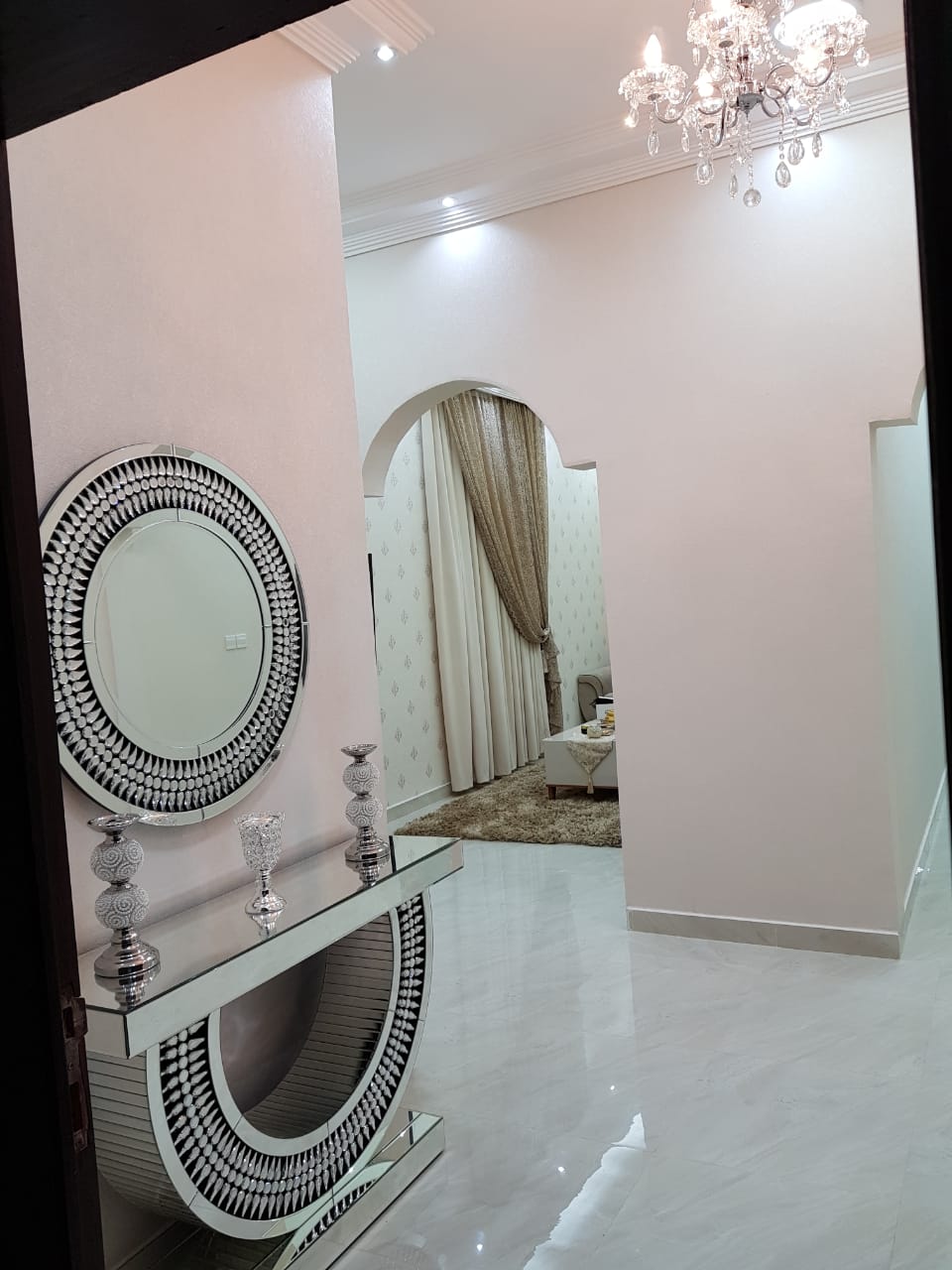
Houseways: Who Visits Which Rooms?

Upper-class, English, Victorian-era homes had a set of rooms for children which would include a day nursery, night nursery, schoolroom, bathroom and the nanny’s room. In present-day America, a middle-class child might play on the kitchen floor while a parent is cooking, do homework on the dining room table, watch TV in a basement rec room, sit by the fire in a den or study, i.e. sit in different rooms for different purposes during one day.

Whereas young Dhofari children spend most of their in-door time in their parent’s bedroom and the salle. When they are close to puberty they will move to their own bedroom or a room with several children who are the same gender and around the same age. Children are only in the majlis in the presence of adults and for a reason, for example an uncle is visiting or they are working with a tutor.

Dhofari children spend a lot of their free time out of the house once they can walk: in the hosh if younger than 3 or 4, then in front/ near house, then within the neighborhood in mixed gender/ mixed age groups until close to puberty. They also know the salle or majlis of many houses (grandparents, uncles/ aunts and older siblings) but will usually not play/ hang out in a cousin’s bedroom, although they might sleep there if it is an overnight visit. Children sleeping over at relatives’ houses is common, even among families which live close to each other. For example, when one female Dhofari friend was sick, she sent her child to stay for two weeks with her parents who live nearby.

As children grow older, they experience the same house differently as the use of rooms is linked to both gender and age. For example, a Gibali girl visiting her paternal uncle’s house: as a baby she might be taken into the majlis by her father who is holding her; as a five-year old, she might spend the visit playing outside with male and female cousins; as a 14 year old, she might sit in the salle with her mom and older sisters. If she marries a cousin from this family, she will be expected to go into the majlis when there are visitors to bring tea and, perhaps, sit and visit.

Further, men experience houses differently according to what his relationship is with the house owners. A boy will spend time in the salle of relatives’ houses when young and the majlis when older but there are many variables. For example, a 25-year-old Gibali man with three sisters (A, B and C) would have different visiting patterns depending on who owns/ controls the house that the sister lives in. He visits sister A in her salle because A and her husband own their own home and visits sister B in her salle because B married a cousin, thus the other women in the salle are his relatives. But he visits sister C in the majlis because C lives in her husband’s father’s home who are not relatives, so the salle is for C’s mother- and sisters-in-law.

In a similar way, a married man who visits his wife when she is at her parent’s house might sit in the salle (if he is closely related to her family) or the majlis (if he is not). As most Dhofari women stay with their mother or an older sister for 40 days after the birth of their first child, a husband’s behavior is on display. All the female relatives of the new mother will know how often he visits, how long he stays and what he brings with him. This information is passed on to the general community, for example when a general question such as “how is the new mom doing?” is answered with, “fine, alhamdulillah, and her husband came every day to visit in the majlis,” his reputation (and the reputation of his family) is increased. This is a man who respects his wife and takes his responsibilities seriously. When the sister of one friend had her first baby, the family tried not to use the majlis at certain times so the husband could visit his wife and baby in privacy.

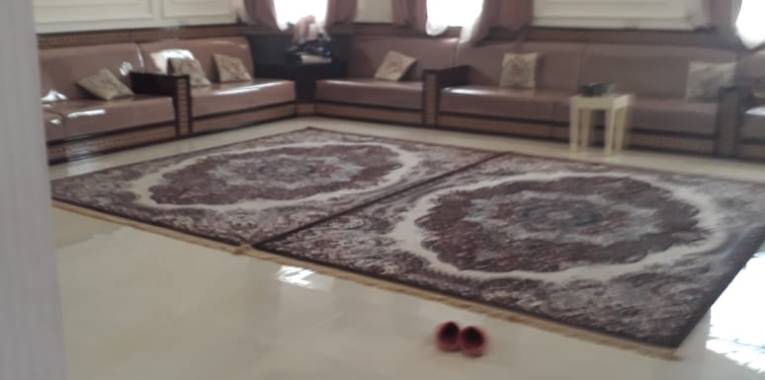
(photo of majlis by informant, used with permission)

Houseways: Comparisons – Types of Rooms and Sightlines

I think of Dhofari houses as the antithesis of expensive Victorian-era houses with all those little rooms with separate purposes: the morning room, the seamstress’ room, billiard room, the music room, the library etc. In Dhofari houses, there are usually only four types of rooms: sitting room, bedroom, kitchen and bathroom. The first three types are furnished with the same pattern of empty space in the middle: the majlis/ salle with stuffed chairs and sofas around the walls with coffee tables next to them and an open space in the middle; the bedroom with the bed and cupboards/ dressers against the walls and open space in the middle of the room and kitchens with counters set around the walls. Furthermore, all rooms are built square or rectangular; there are no nooks or closets. Books, dishes, clothes, beddings, etc. are stored in pieces of furniture that are placed next to a wall. Dining and kitchen tables are placed close to one wall or where two walls meet. To look at this from a child’s perspective, while playing hide-and-go-seek, kids can’t hide in closets or behind furniture. The only places to hide are behind doors or inside kitchen cabinets/ bedroom clothes cupboards.

The effect of this pattern in that when you walk into a room, you can see everyone and everything immediately. I believe the reason for this pattern is that when Gibalis sit together, they always try to keep everyone in the group in view. Men sitting on sofas placed next to the walls in a majlis are a mirror image of men sitting on a mat near a fire for a picnic. One way to keep a more rounded shape in a square or rectangular room is that instead of sectional sofas meeting at a 90 corner angles, either the corner section is angled, or an arm rest is placed at the corner (see examples below).

Further, hallways in Dhofar are much wider than the arm span. Thus, although houses aren’t built ‘open plan,’ from certain vantage points, you can see many different spaces. Standing in the main ground-floor hallway, one can usually see the front door, the entrance to the kitchen, the main stairs and into the salle. From the top of the stairs one can usually see down to the main ground-floor hallway, the open space (sometimes used as a salle) at the top of the stairs and the doors to most or all of the first-floor bedrooms.

A North American house might have a “great room” with a combined kitchen, dining area and sitting area, but normally this is not in sight of the front door. Whereas in a Dhofari house, an older female relative who sits in the salle will see every person who comes in or leaves unless they leave by the kitchen door.

Another way to think about types of rooms is to consider that many middle- and upper-class North American homes have rooms for work, relaxation and/ or exercise such as a home office, craft room, gym, yoga studio. etc. which might be the former bedroom of a child who has moved out. There is a standard trope of a child going to college and his/ her room ‘disappears’ as it has been entirely repurposed.

Whereas in Dhofar, while the people who stay in a room might change, the purpose seldom does. For example, three boys might share a bedroom on the ground floor. In time, an additional story is added and two boys move to an upstairs bedroom while the original room is redone for the oldest boy and his bride. After this couple have a few children, they move to a suite on the first floor and the room is refurbished for a grandparent who cannot manage to walk up stairs.

One consequence of these building and furnishing conventions is that for some Dhofaris, “privacy” refers to their personal thoughts and emotions as they are almost always in actual or potential sight of other people when in a house. Privacy might never be found in a bedroom as children might share a room (once close to puberty, in single gender groups) and young children stay with their parents.

Another consequence is the Dhofari ability to have secret conversations in front of other people. In American families, there can be family-only codes such as saying, “FHB” (family hold back) at a party, meaning there might not be enough food so family should eat less so the guests can have as much as they want. Or an older person raising their eyebrows, opening their eyes widely and staring at a person to show dissatisfaction with inappropriate behavior but it is more common for family members simply to make verbal requests/ demands in front of visitors.

In Dhofar, having a large salle with a perfect view of every person combined with the need to always show a calm and positive expression means it more usual for older relatives to direct younger people with quick eye movements (such as looking at the AC unit to tell someone to make the room cooler) or hand gestures. When I taught a class on culture and asked students to come up with examples of non-verbal communication, many explained the signals for “bring fresh tea” and “bring more food” that older siblings and parents used. Several times at weddings, I have sat next to a woman who was part of the hosting family and a sister would come over to, almost inaudibly, ask a question or give information. The two would discuss hosting emergencies (not enough food, the bride will arrive very late, etc.) with no visible sign of agitation so that the dozens of women who could see them have no idea that there is a problem.  

A note on bathrooms: Bathrooms are almost always ‘dead-end.’ I have seen only one example of a ‘pass-through’ bathroom with two entrances in a house built before 2000. They are usually rectangular and built with the narrow end on an outside wall or lightwell to allow for the window and extractor fan. They are usually set up with an open design (e.g. no interior walls such as a low partition to screen the toilet) with a pedestal sink or sink on a counter with empty space beneath and a shelving unit next to the wall. The sink is always closest to the door. The shower area usually does not have a curtain and is marked off with a slightly lowered floor with a drain. Some have tiled steps along one side. Bathtubs are rare; if there is one, it usually has a seat. The steps and seat are for the ritual washing before prayers during which face, hands and feet must be cleaned.

The door to a guest bathroom that is attached to or near the majlis and salle often opens to a space with one or more sinks, then another inner door leads to a small room with a toilet, shower and sink so that guests might wash their hands while the toilet/ shower room is in use. (see example below)

Bathrooms in the family/ private area of the house are built open-plan for one person to use at a time, unless it is a parent helping a small child (see example below). Some North American bathrooms are set up with the toilet half-hidden behind a low wall and shower curtains so that two people might use the room at the same time but I have not heard of that in Dhofar.

examples of majlis/ salle designed to create circular seating pattern in square room

This slideshow requires JavaScript.

examples of bathrooms

This slideshow requires JavaScript.


Houseways: Windows/ Design, Construction and Safety

Over the last twenty years or so, the predominate style for living and bedroom windows is 2 or 3 panel, lift-out, sliding windows placed about 1 meter from the floor with the window either single pane or divided. Usually the window itself is rectangular (for example height of 110 cm and width of 120 cm) with an inset plastered/ painted arched niche or an arched fanlight above (for example with height of 45 cm, see note about arches below).

In the last few years, there is a greater mix of styles. While some houses continue to have arched windows, square windows, large picture windows and/ or an entire wall (one or more stories high) of windows are more common. In particular, rental houses often have floor to ceiling windows with sliding glass or French doors. Bay and bow windows are rare.

Most windows are reflective – either because the glass itself has been treated while being made or a thin reflective film was put on. This is done to cut cooling costs as it means less direct sunlight enters a room; it also means windows are difficult or impossible to see through during a sunny day but that is less important as most windows are completely covered with drapes/ curtains [see:  Houseways – Windows/ Sightlines]

Kitchen windows are usually smaller (for example, 1m x 80cm) and set above the sink. Bathroom windows are smaller still (for example 65cm x 50cm). Both have opaque glass and sometimes there is a small fan incorporated into the window space or the arched fan light. Both rooms might have 2-panel, lift-out sliding windows or hopper [the top of the window inclines inward]; awning [the bottom of the window inclines outward] is less common. (see below for examples)

Sometimes windows are incorporated into the front door frame: either as transom/ fan lights above the doors and/ or as thin windows on either side of the door. These windows are opaque, perhaps made of translucent glass blocks or colored with real stained glass or a plastic, press-on designs that looks like stained glass. (see above for example)

Window frames are metal, usually 3 to 5m wide and, as can be expected when fitting arched windows in metal frames into cement block buildings, there are often thin gaps which let in wind, sand and rain. As windows are often completely covered with curtains/ drapes, wind and sand is not that much of a problem, although drifts of sand appear on the floor during sandstorms. For rainstorms, some Dhofaris take the preventative option and nail plastic sheeting over windows; some simply move furniture and rugs away from the window and mop up the water.

Ground floor windows are usually barred to prevent opportunistic pilfering rather than pre-planned intent to harm and to keep track of inhabitants. There might be a perception that windows are barred to monitor females but if a female is going to have an illicit meeting, a man coming to her house or her leaving her house would be stupidly dangerous. There would be no possible justification for her being out of the house and several Gibali men have told me that they have the right to kill any man who is in their house at night.

Also, the control is in force for boys as well as girls, albeit with different consequences. I have heard of many cases of boys being given a curfew and if they come late, they have to sleep in the majlis or a relative’s house unless a sister can get a door or window open for them to sneak in.

To me, barred windows can seem at odds with the fact that doors are usually open during the day, and sometimes only locked to keep small children from leaving. I read this as a perception switch from what I call welcoming house when inhabitants are awake and moving (majlis and front door are often open) to fortress house when the inhabitants are sleeping and, while perhaps the majlis door is open, the door from the majlis to rest of the house, all house doors and all bedroom doors are locked.

To look at this issue another way, I have not seen doors with ‘peep-holes’ in them. If someone knocks, you open the door. If some of the research guys stop by unexpectedly and knock, if I ask, “Who’s there?” they will refuse to answer and pound on the door. The first time this happened I was very scared, but I had the presence of mind to run to the window to look at the place for parking. I saw a few cars and recognized one, so I answered the door and got a lot of comments about my rudeness. When I tried to explain that I was afraid, I was told there was nothing to be afraid of. In the same way, if I get a call on my phone from an unknown number, the research guys encourage me to answer. There is nothing to fear from another person who is in front of your house or on the phone, i.e. communicating with you while you are awake. The necessity of trusting yourself, being polite to guests and the implied, ever-present available backup of living in a house with over 30 people, means that having an open door or opening a door to a stranger is considered safe. The danger is what might happen when you are sleeping; when you and your family are not able to see/ assess a possible threat, hence, locked doors and barred windows.

A note on arches:

more common: flat arch / French arch, nested, ogee, “oriental,” lancet, segmental, trefoil (Gothic), Tudor. Some have a flat lintel with a relieving arch [in brick houses this would be a pattern created by bricks angled on the vertical; in Dhofari houses, the arch pattern is created by plaster- or tile-work, unrelated to structural support]; occasionally used: onion, Venetian

less common: art nouveau (non-symmetrical), draped, horseshoe (Syrian), inflexed, keyhole, parabolic; in general, window and door arches do not curve inwards, nor are the sides narrower than the maximum span (width of arch), i.e. the arch usually connects to the sides seamlessly, without a large differential of size.

Examples of kitchen windows – photos by myself or informants, used with permission

This slideshow requires JavaScript.

Examples of bathroom windows – photos by myself

This slideshow requires JavaScript.

Example of ground-floor barred window – photo by Onaiza Shaikh

barred window

Houseways: How to “Read” a House for Information about the Occupants

If you are standing in front of a Dhofari house, how would you know if there were people inside and what they are doing? You can’t necessarily know about the wealth of the occupants, but you might be able to make some guesses based on lights, cars and shoes.  

Wealth

Unless it is a mini-palace set on 4 or 5 lots, you cannot tell the wealth of the inhabitants by looking at the house as it might not have built by or for the people who currently live in it. Houses and land can move within families members as richer members help others. A man might build himself a new home and give his previous house to a relative. A woman might live with her husband and build a house for her mother and her younger siblings. A divorced or widowed women and her children might live in a house built for her by her husband or his family. One informant’s father built a new house next to his home, moved into the new house and handed over his previous home to his brother with all the furnishings intact.

Also, the house might have been built with (non-interest) loans, either from a bank or family members. Or a large house might have been built slowly over several years by siblings who paid for labor and supplies when they could.

A house that looks old or poorly kept-up might be owned/ lived in by people who are using their money in other ways, such as paying for college or treatment for a sick relative, or they might be waiting for a coming wedding or Eid to paint/ refurbish. There might be reasons for the lack maintenance such as the house belongs to a person who has died and the heirs are deciding what should be done with it. A very wealthy older man might refuse to move to a larger/ newer house as he lived his whole life in that home.

It is important to remember that once the house is built, it belongs to the owner forever. There are no yearly land or property taxes. In extreme circumstances, the water and electricity might be cut off but there is no way for a person to be alienated from their property and left homeless. If the government claims eminent domain, the person will be given land and a house or land and enough money to build a house.

Lights

All houses have outside lights near or above the two front doors. These are almost always turned on at night if people are in the house. They are sometimes left on all night or turned off when the household goes to sleep.

Indoor lights are usually turned off or down if there is no one in the room and although most windows are heavily curtained, one can sometimes see light leaking out through a corner to know if there are people sitting in the majlis or salle. Or the majlis or front door might be open with light spilling out to show that people are in.

Houses have a series of lights that look like small lanterns along the top or sides of the walls surrounding the house and along the roof-line. These lights are usually only on if there is a party. This is done as part of the understanding that lights = joy, to alert neighbors and to help guests find the house. If the roof lights are on, it’s a happy party: graduation, someone returning from a long trip overseas, someone who has recovered from an illness, etc. For weddings, there are often rented strands of colored lights which are draped in half circles from the roof. A few people also do this on Omani National Day, November 18.

Basically, the more lights you can see, the more people are in the house. If a house is completely dark, then you think about place and time. People usually go to sleep later in towns so if a house is dark at 10pm in town, chances are everyone is out of the home; if a house is dark at 10pm in an isolated place with structures for herd animals, chances are everyone is sleeping. One informant who lives in town has a sleep pattern that is five hours later than his brother who lives in the mountains.

Cars

There is not usually space inside the hosh (courtyard) for cars, so there is often a parking space in front of the wall surrounding the house. This can be ‘read’ by thinking about how the cars are parked, the time of day, and which day it is.

If there is covered parking, it is for the senior man in the house, seeing a car in that space means it is more likely that he is at home (of course, there is a chance that he was picked up by a friend). If there is a car parked slant-wise, blocking other cars in or in the road, it is probably a delivery, meaning someone is at home.  

Working and school hours are usually Sunday-Thursday from 7or 8am to 1 or 2pm, but if no cars are in front of the house during those times, it doesn’t mean the house is empty. People who don’t work, young children and older relatives will be sleeping or in the salle. If you want to know how many people are in the house, look at the number of cars around 2 or 3 pm as it’s usual for families to eat lunch together.

You can get a sense of the extended family by looking at the cars around 1 or 2 pm on Fridays as married children will usually have the main meal after Friday prayers with the husband’s parents. Lots of cars means that there is a pater and/ or mater familias living there. No cars can mean that there is probably a nuclear family in the house who have gone to have lunch with parents and/ or siblings.

Shoes

When I asked one informant how you tell if someone is at home, the response was, “shoes!” Shoes do give you the most details about who is at home but you have to have good eyesight as it is not acceptable to walk up to the front door of a house unless you are invited or you are from Dhofar and following local rules for visiting.

As shoes are not worn in the house, everyone slips off their shoes next to the door. Counting shoes, noting which door the shoes are next to and which type of shoes there are tells you a lot of information. If you know the inhabitants well, you start to learn who each pair belongs to can know who is inside before you walk in.

Men usually wear thick-soled, black leather sandals. If the shoes are next to the majlis door, it means the man is probably visiting; men who live in the house will leave their sandals by the main door. You can tell children’s shoes by their size and, again, if they are next to the majlis they are visiting with an older male relative and if they are by the main door, they live in the house. Women’s sandals are usually colored and have thinner soles then men’s.

Thus, if you put together cars, lights, shoes and some additional information, you can make reasonable guesses about what is going on.

For example, many cars and many pairs of men’s sandals next to the majlis door means a lot of men are visiting. If one then looks at the main door and sees lots of women’s and kids’ sandals, this means there is some sort of family gathering. If there are lights on the roof-line, it’s a party. [If it’s good weather, a lot of people and there is a large court-yard, the men might be sitting outside on mats, so that women have the freedom to move throughout the whole house, including the majlis.]

But if there are a lot of men’s sandals by the majlis and only a few women’s shoes, it means there is probably a meeting. In which case you need to think through football (soccer) schedules, it might be a group of young men watching a game or older men sorting through a serious family issue. Lots of women’s and children’s shoes but no men’s shoes (and a few or no cars) means it’s a women’s gathering [see below].

If there are lots of shoes and cars, the timing and the sounds can also help tell you about the gathering. The normal times for parties are weekdays after 7 or 8, Fridays after noon prayers for families and Friday and Saturday evenings.

Neighbors might visit each other but Dhofaris usually do not hold large gatherings during the day Sunday-Thursday or Friday and Saturday mornings. If there are a lot of cars and shoes during those times, it might mean that someone has died and people have come to sit with the family for the three days of mourning.

Sound can also be a factor as there is often music playing for a wedding and, during a party if the front door is open, one cannot hear distinct voices but a general hum of chatter. However if the house is in mourning, there will be no sound except perhaps a recording of the Holy Qu’ran.

Note on Cars and Gender –  A meeting of ten male relatives who don’t live in the same house will probably mean ten parked cars; a meeting of ten female relatives will mean fewer cars as they will be dropped off by male relatives, usually father, husband, brother or son. Women drive alone but if there is a family gathering, they will often bring other women and children. For example, if one female informant visits her aunt, she may pick up her mother, an unmarried sister and a married sister so that they can chat in the car.

The fact that Dhofari men drop off female relatives for visits can be read as some Dhofari women are dependent on men and thus have no freedom/ autonomy/ agency. Some Dhofari women have this point of view, but my male and female informants (including women who don’t drive) do not. Several Dhofari women have told me that having a husband drive her meant having a chance to talk to him alone. One explained to me that when living in a house with over 30 people and constant visitors, time driving to and from relatives was her chance to catch up with him. She did not want to learn how to drive as this would give him his freedom to spend evenings with his friends; driving would not give her her freedom.

For men, bringing women to visit relatives is not seen as job, chore or imposition; I have never heard any of the men in my research group man complain about it. Keeping family ties is important and a woman has the right to visit her family. Once a woman is married, the responsibility does not devolve solely on the husband. It’s usual for a relative who drives to pick her up from her husband’s father’s house, bring her home for an evening and then return her. I know of one Dhofari woman who asked for a divorce partially because her husband refused to allow anyone else to drive her, not even her brothers could take her to visit her mother. Her family supported her as his insistence that only he could drive her was seen as unfair and unnecessarily severe.

Note on photos: It would be interesting to have photos of the front of a house at different times to show the number of vehicles that are parked at different times, but to me that would be too intrusive as Dhofaris would be able to identify the house and car owners. Also as taking photos of your own house when there is no reason (such as a party) is odd, informants took these photos at times when there were not many people around, hence, not many shoes.

Photos (by informants, used with permission)

shoes 1

Husband and wife at home – family-owned apartment building

shoes 2

late morning (everyone at work), family house

shoes 3

Family house, time unknown but note that all shoes are to the left side, none near the majlis door to the right, hence it would be likely that there are no guests. Sneakers are far to the left as they might have a bad smell. One of my neighbor’s has a front door with a small landing which is near the wall surrounding the house, so sandals are left near the door but the men put their football (soccer) shoes on top of the wall.

Today I will be presenting my talk “Ethical Eating in Southern Oman” for the Just Food conference, hosted by the Culinary Institute of America and New York University.


“Ethical Eating in Southern Oman.” Just Food, virtual conference of the Association for the Study of Food and Society; Agriculture, Food and Human Values Society; Canadian Association for Food Studies and the Society for the Anthropology of Food and Nutrition, hosted by the Culinary Institute of America and New York University. June 9-15, 2021. 


My presentation combines research from the fields of anthropology and food studies to examine the connections between food and morality in Dhofar, the southern region of Oman. Much has been written about Arab hospitality in terms of generosity to guests, but this presentation focuses on two other aspects of food-related behaviors: the ethical way to eat and to dispose of food.

 “Ethical eating” refers to two common behaviors in Dhofar. One is the social pressure to eat in such a way that the left-over food is “clean,” meaning suitable to give to others because it is not touched by people’s hands. A second issue is that the remaining food must be given away, as quickly as possible, following the culturally-accepted sharing hierarchy of friends/ family, other humans, then animals.

 The information discussed has been gathered from formal interviews during 2019-2020 and countless social events with Dhofari informants and friends over the past 14 years.

This work is part of my Foodways in Southern Oman project.

Foodways in Southern Oman (Routledge) examines the objects, practices and beliefs relating to producing, obtaining, cooking, eating and disposing of food in the Dhofar region of southern Oman. The chapters consider food preparation, who makes what kind of food, and how and when meals are eaten. Marielle Risse connects what is consumed to themes such as land usage, gender, age, purity, privacy and generosity. She also discusses how foodways are related to issues of morality, safety, religion, and tourism. The volume is a result of fourteen years of collecting data and insights in Dhofar, covering topics such as catching fish, herding camels, growing fruits, designing kitchens, cooking meals and setting leftovers out for animals.


https://www.routledge.com/Foodways-in-Southern-Oman/Risse/p/book/9780367859558

https://www.barnesandnoble.com/w/foodways-in-southern-oman-marielle-risse/1137456632?ean=97803678595587


Pre-historical and Historical Houseways in the Dhofar Region: Selected References


Selected references – Al Baleed/ Sumhuram

Albright, Franklin. 1982. The American Archaeological Expedition in Dhofar, Oman, 1952-1953. Washington DC: American Foundation for the Study of Man.

Avanzini, Alessandra. 2007.“Sumhuram: A Hadrami Port on the Indian Ocean,” in The Indian Ocean in the Ancient Period: Definite Places, Translocal Exchange BAR International Series 1593. Eivind Heldaas Seland, ed. Oxford: Archaeopress. 23-31.

—. 2002. “Incense Routes and Pre-Islamic South Arabian Kingdoms.” Journal of Oman Studies 12: 17-24.

Belfioretti, Luca. and Tom Vosmer. 2010. “Al-Balīd Ship Timbers: Preliminary Overview and Comparisons.” Proceedings of the Seminar for Arabian Studies 40: 111-18.

Buffa, V and A.V. Sedov. 2008. “The Residential Quarter,” in A Port in Arabia between Rome and the Indian Ocean (3rd C. BC – 5th C. AD). A. Avanzini, ed. Khor Rori Report 2, Roma: L’Erma di Bretschneider: 15-59.

Carter, Henry. 1846. “The Ruins of El Balad.” Journal of the Royal Geographical Society of London 16: 187-99.

Cleveland, R. L. 1960. “The 1960 American Archaeological Expedition to Dhofar.” Bulletin of the American Schools of Oriental Research 159: 14-26.

—. 1959. “The Sacred Stone Circle of Khor Rori (Dhofar).” Bulletin of the American Schools of Oriental Research 155: 29-31.

Costa, Paulo. 1982. “The Study of the City of Zafar (Al-Balid).” Journal of Oman Studies 5: 111-50.

Degli Esposti, Michele and Alexia Pavan. 2020. “Water and Power in South Arabia: The Excavation of “Monumental Building 1” (MB1) at Sumhuram (Sultanate of Oman).” Arabian Archeology and Epigraphy. 1 – 29. DOI: 10.1111/aae.12159

Franke-Vogt, Ute. 2002. “Remarks on the Classification of the Pottery from Al-Balid, Dhofar (Oman).” Unpublished ms., Office of the Advisor to HM the Sultan for Cultural Affairs: Muscat-Salalah.

Fusaro, Agnese. 2021. “The Islamic Port of al-Balīd (Oman), between Land and Sea: Place of Trade, Exchange, Diversity, and Coexistence.” Journal of Material Cultures in the Muslim World 1.1-2: 67-95. doi: https://doi.org/10.1163/26666286-12340003

Giunta, Roberta. 2009. “Coins from Al Balid, A Preliminary Report.” Unpublished ms, Office of the Advisor to HM the Sultan for Cultural Affairs: Muscat-Salalah.

Newton, Lynne and Zarins, Juris. 2014. “A Possible Indian Quarter at al-Baleed in the Fourteenth-seventeenth Centuries AD?” Proceedings of the Seminar for Arabian Studies 44: 257-76.

Orazi, Roberto. 2002. “The Harbour and City of Khor Rawri.” Journal of Oman Studies 12: 210-222.

Pavan, Alexia. 2020. “The Port of Al Baleed (southern Oman), the Trade in Frankincense and Its Coveted Treasures.” Polish Archaeology in the Mediterranean 29.1. doi:10.31338/uw.2083-537X.pam29.1.13

—. 2017-2018. “Husn Al Baleed: Civil and Military Architecture along the Indian Ocean in Medieval Times.” Journal of Indian Ocean Archaeology 13-14: 28-41.

Pavan, Alexia and Michele Degli Esposti, 2016. The Urban Shrine in Quarter A at Sumhuram: Stratigraphy, Architecture, Material Culture. Quaderni di Arabia Antica, Roma: L’Erma di Bretschneider.

Pavan, Alexia, Agnese Fusaro, Chiara Visconti, Alessandro Ghidoni, and Arturo Annucci. 2020. “New Researches at The Port of Al Balid and Its Castle (Husn): Interim Report (2016-2018).” The Journal of Oman Studies 21: 172 – 199

Pavan, Alexia, S. Laurenza, and R. Valentini, 2020. “Masonry and Building Techniques in a Medieval City Port of the Sultanate of Oman: Preliminary Typological Atlas at al-Balīd.Newsletter Archeologia 10.

Pavan, Alexia and Chiara Visconti. 2020. “Trade and Contacts between Southern Arabia and East Asia: The Evidence from al-Balīd (southern Oman).” Proceedings of the Seminar for Arabian Studies 50: 243–257.

Pirenne, J. 1975. “The Incense Port of Moscha (Khor Rori) in Dhofar.” Journal of Oman Studies 1: 81-96.

Zarins, Juris and Newton, Lynne. 2012 “Al Balid: Ancient Zafar, Sultanate of Oman. Report of Excavations, 2005-2011 and Salalah Survey.” Unpublished ms., Muscat-Salalah.


Selected references: Himbert, Rose and Usik – Pre-historic

Hilbert, Yamandu. 2013. “Khamseen Rock Shelter and the Late Palaeolithic-Neolithic Transition in Dhofar.” Arabian Archeology and Epigraphy 24: 51-58.

Hilbert, Yamandu, A. Parton, M. Morley, L.P. Linnenlucke, Z. Jacobs, L. Clark-Balzan, R. Roberts, Chris Galletti  J.-L. Schwenninger and Jeff Rose. 2015. “Terminal Pleistocene and Early Holocene Archaeology and Stratigraphy of the Southern Nejd, Oman.” Quaternary International 282: 250-263.

Hilbert, Yamandu, J. Rose, and R. Roberts. 2012. “Late Paleolithic Core Reduction Strategies in Dhofar, Oman.” Proceedings of the Seminar for Arabian Studies 42 1-18.

Hilbert, Yamandu, V. Usik, Chris Galletti, M. Morley, A. Parton, L. Clark-Balzan, J-L Schwenninger, L. Linnenlucke, R. Roberts, Z. Jacobs, and Jeff Rose. 2015. “Archaeological Evidence for Indigenous Human Occupation of Southern Arabia at the Pleistocene/Holocene Transition: The Case of al-Hatab Dhofar, Southern Oman.” Paléorient 41.2: 31-49.

Rose, Jeff and Yamandu Hilbert. 2014. “New Paleolithic Sites in the Southern Rub’ Al Khali Desert, Oman.” Antiquity 88.381.

Rose, Jeffery, Yamandu Hilbert, Anthony Marks and Vitaly Usik. 2018. The First People of Oman: Palaeolithic Archaeology of the Nejd Plateau. Sultanate. Muscat: Ministry of Heritage and Culture

Rose, Jeff, Vitaly Usik, A. Marks, Yamandu Hilbert, Chris Galletti, A. Parton, V. Černý, J. Geiling, M. Morley, and R. Roberts. 2011. “The Nubian Complex of Dhofar, Oman: An African Middle Stone Age Industry in Southern Arabia.” PLoS ONE 6(11) e28239.

Usik, V., J. Rose, Y. Hilbert, P. Van Peer, and A. Marks. 2013. “Nubian Complex Reduction Strategies in Dhofar, Southern Oman.” Quaternary International 300: 244-266.


Other selected references – pre-modern

Bortolini, Eugenio and Olivia Munoz. 2015. “Life and Death in Prehistoric Oman: Insights from Late Neolithic and Early Bronze Age Funerary Practices (4th – 3rd mill. BC).” Proceedings of the Symposium: The Archaeological Heritage of Oman. Paris: UNESCO. 61-80.

de Cardi, Beatrice. 2002. “British Archeology in Oman: The Early Years.” Journal of Oman Studies 12, 2002.

Charpentier, Vincent, Alex de Voogt, Remy Crassard, Jean-Francois Berger, Federico Borgi and Ali Al-Mashani. 2014. “Games on the Seashore of Salalah: The Discovery of Mancala Games in Dhofar, Sultanate of Oman.” Arabian Archaeology and Epigraphy 25: 115-120.

Costa, Paulo. 2001. Historic Mosques and Shrines of Oman. Oxford: British Archaeological Reports.

—. 1983. “Notes on Settlement Patterns in Traditional Oman.” Journal of Oman Studies 6.2: 247-68.

Cremaschi, Mauro, Andrea Zerboni, Vincent Charpentier, Remy Crassard, Ilaria Isola, Eleonora Regattieri, Giovanni Zanchetta. 2015. “Early-Middle Holocene Environmental Changes and pre-Neolithic Human Occupations as Recorded in the Cavities of Jebel Qara (Dhofar, southern Sultanate of Oman).” Quaternary International 382: 264-76.

Garba, Roman and Peter Farrington. 2011. “Walled Structures and Settlement Patterns in the South-western Part of Dhofar, Oman (poster).” Proceedings of the Seminar for Arabian Studies 41: 95–100.

Hulton, Jessop and J. Smith. 1830. “Account of Some Inscriptions Found on the Southern Coast of Arabia.” Journal of the Royal Asiatic Society of Great Britain and Ireland 5.1: 91-101.

McCorriston, Joy, Michael Harrower, Tara Steimer, Kimberly D. Williams, Matthew Senn, Mas‘ūd Al Hādhari, Mas‘ūd Al Kathīrī, ‘Ali Ahmad Al Kathīrī, Jean-François Saliège and Jennifer Everhart. 2014. “Monuments and Landscape of Mobile Pastoralists in Dhofar: the Arabian Human Social Dynamics (AHSD) Project 2009-2011.” Journal of Oman Studies 12: 117-44.

Newton, Lynne. 2010. “Shrines in Dhofar,” in Death and Burial in Arabia and Beyond: Multidisciplinary Perspectives, Society for Arabian Studies Monographs 10. Lloyd Week, ed. 329-340.

Newton, Lynne and Juris Zarins. 2017. The Archaeological Heritage of Oman. Dhofar Through the Ages. An Ecological, Archaeological and Historical Landscape. Muscat: Ministry of Heritage and Culture Sultanate of Oman.

Potts. D. 2016. “Trends and Patterns in the Archaeology and Pre-Modern History of the Gulf Region,” in The Emergence of the Gulf States: Studies in Modern History. J.E. Peterson (ed.). London: Bloomsbury. 19-42.

Zarins, Juris. 2001. The Land of Incense: Archaeological Work in the Governorate of Dhofar, Sultanate of Oman, 1990-1995. Muscat, Oman: Sultan Qaboos University Publications.

Zerboni, Andrea, Alessandro Perego, Guido S. Mariani, Filippo Brandolini, Mohammed Al Kindi, Eleonora Regattieri, Giovanni Zanchetta, Federico Borgi, Vincent Charpentier and Mauro Cremaschi. 2020. “Geomorphology of the Jebel Qara and Coastal Plain of Salalah (Dhofar, southern Sultanate of Oman).” Journal of Maps 16:2, 187-198.

Zimmerle, William. 2017. Cultural Treasures from the Cave Shelters of Dhofar: Photographs of the Painted Rock Art Heritage of Southern Oman. Washington: Sultan Qaboos Cultural Center/Liberty Press.

—. Crafting Cuboid Incense Burners in the Land of Frankincense: The Dhofar Ethnoarchaeology Preservation Project. 2017. Washington: Sultan Qaboos Cultural Center/Liberty House Press.

 (updated Dec. 2021)


Houseways: Roofs (how one aspect of house design affects other aspects)

[this essay is part of a series about the practicalities and pragmatics of one-, two- or three-story houses built within the last few decades on one or two plots of land in the Dhofar region of Oman; extremely expensive houses often take up three or more plots and have very different architectural styles] – photo by Onaiza Shaikh

In Dhofari-designed houses the roof is accessed by an internal staircase; this necessity creates certain ‘rules’ about house architecture and space use. First, because the floor, roof and steps are from poured cement and there needs to be space for the support poles, there are always landings and an empty space next to the main staircase (see below 1). Even the back set of stairs (in large houses) are wide with an open area at the bottom. As stairs aren’t built narrowly between two walls, it is easy to get large pieces of furniture to the upper stories. Further, because there is always open space on at least one side of the main staircase, there are always banisters [handrails supported by balusters].

Second, there is always empty space under the stairs which can be used for storage or decorated with a piece of furniture. Third, there is always a landing at the top of the stairs which is usually used as a storage space. This landing space can look like, from outside, a small, four-sided “hat” or cupola. Normally the cupola has windows on several or all sides which, depending on the house design, brings light into the hallway below. The roof of this small space is accessed by a ladder and often holds satellite dishes and the round, white plastic water tank. Water comes from the municipal supply or a well and comes into the house using gravity, although some houses have a small pump to increase force water up into the tank.

In some larger houses, there is both a square room at the top of the stairs and a decorative cupola which is round and is entirety made of glass.

Another aspect of house patterns is that while almost all modern houses have flat roofs, looking at roof accessibility can tell you if the house is Dhofari-designed [meaning either the architect is Dhofari or a Dhofari is planing to live in the house.] While Dhofaris don’t necessarily use the roof space, it is always very easy to enter. If one can only get on the roof by a ladder, the house is not Dhofari-designed.

When cement block houses started to be built, roof-lines often looked like battlements with the edge wall as a parapet with crenellations, sometimes fashioned to look like the distinctive local style of incense burners, majmar (see below 2). Now there are many choices including closely spaced decorated balusters, glass inserts, metal railing, etc. (see below 3).

By law, all roofs have some sort of wall around the edge for safety. The most common type is plastered cement blocks up to waist height.  Sometimes there is no discernible difference between wall of the highest floor and the roofwall, e.g. there is a smooth facade until the top of the roof wall, which often has a cornice with a dentil pattern. Sometimes there is a clear division in that the roofwall protrudes slightly and is painted/ decorated. Some newer houses have a flat roof that is smaller than the footprint, a wall at the edge, then a slope of three to five courses of clay tile which meet the wall of the upper story.

Most roofs have a series of lights, often looking like small lanterns, placed at intervals along the roof wall (see below 3).

Roofs are not seen as part of the living space although there might be a metal or poured cement roofed area for women and children to sit outside, instead of sitting on the front steps. If there is not enough room in the hosh (courtyard), there might be a clothesline (as clothes dryers are rare) and miscellaneous objects which wouldn’t be damaged by being outside, such as leftover tiles. Sometimes there is a laundry room, an extra room for the maid and/ or small room for storage, either free-standing or sharing a wall with the small room at the top of the stairs.

A roof can be finished, meaning that the homeowner does not mean to build another story, or unfinished, meaning although the roof might be tiled and/ or have decorations such as crenelations the owner might build an additional story. This type will have distinctive short, poured cement pillars which cover reinforcing bars, aka rebar. When an upper story is added, the tiles, decorations and tops of the short pillars are broken. [I will discuss the cement/ rebar pillars in a later essay about house building.]

Two personal notes about roofs:

– Hurricane Mekunu (2018) and roofs: Given the infrequent, but heavy, water accumulation after rainstorms, there are often holes drilled at the bottom of the edge wall to allow the water to drain. One neighbor did not have this and after Mekunu hit, his roof looked like a swimming pool for over a week. The day after the storm, I told my landlord who called the neighbor, but he did not come and fix the problem, perhaps because he would have needed to climb up a ladder carrying a pump. Opening the roof door would have meant all that water coursing into the house. As the water very slowly evaporated, I could see the damp seeping into the cement blocks, eventually reaching halfway down the side of the house.

My roof had holes for the water escape and the roof door had a ledge in front of it but the huge amount of water from Mekunu meant that rain came into the landing at the top of the stairs. However, the stairs were slightly canted so that the rain ran down the left side of the stairs and at the first landing spilled over the edge into the stairwell instead of continuing down the stairs. For several hours there was a waterfall in the stairwell but no roof water entered my apartment or the apartment downstairs as the water seeped out in the gap under the front door.

I wonder how the neighbor’s roof door was so watertight. The water was at least two feet deep and took many days to evaporate. I don’t know that neighbor well enough to ask if I can prowl around his house but it is an interesting question.

– When I lived in my previous house, I paid a gardener to keep the roof clean and water various plants in pots. When I looked at the area where I lived on satellite maps, I realized the mine was the only house with a clean roof. (Which begs the question of the tradeoff between having a lower electricity bill because a clean, white-tiled roof reflects heat and wasting water to keep the roof clean.)

Examples of staircases: photos from social media (newly-built house for sale) and an informant

This slideshow requires JavaScript.

Examples of typical Dhofari-designed rooflines: photos by Onaiza Shaikh

This slideshow requires JavaScript.

Examples of recently-built roofs: photos from social media (newly-built house for sale and rental house)

This slideshow requires JavaScript.

Houseways: Windows/ Sightlines

[this essay is part of a series about the practicalities and pragmatics of one-, two- or three-story houses built within the last twenty years on one or two plots of land in the Dhofar region of Oman; extremely expensive houses often take up three or more plots and have very different architectural styles]

One of the hardest concepts for language students to grasp is to rethink common metaphors. It’s ok to call kids “monkeys/ cheeky monkeys” in North America and the UK, but not in Oman. “Moon faced” is negative in the US, but not in Oman. In the Middle East, the full moon is seen as a time of safety and peace because you can see everything without the heat of the sun, unlike the negative connotations of danger found in North America.

It’s the same way with architectural details. Someone from the UK might argue that windows should be used to look out of, thus a window should be made of clear glass, uncovered during the day, often uncovered at night and, in good weather, left open to let in fresh air. The front door will usually be closed all the time.

None of this obtains in Dhofar. Windows are either made of opaque glass (in bathrooms and the kitchen) or are completely covered with treatments which usually have several layers, such as a heavy or lined, light-blocking fabric with a tulle/ sheer overlay which is sometimes tied back or swept to one side [jabot] with a fringe and/ or beading. There are usually heavy frame elements with a valance or pelmet/ cornice with swags. Sometimes there are three layers, a plain, dark fabric which hangs straight, a sheer overlay and then decorated drapes pulled to one side. This makes it look like one might be able to see out/ in but in fact the window is totally covered. [see examples below]

Drapes seldom have a simple, open style such as tabs and if there is a visible rod, there is almost always a finial. Café curtains are rare – usually the whole window is covered at all times. Ground-floor windows and the window at the first landing of a stairwell are frequently barred. However, depending on the weather and the neighborhood (how close are the other houses and whether the neighbors are ‘known’ and/ or family) the front door might be left open during the day.

Given that windows have reflective treatments which make it difficult/ impossible to see in, sometimes the heaver drapes might be opened during the day, leaving only the sheer covering.  If there are no possible sight lines, i.e. there is a high surrounding wall, the house is far from other houses and the road, etc. the heavier covering might not be closed at nightfall but windows that allow you to see directly  into a house is rare.

Another way to explain the non-use of windows is that before the infrequent, severe rainstorms, Dhofaris often cover the house windows with blue or grey/ opaque tarps, which are sometimes left up for weeks or months after the storm. Some houses are built with no windows on the side that is close to the surrounding wall and facing another property.

As Dhofaris are always fully dressed in their houses (see below), sometimes an upper story window in a public part of the house (for example, a family salle at the top of the stairs) will only be covered with sheet fabric if there are no direct, close sightlines. One can sometimes get a glimpse of an indistinct shape moving, but there is nothing like the large, uncovered, picture windows in the living rooms of most American mid-western towns.

Light indoors is provided by overhead florescent tube-lights and/ or chandeliers; sometimes there are transoms/ fanlights over doors. If someone needs to see something, they go to the front door and look out. During over ten years of visiting, I have never seen an adult pull back a curtain to look outside. Small kids will sometimes do so, then tell an adult in the room what they see, but usually grown-ups don’t show their faces in a window.

To say that a person “looks out of windows” is the only negative comment I have heard from informants and friends about a neighbor. I have heard that expression three different times and always with a sense of exasperation. The issue is not simply the “looking” but the interest in other people’s lives and telling others what was seen: two very unattractive traits. The correct behavior is, of course, to try not to see and, if seen, never discuss any speech or actions done by neighbors. If one has good neighbors, say alhumdulilah and if not, a dismissive wave of the hand is enough.

In the three cases I know of, I was told about the person because of circumstances that warranted me knowing. For example, a Dhofari friend (X) asked me to be sure to wear Dhofari clothing when I visited her because she had a neighbor (Y) who “looks out of windows” and if Y saw a Western person enter X’s house, Y would tell people and insist on knowing who I was and why was I visiting. In the other two cases, when asking Dhofaris if they were free to visit, the friends told me that there was a problem within the family because of a neighbor who misconstrued something seen and told other people.

As the exception that proves the rule, rental houses usually have sitting rooms with sheer curtains as such houses usually have higher than normal surrounding walls and are located outside of congested areas. The understanding is that no one can see in and everyone in the house is related, so window coverings are not necessary. Rental houses sometimes also have bigger windows because there are often small jungle gyms/ playground equipment and/ or pools so adults can easily sit inside and watch the children. [see example below]

The information above is for houses in and close to towns; outside of towns, as there are either no neighbors or the neighboring houses belong to relatives, there is less concern about privacy. The surrounding walls are low (waist-high) and serve primarily to keep livestock away from the home. Houses often have a dekka, an outside seating area accessible from the front door. Sometimes it is covered and furnished, sometimes it is simply clean swept mats to sit on. If the house is built up and there is only a small landing in front of the main door, people will sit on front steps in cool weather. Thus, although windows are similarly covered with fabric, people have far more visual access to their surroundings.

Housing/ Clothing: The point about Dhofaris always being fully dressed at home is very important. As I have explained in my first book: Once outside the bedroom, there is a chance to see any of the other people in the house, the live-in maid and/ or a repair person. Therefore, at all times, a man must wear at least a wazar (sarong) and t-shirt, a woman must be in a dhobe (loose housedress) and losi (light cotton headscarf), kids are dressed in at least shirts and underwear/ diapers.

Housing design and living patterns create this necessity of always being modestly dressed. For example, a man leaving his bedroom might see a brother’s wife who lives across the hallway, the teenage daughter of another brother or an older female relative. As he leaves the house, he might pass the salle [female/ family sitting room] which is open to the main hallway and see/ be seen by his mother’s sisters or female neighbors who are visiting.

I will discuss window design and construction in a following essay.

examples of covered windows

This slideshow requires JavaScript.

examples from rental house (larger windows, less covering)


Houseways: Rental Apartments in Dhofar, Khareef and Dhofari/ Non-Dhofari Designs

A unique aspect of housing market in Dhofar is that there is a large supply of furnished rental apartments and houses because of the khareef (monsoon) season. In non-covid times, thousands of Arabic visitors come between June and August to enjoy the cool, foggy weather. Visitors to Dhofar will often stay 2-3 weeks, so they want all the conveniences of a set-up home. In other parts of Oman, unfurnished apartments and houses are the norm because the expectation is that people will rent for several months or years and landlords don’t want to deal with the wear and tear on furniture from renters.

Another aspect of the huge rental market for khareef is that landlords will sometimes rent apartments and houses very cheaply for 9 or 10 months (September to May or June), then raise the prices for high tourist season. For example, a 2-bedroom apartment might be 150 OR per month for most of the year, and then 50 OR per night in July and August. This means some renters will, year after year, move their belongings into their office and leave for the summer, then move back in September first.

In terms of how the apartments are planned, there is a basic division between those designed by and built for Dhofari Omanis and for non-Dhofari Omans. [For a general discussion of apartment buildings see Houseways – Types of Apartments Buildings (Family/ Public) ]

The main difference is that for Dhofari-Omanis space is allocated between guests and family members with the intention that family members can move freely within the apartment, in addition to usually being able to come in and leave.

Most Dhofari-designed apartments have two doors [see example below] so that, like houses, guests are secluded in one room while family members have access to all other rooms and the main entrance.

There are other formats. In my (Dhofari-designed) apartment [see Houseways – Cultural Perspectives and Movement within an Apartment: The Practicalities of Having Guests  ], the front door is not visible from the majlis so anyone could come and go without being seen. In another apartment [see Houseways – Balancing Privacy and Hospitality within an Apartment ] this is not possible because the majlis is next to the door, but there is a door to the salle which cannot be seen by a guest sitting on the sofa, so family members can go into and out of the salle and kitchen without being seen. Further there is a hallway door, so the area with bedrooms is visually and acoustically separated.

Another type of design is a one main door which opens into a hallway, with the main sitting room as the first door on the left or right. Once guests are inside, the family members have access to the hallway and all other rooms. For the moments of entry and exit, the host will be speaking loudly, welcoming guests or trying to convince them to stay/ saying goodbye, so everyone will know the hallway is in use.

Rental apartments for tourists are usually built within a different framework, in which the section of the apartment near the front door is open to the back of the apartment so that if there are male guests, there can be little or no movement.

An example: the front door opens directly into a small living room with six armchairs. Along the left-hand wall is a guest bathroom. In the back left-hand corner is a short, five-foot hallway which ends in six-sided open space about eight feet across with four doors. First door to the left is small kitchen, second door (ahead, to the left) is bedroom, third door (straight ahead) is a bathroom, then there is a small alcove with a washing machine, then fourth door (to the right) bedroom. Thus, guests can hear anything that is happening in the back of the apartment and those sitting along the far wall of the sitting room can see down the short hallway.

In this set-up the front “controls” the back of the apartment. This makes sense in terms of khareef rentals as tourists come as large groups of family or friends, thus there is no need to worry about keeping guests separate. The housing space is family-only. If a male tourist meets a friend in Salalah, they will both understand that the housing is not set up to entertain guests and they will have a picnic or take a meal/ coffee together in a restaurant (pre-covid).

(Example of apartment with two doors, main door and majlis to the right, photo by homeowner and given to me with permission to use for this website)

g - doors 2

Houseways: Cultural Perspectives and Movement within an Apartment, The Practicalities of Having Guests

Illustration by Maria Cristina, website: https://www.mariacristinah.com/

In this essay I would like to focus on Dhofari cultural expectations of space and movement, using the example of Dhofari men from my research group visiting me in my apartment. I want to highlight what physical movements are possible within a typical Dhofari-designed apartment in terms of both spacing and cultural beliefs. What actions would they expect to take and what actions would they expect of me? What are my personal and cultural expectations of where I should stand and sit? [The examples are from pre-covid times.]

My apartment is on the first floor of a 4-apartment building, with one apartment below and 2 others (ground floor and first floor) which are entered through another door.

To enter, you walk up one flight of stairs (with a turn and landing 1/2 up) to reach my landing, from which the stairs continue up to the roof. [illustration is above and below]

Standing just inside the front door, the kitchen door is 5 feet to the right. Ahead and a little to the left is the main hallway. About half-way down the hallway to the left is the opening for the salle [women’s and family’s sitting room], but it’s set back so you can’t see into it. Down to the right is the door to one bedroom. At the end of the hallway, opposite the front door, is a bathroom. There is a bedroom to the left and to the right of the bathroom, with both doors set back.

Thus, when a guest steps inside, the only spaces visible are the hallway and the guest bathroom which is 8 feet to the left. You can’t see the kitchen (as it is obscured by the open front door) or the majlis [the men’s/ guest’s sitting room]. The door to the majlis is parallel to the front door but set back. To enter, you need to turn left, walk a few steps and, in front of the door to the guest bathroom, turn left.

How I would want to behave with guests is to open the front door with my left hand, verbally welcome guests and make “come in” gestures with my right hand and point them to the majlis. The guests would enter in the order that they have walked up the stairs, pass in front of me, move to my right, then I close the door with my left hand.

This doesn’t work for my apartment for several reasons. First, the men in my research group, like most Dhofari men, will never walk straight through a doorway if they are part of a group. There will be many slight movements (such as stepping backwards/ to one side or pushing another man gently forward) to allow another man the honor of being first through the door.

So men won’t enter in the order that they walk up the stairs, there will be a little logjam on the landing, with men perhaps walking up or down one or two steps to avoid being first. This is accompanied by friendly banter as I stand near the open door.

I can’t hold on to the door, as this would mean that the men would have to pass too close to me. For their comfort and mine, we usually stay at least three feet apart unless we are eating from the same platter. So I have to let go of the door and step back down the hallway, where my sightlines become very limited with walls on either side of me. As I call out greetings and try to signal ‘go to the right,’ they eventually settle on who is walking in first and then a second small problem arises.

I am signaling ‘go right’ but when they turn, they see an open guest bathroom door, something that never happens in their own houses as bathroom doors are always kept shut. [see below] Also, the door to the majlis is not visible until they have taken a few steps, so there is a moment’s hesitation as it appears I am telling them to walk into the guest bathroom.

Once they are all in the majlis there is another series of micro-hesitations, as I, as host, should already be in the majlis and telling them where to sit, making sure everyone has a cushion to lean on and there is a little table with a tray of drinks and snacks near them.

But I am, instead, hovering near the door because I have to wait until the last person has entered the apartment to shut the door. Then I have to wait to enter the majlis because there are 5 men milling around the middle of the majlis trying to give each other the best place to sit.

Once they have all sat down, I greet them, then try to disappear into the kitchen to bring tea and coffee, while they all yell that they don’t want anything to drink. This is hard for both them and me. The water, soda and snacks are already set out but as I am not sure about when they will arrive, I don’t make the tea and coffee until they are in the apartment. As an American, I am not worried about leaving guests alone for a moment to get something from the kitchen, but their expectation is that the host has set up all the food and drinks before their arrival so the host will immediately sit down and will (should) not stand up again until everyone leaves.

A few times I tried a different way. I opened the door, stepped to the right (beckoning them to follow me), walked backwards into the majlis and sat in the furthest corner, then I could direct people where to sit and toss cushions around. But when I tried to stand up to bring tea, they stormed at me. It’s overwhelming as men who are always patient and low-key will suddenly and voraciously protest my attempting to leave the room: “SIT DOWN,” they yell, “WE DON’T WANT ANYTHING.” To them, they are showing that they are good (non-demanding) guests by saying that they don’t want me to make more of an effort to bring them hot drinks.

I know, and they know, that the visit will probably be two or more hours so I steel myself and leave the room to make tea. When I am in the hallway, I turn the key to lock the front door. When the door is not locked, if someone opens the house door (downstairs), my front door opens, so I make sure it is locked at all times. In most Dhofari houses, especially those outside of the city of Salalah, front doors are usually not locked during the day.

When they are ready to leave, they will stand up. From Dhofari perspectives, a good host will attempt to stop guests from leaving to show that they are welcome to stay as long as they want. Therefore, I should be protesting and telling the men from my research group to stay, but they and I both know that once they stand up, they will leave. I deal with the contradiction of both expressing politeness and acknowledging reality by saying the expected words, while dashing out of the majlis so I can unlock the front door, then step back down the hallway to be out of the way for their exit. So there is a silly moment of me saying, “stay, stay” at the same time I am opening the door.

If I don’t move quickly, they will leave the majlis, walk into the hallway then hesitate by the front door, creating a brief logjam. There are a few seconds while the person closest to the door realizes it is locked and figures out how to unlock it. Meanwhile, I am stuck in the majlis, keeping space between myself and the last man. This means that by the time I get to the front door, some of the men are already out of sight beyond the turn in the stairs.

This is fine for them as, among friends, there are no protocols for leaving. But the few times this happened, I was overwhelmed with a feeling of incompleteness. I hadn’t realized how important it was to me to say ‘goodbye.’ Once I followed them down the steps and got yelled at, “GO BACK!” (again, them expressing politeness by telling me it is not necessary to follow them to their cars.) So now I make sure I leave the majlis first so I can say ‘goodbye.’

Because there are fewer cultural constraints on women being in physical proximity to women, the space limitations in my apartment don’t matter when Dhofari women visit. I can stand with my left hand on the front door, signal where to go and be in the majlis when they are choosing their seat. There are no protests if I get up to get tea and we can all crowd by the door when they leave.

Note: Bathroom doors are a good example of cultural perceptions impacting space. In Oman, bathroom doors are almost always closed when not in use as bathrooms are perceived as unclean at all times. In the States, bathroom doors are often left open when not in use. Sometimes it’s to allow more light into the hallway or the bathroom is nicely decorated or it might have the cat’s litterbox or to show that it is not occupied, etc.

apartment plan

Illustration by Maria Cristina, website: https://www.mariacristinah.com/