Houseways: Windows/ Sightlines

[this essay is part of a series about the practicalities and pragmatics of one-, two- or three-story houses built within the last twenty years on one or two plots of land in the Dhofar region of Oman; extremely expensive houses often take up three or more plots and have very different architectural styles]

One of the hardest concepts for language students to grasp is to rethink common metaphors. It’s ok to call kids “monkeys/ cheeky monkeys” in North America and the UK, but not in Oman. “Moon faced” is negative in the US, but not in Oman. In the Middle East, the full moon is seen as a time of safety and peace because you can see everything without the heat of the sun, unlike the negative connotations of danger found in North America.

It’s the same way with architectural details. Someone from the UK might argue that windows should be used to look out of, thus a window should be made of clear glass, uncovered during the day, often uncovered at night and, in good weather, left open to let in fresh air. The front door will usually be closed all the time.

None of this obtains in Dhofar. Windows are either made of opaque glass (in bathrooms and the kitchen) or are completely covered with treatments which usually have several layers, such as a heavy or lined, light-blocking fabric with a tulle/ sheer overlay which is sometimes tied back or swept to one side [jabot] with a fringe and/ or beading. There are usually heavy frame elements with a valance or pelmet/ cornice with swags. Sometimes there are three layers, a plain, dark fabric which hangs straight, a sheer overlay and then decorated drapes pulled to one side. This makes it look like one might be able to see out/ in but in fact the window is totally covered. [see examples below]

Drapes seldom have a simple, open style such as tabs and if there is a visible rod, there is almost always a finial. Café curtains are rare – usually the whole window is covered at all times. Ground-floor windows and the window at the first landing of a stairwell are frequently barred. However, depending on the weather and the neighborhood (how close are the other houses and whether the neighbors are ‘known’ and/ or family) the front door might be left open during the day.

Given that windows have reflective treatments which make it difficult/ impossible to see in, sometimes the heaver drapes might be opened during the day, leaving only the sheer covering.  If there are no possible sight lines, i.e. there is a high surrounding wall, the house is far from other houses and the road, etc. the heavier covering might not be closed at nightfall but windows that allow you to see directly  into a house is rare.

Another way to explain the non-use of windows is that before the infrequent, severe rainstorms, Dhofaris often cover the house windows with blue or grey/ opaque tarps, which are sometimes left up for weeks or months after the storm. Some houses are built with no windows on the side that is close to the surrounding wall and facing another property.

As Dhofaris are always fully dressed in their houses (see below), sometimes an upper story window in a public part of the house (for example, a family salle at the top of the stairs) will only be covered with sheet fabric if there are no direct, close sightlines. One can sometimes get a glimpse of an indistinct shape moving, but there is nothing like the large, uncovered, picture windows in the living rooms of most American mid-western towns.

Light indoors is provided by overhead florescent tube-lights and/ or chandeliers; sometimes there are transoms/ fanlights over doors. If someone needs to see something, they go to the front door and look out. During over ten years of visiting, I have never seen an adult pull back a curtain to look outside. Small kids will sometimes do so, then tell an adult in the room what they see, but usually grown-ups don’t show their faces in a window.

To say that a person “looks out of windows” is the only negative comment I have heard from informants and friends about a neighbor. I have heard that expression three different times and always with a sense of exasperation. The issue is not simply the “looking” but the interest in other people’s lives and telling others what was seen: two very unattractive traits. The correct behavior is, of course, to try not to see and, if seen, never discuss any speech or actions done by neighbors. If one has good neighbors, say alhumdulilah and if not, a dismissive wave of the hand is enough.

In the three cases I know of, I was told about the person because of circumstances that warranted me knowing. For example, a Dhofari friend (X) asked me to be sure to wear Dhofari clothing when I visited her because she had a neighbor (Y) who “looks out of windows” and if Y saw a Western person enter X’s house, Y would tell people and insist on knowing who I was and why was I visiting. In the other two cases, when asking Dhofaris if they were free to visit, the friends told me that there was a problem within the family because of a neighbor who misconstrued something seen and told other people.

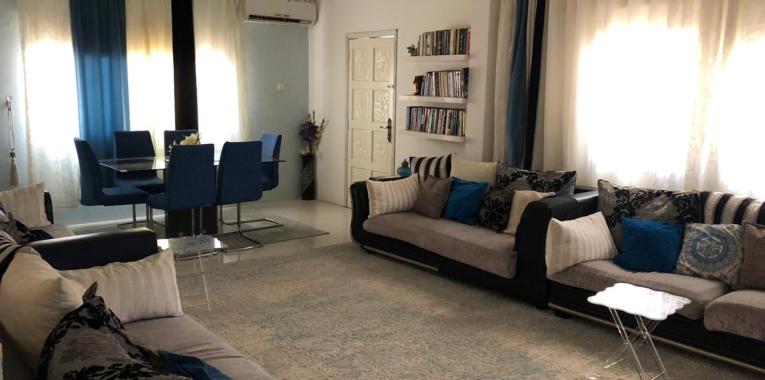
As the exception that proves the rule, rental houses usually have sitting rooms with sheer curtains as such houses usually have higher than normal surrounding walls and are located outside of congested areas. The understanding is that no one can see in and everyone in the house is related, so window coverings are not necessary. Rental houses sometimes also have bigger windows because there are often small jungle gyms/ playground equipment and/ or pools so adults can easily sit inside and watch the children. [see example below]

The information above is for houses in and close to towns; outside of towns, as there are either no neighbors or the neighboring houses belong to relatives, there is less concern about privacy. The surrounding walls are low (waist-high) and serve primarily to keep livestock away from the home. Houses often have a dekka, an outside seating area accessible from the front door. Sometimes it is covered and furnished, sometimes it is simply clean swept mats to sit on. If the house is built up and there is only a small landing in front of the main door, people will sit on front steps in cool weather. Thus, although windows are similarly covered with fabric, people have far more visual access to their surroundings.

Housing/ Clothing: The point about Dhofaris always being fully dressed at home is very important. As I have explained in my first book: Once outside the bedroom, there is a chance to see any of the other people in the house, the live-in maid and/ or a repair person. Therefore, at all times, a man must wear at least a wazar (sarong) and t-shirt, a woman must be in a dhobe (loose housedress) and losi (light cotton headscarf), kids are dressed in at least shirts and underwear/ diapers.

Housing design and living patterns create this necessity of always being modestly dressed. For example, a man leaving his bedroom might see a brother’s wife who lives across the hallway, the teenage daughter of another brother or an older female relative. As he leaves the house, he might pass the salle [female/ family sitting room] which is open to the main hallway and see/ be seen by his mother’s sisters or female neighbors who are visiting.

I will discuss window design and construction in a following essay.

examples of covered windows

This slideshow requires JavaScript.

examples from rental house (larger windows, less covering)


Houseways: Rental Apartments in Dhofar, Khareef and Dhofari/ Non-Dhofari Designs

A unique aspect of housing market in Dhofar is that there is a large supply of furnished rental apartments and houses because of the khareef (monsoon) season. In non-covid times, thousands of Arabic visitors come between June and August to enjoy the cool, foggy weather. Visitors to Dhofar will often stay 2-3 weeks, so they want all the conveniences of a set-up home. In other parts of Oman, unfurnished apartments and houses are the norm because the expectation is that people will rent for several months or years and landlords don’t want to deal with the wear and tear on furniture from renters.

Another aspect of the huge rental market for khareef is that landlords will sometimes rent apartments and houses very cheaply for 9 or 10 months (September to May or June), then raise the prices for high tourist season. For example, a 2-bedroom apartment might be 150 OR per month for most of the year, and then 50 OR per night in July and August. This means some renters will, year after year, move their belongings into their office and leave for the summer, then move back in September first.

In terms of how the apartments are planned, there is a basic division between those designed by and built for Dhofari Omanis and for non-Dhofari Omans. [For a general discussion of apartment buildings see Houseways – Types of Apartments Buildings (Family/ Public) ]

The main difference is that for Dhofari-Omanis space is allocated between guests and family members with the intention that family members can move freely within the apartment, in addition to usually being able to come in and leave.

Most Dhofari-designed apartments have two doors [see example below] so that, like houses, guests are secluded in one room while family members have access to all other rooms and the main entrance.

There are other formats. In my (Dhofari-designed) apartment [see Houseways – Cultural Perspectives and Movement within an Apartment: The Practicalities of Having Guests  ], the front door is not visible from the majlis so anyone could come and go without being seen. In another apartment [see Houseways – Balancing Privacy and Hospitality within an Apartment ] this is not possible because the majlis is next to the door, but there is a door to the salle which cannot be seen by a guest sitting on the sofa, so family members can go into and out of the salle and kitchen without being seen. Further there is a hallway door, so the area with bedrooms is visually and acoustically separated.

Another type of design is a one main door which opens into a hallway, with the main sitting room as the first door on the left or right. Once guests are inside, the family members have access to the hallway and all other rooms. For the moments of entry and exit, the host will be speaking loudly, welcoming guests or trying to convince them to stay/ saying goodbye, so everyone will know the hallway is in use.

Rental apartments for tourists are usually built within a different framework, in which the section of the apartment near the front door is open to the back of the apartment so that if there are male guests, there can be little or no movement.

An example: the front door opens directly into a small living room with six armchairs. Along the left-hand wall is a guest bathroom. In the back left-hand corner is a short, five-foot hallway which ends in six-sided open space about eight feet across with four doors. First door to the left is small kitchen, second door (ahead, to the left) is bedroom, third door (straight ahead) is a bathroom, then there is a small alcove with a washing machine, then fourth door (to the right) bedroom. Thus, guests can hear anything that is happening in the back of the apartment and those sitting along the far wall of the sitting room can see down the short hallway.

In this set-up the front “controls” the back of the apartment. This makes sense in terms of khareef rentals as tourists come as large groups of family or friends, thus there is no need to worry about keeping guests separate. The housing space is family-only. If a male tourist meets a friend in Salalah, they will both understand that the housing is not set up to entertain guests and they will have a picnic or take a meal/ coffee together in a restaurant (pre-covid).

(Example of apartment with two doors, main door and majlis to the right, photo by homeowner and given to me with permission to use for this website)

g - doors 2

Foodways: Thoughts on Iftars, Food and Cultures

One aspect of living in Dhofar that can be hard to explain is that people are often judged on the intention, not on the rightness (or wrongness) of the action. I have been the happy recipient of this characteristic as I muddle along trying to do what is appropriate.

A few days into Ramadan my doorbell rang about half an hour before the maghreb (sunset) call to prayer which ends the day’s fast. It was an Omani neighbor who had moved in a few months before. We had waved ‘hello’ but didn’t know each other. He had set a covered paper plate, a small packet of dates and a small packet of figs down on the table next to my front door. I smiled and said, “thank you! Ramadan kareem.” He waved at me and walked back down the stairs.

The plate had 2 pieces of grilled bread with cheese, 2 quarters of a toasted sandwich with sliced hotdogs and cheese, 2 samosas with a hash of meat and potatoes and 3 spicy, breaded, fried mashed-potato rounds. YUM! Neighbors, relatives and friends often give each other plates of prepared food for Iftar, the meal at sunset that breaks the fast. This was a kind gesture and the way it was packaged meant there was no dishes that I had to return.

I knew I should reciprocate, but not the next day (which could lead to a ‘food war’). In Dhofar, with family and close friends, it doesn’t matter if or when you give a return gift, but for people you don’t know well, it’s best to wait a few days and keep the energy causal, not frantically trying to quickly repay.

So I waited a few days and then started to think what I should give. First, I should not give something that I had made as there is often a worry that I might have accidentally added something haram (forbidden). Second, I decided to give items that would keep for a few hours, so if the family already had a plan for Iftar, what I gave could be kept for a later meal or suhoor, the meal eaten before dawn.

As only a husband, wife and small child lived in the house, I went to a well-known Lebanese restaurant and bought a plate of falafels with cut tomatoes, lettuce and pickles, a container of hummus, a container of tabouli, two packets of fresh Lebanese bread and a plate of mixed, fried sweets.

Then, I went to the front of their house and was surprised to see two doorbells on the outside gate, and a low wall dividing the interior courtyard. Because of the relative position of our houses, I had only seen one side of the house, with the kitchen door through which I had seen the three occupants enter and leave. But two doorbells meant the house was subdivided, probably two close relatives and their families, which meant they would be having Iftar together and my food gift was going to be wildly inadequate.

Which is what happened. The people I knew didn’t answer, but a woman from the other side of the house opened a window and as I tried to explain what I was doing there, she said that the woman who I knew was her sister. So I handed over the bags, feeling rather stupid, and went home. Then I realized that I had mis-read the time. It wasn’t 40 minutes to Iftar (a time when most people are up and awake); it was 1 hour and 40 minutes to Iftar, often a time for napping.

But the normal Dhofari kindness won through and about five days later, my neighbor stopped by again with a plate of pakoras, vegetable samosas, triangles of tuna salad on white bread and arays [Lebanese bread sliced open, spread with spiced meat (kafta), grilled flat and cut into triangles]. And their Eid present from me? A very large box of chocolates!

***********

My favorite Ramadan treat is triangle cheese samosas: the perfect food. Delicious hot or cold and they pair with condiments from any culture: cranberry sauce, mango chutney, onion marmalade, or coconut/ green chili sauce. They are only sold in Ramadan, usually from a road-side stand set up in front of a bakery about two or three hours before the maghreb (sunset) call to prayer, earlier now because of the curfew.

These samosas are a good example of food can get connected and unconnected to religious holidays. I wonder if there are Omanis in the States who mark Christmas time by the arrival of peppermint-mocha coffees or Omanis in the UK who mark Easter by the appearance of Cadbury eggs.

The samosas are also an example of how foods which represent cultures can be very idiosyncratic. “Amazing Italian food” to me doesn’t mean pasta, it means the little stands with a cascading fountain of cool water with small pieces of fresh coconut that I first saw in Florence when I was a teenager. It seemed to me the most perfect snack and I begged my father for cash to buy pieces every time I saw one.

“German food” makes me think of my absolute terror of ordering bread in a German bakery when I lived there. Counter-people and other customers expected you to have your order ready and be able to answer the quick, sharp questions hurled at you. Hesitation or confusion resulted in many baleful glances. I would stand outside and practice saying my order to myself for a few moments before I ventured into bakeries.

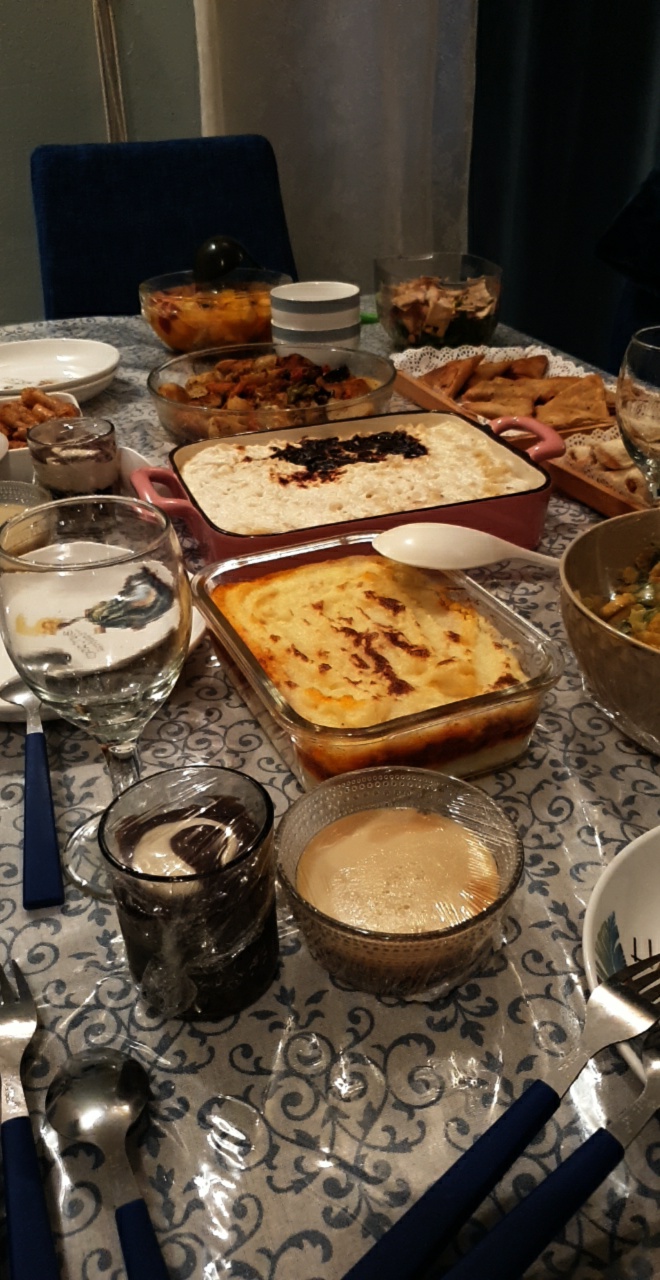
(photo of a family Iftar by an informant, shared with permission to use on this website)

iftar - g

***********

an interesting ad campaign about not wasting food during Ramadan

This slideshow requires JavaScript.

Houseways – Types of Apartments Buildings (Family/ Public)

To start this discussion of apartments in Dhofar, I would like to informally divide apartment buildings into two types: “public” meaning available to be rented to any person (usually expat or non-Dhofari Omani) and “family,” meaning built to be given or rented to only people who the owner knows (usually family or tribe-members) or someone vouched for by a close friend or relative. Thus family-type apartments are almost always rented by Dhofari Omanis.

This difference is sometimes, but not always, by location, as some sections of land in Salalah are occupied by inter-related families within one tribe while others, especially newly-built areas, have a mix of inhabitants.

In general, “public” buildings have several floors and an on-site manager who has a small office and/ or lives in a small apartment near the front door and is responsible for up-keep, fixing problems and keeping an eye on the building.

A person who owns a “public” apartment building will advertise widely, for example hanging a ‘for rent’ sign, taking photos and putting them on social media and/ or registering the apartment with rental companies.

“Family apartment” buildings are usually smaller, either 2 or 3 floors, a subdivided house or apartments built into the back of a family house. When the apartments are ready, the owner will not advertise in any way, but fill the apartments by word of mouth among friends and relatives. There would never be an on-site manager for a family-only building as no one would want someone watching who comes and goes and when.

There are also significant differences in terms of how the rooms are placed and designed which I will discuss in a later essay.

“Family”

For the past 50 years or so, a “house” meant cement-block built living space for a father, mother, unmarried sons and daughters, married sons and their families, older relatives and temporary guests, for example a married daughter whose husband is out of town for work. Sometimes the house would be built to 2 or 3 floors, or one floor was built, then upper floors added when more space was needed.

From the 1990s until recently, sometimes the majlis (the male/ guest sitting room which has its own entrance and bathroom, separated from the rest of the house by an interior door) was rented out in khareef, the monsoon season from the end of June until the end of August. The owner would give the space to family living in other parts of Oman or rent it by letting friends and relatives know the space was available.

Sometimes there was the opposite use of space, in which a house was rented out but the majlis was kept for the owner. For example, if the owner worked in Salalah but lived in the mountains, the owner would be able to use the majlis as a place to nap/ relax and occasionally sleep in and rarely see/ interact with renters who lived in the house.

Another division I have seen (only once) was for the owner to put a new interior wall and a wall in the hosh (courtyard), then broke an exterior wall to make a door, thus lengthwise dividing a one-story house into two apartments: one with the majlis and salle (women’s sitting room) at the front of the house and the second with the kitchen and two bedrooms at the rear. The renters of the back half of the house had a narrow driveway to reach the kitchen door.

 A newer style is to buy land that is open on two sides, usually a main road to the front and an alley to one side. The house is designed with a front gate opening to the main road and a smaller gate on the side (which would normally lead to the kitchen) leading to a door which opens to a small landing with 1 or 2 small apartments. Thus the family lives in the main house, sharing a wall (but not entrance) with several small apartments which can be rented to help pay for the mortgage, given to relatives or, in time, given to the married sons so that the couple has some privacy, while still being close to the husband’s family.

Another style is to make a small apartment block with the same type of divided entrances. For example, a 2 story-building with 4 flats in which 2 flats (ground-floor and 1st floor) are accessed though one gate and the other 2 flats (ground-floor and 1st floor) are accessed through a second gate, with a cement-block wall dividing the hosh into two spaces. (example A, discussed below)

There are a few housing complexes, often only 4 to 10 houses surrounded by a wall with narrow, internal road(s), which are usually “public” and rented to expats, as well as Omanis who use the houses for informal get-togethers, not to live in. A few complexes are for one family, for example a wall surrounding 4 houses and a separate majlis for a man with four wives or a father with several sons. Infrequently there are larger complexes (with over 20 large houses) for one extended family.

Apartments and Sightlines

Another factor besides having a manager and number of units to differentiate “family” and “public” types of apartments is that for “family” apartments, it’s important to limit sightlines for outsiders. For example, in a small apartment building (A) as described above, not only are their two entrances, but each ground floor apartment is given control over the small hosh area, while each first-floor apartment is given control over half the flat, tiled roof.

Thus there are two factors to heighten privacy. First, the inhabitants of all four apartments have their own outside area to use for drying clothes, growing plants in pots, etc. The roof area is divided by a low wall, with the built-in drying racks built at opposite sides of the space.

Second, the building design means that the apartment’s front door is seen by very few people. If a person in the ground-floor apartment wants to leave and, while opening the front door, hears footsteps on the stairwell, they can quickly close the door, wait for the person (from the first-floor apartment) to leave, then go out. Thus the residents can limit or prevent being seen by anyone else.

Whereas a “public” style apartment building would have one hallway on each floor and only one main entrance, with perhaps a small back staircase for fire safety if it was several stories high. Every time a person exited their apartment, they would be on display, so to speak, for all the other neighbors to see and everyone would pass through the main entrance.

Two additional notes:

None of these houseways essays argue that these types of buildings/ ways of using the buildings in Dhofar are unique. I am trying to explain the current pragmatics of housing without making a claim that these methods are found only in southern Oman. For example, the methods of small-scale landlords using renters to find other renters (i.e. preferring to fill small buildings by word of mouth and personal recommendation, not using social media or public signs) reminds me of renting while I was getting my PhD in North Dakota. A friend (X) in my program found a beautiful apartment in a converted house that had two other apartments. Within a year both other apartments were also rented by English graduate students. X had parties, everyone liked the building and location, several colleagues asked about the two other apartments and the owners liked X, so as the two apartments came open, the owners asked X for recommendations. I eventually took over X’s apartment and when I left, another English graduate student took that apartment.

I would like to highlight that both men and women can own land and houses, although it is less common for a woman to live in a house she has bought entirely herself. For example, a woman might be given or buy a plot of land and have a house built which is then rented out while she lives in a house which her husband/ husband’s father owns. As I continue to look into houseways in Dhofar, I hope to find statistics on land and house ownership delineated by gender but among my informants I know of many types of ownership:

  • one man owning the land/ house where his wife, married sons and unmarried sons and daughters live
  • one man owning the land/ house where his wife and children, mother, married brothers and unmarried brothers and sisters live
  • brothers and sisters joining together to buy land and build a house for their mother to live in with them if the mother is widowed or divorced, with the deed either in the name of several siblings or one brother’s name (who acknowledges the ownership rights of his siblings although those rights are not legally represented)
  • one woman owning the land/ house which is rented out

There are a lot of possible permutations as house/land ownership and house/land occupancy are not necessarily the same. For example, it’s rare but an older woman might live alone in her father’s house when all the other family have moved away. The house might legally belong to a brother or a nephew, but the house is discussed as being “hers,” with the understanding that she has the right to live in it until she passes away. On the other hand, a man might live temporarily on land that is not his. For example, when herding camels, a man might set up a semi-permanent camp and stay for several weeks on land that he does not have a permit for.

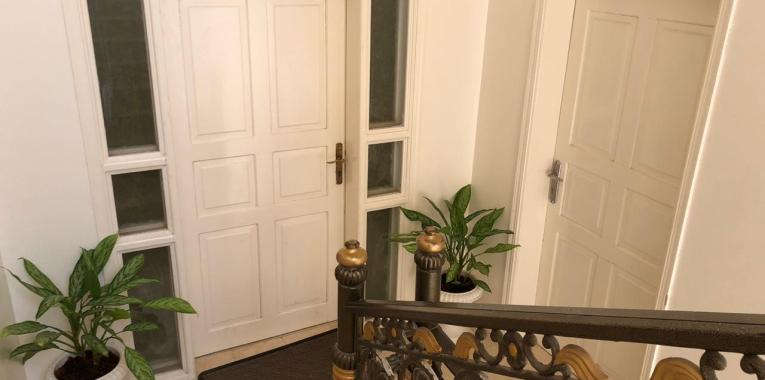
Example of front door to family apartment building, having one door signals that the interior is divided into apartments as almost all  single-family houses have two front doors, one for the majlis and one for the main section of the house (photo taken by informant who wishes to remain anonymous and given to me for use on this webpage)

New Essay: “Dha” on the ‘The Arabic Alphabet’ website

The Arabic Alphabet: A Guided Tour

by Michael Beard, illustrated by Houman Mortazavi

http://alifbatourguide.com/the-arabic-alphabet/dha/

Opening of Dha is for Zildjian

فی ذکری
PBW
(1945-2021)

It is unseemly, says a friend of the Persian poet Sa‘dî, and contrary to the judgment of the wise, for two things to happen:

ذو الفقار علی در نیام و زبان سعدی در کام
Dhû al-fiqâr-e ‘Ali dar niyâm va zabân-e Sa‘dî dar kâm
…for `Ali’s sword to remain in its scabbard and for Sa`dî’s tongue to remain in his mouth

Sa‘dî’s friend is revving him up to write his masterpiece, the Golestân. It was clearly a convincing argument.There are readers who may say that eloquence is more powerful when the tongue operates inside  the mouth rather than outside, but it’s not as if we didn’t know what Sa‘di’s friend means. It’s a powerful argument, cunningly located, since it makes the creation of the Golestân a kind of heroism, heroism without the sword.

Islamic tradition has tales of heroism and chivalry which will be understandable to western readers. As with us, a hero’s sword may have a name, in the manner of Excalibur in the Arthur stories and Roland’s Durendal. Ali, the Prophet’s nephew, was a historical figure, but he became a legendary hero with enough cachet to deserve a legendary sword. Dhû al-fiqâr (usually transliterated as Zulfiqâr) is etymologically that which possesses a backbone (from fiqâr, spine, from a stem meaning to pierce or perforate). Sa‘dî’s friend makes a clearer case: if you have a tongue with the power of Ali’s sword, out with it. En garde, miscreants.

Dhû means possessor, owner, holder or master of… You can be master of an object or a concept. Dhû al-Qa‘da and Dhû al-Ḥijja are names of months in the lunar calendar. During Dhû al-Qa‘da, military conflict was suspended (since it’s a month characterized by qa‘da, “sitting,” thus “sitting out the action”). Dhû al-Ḥijja is the month of pilgrimage (Ḥijja, the pilgrimage). Dhû ‘aql, possessing reason, understanding, is a term for an intelligent person. Dhû al-Ḥiyyâtayn, the possessor of two lives, is an amphibian. Dhû al-Qarnayn is “the one who possesses two horns” (from qarn, “horn”). In European tradition the hero with horns would be Moses (which we know from Michelangelo’s statue of a horned Moses with the ten commandments); in Islam Dhû al-Qarnayn is Alexander the Great, well known in the Islamic world as Iskandar, who is portrayed in Sura 18 of the Qur’ân, building a wall to keep out Yâ’jûj and Mâ’jûj , our Gog and Magog (Q 18.93-97). Dhû al-Nûn is an epithet of Jonah (Nûn can mean a Ḥût, “whale”): it demonstrates that dhû doesn’t always mean “possessor,” unless we think of Noah as owning the whale. “He of the whale.”

Foodways: Iftars in Ramadan

Ramadan started on Tuesday night in Oman. Given the circumstances of fighting Covid-19 there are fewer advertisements showing large gatherings/ family iftars (the meal eaten at sunset to break the fast). Families are highly encouraged to only share meals with those who live in the same household.

Photos such as these (above and below) are usually shared just within family members (usually with a ‘wish you were here’ kind of greeting). I asked X, who has helped me with my food research, if X might take a photo that I could use on this webpage to show a typical Dhofari iftar.

A few things to note:

  • Every-day family dinners usually have one large dish (fish or meat [cow, camel, goat] with rice or pasta) accompanied by salad and condiments, For rice dishes, plates are not needed as everyone shares from the platter. But for iftars, there is often soup (requiring bowls) and various choices, never only one dish. This means that everyone has a plate to take a little from the numerous dishes, including dates (the most important element), stuffed grape leaves, salads, sandwiches, a fruit bowl (bananas, grapes, oranges), cut fruit and/ or fruit salad with oranges, watermelon, apples, etc.
  • Three typical iftar dishes are 1) sambusas (aka samosas, a baked or fried pastry with a savory filling such as spiced vegetables, cheese or meat). Meat and vegetable sambusas are available all year, but cheese ones are usually only available during Ramadan. Sambusas are sometimes made at home but are usually bought at little covered stalls which are set up outside most bakeries from 4pm-6pm; they are sold by the kilo in brown paper bags. 2) shorba, a soup made with beef, vegetables and oats (sometimes with lemon) and 3) thareed, a dish made with khubz roqaq (raqeeq/ roqaqr, a round bread about 24 inches across and very thin) soaked in a beef or chicken stock with spices. Sweets include custards, kanafeh/ kunafa (shredded filo pastry or semolina dough that is baked in sugar-based syrup usually with a layer of cheese, sometimes served with cream or nuts), luqaymat/ loukoumades (sweet fried dumplings dipped in sugar syrup), saffron/ coconut/ chocolate cake, etc. The most important drink is laban/ labneh/ leben (fermented milk, known in America as buttermilk) which is usually taken with dates to break the fast. The second most common iftar drink is Vimto, a cordial of fruits and spices that is diluted with water. (I think of it as the Omani equivalent of eggnog, a pumpkin spice latte, or a peppermint-mocha coffee, a drink that it is ubiquitous during a holiday season; even the people who hate it admit it is part of the atmosphere.)
  • Another difference between every-day family dinners and an iftar is that normally the food is not served close to prayer times and everyone eats at the same time. There is little conversation while eating and the food is cleared away as soon as everyone is done. For iftars, as seen below, most of the food is kept in a covered containers as it has to be prepared and set out before the call to prayer. After the sunset prayer, family members will sit together for a longer time, eating slowly as they have been fasting all day. Some will eat a little, wait for some time, then eat again. Thus the iftar meal can be left out for hours and the food choices need to either be palatable at room temperature or kept in covered containers.
  • School-age children eat lunch at home, not at school, and most adults are also home for lunch which is the main meal of the day. Dhofaris who work will rarely eat a packed lunch at their desk. This means that kitchen are usually not equipped with the accoutrements for household members taking meals from the house like lunch boxes, mini ice-packs and single-serving size plastic containers. But most households share many-portion amounts of food with neighbors and relatives so there are usually inexpensive duplicates of items such as coffee carafes and glass or plastic serving dishes, and single-use thin metal containers with cardboard covers. For example the dish below with the green cover will hold a rice or pasta dish. This would be used as shown below, with the cover on to keep the food warm until the call for prayer has sounded, or filled with food and given away. A typical kitchen will have several of these so that there is no need to worry if/ when it will be returned if one is given away.

iftar k - 2

Houseways – Balancing Privacy and Hospitality within an Apartment

This is the first of several short essays about housing in Dhofar. After a few posts with photos illustrating types of homes, I will write about theories and cultural perceptions of safety and privacy within home-spaces. Before I begin I would like to thank my Dhofari friends and informants who are so patient in answering questions and so kind in allowing me to take and post these photos.

Normally, pictures are only taken while building a house or when someone has just moved in, in which case they are only shared between close friends. Rooms which have been prepared for a marriage (with wedding gifts on display) are sometimes circulated, without names, through social media. The only other time photos of interiors are taken is for a host or hostess to show that the house is ready for a party; photos of exteriors are usually only taken to be sent to delivery people so that they can recognize the house. So it is not normal to take “every-day” photos of a lived-in house. I am very grateful for their trust in me and their willingness to support my efforts to understand the cultures of Dhofar.  

These are photos from a newly-built, Dhofari-designed apartment that is at the side and back of a family house. The owner’s (X) family lives in a 3-story house which is accessible through a gate facing the main road. The apartment is on the south side, facing an unpaved alley, and is entered through a side gate which leads to a small paved area and steps up to the entry door. On the ground floor landing, there are two doors (with metal numbers attached so food delivery workers know which doorbell to ring) and then steps up to the upper floors. One of the ground floor apartments is my informant’s (Y, who is a member of X’s extended family) and the other is for a relative of X. On the first floor are two apartments: one used by X as a retreat and to entertain male guests without having to bother anyone in the main house; the other is for a relative of X. The top floor is one apartment rented by a relative of X, who is also related to Y.

I will discuss this sort of building in a later post, but briefly, this sort of structure is normal in the main city of Salalah. Until the last 5 or 10 years, houses were built as one entity, often one story, with additional stories added later to accommodate married sons and their families. Now, some homeowners find it easier to take (no-interest) loans from the bank or family/ friends, build a large (3-story) house with a few small, separate apartments which are entered through a second door. The flats are then rented out to help repay the loan and/ or given to older relatives, married sons or relatives in need (for example a young relative who is attending college in Salalah).

Larger homes have two front doors: one leading to the majlis, the men’s and male visitor’s sitting room. The other leads into the family/ private part of the house, with a long hallway which has a large opening for the salle (women’s, close family and female guests’ sitting room), e.g. the salle is a three-sided room with one side open to the hallway. But in an apartment with one entrance, the majlis is the open area is directly in front of the door and the salle is a room near the front of the apartment which can be closed off with its own door.

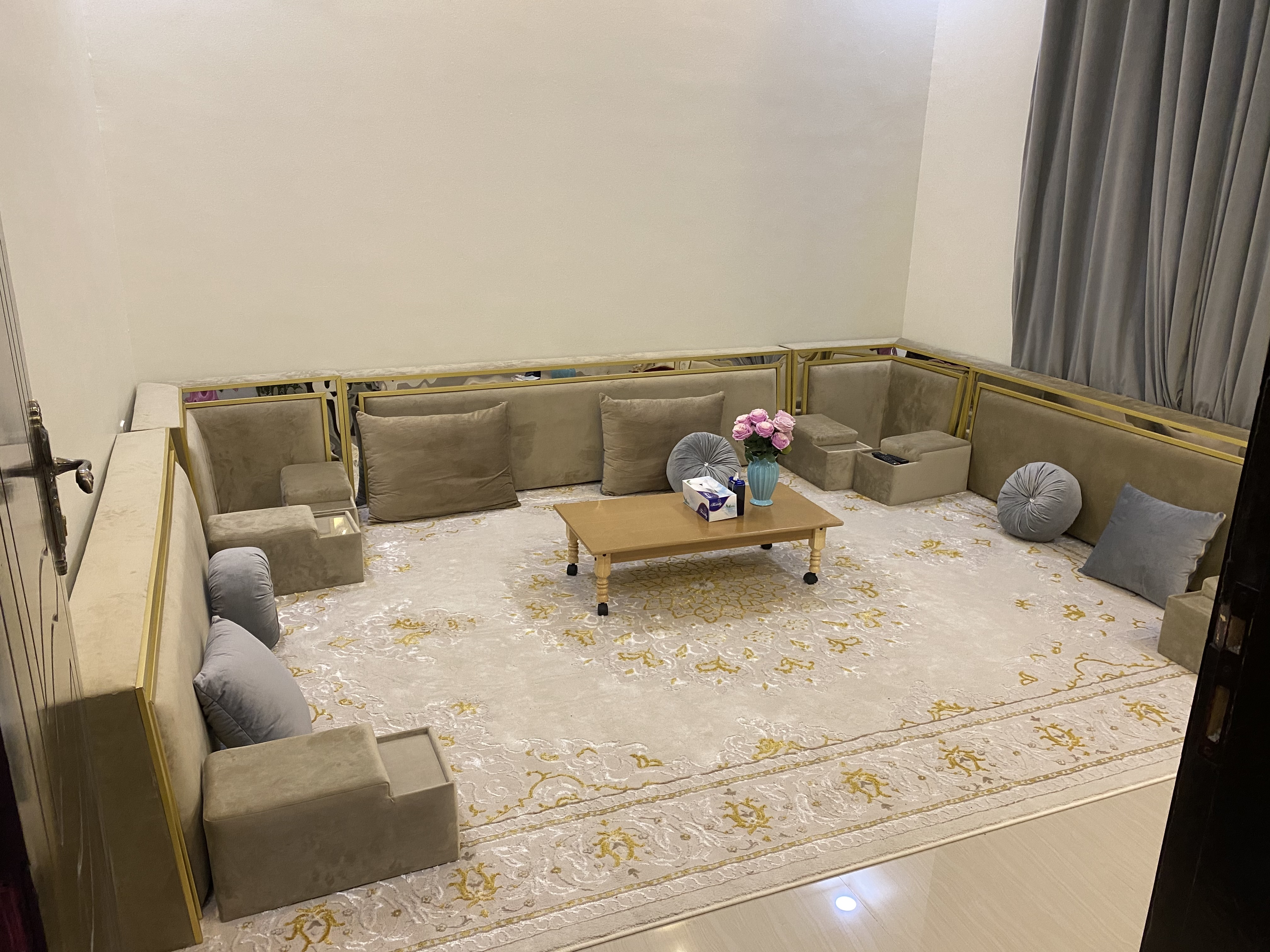
When you open Y’s door, directly ahead is the majlis area with a sectional sofa along the left wall and straight ahead with a coffee table in front of it. At the end of the sofa to the right is an archway leading into a hallway off of which are the family/ private areas. To the right of the archway is a door leading to the salle and to the far right is a guest bathroom (with the door partially hidden by a curtain). Thus male guests are placed on the longer part of sofa (under the AC, facing the front door) so that if women are in the salle, they can get up and move to the kitchen and bedrooms without being seen. Or women can simply stay in the salle and close the door.

fa - majlis entry

[edge of majlis sofa and coffee table, hallway, door to salle and door to guest bathroom]

fa - hall

[edge of majlis sofa and the hallway; looking down the hallway, the kitchen door is to the left, then there is a hallway door so that the two bedrooms (each with their own bathroom, one bedroom door can be seen, the other is out of sight to the right) can be completely shut off from the front of the apartment. Thus a man can entertain male friends in the majlis area, with access to the guest bathroom and the kitchen, without disturbing other inhabitants. Women, children and other men can also access the kitchen without disturbing guests.]

fa - salle

[salle, notice how there are many square armrests with a set-in-square of glass – they are for cups of tea and small plates. When eating a meal, it’s normal to set the platter of rice and meat on a plastic mat on the floor, along with cans of juice or soda. But for relaxing, it’s normal to have the cups of tea and small plates with sweets up off the floor.]

fa - kitchen

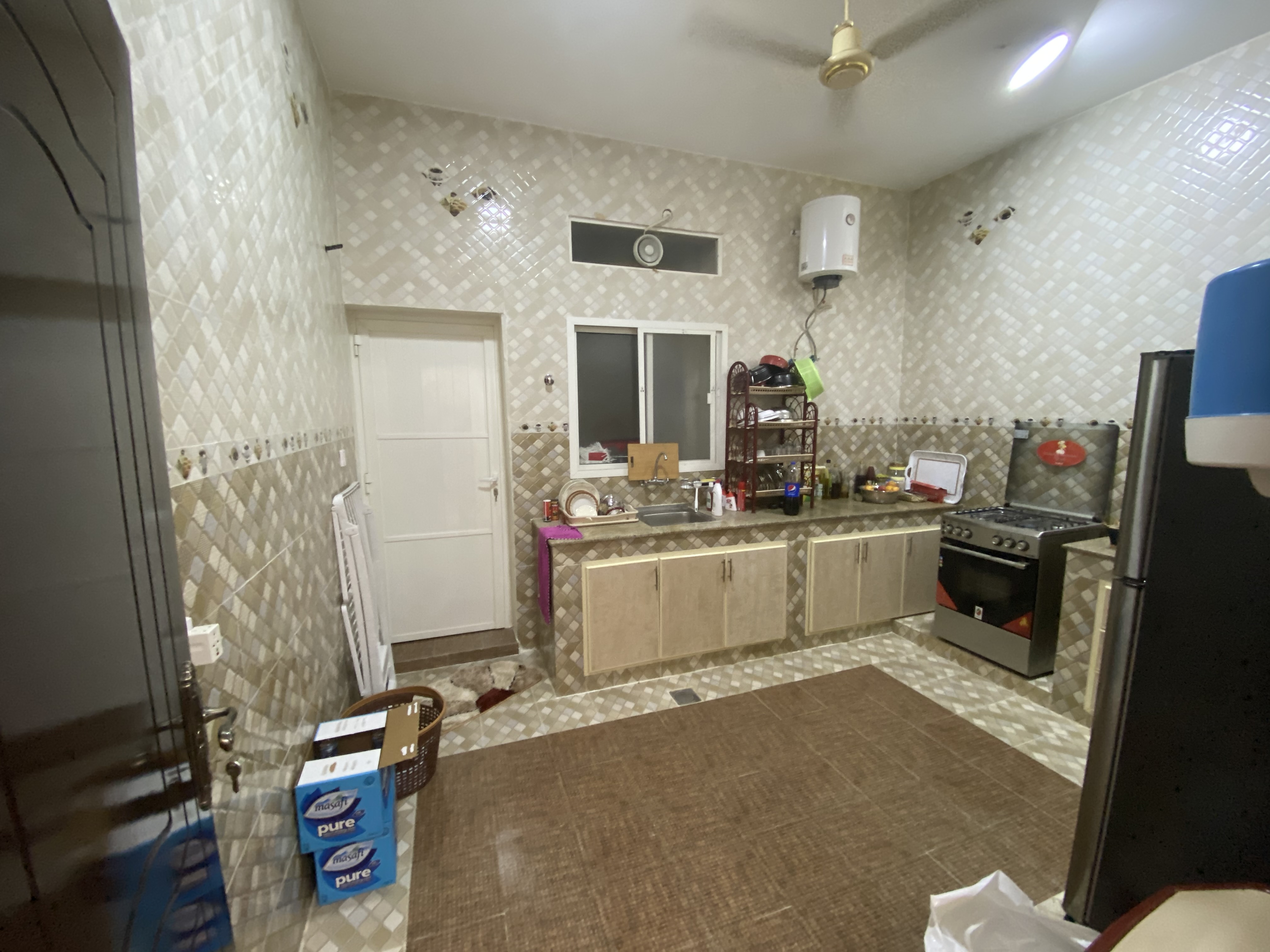
[kitchen, note that since this apartment is on the ground floor, this kitchen has access to the bottom of the light well (door straight ahead) where the washing machine is placed; apartments on upper floors have only window access (above the sink)]

fa - kitchen2

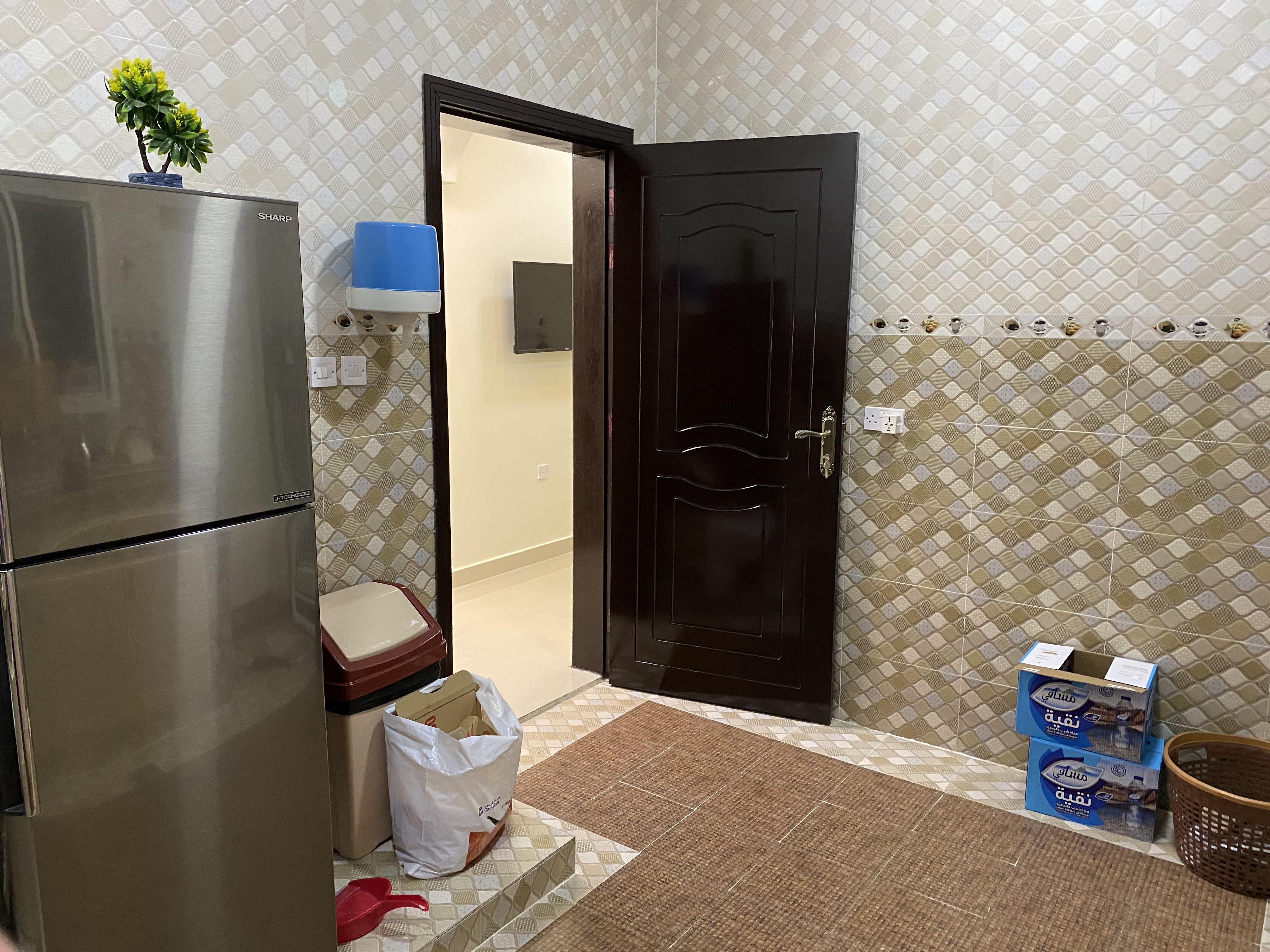
[view from kitchen back towards hallway, note that walls are tiled up to the ceiling and the floor has a tile pattern that looks like a rug, the fridge (and stove) are slightly raised on platforms so that floor can be cleaned by sluicing water, which drains though an opening in the floor in front of the sink]

I will be presenting “Ethical Eating in Southern Oman” at the annual convention of the Society for the Anthropology of Food and Nutrition, June 2021.

I am pleased to announce that I will be presenting “Ethical Eating in Southern Oman” at Just Food, virtual conference of the Association for the Study of Food and Society; Agriculture, Food and Human Values Society; Canadian Association for Food Studies and the Society for the Anthropology of Food and Nutrition, hosted by the Culinary Institute of America and New York University. June 9-15, 2021.

(photo from social media)

y - good morning 1

https://foodanthro.com/2020/12/01/just-food-because-it-is-never-just-food/

https://www.food-culture.org/2021-conference/

Foodways and Living Expat on the Arabian Peninsula – part 2

(photo by Salwa Hubais)

I love those moments in which foodways and culture interact in ways that take me by surprise. When I lived in Cyrus, a friend from India kept trying to find “Indian Chinese,” Chinese food spiced the way it is in India. I didn’t really understand what she meant until I moved to the Arabian Peninsula and realized that what I had thought of a “Chinese” was really “American Chinese”; there is no General Tso’s chicken outside of North America!

A non-American friend asked me why all American breakfast foods are spiced with cinnamon in the same way I wonder why people in the UK insist on putting raisins in every dish.

It’s always impossible to say what foods you will miss most when you move abroad. When I lived in Europe, I asked my mom to send me crab seasoning, a spice I never liked before and never used, but that little tin sat on my bookshelf proudly for a year.

Moving overseas always means culinary adjustments. One friend is vegetarian by choice, but when he tried to be vegetarian on the Arabian Peninsula, what he ate became the main topic of every meal. After many conversations centered around his food choices, he decided that when he was in the Middle East, he would eat vegetarian when he could (which meant, when he was alone) and ate sparingly of what was offered when he was eating with friends.

When I used to do cultural orientations for new teachers, I would tell them that everyone has unspoken/ unacknowledged expectations about foreign cultures in that they will think, “I know that X will be different but of course Y will be the same.” And when they see their “of course Y will be the same…” start to fall apart, it is painful. Especially when it comes to basics such as grocery stores (no pastrami, scone mix, turkey, toasted onions, salad-in-a-bag or soft pretzels); potato flakes are shelved next to pancake mix and every Cheeto is ‘flaming hot’ here.

You are faced with “Party fever” spray deodorant, hokey-pokey (ask someone from New Zealand), Jaggery (isn’t that a Dickens’s character?), angel delight (?), Tim-Tams (ask someone from Australia), “Chicago Sauce,” fish maw soup, and jungle oats with a recipe on the side for “fish cakes” which begins with “one tin of sardines in tomato sauce.”

The oil aisle is a pure delight. Of course you have your basics: almond oil, sunflower, coconut oil, pure ghee, Mazola, grape seed, and peanut oil, then the flights of fancy take off: olive oil from Spain and Italy, toasted sesame oil, gingelly oil, olive pomace oil, ground nut, walnut oil from France, basil, lemon, soy bean, avocado oil. The spice aisle has “Zeal” (aka MSG), “Spice for Mince,” “Zulu Fine,” “Spice for Rice,” “Spice for Mince,” “Veggie Season,” juniper berries, and my favorite: bits of raw sugar and cinnamon sticks in a grinder.

Many texts about the Middle East talk about guests being forced to over-eat or the horrors of being given camel eyes to eat. I have not seen that – my issues are with the jalapenos lurking under the cheese on pizzas, never being able to drink filter coffee (it’s always hot water added to an espresso), being invited for dinner at 8pm and having the food actually served at midnight, discovering that the dessert is sweetened shredded carrots, being invited over to chat and given a glass of tap-water and nothing else… Salads don’t have dressings, bread is not served with butter, drinks are brought out after the meal is finished – it’s different. Not better, not worse – just different.

good words