Musing

Foodways in Southern Oman – Images of Kitchens

As part of my Foodways in Southern Oman project, this is the first of several planned posts using photos with commentary to explain aspects of how food/ meals are cooked and served in the Dhofar region.

First, I would like to thank all of my Omani friends and informants who took and allowed me to use these photos. I am very grateful for your support of me and this project. [The photos of empty/ undecorated rooms are from either rental houses or houses that are for sale and the owner put the photos on social media.]

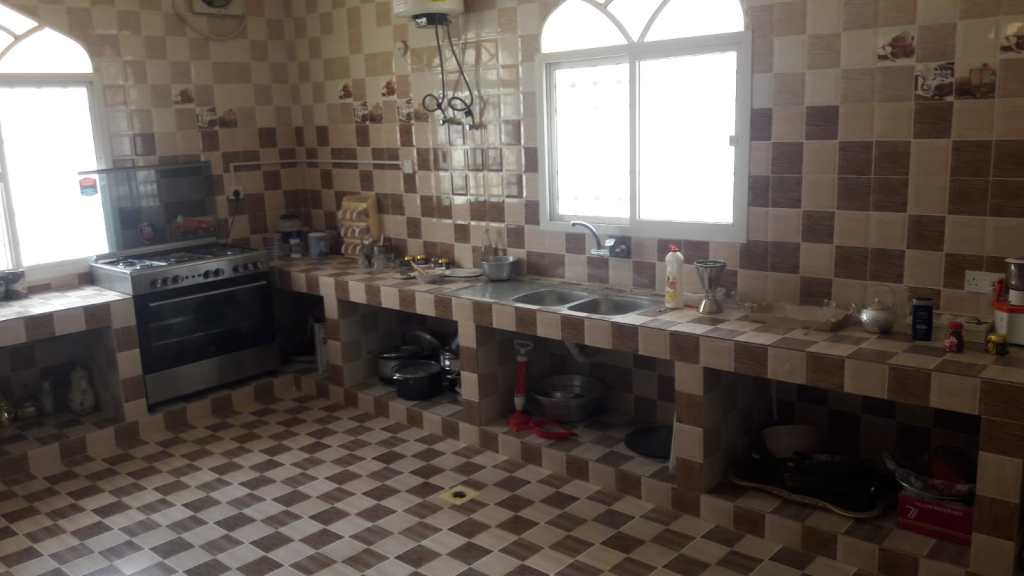
Overview – In general kitchen have tiled walls and floors (with a floor drain), high ceilings, a ceiling fan (but usually not AC), an extractor fan and florescent lighting. If there is a window (most often over the sink) it has opaque glass. There is often a door to the outside, which is not decorated as the front doors are.

As it is common to have twenty or more people (from different generations) in one house, kitchens are big enough to make large meals. Like most rooms in a Dhofari house, everything is placed around the sides of the room with an open space in the middle of the room or, sometimes, a table with chairs.

There is usually a lot of counter-space. Although I live an apartment built for one nuclear family, I have 24 feet of counter-space. In one house I lived in, there was 27 feet. Cupboards are built under the counters, with additional counters overhead, often with clear glass or plastic fronts. Accoutrements for entertaining (trays, tea and coffee cups and pots, thermoses, etc.) are always within sight and easy reach.

The refrigerator, stove and washing machine (if it is in the kitchen) are usually set up on a platform about 4 inches high. The below-counter cupboards are also set slightly above floor-level so that the floor can be cleaned by mopping/ sluicing.
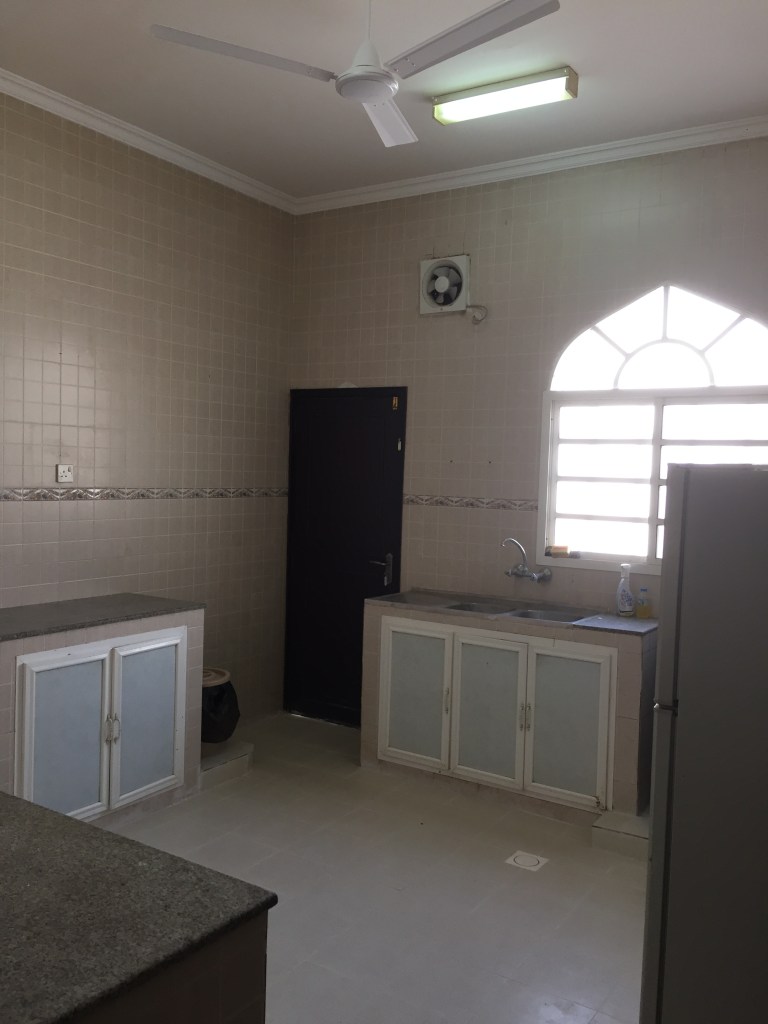
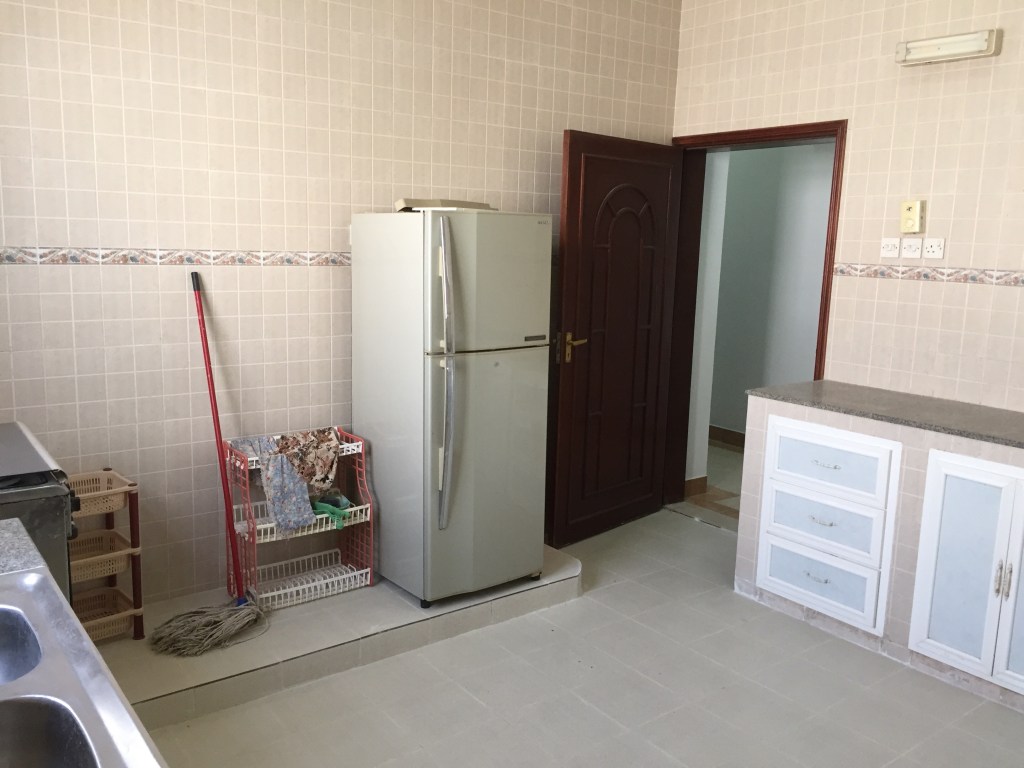
two images of same kitchen – left: door to outside, extractor fan, window over double-sink, under-counter cupboards; above: door to the rest of house, fridge up on platform, tiled walls with decorative pattern, florescent light near door (and one on ceiling with fan) gas stove to right of sink

a more old-fashioned type of kitchen with all-over patterned tiles, no cupboard doors or dividers, window over double-sink
the small room to the left is a store-room for bulk foodstuffs and extra kitchen equipment

two other examples – left: note the hot water heater in upper left and clear fronted upper cupboards where tea/ coffee sets would be displayed (as in right photo) – the stoves integrated into the counter-top mark these as newer kitchens

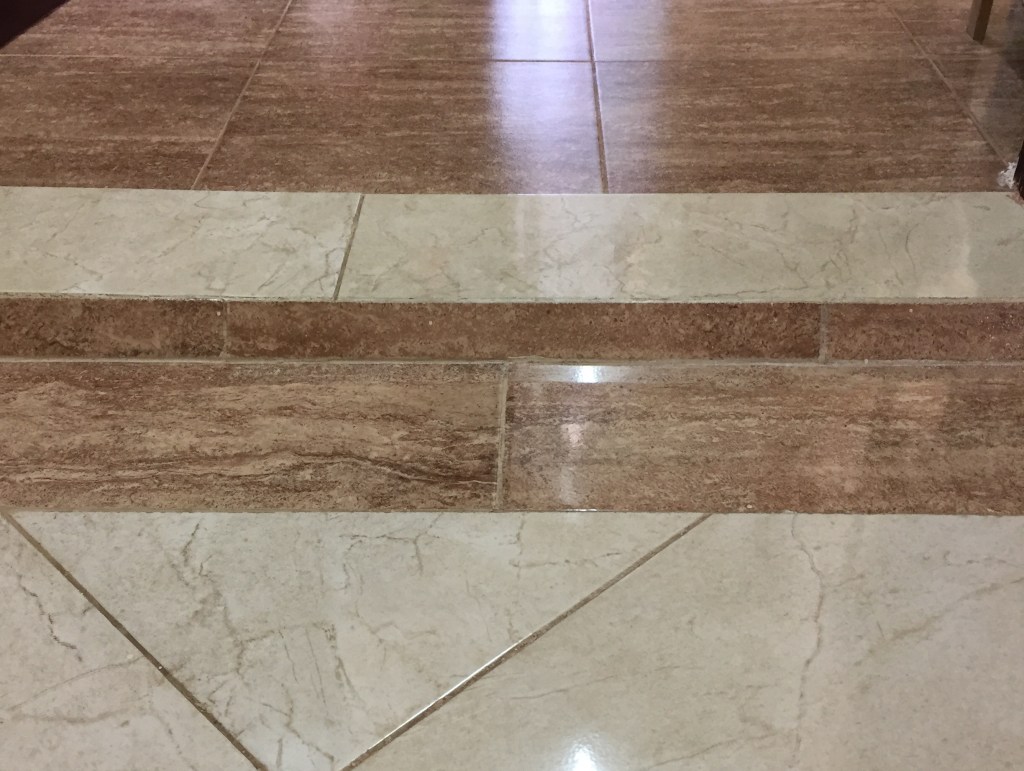
Kitchens (and bathrooms) are set at different level than the rest of the house so that even in the tiles are the same color, the cement base is lower or higher. Left: threshold of kitchen looking towards hallway with 1 inch ‘ramp’ to the white tile border; right: same threshold looking into kitchen, note the ‘ramp’ is much higher (4 inches to 1 inch) so that the kitchen is 3 inches HIGHER than the rest of the house. Thus the kitchen can be cleaned by sluicing water with the raised white tile border acting as a dam so whatever is spilled in the kitchen stays in the kitchen. Kitchens can also be set lower than the house (I have been in one which was set three steps down).

Example of landing outside of kitchen door used to hold cleaning supplies.
Foodways in Southern Oman – Historical Sources

There are several historical sources about what and how people in the Dhofar region ate in the past; here I would like to highlight a few authors.                                                             

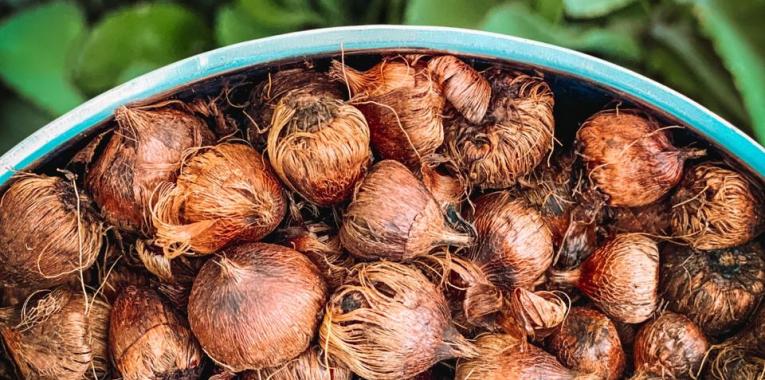
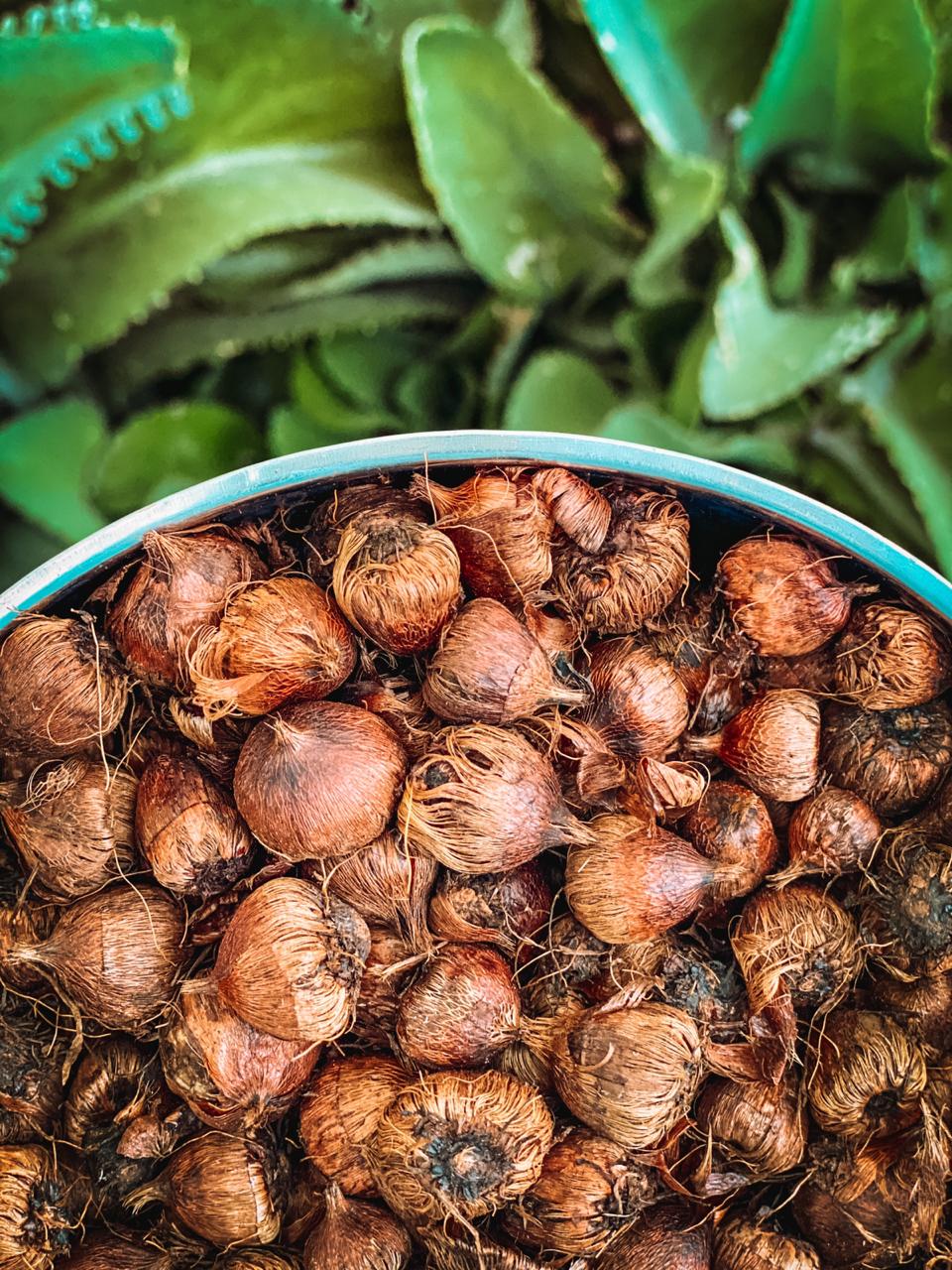
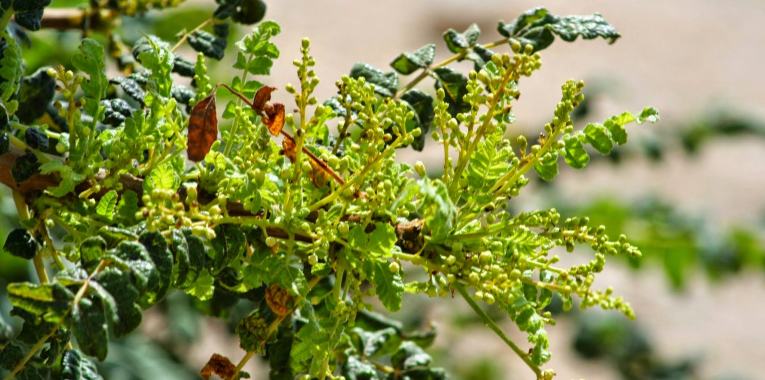
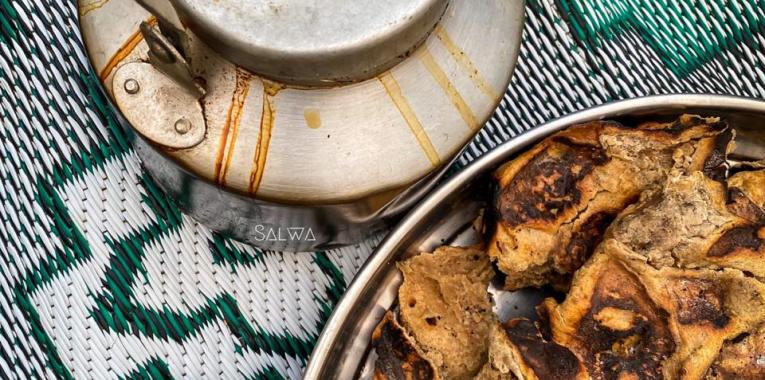
(the photo by Salwa Hubais is of bidah, the bulb from the white flower, gladiolus candidus, which is cooked and eaten)

 Bent, James. “Exploration of the Frankincense Country, Southern Arabia.” The Geographical Journal 6.2, 1895, 109-33.

Bent, James and Mabel Bent. Southern Arabia. London: Elibron, [1900] 2005.

Bent, Mabel. The Travel Chronicles of Mrs. J. Theodore Bent, Volume III: Deserts of Vast Eternity, Southern Arabia and Persia. Gerald Brisch, ed. London: Archaeopress, 2010.

Theodore and Mabel Bent were in the Dhofar region from December 20, 1893 until January 23, 1894. During their short stay, they traveled along the coast and a short distance in the mountains; I believe they are the first Westerners to visit the Dhofar mountains and write a description of it. In Southern Arabia (1900/ 2005), they recount that along the coast they saw coconut palms, “bright green fields,” “[t]obacco, cotton, Indian corn, and various species of grain” (233); as well as gardens with “the plantain, the papya, mulberries, melons, chilis, brinjols [eggplants], and fruits and vegetables of various descriptions” (234). During their journey through the mountains, they saw the still-used method of cooking meat on heated stones (250); plant-life including sycamores, acacia, jessamine, convolvulus, maidenhair ferns and fig trees (256); and describe how rice was eaten (275). They also met an elderly sheikh who had 500 head of cattle and 70 camels (250).

Thomas, Bertram. Arabia Felix: Across the Empty Quarter of Arabia. Jonathan Cape: London 1932. reprint.

In Arabia Felix (1932) Thomas recounts his journey across the Rub al Kahli (Empty Quarter) in the fall/ winter of 1930. His trip started in Salalah, so there are a few food references. For example, at the home of a prosperous merchant, he is given a meal of “beef grilled crisp and black, spaghetti drenched in tomato sauce, and slices of pineapple” (19). During a short trip in the mountains, he explains that the Gibali diet was milk, honey and beef (51) and that hyena, fox and “eggs, chicken and all manner of birds are under strict taboo” (59). He also discusses the custom of killing half of a man’s cows at his death (55-56).

Janzen, Jorg. Nomads in the Sultanate of Oman: Tradition and Development in Dhofar. London: Westview Press, 1986.

Janzen, who did his fieldwork from January to August 1977 and January to May 1978 (xxi), identifies nine bands of vegetation: the coastline belt, grassland of coastal plain, bush and tree vegetation of the foothills and escarpment, grassland of the lower and middle levels of the plateau, bush and tree vegetation of the mountain wadi area, grassland of the upper plateau, desert vegetation of the transition zone to the Nejd, desert vegetation of the Negd and sand desert vegetation (34-35). He notes that there “are many indications that the plateaus were once more thickly wooded than they are now” and that the “last stands of trees” on the coastal plain were cut down in the 1960s (35).

He discusses the traditional “monsoon-rain fields” in which millet and beans are grown along with cucumbers, tobacco, maize, “red” (chili) peppers, and tomatoes in the mountains (107, drawing 106, details of planting 108). In the mid-1950s, when diesel pumps could bring up water faster and cheaper than animal labor, crops included millet, wheat, maize, “watermelons, cucumbers, tomatoes, sweet potatoes, eggplants, onions and peppers,” as well as bananas, papayas and coconuts (154). In the mid-1970s, the composition of plantations changed in that cereals were no longer sown given that corn and flour became easily available and that land was given over to fruits and vegetables which were in higher demand (154).

His book also includes important historical data such as balance of trade data for 1896 which lists the top six exports: incense, butter fat (samn), cotton, skins, latex, sharks’ fins; and top six imports: rice, sugar, cotton cloth, dates, coffee, wheat (47) and a chart on the “Movement of  Livestock Prices in Dhofar” for cattle, camels and goats with data from 1965-70, 1971-75 ad 1976-78, showing, for example, the cost of a milk cow as 40-100 OR in 1971-75 and 250-330 OR in 1976-78 (102).

bidah

I am pleased to announce that I will be presenting about my ‘Foodways in Southern Oman’ project at the American Anthropological Association annual meeting

I will be presenting about my ‘Foodways in Southern Oman’ project at the annual meeting of the American Anthropological Association in November in the session: “Uncovering Truths, Building Responsibility in A Pandemic: Insights from Emerging Monographs at the Nexus of Culture, Food, and Agriculture.”

Cookbook, Coffee and and the “Omani Sandwich”

A few tidbits from my food research:

I recently found a cookbook about Omani food:

Al Maskiry, Fawziya Ali Khalifa. 2004. A Taste to Remember, 3rd edition. Muscat: Al Nahda Press. 

Al Maskiry states that her first edition (2005) was first cookbook in English published by an Omani. She has a practical approach to measurements, instead of the American system (cups), metric system or using weights, she uses “coffee cup” (the small, handle-less cup used for Arabic coffee, finjan), “tea cup” and “mug” in the recipes, with ml, flour ounce and sugar ounce equivalents at the beginning of the book (4).


I had socially distanced coffee with two friends a few days ago and after ten minutes, their cups were empty. I always forget this big cultural difference. When I have a cup of coffee it lasts at least half an hour, usually longer. When working, two cups last me about four hours. But most people from Arab countries approach coffee (and tea) drinking as serious business. The cups are smaller and ones focuses on getting the liquid down quickly, then it’s time to talk (or work).

Part of this difference is that Turks and Italians, for example, drink small cups of heavy/ thick coffee while North Americans normally drink bigger cups of weaker coffee. This has lead to the (ghastly) appearance of “Americanos” in coffee shops – an espresso with hot water added. This awful drink combines the worst of both worlds!


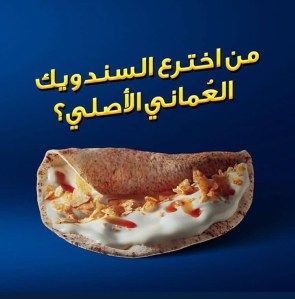
There is a cute new advertisement about “the Omani sandwich“:  bread with processed cheese spread and crushed spicy potato chips. People may argue about which type of bread to use (pita/ Lebanese or white bread, toasted) and which kind of cheese, but everyone agrees that it has to be Chips Oman!


Poems

September is the time to read lots of poems, trying to find good ones to teach. Here is one of my favorites:

My childhood is a long way off

My old age is a long way off

My country, my exile, a long way off.

Tourist!

Give me your binoculars

Perhaps I might glimpse a hand or a handkerchief

In this world

Waving at me

Take my photographs as I weep

Crouching in my tatters on the steps of the hotel

Write on the back of the picture

“This is a poet from the East.”

Spread your handkerchief on the pavement

And sit beside me under this tender rain  

Let me disclose to you a great secret:

“Go dismiss all your guides

Throw to the mud…to the fire

All the notes and impressions you’ve written

Any old peasant in this land

Can tell you with two verses from our sad ‘Ataba songs

All the history of the East

As he rolls his cigarette in front of his tent.”

            Muhammad Al-Maghut (1987)

Other good poems

“Arabic Coffee,” a poem by Naomi Shihab Nye

Favorite Poems

and the favorite poem of all poetry teachers:

Poems – “Finding Poems for my Students” by Mohja Kahf


I am pleased to announce that my chapter “Teaching Paired Middle Eastern and Western Literary Texts” has been published

Risse, Marielle. 2020. “Teaching Paired Middle Eastern and Western Literary Texts.” Advancing English Language Education,  Wafa Zoghbor and Thomaï Alexiou (eds.). Dubai: Zayed University Press. 221-223.

“Teaching Paired Middle Eastern and Western Literary Texts” – This chapter focuses on a technique which increases students’ participation, creativity and analytical ability in literature and language classrooms. By teaching two texts in English together, one from a Western and one from a Middle Eastern culture, students can compare and contrast a familiar text to one that has new settings, themes, people and opinions. This analysis allows students to see how characters, leitmotifs and points of view can be both similar and different across cultures, and in turn improves students’ reading, writing, speaking and critical thinking abilities. As some teachers might be hesitant to use literature in a language classroom or be unfamiliar with texts from a different culture, this chapter gives several specific examples, in addition to explaining how to teach paired texts. When teachers overcome the fear of working with new texts, they can pass on their insights to students.

Click to access AELE_Book_ALLT_ZU_Web_V02.pdf

Dreaming of Dhofari Picnics

I am very happy that my Dhofari friends are being careful about corona and not having social events and at the same time… I miss picnics! It’s almost time to go back to work but, even with all the lovely khareef drizzle, it doesn’t feel like there was a vacation as there were no picnics this summer.

“Picnic,” like all food terms, has different meanings as you move between cultures. Visiting family and friends at home, picnics mean making or buying food and then eating it on blankets in a scenic place. I miss deviled eggs, potato salad, coleslaw, and most of all: pie! Sometimes we grill hamburgers or hotdogs, but picnics usually do not mean cooking, especially a picnic with my mom. Her idea of a picnic is getting sandwiches or little containers of chicken salad, tangerine sodas and one bag of chips for me (because of course she doesn’t want any), then driving to a little cove near her house, sitting on a bench and watching the ocean. Pretty perfect except for her relentless chip-stealing.  

Picnics here usually involve cooking and a lot of communal work. One person will bring meat and vegetables, others will help cut everything, someone will cook and we will all eat off one plate. Really wonderful in normal times, but dangers abounding in the time of corona as most items are passed hand to hand, such as knives, plates, Tabasco, bottles of water, Kleenex, limes, etc.

I sometimes wish dinner was severed at a less than thermonuclear level of spiciness, but other than that, picnics in Dhofar are delightful and I am looking forward to the winter in which, I hope, corona goes away and I am back on a beach with good food and good friends.