Reflections on Ethnographic Work: Ending and Beginning

Now that my time in Oman is ending, I am thinking about when I first came here. My friendships began in the usual ways: meeting colleagues, accepting an invitation to dinner, deciding to take an evening class, accepting a lunch invitation, deciding to teach a summer class and deciding to take language lessons. These small decisions had many consequences, but not life-changing consequences. If I had not accepted that dinner invitation, there would have been another one, or if I had not met that person, I would have met someone else.

Starting my unexpected foray into ethnography was quite different; my academic work hinged on two insignificant, random acts: reading a footnote and cutting vegetables. Thanks to those two actions, I published three books and several articles, gave many presentations and tried to help newcomers with orientation sessions. I also have a whole set of life skills I will probably never use again from making a fire with damp wood to driving up steep inclines to sitting patiently for hours to speaking colloquial Arabic.

The story of the footnote starts on the first day of khareef (the monsoon season) in June 2006. A few Omani men (who were part of a larger group of Omanis and expats that I was part of) sent me a message saying they were in town and wanted to meet. I invited them to my house, sad that the heavy mist would mean that we would have to sit indoors instead of enjoying my nice garden.

But when they arrived, they picked up the trays of water, soda, chips and cookies and brought everything outside. “Khareef!” they proclaimed joyfully as we sat amidst the mosquitos and drizzle. “This is not fun” I thought, but their enjoyment of the humidity and light rain made me realize that there was a lot about them I did not understand. And what field of study helps people comprehend foreign behavior? Anthropology.

So I asked my dissertation professor, Michael Beard, if he had any recommendations for basic anthropology texts to help understand the cultures I was now living amongst. By chance he had a friend and colleague who taught anthropology and was retiring; Gretchen Lang kindly boxed up 20 texts and sent them to me.

I read the books throughout the fall. They were interesting but so few of the texts’ examples dealt with the Arabian Peninsula, I felt that they didn’t pertain to my life. Then I read a footnote that referenced Wikan’s work in Oman as an example of a particular phenomenon. And it was off to the races.

I read all of Wikan, then started reading the works in her bibliographies, leaving my home provinces of literature, pedagogy and travel writing for archeology, architecture, cultural studies, folklore, history, Islamic studies, political science and tourism, then farther afield to animal husbandry, city planning, house construction, fishing, ornithology, use of public spaces and zoology. I ended up writing about Dhofar/ Oman in terms architecture, comparative literature, cultural acquisition, ethnography, fairytales, foodways, gift/ gift theory, houseways and urban studies.

The second act happened in August, 2013. By this time I was part of two research groups with Dhofai men, which were centered around A and B (see note). B’s group included C and some of his friends. In August, C invited me for a picnic dinner with only his friends. We all had a good time and one week later, C invited me again. As we settled down on the mat, he handed me a plate of vegetables and said, “cut these.” I took the metal plate and knife and got to work. From that night until covid hit and we stopped meeting, cutting vegetables was my job. After the covid restrictions waned, the guys started to bring prepared food from home and my job changed to bringing the soda and water.

Years later, when we were talking about how we all met and how long we had all known each other, I mentioned those first beach picnics and C said that his asking me to cut vegetables was a test as he wanted to understand my personality. If I had refused, then he never would have invited me again.

His words were not surprising because by then I knew how the men always teased and tested friends, but it struck me that so much had rested on one small act.

All the men in A’s group spoke at least some English and had traveled; most of the men in B’s group spoke some English and had met other Western people. Also, when I hung out with A’s and B’s groups, we usually met in spaces where they would not see anyone they knew.

But in his group, C was the only one who spoke English so I generally spoke only Arabic. In over 300 picnics with C’s groups I had the chance to improve my Arabic, meet dozens of men, go camping and ask endless research questions. We celebrated weddings and births, mourned deaths, ate a lot of (too spicy!) meals and discussed all sorts of geo-political upheavals.

And, since none of the men had ever socialized/ eaten a meal with a Western, female Christian we went through a lot of steep learning curves together. This June I handed a package of cookies to one man and he replied by saying “Duck?” in Arabic. I thought that was odd, so I repeated “Duck?” then thought, he is making a joke by asking if I am giving him duck food! So I said, “Duck” again and began to quack.

C, who was scrolling through his phone, said, “Open” in English. Oops! I misunderstood; the man said “Open?” in the local slang of Hindi, not “Duck?” in Arabic – two words which sound somewhat similar. And by “Open?” he meant: should I open the cookies now or save them for my children? So I said, “for your children” in Arabic. No one commented on the fact that I had enthusiastically quacked for 10 seconds. This is what you have to put up with when you have friends from different cultures.

Reflecting on over eleven years of meetings, I brought up the subject of how we started to work together with C a few weeks ago. I asked him if he remembered the first time he invited me to a picnic, then the second invitation and “did you ask me to cut vegetables?”

He said, “yes,” then asked me why I was thinking of that subject.

The conversation in Arabic went something like this:

me: Now that I am going, I am thinking of the beginning, and I remember you told me once that when you asked me to cut vegetables it was a test. And I am thinking that it was a chance, an important chance, and if I had said no, then we would not be friends.

C: It is important to test people you don’t know. If they will just sit and never work, there will be trouble later. So it is better to see how a person is at the beginning.

me: I understand, but I am thinking if I was in a bad mood or sick and said “no,” maybe I would have missed knowing you and these men. It was just that one chance. You said you would have not invited me again.

C: I would have invited you once or twice more. You have to give space for a person, maybe they are tired or maybe they are saying “no” because they don’t know what to do. If you had said, “no” I would have given you another chance, because maybe you would have said, “I don’t know how.”

I nodded and we changed the subject. The next day I decided to check my recollections by looking at my excel spreadsheet where I have information (date, place, names, what we ate, what we talked about etc.) on all picnics and camping. For August 11, 2013 I have an entry about meeting at ‘the place’ with C and four of his (now my) friends. For August 17, there is another entry about meeting at the same place with the same people and after the summary for what we had for dinner is the note “me cutting vegetables.”

It’s nice to see my research life validates two of my constant talking points with other researchers: document everything and you may never know the good thing you do that will open doors for you.

Note: For the research guys, their friend groups are never conceived of as being “centered” on one person. I use this terminology as it reflects my reality. In each group there was one man I met first, who introduced me to the other men and ran interference in terms of me asking questions (what should I wear?) and other men asking questions about me.

Antigone and Ismene – Making Difficult Choices

Conference presentation about conducting research on the Arabian Peninsula

Reflections on Ethnographic Work: The Grasshopper

Reflections on Ethnographic Research: Claiming Knowledge and Shifting Perceptions

Reflections on Ethnographic Research: What is Missing and What Changes
Reflections on Ethnographic Work: Being Safe and Secure

One aspect of talking to expats is that if I intimated that something they did might not be safe in my opinion, my advice often had to be negated by them pointing out my actions were unsafe, particularly me going camping with only Omani men. This makes me think of how to define “safe” in terms of my life in Oman. On one hand, I camped with men I had known for years and I had usually met members of their family: brothers, cousins, parents, wives and children. On the other hand, I frequently felt insecure and lost. I was constantly telling myself to trust them, trust the process and that, if nothing else, I was going to have a useful learning experience. “Useful,” not necessarily fun or easy.

One Wednesday night, I got phone call at 9pm. It was hard to hear with the sound of wind and waves in the background. A group of the research guys were camping at a beach far from town and they had decided I should come. I wrote out what they wanted me to bring (water, more water and wood), hung up and started prepping. I had to proctor an exam at 8am, which meant getting up, going to work, stopping at store on the way home while I was still in regular clothes, putting everything in the car, buying drive-through McDonalds for lunch, then lots of driving.  

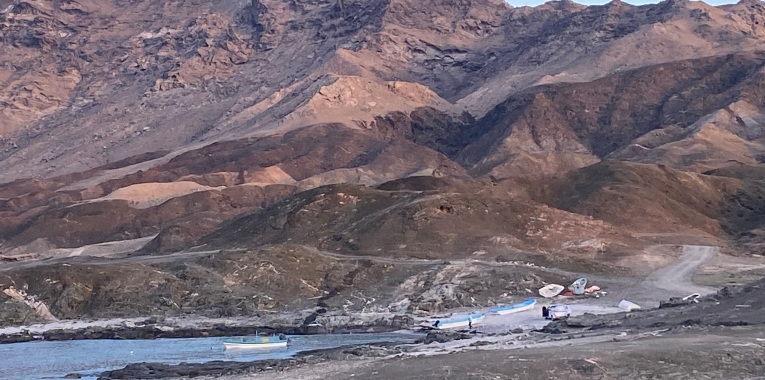
I got to the beach around 4pm. We talked, then they decided that they would take me for a short boat ride. This was not “How are you feeling?,” “Would you like a boat ride?” or “What have you eaten today, as in what are the chances you will throw up if we go out in the boat?’ No, it was: “Now you will go in the boat.”

So, I changed into boat clothes and out we went. It was very nice; the sea was calm and it was lovely to see the shore and hills… but wait. We appeared to be stopping. They were maneuvering a large barrel full of fishing line with many 4 inch hooks imbedded in soft foam to the edge of the boat. Oh, it was a curtain met, a long, strong fishing line to which plastic laundry soap bottles are tied at intervals so it didn’t sink and every 6 feet of so, a short line going down with a hook which they baited with a sardine (like the “icicles” type of Christmas lights which have a long horizontal line with short verticals going down). 

Hooking sardines and tossing the line out took over an hour. The sun sank lower, it got colder, they didn’t let me help so I watched the ocean, shore and seabirds trying not to think about being cold. Then we drove off in the direction opposite camp. I wanted to say that I wanted to go back, but I stayed quiet. If we were driving over to the other side of the bay, they must have a reason.

As the guy who was steering the boat turned off the motor, I realized we were going to a stop next to a fish-trap buoy. He had driven to one of his “boxes” (fish traps) which was very close to shore, meaning it probably had lobsters and since they know I like lobsters, he was deliberately going to the box most likely to have them for my sake (they think lobsters are so-so and would much rather have fish). And, yes, the trap had 8 large lobsters but no fish.

We drove back to shore and moved our camp to up to the top of small headland with a small bay to one side and the large bay (about 2km across) on the other. There were no lights visible so the sky was full of stars. They made a dinner of white rice, a kind of chutney made from various cooked vegetables and lobster taken out of the shell and cooked directly on rocks heated by coals. 

As the rice was cooking, one of the guys took a small shark they had caught earlier in the day and prepped it for drying. He cut it open, took out the guts, then cut the meat into long, thin strips which are all attached to the back of the head so it looked sort of like an octopus (or a small alien from the movie Alien). This is tossed over a rope to dry in the sun for a few days, then eaten. I saw the man cutting the shark, but hadn’t realized he had had put it on a rope that was tied between my truck and their truck.

After dinner, I glanced over at my truck and saw something white, taller than a cat and odd-shaped underneath it. This thing was less than 10 feet away from me so I called the name of the guy who was sitting closest to me, about 6 feet away.

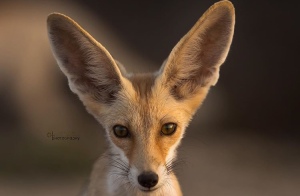
He did not respond, so I said his name again. He said, “fox.” I said fearfully, “that is not a fox” as I have never seen a fox come so close to humans and the thing seemed to be square-shaped. I heard him shift, then his phone light shone on exactly the place I was looking. It was a fox whose hair for some reason glowed white in the darkness and it was standing at an angle so I could see the side of its body and hindquarters, with its tail was wrapped around its body so it looked like a square.

The point of this story is that when I turned back around, I realized that I had been blocking his view. The research guy heard me say his name, saw me looking back towards my truck and said, “fox” without knowing why I was saying his name or what I was looking at. He had instantly put together from how my head was turned that I was looking at the area below where the drying shark meat was hung and the anxiety in my voice meant there was something I could not understand – so the answer had to be “fox.” When I said, “that is not a fox,” he moved over and picked up his phone to show me that, with no visual or sound cues, he knew what it was better than me, the person who was staring at the fox.

So sometimes I felt cold, confused, tired or worried and yet, at the same time, always secure.

Reflections on Ethnographic Work – Trying to Make Sense of Words and Actions

Two poems for courage: “Against Hesitation” by Charles Rafferty and “Thalassa” by Louis MacNeice

Presentation – “Windguru and Other Gurus: Fishing off the Coast of Dhofar, Oman”

Predator Anthropologists, Anthropologist Predators: Anthropological Metaphors in Popular Movies

photo by Hussein Baomar

Reflections on Ethnographic Work: The Grasshopper

 In a recent literature class, we were talking about whether or not parents apologize to their children if the adults have made a mistake. This led to a discussion about how people express forgiveness and care/ concern in indirect ways. For example, a person might bring someone a cup of tea instead of saying the words, “Are you ok?” or “I am sorry.” This conversation reminded me of a short interaction with the research guys and, like most interactions here in Dhofar, it takes much longer to explain than the time of the actual experience.

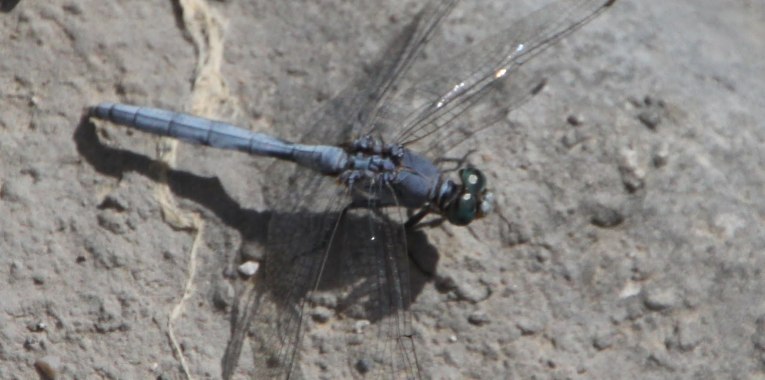
(photo by S.B., I know that’s a dragonfly but I don’t have a photo of a grasshopper)

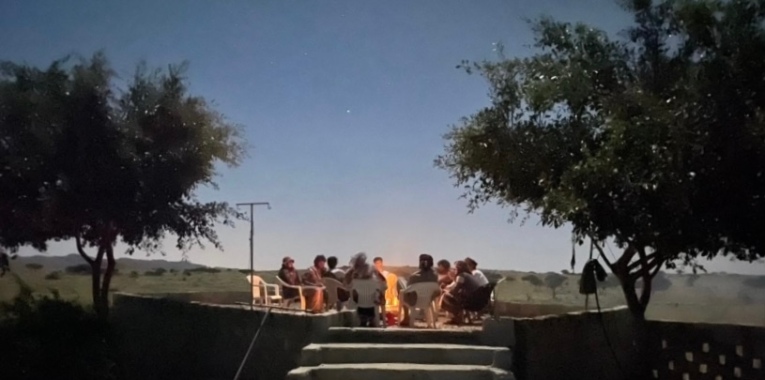
After a dinner together, I was sitting in a chair to the north side of a small, plastic, woven mat. My truck was directly to the east, four of the research guys were in chairs on the south side of the mat and there was a fire about 2 yards away to the west.

 Suddenly something that felt like 6 or 7 pins, a few millimeters apart, sunk into my right hand. I yelped, stood up and took a few steps forward onto the mat; one of the men gave a short vocalization of surprise. By the time I was standing still on the mat and pulled my hand up close to my face, two of the men had their phones’ flashlights aimed at me. I could not see any mark on the back of my hand, but it hurt a lot. There was nothing on my sleeve so I started to shake out my long dress; I stamped my feet, hitched up the hem to look at the cuffs of my leggings and scanned the mat. There was nothing.

I said, “my hand!” and started to panic. Faster than I can explain, my brain was processing possible threats but, since I couldn’t think of any likely explanation, my fear grew. I had not felt anything on my wrist or arm before the pain started, nor had I felt something move away as I stood up so it could not have been a snake, spider or scorpion. The fire was too low and far away for it to be a stray spark. There had been no noise and several points of pain all at once so it couldn’t have been a mosquito, sand fly, bee or Jack Spaniel wasp. If it were a group of biting ants, I would see them on my dress. And the pain was far too specific and severe to be a sudden hand cramp.

I kept shaking my dress and scanning the mat, trying to figure out what had happened, when I heard a man say, “Here” in Arabic. I looked to my right and saw that that the man closest to the fire had stood up and was shining his phone flashlight on my chair and the ground around it. There, at the edge of the mat, was a large grasshopper calmly walking along.

I exhaled. I could now process what happened: a grasshopper had jumped on my hand (no noise, no pressure on my wrist or arm), its tiny claws had sunk into my skin and when I moved, it flew off. “Shukran,” I said and sat back down.

In silence, we watched the grasshopper walk across the mat and disappear under my truck. I opened the cooler next to me, pulled out a can of cold soda, balanced it on the back of my hand to numb the pain and I leaned back in my chair. There were a few more seconds of silence, then the men started to talk again.

The whole event took less than ten minutes and there were only 5 vocalizations: my yelp, the man’s expression of surprise, “my hand,” “Here” and my “thank you.” Their concern was expressed through actions (they stopped talking and had their phone flashlights instantly pointed at me), not speech. No one asked “what’s wrong” or “what happened”? They could read the situation perfectly and didn’t need to communicate in order to act effectively. Only the man closest to me stood up and, since I was scanning the area in front of me, he moved to my right side to get a different perspective without anyone saying “look over there!” When he noticed the grasshopper, he trusted that I only needed to see it to put together what happened, so he drew my attention by saying “here.”

Once I had seen the grasshopper, the man sat down and there was a pause so that I could speak if I needed to. There was no reason to kill the bug as it is not dangerous and no one asked “are you ok” or “does it hurt”? If I was pulling out a can of Mountain Dew to set on the back of my hand, of course it hurt. When I leaned back in my chair without talking, I was signaling that I was ok and, from their point of view, there was no need to discuss such a small matter, so the issue was over and normal talk could resume.

Thinking about the incident as I was driving home, I realized that it was a great encapsulation of interactions with the research guys. They can talk for hours about subjects of interest but in the moments of (my) panic, they don’t to need to speak. They instantly assess what is going on and what needs to be done without words.

If I squawk and jump out of a chair, they didn’t have to ask me a question. Clearly something startled me so the best thing to do is stay still, shine light and figure out why I was scared. Once the cause was clear, it wasn’t necessary to say “Wow, you were really scared” or “Gee, you sure moved quickly.”

They don’t have the habit of verbally expressing care. Their concentration, speed of getting lights on me and silence, waiting to see if I needed to say anything once I sat down, proved their concern. 

[As with all of my musings on ethnography, after I wrote this I checked with one of the men who was there that night to ask for permission to write about the event and to check my understanding of what happened. He gave his permission with the usual comment of “don’t use names” and agreed with my opinion. “Why talk?” he asked after I explained this essay, “with something small, there is no need to talk.”]

A good poem for hard times – “Atlas” by U. A. Fanthorpe

Antigone and Ismene – Making Difficult Choices

Reflections on Ethnographic Work – Trying to Make Sense of Words and Actions

Conference presentation on fishing off the coast of Dhofar, Oman

Conference presentation about conducting research on the Arabian Peninsula

Conference presentation about conducting research on the Arabian Peninsula

I am happy to announce that I will be presenting my paper “Conducting Research on the Arabian Peninsula: How To Create Effective Interactions” at the Middle East Studies Association Annual Conference which will take place November 11-15, 2024.

abstract

My talk outlines strategies for anthropologists and researchers to communicate effectively on the Arabian Peninsula, with a concentration on Southern Arabia. Using first-person ethnographic accounts, as well as scholarly texts from the fields of anthropology, history, literature, political science and travel writing, this presentation will give clear advice so non-locals can create successful interactions. As I have lived on the Arabian Peninsula for more than 20 years, this talk is a distillation of observations, academic research and a longstanding, deep involvement within local communities. My background experience includes teaching cultural studies classes at the graduate and undergraduate level, giving lectures about local cultures to visiting expats, doing orientation lectures for new faculty, publishing scholarly and non-fiction articles about cultural interactions and taking classes taught by locals.

https://mesana.org/annual-meeting/program

Conference presentation on fishing off the coast of Dhofar, Oman

I am happy to announce that I will be presenting “Windguru and Other Gurus: Fishing off the Coast of Dhofar, Oman” for the Navigating the Transcultural Indian Ocean: Texts and Practices in Contact Conference, sponsored by the Rutter Project, June 5, 2024.

Research on Fishing in Dhofar

Foodways: Researching Fishing Practices in Dhofar and Selected Bibliographies

– طرق الطعام : بحث في ممارسات الصيد في ظفار وببليوجرافيات مختارة – Foodways: Researching Fishing Practices in Dhofar (in Arabic) and Selected Bibliographies

Recent publications on important archeological sites in the Dhofar region, updated April 10, 2024

Aston, Warren. 2022. “Mysteries in Stone: The Enigmatic Minjui – Potential Traces of a Forgotten Dynasty in Dhofar.” Popular Archaeology. 1-17. https://popular-archaeology.com/article/mysteries-in-stone/

Degli Esposti, Michele. 2022. “Khor Kharfut (Dhofar). A Reassessment of the Archaeological Remains.” Archeologie tra Oriente e Occidente (CISA) 1: 15-34. http://www.serena.unina.it/index.php/cssaunior/article/view/9559

Ghidoni, Alessandro and Alexia Pavan. 2022. “Boats, Horses, and Moorings: Maritime Activities at al-Balīd in the Medieval Period.” Proceedings of the Seminar for Arabian Studies Volume 51: 169-82. https://archaeopresspublishing.com/ojs/index.php/PSAS/article/view/599

Giunta, Roberta and Alexia Pavan. 2022. “First Archaeological Activities by the University of Naples L’Orientale in Dhofar, Sultanate of Oman.” Archeologie tra Oriente e Occidente 1: 1-10. https://doi.org/10.6093/archeologie/9712

Lischi, Silvia. 2023. “A First Definition of the Dhofar Coastal Culture Archaeological Exploration on the Inqitat Promontory in the Khor Rori Area (Dhofar, Sultanate of Oman).” Ancient Civilizations and Cultural Resources 1: 23-38. https://www.academia.edu/104462977/A_First_Definition_of_the_Dhofar_Coastal_Culture_Archaeological_Exploration_on_the_Inqitat_Promontory_in_the_Khor_Rori_Area_Dhofar_Sultanate_of_Oman

Pavan, Alexia. 2024. “After the Fall of the Caravan Kingdoms: Notes about the Occupation of Sumhuram and the Area of ​​Khor Rori (Oman) from the Fifth Century AD to the Islamic Period.” Études et Travaux 36: 111–31. https://doi.org/10.12775/EtudTrav.36.006

—. 2020. “The Port of Al Baleed (southern Oman), the Trade in Frankincense and its Coveted Treasures.” Polish Archaeology in the Mediterranean 29.1: 249-65.  https://doi.org/10.31338/uw.2083-537X.pam29.1.13.

Pavan, Alexia, Agnese Fusaro, Chiara Visconti, Alessandro Ghidoni, and Arturo Annucci. 2020. “New Researches at The Port of Al Balid and Its Castle (Husn): Interim Report (2016-2018).” The Journal of Oman Studies 21: 172-99.

Rose, Jeffrey. 2023. “Conclusion: Progress Report on the State of Palaeolithic Research in Arabia.” Paléorient: Revue pluridisciplinaire de préhistoire et de protohistoire de l’Asie du Sud-Ouest et de l’Asie centrale 49.1: 155-60.

Antigone and Ismene – Making Difficult Choices

This is a wonderful article:

https://www.washingtonpost.com/opinions/2024/01/15/hong-kong-security-law-chow-hang-tung-jailed/

I have taught Antigone many times. The first was almost by chance. I needed a Greek play and didn’t want to do Oedipus, so I picked up Antigone and was amazed by how powerful the play was. I had forgotten its strength and, importantly for a literature professor, how it balances out everyone’s POV. There is something to be said about each person’s argument. Teaching it was a joy. All the students had an opinion about what should happen and were happy to engage with the characters and plot. I ended up writing some essays and doing some presentations about using Greek plays on the Arabian Peninsula but what was most interesting about Antigone was that students did not judge Ismene harshly.

Gan’s article sets up a dichotomy with Antigone as the brave/ correct one and Ismene as the sister who must be forgiven. My students did not not make that division – each sister was doing what she felt was right. Most agreed that Antigone was correct to bury her brother against the laws of the state, but that did not necessarily mean that Ismene was behaving badly. I found that quality of acceptance very heartening.

Articles:

“Using Cultural Understandings to Improve Teaching in Oman,” in Unpackaging Theory and Practice in Educational Sciences. Abdülkadir Kabadayı, ed. Lyon: Livre de Lyon. 2023: 129-141.  https://www.livredelyon.com/educational-sciences/unpackaging-theory-practice-in-educational-sciences_595.

“Teaching Paired Middle Eastern and Western Literary Texts,” in Advancing English Language Education. Wafa Zoghbor and Thomaï Alexiou, eds. Dubai: Zayed University Press, 2020: 221-223.

“Teaching Literature on the Arabian Peninsula,” Anthropology News website, October 7 2019. http://www.anthropology-news.org/index.php/2019/10/07/teaching-literature-on-the-arabian-peninsula/

“Writing Prompts to Facilitate Creativity and Interesting Texts,” Proceedings of the 15th Oman International ELT Conferences. Muscat: Sultan Qaboos University Press, 2016: 46-52.

“Selecting the Right Literary Texts for Middle Eastern Students: Challenges and Reactions,” in Focusing on EFL Reading: Theory and Practice. Rahma Al-Mahrooqi, ed. Muscat: Sultan Qaboos University Press, 2014: 165-188.

“Who Are You Calling ‘Coddled’?: ‘Cloistered Virtue’ and Choosing Literary Texts in a Middle Eastern University,” Pedagogy 13.3, 2013: 415-427.

“Do You know a Creon?: Making Literature Relevant in an Omani University,” in Literature Teaching in EFL/ESL: New Perspectives. Rahma Al-Mahrooqi, ed. Muscat: Sultan Qaboos University Press, 2012: 302-314.

Selected Fiction (Novels and Short Stories) – Arabian Peninsula

A history-focused Whatsapp group I belong to recently had a discussion which elicited numerous suggestions about fictional works set on the Arabian Peninsula. I am including the works mentioned below along with some texts I have taught in my literature classes and/ or used for my research.

Anthologies

Akers, Deborah and Abubaker Bagader, eds. and trans. 2008. Oranges in the Sun: Short Stories from the Arabian Gulf. London: Lynne Rienner.

Jayyusi, Salma Khadra, ed. 1988. The Literature of Modern Arabia: An Anthology. London: Kegan Paul International.

Michalak-Pikulska, Barbara. 2016. Modern Literature of the Gulf. Bern: Peter Lang GmbH.

Pedagogy

Heble, Ayesha. 2007. “Teaching Literature On-line to Arab students: Using Technology to Overcome Cultural Restrictions.” Arts and Humanities in Higher Education 6.2: 219-226.

Michalak-Pikulska, Barbara. 2006. “The Mosaic of Quotations and the Labyrinth of Interpretations: The Problems of Intertextuality in the Modern Literature of the Gulf.” Intertextuality in Modern Arabic Literature since 1967. 187-200.

Ramsey, Gail. 2006. “The Past in the Present: Aspects of Intertextuality in Modern Literature in the Gulf.” Intertextuality in Modern Arabic Literature since 1967. 161-86.

—. 2004. “Confining the Guest Labourers to the Realm of the Subaltern in Modern Literature from the Gulf. Orientalia Succana, 53: 133-42.

Webb, Allen. 2012. Teaching the Literature of Today’s Middle East. London: Routledg

Short stories/ novels

‘Abd al-Majd / Abde Meguid, Ibrahim. The Other Place.

Algosaibi, Ghazi. An Apartment Called Freedom.

Alshammari, Shahd. Notes on the Flesh.

Wilson, G. Willow. 2012. Alif the Unseen. New York, Grove Press.

Oman

Al-Farsi, Abdulaziz. 2013. Earth Weeps, Saturn Laughs: A Modern Omani Novel. Trans. Nancy Roberts. Cairo: American University of Cairo Press.

Al-Harthi, Jokha. Celestial Bodies

Hamed, Huda. I Saw Her in my Dreams.

Michalak-Pikulska, Barbara. 2002. Modern Poetry and Prose of Oman. Krakow: The Enigma Press.

UAE

Al‑Murr, M. 1998. “The Wink of the Mona Lisa” and Other Stories from the Gulf. J. Briggs, trans. Dubai: United Arab Emirates: Motivate Publishing.

—. 2008. Dubai Tales. P. Clark and J. Briggs, trans. Dubai: Motivate Publishing.

Al-Suwaidi, Thani. The Diesel.

Johnson-Davies, Denys, ed. 2009. In a Fertile Desert: Modern Writing from the United Arab Emirates. Cairo: The American University in Cairo Press.

Krishnadas. 2007. Dubai Puzha.

Michalak-Pikulska, Barbara. 2012. Modern Literature of the United Arab Emirates. Krakow: Jagiellonian University Press.

Unnikrishnan, Deepak. Temporary People.

Kuwait

Abulhawa, Susan. 2020. Against the Loveless World.

Al-Nakib, Mai. 2022. An Unlasting Home.

Alsanousi, Saud. The Bamboo Stalk.

Saudi

Aima, Rahel. Moon Rose – short story https://www.eflux.com/architecture/cascades/400332/moon-rose/

Al-Khamis, Omaima Abdullah. Al-Bahriyat.

al-Sanea, Rajaa. Girls of Riyadh.

Alireza, Marianne. 2002. At the Drop of a Veil.

Alwan, Mohammed. 1988. “Love and Rain” in The Literature of Modern Arabia: An Anthology. Ed. Salma Khadra Jayyusi. London: Kegan Paul International. 302-306.

Benyamin. Goat Days.

Ferraris, Zoe. Finding Noof. 2008. New York: Little Brown, 2012. (also Kingdom of Strangers and City of Veils)

Munif, Abdul Rahman. Cities of Salt.

Yemen

‘Abd al-Wali, Mohammad. They Die Strangers.

Ba-Amer, Salih. 1988. “Dancing by the Light of the Moon,” in The Literature of Modern Arabia: An Anthology. S. K. Jayyusi, ed. London: Kegan Paul International. 318-22.

Bajaber, Khadija Abdalla. 2021. House of Rust.

Dammaj, Zayd Mutee’. The Hostage.

Hunter, Barry Stewart Hunter. 2017. Aden.

Fairy/ Folk Tales

Al Taie, Hatim and Joan Pickersgill. 2008. Omani Folk Tales. Muscat, Oman: Al Roya Press and Publishing House.

Al Thahab, Khadija bint Alawi. 2012. Stories of My Grandmother. [Dhofari] Trans. W. Scott Chahanovich. Washington, D.C:  Sultan Qaboos Cultural Center.

ElMahi, Ali Tigani and Ahmed Mohamed al Khatheri. 2015. “A Folk Story from Dhofar: A Pathway to Indigenous Knowledge.” Journal of Arts and Social Sciences 6.2: 5-12. DOI:10.24200/jass.vol6iss2

Hamad, Abdulsalam. Omani Folk Tales. 2006. Seeb: Al-Dhamri Bookshop.

Johnstone, T.M. 1974. “Folklore and Folk Literature in Oman and Socotra.” Arabian Studies 1: 7-24.

Johnstone, T.M. 1978. “A St. George of Dhofar.” Arabian Studies 4: 59-65.

Johnstone, T. M. 1983.“Folk-Tales and Folk-lore of Dhofar.” Journal of Oman Studies 6.1: 123-127.

Mershen, Birgit. 2004. “Ibn Muqaarab and Naynuh: A Folk-tale from Tiwi.” Journal of Oman Studies 13: 91-97.

Paine, Patty, Jesse Ulmer and Michael Hersrud, eds. 2013. The Donkey Lady and Other Tales from the Arabian Gulf.  Highclere, Berkshire: Berkshire Academic Press.

Todino-Gonguet, Grace. 2008. Halimah and the Snake, and other Omani Folk Tales. London: Stacey International.

Also of interest

The Saif Ghobash Banipal Prize for Arabic Literary Translation [https://www.banipaltrust.org.uk/prize/ ]

Banipal Magazine [ https://www.banipal.co.uk/ ] which has special issues on specific countries, for example: Yemen [ https://www.banipal.co.uk/back_issues/73/issue-36/ ]

Literature and Ethnography

Teaching Literature and Staying au courant – The Man from Nowhere and the Ancient Greeks

Reflections/ Research on Teaching Cultural Studies and Literature

Foodways and Literature – Food Stories and Poems

Foodways and Literature – Animal Poems

Reflections on Ethnographic Work – Trying to Make Sense of Words and Actions

I recently asked one class what “lullaby” meant and one answer I heard was “candy.” I like those moments when I can make sense of where the distortion is as the ‘b’/ ‘p’ distinction is sometime difficult for native speakers of Arabic. I walked to the board and wrote “lullaby” and “lollypop.”

I explained the difference between the two words, then we started another loop of misunderstandings.  I said, “lullaby sounds like your term: lowlay.” My students looked at me in confusion, so I said, “lowlay” again. They were still confused so I tried to change my pronunciation,  “lowlie,” but the word had no meaning for them.

At the start of a different class, I asked, “Does the term ‘lowlay’ mean anything to you?” A few students called out, “it’s a lullaby.”  Aha! I had thought lowlay was a general Arabic term, but it turns out it has only a regional usage.

It’s sometimes exhausting, sometimes fun to be constantly in the middle of making meaning. Of course I expect this when I am teaching and walking my students through color metaphors (such as the connotations of saying “I’m blue,” “she looked green” and “he’s yellow”) and the various shifting frameworks that come up, such as how it’s polite in some cultures to hand cash directly to a person and in other cultures that is rude.

But I believe that as soon as you leave your door-yard, you are confused. I was recently at a grocery store check-out counter sorting things into different bags as some items needed to go to my house, some stayed in the car for camping and some had to go to my office. When I was done, I looked at the clerk and she asked me in Arabic, “Why are you doing this?” and pressed her lips together. “Are you sick?”

Pressing lips together in the States is a common physical reaction to concentrating but it did not hold that meaning for her; she thought it was a reaction to being in pain. I said, “I do this when I am trying to think carefully.” She nodded. I am glad she asked because there are so many chances to misunderstand something or guess the wrong meaning, it’s always better to check.

This makes those moments when I know what to do so much sweeter. Last week I went to an ATM on salary day, the 21st of the month when almost every company in Oman pays the monthly salary and ATMs are very busy. As expected a few men were waiting, not in a line but spaced out to the left and right of the ATM.

I got out of my car and instead of going to stand as close to the ATM as possible (which would signal that I was trying to claim the female and/or expat privilege of cutting into the line), I leaned against the side of the hood. I glanced quickly at the other men, then gazed off into the middle distance. When new men came, I glanced at them quickly and when all the men who were there before me had taken cash, I walked up to the machine.

Because that’s how you do it. There is no clear queue; you need to look at everyone who was scattered around the ATM when you arrived and instantly memorize them (it’s not polite to stare!). Then you wait and watch so that when all the people who were there before you have finished, you move towards the machine. (Make a QUICK first move so the guys who are waiting won’t try to jump ahead of you, then walk slowly.)

When I got back into my car, one of the research guys walked past. He glanced at me and kept walking. So I rolled down the window and read articles on my phone; when he was done, he came to my car and we chatted for 10 minutes.

He first walked by without acknowledging me because to stop would throw off the rhythm; the men who came after him would not know that he was waiting for the ATM. Better to take his position, get his cash, then talk to me. If I had driven off, he would assume that I was in a hurry or that I felt ‘shy’ to speak to him in front of so many men. By waiting and putting the window down, I was signaling that I was happy to talk. If he had walked away without speaking, it would mean he was in a hurry or that there was an older person in the car (i.e. he should not keep that person waiting).

It took a lot of questions in similar circumstances to figure out the permutations of dealing with ATMS and running into research guys by chance. Now I am glad I’ve got the basics down. Sometimes it’s “every new day is a chance to wildly misunderstand what is going on” and sometimes it’s  “every new day is a chance to learn.”

Reflections on Ethnographic Research: What is Missing and What Changes
Reflections on Ethnographic Research: Claiming Knowledge and Shifting Perceptions

Reflections on Ethnographic Research: Getting it Wrong