This proposal was accepted for the Royal Geographical Society’s 2024 annual conference but I had to cancel as I moved back to Boston. Since I had notes written up, I decided to post this essay as a less academic version of what I planned to talk about.
Proposal – “Mental Maps and Wayfinding Apps in Dhofar, Oman” for the Royal Geographical Society (with the Institute of British Geographers) Annual Conference. August 27-30, 2024. https://www.rgs.org/research/annual-international-conference
One of the Dhofari men in my research group recently told me that the road I needed to turn off onto to get to the beach where we were meeting was after the mosque “where the road goes up and then down.” I knew that particular road weaves among foothills for over 30 kilometers without any straightaways. When I finally figured out after which mosque and which going “down” I realized that there was a sign at the turnoff.
But the men I do research with in southern Oman do not heed or discuss road signs when giving directions. Their mental maps are made up of geographical, not written, markers.
Electronic geo-locating is used throughout southern Oman for only two general purposes. The first is for finding a house. As most delivery drivers are not Omani and some do not speak Arabic or the local Modern South Arabian languages, finding a house is done with various mapping apps and the person who made the order must send a photo of their house. Also, fishermen have adopted different kinds of modern technology such as Google maps and Windguru to keep up to date about wind speed and direction. They also plot fishing areas on maps which are shared.
The result is that fishermen in my research group are very fluent in map-reading when gathering information about tides, currents, underwater formations, wave height, etc. but will navigate on land using only mental maps created from their own travels and what close friends and family members have told them. I have been lost with them many times, but the solution is always to simply keep going to see what happens, ask a person if possible or stop and look at the landscape to try to guess where the road might lead. Opening up any type of printed or electronic map is never an option. Hence, in 19 years of teaching and doing ethnographic research in the Dhofar region, I have never heard a man refer to a road by its given name. Roads are called by the towns they pass through or their endpoint.
In my presentation I will discuss how men and women in Dhofar not only create and pass on information about important locations using permanent indicators, such as mosques, tombs, hills and the color of rocks. I will also address how this use of mental mapping stands in contrast to the limited use of electronic geo-locating devices and applications.
Essay
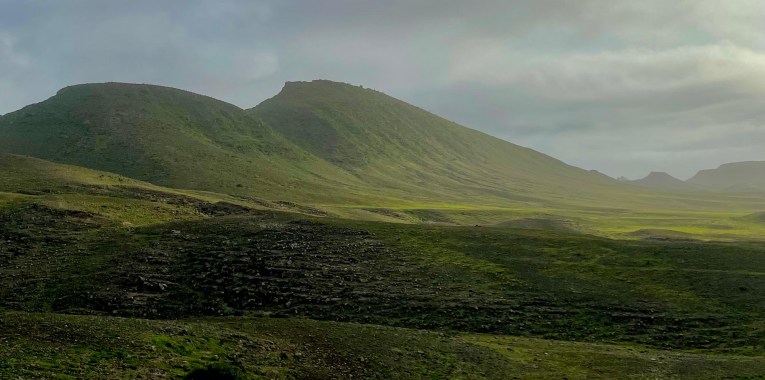
In spring 2024, one of the research guys got in touch to say that the group would go camping. If I wanted to join, I should be at one of the fishing towns on Thursday at 2pm. I met up with two other men in another pick-up and we drove about 1/2 hour on a good, one-way-each-direction road, then off onto a gravel road through a wide wadi (dry river bed). After about 20 minutes, we turned off onto small road, threading though hills about 20-50 feet high, usually with the rocky inclines on either side of one-car-wide path.
Then it got bad. Either climbing up-hill (rocks on one side of road, steep drop off on the other) or balancing along on top of hills, lots of sharp curves and most inclines were ‘hail Mary,’ i.e. the angle is so steep that when you reach top of hill, the hood is up so high, you can’t see road or which way to turn. I was thinking “thank heavens I am following someone because this is hard driving, bleak landscape and no cellphone signal” (foreshadowing!).
We finally pulled out onto a sandy track following the curve of a beach about 4:15pm and drove to a shelter where the other guys were relaxing. We chatted and had dinner about 8pm, then I realized two of the men were there for fishing and had gotten up at 5am. By 9pm, it was bedtime, whereas usually we stayed up talking until 1 or 2am. I tried to sleep (on mat, under stars) and got bit my every insect imaginable. I wasn’t feeling great so I never fell asleep; the men all got up at 5am for prayers, then breakfast and the fishermen went out to sea to check their boxes (fish traps).
I thought “I need to get home and sleep” but how could I leave when I wasn’t sure that I knew the road out? So I drank tea and chatted with the men who weren’t fishing. After 2 hours, I mentioned that I thought I should go home and by the grace of God, one man wanted to leave. They all decided it was better that he pray the Friday prayer at home; it was decided that we should leave around 10am, meaning another hour of chatting and tea-drinking. Then I drove back with the man who knew the road, he let me choose the way, correcting me when I made one mistake.
2 weeks later one of the guys sent a message on Thursday saying that we couldn’t meet on Friday as usual because they were busy, but they were free that night. So I drove out to the beach only to discover that the reason they were busy Friday was that they was going back to that same beach. And they thought I should come, driving alone with a large cool-box (almost the size of my pick-up’s bed) filled with ice. They would fill the box with that day’s catch Friday night, then Saturday morning I would drive the freezer back to town where the guy who buys their fish would take it, while they would fish all day Saturday, then return home by boat.
It was all such fantastical nonsense, that I could cope with a huge chest full of ice over that road, that I could get to that exact beach again, I just looked at them and said, “I love your trust in me and I would love to be worthy of that trust but…” But this was not a discussion.
One of them gave me verbal instructions (“turn off after the mosque where the road goes up and then down and when your car is turned like this, do not take any right, but when your car is turned to there, then take the first right…”). No cell signal, no one with me and the hills so close and high, I could not plot by the sun. Oh, and since I was going on a Friday, I had to be in the fishing town at 10am the next morning so the other men could load my pick-up before Friday prayers. And it was now 10pm!
I drove home and organized everything. Got up at 8am and packed, went to the store for water and soda, was in the town at 10am, and back on the road by 11. I was stressed for the entire drive, but made it to the right place. Other people were already in the shelter we had stayed in so I went to a nearby elevated place and waited. And waited. I had thought (from the last trip) that they would be done with fishing by about 4pm but it got to be 5:15pm with no sign. I had no idea where they were or if anything had happened.
The sun was going down and I didn’t trust myself to choose the right roads in the dark so I knew I would sleep there. I had everything I needed to spend the night and was not concerned about being alone; however, I was not sure if they were ok or if I had missed some vital piece of information, such as I was supposed to be someplace else.
I was also a little angry because they had told me to send a message when I reached the fishing town, when I turned off the main road and from the last high hill, but when I drove back up to the high hill (where I could get cell signal) at 5pm, I could see that they had not seen any of the messages I sent, meaning they didn’t know if I had reached the place or not. The road is easy for them but it was my first time driving it alone and I felt like they had asked me to do something a little difficult, then not taken care to make sure I was ok.
They finally showed up at 5:30, loaded fish into the ice chest and we set up camp. When everyone settled down to drink tea, I asked about their day. They had left their town (by boat) and had spent the whole morning fishing. The waves were high, so they could not look at their phones. At 2pm, they drove into the large bay to check messages. They could not get a signal so they drove in closer to shore until they could see my truck on a wide ledge over the ocean. Now that they knew I had gotten there and was ok, they went back out to open sea to check fish traps. It made me feel a lot better to know that they had, in fact, checked on me.
After we ate dinner, I asked one of the men where the beach road ended towards the eastern and western directions. He answered then said to me, “now you are smart,” meaning that a wise person gathered information about the nearby roads. The “now” was added because during my first trip to that beach, I hadn’t asked about the road network. The third time I went there; I drove the beach road in both directions until it ended and was again complimented for (finally!) acting like an intelligent person.
On my last trip to that beach I realized that there was a sign for a small town a few klicks before the turn off from the main road, as well as a road sign with the name of the area directly before the turnoff point. They could have used the two signs in their directions instead of “turn off after the mosque where the road goes up and then down.”
But they don’t use man-made aids to navigate away from towns. I have never seen any of them use a paper map or call a road by its official name; they call a road by the town they are going to or its termination, i.e. “the Muscat road.” And they don’t say unnecessary information, e.g. “take the wadi before Hadbeen” not “turn left into the wadi before Hadbeen,” because the ocean is on the right side of the road, a wadi could only be on the left side. The only times I have seen one of them use GPS on land is when we wanted to get to a myrrh tree which someone had dropped a pin on and to drive around in the Empty Quarter.
The point of view of the research guys is that a good person is constantly constructing mental maps as it’s your responsibility to know where you are on land. When you go to a new place you should ask about the road networks and, if there is time, drive to endpoints. It is fine to ask someone about the road if it is your first time in the area, but you should memorize every road so well that you only ask once and can easily return to the same spot years later.
And never show fear. My favorite quotes from the guys are their responses to my expressing dread at having to drive up a steep slope: “You think that’s a hill? Give me your car, go sit at home.” Upon seeing the wreck of a piece of heavy machinery that had fallen off a steep road with a sheer wall of rocks to one side and a long drop-off on the other, one of the men said, “the driver meant to do that.”
In towns, they use landmarks, usually mosques, to navigate; the Dhofari women I know navigate by mosques, but also use shops and restaurants. If you need to get to a person’s house, either someone would drive you or give precise instructions. If you are going to attend a wedding or to give condolences, once you are in the general area, it’s easy to spot the house as it would have many cars parked out front (and strings of lights for a wedding).
GPS/ dropping a pin on your location is usually for expat delivery drivers who might not be fluent in Arabic or English. To receive food or a mailed package, you turn on your phone’s location and send a photo of the outside of your house or office building.
In other words, navigation is almost entirely based on visual clues. Dhofaris use what they can see to move across landscapes in contrast to using, for example, distances (“go three kilometers”), time (“drive for ten minutes”) or cardinal points. Expats use GPS to get to a general area, then use a photo of the building, as opposed to using street names and house numbers.
For navigating at sea, however, fishermen use both traditional and electronic methods of navigation. The most basic method of positioning is to triangulate using two points on land, e.g. “when I see that rock by the headland and the side of that mountain, then I know I am in the right place.” Fishermen also carry internal schedules of tides, as well as wind and wave patterns. The men I know would often tell me that, for example, the wind would die off in an hour or would start up at dawn.
I was terrified the first few times we returned from night fishing; sitting at the bow, I was amazed that they could drive their boats safely through rocky areas on moonless nights. With only weak starlight for illumination, they would bring the boat right to the beach without hesitation. If I expressed surprise at their knowledge, they would say, “If you do not know this, you should not be in a boat!”
But, in compliment to their personal knowledge, they also use GPS and weather/wave apps such as Windguru [https://www.windguru.cz/53 – sample page below]. The result is that fishermen in my research group are very fluent in map-reading when gathering information about tides, currents, underwater formations, wave height, etc. but will navigate on land using only mental maps created from their own travels and what close friends and family members have told them.
Coda
I saw The Finest Hours (2016, about an American Coast Guard rescue in heavy weather) with a Gibali-speaking hakli fisherman and he kept a quiet running critique of the boat handling skills with an occasional “not bad.” He guessed correctly that the townspeople would bring their cars to the water’s edge to help guide the boat home as he been part of similar efforts in his own town. The tagline of the movie is “We all live or we all die” which sums up how the fishermen envision their community.
They never try to hide information about good fishing locations as they know that all aspects of their lives are in Allah’s care; if they are supposed to have a good catch, they will have it, if not, then not. Therefore, all fishing spots that are marked on weather/ map apps are set for anyone to see, not hidden. There is a strong belief that a person who persistently and knowingly works selfishly against the good of the community will be given some sort of divine punishment and it is not the responsibility of the other fishermen to bring that consequence about, beyond the necessity of avoiding the man and making excuses not to fish with him.
Example of Windguru data

New book – Researching and Working on the Arabian Peninsula: Creating Effective Interactions
Reflections on Ethnographic Work – Trying to Make Sense of Words and Actions
Culture Shock – (Not) Being Under Observation
Culture Shock: The Parable of the Boxes



 Come From Away
You must be logged in to post a comment.