You Have Nothing to Fear from Sheep’s Eyes but Beware the Carrot Sweet: Researching Foodways in Southern Oman

During over a decade of picnics with men from southern Oman, I have never been offered the eyes, brain, tongue or tail of any animal. The cliché of guests being offered the ‘unloved’ parts of an animal doesn’t hold here in the Dhofar region. And it’s not that large platter of rice and meat that will cause you problems. Men will encourage you to eat, but if you gather up a few grains of rice in your hand and lift it towards your mouth, the host’s attention will move on.

If you are given a fish, you can turn the head away from you and start to eat from tail up, scattering by chance a few shreds of lettuce over the eyes. Then you declare yourself full before you need to deal with the stomach area, much less digging into the skull for the fish cheeks.

What you should fear is ladies’ parties with lots of very generous, caring, strong-arming women.

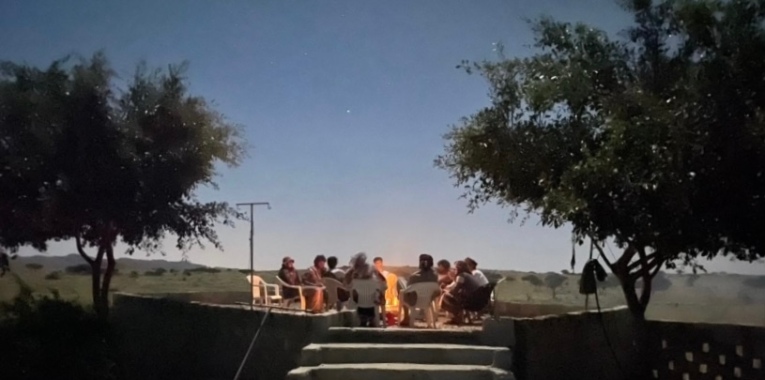
Men usually have dinner with friends on the beach or in a scenic place in the mountain. It’s dark, eating is done quickly and men come and go freely; there is little policing of who eats what. Although the cook might toss special pieces of meat or fish towards you, if you don’t want to eat them, simply leave them alone.

But women parties are usually indoors, with lots of light and everyone sits in their places for several hours so you are constantly under observation.

I love wedding parties because the air is full of beautiful perfumes and everyone is in gorgeous, comfortable, multi-color thobes (the loose, traditional Dhofari dress). And the food is delicious, but you cannot escape it. Either waitresses or relatives of the groom will bring around trays of drinks and sweets and everyone, not just the hostess, but all the other guests, will encourage you to partake.

You have had four cups of super-leaded, espresso-strength, cardamom-spiced Omani qahwa (coffee)? The generous women would like you to have a fifth cup! “You didn’t drink anything! Do you not like the coffee? Do you want tea! BRING TEA, SHE WANTS TEA!”  they call.

You protest but, alas, give up. The tsunami of kindness is coming for you. Take up the tea cup and drink. And as soon as you set down the cup, here come someone with juice, soda, instant coffee, chai ahmar (“red tea,” black tea with only sugar added), chai haleeb (“milk tea,” black tea with milk and sugar), or karak (loose tea with spices and milk).

Then come the sweets accompanied by women benevolently asking you to take another spoonful of halwa, the traditional Omani dessert. And like a swan-dive into a bowl of whipped cream, you submit to your fate: a small plate of carrot sweet, a bowl of crème caramel, a slice of cake, a bowl of ice cream, fruit salad, luqaymat/ loqeemat (sweet fried dough with a sugar syrup), basbousa, and wrapped chocolates.

And now, just as you give up any thought of ever moving again, dinner is served. A generous woman hands you a plate heaped high with a selection of appetizers (hummus, fattoush, baba ghanoush, etc., with pita bread) and qabooli (a dish with spices, rice and meat). Then, of course, dessert is served.

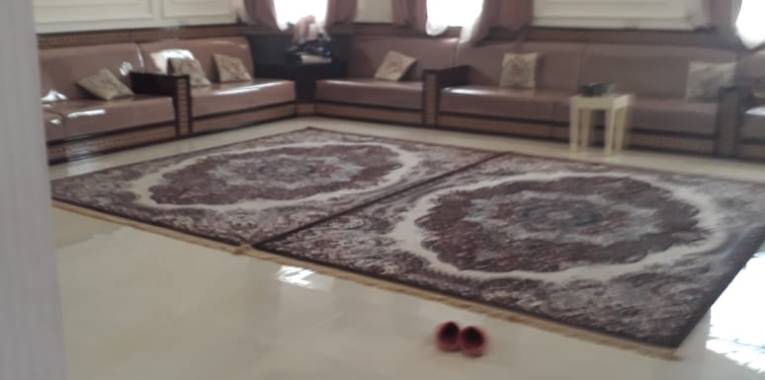
There have been weekends in which I have inhabited both worlds. One night was spent wearing loose cotton trousers and a tunic top with a plain blue headscarf and sitting on a plastic mat on a beach out of sight from any man-made lights. Dinner was fresh-caught fish cooked over a fire. The men in my research group and I ate with our hands, drank Dew, looked at the stars, listened to the sea and talked until 1am. The next night I wore a decorated velvet thobe with full make-up, my meager supply of gold jewelry and a lot of duty-free perfume, in a room full of air-conditioning, bright lights, and delightful women who wanted to stuff me until I burst.

Omani people are very open-hearted and open-handed and doing research on foodways is a lot of fun, but it is not for the meek or the small of stomach.
Foodways: Cultures, Food Selfishness and “Could I Have a Little Bite?”

“May I have a sip?” asks a much-loved older relative.

I stifle a sigh and hand over my coffee cup.

Three minutes later, “Can I have another sip?”

With a small sigh, I hand over the cup.

Two minutes later, “Can I…” and I hand the cup over while biting my lip.

I don’t want to share. That cup of caramel/ Brazil nut/ vanilla-flavored coffee is my first flavored filter coffee in 11 months and, since I probably won’t be back to that store again this summer, it’s the last of that kind for another year. And I want to savor every drop of it.

And cherished older relative could have bought their own, heck I would have paid for their own. But no, my relatives want “just a sip” and “just a bite.”

This might have turned me into a person happy to share, but it did not. I turned into a person who hates handing over my coffee cup, doing it only under duress and after chiding myself about the importance of generosity.

Then I moved to Oman and learned a whole new system of dealing of food. There is no “mine” and no “yours” when eating with my Dhofari friends. There is “ours” and everyone attempts to be the person who is fastest to pass the freshly poured cup of tea or the newly opened box of cookies to someone else.

When I am with female friends at restaurants; food is automatically pushed towards the center of the table. We cut off pieces of whatever we ordered and place it on each other’s plates, even if that person is protesting that they don’t want any. We unconsciously put some French fries on a plate in the middle of the table or turn our plates so it’s easy for someone to take some.

On picnics, the food is set out communally on a platter. No one takes anything out of the coolbox without asking each person what they want first. At the end of the night, you try as hard as possible to give the leftovers to someone else. Several times I have pushed others to take food (halwa or qibqab, a thin, plain cracker-like bread) that I really wanted to bring home.

I do this instinctively in Oman but when I am staying with family, my food protection systems engage, the remnant of years of fending off “just a bite” and “you should share.”

Seeing food (taco salad! cinnamon-raisin bread! potato salad! cranberry muffins!) that I haven’t had for almost a year, I get selfish. When I open a small (one person!) bag of Old Bay-spiced potato chips and a relative hovers and dives in, I fight my instinct to hold the bag out of reach.

When people ask for “just a sip,” I am still cranky but I envision my Omani friends’ horror at the thought of my behaving badly. I remember all the meals shared and all the French fries I have stolen as I hand over the coffee cup.

“It’s just pie, people are more important than pie,” I say to myself as a foreign fork appears at the side of my plate. I push my plate towards the fork, saying “go ahead” with a cheery tone. Ethnographic work changes you. For the better.


New essay: “Sîn is for Zenith” on the Arabic alphabet website

The Arabic Alphabet: A Guided Tour – http://alifbatourguide.com/

by Michael Beard, illustrated by Houman Mortazavi

“Sîn is for Zenith” – http://alifbatourguide.com/the-arabic-alphabet/sin/

excerpt:

The sound of Sîn (pronounced “scene”) is the clear sibilant we represent with our letter S. The S we know is all curves. Sîn is usually more angular, a little closer to the W shape of its Phoenician ancestor. Greek Sigma comes from the same source, the W shape tipped up 90 degrees clockwise.There was a Nabatean predecessor of Sîn in the form of a bowl shape with an upright growing out of it, something like Hebrew Shin. The shape of Sîn grows out of it: two miniature half-circles resting side by side. What strikes the eye are those three short uprights, referred to as “teeth” (Sîn word sinân in Arabic, the plural of sinn). It is not my job to say what is beautiful and what isn’t, but what I’m taken by in the most elegant handwritten Sîn is a slight asymmetry: the space between the first two teeth (reading right to left) is slightly narrower than the space between the second and third.

In terminal form Sîn ends with a rounded clockwise sweep, a shape which fledgling calligraphers struggle over, the clockwise descent and return, thickening along the bottom, tapering to a point as it rises on the left. The same curve reappears in Shin, Ṣad & Ḍad.

Sîn went through a period in its evolution when it had a triangle of dots suspended below the line, to distinguish it from the letter Shîn, the next in sequence, which has three dots above. (Shîn kept them. Present-day Sîn goes commando.) A streamlined variant of Sîn, still used, was developed in interests of efficiency: it can take the form, perhaps as a visual representation of the smooth prolonged sound of sibilance, of a straight unrippled line, often descending slightly, throwing the base line down a notch and continuing at a lower level. Easiest letter ever. In the initial or medial position the line simply continues on for a bit with nothing else happening.

The source of sinn, “tooth,” is the Arabic stem S–N–N, which, as a verb, means to sharpen, mold, shape. In one form, sunna, it means, in Hans Wehr’s definition, “habitual practice, customary procedure or action, norm, usage sanctioned by tradition; al-sunna or sunnat al-nabîy, the Sunna of the Prophet (nabîy), i.e. his sayings and doings, later established as legally binding precedents…” In other words, the ahl-al-sunna are the follows of the sunna, in English “Sunnis.” It’s an admirable definition, if only because Wehr defines the etymological stream of meanings without getting excited, or lost in detail. A history book, once it has said “Sunni,” has to go into teacher’s mode, including the actors and the theology, plus the alternative, Shiism, and to describe how Shiism ended up breaking away from “Sunnism.” Today everyone knows it, or can look it up, and the history hardly seems necessary. Hans Wehr defines shî‘a, the other major branch, as “followers, adherents, disciples, faction, party, sect”; al-shî‘a, the faction of Ali, the Shiah, the Shiites (that branch of the Muslims who recognize Ali, the Prophet’s son-in-law, as the rightful successor.)” It’s all the definition you need. They’re just words, ordinary words. Neither sunna nor shî‘a occur in the Qur’ân.

Reflections on Houseways Research

I got the e-mail confirming that my Houseways book will be published in January 2023 while sitting in a living room that is completely opposite of the rooms I have described and lived in Oman. The Canadian house had wooden floors and furniture, windows without curtains, no AC, a big fireplace, floor lamps, crocheted afghans, many photos and bookshelves overflowing with novels, candles, puzzles, souvenirs and small wooden carvings of birds. Looking at the room while thinking of the descriptions of Omani houses in my book was a good reminder of how differently people arrange their living spaces.

Given that my academic background is literature and travel writing, it might seem odd that I decided to write about houses, but I grew up in a home in which everyone had strong opinions about how to live and an active interest in building decks, planting gardens, finding a rug in exactly the right shade of blue and putting the sofa there, no, not there, there, a little to the right, no, now forward a little.

As I child, I wanted to live in a Baroque castle; everyone else wanted to live in a modernist, northern European design-aesthetic structure. I wanted to read novels; everyone else wanted to figure out if it was possible to punch a hole in that wall to put in a window. For my 13th birthday I wanted a ball gown and was given my very own tool kit with hammer, pliers, wrench, level and screwdrivers.

I heard about Mansard roofs, color wheels, mixed-use developments and Frank Lloyd Wright. Our living room had a Barcelona chair, a Scandinavian Designs sofa and a Century House (Madison, WI) rug; when my father and I went to England, it was to see Milton Keynes and Welwyn Garden City. I watched my family build furniture, swatch paints, install insulation, build benches to strengthen community bonds in our neighborhood and weed. I read in cafés while they re-framed doorways.

The root of this problem was that when he was in his early 20s, my father walked into Louisburg Square in Boston and thought, “everyone should live like this.” That collection of houses changed his life; he became an urban planner and spent more than 60 years thinking, talking, writing and teaching about how to form better-organized houses, neighborhoods and cities. My mother creates gardens and both siblings have planned renovations of their houses down to the trim on the underside of cabinets.

I thought I had escaped this legacy until I got interested in how Dhofaris design kitchens as part of my Foodways project [ Foodways in Southern Oman – Short Essays and Images ]. I realized, while that I am not interested in decorating or remodeling, I love listening to people’s stories about how they live in their houses, what choices they make and why.

I am grateful to my family for all that early training and to the Omanis who have trusted me with their stories, opinions, photos and friendship.

https://www.routledge.com/Houseways-in-Southern-Oman/Risse/p/book/9781032218595

https://www.taylorfrancis.com/books/mono/10.4324/9781003270317/houseways-southern-oman-marielle-risse